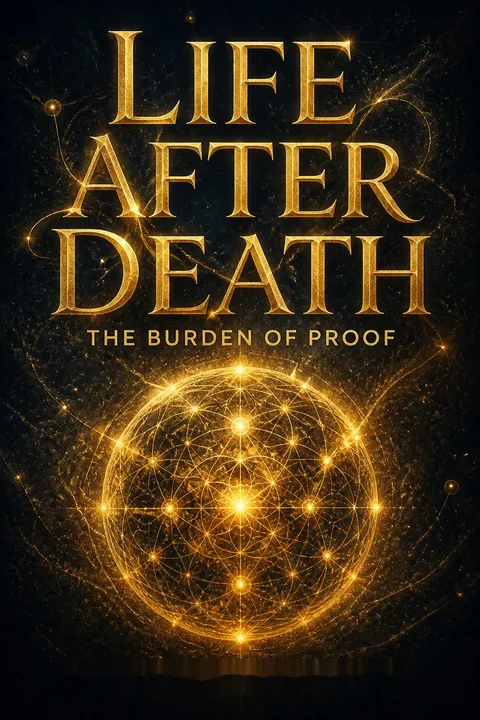


Key Takeaways
Treat death as transformation if consciousness, not the body, is fundamental
The central proposal. Chopra asks readers to consider that death ends a bodily form without ending consciousness itself. The idea draws on Vedanta, a tradition in which the deepest self, Atman, is not a possession inside a person but part of a reality that exceeds individual bodies. A changing stream of water serves as an image: its forms alter, while the underlying substance continues. The book presents this as a spiritual interpretation, not a demonstrated biological fact.
Savitri meets Death. The recurring story follows Savitri, whose husband Satyavan is due to die. A sage teaches her to look beyond appearances and question whether the body is the whole of a person. The parable gives the book’s argument an emotional shape: fear loosens when identity is understood as more than a temporary physical form.
What's compelling is the distinction between a changing organism and the experience of being a self. Biology readily supports the first: bodies continually renew and eventually fail. It does not, by itself, establish the second claim that awareness survives death. That gap is precisely where the book’s metaphysics begins. Readers can find value in its challenge to treat the visible body as the whole person while keeping separate two questions that are often blurred: whether consciousness is more than brain activity, and whether an individual’s memories and personality continue after death.
Practice loosening identity before death forces you to confront it
The self keeps changing. In Savitri’s journey, she sees earlier versions of herself as ghosts: the child, the adolescent, and the young woman who fell in love. Each once felt like the whole self, yet none is identical to the person she is now. Chopra uses this image to argue that personal identity changes even during life, rather than surviving as one fixed personality.
Train the witness. The book calls the capacity to observe thoughts and feelings without being swept away by them “witnessing.” Chopra recommends reviewing the day’s events in reverse order before sleep, noticing reactions rather than merely reliving them. This practice is meant to make awareness familiar, so that identity can feel larger than any one mood, memory, or role.
This section connects naturally to metacognition, the ability to notice thinking as it happens. In psychology, such distance can help people respond less automatically to distressing thoughts. The practice does not require a belief in souls to be useful: observing a feeling is different from treating it as a complete description of the self. The harder philosophical question remains personal continuity. If memories and personality change, what exactly persists? Chopra answers with awareness itself, but the book invites reflection more than it supplies an independent test of that answer.
Expect beliefs to shape afterlife imagery, not prove what lies beyond
A transition, not a destination. Chopra uses “crossing over” for the early transition between bodily life and a more subtle, imagined state. Reports he discusses include floating away from the body, seeing familiar surroundings recede, sensing a presence, and encountering nonphysical images. He compares accounts across cultures: Tibetan delogs describe Buddhist realms, while people from other traditions may report figures and settings familiar to them.
Expectation supplies landmarks. The book argues that a dying person may draw on religious teaching, memory, and personal desire to make an unfamiliar experience understandable. Chopra describes this as consciousness shaping its own imagery. The claim offers a way to understand why reports differ, but it also means that a vivid vision cannot, by itself, establish that its apparent setting exists independently of the person experiencing it.
The role of expectation is a useful bridge between spiritual accounts and cognitive science. Human perception is not a camera recording the world neutrally; memory and prior beliefs help interpret ambiguous signals. That may explain why people make sense of unusual experiences through familiar symbols. But the same explanation cuts both ways. If cultural expectation shapes the imagery, similarities between reports need careful analysis, and differences do not automatically confirm separate afterlife realms. The book’s model is most persuasive as an account of how people experience uncertainty, less so as proof of what exists beyond it.
Let love deepen your life without asking change to stop
Love does not prevent loss. In one episode of Savitri’s story, she and Satyavan escape the expected death by starting a new life on an island. They raise children and grow content, until a storm sweeps their home and family away. The apparent years of safety dissolve, and Savitri finds herself back at the moment when she first met the sage. The tale makes its point through reversal: escape from death cannot mean escape from change.
A different kind of courage. The story’s conclusion imagines Savitri meeting Death with love rather than panic. Its consolation is not that bodies or relationships remain unchanged, but that love can change how a person faces their ending. Chopra also describes a dying husband who responds calmly after learning his wife has died, showing how acceptance can be cultivated even amid grief.
The story refuses a common bargain: that love should protect people from loss. Contemporary grief practice often recognizes continuing bonds, the ways a relationship remains meaningful through memory, ritual, and changed forms of connection. That perspective can support the book’s emphasis on love without requiring a supernatural conclusion. The important distinction is between emotional continuity and literal survival. Savitri’s tale can help a reader face impermanence, but it should not be used to minimize grief or suggest that acceptance arrives on command.
Treat karma as accumulated patterns, not a divine points system
Consequences shape the self. Chopra describes Karma as the continuing connection between actions and their effects. Rather than a simple tally of good and bad deeds, it is a pattern that can shape habits, desires, suffering, and future choices. In his account, hell is less a permanent sentence imposed by an external judge than a state of distress fed by guilt, attachment, and disconnection from oneself.
Put the idea to ethical use. Chopra associates a more mature life with self-worth, love, truth, gratitude, reverence, and nonviolence. These values matter now, not only as supposed preparation for a later reward. His approach shifts attention from calculating cosmic punishment to asking what repeated actions are doing to a person’s character and relationships.
This reading makes karma psychologically legible: habits and actions do shape what a person notices, expects, and repeats. It also keeps responsibility in view without relying on an all-seeing judge. Yet karmic explanations can become harmful if they imply that illness, poverty, or violence are deserved consequences of past behavior. A humane interpretation should focus on how choices influence conduct and relationships, not use an unverifiable cosmic ledger to explain another person’s suffering. The book’s ethical emphasis is strongest when karma encourages accountability and compassion together.
Observe desire before it chooses your next move
Map the life being made. Chopra argues that the choices shaping a person’s future begin with awareness of the present. He suggests examining seven parts of a life: its story, expectations, purpose, destination, path, obstacles, and allies. The questions are meant to uncover assumptions that ordinarily operate without notice. For example, repeated fear of failure may reveal more about a person’s expectations than about the actual possibilities ahead.
Use attention as practice. The book also describes five subtle capacities: self-awareness, willingness to reconsider beliefs, intention, discrimination, and acceptance. These are not presented as powers that guarantee control over events. They are ways to notice impulses and respond more deliberately. Chopra’s practical advice is to keep examining what is driving a choice, rather than assuming every desire deserves immediate obedience.
The framework resembles reflective tools used in counseling and decision science: clarify goals, identify constraints, and distinguish automatic reactions from deliberate commitments. Its strength is that it turns a remote question about the afterlife into questions that can guide present action. Its limitation is that reflection alone cannot resolve every conflict. Economic pressure, illness, and social power shape choices too. A strong application pairs introspection with attention to circumstances, so that personal responsibility does not become a polite way of blaming people for conditions they did not choose.
Work across five layers of experience, not only the body
A layered map of the self. The “Five Koshas” are five sheaths or dimensions through which Chopra describes human experience: the physical body, vital breath or life force, mind, ego and intellect, and a body of bliss. The framework presents a person as more than physical sensation, while treating each layer as part of an interconnected self-system.
Explore each layer. The book associates physical postures with bodily awareness, breathing exercises with vitality, careful discernment with the mind, and meditation with the sense of “I am.” Deep silence is associated with bliss. These practices are offered as ways to experience different aspects of awareness during life, not merely as preparation for a future world. The framework encourages readers to notice how body, emotion, thought, and identity interact.
The Koshas offer a memorable map because they connect bodily experience with thought, identity, and moments of absorption or joy. Modern embodied cognition similarly treats thinking as deeply shaped by bodily states and surroundings, rather than as an isolated activity in the head. That connection supports the framework as a practical model, not as proof that five literal bodies exist beyond death. Its value lies in directing attention across several dimensions of experience; its claims about postmortem layers remain metaphysical.
Read near-death and past-life reports as clues, not verdicts
Reports invite investigation. Chopra cites a 1991 Gallup poll in which about 5% of Americans reported a near-death experience. He also describes a Dutch study of 344 resuscitated cardiac-arrest patients: about 18% reported at least one familiar feature, such as an out-of-body sensation or a bright presence. He gives particular weight to reports said to occur during periods of absent brain activity, while acknowledging that medical explanations remain debated.
Past-life cases are another strand. Chopra recounts psychiatrist Ian Stevenson’s collection of more than 220 children who described previous lives, including 14 cases in which reported memories of fatal wounds were associated with scars. These accounts raise questions about memory and identity, but the book presents individual reports rather than a settled scientific demonstration of reincarnation.
First-person reports deserve humane attention, especially when they alter how people live with mortality or grief. Their evidential meaning is a separate matter. Resuscitation timelines, residual brain activity, memory formation, selective reporting, and the difficulty of independently checking details all affect interpretation. Past-life claims likewise require careful records made before a match is found, not only striking details selected afterward. The book is right that unusual experiences should not be dismissed merely for being unusual. They also should not be treated as conclusive simply because they are emotionally powerful.
Let quantum physics pose questions, not certify an afterlife
Akasha as a proposed field. Chopra reinterprets Akasha, a Sanskrit term for space, as a universal field of consciousness and creative potential. He connects it to the Zero Point Field, the fluctuating activity physicists associate with apparently empty space. The book also cites experiments by Helmut Schmidt and Robert Jahn, reporting that participants influenced random-number devices at rates around 51% to 52%, slightly above chance.
A suggestive analogy is not a result. Chopra uses these ideas to argue that mind and matter may be connected and that consciousness might not be confined to the brain. But the experiments and their interpretation are not presented as proof that a soul survives death. The book’s strongest claim is a philosophical possibility: if consciousness is fundamental, bodily death may not be the end of all awareness.
The speculative reach is the book’s most ambitious and most vulnerable move. In standard quantum physics, an observer generally means a physical measurement interaction, not necessarily a conscious person willing a particle into existence. Parapsychology findings also require independent replication and scrutiny of methods before they can support sweeping conclusions. These cautions do not make consciousness an unimportant scientific problem; they clarify what existing physics can and cannot say. The distinction matters because a reader can remain open to Chopra’s metaphysics without mistaking quantum vocabulary for empirical confirmation.
Analysis
The book’s most durable contribution is a change in how the question is asked. Rather than treating the afterlife only as a destination, Chopra frames it as a problem of identity: what is a self, and which parts of it might persist when the body no longer supports ordinary experience? The recurring story of Savitri gives that abstract inquiry emotional stakes. Her struggle begins as an attempt to save one loved person and becomes a meditation on what love can mean when change cannot be prevented.
The book moves between two kinds of argument. Its philosophical case draws on Vedanta: consciousness is primary, physical reality is one expression of it, and death may be a transition between forms of awareness. Its empirical case gathers near-death accounts, childhood memories attributed to former lives, and parapsychology experiments. The two registers do not provide equivalent support. Testimony can show that people have vivid experiences and that those experiences alter their beliefs. It does not establish that the experiences reveal an independent afterlife. Quantum field theory likewise describes physical phenomena, but its technical language does not, by itself, demonstrate a universal mind.
A further tension concerns personal survival. Chopra sometimes describes consciousness as universal and impersonal, while readers often want to know whether their particular memories, attachments, and relationships continue. A permanent field of awareness would not automatically preserve the person who asks the question. The book gestures toward a distinction between enduring consciousness and changing personality, but cannot resolve it through evidence.
Its practical value is clearest where the metaphysics becomes a discipline of attention: notice attachment, examine inherited expectations, and make room for loss without reducing a life to its physical form. That approach can comfort believers and invite skeptics into reflection, provided neither group is asked to mistake consolation for proof. The book is best read as a spiritual hypothesis and a guide to confronting mortality, not as a scientific verdict on what happens after death.
Review Summary
Life After Death explores Hindu spirituality and the afterlife through stories and quantum physics concepts. Many readers found it thought-provoking, though some felt it was repetitive or difficult to follow. Chopra's writing style received mixed reviews, with some appreciating his ability to explain complex ideas, while others found it convoluted. The book's blend of Eastern philosophy, science, and personal anecdotes resonated with some readers seeking comfort about death, but others felt it lacked depth or relied too heavily on pseudoscience.
People Also Read




Glossary
Akasha
field of consciousnessA Sanskrit term commonly associated with space, which Chopra uses for a universal field of consciousness and creative potential. In his account, physical and subtle worlds arise within this field, which also holds patterns, images, and memories. This metaphysical interpretation is not the same as an established physics theory.
Atman
the deepest selfIn the Vedantic account presented by Chopra, Atman is the deepest self, beyond the changing body, memories, and personality. It is not a separate possession that belongs to an individual, but is ultimately one with the universal reality called Brahman. Chopra compares it to the soul while emphasizing this nonseparation.
Karma
action and its consequencesChopra uses Karma for the continuing pattern connecting actions with their effects across a life and, in the book’s spiritual model, across lifetimes. It is more than a score of good and bad deeds: habits, desires, and unresolved causes shape later experience. The book distinguishes this cosmic principle from personal karmic effects.
crossing over
early afterlife transitionThe initial transition Chopra describes between bodily life and a fuller experience of the afterlife. Reported features include awareness that the body has stopped functioning, a sense of leaving familiar surroundings, continuing thought or perception, and encounters with nonphysical images or a divine presence. The imagery may reflect a person’s beliefs and expectations.
Five Koshas
five layers of experienceA Vedantic model of five sheaths that Chopra uses to describe the self-system: the physical body, vital breath or life force, mind, ego and intellect, and bliss. The layers are presented as interrelated dimensions of consciousness, not as five separate physical bodies. Practices such as posture, breathwork, discernment, and meditation are linked to them.
witnessing
observing without identificationThe capacity to notice one’s thoughts, desires, feelings, and circumstances without being entirely absorbed by them. Chopra treats witnessing as a form of self-awareness that can loosen compulsive reactions and clarify choices. In his account, greater witnessing also allows more freedom in shaping one’s life and spiritual development.
Moksha
liberation from karmic cyclesA Sanskrit term for liberation. In Chopra’s discussion, Moksha is freedom from the cycle of rebirth and the attachments that keep consciousness identified with bodily life. It does not mean that existence simply ends; it describes release into a state of pure awareness beyond ordinary pleasure, pain, and personal identity.
delog
returning from the deadA Tibetan term for a person said to die, journey through the afterlife, and return with memories of the experience. Chopra describes delog accounts as including journeys through Buddhist afterlife realms and messages for the living. He compares them with near-death reports while noting that their religious details reflect Tibetan tradition.
Devata effect
creative process of awarenessChopra’s name for the active process through which consciousness is said to turn subtle possibilities into experienced reality. He associates it with devata, a Sanskrit term related to divine or angelic agents. In the book, the idea explains how symbols, meaning, and experience are formed, rather than identifying a scientifically established force.
Sat Chit Ananda
existence, awareness, blissA Sanskrit expression Chopra uses for three foundational qualities of reality: existence or truth, consciousness or awareness, and bliss or creative potential. He presents these not merely as abstract definitions but as aspects of a state in which ordinary images and distinctions have fallen away. The expression belongs to the book’s Vedantic metaphysics.
Zero Point Field
quantum vacuum activityA physics term for the lowest-energy state of a quantum field, which is not simply empty in the ordinary sense. Chopra connects it to Akasha and suggests that it may provide a basis for information, coordination, and consciousness. That connection is his speculative interpretation, not a conclusion established by the term’s use in physics.
Three worlds
three modes of awarenessChopra’s map of experience divides awareness into consciousness of physical objects, consciousness of subtle objects such as dreams and imagination, and pure consciousness aware of itself. These are described as distinct modes rather than separate locations. The model links ordinary life, inner experience, and spiritual awareness within one underlying field.
FAQ
What's Life After Death: The Burden of Proof about?
- Exploration of Death: The book investigates what happens after death, integrating personal experiences, ancient Vedic philosophy, and modern science.
- Mind-Body Connection: Chopra suggests that death is an illusion, emphasizing the ongoing evolution of the soul.
- Practical Exercises: It includes exercises to help readers explore their spirituality and beliefs about the afterlife.
Why should I read Life After Death: The Burden of Proof?
- Addressing Fears: Chopra offers insights to help readers overcome fears of dying, providing a comforting perspective on death.
- Interdisciplinary Approach: The book combines spirituality, psychology, and physics, offering a comprehensive understanding of life and death.
- Personal Growth: Readers are encouraged to reflect on their spirituality, potentially leading to personal transformation.
What are the key takeaways of Life After Death: The Burden of Proof?
- Death as Transformation: Death is seen as a transformation, with the soul continuing its journey toward enlightenment.
- Illusion of Separation: The book argues that life and death are not separate; the soul remains connected to the universe.
- Empowerment through Awareness: Self-awareness and understanding consciousness help individuals navigate their spiritual journeys.
What are the best quotes from Life After Death: The Burden of Proof and what do they mean?
- “Death is our wedding with eternity.”: Death is portrayed as a union with the eternal, highlighting the soul's continuity.
- “You accept death because you accept birth.”: Understanding birth helps in understanding death, as both are intertwined.
- “The soul is wherever it is, has been, and will be.”: This reflects the soul's continuous journey through various states of being.
How does Life After Death: The Burden of Proof address the concept of consciousness?
- Consciousness as Fundamental: Consciousness is the basis of reality, crucial for understanding life and death.
- Interconnectedness: All beings are interconnected through a shared consciousness, transcending physical existence.
- Dynamic and Evolving: Consciousness evolves as individuals grow, shaping their understanding of life and the afterlife.
What is the role of karma in Life After Death: The Burden of Proof?
- Karma as Action: Karma refers to actions and their consequences, influencing experiences in this life and the next.
- Continuous Cycle: It is part of an ongoing cycle of learning and evolution for the soul, not just about rewards and punishments.
- Impact on Afterlife: Unresolved karmic debts can affect the soul's journey after death, influencing future incarnations.
How does Life After Death: The Burden of Proof address near-death experiences (NDEs)?
- Personal Accounts: The book includes stories of individuals who have had NDEs, highlighting common themes of love and interconnectedness.
- Scientific Research: Chopra references studies validating NDE phenomena, suggesting consciousness can exist independently of the body.
- Implications for Death: NDEs challenge conventional views, presenting death as a continuation of consciousness.
What is the concept of Akasha in Life After Death: The Burden of Proof?
- Field of Consciousness: Akasha is the fundamental field of consciousness underlying all existence.
- Interconnectedness and Memory: It holds the memories and experiences of all beings, suggesting a shared consciousness.
- Creative Potential: Akasha is an active source of creativity, allowing for the manifestation of new realities.
How does Life After Death: The Burden of Proof compare Eastern and Western views on the afterlife?
- Cultural Perspectives: Chopra contrasts linear Western views with cyclical Eastern philosophies regarding the afterlife.
- Unity vs. Separation: Eastern traditions often see the afterlife as a continuation, while Western views may focus on judgment.
- Personal Experience: Chopra encourages a personal understanding of the afterlife, transcending cultural boundaries.
How does Life After Death: The Burden of Proof address the fear of death?
- Reframing Death: Death is presented as a natural part of life, not something to be feared.
- Understanding Impermanence: Recognizing the impermanence of the body and the eternity of the soul can alleviate fear.
- Embracing the Unknown: By exploring death and the afterlife, readers can cultivate peace and acceptance.
What exercises does Chopra recommend in Life After Death: The Burden of Proof?
- Self-Reflection: Engage in self-reflection to understand beliefs about death and the afterlife.
- Meditation Practices: Use meditation to connect with the soul and explore deeper states of consciousness.
- Visualization Techniques: Visualize journeys beyond death to promote peace and acceptance.
What is the significance of the Five Koshas in Life After Death: The Burden of Proof?
- Layers of Existence: The Five Koshas represent different layers of the self, from the physical body to the body of bliss.
- Interconnectedness of Layers: Each Kosha interacts with others, influencing the overall experience of reality.
- Path to Self-Realization: They guide individuals toward understanding their true nature and unity with the Akashic field.
About the Author
Other books by Deepak Chopra





Download PDF
Download EPUB
.epub digital book format is ideal for reading ebooks on phones, tablets, and e-readers.








