

Key Takeaways
Trade the reflex to fight life for a lighter, less reactive stance
The struggle story matters. Dotts begins with a student who describes himself as always seeking a bigger fight. The author sees that attitude as a sign of a deeper belief: life is a sequence of battles. In his view, expecting trouble can keep attention fixed on setbacks and make a person respond defensively. He connects that pattern to his own years of worry and depression, which he says began to shift when he stopped treating difficulty as inevitable.
A gentler starting point. The book's broad path is to loosen the grip of current worries, choose what one wants, then entrust the outcome to a deeper source within. Dotts presents this as an experiment in attention and inner experience, not a rigid checklist. His promise that outer circumstances must follow inner change is a spiritual claim, not a demonstrated guarantee.
The useful insight is not that hardship can be thought out of existence, but that a struggle-first mindset can narrow attention and shape responses. Stress research broadly supports the idea that appraisals affect how people cope, while not showing that beliefs summon external events. This distinction preserves the book's practical invitation without turning adversity into evidence of flawed thinking. That matters especially for readers facing illness, poverty, discrimination, or loss, where circumstances cannot fairly be attributed to their mindset.
Treat beliefs as editable filters, not objective reports of reality
The mind files experience. Dotts compares beliefs to an internal filing system: a set of categories that organizes new information and makes it easier to interpret. The same interaction can be filed in different ways. Someone who expects people to be unkind may take a brusque exchange as proof of selfishness; someone with a more generous expectation may see a person having a bad day. Neither interpretation contains the whole event.
Notice the sorting rule. The author argues that repeated experiences can reinforce a belief because the mind notices confirming examples and explains away exceptions. His practical question is whether a recurring difficulty points to an unhelpful way of interpreting events, rather than an inherently defective world. The filing metaphor makes beliefs easier to inspect, though it does not prove that changing a belief will change every external condition.
This metaphor aligns with cognitive schemas, the mental templates people use to interpret ambiguous situations. It also echoes confirmation bias: evidence that fits an expectation often receives more attention than evidence that contradicts it. The framework is valuable because it encourages checking interpretations before treating them as facts. Its limit is equally important: some problems are not just filing errors. A hostile workplace, for example, may be genuinely hostile, so reinterpretation should not replace boundary-setting or practical change.
Notice thoughts without letting each one dictate your emotional state
Separate thought from response. Dotts sketches a chain in which stored beliefs prompt spontaneous thoughts, thoughts provoke feelings, and feelings contribute to what happens in a person's life. He argues that trying to control every thought or replace each negative belief is exhausting. Instead, he recommends noticing mental chatter without treating it as truth. A thought such as suspicion about a colleague, he says, can grow into a much broader story if it is repeatedly entertained.
Practice observing. The author recalls meditating while following vivid inner images, then mistaking those images for spiritual messages. His advice is to watch thoughts arise, notice their emotional effect, and let them pass rather than chase them. This resembles mental decentering, but his claim that feelings create physical events through an energetic field is a metaphysical explanation, not established evidence.
The distinction between having a thought and endorsing it is central to cognitive defusion, a practice used in some psychological approaches to help people relate differently to distressing thoughts. It can reduce the automatic escalation from an initial worry into a wider narrative. However, observation is not the same as suppression, and unwanted thoughts do not need to be treated as dangerous. The book's most grounded contribution here is a pause between thought and reaction, not its claim that thoughts directly produce external events.
Release the feeling beneath a recurring habit before attacking the habit
Look beneath the behavior. Dotts proposes that recurring habits can be tied to familiar emotional payoffs. He gives examples such as worry, gossip, jealousy, and overeating, suggesting that the person may return to feelings like self-righteousness, comfort, guilt, or shame. In his account, focusing only on the visible behavior misses the emotional pattern that keeps it compelling.
Make a pause. When an urge appears, he recommends stopping briefly, noticing how it feels in the body, and asking whether it can be released and when. He adapts these questions from the Sedona Method. The goal is not instant perfection: the reader can still choose the behavior after the pause, while practicing awareness of the urge. This is not a complete treatment for addiction, and the book's reduction of addiction to emotional attachment leaves out biological and social causes.
A pause can make an automatic behavior more observable, a useful opening for changing a habit. The book's focus on emotional function also resembles functional analysis, which asks what a behavior does for someone in a particular context. But substance use disorders and compulsive behaviors can involve dependence, withdrawal, trauma, access, and other pressures beyond a desired feeling. Treating the pause as a small self-awareness tool is more responsible than treating it as a substitute for medical care, therapy, or recovery support.
Clear emotional resistance before choosing what you want to create
Start with the canvas. Dotts calls a calm, non-resistant inner condition the zero state: a settled state in which worries and fears are not dominating attention. He compares beginning a manifestation to starting artwork on a clean surface. In his view, adding a desire while still preoccupied with fear produces a mixed intention. He therefore asks readers to notice unease first, identify what it concerns, and use the release questions to reduce its grip.
Make calm the practice. The author says he used two hours of daily commuting to let go of unwanted feelings, and reports that his life began improving after he released many of his negative thoughts. That is his personal account, not proof of a universal effect. The exercise can be understood as a way to settle attention before making a decision, without requiring forced positivity or denying that a real problem needs action.
A deliberate pause before goal-setting can help distinguish a chosen aim from a reaction driven by panic. This resembles emotion-regulation practices that make room for a feeling without letting it take over a decision. The clean-canvas image is memorable, but zero should not become another standard people feel they must achieve before acting. Anxiety may signal a real risk or unmet need. Calm can support judgment, yet it is not a prerequisite for deserving success or taking practical steps.
Picture a believable step toward a desire, not only its distant ending
Choose a reachable scene. Dotts uses the term manifestation point for any imagined moment along the path to a desired outcome. Someone picturing a first cruise, for instance, might imagine receiving travel documents or telling a friend about the booking instead of trying to picture the entire trip. The best point, in his account, is one that feels easy to imagine rather than one that requires strained effort or invented details.
Hold it lightly. Once a scene is chosen, the reader briefly imagines it and notices the associated feeling of completion or assurance, then lets the intention go. The author advises working with only one or two major desires at a time. The exercise can clarify what an outcome would mean and make a goal feel more concrete, but the book's assertion that this imprints desire on a universal energy field is not empirically established.
A concrete intermediate scene can make an abstract wish easier to think through. It may also reveal practical steps that a distant end-state hides, such as planning, asking for help, or saving money. That makes the technique useful even without a metaphysical interpretation. There is a meaningful difference between mentally rehearsing a route and expecting the image to cause the destination to appear. Visualization can orient effort; it cannot guarantee access, resources, or another person's choices.
Separate the unwanted present from the desired future before seeking change
Two aims can conflict. Dotts says a change often contains both a wish to leave an unwanted condition and a wish to create a preferred one. A person hoping for a new car may also be dwelling on repairs to the current car or worrying about the cost. He argues that attention to the unwanted situation can undermine focus on the desired one, even when the person is verbally rejecting the problem.
Untangle the intentions. His proposed sequence is to reduce attention to the current difficulty, return to a settled state, and then focus on the preferred condition as its own intention. The example of wanting more money while repeatedly dwelling on financial shortage illustrates the conflict he sees. In practical terms, separating the two can clarify priorities; it should not mean ignoring bills, repairs, or other conditions that require direct planning.
Separating a problem statement from a goal can improve clarity: wanting to escape a bad situation is not always the same as knowing what a better one looks like. The distinction helps convert vague frustration into a positive target. Yet attention to a problem is sometimes necessary, especially when it informs safety, budgeting, or negotiation. A sound use of the idea is to avoid letting rumination consume the whole plan, not to pretend that naming a difficulty causes it to persist.
Use a neutral cue to loosen attention's grip on unwanted concerns
A word as a reset. Dotts calls his technique the Light Touch Dropping Sequence. After settling into a peaceful state, the reader silently uses a neutral cue, such as drop, reset, or erase, without naming the specific concern. He argues that naming a problem can renew attention to it, while a neutral cue lets the mind release what no longer serves it. The book compares this to turning attention toward the blank spaces around words on a page rather than staring at the printed words.
Do not check for proof. The author recommends returning to the cue during ordinary activities and not repeatedly checking whether the problem has disappeared. He presents the process as a way to dissolve underlying beliefs and circumstances. A neutral word may help interrupt rumination, but there is no reliable basis for promising that it will remove an external problem.
The technique's most plausible value lies in giving attention a simple alternative to rehearsing a worry. A brief cue can function like a mental bookmark: it signals a pause without requiring a lengthy argument with the thought. But avoiding the concern altogether can become avoidance, especially when action is needed. The cue works best as a way to disengage from repetitive mental loops, then return to the issue with clearer attention when practical decisions remain.
Let inner calm guide action, rather than confuse light touch with passivity
Ease is not inactivity. Dotts stresses that his idea of doing less forcefully does not mean refusing to act. He says that when a useful action is needed, it can arise naturally from a clearer, less fearful state. His larger sequence is to loosen fixation on current problems, choose a desire without strain, and yield control of the result to the higher self or divine source. The language is spiritual, but the distinction between calm action and frantic reaction is practical.
Use the method in ordinary life. The author describes using commutes and daily moments to settle himself, rather than setting aside extra time for every exercise. He recommends acting when an impulse feels clear, while letting go of demands about exactly how events should unfold. That can reduce pressure, but intuition alone is not a dependable guide to every decision; evidence, responsibilities, and other people's needs still matter.
The book's defense against passivity is important: lightness describes the emotional stance, not necessarily the amount of effort a situation requires. In decision-making, reduced panic can make it easier to weigh options and follow through. Still, a feeling of certainty is not proof that an impulse is wise or divinely guided. Pairing calm with feedback and concrete checks keeps the spiritual language from displacing ordinary judgment.
Analysis
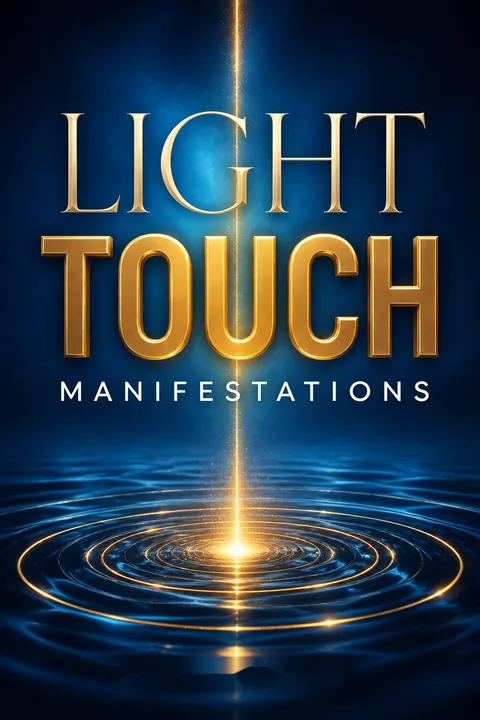
Light Touch Manifestations is a spiritual self-help book that moves from diagnosis to practice. It begins by questioning the cultural habit of treating life as an endless sequence of fights, then explains how beliefs shape interpretations, describes a thought-to-feeling-to-outcome chain, and offers exercises for releasing emotional charge and setting intentions. Its recurring filing-system metaphor gives abstract claims a tangible shape, while the author's account of depression and chronic worry supplies a personal narrative of change.
The book's strongest practical ideas are modest and recognizable: beliefs influence attention, thoughts need not be accepted as facts, a pause can interrupt an automatic response, and a clear goal is easier to pursue than a tangled mix of fear and desire. These points resonate with cognitive approaches to appraisal and emotion regulation. The more ambitious claim, that feelings transmit energetic patterns which cause outer events to match them, is not established by the experiences or examples presented. The distinction matters because readers should not infer that suffering reflects faulty beliefs, or that calm alone will resolve illness, financial hardship, discrimination, or unsafe circumstances.
The advice on addiction and depression also needs boundaries. The author treats recurring behavior largely as attachment to an underlying feeling and recommends letting that feeling go. Self-observation can be useful, but serious mental health conditions and substance dependence can involve biological, relational, and environmental factors that a simple release exercise cannot address. The book is best approached as a set of reflective practices rather than a complete clinical or causal theory. Its most sustainable promise is not guaranteed manifestation, but a less reactive relationship to inner experience, which can support clearer choices and more deliberate action.
Review Summary
Readers highly praise Light Touch Manifestations for its clear, simple approach to manifestation. Many find it enlightening, offering deeper insights into why they struggle with manifesting desires. The book emphasizes resetting to a zero state, breaking unconscious manifestation patterns, and using a "light touch" approach. Reviewers appreciate Dotts' ability to simplify complex concepts, making them easy to understand and implement. The book is particularly noted for addressing the "allowing" step in the Law of Attraction. Overall, readers find it a valuable resource for spiritual growth and manifesting desires.
People Also Read






Glossary
Light Touch Manifestations
Low-effort intention practiceThe author's approach to manifestation begins with reducing emotional resistance, then holding a desire gently rather than trying to force an outcome, and finally releasing attachment to the result. Dotts explains it through a spiritual model in which inner states influence external events. The practice can also be read as a way to settle attention and clarify intentions, without assuming that its metaphysical claims are proven.
Internal Filing System
Beliefs organizing experienceDotts's metaphor for the beliefs and assumptions that sort new experiences into familiar categories. Like an office filing system, it makes information easier to interpret and retrieve, but can also distort details to fit existing expectations. The metaphor explains how a belief may shape a person's reading of events and how repeated interpretations can reinforce that belief.
zero state
Calm, non-resistant awarenessA condition of inner quiet that Dotts recommends before setting an intention. In this state, worry and fear are not dominating awareness, and the person is not straining to force a result. The author describes it spiritually as a blank starting point for creation. In practical terms, it can be understood as a settled state for reflection, not a guarantee of external change.
manifestation point
An imagined step toward fulfillmentAny moment along the path to a desired outcome that a person can picture and emotionally connect with. Rather than imagining only the final result, Dotts suggests choosing an intermediate scene that feels believable and natural. A manifestation point might represent an early step toward an experience or the moment a person recognizes that a desired outcome is underway.
Light Touch Dropping Sequence
Neutral cue for releaseA technique in which a person first settles into a peaceful state, then silently uses a neutral word associated with release, such as drop or reset, without naming the specific problem. Dotts says this loosens attention from unwanted circumstances and clears their underlying cause. Its effects on external events are a spiritual claim; as a mental exercise, it may serve as a cue to disengage from rumination.
resistance
Inner tension around a desireDotts uses resistance to describe worry, fear, unease, or other feelings that interfere with a person's calm focus on an intention. He recommends noticing and releasing these feelings rather than covering them with forced positivity. In his metaphysical account, resistance affects manifestation; in everyday language, it can refer to emotional conflict or apprehension around a goal.
Law of Attraction
Like feelings attract outcomesThe spiritual principle Dotts invokes to explain why thoughts and feelings of a particular nature are said to draw similar experiences into a person's life. He presents this as a universal mechanism connecting inner states with physical manifestations. The book treats the principle as fact, but the claimed energetic causation is not established by the examples it provides.
Sedona Method
Questions for releasing feelingsA named method that Dotts draws on to help readers loosen unwanted emotional states. Its questions invite a person to consider whether a feeling can be released, whether they are willing to release it, and when they might do so. In the book, the questions are prompts rather than a reasoning exercise, and are used to create a pause around worry, anger, or an urge.
FAQ
What is "Light Touch Manifestations: How To Shape The Energy Field To Attract What You Want" by Richard Dotts about?
- Core Premise: The book teaches how to manifest desires by shaping your energy field through a "light touch" approach, rather than forceful effort or struggle.
- Manifestation Redefined: Dotts challenges the belief that life is a struggle and instead advocates for ease, flow, and non-resistance as the foundation for effective manifestation.
- Inner State Focus: The process centers on clearing negative beliefs and emotions, returning to a peaceful "zero state," and then lightly intending new realities.
- Practical Techniques: The book provides step-by-step methods, including letting go of negative feelings, using "dropping sequences," and focusing on the "white space" to dissolve unwanted issues.
Why should I read "Light Touch Manifestations" by Richard Dotts?
- Breaks Manifestation Myths: The book demystifies common misconceptions about manifestation, offering a fresh, practical perspective.
- Emphasizes Inner Work: It highlights the importance of inner peace and emotional clarity as prerequisites for successful manifestation.
- Simple, Actionable Methods: Dotts provides easy-to-follow exercises and techniques that can be integrated into daily life without complex rituals.
- Empowering Message: Readers are encouraged to reclaim their power as conscious creators, free from limiting beliefs and emotional baggage.
What are the key takeaways from "Light Touch Manifestations" by Richard Dotts?
- Beliefs Shape Reality: Your deep-seated beliefs and emotional states directly influence what you experience in life.
- Letting Go is Essential: Releasing negative feelings and dropping resistance is more effective than forceful positive thinking or affirmations.
- Manifest from Zero State: True manifestation happens when you return to a peaceful, neutral inner state before setting intentions.
- Light Touch Works Best: Holding intentions lightly, without attachment or effort, allows the Universe to deliver your desires more easily.
How does Richard Dotts define the "light touch" approach to manifestation?
- No Forcing or Striving: A light touch means not trying hard, not forcing outcomes, and not obsessing over results.
- Gentle Intention Setting: You hold your desires gently in your awareness, without emotional attachment or resistance.
- Effortless Allowing: By letting go and trusting the process, you allow manifestations to unfold naturally.
- Contrast with Heavy-Handedness: Dotts contrasts this with the common "try harder" mentality, which often blocks manifestations.
What is the "internal filing system" concept in "Light Touch Manifestations" by Richard Dotts?
- Belief System Analogy: Dotts compares your belief system to a mental filing system that organizes experiences and information.
- Automatic Categorization: Your mind files new events according to existing beliefs, often reinforcing negative patterns unconsciously.
- Problems as Constructs: All problems are seen as man-made constructs, created and maintained by faulty or limiting beliefs.
- Change the Filing Rules: By becoming aware of and changing your internal "filing rules," you can shift your reality.
How does Richard Dotts explain the manifestation sequence in "Light Touch Manifestations"?
- Four-Part Chain: The sequence is: (1) Unconscious memories/beliefs → (2) Conscious thoughts → (3) Feelings/emotions → (4) Physical manifestations.
- Law of Attraction Link: The Law of Attraction connects your inner emotional state to your outer reality.
- Breaking the Chain: The key is to break the link between thoughts and feelings, so negative thoughts no longer trigger negative emotions or outcomes.
- Letting Go as Shortcut: Letting go of emotional responses is faster and more effective than trying to change every thought or belief.
What is the "zero state" and why is it important in "Light Touch Manifestations" by Richard Dotts?
- Definition of Zero State: The zero state is a peaceful, neutral inner condition free from resistance, negative thoughts, and emotional clutter.
- Foundation for Manifestation: Manifesting from this state ensures your intentions are not tainted by past fears or doubts.
- Spontaneous Well-being: In the zero state, feelings of joy and well-being arise naturally, making you vibrationally compatible with your desires.
- Access to Inspiration: This state allows you to receive clear guidance and impulses from your higher self or the Universe.
What is the "dropping sequence" technique in "Light Touch Manifestations" by Richard Dotts?
- Effortless Letting Go: The dropping sequence is a mental process where you use a word like "drop," "reset," or "erase" to release unwanted issues without focusing on them.
- No Problem Rehashing: You do not need to analyze or even think about the problem; simply invoke the dropping word to clear it from your consciousness.
- Inspired by Healing Modalities: Dotts draws on methods like Ho’oponopono and the Sedona Method, adapting them for manifestation.
- Consistent Practice: Regular use of the dropping sequence lightens your inner state and dissolves recurring problems.
How does "Light Touch Manifestations" by Richard Dotts address recurring life themes and addictions?
- Feelings Behind Addictions: Dotts explains that addictions (to substances, behaviors, or emotions) are really addictions to certain feelings.
- Identify and Release: The book guides you to identify the core feelings behind recurring themes and use letting go techniques to release them.
- Breaking Emotional Cycles: By dropping the emotional charge, you weaken the compulsion and allow new, positive patterns to emerge.
- No Self-Blame: The approach is compassionate, focusing on awareness and gentle release rather than guilt or self-criticism.
What are "manifestation points" and how are they used in "Light Touch Manifestations" by Richard Dotts?
- Flexible Visualization: Manifestation points are any steps or moments along the path to your desired outcome, not just the final result.
- Choose What Feels Real: You can visualize booking a ticket, telling a friend, or any intermediate step that evokes the feeling of completion.
- Lightly Hold the Feeling: The key is to immerse yourself in the feeling associated with the chosen point, then let it go.
- Reduces Resistance: This approach makes manifestation feel more attainable and reduces emotional resistance.
How does "Light Touch Manifestations" by Richard Dotts handle manifestations involving change or unwanted situations?
- Two-Part Process: First, drop the unwanted current reality from your consciousness using the dropping sequence. Second, focus on the new desired reality.
- Avoid Canceling Intentions: Dotts warns that focusing on both the problem and the solution at once can cancel out your manifestation efforts.
- Withdraw Attention: Success depends on your ability to withdraw attention from the problem, not just affirm the solution.
- Step-by-Step Transition: The book recommends handling each part separately for more effective results.
What are the best quotes from "Light Touch Manifestations" by Richard Dotts and what do they mean?
- "Life is meant to be easy." – Dotts emphasizes that struggle is not necessary for success; ease and flow are natural states for manifestation.
- "You are the creator of your own reality." – This quote underlines the book’s core message of personal empowerment and responsibility.
- "Drop, and it is done!" – The simplicity of the dropping process is highlighted; letting go is often all that’s needed for transformation.
- "The good you are seeking is seeking you!" – Dotts reminds readers that their desires are already aligned with them at a deeper level, and only resistance stands in the way.
- "When you take a light touch and stop pushing so hard against the perceived issues and challenges in your life, they stop pushing back at you as well." – This encapsulates the book’s philosophy of non-resistance and gentle allowing.
About the Author
Other books by Richard Dotts






Download PDF
Download EPUB
.epub digital book format is ideal for reading ebooks on phones, tablets, and e-readers.








