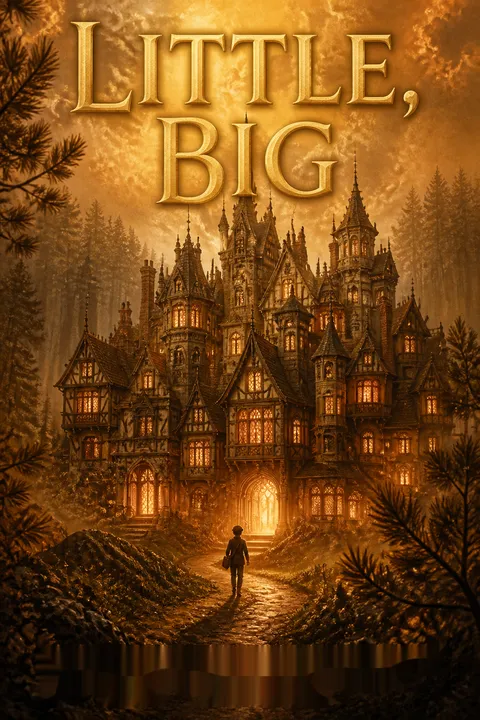


Plot Summary
The Clerk Finds a Face
Smoky Barnable has learned to live almost unnoticed. Raised by a drifting, scholarly father and trained to check telephone listings for errors, he reaches adulthood with knowledge but little sense of himself. In the City, George Mouse draws him into a noisy family that makes him feel visible.
At a gathering there, Smoky meets Daily Alice Drinkwater, a tall country girl whose gaze seems to bring his scattered self into focus. They fall in love, and their letters deepen the bond while Alice tells him of a childhood encounter with a rainbow and a promised future husband she believes she has now found. When she says their wedding must follow exact conditions, Smoky sets out on foot toward Edgewood.
Smoky’s anonymity is not merely shyness. It is a social and psychological condition produced by unstable family ties, itinerant schooling, and a life spent observing other people rather than entering their stories. Alice’s attention gives him a self, but the exchange is not simply romantic: her certainty places him inside a narrative already underway. His willingness to walk, eat homemade food, and obey unfamiliar conditions marks the first shift from passive observer to participant.
A House Built of Worlds
Long before Smoky’s journey, architect John Drinkwater abandons a conventional career after a growing sense that his buildings are inadequate. In England he meets Violet Bramble, a young woman whose accounts of other realms have exhausted and endangered her.
He offers her a home and accepts the child she carries, then designs Edgewood as a compound of architectural styles, with rooms and routes that resist ordinary geometry. Violet recognizes the house as a place where her lost world may still be reached.
John’s engineering, her knowledge, and the house’s growing legend become inseparable. Their descendants inherit not only the property but a puzzle: the boundaries between house, landscape, memory, and another world are never quite where they appear.
Edgewood is more than a fantastical setting. Its architecture turns the novel’s central problem into something inhabitants must physically negotiate: inside and outside, refuge and passage, ordinary space and the impossible. John builds to protect Violet, yet the house cannot be reduced to a container for her experience. Its rooms imply that shelter can also be an entrance, and that human attempts to impose order may create structures whose meanings exceed their makers.
The Long Road In
At the edge of the countryside, Smoky loses the commercial roads and finds help from Margaret and Jeff Juniper, who feed him and direct him toward the hidden town. He reaches Edgewood the next day, where Great-aunt Cloud explains that the wedding requirements were safeguards, not a test.
The house confounds him with shifting fronts, imaginary rooms, and plumbing no one can reliably locate, yet Alice welcomes him into the bedroom prepared for him. Before their wedding, her father asks about his prospects; Smoky can offer little beyond an education and modest inheritance. The Doctor accepts him anyway, partly because the Drinkwaters have wealth and partly because Smoky has already been chosen by Alice.
The journey makes Smoky’s admission into Edgewood bodily rather than theoretical. He arrives tired, dependent on hospitality, and unable to navigate the house by conventional means. His limited prospects contrast with the family’s inherited resources, but the Doctor’s welcome shows that usefulness is not the only basis for belonging. Smoky enters a world he cannot understand through affection and trust, a pattern that will shape both his marriage and his uneasy relationship with the family’s secrets.
A Wedding Among Strangers
Cloud leads Smoky through neglected grounds to a summer house, then through woods and across a lake to Alice, who waits at a gazebo with a crowd of relatives and neighbors. The minister stumbles through the ceremony, and the guests treat the marriage as a long-promised event rather than a private choice. Afterward they depart the island, leaving the newlyweds together.
Sophie, Alice’s younger sister, watches their intimacy from the darkness and feels love, envy, and exclusion tangled beyond her ability to name. On their first night, Alice offers Smoky the childhood he missed, a gift he cannot yet use because he never shared her belief in fairies. He accepts the offer of faith anyway, not wanting to be left behind.
The wedding is both a personal union and a communal acknowledgment of a promise whose origin remains obscure. The guests’ gratitude makes the marriage feel larger than the couple, while Sophie’s silent witnessing reveals the cost of that largeness: one sister’s fulfillment can become another’s wound. Smoky’s acceptance of Alice’s childhood is an act of intimacy, but also an early bargain with belief. He wants closeness before he knows what it will require.
The Camera Finds Faces
John and Violet’s son Auberon grows into a photographer and schoolmaster who believes evidence should settle questions. As a boy, he takes his nieces Alice and Sophie into the woods to look for hidden beings; their photographs reveal small figures among leaves and branches, though Auberon himself never sees them directly.
He enlarges the images and searches for proof, but the pictures remain ambiguous. His parents publish them in a book, weakening rather than strengthening his case.
Meanwhile, John retreats from architecture, worries over weather and time, and raises children in a house whose mystery he can describe but not resolve. Auberon keeps photographing, caught between the evidence his camera records and the exclusion he cannot explain.
Auberon’s camera represents a modern wish to make the invisible answerable to proof. It does reveal something, but not in a form that ends uncertainty. The photographs multiply evidence without producing shared belief, exposing a gap between seeing and knowing. Auberon’s scientific discipline is also psychologically defensive: if he can classify the hidden beings, he may escape the painful sense that his family has access to a world from which he is barred.
August Bargains for Desire
John and Violet’s son August wants a garage and Ford dealership, but his father refuses to back the plan. Fishing for an answer, August tastes a fish’s blood and hears a kingfisher offer him a bargain: return Violet’s unusual cards and receive what he most wants.
He steals the deck, leaves it at a woodland pool, and takes a squirrel’s tail, which gives him a devastating power over women. August first pursues Amy Meadows, then becomes consumed by desire for other young women, leaving heartbreak and confusion behind him.
When Amy becomes pregnant, August abandons his car and walks into the woods, never returning. Amy is taken in at Edgewood and gives birth to John Storm, whom the family raises without settling the questions surrounding his father.
August’s bargain exposes a distinction between power and agency. He asks for command over desire, but receives a force that commands him in turn. His apparent abundance of choice produces compulsive repetition, not freedom. The story also makes consequences communal: Amy’s pregnancy, August’s disappearance, and John Storm’s upbringing become part of a family structure that manages damage through care while withholding a clean account of what happened.
The Stolen Child
Years after the wedding, Sophie and Smoky have a brief, confusing sexual relationship, and Sophie gives birth to Lilac, whom the family presents as Smoky’s child. One winter night, beings enter Sophie’s room and take the infant, leaving a substitute in her arms. The replacement seems normal at first, but gradually ages and withers.
Unable to explain the change, Sophie secretly brings it to George Mouse, who recognizes that it is not a living child. When it begins eating burning coals, he lures it into his fireworks workshop and destroys it in an explosion. Sophie blames him for killing her daughter, though she had already realized the child was false. Grief drives her into retreat and eventually toward the study of Violet’s cards.
The substitution turns maternal love into a crisis of knowledge: Sophie must trust her attachment while questioning the evidence of her own arms. The false child is not simply a villain but a counterfeit presence that consumes care without being able to return it. George’s rescue is necessary and devastating, because practical intervention cannot restore what was taken. Sophie’s grief becomes the emotional engine of her later search, while silence protects the family at the price of shared understanding.
The Boy Who Stayed Behind
Smoky and Alice raise four children at Edgewood, and Smoky becomes the local schoolteacher. Their youngest son, Auberon, grows up with an imaginary companion named Lilac, while the family avoids explaining the real baby Sophie lost. At about seven, Auberon’s imaginary Lilac vanishes during a family picnic.
He pursues her into the woods and calls after her, but she does not return. As he grows older, he tries to investigate the family through old photographs and John Drinkwater’s architectural book, yet the evidence frustrates him. Feeling shut out and unable to speak plainly with Smoky, Auberon leaves for the City to seek a writing career and a life beyond Edgewood.
Auberon’s departure follows a double loss: the disappearance of a childhood companion and the discovery that adults will not explain the family’s most consequential events. His secretiveness is not simple rebellion; it is a strategy for preserving a private self in a household where everyone seems to know more than he does. Leaving promises autonomy, but it also repeats the family’s older pattern of seeking answers elsewhere.
A Destiny in the City
In the City, Auberon stays with his cousin George Mouse, who has turned a block of abandoned buildings into Old Law Farm, a precarious refuge for people and animals. Auberon meets Sylvie, a quick-witted Puerto Rican woman who helps care for the farm and believes a spiritualist has foretold her great destiny.
She has left a difficult family life and fears that destiny may take her away from any ordinary happiness. Auberon, who has come to write for television, offers her a place in his tiny folding bedroom; its hidden bed opens from a wardrobe. They become lovers, and he finds that their intimacy gives shape to desires he had barely understood. Together they begin imagining stories for a television drama.
The folding bed makes a cramped refuge expand, echoing Edgewood without reproducing it. Auberon and Sylvie build a shared life through improvisation: she brings plot, appetite, and social intelligence; he brings language and structure. Their attraction is not a cure for hardship, but it gives them a temporary way to convert scarcity into mutual invention. Sylvie’s destiny remains both promise and threat, since she wants a life she can choose rather than one imposed by prophecy.
The Messenger Disappears
Sylvie takes a job with Winged Messenger Service and receives an oddly wrapped package addressed to a tiny door in a City building. On the train, she removes the ring that La Negra gave her, and the parcel seems to vanish before returning larger than before. She follows the address down a narrow passage and enters a miniature house, leaving Auberon with no explanation.
He searches for her, then becomes a homeless drinker, repeatedly mistaking strangers for her and building stories around her absence. During a turbulent political march, he sees a woman resembling Sylvie and spends the night with her brother Bruno, but the encounter only sharpens his loss. He finally uses a park as a memory system to order his grief.
Sylvie’s departure turns the City from a place of chosen adventure into a maze that refuses Auberon’s usual methods of explanation. The ring and package make destiny tangible, yet neither tells him where she has gone. His memory park is an attempt to regain agency by arranging pain into orderly symbols. The work grants insight, but cannot restore the relationship or guarantee that knowledge will make him less vulnerable.
The Emperor Awakens
Ariel Hawksquill, a powerful practitioner of the Art of Memory, is hired by the Noisy Bridge Rod and Gun Club to investigate Russell Eigenblick, a charismatic lecturer whose followers are gathering influence.
She studies his speeches, histories, and the changing Zodiac in the City’s great railway terminal. Her research identifies him as Frederick Barbarossa, the medieval emperor whose people believed he slept until their hour of need. Hawksquill warns the Club that forces beyond its control may be involved, but its members plan to co-opt Eigenblick by offering him the Presidency.
She then enters his hotel room unseen, tells him the Club intends to use him, and urges him to refuse its offer. He accepts her as an ally, though neither understands the full design.
Hawksquill’s memory art converts information into architecture, but her discovery does not make her omniscient. She correctly identifies Eigenblick and still misreads the scale of the forces around him. The Club’s political pragmatism is similarly limited: it assumes that charisma can be domesticated by office. Both approaches treat history as something manageable, while the novel suggests that stories can recruit people into roles before they understand the script.
Lilac Returns Awake
The real Lilac has been raised in the other world, where Mrs. Underhill educates her and teaches her to sleep. After a tour through Edgewood and the City, Lilac finally falls asleep in an autumn wood. Years later she wakes, follows a path to the Junipers’ cottage, then reaches Edgewood and finds Sophie.
She tells her mother that the hidden people are dwindling and that a peace Parliament must meet on Midsummer Day. Sophie has spent decades unable to imagine Lilac’s return; now she must accept both the child before her and the scale of the summons. Lilac says the house is the door, but Sophie must use the cards to discover how the family can follow.
Lilac’s return does not undo Sophie’s loss so much as change its meaning. The child has been educated through separation, while Sophie has survived by refusing to imagine reunion. Their meeting reveals how protection and injury can occupy the same history: Lilac’s removal enabled her training, but Sophie paid for that purpose without consent. The promised Parliament shifts their private grief into a collective obligation.
A Summons Through the Cards
Sophie lays out Violet’s cards and reads a route involving a door, a dog, a river, and a guide, though she cannot tell the group exactly where it leads or how anyone will return. She summons the Drinkwaters, Barnables, and neighboring families whose histories are entangled with Edgewood.
Many arrive already feeling that they have been waiting for this call. Sophie says the hidden people are vanishing and that they must help end the war.
Her relatives ask whether the journey is dangerous and whether the destination is real; she cannot promise either way. Blossom proposes a circle of joined hands, but the gathering dissolves into practical preparations and private fear. The departure remains unresolved, and Smoky asks how they will get back.
The cards provide direction without certainty, a form of knowledge suited to a crisis in which ordinary guarantees have failed. Sophie’s inability to explain the destination does not make her summons empty; it forces the others to decide whether relationship and obligation can justify action without a map. The attempted circle shows the group’s desire for unity, but its failure also preserves individual choice and anxiety.
The Cards Leave Hawksquill
Before the gathering can depart, Hawksquill steals the cards and boards Eigenblick’s presidential train, hoping to use them to guide him away from the forces that placed him in his role. Eigenblick senses the deck and demands it, but Hawksquill cannot persuade him to trust her.
When the train stops in a remote wood, he and his guards pursue her. Hawksquill drops the black-cat bone that had made her invisible and is shot. She reaches a small, welcoming house as her human body fails, but the surviving consciousness passes into the stork that once carried Lilac.
Eigenblick takes the cards aboard the train, which disappears into a tunnel that should not exist. His political future remains uncertain, and his legend of a sleeping emperor begins anew.
Hawksquill’s knowledge and power cannot exempt her from consequence. By taking the cards for her own strategic purpose, she acts against the very network she has only begun to understand. The transformation into the stork preserves continuity without offering a clean escape: the self survives, but in a body and life she did not choose. Eigenblick’s disappearance likewise converts political failure into myth, allowing a defeated movement to persist as expectation.
Alice Opens the Way
As the families wait, Smoky discovers that Henry and Harvey Cloud’s orrery is a perpetual-motion machine whose linked weights and counterbalanced arms can turn if given one initial push. It begins to run and sends power through the house, restoring lights, heat, and machinery. The revelation does not persuade Smoky that he can join the others, but it keeps Edgewood alive.
Alice leaves first, stepping out through the front door before dawn. She travels into the woods, meets George as her guide, and later encounters the stork who is now Hawksquill. Alice accepts that she must go ahead so the others will have somewhere to arrive. Her departure is an act of care, not abandonment, though Smoky does not yet know how to understand it.
The orrery condenses the novel’s competing accounts of causality. Smoky believes a mechanism needs an external push; the machine then sustains itself, giving him a practical answer without resolving the metaphysical question. Alice’s departure parallels that motion: one person’s difficult first step makes a destination possible for others. Her courage is less triumph over fear than willingness to act while fear remains.
The Forest Reclaims George
Auberon, George, and Fred Savage enter the woods by way of the underground transit system, seeking the river and a crossing. The forest repeatedly changes its apparent geography, and each man loses the ordinary sense of where he is. George wanders away from the others and, through a sequence of confused memories, reaches a small farm that feels like home.
Fred becomes a tree, leaving Auberon to continue alone. Auberon glimpses a girl in blue but cannot remember her name or catch up with her. At the forest’s center he builds a memory park, hoping to order the search, then sees Sylvie moving through the City below. This time he calls her by name and turns toward her.
The journey makes memory a navigational problem rather than an archive. George’s route back to a familiar farm and Fred’s rooted transformation show that not everyone travels toward the same kind of arrival. Auberon’s repeated failure to name the girl reveals the limits of his earlier method: he can arrange memories, but love cannot be recovered by classification alone. His call marks a modest, crucial change from interpreting the past to risking contact.
The Banquet Finds Sylvie
Sylvie reaches a moonlit banquet beneath a flowering tree, carrying a present for Auberon. She finds George among the guests and learns that the gathering is also a wake for Auberon’s father. Auberon is there, and the two meet at last, with their past suffering still visible but no longer separating them.
The gathering shifts from mourning into celebration; Sylvie crowns Auberon with flowers and joins the dance. He realizes that their shared story has not concluded but expanded into a future too large to outline. The reunion does not erase her departure or his years of grief. Instead, it gives their love a place in the larger gathering, where loss, desire, and renewal can coexist.
The banquet refuses the usual bargain in which reunion cancels pain. Auberon and Sylvie return to each other carrying histories that cannot be made harmless, yet the communal setting lets private love join a wider cycle of mourning and celebration. The scene’s shift from wake to dance reframes endings as transitions, not reversals. Their future is not secured by prophecy; it becomes possible because both are present.
Smoky Chooses the Journey
Back at Edgewood, Smoky initially refuses to join the others, saying he must stay to care for the house. Lilac arrives and identifies herself as his daughter, then tells him he is needed at the Parliament. He still resists, fearing that leaving means losing Alice and the life he understands. Sophie cannot promise him a safe return, but she presses him to come.
Smoky finally packs a few necessities in a battered carpetbag, which feels strangely familiar in his hand. He leaves the lights burning and follows the family from the porch. At the gate he understands that their destination is not simply another place: they are returning to the story and world that have shaped them all along.
Smoky’s refusal is not cowardice but a defense of the only home he trusts. The carpetbag, once associated with an impossible encounter, becomes a portable capacity to carry what he cannot yet name. His decision is less an act of belief than a choice to remain in relationship with Alice and the family. The threshold changes meaning: leaving home may be the only way to understand what home has been.
The House Becomes a Story
As the company moves out, Smoky cannot follow through the gate he first entered decades earlier. Instead, a revelation opens within him: the place they seek is also the land called the Tale, where the house, the family, and their memories already belong. In the distance, Auberon and Sylvie join the feast, while Alice has gone ahead and Sophie continues toward the gathering.
Edgewood remains powered for a time, lit and open, but its inhabitants do not return to live there. Weather and animals reclaim the rooms; the machine continues until its parts wear down. The house becomes a story people search for, and its story joins others about a world where doors once stood open.
The ending resists a simple account of departure, salvation, or death. The destination is not a separate country waiting intact beyond the woods; it is made through the travelers’ memories, relationships, and willingness to enter it. Smoky’s revelation resolves his lifelong exclusion without converting him into a believer in the conventional sense. The abandoned house preserves the cost of the passage: a home can remain present as story even after its inhabitants have gone.
Analysis
Little, Big treats belief less as a verdict about whether fairies exist than as a way of inhabiting uncertainty. Its characters repeatedly face partial evidence: photographs that show figures without explaining them, cards that predict without clarifying, a house whose doors do not lead to the same place twice. Those objects do not reward mastery. They expose the limits of control, especially when characters try to convert love, grief, or history into a system they can command.
The novel’s family structure carries this argument across generations. Smoky’s anonymity makes him eager to be chosen, while Auberon’s secrecy grows from the opposite fear: that others possess knowledge he lacks. Sophie protects herself by refusing to imagine reunion; Alice accepts a destiny but still chooses Smoky as her own. Their different responses show that belief is not a personality type. It is a relationship with risk, attachment, and the possibility of being changed.
The political plot enlarges the same problem. The Noisy Bridge Rod and Gun Club believes power can be managed through appointments; Eigenblick believes history guarantees his restoration; Hawksquill trusts that superior interpretation will let her remain outside the forces she studies. Each is partly right and dangerously mistaken. The hidden world does not behave like a government, a machine, or a story with a predictable ending.
Edgewood therefore functions as both home and method. It makes room for contradictions without resolving them, and its survival depends on an unlikely machine that must be started before it can sustain itself. The ending extends that paradox: the characters travel toward a world that is also the story they have already been living. Their destination is not escape from ordinary life, but a widened version of it, where memory and imagination become forms of belonging rather than instruments for possession.
Review Summary
Little, Big by John Crowley is a divisive novel that blends fantasy and realism. Many readers praise its lyrical prose, intricate multi-generational story, and dreamlike atmosphere. The book follows the Drinkwater family and their connection to a mystical world. Critics find it slow-paced and confusing, while admirers appreciate its ambition and depth. The novel explores themes of destiny, magic, and the nature of reality. Its unique style and complex narrative make it a challenging but rewarding read for those who connect with Crowley's vision.
People Also Read

Characters
Smoky Barnable
The reluctant believerRaised in motion by a distant father, Smoky becomes observant, learned, and almost invisible to others. He wants to belong, but distrusts claims he cannot verify and avoids asking questions that might expose how little he understands. His love for Daily Alice gives him a stronger sense of self, while life at Edgewood asks him to live beside beliefs he does not share. His practical patience, quiet loyalty, and capacity to endure make him central to the family even when he feels like a minor character in its larger story.
Daily Alice Drinkwater
The long-sighted brideAlice is tall, physically confident, and at ease with a world that seems alive with signs. She trusts intuition and family lore without needing to turn them into proofs. Her love for Smoky is both chosen and entangled with a promise she has carried since childhood. As daughter, sister, wife, and mother, she often recognizes more than she can explain, but her composure is not invulnerability. She is driven by attachment and a deep sense of responsibility to the people around her.
Auberon Barnable
The searching sonSmoky and Alice’s son grows up bookish, guarded, and hungry for explanations. His childhood companion and his family’s silences leave him suspicious of what adults know and what they conceal. He wants to write, but is more comfortable arranging stories than understanding people. In the City he discovers desire, ambition, and the cost of trying to turn emotional uncertainty into a solvable puzzle. His life is shaped by his effort to find both a place of his own and a language for loss.
Sophie Drinkwater
The sleepless sisterAlice’s younger sister is an intuitive dreamer who spends much of her life in sleep and develops a private language of visions. She loves her sister intensely and is vulnerable to the pain of being left outside Alice’s promised future. Her patience, imagination, and capacity for care coexist with a deep reserve. After a devastating loss, she turns to the family’s cards, seeking a way to ask questions that ordinary speech cannot hold.
Lilac
The returning messengerLilac is associated with childhood, absence, and the hidden world surrounding Edgewood. She is curious, independent, and accustomed to a life whose rules differ from those of her human family. Her long education gives her a task larger than personal reunion, yet she retains a child’s impatience with explanations adults consider essential. She links the family’s private grief to the fate of the beings who have shaped their history.
George Mouse
The generous City guideGeorge is Smoky’s first close friend, a charismatic, theatrical man whose humor and appetite for life mask a talent for practical kindness. In the City he builds a refuge from neglected buildings and takes in people who have nowhere else to go. He is resourceful, secretive, and more emotionally perceptive than he pretends. His loyalty to family and friends is strong, though he often meets the inexplicable with action rather than analysis.
Sylvie
The woman with a destinySylvie is sharp, funny, sensual, and protective of her independence. Raised amid family instability and hardship, she reads people quickly and distrusts promises that offer no practical help. A spiritual prediction has made her feel both special and trapped. With Auberon she finds an intimate partner and creative collaborator, but she continues to want a future she has chosen for herself, not one assigned by prophecy or family.
Ariel Hawksquill
The memory mageHawksquill is a disciplined, ambitious practitioner of the Art of Memory. She builds elaborate mental architectures to organize knowledge and prides herself on seeing patterns others miss. Her work for the Noisy Bridge Rod and Gun Club draws her into a political and supernatural crisis that tests both her judgment and her desire for power. She is incisive, self-reliant, and capable of changing course when evidence overturns her assumptions.
Violet Bramble Drinkwater
The keeper of the cardsViolet is a mystic whose perceptions shape John Drinkwater’s architecture and the family’s inherited sense of another world. She is loving but difficult to pin down, often unable to translate what she knows into explanations her family can use. Her cards offer partial glimpses rather than reliable commands. Violet’s influence persists through the house, the family’s silences, and the questions successive generations inherit.
John Drinkwater
The architect of EdgewoodJohn is an imaginative architect who turns from conventional commissions toward the design of a house that can contain many styles and meanings. His love for Violet makes him protective, but his rational intelligence cannot fully follow her experience. He gives his family a remarkable home and an enduring puzzle. His affection is steady, even when understanding remains incomplete.
Auberon Drinkwater
The camera-bearing uncleViolet’s son and Alice and Sophie’s uncle, Auberon is a methodical photographer who searches for visible proof of the beings his family takes for granted. He is intelligent, lonely, and drawn to images because they promise a record that cannot argue back. His photographs reveal fragments without giving him the access he wants. He represents both the rigor and the emotional cost of insisting that every mystery be made legible.
August Drinkwater
The restless Ford enthusiastAugust longs for modern machinery, independence, and an ordinary future beyond Edgewood. He trusts practical explanations more than his family’s lore, yet is drawn into a supernatural bargain through his own desires. His impatience and charm affect many lives around the five towns. He is a restless figure whose ambitions reveal the strain between inherited mystery and a changing modern world.
Russell Eigenblick
The returning emperorEigenblick is a charismatic lecturer whose public speeches gather a following during a period of political instability. He combines theatrical confidence with a genuine ability to move audiences, while keeping his identity and aims partially obscured. He believes history has assigned him a role and resists being managed by the powerful people who seek to use him. His presence blurs the line between political leadership and myth.
Fred Savage
The streetwise messengerFred is an old City wanderer who knows hidden routes, forgotten passages, and the people who survive between institutions. He guides Auberon through the urban maze and later accompanies him toward the woods. His jokes and practical advice make him seem unserious, but he is more at home in uncertain territory than almost anyone around him.
Mrs. Underhill
Lilac’s otherworldly teacherMrs. Underhill is an ancient caretaker who educates Lilac and manages duties extending far beyond one family. She is brisk, affectionate, and impatient with questions that cannot be answered simply. Her knitting, house beneath an oak and thorn, and knowledge of the long Tale make her a guide to a reality whose scale dwarfs human life.
Dr. Drinkwater
The animal-loving fatherAlice and Sophie’s father writes animal stories and pays close attention to the natural world. He is gentle, distracted, and less interested in social convention than in the creatures and patterns around him. His advice and teaching connect the younger generations to the land, though his own knowledge often arrives as a story rather than a direct explanation.
Amy Woods
The steadfast motherAmy is a young woman whose relationship with August places her in a difficult position within the extended family. She is resilient, affectionate, and willing to keep caring for the people tied to that history. Her presence connects the Drinkwaters to the Woods family and helps carry consequences across generations.
Tacey, Lily, and Lucy
The daughters who observeAlice and Smoky’s daughters are closely bonded and attentive to births, courtships, and family changes. Tacey is deliberate and ceremonial; Lily and Lucy share private jokes and a less formal intimacy. Their needlework and quiet acts of observation place them at the edge of the family’s mysteries, where they notice patterns adults overlook.
Margaret Juniper
The roadside hostMargaret Juniper and her husband offer Smoky food and shelter on his journey to Edgewood. Her modest house is a threshold between the commercial roads and the hidden country, and her kindness makes the unfamiliar journey feel briefly ordinary.
Plot Devices
Edgewood
A house that opens outwardJohn Drinkwater designs Edgewood as a compound of architectural styles, with rooms that shift in apparent size and passages that can lead into landscape or other realms. The house shelters the family, stores its history, and functions as a door into the Tale. Its later dependence on the orrery’s power makes its physical survival part of the central conflict.
Violet’s cards
A map made of storiesThe unusual deck combines ordinary suits with trumps depicting people, places, things, and ideas. Violet and later Sophie use its arrangements to anticipate events, but its meanings remain flexible and incomplete. The cards link private family decisions to the larger story and give Hawksquill a way to understand the political and otherworldly conflict.
The Art of Memory
A mind built like a placeHawksquill stores knowledge in imagined buildings, rooms, and vivid symbols, then walks those structures to retrieve and interpret it. Auberon independently tries a related method in the City park, arranging memories of Sylvie so he can understand his loss. The device offers order, but neither memory nor symbolism can fully control what a person discovers.
The Cosmo-Opticon
A clockwork sky that needs a pushJohn Drinkwater and Henry Cloud’s elaborate orrery models planetary motion through linked gears, weights, and spheres. Smoky studies it for years, convinced it needs a motive force, until he discovers its self-balancing mechanism and starts it moving. It then powers Edgewood, tying the house’s continued life to the novel’s questions about motion, agency, and unseen intervention.
The layered world
A world hidden inside this oneFairy realms are not reached by a single consistent route. A door for one person may be irrelevant to another, and the same woods or streets can conceal different scales of reality. Journeys depend on temperament, memory, love, and timing as much as geography. This device lets the novel make the supernatural a shared possibility without reducing it to a simple map.
FAQ
0. Synopsis & Basic Details
What is Little, Big about?
- A Generational Saga: Little, Big follows Smoky Barnable, a seemingly ordinary man from the City, as he journeys to Edgewood to marry Daily Alice Drinkwater, a woman from a sprawling, eccentric family deeply intertwined with a hidden, magical world. The narrative spans generations, exploring the lives, loves, and destinies of the Drinkwater family and their descendants, who live on the border of Faëry.
- Blurring Reality and Myth: The novel delves into the subtle ways the magical "Otherworld" coexists with the mundane human world, often unnoticed by most. It explores how the Drinkwater family's unique perception and heritage allow them to interact with this hidden realm, influencing their lives, relationships, and understanding of reality.
- The Nature of Story and Home: At its heart, Little, Big is a meditation on the power of stories, family legacies, and the concept of "home." The house of Edgewood itself is a central character, a complex, ever-changing entity that serves as a gateway and a symbol for the family's connection to the larger, unfolding "Tale" that governs their existence.
Why should I read Little, Big?
- Immersive World-Building: Readers seeking a deeply immersive and intricately detailed fantasy world that feels both familiar and utterly unique will find Little, Big captivating. John Crowley crafts a setting where magic is not overt but woven into the fabric of everyday life, inviting a sense of wonder and discovery.
- Profound Thematic Exploration: Beyond its fantastical elements, the novel offers profound insights into themes of love, loss, identity, memory, and the passage of time. It challenges perceptions of reality and explores the enduring power of belief, making it a rich text for contemplation and discussion.
- Literary Craftsmanship: Crowley's prose is renowned for its lyrical beauty, subtle humor, and intricate structure. The novel is a masterclass in literary fiction, blending elements of fantasy, magical realism, and family saga into a cohesive and unforgettable reading experience.
What is the background of Little, Big?
- Architectural and Theosophical Roots: The novel's intricate world is partly inspired by the Arts and Crafts movement and theosophical ideas prevalent in the late 19th and early 20th centuries. John Drinkwater, the family patriarch, is an architect influenced by these movements, designing Edgewood as a "compound illustration" of his architectural philosophy, which later incorporates his wife Violet Bramble's spiritualist beliefs.
- Mythological and Folkloric Underpinnings: Crowley draws heavily from European folklore, particularly English and Irish fairy tales, but reinterprets them through a distinctly American lens. The "Little People" are not merely quaint figures but ancient, powerful beings whose world is infundibular—larger the further one penetrates it—a concept introduced by Violet's father, Dr. Bramble.
- Critique of Modernity: The narrative subtly critiques the encroachment of modernity and industrialization on traditional ways of life and the natural world. The "depopulation of the farms" around Edgewood and the "industrial park" Smoky traverses highlight a tension between the old, magical world and the new, rationalized one, a theme that resonates throughout the book.
What are the most memorable quotes in Little, Big?
- "The further in you go, the bigger it gets.": This quote, attributed to Dr. Bramble and later echoed by characters like Hannah Noon and Lilac, encapsulates the novel's central metaphysical concept of the infundibular nature of the Otherworld. It defines the paradoxical expansion of reality as one delves deeper into its hidden layers, a core theme in Little, Big explained.
- "The things that make us happy make us wise.": This phrase, found on a sampler in the Junipers' home and later repeated by Smoky, serves as a poignant thematic anchor. It suggests that true wisdom is not found in intellectual pursuit alone, but in the profound, often simple, experiences of joy and connection, offering a key insight into Smoky Barnable's motivations.
- "Life is long. Too long.": Grandfather Trout's gloomy pronouncement to Daily Alice offers a stark contrast to her youthful assertion that "Life is short." This exchange highlights the differing perceptions of time between mortals and the ancient beings of the Otherworld, underscoring the novel's exploration of mortality and eternity, a significant theme in Little, Big.
What writing style, narrative choices, and literary techniques does John Crowley use?
- Lyrical and Evocative Prose: Crowley's writing is characterized by its poetic quality, rich in sensory detail and metaphorical language. He employs long, flowing sentences that often build a cumulative effect, drawing the reader into the dreamlike atmosphere of Edgewood and the surrounding world. This style contributes to the novel's immersive and often hypnotic reading experience.
- Non-Linear and Multi-Perspective Narrative: The story unfolds across generations and through various characters' viewpoints, often shifting abruptly in time and perspective. This non-linear approach mirrors the fluid nature of time and memory within the novel, creating a complex tapestry of interconnected lives and events. The narrative often circles back on itself, revealing new layers of meaning with each return.
- Subtle Magical Realism and Symbolism: Rather than overt magic, Crowley integrates fantastical elements subtly, blurring the lines between reality and imagination. Everyday objects and occurrences are imbued with symbolic significance—houses transform, animals speak, and dreams hold prophetic weight. This technique encourages readers to look for deeper meanings and hidden connections, making Little, Big analysis a rich endeavor.
1. Hidden Details & Subtle Connections
What are some minor details that add significant meaning?
- The Orrery's Backward Motor: Smoky discovers that the magnificent orrery, designed by Henry Cloud, has an electric motor installed "backwards, and not by mistake." This seemingly minor detail symbolizes the inverted logic of the Otherworld and the Drinkwater family's unique relationship with time and causality, where conventional mechanics are subverted to serve a deeper, magical purpose. It hints at the idea that the house itself operates on a different set of rules, a key element in Edgewood's symbolism.
- The Single Eyebrow as a Mark: Auberon's observation that some family members, like Violet and her descendants, possess a "single eyebrow" (unibrow) is a subtle physical marker. While Violet dismisses it as a sign of a "violent, criminal person" in her English folklore, Auberon later connects it to the ability to perceive the Little People. This detail subtly links physical traits to mystical perception, suggesting a genetic component to their connection to Faëry, a crucial aspect of Drinkwater family lore explained.
- George Mouse's Hashish Source: George's "gift" of potent hashish, initially thought to be from a dead dealer, is later revealed by Smoky to be from old Lebanese candy stores in George's City neighborhood. This detail grounds a seemingly magical element (George's constant supply) in a mundane, historical reality, while also highlighting the City's hidden layers and George's unwitting connection to a past era of illicit trade, adding depth to George Mouse's character analysis.
What are some subtle foreshadowing and callbacks?
- Daily Alice's Rainbow Story: Daily Alice's childhood memory of chasing a rainbow and learning to "walk away from it" to enter a "whole colored world" subtly foreshadows Smoky's own journey to Edgewood. Her statement that "you were the one Spark talked about" directly foreshadows Smoky's destined role in the Tale, establishing his importance long before he understands it. This early conversation is a key piece of Little, Big foreshadowing.
- The "Elf" in the Photograph: The caption of the old photograph in Upstate Houses and Their Histories explicitly mentions "John Drinkwater and Mrs. Drinkwater (Violet Bramble;) elf. Edgewood, 1912." This early, almost throwaway detail directly confirms the existence of the Little People and Violet's interaction with them, setting the stage for the later revelations about Lilac and the true nature of the Drinkwater family's world. It's a crucial hidden detail in Little, Big.
- Smoky's "Perpetual Motion" Orrery: Smoky's frustration with the orrery, which he believes is a "perpetual motion machine" that "depends on itself to go around," echoes the cyclical nature of the Tale and the family's destiny. His inability to find an external "motive force" for the orrery mirrors the characters' struggle to understand the underlying forces governing their lives, a recurring theme in Little, Big analysis.
What are some unexpected character connections?
- Doc Drinkwater's Illegitimacy: The revelation that Doc Drinkwater is "technically a bastard," the son of August and Amy Meadows, is an unexpected twist that deepens the family's interconnectedness. This detail links the seemingly disparate branches of the family (Drinkwater, Meadows, Woods) and explains Doc's unique perspective on his heritage, adding complexity to Doc Drinkwater's character motivations.
- Ariel Hawksquill's Family Ties: Ariel Hawksquill, the powerful mage, is revealed to be a distant cousin of the Drinkwaters, specifically the granddaughter of Oliver Hawksquill, who had an affair with Violet Bramble before her marriage to John. This connection explains her innate understanding of the family's mystical world and her ability to interact with the cards, making her a more integral part of the narrative than initially perceived. This is a key Ariel Hawksquill character analysis point.
- George Mouse as Lilac's Father: The most shocking revelation is that George Mouse is the biological father of Sophie's daughter, Lilac, conceived during a "crazy fling." This unexpected paternity links George directly to the central mystery of Lilac's disappearance and the larger Tale, transforming his role from a mere family friend to a pivotal figure in the magical lineage. This is a critical George Mouse character development moment.
Who are the most significant supporting characters?
- Great-aunt Cloud: As the oldest living Drinkwater, Cloud serves as a repository of family history and a conduit to the mystical. Her card readings, though often cryptic, provide crucial insights and foreshadowing. Her calm demeanor and deep understanding of the "Tale" make her a grounding presence, guiding the younger generations through their complex destinies. Her role is central to Little, Big themes.
- Grandfather Trout: This ancient, albino fish in the deep pool acts as a reluctant oracle and messenger for the Little People. His gloomy pronouncements and philosophical musings offer a non-human perspective on the unfolding events, highlighting the vast, ancient nature of the Otherworld and its indifference to human concerns. He is a key piece of Little, Big symbolism explained.
- Fred Savage: The Wingéd Messenger, Fred Savage, is a recurring figure who appears at crucial junctures, delivering messages and guiding characters through the City's hidden pathways. His enigmatic nature and connection to both the mundane and magical aspects of the City make him a vital, if often overlooked, supporting character, embodying the pervasive influence of the Otherworld. His appearances are significant for Auberon Barnable's journey.
2. Psychological, Emotional, & Relational Analysis
What are some unspoken motivations of the characters?
- Smoky's Desire for Solidity: Beneath his initial anonymity, Smoky harbors a deep, unspoken longing for a concrete identity and a sense of belonging. His love for Daily Alice is intrinsically linked to her ability to "cure" his anonymity, making him "thicken." His later efforts to understand the orrery and maintain the house are driven by a desire to anchor himself in a tangible reality, a core Smoky Barnable motivation.
- Violet's Retreat from the Mundane: Violet's withdrawal to her upstairs room after John's death, and her earlier embrace of spiritualism, stems from a profound disillusionment with the "ordinary" world and a yearning for the deeper, more meaningful reality she glimpsed through the Little People. Her abstraction is a form of self-preservation, a refusal to engage with a world she perceives as increasingly "unreal," a key aspect of Violet Bramble's character analysis.
- Auberon's Quest for Control: Auberon's journey to the City and his pursuit of a writing career are driven by an unspoken need to assert control over his own life and destiny, in stark contrast to the predetermined "Tale" of Edgewood. His initial rejection of the family's mysteries and his later attempts to "solve" them through scientific methods reflect a deep-seated desire for rational understanding and agency, a central Auberon Barnable motivation.
What psychological complexities do the characters exhibit?
- Sophie's Burden of Knowledge: Sophie carries the heavy psychological burden of knowing the true, often painful, secrets of the family's Tale, particularly concerning Lilac. Her "sleeplessness" and her intense study of the cards are manifestations of her struggle to reconcile this knowledge with her emotional reality, leading to a complex interplay of grief, duty, and a yearning for understanding. This highlights Sophie Drinkwater's psychological complexities.
- George Mouse's Dual Nature: George Mouse embodies a fascinating psychological duality: he is both a pragmatic City man, dealing in hashish and navigating urban realities, and a deeply sensitive individual connected to the mystical. His "mental sympathies" allow him to perceive others' dreams and feelings, but he often struggles to articulate these insights, leading to a sense of being an outsider even within his own family. This is a key element of George Mouse's character development.
- Ariel Hawksquill's Intellectual Detachment: Hawksquill's mastery of the Art of Memory and her scientific approach to magic create a psychological distance from emotional engagement. She views the world as a system to be understood and manipulated, often struggling with empathy or personal connection. Her "contempt" for Russell Eigenblick's character, despite his power, reveals her intellectual pride and her difficulty in relating to human foibles, a central aspect of Ariel Hawksquill's motivations.
What are the major emotional turning points?
- Smoky's Cure of Anonymity: The moment Smoky realizes Daily Alice's love is "curing" his anonymity, making him "thicken," is a profound emotional turning point. It marks his transition from a detached observer to an actively engaged individual, laying the foundation for his emotional investment in the Drinkwater family and the Tale. This is a pivotal moment in Smoky Barnable's emotional arc.
- Violet's Acceptance of John's Proposal: Violet's decision to marry John Drinkwater, despite her initial reluctance and the circumstances of her pregnancy, is a major emotional shift. Her laughter at the "many houses" of Edgewood and her subsequent telling of her "secrets" to John signify her acceptance of a new life and a new form of protection, moving from a state of fear to one of tentative hope. This is crucial for Violet Bramble's relationship analysis.
- Auberon's Breakdown in the Kitchen: Auberon's emotional collapse in the kitchen upon his return to Edgewood, confessing to his mother the "awful mess" he's made, is a significant turning point. It marks the shedding of his carefully constructed persona of self-sufficiency and intellectual detachment, allowing him to reconnect with his family and his own vulnerability. This moment is central to Auberon Barnable's emotional journey.
How do relationship dynamics evolve?
- Smoky and Daily Alice: From Destiny to Partnership: Their relationship evolves from an initial "first sight" destiny, where Alice "recognized" Smoky, to a deep, enduring partnership. Alice's initial role as the "guide" who brings Smoky into the Tale gradually shifts as Smoky, through his own efforts and love, becomes an active participant and protector of their shared world. Their bond becomes the anchor of the family's future, a key aspect of Daily Alice and Smoky's relationship.
- Sophie and Lilac: A Mother's Enduring Grief and Reunion: Sophie's relationship with Lilac is defined by profound loss and an enduring, almost obsessive, search for her lost daughter. The eventual reunion, though with a child who has not aged, transforms Sophie's grief into a renewed sense of purpose and a deeper understanding of the Tale's complexities. This mother-daughter bond is central to Sophie Drinkwater's character arc.
- Auberon and Sylvie: Love as a Catalyst for Self-Discovery: Their passionate and tumultuous relationship in the City serves as a catalyst for Auberon's self-discovery. Sylvie's uninhibited nature and her "Destiny" challenge Auberon's intellectual detachment, forcing him to confront his own desires and limitations. Their love, though fraught with complications, ultimately leads Auberon to a deeper understanding of himself and his place in the world, a significant part of Sylvie's relationship dynamics.
4. Interpretation & Debate
Which parts of the story remain ambiguous or open-ended?
- The Nature of the Little People: While Dr. Bramble offers a "scientific" explanation of the Little People as "elementals" inhabiting an "infundibular" world, their true nature remains largely ambiguous. Are they literal beings, or manifestations of human perception, belief, or even psychological states? The narrative often presents them through the subjective experiences of characters, leaving their objective reality open to interpretation, a central Little, Big symbolism debate.
- The "Tale" and Free Will: The concept of the "Tale"—a predetermined narrative that the Drinkwater family is part of—raises questions about free will versus destiny. While characters like Daily Alice believe in the Tale's benevolent unfolding, others, like Auberon, struggle against it. The extent to which characters can influence or deviate from the Tale, or if their struggles are merely part of its design, remains a profound ambiguity, a key themes in Little, Big discussion.
- The Ending's Cyclical Nature: The novel concludes with a sense of both finality and endless continuation, as characters embark on new journeys and the house of Edgewood remains, lit and open. The cyclical nature of time and events, where beginnings and endings blur, leaves the ultimate fate of the characters and the world open to interpretation. Is it a true resolution, or merely another turn in an eternal cycle? This is a core question in Little, Big ending explained.
What are some debatable, controversial scenes or moments in Little, Big?
- Auberon's "Photography" of Nora and Timmie Willie: Auberon's early photography of his naked sisters, Nora and Timmie Willie, in the woods, which he later uses to "find the faces" of the Little People, is a controversial moment. While presented as an innocent, scientific pursuit from his perspective, it raises questions about voyeurism, exploitation, and the boundaries of childhood innocence, prompting debate on Auberon Barnable's character motivations.
- George Mouse's Destruction of the False Lilac: George's violent act of blowing up the "false Lilac" with fireworks, believing it to be an evil, inanimate construct, is a shocking and debatable scene. It forces readers to confront the nature of reality and illusion within the story, and whether George's actions were justified, necessary, or a tragic mistake born of ignorance. This scene is crucial for Lilac's symbolism analysis.
- Smoky's Reluctance to Join the Journey: Smoky's initial refusal to join his family on their final journey, choosing instead to stay and maintain the house, can be seen as controversial. It challenges the traditional heroic narrative and raises questions about the value of the mundane versus the magical, and whether his choice is an act of defiance, love, or a failure of belief. This is a key point for Smoky Barnable's character development.
Little, Big Ending Explained: How It Ends & What It Means
- The Great Journey and the Banquet: The novel culminates in the Drinkwater family and their allies embarking on a collective journey to the Banquet of the Little People, a peace conference to end a long-standing "War" between their worlds. Lilac, now a child again, acts as their guide, having returned from her long sleep in the Otherworld to summon them. This journey signifies a conscious engagement with the magical realm, a departure from passive coexistence.
- Smoky's Choice and the House's Revival: Smoky initially refuses to go, believing his duty is to maintain the house of Edgewood, which he has successfully revived through his efforts with the orrery. However, Lilac's return and her declaration that she is his daughter persuade him to join. His decision to embrace the journey, while still carrying the "weight" of the house, symbolizes the integration of his mundane responsibilities with the family's magical destiny. The house, now a beacon, remains as a potential point of return or a symbol of their enduring legacy.
- The Blurring of Worlds and the Endless Tale: The ending suggests that the boundaries between the human and Faëry worlds are not dissolving but becoming more permeable and intertwined. Characters like Ariel Hawksquill and Russell Eigenblick are absorbed into new roles within this shifting reality, while Auberon and Sylvie find their own paths within the City's hidden magic. The "Tale" itself is revealed to be endless, a continuous unfolding of events that encompasses all lives, past, present, and future, implying that the "end" is merely a new beginning within a larger, ongoing narrative. This offers a comprehensive Little, Big ending explained.
Download PDF
Download EPUB
.epub digital book format is ideal for reading ebooks on phones, tablets, and e-readers.








