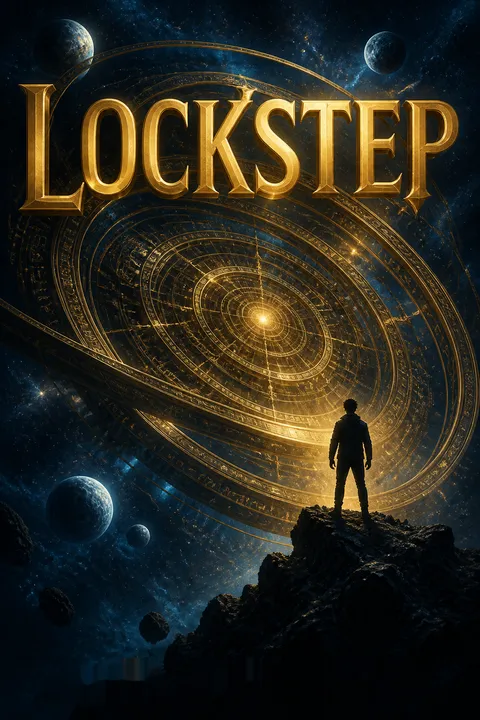


Plot Summary
Prologue
On Barsoom, an aging ruler learns that Toby McGonigal has been found alive after forty years in cold sleep. Though the news shakes him, he orders his adviser to prevent Toby from returning, by sending him away or killing him.
His adviser points out that someone has waited for Toby all this time. The ruler refuses to reconsider, then collapses alone, stricken less by the decision than by what it reveals about himself.
The opening makes a private wound look like a matter of state. The ruler’s order is presented as practical policy, yet his physical collapse exposes how thoroughly grief and fear have entered his political judgment. His adviser’s question about the woman waiting for Toby introduces a conflict between authority and attachment before the reader knows the family history. The scene also plants the novel’s central pressure: a return can threaten a carefully maintained order, even when what is threatened is a human bond that order was built to protect.
A Pebble Through the Ship
Seventeen-year-old Toby McGonigal wakes from hibernation to a dark, powerless ship, its cabin ruptured by a grain of space debris. He and the two simulated companions he calls Sol and Miranda revive enough systems to discover that repair bots have kept the engine running only briefly. Their destination, the comet Rockette, is gone from the navigation picture.
Instead, a vast dark planet fills the telescope, its frozen surface marked by geometric cities. The engines cannot be restarted, communications are down, and the small ship cannot land. Toby has been sent to claim Rockette for his family’s distant colony, Sedna, but now he seems stranded above a world that appears as lifeless as the space around it.
The accident turns a seemingly routine family errand into a confrontation with the limits of human planning. Toby’s initial reliance on Consensus, the gameworld he shares with his brother, is practical as well as emotional: simulation has taught him to expect a rescue mechanism when a crisis becomes unbearable. The frozen cities deny him that comfort. His first test is not courage in battle but whether he can face evidence that offers no satisfying explanation and no audience to reassure him.
Fourteen Millennia Later
Toby chooses a final controlled hibernation rather than waiting for the ship to die around him. He wakes in a real bedroom on Lowdown, where Persea Eden and Ammond Gon Alon explain that they recovered his ship from orbit. The planet he thought dead is alive during its waking season, then shuts down for decades at a time.
Humanity has built tens of thousands of such lockstep worlds, synchronizing hibernation so distant planets can function like neighbors. Toby learns that fourteen thousand years have passed since he left Earth, though only twenty years since his last sleep. His family, he is told, died long ago. He runs from the news and collapses outside, where he glimpses Corva Keishion, a girl who knows more than she will say.
The revelation separates biological time from experienced time, and Toby becomes its most extreme case. His grief is not simply that people are gone; their absence has been converted into a civilization that regards his own era as remote prehistory. The lockstep is an ingenious answer to distance, but it also makes time governable by those who control the sleep cycle. Corva’s fleeting appearance offers a counterpoint to the hosts’ polished explanations: the first person to treat Toby as a danger may be the first person who is not trying to manage him.
A Warning in Transit
As Toby recovers at Ammond’s estate, memories of Earth return in fragments. He recalls his father describing the violence and inequality that drove the family toward Sedna, and his mother and sister grieving his departure. Ammond and Persea propose taking Toby to Little Auriga, another inhabited lockstep world.
During the journey, Corva slips aboard the ship and wakes Toby briefly to warn him not to trust the people who rescued him. He recognizes her as the girl from the courtyard, but his body is already sinking back into hibernation before he can learn why she is pursuing him. The warning unsettles the fragile trust he has begun to place in Ammond and Persea, who have concealed both his identity and their reasons for protecting him.
The Earth memories complicate Toby’s nostalgia: the home he longs for was also a society where concentrated wealth made ordinary safety precarious. His parents’ decision to leave was not an escape from all conflict but a wager on building a different kind of life. Corva interrupts the hosts’ authority without yet proving herself trustworthy. That uncertainty matters, because Toby’s repeated dependence on others is not a flaw he can simply discard; it is the condition that makes both rescue and manipulation possible.
The Twentier Knows Him
On Little Auriga, Toby sees a vast city beneath an ice ceiling and learns that the world’s inhabitants also hibernate. Ammond brings him to a meeting where a centuries-old mining robot, recovered from Sedna, responds only to Toby’s biometric command. The test proves he is the McGonigal heir and legally owns Sedna, now a wealthy world within the lockstep.
Ammond admits that his allies need Toby’s claim and offers adoption as a path to political power. When Toby refuses, the men begin arranging to control him with a neuroshackle. He overhears them through the robot’s sensors, then orders the twentier to smash through the underwater wall. A denner in the black ocean helps him reach Corva’s boat, carrying the old robot’s data block with him.
The bot converts family identity into a credential with material consequences. Toby is no longer merely a lost boy to be sheltered; his body can unlock property, machines, and a disputed inheritance. The proposed neuroshackle makes the danger explicit: in this society, political consent can be replaced by technological compulsion. Toby’s escape begins when he stops accepting other people’s accounts of his value and uses the very property test meant to authenticate him as a tool of his own survival.
Orpheus Joins the Run
Corva, Shylif, and Jaysir shelter Toby among the stowaways living outside the lockstep’s legal economy. Their denners, small engineered animals with hibernation abilities, can keep a human alive without an official cicada bed.
Toby bonds with a black denner and names him Orpheus before crawling into a freight container bound for Wallop. During the cramped journey, Corva explains that his brother Peter is alive and rules the largest lockstep as the Chairman. His sister Evayne also lives, while their mother has been asleep for millennia.
Stories across the worlds have turned Toby into a returning savior. Corva wants to reach her brother Halen, trapped aboard a quarantined ship, but Toby distrusts her motives and insists on finding his own way first.
The denner changes hibernation from a corporate service into a relationship of mutual dependence. Toby’s choice to name Orpheus marks his first commitment in the new world that is not inherited, assigned, or politically useful. At the same time, Corva’s history reveals how the lockstep turns ordinary family separation into legend. Toby cannot yet distinguish the brother he remembers from the ruler people describe, so he clings to independence even as survival depends on accepting help.
Consensus Made Real
Orpheus wakes Toby first on Wallop, a world of floating cities suspended among colossal storms. Toby leaves the sleeping Corva and Shylif behind, taking Jaysir’s cash card and advice on surviving without an identity.
He explores the city, earns money by helping robots recover stolen cargo, and recognizes the streets as a physical version of Consensus, the game he designed with Peter. The realization gives him pride, but his search for information brings a sharper shock: the grown faces of Peter and Evayne look like strangers.
At a pilgrimage center, he saves Kirstana from an attack and learns that the lockstep’s official faith casts him as the Emperor of Time. He has escaped the people who wanted to control him, only to find his name already belongs to millions.
Wallop gives Toby both the pleasure of recognition and the discomfort of seeing a private creation turned into public reality. Consensus was an experiment in safety and social design; here its aesthetic has become a culture that Toby did not consent to lead. The pilgrim violence also punctures the assumption that Peter’s world has outgrown conflict. Toby’s effort to live anonymously is not mere modesty. It is a refusal to let an inherited myth decide what he must do next.
The Family in the Data
Jaysir repairs Toby’s glasses and opens the data block taken from the Sedna twentier. Among years of mining records are saved versions of Consensus and hidden recordings made by Toby’s father, Carter. Toby watches his parents argue over surveillance, security, and the danger of a saboteur inside their colony.
His mother resists spying on their neighbors, while Carter argues that someone could sabotage life support. The footage shows Toby’s disappearance already splitting the family: his mother refuses to call him dead, while Carter focuses on keeping Sedna alive.
Toby still cannot bear to study the public histories of Peter and Evayne, but the private recordings reveal how the colony’s survival practices grew out of fear, scarce resources, and a family unable to agree on what mattered most.
The recordings offer intimacy without resolution. Toby can see his parents’ faces and hear their reasoning, yet the footage cannot restore the context he lost by sleeping. His father’s surveillance scheme echoes the billionaire society the family fled, showing how defensive measures can reproduce the habits they were meant to oppose. The data block functions as an imperfect family archive: its fragments make the past more vivid while also proving that no record can return Toby to the moment when those choices were made.
The Quarantine Below
Corva returns to Toby and admits that she needs his help rescuing Halen, her brother, from a passenger ship held below Wallop’s city. Peter has imposed a punitive quarantine on Thisbe, forcing its people to endure an accelerated schedule. Toby agrees to help, and Jaysir guides the group through restricted elevator routes to the ship’s hibernation system.
Toby discovers he can issue commands to the beds, even though activating the system may expose him to the McGonigals. He wakes Halen and the other stranded passengers. Shylif, meanwhile, spots Sebastine Coley, the man he blames for the loss of the woman he loved, and abandons his post to confront him. That triggers the alarms, bringing police bots down on the rescuers.
Toby’s decision to help is a shift from self-protection toward chosen responsibility. He does not yet know whether Corva’s political cause is just, but he sees that her brother’s confinement is a concrete harm he can address. The command console makes his return detectable, so compassion carries political cost. Shylif’s pursuit of Coley shows a different response to stolen time: he has organized his life around recovering a past wrong, even when the person before him may no longer resemble the young man who caused it.
Home Arrives Older
Toby shuts down the pursuing police bots and leads the rescued passengers through Wallop’s frozen passages. At the terminal, Shylif mistakes an elderly man’s grandson for Coley, then confronts the actual Sebastine Coley.
When the case reaches a court on Thisbe, Coley admits what he did, and the judge orders him to tell the truth to each generation of his family in Shylif’s presence. The group reaches Thisbe, where Corva is reunited with parents and siblings who have aged years during her absence.
Toby recognizes her shock because he has already lost his own family to the lockstep’s uneven clocks. As the planet struggles under Peter’s blockade, Toby agrees to help Corva challenge it, though he is still unsure what his McGonigal identity allows him to do.
The return to Thisbe makes temporal injury visible in faces and family roles. Corva has come home physically, but the people she expects to meet have continued living without her. Shylif’s judgment offers no fantasy of restoring Ouline or recovering lost years; instead, it makes the harm part of the family’s memory. Toby’s choice to help is similarly limited. He cannot undo what time has taken, but he can decide whether the power he has inherited will be used to impose more loss or interrupt it.
The Emperor's Name
Toby settles among the Keishions, studies how lockstep economies depend on synchronized schedules, and learns that Thisbe’s unauthorized timing change prompted Peter’s blockade. On the planet’s turn’s end, Halen reveals Toby’s identity to the government. After hibernation, officials greet him with an army and treat him as the prophesied Emperor of Time.
Toby admits he can control the cicada beds and promises to restore Thisbe’s proper frequency. He also learns that Evayne is approaching with a fleet. While officials debate defense, Toby sees how quickly his return could ignite a religious uprising: Halen expects him to use the myth to rally an army, while Toby wants only to see his family and stop the punishment of Thisbe.
Toby’s public identity arrives before he can decide what it means. The crowd’s reverence gives him leverage, but it also threatens to turn his private return into a political instrument. His pledge to repair the timing system is concrete, yet even that act is read through prophecy. The conflict is not simply between a ruler and a challenger; it is between lived intention and the meanings other people have attached to a person’s name.
A City Wakes
Toby delays Evayne by manipulating the lockstep network, waking scattered towns so her forces must investigate each possible gathering. He and Corva hide through repeated cycles, using Orpheus and Wrecks to sleep outside the official system. When Evayne’s troops begin sweeping a city, Toby wakes the entire population to prevent them from being isolated and seized.
Her forces pump irritants into a tower and search the evacuated crowd. Orpheus is struck by a drone, and Toby is identified when he runs to him. An officer who serves Evayne helps Toby escape by aircar as loyal and disloyal machines clash across the city. Toby reaches neutral Lockstep 180, where Evayne approaches unarmed and demands that he renounce his identity.
Toby’s ingenuity now resembles the game strategies he once designed with Peter, and that resemblance is morally dangerous. He wakes civilians to protect them, but he also uses their presence to complicate Evayne’s plans. The tactic works until Orpheus draws him out of hiding, making affection the vulnerability that his opponents can exploit. The escape shows that even a system designed for control contains people capable of choosing against their orders, but it leaves Toby facing the limits of maneuver rather than a clean victory.
The Mother Trap
At the neutral border, Evayne warns Toby that if he continues, she will ensure their mother can never wake. Rather than surrender or seize his sister, Toby leaves for Wallop to confront Nathan Kenani, the original colonist who once gave him a chance to escape. Kenani confirms that the sacred site on Destrier is a decoy: Cassandra is hidden elsewhere, and Peter and Evayne have kept her asleep after taking control of the lockstep.
Kenani also explains how Toby’s mother began extending hibernation to preserve Sedna’s resources and search for her missing son. Toby sends Peter a message through Kenani, then takes a fast courier ship to Rockette, the comet he never reached on his first journey.
Evayne’s threat converts family history into an immediate hostage crisis. Toby refuses the false choice between surrendering himself and letting his mother remain imprisoned, but he cannot yet confront Evayne directly. Kenani’s account reframes the lockstep as both Cassandra’s practical innovation and the result of political conflict among her children. Rockette completes a circle in Toby’s life: what began as a failed claim becomes the place where he can finally ask his family what happened.
Rockette's Hidden Bed
Toby reaches the hidden chamber inside Rockette and finds Cassandra’s cicada bed. When Peter arrives, he tries to put her back to sleep, but Toby’s commands override him.
The brothers confront the secret that has shaped their lives: Peter believes their father arranged his childhood kidnapping to rally money and support for the Sedna colony. Peter also reveals that he and Evayne imprisoned Cassandra after she tried to limit their control of the lockstep.
Their dispute over the system becomes a vote among four family shareholders, with Toby proposing one share for every bed user. Instead of restoring his mother and claiming power alone, Toby asks Peter to join a vote that would end the family’s monopoly and give the lockstep a chance to govern itself.
The climax brings private trauma and institutional design into the same room. Peter’s suspicion is not a random obstacle; it grew from a child’s experience of betrayal and from the family’s later silence. Toby’s proposal answers the political crisis without pretending that he can erase its causes. He shifts the question from which sibling should rule to whether any family should own the machinery that determines everyone else’s time. The vote makes reconciliation inseparable from surrendering power.
The Future Votes
Cassandra wakes, and the McGonigals begin transferring control of the lockstep toward a system where each cicada bed has a share. On Barsoom, Evayne tells a vast assembly that the family and the Guides are no longer needed to hold the civilization together. The siblings remain estranged in places, but Toby and Evayne begin speaking again, and Peter’s familiar humor returns beneath the years of rule.
Corva finds Toby with Orpheus after his long absence; she has chosen to leave her family’s political struggle and travel with him. Toby rejects the titles of emperor and family head. He and Corva set out toward the fast worlds, where few people know his name, accepting that one night of travel may cost them years with those they leave behind.
The ending does not restore the childhood Toby lost or make the family’s political history innocent. Instead, it changes who bears responsibility for the lockstep and allows the civilization to outgrow its founders. Evayne’s public admission marks a transition from personal authority to collective stewardship, while Toby’s choice to leave resists turning survival into permanent rule. His partnership with Corva offers no escape from time’s costs; it offers a way to meet those costs together, with the future left open rather than prescribed.
Analysis
Lockstep treats time as infrastructure. In this society, a schedule is not merely a calendar: it governs travel, trade, resource use, political membership, and the interval between a parent seeing a child. Control of hibernation therefore becomes a form of sovereignty. The McGonigals’ system solves real problems of distance and scarcity, but its efficiency also permits them to decide who must wait, who may trade, and which worlds can keep pace. The novel’s central political question grows from that contradiction: can a useful system remain legitimate when its founders retain exclusive control over its timing?
Toby’s return makes the contradiction intimate. He is not an abstract claimant arriving to seize power; he is a teenager who still remembers Peter and Evayne as children. Yet the civilization has converted his disappearance into a foundational myth, so his ordinary desire to see his family carries the force of a political event. The gap between who Toby is and what others need him to symbolize dramatizes how public stories can outlive the people they describe. Evayne and Peter are not free of that pressure either. They maintain the myth to stabilize an enormous society, then find themselves trapped by the expectations it creates.
Consensus provides the psychological bridge between childhood and empire. The brothers once rehearsed political structures as a way to make a frightening world feel manageable. Their designs become dangerous when simulation’s controllable populations are replaced by real communities with independent histories and interests. Toby’s eventual challenge is therefore not to become a better ruler, but to stop treating people as elements in a design problem. The proposed transfer from family ownership to shared governance marks that ethical shift.
The novel does not claim that technology can undo grief. Toby cannot recover the years lost with Corva, restore his childhood, or return to the family exactly as he left it. What he can do is refuse to make other people’s futures answer for his pain. The ending locates hope not in escaping time, but in sharing its uncertainty with someone willing to move forward beside him.
Review Summary
Lockstep received mixed reviews, with praise for its innovative world-building and concept of synchronized hibernation across planets. Readers appreciated the unique premise and hard science fiction elements. However, some found the characters underdeveloped and the plot slow-paced. The denners, cat-like creatures, were a popular aspect. While some readers struggled with the complex time-manipulation concepts, others found the book thought-provoking. Overall, reviewers commended Schroeder's creativity but had varying opinions on the execution and character development.
People Also Read



Characters
Toby McGonigal
The lost eldest brotherToby is a seventeen-year-old raised on the remote colony of Sedna, where he helped his parents and cared for his younger siblings. He is imaginative, observant, and more comfortable exploring a designed world than confronting an unpredictable one. His partnership with Peter in building Consensus shows both his capacity for empathy and his temptation to solve fear by controlling the environment. He wants the people he loves to remain safe, but he is still learning that responsibility does not give him the right to choose for everyone. His long absence places him in a future that has turned family history into politics, forcing him to decide what parts of his old identity still belong to him.
Corva Keishion
The wary stowawayCorva is a resourceful young woman from Thisbe who studies how buildings can survive long periods of abandonment. She distrusts powerful institutions, but her caution does not make her passive: she breaks into ships, moves through dangerous places, and acts when someone is in danger. Her loyalty to her family is fierce, though she recognizes that returning to them may not restore the lives they shared. With Toby, she is blunt enough to challenge his assumptions and vulnerable enough to admit when she has misjudged him. Her practical intelligence gives shape to the story’s questions about trust, home, and the cost of crossing time.
Peter McGonigal
The guarded younger brotherPeter is Toby’s younger brother, whose childhood trauma left him suspicious of other people and hungry for predictable rules. He and Toby created Consensus together, using its simulated worlds to explore safety, power, and social order. Peter is brilliant at systems and deeply invested in the structures that keep his world from falling apart. His protective instincts can harden into control, especially when he believes the consequences of failure are catastrophic. Beneath his political stature is the boy Toby remembers, but years of responsibility and separation have changed what Peter understands as loyalty.
Evayne McGonigal
The ambitious younger sisterEvayne is Toby’s younger sister, quick-minded and forceful even as a child. She often sees the practical path through a crisis and understands how stories shape the people who hear them. In adulthood, she becomes adept at managing the vast cultural and political consequences of the lockstep. She is not simply a distant authority figure: Toby remembers a sister who sought his help and shared his imaginative life. Her central tension is between the private person she once was and the public role she has learned to inhabit.
Cassandra McGonigal
The resourceful motherCassandra is a gifted designer of industrial systems whose ability to turn waste into useful resources helps make the Sedna colony viable. She is practical without being emotionally detached, and her refusal to treat people as expendable shapes the family’s arguments about survival. Her response to Toby’s disappearance is rooted in love, but also in a conviction that uncertainty should be met with action. As the family’s choices grow beyond the scale of their original colony, Cassandra’s resourcefulness becomes inseparable from the political question of who should control the systems she helped create.
Carter McGonigal
The determined fatherCarter is a salvage entrepreneur whose work and practical discipline help prepare the family to settle Sedna. He tends to weigh decisions against the survival of the whole colony, while Cassandra is more willing to center a particular person’s needs. His strained conversations with her show a man trying to carry responsibility through uncertainty, even when his choices make him difficult to understand.
Ammond Gon Alon
The calculating rescuerAmmond is a wealthy Lowdown businessman with a talent for recognizing opportunities and recruiting allies. He is confident in negotiations and accustomed to making plans for other people, including Toby. Beneath his polished manner, he can be moved by loyalty and by the possibility that power might serve more than private advantage. His relationship with Persea combines business partnership with a shared appetite for influence.
Persea Eden
Ammond's pragmatic partnerPersea is Ammond’s business partner, a composed and socially assured woman who understands the risks surrounding Toby before he does. She helps guide his recovery and adapts quickly when their plans become unstable. Persea’s instincts are practical, but she also recognizes that earning Toby’s trust requires more than explaining his legal value. Her reserve reflects a person accustomed to managing consequences before revealing what she wants.
Jaysir
The self-reliant makerJaysir is a stowaway and maker who builds much of what he needs instead of relying on the lockstep economy. He is inventive, irreverent, and proud of his technical independence, though his quick wit can make him seem less serious than he is. He introduces Toby to the practical skills of surviving outside official systems and becomes an important source of technical knowledge. Jaysir values autonomy enough to distrust easy promises, while his attachment to his creations reveals that self-sufficiency does not mean living without bonds.
Shylif
The patient outsiderShylif is a stowaway from a fast world who has spent much of his life navigating the loneliness created by lockstep time. He is steady where Jaysir is restless, and he prefers useful work to political performance. His history gives him a personal understanding of how a single night in one world can erase decades in another. Shylif is drawn toward justice, but his determination can become entangled with the wish to recover what time has taken from him.
Nathan Kenani
The old colonist guideNathan is one of the original Sedna colonists and a Guide who helps preserve the lockstep’s shared culture. He is politically seasoned and understands the distance between public myths and private motives. His affection for Toby is complicated by obligations to the McGonigals and by his own history with the colony. He often speaks through strategy, but his actions suggest a conscience that has survived years of serving powerful people.
Halen Keishion
Corva's driven brotherHalen is Corva’s brother, politically committed and impatient with the inequalities built into the lockstep. He wants his family protected and his world free to choose its own course. Halen’s strategic confidence makes him persuasive, but he can treat other people as pieces in a larger plan. His relationship with Corva carries both affection and the strain of trying to decide what is best for someone whose experience has changed.
Orpheus
Toby's denner companionOrpheus is a small, intelligent denner whose engineered body can help a human survive hibernation without a standard cicada bed. He is curious, stubborn, and attentive to Toby in ways Toby does not always understand. Their bond begins as a practical necessity but gradually becomes a source of emotional steadiness. Orpheus’s animal perceptions offer Toby a different way to read people and places, reminding him that communication does not depend on sharing the same language.
Wrecks
Corva's watchful dennerWrecks is Corva’s denner, a lively and perceptive companion who travels with her through the dangerous spaces between official systems. He offers both practical help and comfort, while his playful behavior softens Corva’s guarded manner. Like Orpheus, he is a living partner rather than a piece of equipment, and his presence makes the risks of stowaway life personal.
Kirstana
The curious local guideKirstana is a young woman from Barsoom who loves exploring the many cultures and landscapes gathered in the lockstep. She is curious, generous, and comfortable treating an unfamiliar world as an invitation rather than a threat. Her friendship with Toby gives him his first welcoming introduction to Wallop’s broader civilization, even as her understanding of its mythology exposes how much of his identity has been shaped without his knowledge.
Sol and Miranda
Toby's game companionsSol and Miranda are personalities from Consensus who act as Toby’s companions through his glasses. Their calm, encouraging responses help him think through danger, and their familiar presence connects his new life to the world he built with Peter. They are simulations, not independent people, but their role in Toby’s emotional life is real. Their limited nature becomes most apparent when he needs forms of help no programmed personality can provide.
Sebastine Coley
The aging travelerSebastine is an elderly passenger whose past actions become central to Shylif’s pursuit of justice. He is surrounded by descendants who know him as a family patriarch, not as the young man he once was. His presence makes the distance between chronological guilt and lived change impossible to ignore.
Long Seville
The skeptical ministerLong Seville is Thisbe’s minister of security. He is dry, cautious, and less impressed by Toby’s public image than the officials around him. His plainspoken advice helps Toby recognize how easily his words can be misread as prophecy.
Ourobon
The divided officerOurobon serves among Evayne’s forces but is not blind to the conflict within her ranks. He is disciplined and attentive to his duty, yet capable of questioning where that duty should lead. His choices show how political loyalties can fracture when the person behind a revered name finally appears.
Naim M'boto
The political intermediaryNaim M'boto is one of Ammond’s allies on Little Auriga, involved in the political maneuvering around Toby’s inheritance. He is direct, impatient, and focused on the practical advantage Toby’s identity might offer. His presence reveals how quickly a family claim can become a bargaining tool.
Plot Devices
Lockstep time
Distance compressed by sleepLockstep worlds synchronize long periods of hibernation with short waking seasons. People can travel between distant planets while both ends sleep, then arrive as if the journey took only a night. Different schedules create sharp disparities in experienced time, shaping trade, politics, family life, and the possibility of reunion. The system makes interstellar society possible without faster-than-light travel, while giving those who control its timing immense power over everyone who depends on it.
Cicada beds
Machines that govern wakingCicada beds prepare people for hibernation, preserve their bodies, and wake them according to the lockstep schedule. Their network coordinates the timing of cities and worlds, making them far more than medical equipment. Access to the beds determines who belongs to the official system and when a population can act. The story uses them to connect the intimate experience of sleep with the political machinery of a civilization, and to make control over time a material, contested resource.
Denners
Living alternatives to bedsDenners are engineered animals with biological systems that can support hibernation outside standard cicada beds. Stowaways depend on them to evade official tracking and travel beyond the legal economy. Their abilities make them essential, but the story never treats them as mere appliances: they form attachments, interpret their surroundings, and act with a degree of initiative their human companions cannot fully explain. Orpheus’s bond with Toby gives the technology an emotional consequence, turning escape into an act of mutual care.
Consensus
A game becomes a blueprintConsensus is the simulated world Toby and Peter built to explore safety, government, and social order after Peter’s childhood trauma. Its settings and ideas later echo through the lockstep, where Toby recognizes familiar architecture and systems. The game serves as a record of the brothers’ shared imagination, but also as a warning: choices that feel harmless in a simulation can become coercive when imposed on real people. It gives Toby a way to understand his siblings while forcing him to question the political instincts they practiced together.
The Toby myth
A name becomes political forceStories across the lockstep transform Toby into a prophesied figure whose return is expected to change history. The myth has helped create continuity among worlds separated by millennia, but it also confines living people to roles they did not choose. Toby’s identity can inspire followers, frighten rulers, or trigger violence before he has even spoken to them. This device makes the conflict about more than whether the McGonigals should govern: it asks what happens when private family history becomes public religion.
Download PDF
Download EPUB
.epub digital book format is ideal for reading ebooks on phones, tablets, and e-readers.








