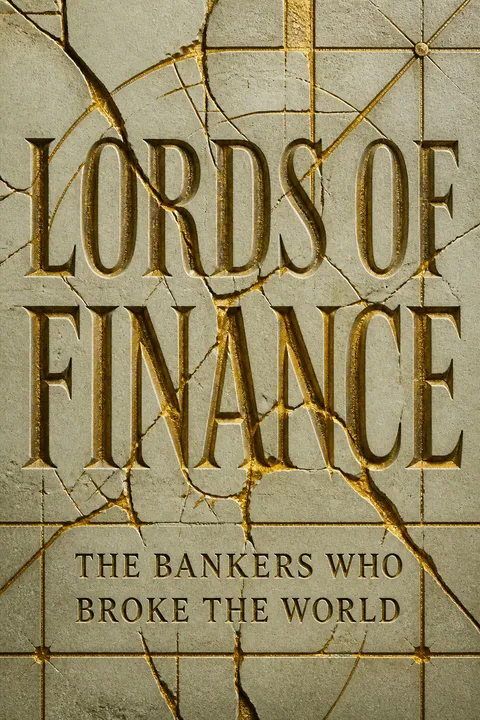


Key Takeaways
A 1931 banking panic exposed how four central bankers helped turn recession into catastrophe
A crisis with faces. In 1931, factories closed, unemployment surged, and banks failed across Europe and the United States. The Bank of England’s Montagu Norman was so overwhelmed that he suffered a breakdown. The book follows four central bankers through the decisions behind this collapse: Norman, America’s Benjamin Strong, Germany’s Hjalmar Schacht, and France’s Émile Moreau. Their private rivalries and public choices make a complicated monetary history legible as a human drama.
A system under strain. The central question is not simply why markets crashed. It is how war debts, fragile currencies, a rigid gold standard, and leaders’ misjudgments reinforced one another until separate downturns became a global depression. The argument is forceful, though it does not reduce the crisis to four men alone: governments, lenders, voters, and economic structures also shaped what these bankers could do.
The biographical method is more than narrative decoration. It reveals how institutional choices pass through temperament: Norman’s instinct and secrecy, Strong’s drive, Schacht’s ambition, and Moreau’s national priorities. That approach resembles organizational analysis, where formal rules matter, but so do authority, trust, and the people who interpret rules under pressure. The risk is that vivid leaders can seem more decisive than diffuse forces such as mass unemployment or political backlash. The book’s strongest use of biography is to show not that individuals control history, but that personal judgment can either widen or narrow a crisis.
Treat gold as a policy choice, not an untouchable law
A fixed promise. Under the gold standard, currencies were defined by a fixed quantity of gold, and people could in principle exchange paper money for bullion. Because national currencies were all tied to gold, their exchange rates were fixed against one another. Central banks adjusted interest rates and credit to protect those promises. Before 1914, the system supported international trade, but its supply of money ultimately depended on the uncertain supply and distribution of a scarce metal.
A narrow foundation. After the First World War, the world had more paper money and debt, but gold reserves were scarce and concentrated in the United States. Rebuilding the old system therefore meant forcing economies to adjust to gold, not adapting the monetary system to changed conditions. The standard could restrain inflation, but it could not prevent financial manias. Its reputation for discipline obscured its dependence on political choices and favorable circumstances.
The gold standard’s appeal came partly from its institutional function: it made promises harder for governments to alter at will. That credibility can protect savers and restrain opportunistic inflation. But a rule that limits discretion can also prevent a necessary response when the economy is contracting. The deeper issue is not rules versus no rules, but whether a rule has an escape mechanism for exceptional conditions. Monetary arrangements gain trust from predictability, yet they lose legitimacy when the costs of maintaining them fall persistently on workers and debtors.
Unpayable war claims turned peace into a chain of financial reprisals
Debts passed along. The First World War left European countries owing vast sums to one another and to the United States. Britain and France expected Germany to pay reparations, while Britain and France themselves owed America war loans. The debts were treated as separate legal obligations, although Europe saw them as one connected burden. Keynes argued that Germany could not generate large export surpluses without forcing its trading partners to absorb more German goods, putting their own industries under pressure.
A toxic settlement. The 1919 peace treaty imposed territorial losses, disarmament, and reparations on Germany. In 1921, the Allies set its reparations bill at about $12.5 billion. Germany struggled to pay; France feared German recovery; Britain needed economic stability; and the United States insisted on repayment. Repeated conferences postponed the conflict rather than resolving it. Each country’s attempt to protect its own claim made cooperation harder and helped turn a settlement into a lasting source of instability.
This episode shows how accounting categories can conceal economic interdependence. A creditor may regard a loan as a contract, while a debtor experiences it as a claim on future production, employment, and political consent. The same distinction appears in modern sovereign-debt disputes: legal enforceability does not guarantee that a payment path is economically sustainable. The book’s account also warns against treating debt relief as a simple act of generosity. Relief can benefit creditors too when it restores trade and reduces the chance that defaults spread through connected balance sheets.
Do not defend yesterday’s exchange rate by sacrificing today’s economy
Two painful routes. After wartime inflation, governments faced a choice: deflate by shrinking the money supply and forcing prices down, or devalue by resetting the currency’s gold value. Deflation imposed costs on workers, businesses, and borrowers; devaluation reduced the value of savers’ claims. Britain and the United States pursued deflation, while Germany and France devalued. Britain’s effort to restore sterling to its prewar value required high interest rates, severe recession, and mass unemployment.
A symbolic decision. In 1925, Winston Churchill returned Britain to gold at the old rate, though British prices remained too high to compete easily with American goods. Norman strongly supported the move, believing sterling’s credibility was essential to London’s financial standing. Keynes and Churchill’s own advisers warned that the exchange rate would burden industry. The pound’s prestige was preserved, but unemployment stayed high and industry struggled. The case illustrates how defending a national symbol can impose concrete costs on people with little say in the decision.
Exchange-rate policy is also distributional policy. The choice determines whose claims retain value and who absorbs adjustment, a point that political economy often makes more clearly than abstract monetary models. Britain’s decision reflected a genuine concern: a reserve currency depends on confidence in its convertibility. Yet credibility is not free, and a currency can be formally strong while the economy beneath it weakens. The useful question is therefore not whether stability matters, but whether the chosen parity is compatible with productive capacity and a society’s willingness to bear the adjustment.
A currency can recover when governments make scarcity credible
The Rentenmark experiment. By 1923, Germany’s currency had become nearly useless. Prices rose so quickly that workers were paid daily and rushed to spend their wages before they lost value. The government introduced the Rentenmark, a new currency notionally backed by a mortgage on land and industry. Schacht, appointed currency commissioner, had doubts about this unusual backing, but insisted that the amount issued remain fixed at 2.4 billion Rentenmarks.
A credible limit. Currency reform worked alongside government measures that reduced spending, cut public employment, and balanced the budget. Schacht’s refusal to extend credit to officials, municipalities, banks, and industrialists made the limited supply believable. As prices stabilized, people had reason to hold money rather than spend it immediately, and goods returned to markets. The episode suggests that confidence depends not only on what money is supposedly backed by, but on whether authorities can resist pressure to issue more of it.
The episode illustrates a coordination problem: money works when people expect others to accept it, and that expectation can change quickly once a government’s behavior becomes credible. Scarcity alone is not enough. If currency is scarce because economic activity is collapsing, the result may be hardship rather than trust. Germany’s stabilization combined a clear monetary limit with fiscal changes and an exhausted public desperate for a usable medium of exchange. That combination helps explain the rapid change in sentiment, while cautioning against treating Schacht’s policy as a universal recipe.
Cheap American credit rescued Europe, then fed two dangerous imbalances
A temporary bridge. The 1924 Dawes Plan reduced Germany’s immediate reparations payments and opened the way for an international loan. American money poured into German businesses and municipalities, helping the economy recover from hyperinflation. But Germany also borrowed heavily to finance spending that could not earn the foreign currency needed to repay lenders. Schacht warned that prosperity built on borrowed money could prove fragile.
A wider trade-off. At the same time, Strong kept American credit relatively easy in part to support Europe and sterling. In 1927, he lowered U.S. interest rates after meeting Norman, Moreau, and Schacht. The move helped ease pressure on Britain, but it also encouraged the U.S. stock market’s rise. As Wall Street returns climbed, American lending to Germany dried up, helping push Germany toward recession. The book traces a feedback loop: policies intended to stabilize one part of the system increased vulnerabilities elsewhere.
The episode captures a core problem of interconnected finance: a policy can be locally helpful and globally destabilizing. Low U.S. rates made European adjustment easier in the short term, while also supporting leverage and speculation at home. The book presents this as a consequential misjudgment, although assigning precise causal weight to one rate cut is difficult in a system shaped by expectations, credit flows, and political decisions. The broader lesson is stronger than a single-cause claim: when policymakers manage cross-border spillovers, they need to monitor the risks created in the economy providing the support.
In a panic, refusing support can make a weak bank failure systemic
A bank run spreads. In December 1930, the Bank of United States failed after losses and questionable lending left it insolvent. Despite its name, it was a private bank, serving hundreds of thousands of depositors. Bankers debated a rescue and declined, partly because the institution was insolvent rather than merely short of cash. The failure shook confidence, and depositors began withdrawing money from banks they could not reliably judge.
Liquidity becomes contagion. Banks responded to withdrawals by calling in loans and hoarding cash. Borrowers then pulled deposits elsewhere, spreading the demand for liquidity. In 1931, runs and closures intensified across the United States and Europe. The Fed’s officials often distinguished between lending to a sound bank facing a temporary cash shortage and supporting an insolvent one. But widespread failures made that distinction harder to apply: forced sales could turn otherwise viable institutions into insolvent ones. Individual caution, repeated across the system, deepened the crisis.
This is a classic collective-action dilemma. A depositor who withdraws early may be acting sensibly; a bank that preserves cash may be protecting itself. When many do the same, however, the system loses the liquidity that makes ordinary activity possible. The book’s account invites a distinction between rescuing owners and protecting the payments system. Public support need not reward reckless management, but a credible resolution process must prevent a bank’s failure from destroying confidence in unrelated institutions. The challenge is designing that protection without encouraging future risk-taking.
Abandoning gold ended deflation’s grip faster than austerity could
Britain breaks first. By 1931, the Bank of England was losing gold, while its international lending had left it exposed to debts frozen in Germany and elsewhere. The government cut spending and unemployment benefits to defend sterling, but the withdrawals continued. Britain suspended gold payments in September. The pound fell, and deflation stopped; prices even rose modestly over the following year.
The American reversal. In March 1933, Roosevelt closed the banks, restricted private gold holdings, and then devalued the dollar. The bank holiday and a radio address helped restore confidence, while devaluation gave the government room to push prices upward. Industrial production and spending rebounded sharply, though unemployment stayed high. The book argues that leaving gold helped end the downward spiral. It does not claim that currency changes alone solved the Depression: bank rescues, monetary expansion, public programs, and continuing weaknesses all mattered.
The change in direction matters because deflation raises the real burden of existing debts: as prices and incomes fall, the same nominal payment becomes harder to meet. Reversing expectations can therefore help even before every factory is busy again. Still, devaluation is not a magic lever. Its effects depend on debt structure, trade exposure, public trust, and the government’s ability to support banks and demand. The British and American episodes make the case for flexibility, not for permanent depreciation. A monetary rule is useful only while it serves economic and social stability.
Central-bank leadership depends on judgment, coordination, and institutions beyond one gifted man
Personal authority has limits. Strong dominated the young Federal Reserve and helped develop active tools for managing credit. After his death in 1928, leadership shifted to a divided system of regional banks and a weak central board. During the Depression, officials disagreed over whether to support failing banks and whether monetary expansion could help. Norman and Moreau also clashed over gold and national influence, while Schacht’s expertise became entangled with German nationalist politics.
Rules must survive their authors. In the 1930s, the United States and Britain moved away from gold, while France held on longer. After another world war, Keynes and American Treasury official Harry Dexter White helped design the Bretton Woods system: currencies could be adjusted under rules, and an International Monetary Fund could lend to countries in difficulty. The contrast is instructive. Expertise matters, but durable coordination requires institutions that can adapt, share responsibility, and retain legitimacy when powerful individuals are gone.
The book’s account complicates the familiar hero narrative. Strong’s absence mattered, but a system that depends on one person’s judgment is itself fragile. Institutional design must preserve expertise while making decisions accountable and resilient to succession. The postwar arrangement addressed some failures of the interwar system by pairing rules with adjustment and temporary international lending. Yet coordination always involves political bargaining, not just technical competence. The relevant test for an institution is whether it can act under uncertainty, learn from error, and distribute the costs of action in ways its members will accept.
Analysis
Lords of Finance is a history of how monetary rules became political commitments, and how political commitments narrowed the choices available during crisis. Its most persuasive insight is cumulative causation: reparations and war debts weakened cooperation; the gold standard transmitted pressure across countries; lending and speculation created imbalances; then banking failures and policy errors amplified an initially uneven downturn. No single meeting or decision explains the Great Depression. The narrative instead shows a system in which each attempted fix changed incentives elsewhere.
The four central bankers embody competing national priorities, but they also reveal a deeper institutional problem. Norman and Strong wanted international stability, yet their cooperation relied heavily on personal trust. Moreau used France’s stronger position to protect French interests, while Schacht’s technical capacity became inseparable from his drive to restore German power. Strong’s death exposes the danger of informal governance: knowledge concentrated in one capable leader did not become durable institutional practice. At the same time, the book’s counterfactual emphasis on Strong should be treated cautiously. Better leadership might have limited the banking collapse, but it could not erase political conflict, private debts, or the gold standard’s distributional pressures.
The narrative’s enduring value lies in showing that economic doctrines are never merely technical. Defending convertibility, balancing budgets, or refusing to rescue an insolvent bank all distribute losses among creditors, workers, borrowers, and taxpayers. They also communicate what authorities value and whether those authorities can be trusted. The history therefore resists both easy blame of markets and easy faith in policymakers. Markets can magnify fear, while officials can magnify mistakes by treating inherited rules as more important than changing conditions. Crisis management requires credible rules, but also room to revise them, institutions capable of acting together, and a clear account of who bears the costs. The central failure was not simply that leaders lacked tools; it was that their assumptions and rivalries prevented them from using available tools coherently.
Review Summary
Lords of Finance is praised as an engaging and informative history of the 1920s and 1930s, focusing on the central bankers who shaped economic policy. Readers appreciate Ahamed's ability to make complex financial concepts accessible and his portrayal of the personalities involved. While some find it slow-paced or lacking in analysis, most commend the book for its insights into the causes of the Great Depression and its relevance to modern economic crises. The author's timing in publishing the book during the 2008 financial crisis is noted as fortunate.
People Also Read






Glossary
Gold standard
Currency tied to goldA monetary system in which a currency is defined as a fixed quantity of gold and is meant to be convertible into that metal. Because participating currencies share a gold anchor, their exchange rates are fixed against one another. Central banks must manage credit and reserves in ways that protect convertibility, even when domestic economic conditions make that commitment costly.
Dawes Plan
Revised German payment scheduleA 1924 agreement designed to restart German payments after hyperinflation and the Ruhr crisis. It set a graduated schedule for reparations, established foreign oversight of transfers, and was supported by a large international loan that helped recapitalize Germany and restart lending. It eased immediate pressure without settling the total reparations burden or resolving the linked war debts.
Rentenmark
Germany’s stabilized 1923 currencyA temporary German currency introduced in November 1923 after the mark had collapsed. It was notionally backed by mortgages on agricultural and industrial property, while its total issue was legally limited. Its stabilization depended not only on this backing but also on the government’s fiscal measures and the authorities’ refusal to expand the new currency freely.
transfer protection
Safeguard on foreign paymentsA provision in the Dawes Plan that allowed an independent agent to decide whether German funds set aside for reparations could safely be converted and transferred abroad. The safeguard was intended to prevent payments from destabilizing the mark. Its removal under the Young Plan changed how private foreign creditors ranked alongside governments if Germany faced a payments crisis.
real bills theory
Credit tied to trade inventoriesA theory that banks can avoid causing inflation by lending only against short-term commercial goods, such as inventories in transit or awaiting sale. It assumes that credit issued for productive trade is inherently safe. The book criticizes this view: if prices rise, lending against increasingly valuable inventories can expand credit and add to inflation rather than prevent it.
open market operations
Central-bank buying and sellingA central bank’s purchase or sale of securities to change the amount of money and reserves available to banks. Buying securities injects funds into the banking system; selling them withdraws funds. Benjamin Strong helped make this a more direct monetary-policy tool than relying only on the interest rate charged when banks borrowed from the central bank.
FAQ
What's Lords of Finance: The Bankers Who Broke the World about?
- Focus on Central Bankers: The book centers on four influential central bankers—Montagu Norman, Benjamin Strong, Hjalmar Schacht, and Émile Moreau—who shaped the global financial landscape during the interwar period.
- Economic Policies and Consequences: It examines how their decisions regarding the gold standard and international finance contributed to the economic collapse of the 1930s.
- Historical Context: Set against the backdrop of World War I reparations and the rise of fascism, the narrative explores the interconnectedness of global economies.
Why should I read Lords of Finance by Liaquat Ahamed?
- Insightful Historical Analysis: The book provides a deep dive into the economic decisions that shaped modern financial systems, essential for understanding current economic policies.
- Lessons from the Past: It offers valuable lessons on leadership and sound economic policy, particularly during crises, which remain relevant today.
- Engaging Narrative: Ahamed combines thorough research with a compelling narrative style, making complex economic concepts accessible and engaging for readers.
What are the key takeaways of Lords of Finance?
- Failures of Central Bankers: The book emphasizes that the central bankers' adherence to the gold standard and their failure to act decisively during crises were significant factors in the Great Depression.
- Importance of Monetary Policy: It highlights how monetary policy can either stabilize or destabilize economies, depending on the decisions made by financial leaders.
- Interconnectedness of Global Economies: Ahamed illustrates how the financial decisions of one country can have far-reaching effects on others, underscoring the need for international cooperation in economic policy.
What are the best quotes from Lords of Finance and what do they mean?
- “If you can’t say anything nice, don’t say anything at all.”: Reflects the cautious approach central bankers must take during financial crises, balancing honesty with the need to maintain public confidence.
- “Let me issue and control a nation’s money and I care not who writes the laws.”: Highlights the immense power that comes with controlling a nation’s currency, underscoring the influence of central bankers.
- “Capitalism was saved in eight days.”: Refers to the swift actions taken by Roosevelt's administration to stabilize the banking system, illustrating the potential for rapid recovery when decisive measures are implemented.
How did World War I affect global finance according to Lords of Finance?
- Destruction of Financial Systems: The war led to the collapse of the pre-war financial order, with countries like Britain, France, and Germany facing massive debts and economic instability.
- Shift in Economic Power: The United States emerged as the world's leading economic power, with its gold reserves doubling and becoming the primary lender to Europe.
- Inflation and Currency Issues: Countries resorted to printing money to finance the war, leading to hyperinflation in Germany and other nations, which destabilized their economies post-war.
What role did the gold standard play in the events described in Lords of Finance?
- Economic Constraints: The gold standard limited the ability of central banks to respond to economic crises, as they were bound to maintain fixed exchange rates and gold reserves.
- Deflationary Pressures: Adherence to the gold standard during the Great Depression exacerbated deflation, leading to widespread economic hardship and unemployment.
- Global Impact: The rigidities of the gold standard created a domino effect, where the economic troubles of one country quickly spread to others, highlighting the interconnectedness of global finance.
How did the actions of central bankers lead to the Great Depression?
- Inadequate Responses: Central bankers failed to act as lenders of last resort during banking panics, allowing confidence to erode and leading to widespread bank failures.
- Misaligned Policies: Their commitment to the gold standard and deflationary policies restricted monetary supply, worsening economic conditions and prolonging the downturn.
- International Coordination Failures: The lack of cooperation among central banks during crises led to a fragmented response, exacerbating the global economic collapse.
What were the consequences of the reparations imposed on Germany?
- Economic Instability: The reparations created significant economic strain on Germany, leading to hyperinflation and social unrest, as the country struggled to meet its financial obligations.
- Political Fallout: The burden of reparations contributed to political instability in Germany, fostering resentment and extremism, which would later facilitate the rise of the Nazi Party.
- Long-term Impact on Europe: The reparations issue poisoned relations between Germany and the Allies, creating a cycle of debt and economic hardship that would have lasting effects on European stability.
How did the Dawes Plan impact the global economy according to Lords of Finance?
- Stabilization of Germany: The Dawes Plan was designed to stabilize the German economy by restructuring reparations payments and providing loans from the U.S., leading to a temporary economic recovery.
- International Cooperation: The plan exemplified a moment of international cooperation among the major powers to address the economic fallout from World War I.
- Short-term Success, Long-term Issues: While initially successful, the plan created a dependency on foreign loans and did not address the underlying issues of reparations, contributing to Germany's economic vulnerability.
How did the Great Depression affect international relations, according to Lords of Finance?
- Economic Tensions: The economic turmoil created by the Great Depression strained international relations, as countries turned inward and adopted protectionist policies.
- Shift in Power Dynamics: The crisis altered the balance of power in international finance, with the United States emerging as a dominant economic force while European countries struggled.
- Long-term Consequences: The failures of the interwar financial system and the inability to cooperate on economic issues contributed to the conditions that led to World War II.
How does Lords of Finance relate to modern economic issues?
- Lessons on Monetary Policy: The book serves as a cautionary tale about the dangers of rigid monetary policies and the importance of flexibility in economic management.
- Global Financial Interdependence: It underscores the interconnectedness of global economies, a concept that remains relevant in today's increasingly globalized financial landscape.
- Crisis Management: The historical analysis provides insights into how policymakers can effectively respond to financial crises, emphasizing the need for decisive action and international cooperation.
What is the significance of the Federal Reserve's role in the events of the Great Depression as described in Lords of Finance?
- Lender of Last Resort: The Federal Reserve's failure to act as a lender of last resort during the banking crises of the early 1930s contributed to the severity of the Great Depression.
- Policy Missteps: Decisions made by the Fed, including maintaining low interest rates and failing to curb speculation, played a significant role in the economic collapse.
- Evolution of Central Banking: The events of the Great Depression led to significant reforms in the Federal Reserve's structure and policies, shaping the modern central banking system.
Download PDF
Download EPUB
.epub digital book format is ideal for reading ebooks on phones, tablets, and e-readers.








