

Plot Summary
Arrest at Sarah's Grave
On the anniversary of his wife Sarah’s death, physicist Sam Anderson brings his withdrawn son Ryan and angry daughter Adeline to her grave, hoping they can grieve together. When Sam recalls Sarah’s wish that he and the children find happiness again, Adeline finally breaks down and embraces him.
Police drones interrupt the reunion, stun Sam, and arrest both him and Adeline for the murder of Nora Thomas, Sam’s colleague and new partner. Nora helped create Absolom, a machine that sends convicted criminals into the distant past, where they face exile in another timeline.
Sam wakes restrained at the police station, stunned to learn Nora was found dead that morning. Detectives say surveillance footage places him and Adeline at her home the previous night.
The arrest arrives at the moment Sam’s family begins to reconnect, turning comfort into evidence of vulnerability. His public tenderness toward Adeline becomes a sharp contrast to the state’s impersonal machinery: drones issue commands, medical restraints hold him, and a recorded warning replaces human explanation. The plot makes grief materially consequential. Sam has not simply lost Sarah; his attempt to help his children recover now puts them inside a system he helped create. Absolom’s existence also reframes punishment as technological certainty, while the arrest shows how easily recorded appearances can outrank lived truth.
Blood on Both Andersons
The detectives show Sam the evidence: Adeline argued with Nora, her fingerprints are on the bloody knife found in a toilet tank, and both father and daughter have traces of Nora’s blood on their skin. Sam knows Adeline left Nora alive, but he cannot explain the forensic trail. Police classify the murder as eligible for Absolom, leaving no ordinary bail or easy appeal.
Back in his holding suite, Sam receives an anonymous ultimatum promising Adeline’s release if he confesses and threatening stronger evidence if he refuses. He hides the note after a panic attack, afraid a friend might report it. Meanwhile, he learns that Absolom’s new prototype has divided the founders, and suspects Nora’s opposition to it may have put her in danger.
The evidence works on two levels: it narrows the police case while widening Sam’s private uncertainty. The note weaponizes his deepest fear by offering him a choice that is not really a choice, and his decision to conceal it marks the first fracture in his trust of the people closest to him. The threat also exposes Absolom’s punitive asymmetry. A conventional conviction might be challenged later, but exile removes the accused from the very world where an appeal could happen. Under that pressure, even an innocent man begins treating truth as a luxury his daughter cannot afford.
Shipping's Impossible Machine
As the founders gather in the holding suite, Sam tells Adeline what the public does not know. He, Nora, Elliott Lucas, Hiroshi Sato, and Constance Niven originally accepted venture funding for a device that would teleport parcels, although they privately doubted it could work.
Their experiment did move matter, but into the past and into a branching universe, making ordinary shipping impossible. Investor Daniele Danneros saw a different use: sending dangerous criminals away.
Elliott’s newer Absolom Two can reach their own timeline, which Nora and Sam regard as a threat to reality. Nora wanted it destroyed; Elliott and Hiro wanted to continue, while Daniele supported further development. The argument gives Sam a possible motive for Nora’s death, but no reliable culprit.
The founders’ secret turns scientific achievement into a morally complicated origin story. Their first deception began as a means of rescuing families from illness, addiction, and debt, yet the accidental discovery became a public instrument of punishment. Their motives remain human and uneven, which makes the dispute over Absolom Two more than a contest between cautious and reckless scientists. Nora fears what the machine permits; Elliott sees the possibility of reversing a personal loss; Daniele sees uses others do not. Sam’s disclosure gives Adeline a map of the conflict, but not a verdict, emphasizing how shared knowledge can clarify stakes without resolving responsibility.
Sam Chooses Absolom
Celebrity lawyer Victor Levy offers to fight the case by arguing that exiling one of Absolom’s inventors might endanger the entire present. Sam refuses a long legal battle that could leave Adeline imprisoned for years and instead confesses to Nora’s murder, claiming he acted during the argument and that Adeline tried to stop him.
He asks Daniele to raise his children and legal guardian Ryan, and she agrees, then insists she will work to bring Sam back. In the departure facility, she prepares him for the Late Triassic, warning him about heat, predators, and extinction.
Sam eats, studies survival manuals, and says goodbye through glass to Adeline, Ryan, and the founders. The machine sends him away before he can know whether his sacrifice will protect them.
Sam’s confession is an act of paternal care expressed through self-erasure. He chooses a fate he helped design because the legal process offers no quick route to protect Adeline, and his willingness to accept exile reveals the distance between institutional justice and family loyalty. Daniele’s response gives the sacrifice a counterforce: she refuses to treat his departure as a settled ending. The glass barrier at the farewell makes the emotional cost literal, separating people who can see and love one another but cannot touch. Survival knowledge becomes an alternative form of hope, practical rather than sentimental.
Landfall in Pangea
Sam wakes in darkness beneath a violent storm, falling into salt water instead of arriving on the land he expected. His thick departure clothes keep him afloat, and he rides the waves while drinking rain, knowing seawater will worsen his dehydration.
A glimpse of Pangea’s coast gives him a direction, but not enough strength to swim there; the tide finally carries him onto a beach. In the forest, he drinks from rain pooled on fern leaves and narrowly escapes a small carnivorous dinosaur.
He finds edible ginkgo pods, but they poison him, leaving him barely able to crawl into a shallow rock shelter. At night, two small predators approach. Sam hurls stones until they retreat, discovering that a weak survivor can still exploit an animal’s fear of the unfamiliar.
The landscape immediately strips Sam of the assumptions that made him powerful in his own era. Scientific expertise remains useful, but only when translated into bodily decisions about water, food, shelter, and risk. His first survival victories are modest and contingent: the clothes float, the tide helps, the stones frighten rather than injure. This keeps competence from becoming invulnerability. The failed ginkgo meal is especially important because knowledge does not eliminate error; it only helps him respond to it. Sam’s desire to return to his children gives endurance direction, but the physical world imposes the price of each additional day.
Six Pins in the Ash
A bloodied, elderly prisoner arrives carrying a knife made from dinosaur bone and attacks Sam. Sam survives when his sharpened spear pierces the man, then finds three small Absolom pins embedded in the corpse. A later earthquake destroys Sam’s shelter, and a volcanic eruption sends dinosaurs fleeing through forest and desert while fire and ash darken the sky.
Sam discovers three more pins on an older human skeleton. Their colored lights guide him toward another buried skeleton and a circular device. Joining the pins to it forms a recall ring. With a predator closing in, Sam activates the ring and vanishes from Pangea. The people who sent prisoners after him had unknowingly supplied the pieces he needed to escape.
The survival plot becomes a mystery when another human is present in a timeline where Absolom should have isolated each prisoner in a separate branch. The attacker represents what isolation and violence can make of a person, while the pins turn that threat into evidence of an organized intervention. The eruption compresses the stakes: Sam must solve the device while natural forces are already remaking the landscape around him. His escape is neither a scientific breakthrough achieved in a laboratory nor a rescue delivered by someone else. It depends on his ability to read fragments, persist through catastrophe, and act before certainty is possible.
Las Vegas Opens a Door
After Sam’s departure, Adeline refuses to accept that he is gone for good. Living with Daniele, she plants surveillance devices at Constance’s house and discovers a room cataloguing people and deaths from the older woman’s past.
At Elliott’s home, she finds recordings of his son Charlie shortly before his death, including footage of Daniele nearby. In Las Vegas, Hiro catches Adeline breaking into his hidden basement passage, but shows her the private gambling room he visits to feed an addiction.
Elliott and Hiro explain that Absolom Two can target Sam’s timeline, and that they are sending recall-ring pieces back inside condemned prisoners. They fear Daniele has her own plans for the technology. Before Adeline can settle whom to trust, Daniele drugs her and sends her through Absolom.
Adeline’s investigation makes secrecy feel less like a single clue than a social condition: each founder has a private room, compulsion, or history that can be mistaken for guilt. Her break-ins are driven by grief but also transform her into an active investigator, willing to violate the boundaries she once took for granted. The revelations about Hiro and Elliott complicate suspicion without making them harmless. Their plan to operate on prisoners may help Sam, but it also crosses an ethical line. Daniele’s intervention then converts Adeline’s search into a forced journey, separating her from the present and placing her inside the history she hoped only to investigate.
Stanford, March 2008
Adeline lands on Stanford’s campus in 2008 and recognizes the lecture hall where her mother, Sarah, teaches psychology. Sarah is pregnant with Adeline, but does not recognize the young woman who offers to help with class.
With no working identity or money, Adeline sells diamond earrings and discovers that her Absolom badge conceals a California driver’s license for Daniele Danneros. She understands that she has become the woman who raised her after Sam’s exile.
The earrings’ engraved numbers lead her to an underground document broker, who helps her establish a usable identity. Adeline rents a room, finds work for herself through investment, and chooses not to interfere with the family history she remembers. Her survival now depends on becoming the person who sent her back.
The time jump converts Adeline’s investigation into a problem of self-authorship. She does not arrive with a comfortable explanation or a clear mission, only a hidden identity and the shock of seeing her mother alive. The driver’s license is both a practical tool and a causal trap: it tells her who she must become while offering no answer about where the document originated. Adeline’s restraint around her parents shows that love can require deliberate distance. To preserve the family she longs to reclaim, she must inhabit a life that will eventually make her seem like a stranger to them.
Daniele Builds a Future
Adeline uses her memory of the 2008 financial crash to grow a small stake into enough capital to establish San Andreas Capital, while spending time with Sarah, whose failing health will later take her from the family.
She watches her younger self be born, then leaves the Bay Area to avoid meeting Sam and to prepare for the identity she must assume. Cosmetic surgery changes her appearance. In 2015, she meets entrepreneur Nathan Hill and begins a relationship she keeps at a distance because she expects to build Absolom.
She invests in Syntran, a company developing transplantable organs, and later approaches Elliott with funding for his entanglement research. She also quietly develops a Pacific island as a refuge, anticipating that Sam may return as a wanted man.
Adeline’s new life is built from both prediction and grief. Financial knowledge gives her material agency, but it cannot spare her from watching Sarah’s decline or from leaving before her family can know her. Her relationship with Nathan exposes the personal cost of turning every choice into preparation for a future mission. The island, meanwhile, begins as contingency planning rather than utopian fantasy: it is a place where loved ones might live beyond the reach of the systems that condemned Sam. Adeline’s success therefore carries a persistent loneliness. She gains power by moving through history, but each gain asks her to surrender an ordinary life.
The Six Choose Exile
As Daniele, Adeline assembles the original scientists: Sam, Elliott, Nora, Hiro, and Constance. Their attempt to teleport parcels instead sends matter into the past, but the resulting alternate timelines give Daniele a new proposal. The group repurposes Absolom to exile convicted criminals, despite Constance’s moral objections and Nora’s unease about the consequences.
Governments license the machine, and its first public departure makes crime rates plunge. The founders’ private troubles continue: Sam cares for Sarah as she dies, and Elliott struggles as Charlie’s addiction worsens.
After Charlie dies, Adeline helps the grieving scientists continue their work. Years later, Elliott and Hiro develop Absolom Two, capable of reaching their own timeline. Nora warns that changing the past could destroy their reality, while Adeline secretly builds Tesseract to search historical images for signs of time travel.
The machine’s public success rests on a moral simplification: society treats removal as justice because the destination is remote and unknowable. The founders’ own losses make that bargain more intimate. They have already watched illness, addiction, and grief defeat the very reasons they sought money and influence, so the temptation to use technology against irreversible loss becomes powerful. Adeline’s position is especially unstable. She helps Absolom become a global institution while privately preparing to challenge its one-way logic. Tesseract extends that contradiction: the same surveillance impulse used to enforce the present becomes a means of locating people across historical time.
History's Missing Photograph
Tesseract finds images of Adeline in wartime Stalingrad and later matches showing other people from her circle in earlier eras. The records suggest that time travel has already shaped history. When Syntran CEO Hana Kim describes her company’s work producing bodies for families whose missing relatives cannot be recovered, Adeline recognizes the clue in Nora’s apparent murder.
She has Nora’s grave opened and confirms that the body is a Syntran replica, marked with the company’s identifier. Nora was not killed as everyone believed.
Someone substituted a duplicate to make the crime appear real and drive Absolom Two toward completion. Adeline now understands that the mystery is not simply about identifying a murderer. The apparent death, Sam’s confession, and her own journey to 2008 are parts of a loop that must be completed before she can break its consequences.
The photograph and the replica body challenge the investigators’ most basic assumption: that the past is a stable record of what happened. Tesseract finds traces, but the traces do not explain themselves; the Syntran clue supplies the missing distinction between a dead person and a body that merely satisfies observers. This is a meaningful shift from detective work to causal reasoning. Adeline is not discovering an isolated culprit so much as recognizing the machinery that manufactured the evidence. The revelation also turns her long investment in Syntran into an unexpected moral resource, suggesting that knowledge accumulated for one purpose may later make repair possible.
Nora's Death Is Staged
Sam activates the recall ring in the Triassic and returns to the Absolom Two lab, battered but alive. Adeline and Hiro then send him, a Syntran-made Nora replica, and Adeline herself to the night Nora was supposedly murdered.
Elliott arrives with a gun, convinced Adeline means to kill Nora. Instead, Sam opens the body bag and sees the replica. Adeline explains that Syntran created it, and that Nora’s real body was never in the grave. She reveals that she is the daughter who traveled back and became Daniele.
Together, she and Sam arrange the duplicate as the police will later find it, leaving the evidence that once led to his conviction. Adeline also marks the knife with her own prints, correcting the record while preserving the events that brought them here.
The climax resolves the murder mystery by separating physical evidence from the person it was assumed to represent. Adeline’s return to Nora’s house is not an attempt to erase the past but to perform it accurately enough that the causal loop remains intact. That distinction makes her actions morally uneasy: she preserves a false conviction in order to create the conditions for rescue, while also ensuring the actual victim survives. Sam’s return does not instantly repair the family; it first forces him to confront the fact that his daughter has carried the burden of his rescue across decades. The revelation recasts her as both investigator and architect of the evidence.
Absolom Island Opens
Adeline sends Sam and Nora to Absolom Island, then uses the recall system to move people and equipment there before government investigators can seize the prototype. The island has power, housing, medical facilities, and a rescue center designed for people extracted from the past.
Ryan eventually learns that Daniele is his sister Adeline, sent back in time, and the two prepare to join their father. Constance travels with them after spending years finding people from her past and trying to help those she may have infected.
Her health fails before the island can become a crowded refuge, and the group buries her beside the sea. Her death leaves the new community small, but the island gives Sam, Nora, Ryan, and the others a place to live without hiding their histories from one another.
The island answers the opening’s image of family separation, but it does not restore the household exactly as it was. Sarah is still gone, Constance cannot be saved, and years of secrecy have altered every relationship. The refuge instead offers a different social contract: people can arrive with complicated histories without needing to disguise them. Constance’s death prevents the island from becoming a sentimental cure for every wound. Her work to find people she may have harmed gives the community an ethical inheritance, one rooted in responsibility rather than innocence. The rescue center extends that inheritance into a practical mission.
Charlie Gets Another Life
Once the rescue center is operating, Adeline and Elliott travel back to the night Charlie is close to dying from an overdose. Elliott enters his son’s apartment while Adeline waits with a recall ring and a Syntran replica body. Rather than trying to control Charlie through force, Elliott speaks to him about the danger in his hands and asks him to accept help.
Charlie agrees to leave with them, and Adeline brings him to the island, where Hana treats his withdrawal and Elliott and Claire give him room to recover. The team also uses an Absolom probe to locate a Korean Airlines wreck from 1983, allowing Hana to rescue her father. These missions establish the center’s rule: they can save people only when history proves they already went back.
Charlie’s rescue differs from Sam’s because it begins with a conversation rather than a device. Elliott has to approach his son as a person capable of choosing, not as the lost object his grief has made him. The recall ring can move Charlie, but it cannot make him recover; Hana’s care and the family’s patience must do that work. The mission to recover Hana’s father shows how the island’s technology can answer a private absence without pretending that loss is easily reversed. The center’s historical constraint keeps rescue from becoming unlimited revision. Its work is restorative, but never free of moral and causal limits.
Rescue Along the Trail
Searching historical archives, Adeline finds a drawing and journal that place her and Sam beside a family traveling the California Trail in 1852. The record also documents the family’s later death in a storm, giving the rescuers proof that they must already have visited.
Adeline and Sam travel back dressed for the period and approach the settlers with food and children’s marbles. They offer help rather than announce the future, preparing to move the family before the fatal wreck.
The mission confirms the purpose of Absolom Island: a refuge for people who would otherwise vanish from history. In the epilogue, Tesseract finds Nathan beside Adeline in records of other rescues, and she reunites with him to build a life devoted to saving people across time.
The frontier mission turns the novel’s private rescue into a repeatable practice. Unlike the founders’ original use of Absolom, this work does not remove people deemed dangerous; it intervenes for people whose deaths would otherwise be accepted as historical fact. The journal and drawing make the paradox tangible: a rescue can proceed only because its evidence already exists. Sam’s reflections on belief and time give that constraint a human dimension, suggesting that purpose can shape a future without granting anyone total control over it. Nathan’s return in the epilogue adds a needed personal counterweight, allowing Adeline to imagine companionship alongside duty.
Epilogue
After Sam and Adeline’s first rescue mission, Tesseract finds photographs of Nathan with Adeline during other operations in the past. She travels to a start-up event in San Francisco, where she meets him again.
Nathan has left his old company and is looking for a new purpose. Adeline invites him to join her work rescuing people who would otherwise die in disasters. He accepts, opening the possibility that the life she sacrificed for the mission can also contain love and partnership.
The epilogue does not simply reward Adeline with romance. It returns her to the place where she first chose Nathan, now with a different offer: not to pause her work for love, but to share the work with someone who understands its pace and stakes. His reunion gives emotional closure to the years she spent treating intimacy as a threat to the future. It also shifts the rescue project from a burden carried by one person into a collaborative life. The ending’s optimism remains active rather than settled, since their bond begins with a mission still unfolding.
Analysis
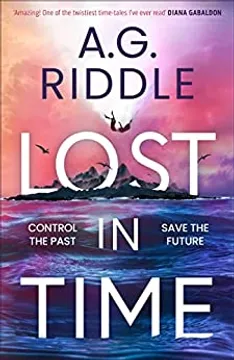
Lost in Time treats time travel less as an escape from consequence than as a machine for making consequence visible. Absolom appears to solve society’s problem with violence by sending offenders elsewhere, yet its clean disappearance conceals the brutality of exile. The founders’ private motives complicate that public confidence: they sought money to save family members, then discovered a technology that could exile strangers, and later became tempted to use it against grief itself. The novel’s central ethical question is therefore not whether the past can be changed, but who has the right to decide which losses deserve intervention.
Adeline’s trajectory gives this question its emotional force. She begins as a daughter who interprets her father’s new love as a betrayal of her mother, then becomes an investigator trying to reverse the consequences of that misunderstanding. Her journey into the past makes her responsible for the very identity she once distrusted. That reversal turns character development into causal architecture: to save her family, she must become the person who shaped the events that wounded it. The loop does not erase pain; it asks whether knowledge can transform pain into responsibility.
The novel also distinguishes rescue from simple reversal. Sarah cannot be returned, and Constance’s illness and death remain part of the story. Charlie and Hana’s father can be saved because the timeline supplies evidence that their rescue already occurred. This rule limits technological power while giving history a communal dimension. Photographs, journals, bodies, and remembered acts become traces through which people can recover one another. Absolom Island finally reimagines civilization not as the removal of everyone deemed dangerous, but as a place where displaced people can live, heal, and contribute. The future is not a clean slate. It is a shelter built from what the past has left behind.
Review Summary
Lost in Time receives mixed reviews, averaging 4.17/5 stars. Fans praise its clever time travel premise, surprising twists, fast-paced chapters, and emotional father-daughter storyline. Many highlight an unexpected mid-book twist as a standout moment. Critics, however, point to flat characters, weak scientific logic, clichéd writing, and a lack of the promised dinosaur content. Some found the ending unsatisfying or illogical. Overall, enthusiasts of light sci-fi thrillers enjoy it, while readers seeking deeper characterization or scientific rigor are often disappointed.
Characters
Adeline Anderson
Grieving investigatorSam and Sarah’s daughter is a perceptive, strong-willed young woman whose grief often arrives as anger or action. After her mother’s death, she withdraws from her father and resists changes that feel like a betrayal of the family she lost. Her intelligence makes her an effective investigator, but it also encourages her to treat uncertainty as a problem she can solve through effort alone. Adeline’s loyalty to Ryan and Sam gives her a durable sense of purpose, while her fear of further loss makes trust difficult. She is drawn to evidence, plans, and hidden systems because they promise leverage over events that otherwise seem arbitrary.
Sam Anderson
Father and physicistA co-inventor of Absolom, Sam is an intellectually accomplished scientist who feels far less certain as a parent. Since Sarah’s death, he has struggled to help Adeline and Ryan grieve, often reacting rather than guiding. He is gentle, reflective, and inclined to assume responsibility for other people’s pain, a quality that can become self-sacrifice. His work places him inside a technology whose consequences exceed its creators’ intentions. Sam’s deep attachment to his children gives him resilience, while his continuing bond with Sarah makes the possibility of loving again emotionally complicated.
Daniele Danneros
Investor and family guardianA wealthy venture capitalist and one of Absolom’s central organizers, Daniele combines strategic patience with a strong instinct for practical intervention. She is comfortable making plans on a long horizon and expects others to accept preparation even when they do not yet understand its purpose. Her history has taught her that financial security can disappear quickly, so she treats money as a form of protection rather than decoration. Daniele becomes an important presence in Sam’s family life and in the founders’ work. Her composed manner can read as warmth or secrecy, leaving others unsure how much she has chosen to reveal.
Nora Thomas
Scientist and moral skepticNora is one of Absolom’s original scientists, known for intellectual humility and a steady concern for the human consequences of discovery. She resists treating scientific capability as proof that an experiment should continue, especially when a technology might alter causality. Her own history of loss makes her sensitive to grief in others, and she often offers practical kindness rather than grand reassurance. Nora values private connection and is wary of fame, seeing the public’s admiration as disproportionate to the uncertain origins of Absolom. Her cautiousness is not timidity; it is an effort to keep ambition answerable to consequence.
Elliott Lucas
Brilliant grieving inventorSam’s oldest friend and a gifted physicist, Elliott is an energetic innovator whose mind keeps working even when his personal life is in crisis. His son Charlie’s addiction leaves him desperate to find a way to reverse loss, and that desperation shapes his relationship with Absolom Two. Elliott’s loyalty to Sam is profound, though grief and alcohol can make him volatile. He tends to translate emotional helplessness into technical work, where problems appear measurable and solvable. His brilliance drives the story’s discoveries, but his willingness to take risks raises questions about whether love can distort judgment as effectively as ambition.
Hiroshi Sato
Absolom's guarded engineerHiro is one of the founders and the group’s most direct technical thinker. He speaks plainly, values precision, and is more comfortable with machines than with social performance. His discipline in the laboratory coexists with a private vulnerability that affects his choices and finances. Hiro’s intelligence makes him essential to both versions of Absolom, while his shame about his personal struggles keeps him isolated from friends who might help. He is not cold so much as guarded, and moments of honesty reveal a person who wants control because he knows how easily compulsion can take it away.
Constance Niven
Ailing scientist seeking repairConstance is a founder whose declining health has made her acutely aware of what illness changes in a person’s relationships. She values being treated as herself rather than as fragile, and she offers others the same attentive respect. Her concern about Absolom’s use on prisoners comes from a broader sensitivity to consequences and consent. Constance carries regret about choices made in her younger years, but she responds to that regret through responsibility, attempting to help people affected by her past. Her determination often exceeds her physical strength, giving her a quiet authority within the group.
Ryan Anderson
The family's youngest anchorSam and Sarah’s son is eleven when the crisis begins. Introverted and absorbed by books and building toys, Ryan retreats into solitary interests after his mother’s death. He is perceptive about tension among the adults and deeply attached to Adeline, even when he cannot articulate what he needs. The loss of his parents’ steady presence forces him to confront change before he is ready. Ryan’s bond with his sister becomes a source of mutual responsibility, while his questions make the adults’ complicated plans feel personal rather than abstract.
Sarah Anderson
The family's lost centerSam’s wife and the mother of Adeline and Ryan, Sarah is remembered for emotional insight, creativity, and an ability to make difficult truths bearable. She teaches psychology and is attentive to how belief, stress, and health shape perception. Her illness reorganizes family life long before her death, leaving Sam to parent while managing his own grief. Sarah’s sewing and her efforts to comfort her children give them lasting objects through which to remember her. She remains a moral presence in the family, especially in Sam’s struggle to understand when honoring the dead becomes a barrier to living.
Nathan Hill
Entrepreneur and partnerNathan is a witty technology entrepreneur who presents himself with more bravado than he shows in private. His company focuses on making websites faster, and his humor reflects both confidence and a fondness for performance. He and Daniele connect through shared ambition, but their relationship is complicated by the demands each places on work. Nathan offers the possibility of companionship without asking either person to abandon their vocation. His persistence and capacity for reinvention make him a natural fit for a life shaped by urgent, unconventional projects.
Charlie Lucas
Elliott's troubled sonElliott and Claire’s son is bright, athletic, and once expected to build a future through football. A serious accident damages his body and changes the path he imagined for himself. Pain, isolation, and substance use compound the loss, while his parents struggle to help without knowing how far his life has narrowed. Charlie’s story exposes the limits of parental love: devotion can keep someone close, but it cannot make recovery a simple act of will. His presence also motivates Elliott’s fixation on technology that might undo irreversible events.
Hana Kim
Syntran's driven founderHana leads Syntran, a biotechnology company working on transplantable organs and related medical applications. Her ambition is grounded in personal experience with a family loss and in a desire to reduce the number of people who die while waiting for treatment. She is persistent in seeking support for her work and attentive to the needs of patients and families. Hana’s scientific and entrepreneurial judgment makes her an important partner for the Absolom project, while her commitment to helping others keeps innovation tied to care.
Claire Lucas
Elliott's steadfast wifeClaire is Elliott’s wife and Charlie’s mother. She shares the strain of trying to help their son while maintaining the family’s limits and routines. Her practical firmness contrasts with Elliott’s tendency to turn distress into technical obsession. She is part of the support system Charlie needs and a witness to the cost of addiction on a household.
Victor Levy
Sam's celebrity attorneyLevy is a polished, media-savvy defense lawyer who understands that fear and public perception can shape a courtroom as much as evidence. He offers Sam a long legal strategy built around the unprecedented danger of sentencing an Absolom inventor to the machine. His theatrical confidence makes him useful in a crisis, though Sam’s priorities differ from the extended fight Levy proposes.
Detective Billings
Lead murder investigatorBillings investigates Nora’s death with a procedural, evidence-led manner. She relies on surveillance footage, forensic testing, and the rules governing Absolom-eligible crimes. Her calm delivery can feel impersonal to the Andersons, but she treats the case as a question to be resolved through available facts rather than personal familiarity.
Plot Devices
Absolom
Exile by time machineAbsolom uses energy, gravity, and quantum effects to move matter into the past, creating a branching timeline rather than changing the inventors’ present. Governments repurpose the device as a punishment for the most serious criminals, sending them away from their own world without a return path. The machine drives the novel’s legal crisis, strands Sam in the Triassic, and gives his daughter the means to pursue a rescue. Its central ambiguity is whether removing a person from society is justice, execution, or a refusal to face the consequences of punishment.
Absolom Two
A bridge into historyThe prototype extends Absolom’s reach into the inventors’ own timeline, using quantum entanglement to target related branches of reality. Its early tests require a causal sequence: the team plans an experiment, searches the past for the object, and sends it only if the evidence proves it was already there. Later work aims to retrieve matter through recall rings. Absolom Two makes Sam’s rescue possible, but also creates the prospect of altering history and destabilizing the present. The scientists’ disagreement over its use drives both the mystery and the moral conflict.
Recall ring and tuning pins
A signal through timeSmall metal pins carry entangled components of a larger recall device. In the past, their indicator lights guide Sam toward the buried ring that can activate a return through Absolom. Because the complete device is too heavy to send within government limits, the scientists divide it and implant its parts in prisoners destined for Sam’s timeline. The pins are both survival tools and evidence that someone has deliberately prepared a route home. Their function links Sam’s prehistoric ordeal to the investigators working in the present.
Tesseract
A camera across centuriesTesseract is software that searches photographs and video archives for selected faces. Adeline uses it to look for evidence of time travelers, initially finding herself in wartime Stalingrad and later locating other members of her circle in historical records. Its results turn scattered images into a map of missions already embedded in history. The system also helps Adeline question what the present believes about the past, though matching a face does not by itself explain why that person was there.
Syntran replicas
Bodies that counterfeit deathSyntran develops biological replicas for cases in which a missing person’s remains cannot be recovered. The technology can produce a body with identifying features and age characteristics, giving families something to bury. In the novel, this capability explains how an apparent death can be staged convincingly enough to mislead investigators and the people closest to the victim. It also gives the rescuers a way to replace those removed from history, preserving the evidence that the world expects to find.
Download PDF
Download EPUB
.epub digital book format is ideal for reading ebooks on phones, tablets, and e-readers.








