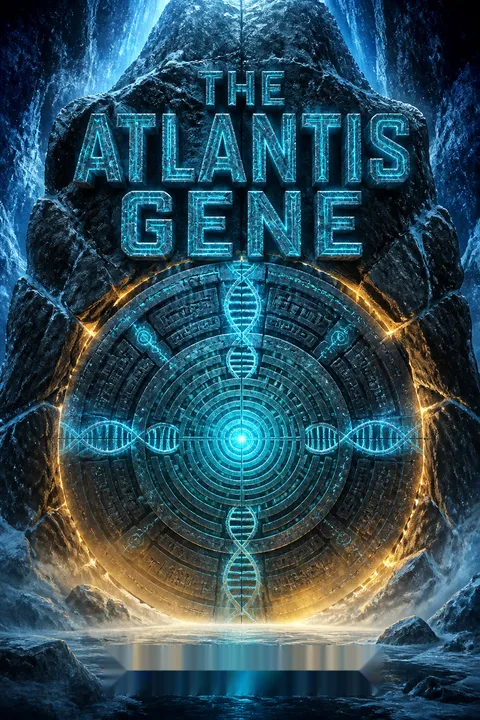


Plot Summary
Prologue
A research vessel tracking a vast Antarctic iceberg spots a Nazi submarine protruding from the ice above a larger, wavering structure. Karl Selig and his colleague Steve Cooper cross the unstable surface to investigate. When a fissure opens, Steve finds a metal-lined cavern with unfamiliar symbols, but the ice collapses before Karl can reach him.
On the ship, Naomi secretly reports the discovery to a contact. A man viewing the satellite feed recognizes the site and alerts his director: the search that has occupied the Immari for generations has finally found its target.
The prologue makes discovery inseparable from danger. Karl begins as a scientist, but the chance of fame and treasure quickly competes with his caution, while the alien-looking structure turns ordinary fieldwork into a threshold crossing. Naomi’s quiet phone call reveals that the expedition has been watched and that the find belongs to a larger, hidden history. The scene therefore establishes the novel’s central imbalance: explorers see a mystery, powerful institutions see an asset, and the people nearest the truth are least able to control what happens next.
Jakarta's Impossible Breakthrough
Dr. Kate Warner has spent five sleepless days at Jakarta’s Autism Research Center, desperate to produce results before its funding disappears. Her assistant, Ben Adelson, sees two boys, Adi and Surya, suddenly solve a difficult puzzle, make eye contact, and take turns, changes Kate did not expect from ARC-247.
Before she can confirm what happened, armed intruders enter the clinic and call her by name. Ben tackles their leader, but is shot; the attackers seize the boys and Kate is knocked unconscious. Police arrive to find a dead technician, missing children, and Kate at the scene. Instead of searching urgently, they treat her as a suspect, turning her medical breakthrough into evidence against her.
Kate’s discovery arrives in the form of changed behavior, not a laboratory readout. The boys’ new social contact challenges the clinical category that has organized her work, while their puzzle-solving hints that the treatment has altered more than symptoms. Yet the breakthrough is immediately enclosed by coercion: the sponsor’s pressure, the assailants’ knowledge of Kate, and the police investigator’s suspicion all claim authority over the children. Kate’s professional purpose is compassionate, but her legal guardianship and secretive research leave her vulnerable to a colonial reading of medical power. The scene makes care and control dangerously difficult to separate.
A Bomb at Manggarai
At Jakarta’s crowded Manggarai station, Clocktower chief David Vale waits for an informant who promised intelligence about an imminent attack called Toba Protocol. A man in a red jacket approaches, but David recognizes the posture of an operative rather than a frightened source.
He pushes commuters away from the train moments before a bomb tears through it, then survives with help from his team. Clocktower director Howard Keegan tells him that stations in several countries have been attacked and that the organization may be compromised.
As David leaves headquarters, a street boy slips him a pipe that appears to be a bomb. Inside is a satellite photograph of the Antarctic iceberg and submarine, along with a coded message confirming that Toba is real.
The station blast converts intelligence work from distant pattern recognition into bodily risk. David’s instinct saves people near him, but it also exposes the limits of a system built around anonymous contacts and compartmentalized knowledge. The false bomb is an especially precise countermeasure: the enemy uses the appearance of an attack to deliver information while forcing David to decide whether to trust any channel at all. The Antarctic image connects the immediate threat to a physical site, making the conspiracy more than an abstract network. David now has a warning, but not yet the means to interpret it.
The Code Points Back
David brings analyst Josh Cohen into a secure room and explains that more than half of the analysts summoned to a global Clocktower conference never returned. Their meeting was a mole hunt, but the breach runs deeper: compromised field operatives are now attacking major stations.
David also reveals his decade-long investigation into Immari International, which he suspects profited from the September 11 attacks and used them as cover for archaeological searches.
Josh decodes the dates and names on the message by locating 1947 obituaries, which point to Gibraltar, an Antarctic U-boat, and Roswell. A Craigslist post then yields a warning that Clocktower itself is about to fall. Before Josh can send more, attackers breach his secure room, and he dies after transmitting his findings.
This section turns the habits of intelligence into the story’s language of historical memory. Obituaries and online personals are mundane public records, but their repeated patterns preserve a message across decades. Josh’s work shows how analysis depends not only on data but on knowing what kind of ordinary object can hide meaning. David’s conspiracy theory also gains substance through a causal chain: Immari funds, archaeological cover, and intelligence infiltration begin to align. Yet the revelation comes at a cost. Josh can expose the structure but cannot survive the institution that has been built to conceal it.
The Doctor Becomes a Target
West Jakarta police chief Eddi Kusnadi tries to extort money from Kate while accusing her of trafficking the children. David reaches the station with evidence that can force Kusnadi to release her, then takes Kate to a mobile operations vehicle. She learns that the people who raided her clinic work for Immari Security, the same corporate network funding her research.
When Kate explains the Toba supervolcano theory, David recognizes that Toba Protocol may seek a new population bottleneck rather than a conventional attack. An Immari strike hits the convoy, killing David’s team and leaving him unconscious. Kate is taken again by Vincent Tarea, the compromised Clocktower officer who led the clinic raid, and delivered to Immari headquarters.
Kate and David begin as people with incompatible definitions of the crisis: she is trying to recover two children, while he is trying to prevent a global catastrophe. Their exchange gives each a missing interpretive tool. Kate supplies the evolutionary history that makes Toba meaningful; David supplies the institutional evidence that makes her research suspicious. The abrupt attack prevents trust from becoming easy or sentimental. Kate is not rescued into safety but shifted from one coercive system to another, and David’s apparent defeat forces him to decide whether his larger mission can remain separate from the lives it is supposed to protect.
A Rescue Through Fire
Fisherman Harto and his son Eko pull David from the river, sacrificing their fishing nets to keep his armored body from sinking their boat. David recruits Cole Bryant, an Immari guard, by convincing him that explosives are strapped to his spine. Together they enter the Jakarta compound during a fire alarm, and David plants charges while searching for Kate.
In a torture room, Kate is injected with a drug that leaves her confused and unable to explain her treatment. David reaches her, kills her captor, and carries her from the building as explosions tear through the docks. She falls into the sea; David dives after her, revives her, and gets her onto a boat. Cole later discovers the supposed bomb was only a marked shirt.
The rescue braids two very different forms of courage. Harto risks his family’s livelihood without knowing whether David is a criminal, while Cole’s fear makes him temporarily useful to the man who has threatened him. David’s violence is tactical and practiced, but Kate’s rescue exposes its emotional limit: he can clear a building, yet he cannot control the water, her drugged body, or the danger that follows them. The false bomb becomes a dark joke about coercion and trust. David has saved Kate by deception, but the next stage requires him to rely on her judgment rather than keep her at a distance.
The Train to Tibet
At David’s coastal safe house, Kate wakes and refuses to stay behind while he follows a new Craigslist message to western China. They fly north in an aging seaplane, crash-land beside a mountain lake, and reach an enormous Immari complex by joining workers on a train. A locker contains disguises and access cards.
Kate enters the residential wing while David heads for the power plant, but guards identify her as an impostor before she finds Adi and Surya. An Immari aide named Naomi intervenes and leads her to the boys. At the same time, David plants explosives in the plant’s circuit room. The complex is not a clinic or prison: it is a hidden research operation built around a device called the Bell.
The journey marks a shift from investigation to participation. Kate rejects the protected role David assigns her because the children are not merely clues to the conspiracy; they are patients and people under her care. Their separate routes through the facility dramatize their complementary strengths: she can read the children and improvise under social pressure, while David can move through armed security and infrastructure. The Bell’s name and scale remain unexplained, but the installation already reveals the Immari’s priorities. They have built a city-sized workplace far from public view, treating secrecy not as a temporary precaution but as the condition that makes their research possible.
The Bell Begins to Kill
Immari forces capture Kate and the boys before she can get them out. David’s charges damage the power system, and the Bell activates during a human test. The machine’s pulsing light and sound cause people in its chamber to bleed and collapse, while Kate survives the exposure and escapes the crowd when the room is breached by water.
She reaches the cargo train carrying David, who has been shot and badly injured. Kate uses supplies from a medical kit to transfuse her blood into him as the train moves into the night. Immari troops stop the train and transfer the pair to another carriage, but they leave Kate with medical supplies. Her blood keeps David alive long enough for them to reach a remote mountain sanctuary.
The Bell transforms the novel’s evolutionary speculation into a physical test with immediate casualties. Its effect is not selective in any moral sense: the machine kills a roomful of people, including workers who may not understand what they are testing. Kate’s survival is therefore a mystery as urgent as the boys’ treatment. Her decision to give David blood reverses their earlier dynamic. She is no longer the protected scientist being carried through danger; she becomes the person keeping the operative alive. The train’s movement offers temporary escape but also carries them deeper into a system whose medical and military powers are indistinguishable.
The Journal Under the Mountain
At the Immaru monastery, the young monk Milo helps Kate treat David with the limited medicines available. Qian, the ancient keeper of the sanctuary, gives her a journal and shows her a vast tapestry tracing floods, human violence, and an ancient people who may have altered humanity. The journal belongs to Patrick Pierce, an American soldier wounded in the First World War.
In 1917, nurse Helena Barton cared for him, and the two grew close as he recovered. The Immari hired Pierce to lead a dangerous excavation under Gibraltar, promising money and influence. When he entered the tunnels, he found a hidden metal structure and concluded that the Immari were searching for something far beyond ordinary treasure.
The monastery offers a counterweight to Immari secrecy. Qian does not claim that a single institution owns the truth; he gives Kate an artifact and a story that must be interpreted alongside science. The tapestry’s religious imagery and Pierce’s practical mining account seem to belong to different systems of knowledge, yet both preserve events that official records cannot explain. Pierce’s courtship with Helena also makes the historical narrative intimate rather than merely archival. The excavation begins as a job accepted for survival and becomes a moral choice, echoing Kate’s own research: knowledge may open doors, but the person who seeks it remains responsible for what the door releases.
The Cost of Atlantis
Pierce’s journal records that the structure beneath Gibraltar contained a Bell and chambers holding humanlike figures. After he entered a tube to escape a tunnel collapse, he emerged to find the Spanish flu spreading from the site.
Helena and their unborn child died, and Pierce blamed himself for helping the Immari reach the structure. The Immari concealed the scale of the outbreak and treated the deaths as useful evidence. In later entries, Pierce describes Konrad Kane’s plan to find the Immaru and prepare for an alleged Atlantean threat.
Kate connects the Bell’s killings in China with the historical plague: the Immari may be using infected bodies to force another population bottleneck, while the ancient gene may have helped humans survive the first one.
Pierce’s loss gives the conspiracy a human cost that cannot be reduced to a strategic forecast. The Immari’s language of necessary sacrifice turns identifiable people into experimental outcomes, while Pierce’s guilt persists because he helped create the conditions for the disaster. Kate’s interpretation of the journal is not a clean answer; it is a hypothesis that joins genetic science to the tapestry’s ancestral memory. That uncertainty matters. The novel presents evolutionary knowledge as powerful but incomplete, and the Immari exploit precisely that gap by treating speculation as permission to kill.
The Monastery Takes Flight
As Kate reads the final journal entries, she and David infer that the Immari intend to create both a population of Bell-resistant people and an army capable of confronting the Atlanteans. Their discussion is cut short when Immari drones attack the monastery. Milo and the monks launch camouflaged hot-air balloons, sending Kate away beneath a canopy painted as sky and forest.
David stays behind to shoot down drones and buy her time. When the monastery is struck, he leaps from a collapsing platform and catches the side of Kate’s basket. She pulls him aboard despite his injuries. The balloon carries them over the mountains with only a few sandbags left, while the journal’s map points toward Gibraltar and an unexplored chamber.
The balloon escape turns the monastery’s contemplative refuge into a practical network of resistance. The monks do not defeat the Immari by matching their technology; they use local knowledge, camouflage, and coordination to make the landscape unreadable to surveillance. David’s decision to remain behind follows his habitual rescue instinct, but Kate’s refusal to abandon him changes rescue from a one-sided duty into mutual action. The scene also makes their intimacy concrete without dissolving the larger crisis. They can trust each other in a moment of physical danger, yet the plague and the Immari’s pursuit remain beyond their immediate control.
Clocktower Was Immari
After reaching India, Kate and David contact Clocktower through a concealed clock shop and travel to Gibraltar, where surviving agents are preparing an assault on Immari headquarters. Kate learns that the children are still being held and agrees to leave with Howard Keegan, believing she can trade herself for them.
David follows the map from Pierce’s journal into the tunnels beneath the Rock. In a hidden Atlantean chamber, Keegan reveals that he is Mallory Craig, the Immari operative who once hired Pierce.
Clocktower was never an independent counterterrorist service; Craig built it as an Immari intelligence arm to infiltrate governments and contain investigators such as David. Craig offers David power within the organization if he helps eliminate Dorian Sloane.
The revelation makes institutional identity itself a weapon. Clocktower’s apparent independence has allowed it to gather the world’s trust, and its fall exposes how easily a protective structure can become an instrument of control. Craig does not tempt David with simple wealth or safety; he offers him a way to direct the machinery that has already harmed him. That offer echoes Pierce’s earlier bargain with the Immari, but David’s position is different: he knows the cost of accepting a role in the system. Kate’s separate choice to surrender herself also shows how both protagonists act from care, though each risks being manipulated through that very commitment.
Kate Faces Her Past
In Antarctica, Dorian Sloane confronts Kate at the Immari research base and identifies himself as Dieter Kane, the child once treated in the ancient tubes. He also reveals that he was the man who seduced Kate in San Francisco and fathered the pregnancy she lost.
Kate tells him that she used stem cells from their unborn child to treat Adi and Surya, information Dorian needs to understand their survival. Martin Grey rescues her during an attack on the facility and explains that the children’s treatment may activate the Atlantis Gene.
He admits he secretly sent David the warnings about Clocktower and the China complex. Martin then reveals that Kate’s biological father is Patrick Pierce, preserved in an Atlantean tube, and sends her down toward the Antarctic structure.
Dorian’s personal history collapses the distance between private grief and public violence. He turns the lost pregnancy into a reason to punish Kate, while the same fetal cells become the means by which the boys may survive the Bell. Martin’s confession adds another layer of compromised care: he hid the truth and helped trigger danger because he believed secrecy was the only way to protect Kate. The revelation of Pierce’s identity gives Kate a past she never knew, but it does not restore the years she lost. Her descent is both an attempt to save the children and a decision to act with knowledge that her family history has been shaped by institutional manipulation.
The Father in the Tomb
Inside the Gibraltar structure, David discovers that the chamber’s holograms depict Atlanteans intervening in human history and a cataclysm that broke their vessel apart. He pulls the spear from a sealed door and enters a deeper section, where a wounded man captures him.
The stranger identifies himself as Patrick Pierce, who has spent only weeks inside the structure while decades passed outside. Meanwhile, Kate survives a cut cable and a punishing fall through an Antarctic ice shaft, reaches the tombs, and finds Adi and Surya.
Dorian enters the structure too, believing his father Konrad is still alive. David and Pierce join forces, then find Kate in a chamber of preserved human ancestors. Kate recognizes the Nazi leader Konrad Kane as the next immediate threat.
The structure makes time and identity unstable, but its effects do not erase responsibility. Pierce has lost decades without experiencing them, while Kate has lived a full life in the world he never saw. Their meeting therefore cannot be treated as a simple reunion; it is a collision between the past he remembers and the person she became. The holograms suggest that ancient intervention may explain human evolution, but the evidence remains partial. David’s instinct to move toward the danger and Kate’s decision to find the boys bring the separate strands together at last, with the next choice no longer belonging to any single generation.
A Bomb Crosses the Portal
Dorian sends Adi and Surya through the tombs carrying timed nuclear warheads, intending them to find Konrad and carry a message to their father. David, Kate, and Pierce fight through the Immari guards.
Kate reaches the boys while Pierce explains how the active portal can send them back to Gibraltar; he stays behind to close the route and keep the bombs from detonating in Antarctica. David holds off Dorian’s men, then shoots Dorian after being riddled with bullets. Kate, the children, and Martin escape in a submersible as the portal’s destruction triggers a blast that shatters Gibraltar.
Immari scientist Shen Chang later reports that samples from Helena’s preserved body and Dorian’s suit have revealed the Atlantis Gene. David is dead, but the epilogue finds him revived in a tube opposite Dorian.
The climax resolves one immediate moral question while leaving the larger biological crisis open. Kate refuses to treat the boys as expendable instruments, Pierce accepts the risk of remaining behind, and David finally stops making survival a private calculation by confronting Dorian directly. Yet the destruction of Gibraltar is not a clean victory: it sacrifices the site, leaves the fate of Pierce uncertain, and does not halt the plague already spreading across the world. Chang’s discovery suggests the Immari may still turn the gene into a weapon. David’s return in a tube further destabilizes death itself, converting apparent closure into another threshold.
Epilogue
David wakes inside an Atlantean tube, his wounds and scars gone. Through the glass, he sees his own dead body lying in the corridor where Dorian shot him. The chamber stretches away in rows of sleeping figures, but one other person is awake: Dorian Sloane, preserved in a tube directly opposite David.
The escape from Gibraltar has not ended the struggle. The two men who tried to decide humanity’s future have been returned to the same mysterious system, while the plague and the newly identified Atlantis Gene remain unresolved.
The epilogue refuses the ordinary contract between sacrifice and closure. David’s apparent death had carried emotional weight because he chose to remain behind, but the tube restores him without explaining the cost or purpose of his return. Dorian’s presence beside him prevents revival from reading as a simple reward; the antagonist is preserved too. The final image compresses the novel’s central uncertainties into one chamber: who controls the technology, what survival means, and whether the people inside the tubes are protected, imprisoned, or being prepared for another conflict. Biological continuation is not the same as moral resolution.
Analysis
The Atlantis Gene builds its thriller around a conflict between prediction and responsibility. The Immari see evolutionary history as a sequence of threats: Toba nearly erased humanity, an ancient intervention may have changed the species, and a returning advanced population could finish what earlier bottlenecks began. Their response is to engineer survival through population reduction, genetic selection, and secrecy. This logic is not presented as mere villainous appetite. It draws strength from real uncertainty about human origins, which makes the Immari’s certainty more disturbing: they convert incomplete evidence into permission to decide who deserves to live.
Kate’s work begins at the opposite scale. She wants to improve the lives of particular children, not redesign humanity. Yet her study is financed by the very organization that appropriates its results, and the children’s extraordinary response makes them valuable to military and evolutionary agendas. The novel therefore refuses an easy opposition between pure science and corrupt power. Research has ethical consequences before it becomes a weapon, especially when consent, guardianship, and social vulnerability are unevenly distributed.
David’s arc tests whether personal grief can become principled action rather than endless retaliation. His search for the people responsible for September 11 initially organizes his life around an enemy; Kate and the children force him to measure success by whom he protects. Pierce’s journal provides an earlier version of the same dilemma. He accepts work for the Immari to build a life with Helena, then discovers that his expertise has opened the way to mass death. Across the generations, the central danger is not knowledge itself but the bargain that lets institutions separate knowledge from accountability.
The ending preserves that problem rather than solving it. The gene is identified, the plague is spreading, Gibraltar is destroyed, and David’s return in a tube makes survival uncertain even after sacrifice. The book’s lasting question is not whether humanity can evolve, but who gets to define the future and what moral limits remain when extinction becomes the argument for every action.
Review Summary
The Atlantis Gene receives mixed reviews, with ratings ranging from 1 to 5 stars. Many readers praise its fast-paced action, intriguing plot, and blend of science fiction and thriller elements. Critics find the writing style choppy, characters underdeveloped, and plot overly complex. Some appreciate the ambitious scope, while others feel it's too convoluted. Positive reviews highlight the engaging storyline and scientific concepts, while negative reviews cite poor execution and implausible scenarios. Overall, readers who enjoy fast-paced thrillers with sci-fi elements tend to rate it higher.
People Also Read
Characters
Kate Warner
The geneticist in flightKate is a brilliant geneticist who directs an autism study in Jakarta and measures herself by whether her work can improve the lives of the children in her care. Her childhood was marked by loss, an absent father, and repeated displacement, so the research center has become both vocation and chosen family. She is disciplined and compassionate, but she can also be secretive and stubborn when she believes a child’s welfare is at stake. Her scientific training makes her attentive to evidence; her personal history makes her wary of being abandoned or controlled. As danger grows, she learns to act beyond the laboratory, drawing on empathy, courage, and a developing capacity to trust others without surrendering her judgment.
David Vale
The counterterrorist investigatorDavid leads Clocktower’s Jakarta station and has spent years tracing Immari activity. The September 11 attacks left him physically injured and personally bereaved, and his recovery became bound to the need to identify those responsible. He is observant, tactically skilled, and accustomed to treating vulnerability as a problem to manage. That self-protective discipline makes him effective but lonely. Kate’s presence challenges his instinct to decide what risks others may take, while his work forces her to confront threats larger than her clinic. Beneath his operational focus is a powerful rescue impulse, one that can make him brave and can also make him vulnerable to people who understand how to exploit it.
Martin Grey
Kate's guarded benefactorMartin is Kate’s adoptive father and the head of Immari Research. He has supported her scientific career, helped establish her work in Jakarta, and remained a distant but important presence in her life. He is intelligent, patient, and skilled at navigating powerful institutions, yet he often confuses protection with withholding information. His affection for Kate is genuine, but so is his willingness to manipulate events when he believes the stakes demand it. Martin’s divided loyalties reflect a conflict between institutional belonging and personal conscience. He hopes scientific knowledge can prevent catastrophe without reproducing the violence that created the danger, but his secrecy repeatedly puts the people he means to protect at risk.
Dorian Sloane
The Immari commanderDorian commands Immari Security and approaches crises as a soldier responsible for humanity’s survival. He is decisive, strategic, and capable of extreme violence, qualities reinforced by a childhood shaped by illness, loss, and isolation. His belief that an advanced enemy may destroy humankind turns uncertainty into a military problem that must be solved before debate can slow him down. Dorian’s private history with Kate gives his strategic thinking an intimate and punitive edge, though he prefers to describe his actions as necessary. He is not simply power hungry; he believes power is the only tool strong enough to prevent extinction. That conviction makes him especially dangerous when evidence is incomplete.
Patrick Pierce
The soldier who kept a journalPatrick Pierce is an American soldier and experienced miner whose First World War injuries force him to reconsider the life he expected to lead. He is practical, proud, and wary of being patronized, especially when his disability becomes an excuse for others to decide his future. His affection for Helena draws him toward family life, while his mining skill brings him into contact with the Immari and their buried project. Pierce’s journal records both the decisions he regrets and the mysteries he cannot explain. He belongs to a generation that understood war through trenches and tunnels, yet his experiences place him at the threshold of a history far older than any modern conflict.
Howard Keegan
Clocktower's directorHoward Keegan is David’s mentor and the senior figure who directs Clocktower from beyond its local stations. He speaks and acts with the authority of someone accustomed to weighing risks across a vast organization. David trusts him because their relationship is longstanding, and that trust gives Keegan’s decisions particular force. He represents the problem of institutional loyalty: in a world of secret agencies, a familiar voice can feel safer than evidence. His role also shows how the distance between a field operative and a director can obscure the motives behind even apparently helpful guidance.
Josh Cohen
The analyst who decodes historyJosh is the chief intelligence analyst at Clocktower’s Jakarta station. He is a careful reader of patterns who understands that intelligence often begins as informed guessing rather than certainty. His professional curiosity makes him willing to question institutional assumptions, while his loyalty to David gives him a personal reason to act under pressure. Josh’s strength is synthesis: he connects scattered records, coded messages, and operational details into a usable picture. His work is intellectually demanding but emotionally isolating, and the crisis reveals how much an analyst’s contribution can matter even when he is far from the field.
Naomi
The embedded Immari aideNaomi travels with the Antarctic research expedition and appears at first to be disengaged from its work. In reality, she is observant and capable of acting decisively when Kate needs help inside the China facility. Her role depends on access: she can move through Immari spaces without immediately attracting suspicion. Naomi’s cool exterior conceals a practical loyalty to people rather than a public cause. She becomes a small but crucial example of how resistance can operate inside a system, using timing, credentials, and familiarity instead of force.
Ben Adelson
Kate's loyal lab assistantBen works beside Kate at the Autism Research Center and is among the few people who sees how much the study consumes her. He is practical, friendly, and willing to question her secrecy without dismissing her scientific commitment. His loyalty to the children is as important as his loyalty to Kate, and he responds to danger by putting himself between them and the armed intruders. Ben gives the lab the texture of a working community rather than a solitary genius’s project.
Adi
One of Kate's young patientsAdi is one of the boys enrolled in Kate’s study, a child whose difficult circumstances have left him without reliable protection. His sudden ability to complete a demanding puzzle signals that Kate’s treatment has produced an extraordinary change. He is not merely a scientific result: his safety and trust matter to Kate, and his presence makes the Immari’s plans tangible. Adi’s bond with Surya gives the children a source of courage when adults and institutions repeatedly move them from place to place.
Surya
The boy found in the forestSurya is a child Kate finds abandoned and severely neglected in the forest outside a village. He has no known family willing to claim him, so Kate gives him a name and brings him into the study’s care. His history makes him especially dependent on consistent adults, but he gradually forms a close connection with Adi and Kate. Surya’s vulnerability helps explain why Kate rejects the idea that the boys are expendable research subjects.
Qian
Keeper of the Immaru recordQian is the elderly guardian of the monastery’s history and the keeper of a tapestry and journal passed down through generations. He sees these objects as records that combine history, warning, and moral instruction, while understanding that no single interpretation can exhaust them. His patience contrasts with the Immari’s demand for immediate, usable answers. By entrusting Kate with the journal, Qian asks her to become an interpreter and a participant, not merely a recipient of ancient knowledge.
Milo
The monastery's young guideMilo is a teenage monk who has learned English through a language course sent by an unknown benefactor. He is cheerful, theatrical, and eager to make visitors feel welcome, but his humor does not prevent him from taking practical responsibilities seriously. He helps Kate care for David and assists the monastery’s escape plan. Milo brings warmth to a story dominated by military secrecy, showing how curiosity and hospitality can coexist with discipline.
Helena Barton
The nurse who sheltered PierceHelena is a nurse who cares for Patrick Pierce after he is wounded in the First World War. She is compassionate without being fragile, and her work in a field hospital gives her a direct understanding of what violence costs ordinary people. Her affection for Pierce grows through practical acts of care, but she also holds firm boundaries and expectations for the life they might build. Helena’s response to suffering helps shape Pierce’s moral decisions and gives his journal its most intimate human stakes.
Konrad Kane
The Immari elderKonrad Kane is an early Immari leader whose ambitions center on the Bell, the Atlantis Gene, and the possibility of an existential threat to humanity. He is forceful, strategic, and convinced that survival justifies preparations others would consider unforgivable. His influence reaches across generations through the organization he helps shape and through Dorian’s understanding of their shared history. Konrad represents the older Immari conviction that humanity must be protected by people willing to make decisions the public could not accept.
Shen Chang
The pressured Bell scientistDr. Shen Chang leads research at the Immari complex in Tibet. He is a capable scientist who recognizes the ethical and practical limits of the experiments demanded by his superiors. Chang tries to understand why the children survive treatment that kills adult subjects, and he develops hypotheses about the Atlantis Gene and its effects on the brain. His position is precarious: scientific caution matters to him, but the Immari control his staff, subjects, and timetable.
Cole Bryant
The reluctant Immari guardCole is an Immari security operative and former Marine who joined for a steady income and hopes of opening a business with his family. He is wary of David, reasonably frightened by the danger around him, and more humane than his employer’s machinery suggests. His predicament shows how people can be recruited into a violent institution for ordinary economic reasons rather than ideological conviction.
Harto
The fisherman who saves DavidHarto is a Jakarta fisherman whose family depends on the nets he and his son use to earn a living. When he finds David in the river, he gives up those nets to keep the injured stranger afloat. His decision is a costly act of generosity made without knowing David’s identity or the danger surrounding him.
Barnaby Prendergast
The suspicious facility scientistBarnaby is a British scientist working inside the Immari research complex. He is skeptical of Kate’s claimed identity and uneasy about the treatment of human subjects, though he initially chooses institutional caution over helping her. His observations later provide a record of the facility’s collapse and Kate’s presence there.
Karl Selig and Steve Cooper
The Antarctic researchersKarl and Steve are graduate researchers tracking a large iceberg when they spot the Nazi submarine and the structure embedded beneath it. Their curiosity draws them toward the discovery before they understand its danger. They embody the ordinary scientific impulse to inspect what has never been seen, while their expedition is already under surveillance by forces that know exactly what the site may contain.
Eddi Kusnadi
The corrupt police chiefEddi Kusnadi is the West Jakarta police chief who uses Kate’s detention to demand money. He is opportunistic and attentive to his own advancement, exploiting the legal uncertainty around the children rather than investigating their disappearance. His behavior gives the conspiracy a local, bureaucratic face, showing how corruption can assist powerful organizations without requiring an ideological alliance.
Plot Devices
The Atlantis Gene
A hidden evolutionary inheritanceThe Atlantis Gene is the genetic factor the Immari believe underlies humanity’s unusual cognitive leap and may allow people to survive the Bell. Kate’s research into autism-related brain wiring unexpectedly produces a therapy that activates related changes in the children. The gene links the clinical study in Jakarta to ancient human origins, the Immari’s experiments, and the possibility that Atlanteans intervened during the Toba catastrophe. It functions both as scientific mystery and contested resource: the Immari seek to activate it for survival or warfare, while Kate’s work begins with improving the lives of individual children.
The Bell
A lethal ancient thresholdThe Bell is an ancient machine found in Atlantean structures. Its pulsing light and sound cause catastrophic bodily damage to most people exposed to it, and the Immari have spent generations studying how to survive its effects. The device serves as both a security barrier and a test of genetic susceptibility. Its presence connects the historical Gibraltar catastrophe to the experiments in Tibet and the Antarctic tombs. The Bell turns abstract theories of human evolution into a physical ordeal, while its uncertain operation gives the Immari a pretext for mass experiments and catastrophic plans.
The 1947 Cipher
A trail through public recordsThe message found inside the false bomb uses dates, names, and word counts to identify old newspaper obituaries, whose extracted words point to Gibraltar, Antarctica, and Roswell. A later Craigslist posting continues the same method in a modern form. The cipher lets a source communicate under surveillance without revealing the full message in ordinary correspondence. It also binds the present crisis to decades of secret research, giving Josh and David a way to discover that the Immari’s reach predates their investigation by generations.
Pierce's Journal and Tapestry
History hidden in testimonyPatrick Pierce’s journal records his work for the Immari beneath Gibraltar and the human cost of the events that followed. Qian’s tapestry provides a symbolic account of fire, flood, violence, and possible intervention in human evolution. Together, the objects give Kate a way to connect twentieth-century experiments with the Toba catastrophe and the lost Atlantean structures. They are not simple instruction manuals: their accounts require interpretation, and their competing forms of evidence invite readers to weigh scientific explanation against inherited memory.
Atlantean Tubes and Portals
Preservation across deep timeThe glass tubes preserve bodies and can restore or alter those placed inside them. The structures also contain portals that connect distant sites, including Gibraltar and Antarctica, while time moves at radically different rates within the hidden environment. These technologies explain how figures from the early twentieth century can return in the present and why the Immari have pursued the structures for generations. They complicate the boundary between death and survival, but they do not erase memory, grief, or responsibility for the choices made before someone entered a tube.
FAQ
Synopsis & Basic Details
What is The Atlantis Gene about?
- Ancient Mystery Unveiled: The novel centers on the Immari, a clandestine organization that has concealed the truth about human evolution for 2,000 years, now racing to prevent an ancient enemy from wiping out humanity. Their quest is tied to a mysterious structure discovered off Antarctica and a Nazi submarine.
- Genetic Breakthrough's Peril: Dr. Kate Warner, a brilliant geneticist, believes she has found a cure for autism, but her discovery, the "Atlantis Gene," is far more dangerous, holding the key to the next stage of human evolution and potentially leading to a mass extinction event.
- Global Conspiracy Unraveled: Counterterrorism agent David Vale, who has spent a decade trying to stop the Immari, teams up with Kate to uncover a global conspiracy that connects human origins, ancient technologies, and a plan to drastically reduce the world's population, known as Toba Protocol.
Why should I read The Atlantis Gene?
- Intriguing Blend of Genres: The Atlantis Gene seamlessly combines elements of a technothriller, science fiction, and historical mystery, offering a fast-paced adventure that spans continents and millennia. It's described as "thought-provoking" with "complex characters and historical and scientific details."
- Deep Dive into Human Origins: The book explores fascinating scientific theories like the Toba Catastrophe and the Great Leap Forward, weaving them into a compelling narrative about human evolution and survival, making it appealing to readers interested in speculative science.
- Relentless Pacing and Suspense: A.G. Riddle crafts a narrative filled with constant peril, unexpected twists, and high stakes, ensuring readers are "thrust into a deadly conspiracy" and kept on the edge of their seats from the Antarctic prologue to the climactic confrontation.
What is the background of The Atlantis Gene?
- Historical Catastrophes & Theories: The narrative is deeply rooted in real-world historical events and scientific theories, such as the 70,000-year-old Toba Catastrophe, a super-volcano eruption in Indonesia believed to have caused a human population bottleneck, and the subsequent "Great Leap Forward" in human intelligence.
- Nazi Obsession & Secret Societies: The plot incorporates the historical Nazi obsession with Antarctica and ancient artifacts, linking it to the discovery of a Kriegsmarine U-boat (U-977) and the Immari's centuries-old search for Atlantean technology, suggesting a hidden history of global manipulation.
- Evolutionary Genetics & Neuroplasticity: The core scientific background revolves around evolutionary genetics, particularly the concept of the "Atlantis Gene" as a dormant genetic component influencing brain wiring and neuroplasticity, which the Immari seek to activate to force the next stage of human evolution.
What are the most memorable quotes in The Atlantis Gene?
- "This novel is fiction, except for the parts that aren't.": This meta-commentary from the author's note immediately sets a tone of intrigue and blurs the lines between reality and fiction, inviting readers to question the scientific and historical elements presented.
- "The human race is the biggest mass murderer of all time. Think about it: we're hard-coded to survive. Even our ancient ancestors were driven by this impulse, driven enough to recognize the Neanderthals and Hobbits as dangerous enemies.": Martin Grey's chilling observation to Kate in Chapter 32 encapsulates a central theme of the novel: humanity's inherent xenophobia and capacity for violence against perceived "others," which the Immari exploit and justify.
- "Every human being on the planet is directly descended from one man who lived in Africa around sixty thousand years ago—a person we geneticists call Y-Chromosomal Adam.": Kate Warner's explanation of the population bottleneck in Chapter 22 grounds the fantastical elements of the "Atlantis Gene" in real scientific concepts, highlighting the shared ancestry of all humanity and the profound impact of ancient events.
What writing style, narrative choices, and literary techniques does A.G. Riddle use?
- Multi-Perspective, Fast-Paced Narrative: Riddle employs a dynamic, multi-perspective narrative, frequently shifting between characters like Kate, David, and the Immari leaders, often mid-chapter, to maintain high suspense and provide a comprehensive view of the unfolding global crisis. This keeps the reader constantly engaged and aware of simultaneous events.
- Integration of Found Documents: A key literary technique is the seamless integration of "found documents" such as Patrick Pierce's journal entries, historical wire releases, and internal Immari memos. This not only enriches the backstory and world-building but also serves as a clever plot device for revealing hidden truths and foreshadowing future events.
- Technological Detail and Scientific Speculation: The author grounds the fantastical elements in plausible (though speculative) scientific and technological detail, from genetic retroviruses and time-dilation devices ("The Bell") to advanced surveillance and combat gear. This commitment to detail enhances the technothriller aspect and lends credibility to the high-concept plot.
Hidden Details & Subtle Connections
What are some minor details that add significant meaning?
- Karl Selig's "Reward Money" Thought: In the Prologue, Karl Selig's fleeting thought of "reward money" if Nazi treasure is found on the U-boat subtly foreshadows the Immari's true, self-serving motivations for seeking ancient artifacts, contrasting sharply with the scientific curiosity he represents. It hints at the pervasive influence of greed and hidden agendas.
- Kate's Childhood Photo: The faded picture of Kate's childhood home in West Berlin (Chapter 1), described as an "empty castle," subtly foreshadows her later revelation as Patrick Pierce's daughter, born in Gibraltar and raised by Martin Grey. It hints at her fragmented past and the secrets surrounding her true origins, connecting her personal history to the larger conspiracy.
- The "Cadbury Creme Egg" Analogy: David Vale's chilling description of the dead man's trigger turning Cole's insides into "gelatinous goo" while leaving his "hard outer shell, just like a Cadbury Creme Egg" (Chapter 33) is a darkly humorous yet disturbing detail. It highlights David's ruthless pragmatism in extreme situations and foreshadows the gruesome effects of the Bell's radiation, which causes internal hemorrhaging while leaving the exterior relatively intact.
What are some subtle foreshadowing and callbacks?
- "Heat Waves" Around Antarctic Structure: In the Prologue, Karl Selig observes "heat waves, the kind that shimmer just over the horizon of a warm highway" around the mysterious structure under the iceberg, despite the Antarctic cold. This subtly foreshadows the Bell's true nature as a device that distorts spacetime and generates immense energy, hinting at its non-conventional properties.
- Strobe Light/Alarm at ARC: The persistent, unexplained strobe light and alarm at Kate's lab in Jakarta (Chapter 1) initially seem like a minor malfunction. However, it subtly foreshadows the imminent Immari attack, indicating a system breach or pre-emptive activation of security protocols by the attackers, hinting at their advanced infiltration capabilities.
- David's "Time Capsule" Photo: David's insistence that Patrick Pierce look at the satellite photo of the U-boat in his pocket (Chapter 123), calling it his "own time capsule," is a clever callback to the journal's role as a historical record. It also subtly reinforces the theme of time distortion and the convergence of past and present events, as the photo itself is a modern image of an ancient discovery.
What are some unexpected character connections?
- David Vale's 9/11 Trauma and Immari: While the summary mentions David's fiancée dying in 9/11, the book reveals his deep dive into the financial beneficiaries of the attack, leading him to Immari International (Chapter 14). This unexpected connection transforms his personal tragedy into the driving force behind his decade-long pursuit of the Immari, making his quest for justice deeply personal and foundational to the plot.
- Martin Grey's Secret Alliance with David: Martin Grey, initially presented as Kate's adoptive father and an Immari Research head, is unexpectedly revealed to be David's anonymous source (Chapter 113). This hidden alliance, driven by Martin's desire to protect Kate and thwart Dorian, adds a layer of complexity to the Immari's internal power struggles and highlights the shifting moral landscape within the organization.
- Naomi's Role as Martin's Agent: Naomi, initially portrayed as a seemingly useless corporate sponsor's assistant (Prologue), is later revealed to be Martin Grey's secret operative (Chapter 113). Her seemingly innocuous presence on Karl Selig's research vessel and her later assistance in China (Chapter 55) are subtle hints at Martin's long-game strategy and the deep infiltration within Immari itself.
Who are the most significant supporting characters?
- Ben Adelson: Kate's loyal lab assistant, Ben, serves as a moral compass and a tragic catalyst in the early chapters. His unwavering belief in Kate's research and his ultimate sacrifice (Chapter 3) underscore the immediate human cost of the Immari's actions and solidify Kate's resolve to protect the children.
- Milo: The young monk from the Immaru monastery, Milo, provides crucial assistance and a touch of innocent humor amidst the chaos. His knowledge of the monastery's secrets, his unexpected English proficiency (from "Rosetta Stone"), and his role in David and Kate's escape (Chapter 93) highlight the Immaru's hidden capabilities and their unexpected connection to the outside world.
- Robert Hunt: The Antarctic drill operator, Robert Hunt, initially a pragmatic mercenary, becomes an accidental witness to the Immari's horrific experiments (Chapter 97). His decision to investigate despite personal risk provides an external, unbiased perspective on the Immari's activities, adding a layer of realism to the unfolding global threat.
Psychological, Emotional, & Relational Analysis
What are some unspoken motivations of the characters?
- David's Redemptive Drive: Beyond avenging his fiancée's death, David's relentless pursuit of the Immari is implicitly driven by a deep-seated need for redemption and to prevent further innocent suffering, as seen in his willingness to sacrifice himself for Kate and the children. His past trauma makes him a "sucker for a lost cause" (Chapter 58), hinting at a desire to save others where he couldn't save his loved ones.
- Martin Grey's Atonement: Martin's unspoken motivation is a profound sense of guilt and a desire for atonement for his past complicity with the Immari and his failure to protect Kate's parents. His actions are a desperate attempt to honor Patrick Pierce's legacy and ensure Kate's safety, even if it means betraying his own organization.
- Dorian Sloane's Twisted Love: Dorian's extreme actions, including orchestrating 9/11 and the Toba Protocol, are not solely about power or racial purity. His deep-seated trauma from being orphaned and awakened alone in a strange world, combined with his twisted love for his father, fuels a vengeful desire to control destiny and create a world where he and his "kind" are safe, even if it means destroying billions.
What psychological complexities do the characters exhibit?
- Kate's Trauma and Resilience: Kate exhibits profound psychological complexity, grappling with the trauma of her miscarriage and abandonment, which she attempts to escape through her obsessive work. Her initial reluctance to engage with the conspiracy gives way to fierce resilience and a protective instinct for the children, mirroring her own unresolved maternal grief.
- David's PTSD and Moral Compromises: David's character is marked by PTSD from 9/11, manifesting in flashbacks and a hyper-vigilance that makes him an effective agent but also emotionally guarded. He grapples with the moral compromises required in his line of work, such as using Cole as a human shield (Chapter 33), constantly balancing the "greater good" against personal ethics.
- Patrick Pierce's Guilt and Sacrifice: Patrick Pierce is a deeply complex character, haunted by the guilt of inadvertently unleashing the Spanish flu and the loss of his wife and unborn child. His "deal with the devil" (Chapter 91) to save his daughter reveals a profound internal struggle between self-preservation and self-sacrifice, ultimately leading him to a redemptive act.
What are the major emotional turning points?
- Kate's Realization of the Children's Abilities: The moment Kate witnesses Adi and Surya solving the savant puzzle (Chapter 3) is a major emotional turning point. Her initial joy at a "cure" quickly transforms into disbelief and then terror as she grasps the true, dangerous nature of her breakthrough, shifting her emotional state from scientific triumph to profound fear.
- David's Rescue by the Fishermen: David's near-death experience after the Jakarta train blast and his subsequent rescue by the Indonesian fishermen (Chapter 26) is a pivotal emotional moment. It strips him of his agency and forces him into a position of vulnerability, highlighting the kindness of strangers and subtly shifting his focus from pure vengeance to a broader sense of humanity.
- Kate's Breakdown and Confession to David: Kate's emotional breakdown while reading Patrick's journal (Chapter 91), leading to her unspoken confession about her miscarriage to David, is a profound turning point in their relationship. It breaks down her emotional walls, allowing for a deeper connection and trust, and reveals the personal scars that drive her actions.
How do relationship dynamics evolve?
- Kate and David: From Distrust to Partnership: Their relationship begins with mutual suspicion and forced cooperation, as David kidnaps Kate from the police station. It evolves through shared peril and vulnerability (e.g., Kate saving David's life in Tibet, David protecting Kate in Jakarta), culminating in a deep bond of trust and a nascent romantic connection, transforming them into true partners in their fight.
- Martin and Kate: The Conflicted Father Figure: Martin's relationship with Kate is initially that of a distant but supportive adoptive father. This dynamic dramatically shifts as his hidden role as a double agent and his past actions (kidnapping the children, being David's source) are revealed. Their bond is tested by his betrayals but ultimately reaffirmed by his genuine love and sacrifice for her.
- Patrick Pierce and Kate: A Reunited Family: The reunion between Kate and her biological father, Patrick Pierce, after decades of separation (Chapter 132), is a powerful emotional climax. Their relationship rapidly evolves from stranger to familial bond, as Kate quickly accepts his complex past and sacrifices, providing both characters with a sense of belonging and purpose.
Interpretation & Debate
Which parts of the story remain ambiguous or open-ended?
- The Atlanteans' True Nature and Intentions: While the Immari believe the Atlanteans are hostile and will exterminate humanity, the story leaves their true nature ambiguous. Patrick Pierce's final act to protect them suggests they might not be a threat, or that their awakening could offer a different path for humanity, leaving their ultimate role in the next book open to interpretation.
- The Full Extent of the Bell's Powers: Beyond time distortion and plague generation, the Bell's capabilities are hinted at but not fully explained. Its ability to heal and preserve (as seen with the tubes) and its seemingly sentient reaction to Kate (shutting down in China) suggest a deeper, possibly benevolent, function that remains largely unexplored.
- The Future of Humanity Post-Plague: The ending leaves the world in chaos, with the Atlantis Plague spreading and humanity divided into evolving and devolving factions. The ultimate outcome of this forced evolution and whether a "cure" will truly save humanity or merely reshape it remains a central ambiguity, setting the stage for the sequel.
What are some debatable, controversial scenes or moments in The Atlantis Gene?
- The Immari's Justification for Toba Protocol: The Immari's belief that mass genocide (Toba Protocol) is a necessary "contingency" to save a "genetically superior" remnant of humanity is highly controversial. Their rationale, rooted in a fear of extinction and a twisted interpretation of evolution, forces readers to confront the ethical dilemmas of utilitarianism and the dangers of ideological extremism.
- Kate's Use of Experimental Stem Cells: Kate's decision to use experimental embryonic stem cells from her miscarried child on the autistic children (Chapter 109) is a morally debatable act. While driven by a desire to cure and protect, it raises questions about informed consent, the ethics of human experimentation, and the unforeseen consequences of scientific ambition.
- Patrick Pierce's "Deal with the Devil": Patrick Pierce's choice to work for the Immari and inadvertently unleash the Spanish flu (Chapter 91) in exchange for his family's survival is a deeply controversial moment. It forces a debate on whether personal sacrifice can justify global catastrophe and highlights the impossible choices individuals face when confronted by overwhelming power.
The Atlantis Gene Ending Explained: How It Ends & What It Means
- David and Dorian in Stasis: The novel concludes with David Vale and Dorian Sloane awakening naked in Atlantean stasis tubes, mirroring the fate of Patrick Pierce and Dieter Kane. This ending signifies that the cycle of conflict and the struggle for humanity's future are far from over, suggesting that both hero and villain are now part of a larger, ongoing experiment or destiny.
- The Gibraltar Portal Sealed: Patrick Pierce sacrifices himself to seal the Gibraltar portal, preventing the nuclear bombs from detonating within the Atlantean tombs. This act signifies a temporary victory against the Immari's immediate destructive plans and a symbolic protection of the ancient Atlantean legacy, but it also isolates the Antarctic tombs from the outside world.
- The Atlantis Plague Unleashed: Despite the protagonists' efforts, the Atlantis Plague is unleashed globally, leading to widespread death and genetic transformation. This means the Immari's core objective of forcing a "Second Great Leap Forward" has begun, fundamentally altering humanity and setting the stage for a new world order, where the definition of "human" is rapidly evolving.
The Origin Mystery Series
Download PDF
Download EPUB
.epub digital book format is ideal for reading ebooks on phones, tablets, and e-readers.








