

Plot Summary
The Collider Finds a Voice
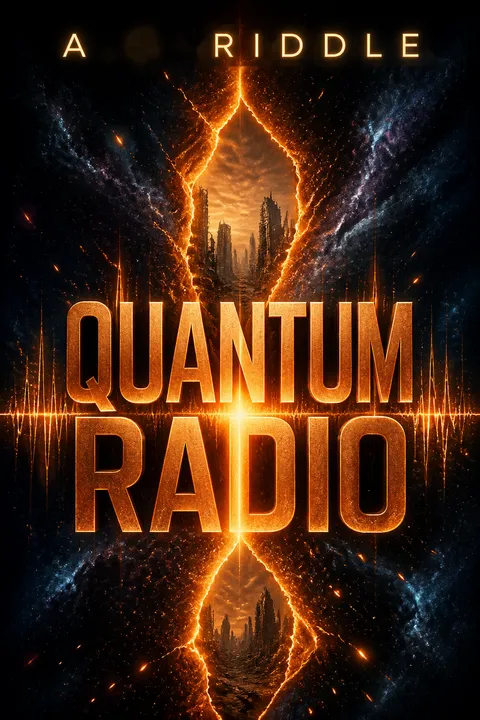
At CERN, physicist Tyson Klein presents the discovery that could unite competing theories of physics: collisions inside the Large Hadron Collider are producing particles that do not belong to the expected results. Their orderly pattern resembles a data stream arriving from somewhere else in space or time. Ty calls it a quantum radio broadcast and asks CERN to fund further research.
His confidence rests on years of work and the kindness his mother taught him to use against his fear of public speaking. That night, a cheap alarm clock arrives at his apartment. Penny Neumann, the woman he has been dating, calls to warn him to flee. The clock explodes behind him as he escapes into the stairwell, destroying his home and injuring neighbors.
Ty’s discovery begins as a scientific triumph, but its first consequence is violence. The alarm clock turns an abstract question about the boundaries of the universe into a bodily threat, while the absent data and destroyed apartment strip him of the security of ordinary scientific practice. His mother’s lesson about kindness is more than character background: it offers a counterforce to the fear that will govern the coming chase. The plot’s central tension is established early. Knowledge can enlarge human possibility, but once powerful actors recognize its value, discovery makes its discoverer vulnerable.
The Girl in the Alley
Penny summons Ty to the Geneva café where they first met. In the alley, he hears her arguing with Heinrich, a German operative who says the Covenant has altered CERN’s data and ordered Ty eliminated. Penny had been assigned to watch Ty, but she claims she did not know the bomb was coming. When Heinrich finds the USB drive containing Ty’s research, Penny secretly leaves it in his pocket, then attacks Heinrich when he threatens them.
Ty joins the struggle; Penny shoots Heinrich as he rises. She destroys Ty’s phone SIM card, warns him that the Covenant can track him, and sends him away. Her admission that the relationship began as a ruse leaves Ty hurt, but the rescue makes him doubt that everything between them was false.
Penny’s betrayal refuses an easy emotional verdict. She did deceive Ty, and the intimacy he trusted becomes evidence of how thoroughly the Covenant penetrated his private life. Yet she risks herself to preserve him and his research, making her actions more complicated than her original assignment. Ty must act without the comfort of knowing what she truly feels. The scene also begins his change from a man who trusts systems because they can be tested to one who must assess people under pressure. His pain remains real, but certainty is no longer available as a shield.
The Father in Zürich
Ty hitchhikes toward Zürich, where he hopes Gerhard Richter, the father absent from his life for thirty years, might help. Truck driver Lars shelters him, then risks arrest by hiding him from police searching for Ty in connection with the bombing, which killed a neighbor.
At a roadside stop, Lars chooses not to turn him in and delivers him near Richter’s office. Richter recognizes Ty, hustles him into a private jet, and explains that the Covenant sent the bomb because Ty’s research threatens its plans.
He brings Ty to Washington, where Ty learns that his mother, evolutionary biologist Helen Klein, works on the secret Origin Project with Richter. DARPA has decoded the broadcast into a machine schematic and four human genomes, then tries to exclude Ty from the investigation.
The journey to Zürich gathers the novel’s central family wound into the same chain of events as its scientific crisis. Lars’s decision to help a stranger contrasts with the institutions that reduce Ty to a suspect or a useful source of data. Richter, meanwhile, offers practical protection without immediately offering emotional repair. Ty’s arrival at DARPA therefore solves one problem and opens another: he has found his family, but the adults around him still control information and choices. Trust here is not a feeling granted in advance. It is a series of consequential acts, each carrying risk.
Four Genomes, One Machine
Ty recognizes that the broadcast’s first file describes a small collider, not a machine for printing people. The other files are human genomes. A search reveals that one belongs to a son of Helen Klein and Gerhard Richter, but Helen warns that either of her identical twin boys could match. The other son, Thomas, is serving time in federal prison.
DARPA also finds a male match in Navy SEAL Kato Tanaka, whose violent Nigerian operation was meant to protect a school from traffickers. Ty resists treating Kato as a criminal specimen. To find the other matches, he proposes a worldwide DNA lottery disguised as a billionaire’s inheritance search, paying people to submit cheek swabs. The plan turns a classified search into a public rush for money.
The genomes make identity both intimate and bureaucratic. DARPA reads people as sequences to be matched, while Ty insists that Kato’s actions must be understood in context rather than flattened into a criminal label. The twin uncertainty also makes family resemblance a scientific problem with personal consequences: a genome can identify kinship without explaining a life. Ty’s lottery proposal shows his characteristic movement from interpretation to practical design. Instead of accepting the limits of the government’s data, he changes the incentives of millions of strangers, converting public appetite into a tool for inquiry.
The Four Corners Assemble
The search identifies Nora Brown, Ty’s childhood friend and first love, now an experimental psychologist at Oxford, and Maria Santos, a singer-songwriter living in a Nashville shelter while fighting opioid dependence. Nora’s father, Robert, disappeared when she was eighteen, another absence that divided her from Ty. Maria is found after she accepts payment for a DNA swab while trying to secure shelter and work.
Ty reunites with his twin Thomas and learns that Thomas is not a match, but he remains under guard. Kato is brought from Nigeria and reunited with his wife Joan and young son Akito. Ty persuades DARPA to grant Thomas a presidential pardon in exchange for help operating the device, and insists that Nora and Kato join the effort.
The four matches are not assembled as interchangeable test subjects. Each arrives carrying a distinct unfinished life: Ty’s scientific ambition, Nora’s broken connection to her father and Ty, Kato’s estrangement from his family, and Maria’s struggle to reclaim creative work from addiction. The government sees a pattern before it understands its meaning, but Ty’s insistence on involving the four people changes the investigation from a search conducted on them into one they can shape. The pardon for Thomas also makes scientific access personal currency, forcing Ty to negotiate for someone he loves rather than accept institutional terms.
The Map Behind the Redactions
As DARPA assembles the palm-sized collider, officials ask Ty to identify the code needed to activate it but refuse to show him its full design. Ty studies Kato’s heavily redacted file and notices that Richter’s cryptic references to its pages point to a hidden map, which can guide an escape through tunnels beneath Washington.
Before the device is finished, Covenant agents breach the facility and armed attackers storm the labs. Ty selects four symbols associated with the group’s birth months and presses them on the medallion.
The device flashes, and the attackers vanish with the familiar Washington around them. The four travelers remain standing on the National Mall, but the museums and monuments have become ruins reclaimed by grass and trees.
The redacted file embodies the novel’s conflict over access: withholding knowledge does not eliminate danger, but it can leave people unable to act on it. Ty turns the marks used to erase Kato’s history into a route toward freedom, making the act of reading an intervention rather than a passive search for information. His activation code is still a guess, and the leap into another world exposes the cost of incomplete understanding. The ruined Mall is a particularly sharp consequence. The team has not simply escaped danger; it has crossed into a history where familiar landmarks record a different defeat.
The Mall After History
A pursuing jet attacks another aircraft above the ruined Mall, and the survivors race into the Natural History Museum as the plane crashes. They rescue the pilot, Commander Matthews, despite the danger of remaining in the open. Ty and Kato search the neighboring American History Museum and find an exhibit describing a world where Germany’s early use of rockets defeated Britain in 1940.
The Axis powers later formed the Covenant, while the United States and other threatened nations became the Pax. Matthews tells Nora that he is a Pax operative who has been investigating a new Covenant missile, the A21. Nora realizes the pilot knows a version of her as a fellow operative, and his account points toward an imminent attack on the Pax.
The alternate history is revealed through public artifacts rather than exposition alone. The museum converts the familiar National Mall into a record of choices that diverged from Ty’s world, while Kato’s historical knowledge lets the team distinguish shared events from the decisive break. Rescuing Matthews also establishes the group’s first moral test: they could flee a world that is not theirs, but instead they accept responsibility for an injured stranger. His recognition of Nora introduces a more intimate dislocation. The team must confront not only a different political history but versions of themselves who have lived inside it.
The Sea Becomes a Weapon
Pax forces rescue Nora and Maria from the museum, while robotic attackers capture Ty and Kato. Aboard the airship, Nora meets her father, Robert Brown, who has become a senior Pax leader. He reveals the planned Poseidon pathogen, designed to kill the ocean phytoplankton that produce much of Earth’s oxygen.
The Pax intends to use it as a last weapon against the Covenant, even though it would make the planet increasingly uninhabitable. Nora discovers that her counterpart helped develop the plan, and she persuades Robert that she is not that hardened operative.
Robert agrees to help her recover Ty and Kato. Once reunited, the four learn the Covenant’s A21 carries a different biological weapon, one meant to suppress the Pax population’s intelligence rather than kill them.
The story’s moral landscape refuses a clean division between a peaceful side and a monstrous enemy. The Pax is fighting oppression, yet its proposed answer would destroy the ecological basis of human life; the Covenant’s plan preserves its targets physically while stripping them of intelligence. Nora’s encounter with her father makes the danger personal, but it also shows her expertise at work: she reads his values and appeals to the attachment beneath his desperation. The opposing biological weapons reveal a shared error. Both sides treat human beings and ecosystems as instruments that can be damaged for the sake of an imagined final peace.
The Singer's Other Life
The team learns that the fourth match, this world’s Maria Santos, is a celebrity scheduled to perform at the A21 ceremony in Peenemünde. The Pax offers help on the condition that the team redirect the missiles toward designated Covenant military bases.
In Argentina, they abduct the wealthy Maria and place their Maria in her home, hoping no one will notice the exchange. Their Maria studies the mansion and the life she might have had, then refuses to let the captive double be harmed.
She also discovers an unfinished song that resembles work she has begun composing herself. Ty breaks into the double’s computer by refining Maria’s guess at the password, revealing the ceremony details and the Covenant’s plan. As the team prepares, Maria writes the anthem she must perform.
The double’s mansion gives Maria a material image of how radically circumstance can separate people who share a genome. The comparison could invite self-condemnation, but Maria’s refusal to torture her counterpart marks a different measure of character: she will not repeat harm simply because it could make the mission easier. Her unfinished song unsettles the boundary between the two women, suggesting that art may carry a pattern across lives without erasing their differences. The password breakthrough likewise depends on respecting Maria’s own memory rather than treating her as dead weight. Her creative and personal judgment both become practical forms of intelligence.
A Double Falls
At Peenemünde, Ty, Nora, Kato, and Maria enter under borrowed South American identities. Ty approaches Penny, this world’s Covenant employee, to learn where the missiles are controlled. Kato’s counterpart grows suspicious, and their confrontation ends with Kato killing him and taking his uniform.
Kato then removes Nora’s counterpart from detention so the team can learn the location of the Bunkerwarte control room. The operation fractures when Penny lures Ty into the primate facility, where a Gestapo officer exposes his false identity and locks him up.
Nora and Kato are also discovered; Kato reaches the control-room doors but is captured before he can enter. Maria is left to perform at the ceremony as the three others face detention and the Covenant prepares to launch.
Kato’s confrontation with his counterpart makes impersonation an ethical as well as tactical problem. He does not merely borrow another man’s access; he kills someone whose body and history mirror his own, and the violence leaves a moral cost that skill cannot cancel. Meanwhile, Ty’s trust in Penny’s counterpart repeats the emotional vulnerability of his first relationship, though this time he approaches her with more caution. The team’s simultaneous failures strip away the fantasy of a perfectly controlled plan. Their survival now depends less on the operation’s design than on the choices of people who still have room to change it.
The World After Begins
Helen Klein, the Covenant scientist leading the ceremony, recognizes that Ty is her son from another world after comparing his DNA with her own. Ty explains that the A21 payload would suppress the Pax’s intelligence, and warns that the Pax is preparing its own ecological weapon.
Nora’s counterpart confirms the danger and accepts a proposal to carry a peace offer home. Helen cancels the missile launch and offers unarmed Covenant engineers, aid, and eventual citizenship to the Pax, while the Pax agrees to consider cooperation.
Meanwhile, Maria performs the song she wrote for the ceremony, finding steadiness in the act of singing rather than in drugs. When the four rejoin aboard the plane, Maria feels pride in her performance, and the team leaves Peenemünde with both biological attacks halted.
The climax is resolved not by making one side militarily superior but by changing what each side believes the other is willing to do. Ty’s relationship to Helen gives his warning unusual credibility, while Nora’s counterpart has the authority to return the proposal to the Pax. Their personal connections become channels across political distrust. Maria’s performance offers a parallel resolution on a smaller scale: she completes a public act without relying on the drug that once seemed necessary for her to function. The peace remains provisional, but the immediate catastrophe is prevented because the characters refuse to treat fear as the only rational motive.
Observers Behind the Worlds
After the team returns to Buenos Aires, four armored figures appear and transport them among hidden Way Stations, including an empty Earth where dinosaurs still roam. They identify themselves as quantum historians, people from a more peaceful Earth who learned to open passages between universes.
They once explored beside the Covenant, until a catastrophe drove the Covenant to exploit other worlds for resources and armies. The historians say the Covenant is preparing to harvest worlds, including the one the team has just helped save.
They admit they tested the four by placing them in danger and watching whether they would protect strangers. The historians offer a glimpse of a possible Looking Glass World, where Ty, Nora, Kato, and Maria have lives shaped by health, family, and purpose.
The reveal complicates the apparent rescue structure. The historians oppose the Covenant, but they also manipulate the four travelers by placing them in a crisis designed to measure their morality. Their pacifism has preserved a principle at the cost of direct action, leaving other worlds to suffer. The team’s anger at being tested is therefore justified, even as their response demonstrates why the historians chose them. The Looking Glass vision makes the offer emotionally potent, but it is not simply a reward. It asks the characters to distinguish a promised future from the responsibilities and losses of the present.
The Price of Ty's Childhood
Ty asks the historians how his father knew so much about the quantum crisis. They show him a recording Gerhard made in 1983, after visitors accurately predicted events in his near future.
Those visitors told him that Ty’s later scientific discovery depended on his absence from the family, which would leave Ty driven to prove his worth. Gerhard refused at first, but the recording also shows that he was asked to support research and ensure Ty would eventually gain control of the medallion.
The historians insist they were not the visitors who approached him, leaving their identity unresolved. Ty reels at learning that his childhood wound may have been deliberately shaped, then chooses to hear the historians’ offer rather than abandon the mission.
This revelation threatens to convert Ty’s pain into a tool, as though his father’s absence were justified by the discovery it helped produce. The recording cannot undo the years of longing, and its prediction risks reducing a person to a causal mechanism. Yet Gerhard’s initial refusal shows that the sacrifice was contested, not inevitable. The historians’ denial also preserves uncertainty at the point where Ty most wants a complete explanation. His decision to continue is not forgiveness or acceptance of manipulation. It is a choice to act while the truth remains incomplete.
The First Quantum Mission
The four agree to serve as quantum agents, provided the historians address their health needs. Maria receives treatment that removes her physical cravings, while the historians cannot cure Ty’s unexplained quantum sickness or erase Kato’s psychological wounds.
Nora offers to help Kato, and the group asks to travel together rather than return home. The historians give each a Gestalt interface that stores knowledge, translates languages, records observations, and provides encrypted clues for future missions.
They warn that its data transmissions can reveal the team’s location to the Covenant. Nora and Ty watch a film together before acknowledging that their renewed love cannot safely become a relationship during the mission. The team enters the first assigned code together, leaving the station for an unknown world.
The ending turns the novel’s promise of escape into an obligation to move toward danger. The team accepts not because every wound has been healed or every question answered, but because each has found a form of purpose that includes the others. The Gestalt makes memory and knowledge portable while also creating a new vulnerability: every completed mission can expose their location. Nora and Ty’s decision to postpone romance is a practical form of care, not a denial of feeling. Their departure completes the shift from isolated specialists to a cooperative unit whose differences are necessary to survive.
Analysis
Quantum Radio treats scientific discovery as a problem of responsibility rather than merely one of knowledge. Ty’s quantum radio can open worlds, but the novel repeatedly shows that the ability to act on a system does not establish the right to control it. DARPA wants to test a device on people it assumes it can access; the Covenant aims to suppress the Pax’s intelligence; and the Pax considers destroying the ecological foundation of the planet. Each plan converts living beings into instruments for a promised future. The counterargument is not that action is always wrong, but that technical power without consent, humility, or attention to consequences becomes another form of violence.
The alternate timeline makes history feel contingent and bodily. A difference in rocket development changes the fate of Britain, the formation of the Covenant, and the lives of families generations later. The novel’s parallel selves extend that question from nations to individuals. Maria’s wealthy counterpart and her own damaged life are not proof that one woman is morally superior; they expose how choices interact with circumstance. Nora and Helen likewise meet versions of themselves shaped by radically different worlds. Identity is neither fixed by DNA nor completely free of history.
Family is the book’s emotional instrument for measuring these abstractions. Ty’s missing father, Nora’s vanished father, Kato’s separation from his wife and son, and Maria’s damaged relationship with herself all turn large-scale conflict into personal stakes. The team becomes effective not by erasing their differences but by assigning decisions to the people best equipped to make them. Its provisional structure offers an alternative to both military hierarchy and solitary genius.
The ending preserves uncertainty rather than granting a complete homecoming. The quantum historians offer the possibility of repairing a world, but their secrecy and their earlier experiment make trust conditional. Ty accepts the mission because the team has already chosen to protect strangers, not because the promise is guaranteed. The novel’s final movement therefore joins curiosity to ethical risk: exploring the multiverse matters only if the explorers remain answerable to the lives they encounter.
Review Summary
Quantum Radio receives mixed reviews, with an overall 4.10 rating. Readers praise its intriguing premise, fast-paced plot, and scientific concepts. Some enjoy the blend of sci-fi, alternate history, and thriller elements. Critics note issues with dialogue, character development, and an overreliance on exposition. The book's shift in tone and genre midway through divides opinions. Many reviewers see it as a setup for a series, with some excited for future installments while others found the ending unsatisfying.
People Also Read
Characters
Tyson Klein
The reluctant physicistA CERN physicist whose obsessive curiosity has led him to search for a Theory of Everything. Ty is intellectually quick but socially awkward, more comfortable testing a hypothesis than interpreting a person. His mother taught him to manage fear by acting with kindness, a lesson that becomes a practical guide when scientific work turns dangerous. He carries unresolved anger toward the father who left his family and guilt about his twin brother’s imprisonment. Ty’s central drive is to understand what reality is made of, but his strongest decisions come when he recognizes that discoveries affect people, not merely equations. He grows more willing to trust others and accept responsibility without pretending to know every answer.
Nora Brown
The mind readerTy’s childhood neighbor, close friend, and first love, Nora is a physician and experimental psychologist whose work explores how people can understand and use their own minds. She is a careful listener with a strong instinct to care for others, but her father’s disappearance when she was eighteen left her guarded and emotionally withdrawn. Nora’s professional training gives her a particular talent for reading motives without reducing people to diagnoses. She values evidence, yet she can recognize that a frightened person may need reassurance before analysis. Her warmth is not passivity: when danger arrives, she learns to turn empathy into strategy and to take responsibility for people whose lives have become entangled with hers.
Kato Tanaka
The scarred protectorA Navy SEAL and devoted student of history, Kato approaches danger as a problem of preparation, timing, and responsibility. His scar and military record reveal only part of him; beneath his discipline lies a man troubled by anger, guilt, and the cost his service has imposed on his wife and son. He believes decisive action can protect the vulnerable, but he knows that force can leave damage even when used for a defensible cause. His practical expertise gives the group a way to survive physical threats, while his interest in the past helps them read the altered world. Kato’s deepest motivation is to protect people without losing the humanity he is fighting for.
Maria Santos
The singer rebuildingA singer-songwriter whose career and personal life have been damaged by addiction, anger, and the exposure that comes with making art in public. Maria has lived through poverty and instability, and she knows how quickly a person can be judged by the worst period of their life. Her notebook is a repository of songs and ideas she believes can help people feel less alone. She is wary of being treated as a liability, yet her creative instincts and hard-earned street sense are essential to the group. Maria’s compassion is strongest when she recognizes that another person could have lived a different version of her life. She wants recovery, but also wants to reclaim the artist she once believed herself to be.
Gerhard Richter
The absent fatherTy’s estranged biological father, Richter is a German-born financier whose calm, controlled manner makes his motives difficult to read. He has spent much of his life around secrets, long-term plans, and decisions whose consequences may not be visible for years. His emotional reserve can feel like indifference, especially to the son who grew up without him, but he is attentive to practical needs and alert to danger. Richter’s relationship with Ty is complicated by old hurt and the gap between knowing facts about someone and actually being present for them. He is drawn to systems and strategy, yet the family he left remains the measure against which his choices are judged.
Helen Klein
The scientist motherTy’s mother, an evolutionary biologist whose scientific curiosity is matched by a gift for turning difficult ideas into guidance a child can use. She raised her children largely on her own and taught Ty that fear is natural but need not dictate behavior. Helen values evidence, care, and personal responsibility, and she can be both nurturing and fiercely protective. Her long separation from Richter has left deep tensions that she does not hide. She sees scientific work as a way to improve human lives, while remaining alert to the damage that ambitious projects can cause. Her mix of intellectual rigor and maternal conviction shapes Ty’s moral instincts long after he has left home.
Thomas Klein
Ty's twin brotherTy’s identical twin, Thomas has spent years in prison after choices that left his family deeply worried. He is more socially perceptive than Ty and can recognize the guilt his brother carries even when Ty tries to conceal it. Thomas has spent time confronting his own past and understands that reflection can teach a person, but endless self-punishment cannot repair what has happened. His bond with Ty is affectionate and candid, shaped by shared history and a sense of responsibility for one another. Thomas represents the life Ty cannot solve with scientific insight alone.
Penny Neumann
The divided confidanteA German graduate student Ty meets in Geneva, Penny is intelligent, composed, and interested in international affairs and the forces that shape political change. Her ease with Ty gives him a rare sense of comfort, while her guardedness suggests a life governed by pressures he cannot see. Penny is capable of keeping secrets, but she is not defined by detachment; her choices are shaped by competing loyalties and a desire to protect people she cares about. Ty’s relationship with her forces him to distinguish intimacy from certainty and to reckon with the possibility that someone’s motives can change.
Lars
The road-worn helperA veteran truck driver who has spent decades crossing Europe at night, Lars is reflective, practical, and uneasy about the compromises that made his life smaller than he once imagined. He once hoped to become a philosopher, but family needs and financial pressure sent him onto the road. His regrets have made him wary, not cruel. When Ty asks for help, Lars weighs the risks against his own sense of what is right. His presence gives the novel a grounded portrait of how ordinary decisions, made under pressure, can change the fate of someone else.
Sanford Bishop
The pressured directorA senior DARPA scientist who coordinates the Origin Project’s effort to decode the quantum broadcast and build the device it describes. Bishop is clever, pragmatic, and accustomed to decisions shaped by national security rather than individual preference. He can be brusque when time is short, particularly when Ty challenges the project’s assumptions. His humor and fixation on mundane routines offer glimpses of the strain beneath his professional composure. Bishop’s role highlights the friction between expertise and authority: he needs Ty’s insight but does not always welcome the uncertainty Ty brings with it.
Robert Brown
Nora's missing fatherNora’s father is a marine biologist whose lifelong attention to the oceans has taught him to see ecological systems as the foundation of human survival. His disappearance shaped Nora’s adult life and her understanding of family, science, and loss. In the world the travelers enter, Robert has been formed by decades of war and by the duty he feels toward his children and community. He is loving but capable of severe choices when he believes survival is at stake. His scientific knowledge and parental attachment pull against the demands placed on him by the Pax.
Helen Klein, Covenant counterpart
The rival scientistA version of Ty’s mother from the Covenant world, Helen is a powerful scientist associated with the Darwin Program and the Peenemünde research effort. She shares the original Helen’s intelligence and ability to explain scientific problems, but years in a militarized society have shaped her priorities and assumptions. She believes scientific intervention can end conflict, even when the proposed intervention risks stripping people of their humanity. Her confidence in institutional plans makes her formidable, while her curiosity leaves room for questions she has not previously allowed herself to ask.
Nora Brown, Covenant counterpart
The hardened doubleThe Nora who grew up in the Covenant world is an operative shaped by war, secrecy, and a lifetime of resistance. She has the same intelligence and history of close family bonds as the Nora Ty knows, but those qualities have hardened under conditions the original Nora never faced. Her fierce self-control makes her difficult to read and harder to persuade. The contrast between the two women shows how different circumstances can produce sharply different moral instincts without making either person a simple opposite of the other.
Plot Devices
The LHC data stream
A message across timeTy’s algorithm detects particles in the Large Hadron Collider that cannot be explained by the collisions that produced them. Their patterned arrangement reveals that they carry organized information, not random noise. The broadcast gives the plot its scientific inciting incident and draws the Covenant, DARPA, and the Origin Project into conflict over who can interpret it. Its unusual medium also links quantum physics to the novel’s larger questions about time, parallel worlds, and human history.
The quantum radio medallion
A door between worldsThe medallion is a compact particle collider with a dial of twelve symbols. Its code can open a passage between worlds, though a mistaken sequence may send its user somewhere uninhabitable. The device is first understood through a schematic hidden in the broadcast, then becomes the travelers’ means of crossing into the alternate Earth. Its portability makes it a tool of escape and a source of danger, since whoever controls it can influence where the team goes next.
The four genomes
A human pattern to decodeFour complete human genomes accompany the machine schematic in the quantum broadcast. DARPA initially assumes they belong to representatives to be created, but Ty argues they identify existing people. The search brings together Ty, Kato, Nora, and Maria, whose separate lives and unfinished projects prove central to the mystery. Their DNA functions as evidence, a selection mechanism, and a reminder that data can point to people without explaining their histories or granting anyone permission to control them.
Kato's redacted file
A map hidden in recordsRichter gives Ty Kato’s heavily censored military file and urges him to examine it from more than one direction. The marks that conceal information also leave a pattern on the reverse of a page, which Ty recognizes as a route through tunnels beneath Washington. The file turns bureaucratic erasure into a practical escape tool and makes reading an active, interpretive skill. It also gives Ty a way to recognize his father’s indirect guidance without yet knowing everything Richter is hiding.
The Gestalt
Knowledge carried in skinThe quantum historians give each traveler a biological interface that stores information in DNA and appears as a menu on the forearm. It holds searchable knowledge, translations, personal research, and a record of what the team learns on each world. The Gestalt can reveal the next destination only after an encrypted mission outcome is achieved, then transmits its data in a way that may expose the team to Covenant pursuit. It equips the travelers while placing a limit on what they can safely share.
Download PDF
Download EPUB
.epub digital book format is ideal for reading ebooks on phones, tablets, and e-readers.








