

Key Takeaways
Follow the footnotes back to the original record
The source trail matters. Richard Evans entered the libel case as an expert witness, not as a judge of the Holocaust’s moral meaning. His task was to test Deborah Lipstadt’s claim that David Irving distorted history. The defense assembled a 740-page report on Irving’s work, then traced his statements through books, speeches, archives, and original documents. That meant checking German wording, the context of a document, and whether a cited source actually supported the claim attached to it.
Research is verifiable work. Irving advertised his command of archives and original material as proof of reliability. Evans shows why the appearance of scholarship is not enough: citations matter only when readers can follow them and test the interpretation. Historians also rely on other historians, but transparent references make that dependence open to scrutiny.
What's striking is how the book turns citation from scholarly decoration into a public accountability mechanism. The approach resembles forensic work: a conclusion is only as dependable as the chain connecting it to the evidence. Yet traceability alone does not guarantee truth. A reader must also ask whether the cited material is representative, whether contrary evidence was considered, and whether the source is reliable. Evans's case is strongest because it tests not just whether a document exists, but what it can reasonably establish.
A genuine document can still be made to say the opposite
Authenticity is not interpretation. In Irving’s account of the 1938 anti-Jewish pogrom, he used an authentic entry from Joseph Goebbels’s diary to imply that Hitler merely allowed local protests to continue. Evans compared the English version with the German text and found that key language had been softened or mistranslated. Goebbels’s entry referred to serious attacks already under way in other cities, and recorded Hitler’s approval of letting the violence continue while police were withdrawn.
Context changes meaning. Other contemporary records, including instructions to police and the Nazi Party’s own investigation, reinforced the account of official complicity. Irving’s version omitted or altered material that complicated his claim that Hitler opposed the pogrom. The lesson is not that documents speak for themselves. It is that authentic evidence can be distorted through selective quotation, translation, and missing context.
This is a useful distinction for any reader evaluating evidence: source authenticity and source meaning are separate questions. In law, science, and journalism, a genuine record can still be quoted selectively or stripped of context. Translation raises the stakes because small shifts in verbs and tone can alter responsibility. A careful account therefore explains both what a source says and what it cannot prove. The comparison also guards against a common mistake: treating a document as trustworthy simply because its paper and provenance are genuine.
When every mistake favors Hitler, sloppiness stops being a plausible excuse
Direction reveals pattern. Evans did not treat every error as proof of deliberate deception. Historians misread documents and make mistakes. But in the examples he examined, the errors repeatedly minimized Nazi violence or made Hitler appear less responsible. Irving invented details about Hitler disciplining a Nazi who had attacked a Jewish shop, while omitting that the witness was a committed Nazi official whose testimony was treated cautiously even by the court hearing it.
The pattern crosses subjects. In another case, Irving presented Nazi official Kurt Daluege’s antisemitic propaganda about Jewish crime as statistical evidence, then altered its figures and meaning. Evans argues that repeated errors pointing in the same political direction are different from scattered carelessness. The cumulative pattern, including suppressed evidence and implausible excuses for contrary sources, supports an inference of purposeful manipulation.
The argument depends on asymmetry, not on the mere existence of mistakes. One error may be accidental; a repeated pattern that consistently benefits the same thesis calls for a stronger explanation. This is close to a general principle of hypothesis testing: explanations should account for inconvenient observations, not only the confirming ones. Still, intent is harder to establish than error. Evans's case gains force by showing recurrence across unrelated episodes, alongside evidence that Irving had access to the material he omitted or altered.
Hitler's records undermine the claim that he knew nothing of mass murder
The evidence converges. Irving argued that Hitler neither ordered nor knew about the extermination of Europe’s Jews. Evans tested that claim against multiple kinds of records. Goebbels’s diary described Hitler as supporting a radical solution to the Jewish question. A 1943 meeting record shows Hitler, speaking to Hungary’s regent Horthy, endorsing the annihilation of Jews who could not work. In occupied Rome, Hitler’s instruction redirected the fate of Jews from local labor proposals to deportation as hostages, a measure that did not save them.
No single paper decides everything. Evans also examines disputed notes and euphemistic Nazi language, showing why each item must be read in context. Together, the records contradict Irving’s picture of Hitler as a protector who was kept ignorant by subordinates. The issue is not whether one signed order survives, but whether the accumulated evidence supports the claim of knowledge and approval.
The strength here lies in convergence. Diaries, meeting records, administrative actions, and testimony carry different weaknesses, but agreement across sources can make a conclusion more robust than any single document. This is especially important when perpetrators use coded or evasive language. At the same time, historians must distinguish evidence of knowledge, policy direction, and personal initiative rather than collapsing them into one claim. Evans's account gains credibility by showing how the record supports responsibility without pretending every operational detail is documented in a direct order.
Holocaust denial shrinks the dead, then attacks those who remember
Denial has recurring moves. Evans identifies a cluster of claims: far fewer Jews were killed than the accepted estimates of 5 to 6 million; gas chambers did not kill large numbers; there was no centrally directed extermination policy; and evidence was fabricated after the war. Irving’s public position shifted sharply around the 1988 trial of Ernst Zündel. He increasingly described mass deaths as disease, disputed gas-chamber evidence, and treated survivors’ memories as unreliable or fraudulent.
Small concessions disguise large denials. Irving sometimes acknowledged shootings or limited gassing, then used those admissions to deny the broader, systematic murder of millions. He also claimed that missing Jews had survived, died in Allied raids, or secretly reached Palestine, without substantiating these explanations. Evans shows how a veneer of technical skepticism can obscure a sweeping rejection of well-established evidence.
The pattern illustrates how denial can borrow the posture of skepticism while applying it unevenly. It demands impossible certainty from evidence for mass murder, then accepts speculation when it reduces the scale of the crime. That asymmetry is more revealing than any single disputed number. Survivor testimony also requires careful evaluation, as all testimony does, but dismissing whole classes of witnesses without comparable scrutiny is not neutral method. A serious account weighs memory alongside documents, physical evidence, and independent corroboration.
A forged Dresden report inflated deaths and clouded debate over bombing
A dramatic number travelled. In The Destruction of Dresden, Irving promoted a report known as TB 47, which claimed 202,040 deaths and predicted a toll of 250,000. He had initially called the document a forgery, then accepted it after finding a copy that supported a much higher estimate. Later records contradicted it: the authentic police report counted 18,375 dead by March 10, and another report listed 22,096 bodies recovered by March 31. The forged version had simply added a zero to key figures.
The real tragedy needed no inflation. Cemetery records and later investigations placed the total around 25,000. Evans shows that Irving continued using inflated figures despite evidence against them. The bombing itself remains a grave moral and strategic question. Inflating its death toll did not clarify that question; it helped create a false equivalence with Nazi mass murder.
The Dresden episode is powerful because it shows how a false statistic can outlive the document that generated it. Numbers feel objective, yet their authority depends on provenance, method, and corroboration. The case also separates two judgments that are often wrongly fused: the Allied bombing may be condemned on its actual record without borrowing fabricated figures. Historical accuracy does not soften the human cost. It gives moral argument firmer ground and prevents one atrocity from being used to erase or diminish another.
The libel trial tested Irving's methods, not whether the Holocaust happened
The lawsuit set the frame. Irving sued Lipstadt and Penguin Books over her description of him as a Holocaust denier and falsifier of history. Under English libel law, the defense had to prove the accusations true. The resulting case examined his treatment of evidence in detail, rather than asking a court to decide whether the Holocaust had occurred. Judge Charles Gray ultimately found the central criticisms justified and identified nineteen instances in which the defense had shown Irving misrepresented the record.
The process had unusual reach. The trial allowed months of examination, long reports, and close comparison of documents. That made it a revealing test of historical method, but not a substitute for scholarship. The judgment rested on expert research and a large documentary record, not on the judge’s authority to decree historical truth.
The trial’s legal structure sharpened accountability but also created risks. Because the defense carried the burden of proof, it had to reconstruct a vast body of evidence to answer a claim that might otherwise have gone unanswered. The judge’s detailed judgment made the reasoning unusually accessible, while the adversarial format encouraged each side to select points useful to its case. The result is best understood as a rigorous review of a specific author’s methods, not as a legal certificate for every historical conclusion.
Keep historical interpretation open, but make evidence answerable to scrutiny
Interpretation is not unlimited. Evans accepts that historians select material, ask different questions, and disagree about meaning. That does not make all accounts equally sound. A historian must consider evidence that challenges a preferred explanation, disclose uncertainty, and revise conclusions when the record requires it. The distinction is between legitimate interpretation and claims that depend on suppressing, altering, or inventing evidence.
Skepticism has duties. Irving repeatedly treated ambiguity as permission to dismiss contrary material, while presenting unsupported alternatives as plausible fact. Evans argues instead for checking sources against one another and making reasoning visible to readers. Historical knowledge is neither a perfect photograph of the past nor a free-for-all of competing stories. It is a disciplined, revisable account constrained by what the evidence can bear.
This is the book’s broadest contribution: it rejects both naïve certainty and radical relativism. Historical accounts are constructed, but their construction can be tested. A useful parallel is scientific practice, where theories remain provisional while still being judged by evidence, explanatory reach, and openness to disconfirmation. The comparison has limits, since historical events cannot be rerun in a laboratory. That makes transparent methods, source criticism, and independent corroboration more essential, not less. Interpretive freedom survives when claims remain accountable.
Analysis
Evans turns a libel suit into a practical demonstration of how historical knowledge is made and how it can be abused. The central achievement is methodological. Rather than asking readers to accept a moral verdict about David Irving, he follows individual claims back through citations, translations, archival records, and later testimony. The reader sees how distortions can occur without inventing an entire document: selective quotation, altered wording, omitted context, dubious statistics, and the repeated treatment of inconvenient evidence as uniquely suspect. The Dresden case adds a revealing counterpoint, since the manipulation of the death toll predates Irving’s open Holocaust denial and exposes a consistent political use of historical numbers.
The book also makes a strong case that intent can sometimes be inferred from a pattern. One misreading is not enough. But errors that repeatedly benefit the same thesis, combined with access to contrary evidence and changing explanations when challenged, support a judgment beyond mere carelessness. The trial gives this argument unusual clarity because the court record preserves the questions, evasions, concessions, and documentary checks. Its adversarial structure, however, is also a limitation. The case was designed to establish whether the defendants had told the truth about Irving, not to provide a comprehensive history of the Holocaust or a balanced assessment of every controversy surrounding the war.
Evans’s deepest point is that historical objectivity is not a claim to be without commitments. It is a discipline of allowing evidence to resist those commitments. Interpretations differ, sources are incomplete, and uncertainty is real. None of that licenses the invention of certainty or the strategic dismissal of evidence. The distinction between disagreement and falsification depends on transparent reasoning, engagement with contrary material, and conclusions proportionate to what sources establish. The book’s most durable value is its insistence that readers can test historical claims themselves, provided they follow the evidence rather than the confidence of the person presenting it.
Review Summary
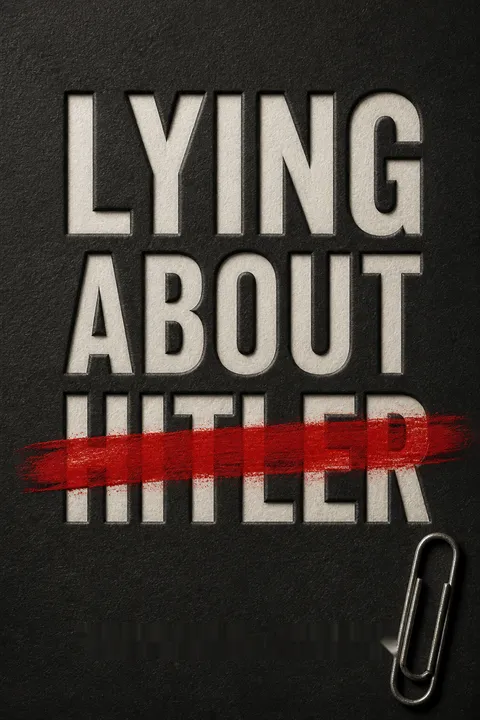
Lying About Hitler is praised for its thorough examination of David Irving's Holocaust denial and the subsequent libel trial. Readers appreciate Evans' meticulous analysis of Irving's historical distortions and the book's insights into historiography. Many find it a compelling read, though some note its academic density. The book is lauded for its exploration of historical objectivity and the responsibilities of historians. While some reviewers desired more detail about the trial itself, most consider it an important work exposing Irving's deliberate falsifications and the dangers of Holocaust denial.
People Also Read



Glossary
Holocaust denial
Rejection of Nazi genocideA set of claims that rejects or radically minimizes the Nazi attempt to murder Europe’s Jews. In Evans’s account, central elements include denying mass extermination by gas, denying a systematic policy, reducing the number of victims, and alleging that evidence was fabricated. Irving adopted these positions increasingly from the late 1980s.
Einsatzgruppen
Mobile SS killing unitsSpecially organized German SS and police task forces that followed the invading army into occupied Soviet territory. They shot Jews and other targeted groups and reported their operations to superiors. Evans uses their records to show both the scale of the killings and the connection between activity in the field and authorities in Berlin.
Reichskristallnacht
November 1938 anti-Jewish pogromThe widespread Nazi-orchestrated violence against Jews on November 9 and 10, 1938. Synagogues and Jewish businesses were destroyed, homes were attacked, and Jews were beaten, killed, and arrested. The term was a popular label for the shattered glass, while Evans’s account emphasizes the organized political direction behind the violence.
Final Solution of the Jewish Question
Nazi plan to exterminate JewsThe Nazi regime’s euphemistic label for the systematic persecution, deportation, and murder of European Jews. The book shows that implementation developed through decisions and actions by Nazi leaders and agencies, rather than relying on a single surviving written order. Nazi officials also used the phrase in discussions whose immediate subject could be narrower.
Discovery
Court-ordered evidence disclosureThe legal process through which parties in the libel case had to disclose relevant documents to one another. Irving’s disclosure included private papers, diaries, recordings, letters, and research materials. This gave the defense access to evidence beyond his published books and enabled close comparison between his public claims and the records behind them.
Tagesbefehl Nr. 47 (TB 47)
Forged Dresden casualty reportA purported 1945 report about the Dresden bombing that gave a death toll above 200,000. Irving promoted a copy as authentic before later evidence showed that the original report gave much lower figures and that zeros had been added to the figures in the forged version. Evans uses the episode to examine statistical manipulation and source criticism.
Institute for Historical Review
Holocaust denial organizationA United States organization that presented itself as a historical research institute while promoting claims that denied the Holocaust. Its journal and conferences provided a platform for writers who disputed the gas chambers, the scale of Jewish deaths, and the existence of a Nazi extermination policy. Irving spoke at its conferences and endorsed its journal.
FAQ
What is "Lying About Hitler" by Richard J. Evans about?
- Holocaust denial on trial: The book examines the libel case brought by David Irving against Deborah Lipstadt and Penguin Books, using it as a lens to explore Holocaust denial and the manipulation of history.
- Irving’s historical distortions: Evans details how Irving systematically distorted historical records to exonerate Hitler and minimize the Holocaust.
- Defense of historical truth: The narrative highlights the importance of rigorous historical methodology and the broader implications of the trial for defending factual history and memory.
Why should I read "Lying About Hitler" by Richard J. Evans?
- Insight into historical methodology: The book offers a clear explanation of how historians work, emphasizing objectivity, evidence, and the dangers of ideological distortion.
- Understanding Holocaust denial: It provides a thorough analysis of Holocaust denial tactics and the importance of confronting them.
- Legal and moral significance: The trial serves as a case study in the intersection of law, history, and public memory, making the book relevant for anyone interested in truth and justice.
What are the key takeaways from "Lying About Hitler" by Richard J. Evans?
- History can be weaponized: The book demonstrates how history can be manipulated to serve hateful or ideological agendas.
- Importance of evidence: Rigorous verification, provenance tracing, and balanced interpretation are essential to historical truth.
- Legal accountability: The Irving trial shows how legal and scholarly processes can expose falsification and defend historical memory.
What is Richard J. Evans’ definition of an objective historian in "Lying About Hitler"?
- Impartial evidence assessment: An objective historian considers all evidence fairly, not just what supports their views.
- Self-critical approach: Historians must abandon assumptions when contradicted by evidence and avoid wishful thinking.
- Truth-seeking mission: The primary goal is to discover and accurately represent the past, not to promote ideological agendas.
How did Richard J. Evans become involved in the David Irving trial?
- Expert witness role: Evans was recruited by Deborah Lipstadt’s legal team to assess Irving’s historical claims.
- Specialist qualifications: As a Professor of Modern History with expertise in German history and archival research, Evans was well-suited for the task.
- Commitment to objectivity: He aimed to provide truthful, objective evidence to the court, regardless of which side he was supporting.
What were the main allegations against David Irving in "Lying About Hitler"?
- Falsification of history: Irving was accused of distorting and manipulating evidence to exonerate Hitler and minimize the Holocaust.
- Holocaust denial: He denied the systematic extermination of Jews and the existence of gas chambers.
- Political agenda: Irving’s writings were alleged to serve a neofascist, antisemitic agenda rather than objective scholarship.
How does Richard J. Evans describe David Irving’s treatment of Hitler and the Jews before 1939?
- Positive bias toward Hitler: Irving portrayed Hitler as a patriot who tried to mitigate antisemitic excesses and was unaware of violence against Jews.
- Manipulation of sources: Evans shows Irving selectively quoted and mistranslated documents to support a favorable image of Hitler.
- Concealment of evidence: Key facts implicating Hitler or Nazi leaders in antisemitic violence, such as Kristallnacht, were omitted or distorted by Irving.
What does "Lying About Hitler" reveal about Irving’s claims regarding Hitler and the “Final Solution”?
- Systematic distortion: Irving falsely claimed Hitler was unaware or opposed to the extermination of Jews, manipulating documents to support this.
- Selective use of evidence: He suppressed or mistranslated key documents that showed Hitler’s involvement in mass murder policies.
- Logical contradictions: Evans highlights inconsistencies in Irving’s arguments and his disregard for the broader context of Nazi extermination policies.
How does David Irving’s work relate to Holocaust denial according to Richard J. Evans?
- Core denial beliefs: Irving minimized Jewish deaths, denied gas chambers’ use, and claimed the Holocaust was a postwar myth.
- Ties to denial groups: He had close connections with Holocaust denial organizations and figures.
- Antisemitic rhetoric: Irving used classic antisemitic tropes, blaming Jews for their persecution and alleging conspiracies.
What were the main controversies about the bombing of Dresden in David Irving’s work, as discussed in "Lying About Hitler"?
- Inflated death tolls: Irving promoted a forged document (TB 47) claiming over 200,000 deaths, ignoring authentic reports of around 25,000.
- Use of propaganda: He relied on Nazi propaganda materials and failed to verify the authenticity of his sources.
- Long-term misinformation: Irving continued to publicize exaggerated figures even after they were proven false, reflecting a pattern of unreliable scholarship.
How did the 2000 libel trial between David Irving and Deborah Lipstadt unfold according to "Lying About Hitler"?
- Focus on evidence: The trial centered on whether Irving deliberately falsified history and denied the Holocaust, with expert historians providing detailed reports.
- Irving’s self-representation: Irving represented himself, facing rigorous cross-examination that exposed his distortions.
- Judgment and verdict: The judge found Irving to be a racist, antisemite, Holocaust denier, and falsifier of history, vindicating Lipstadt.
What lessons does "Lying About Hitler" by Richard J. Evans offer about the use and misuse of history?
- Dangers of distortion: The book warns that history can be weaponized to promote hateful agendas, as seen in Irving’s work.
- Need for rigorous method: Careful verification and balanced interpretation are essential to historical truth.
- Role of accountability: The Irving trial demonstrates how law and scholarship can collaborate to expose falsification and defend memory.
About the Author

Download PDF
Download EPUB
.epub digital book format is ideal for reading ebooks on phones, tablets, and e-readers.








