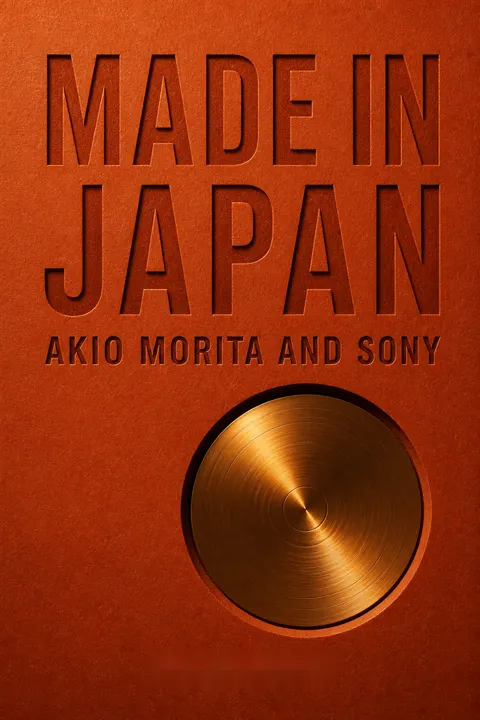


Key Takeaways
Build global quality from local constraints, not inherited prestige.
A start in ruins. In 1946, Akio Morita and engineer Masaru Ibuka began a company in a damaged Tokyo department store, with about $500 in pooled resources. Their first ideas included products that failed, but the partnership endured: Ibuka drove technical invention, while Morita learned to sell and build relationships with customers. The company eventually became Sony.
A choice of succession. Morita was expected to inherit his family’s sake business, but his father accepted that his son could choose another path. Morita’s physics training, wartime research, and early experiments with sound shaped his work with Ibuka. The company’s rise began not with an elaborate business plan, but with two people pursuing a shared ambition amid shortages and uncertainty.
The origin story is memorable because it combines improvisation with complementary strengths. Ibuka’s engineering and Morita’s commercial instincts were not interchangeable, and the company needed both. It also complicates the familiar lone-founder myth: Morita had an excellent education, a supportive family, and access to influential advisers. The book’s account suggests that grit matters, but so do relationships and resources that make a risky choice survivable. The founding lesson is less “start from nothing” than “combine distinct capabilities around a goal worth pursuing.”
Make customers see an invention's use before asking them to buy it.
A costly surprise. Sony’s first tape recorder weighed about 35 kilograms and cost 170,000 yen, an enormous price when a university graduate earned under 10,000 yen a month. Morita demonstrated it widely. People enjoyed hearing their recorded voices, but regarded the machine as an expensive toy. Good engineering had not answered the buyer’s practical question: why own this?
Find the urgent user. A shortage of court stenographers gave the recorder an immediate purpose. With help from education official Tamon Maeda, Sony demonstrated it to Japan’s Supreme Court and quickly sold twenty machines. Schools soon saw another use: playing language recordings and letting students practise speaking. The product had not changed; the customers and the problem it solved had. Morita learned that selling innovation means finding people who already recognize its value.
This is a sharp distinction between liking a demonstration and needing a product. The recorder impressed audiences, but only courts and schools could connect its novelty to a concrete task. That makes early buyers more than sources of revenue: they help reveal what a technology is for. The caution is that a successful niche does not automatically predict mass demand. Sony still had to make the machine more affordable and useful to a wider public. The practical test is not whether people call an invention clever, but whether they can explain what it lets them do.
Pair technical invention with a use, a product, and a story.
Three kinds of invention. Morita argues that commercial innovation requires more than a technical breakthrough. A company must also imagine a useful product and explain its value convincingly. Sony’s Walkman shows the sequence. Ibuka wanted portable music without disturbing other people, but the available equipment was heavy. Sony repurposed a small cassette machine, removing its recording circuit and speaker and adding stereo sound and light headphones.
Sell the new habit. Engineers doubted customers would buy a player that could not record. Morita insisted on a price aimed at young buyers and promoted the idea of private, portable listening. The Walkman sold more than 20 million units across over 70 models by the time of the book. Betamax applied similar thinking to television: record a program and watch it at a chosen time, an idea Morita called time-shift.
The Walkman illustrates how innovation can come from subtraction rather than adding features. The product answered a social preference, listening privately while moving, that the engineering team had initially undervalued. Morita’s model is useful because it connects invention to design and communication instead of treating technical superiority as self-explanatory. Still, confidence is not evidence by itself. A leader’s intuition can open a path, but prototypes, production capacity, pricing, and customer response determine whether the idea travels beyond its champion.
Keep your own name on the product, even when a giant order tempts you.
A tempting contract. An American buyer, Bulova, offered to order 100,000 Sony radios, but wanted the Bulova name on them. Morita rejected the deal, despite pressure from colleagues to accept. He believed the company needed to build recognition under its own name rather than borrow another firm’s reputation. Sony’s name was designed to be short, easy to pronounce internationally, and distinctive.
Own the conversation. Morita also found that layers of distributors could not explain unfamiliar products as well as their makers could. Sony developed direct relationships with dealers and customers, building sales and service networks in overseas markets. The strategy demanded investment and patience, but it protected the link between the product, its quality, and the company responsible for it. A large order can finance growth, yet surrendering the brand can make a young manufacturer invisible.
The Bulova decision makes brand ownership concrete: it was not a design preference, but a commitment to being recognized and accountable. A brand is valuable partly because it concentrates trust, so a company that hides behind another name gives up a major channel for learning from its users. Direct distribution also keeps communication close to the maker. The trade-off is real: refusing large orders can strain a young company’s finances. Brand-building is not automatically virtuous; it has to be backed by reliable products and service.
Treat employees as partners in the company's fate, not disposable inputs.
Shared responsibility. Morita describes Sony as a workplace where employees and managers share the company’s fortunes. He expected new recruits to stay for decades, and argued that security, respect, and meaningful work could motivate people alongside pay. In difficult periods, the company tried to retain employees rather than treat layoffs as the default response. Managers were expected to take responsibility for leading the group, not merely maximizing short-term returns.
Make voice practical. Sony received an average of eight suggestions per employee each year, many aimed at improving a job or process. The company also advertised internal openings so workers could seek roles that suited them better. This mattered because an unhappy employee might feel trapped by a supervisor or a poor job match. Morita’s version of the company family was not just a warm metaphor; it required channels for employees to contribute and move.
The strongest part of this model is its attempt to align security with contribution. Stable employment can encourage people to share expertise, while suggestions and internal transfers give the promise of belonging practical form. But a family metaphor can conceal unequal power: employers still set terms, and long tenure can limit outside options. The book’s most useful implication is not that every organization should copy one national system. It is that commitment becomes credible when employees can see how their ideas matter and how the organization shares hardship.
Invite dissent, move people into better roles, and learn from mistakes.
Disagreement as protection. Morita valued different opinions, arguing that a company where leaders always agreed would have fewer safeguards against bad decisions. Sony’s founding statement, the Sony Spirit, stressed creative work and making room for people’s abilities. The company treated mistakes as opportunities to understand what went wrong, rather than occasions to find a scapegoat. Morita cited costly failures, including Sony’s Chromatron television system, as part of the normal risk of trying new things.
Give people room to move. After a young employee complained that his section chief was blocking his work, Morita introduced a weekly internal job listing. Employees could apply for other roles, and repeated transfer requests could reveal a weak manager. The practice addressed a blind spot in personnel decisions: managers could not always know where an employee would thrive. The goal was to learn from problems without wasting capable people.
The important distinction is between tolerating failure and ignoring it. Morita’s approach asks leaders to examine causes, circulate lessons, and preserve the person’s capacity to contribute. Internal job postings similarly turn dissatisfaction into information about both roles and supervisors. These mechanisms matter because slogans about openness do little when employees cannot safely disagree or change direction. The model also needs accountability: repeated mistakes without investigation are not learning. Candor works best when people can challenge decisions and still be expected to improve the work.
Enter foreign markets by learning local habits, then committing locally.
Study before expanding. Morita’s first trip to the United States left him overwhelmed by the country’s scale. He concluded that selling there required more than shipping products through a trading house. Sony built its own American operation, learned the market, and developed local sales and service capacity before opening a factory. Morita also sought advice from Americans who understood local business practices, rather than relying only on Japanese colleagues abroad.
Adapt without disguising. Sony’s German manager, Yasumasa Mizushima, studied German and developed local operations. Sony adjusted products for different television standards and sound preferences, but Morita resisted copying European styling simply to look local. The company aimed to understand customers while keeping a recognizable identity. Morita even moved his family to New York so they could experience American life directly. International expansion, in this account, required curiosity, local relationships, and a real commitment to the host market.
The chapter treats international business as a learning problem, not a shipping problem. Local staff, language, product standards, and service networks make the company more than a foreign label on a box. The family move reinforces the same idea at a personal scale: immersion reveals habits that a market report may miss. Yet immersion is only one form of knowledge. It must sit alongside local expertise and careful attention to regulation, cost, and customer differences. The balance is to adapt the offering without pretending the company has no identity of its own.
Let domestic competition force better products, not merely lower prices.
A demanding home market. Morita presents Japan’s fierce domestic competition as training for export success. He describes crowded fields in electronics and other industries, where firms had to improve quality, service, and variety to win demanding customers. The number of television makers fell from about 40 to six major firms. Companies that survived that contest had products tested by consumers before they sought buyers abroad.
Compete to expand. Sony initially held a dominant position in tape recorders, then licensed important technology to other manufacturers. Its share fell, but the wider market grew. Morita believed a healthy rival could push an industry to innovate, while a monopoly could weaken that pressure. Competition could also turn destructive: price wars threatened businesses, and intense school competition exhausted students. Rivalry is valuable when it improves the offer, not when winning becomes an excuse to damage the market or its people.
Morita’s account makes competition a discipline: customers compare alternatives, forcing firms to keep improving. The licensing example adds a useful counterpoint to simple market-share thinking, since a larger market can matter more than exclusive control. But competition is not automatically productive. It can reward underpricing, encourage wasteful duplication, or shift costs onto workers. The book itself recognizes these hazards in business and education. The practical question is what the contest improves: product quality and service, or only the ability to outlast someone else.
Treat scarcity as a design constraint, not an excuse to waste.
A duty not to waste. Morita explains mottainai as the belief that resources are entrusted to people and should be used carefully. Sony’s early tape project put that principle to work. With no suitable plastic available, Morita, Ibuka, and engineer Nobutoshi Kihara tried cellophane, then used strong paper as a base. They cooked magnetic powder in a frying pan and applied it with fine brushes. The first recordings were poor, but the process helped them learn how to make a new product from scarce materials.
Make quality economical. Resource limits also shaped Sony’s attention to manufacturing yield and energy use. Morita says the share of usable early transistors rose from 5 percent to over 90 percent. During the oil crisis, Sony redesigned a television tube to reduce power use by 12 percent. For Morita, careful production was not separate from innovation: wasting fewer materials, energy, and finished goods made the product and the business more viable.
Scarcity here acts as a design pressure that makes materials, yield, and energy part of the invention itself. That view is broader than thrift: a product’s quality depends on how reliably resources become something usable. It also explains why Morita connects conservation to pride in workmanship. There is a limit, though. Frugality can become a justification for underinvestment or excessive demands on workers. The durable principle is not to make do with less at any cost, but to question waste while preserving the quality and capacity needed to improve.
Fix the causes of trade conflict instead of blaming foreign suppliers.
Look beneath the deficit. Morita argues that trade disputes cannot be solved by treating exports as the whole problem. In his view, unstable exchange rates could make prices swing independently of the quality or competitiveness of products, undermining investment and planning. He also criticized protectionist complaints when companies chose to buy Japanese-made components or products themselves. The argument was not that Japan had no barriers; Morita acknowledged that its market needed to open further.
Build a presence. Sony’s American television factory embodied his preferred response. Producing close to customers created local jobs, improved service, and reduced the need to ship finished sets from Japan. Morita urged Japanese firms to speak more frankly in international discussions and foreign firms to learn markets rather than dismiss them. His larger concern was that political blame could replace the harder work of strengthening industry and making trade more reciprocal.
The chapter’s lasting contribution is its insistence on diagnosis before accusation. A bilateral trade number can hide where goods are made, who buys them, and which firms benefit. Sony’s local factory offers a tangible alternative to arguments conducted only through tariffs and quotas. Morita’s case is also shaped by his commercial position: as an exporter, he naturally emphasizes currency rules and competitors’ choices. That perspective does not settle every dispute. Adjustment costs and market access deserve attention too, alongside the question of whether domestic firms are investing and innovating.
Analysis
Made in Japan is both a founder’s memoir and a sustained argument about how companies learn. Its narrative begins with wartime collapse, follows Sony from an improvised laboratory to an international business, and uses each stage to test a management claim. The tape recorder teaches Morita that invention without a buyer’s practical need is not a business. The Walkman shows that a product can create a new use rather than answer an explicit request. Overseas expansion demonstrates that market knowledge comes from direct contact, not assumptions about foreign customers. Across these episodes, the recurring loop is experiment, encounter resistance, revise the offer, and explain why it matters.
The book’s strongest framework joins technical invention to product design and marketing. This resists two familiar simplifications: that superior technology sells itself, or that clever promotion can rescue a weak product. Its management philosophy is similarly concrete. Shared employment, internal transfers, employee suggestions, and tolerance for disagreement are presented as operating mechanisms, not merely cultural virtues. Morita’s examples make clear that a company’s values matter only when they shape hiring, production, service, and decision-making.
The account also has limits worth keeping in view. It is written by a successful leader explaining his own success, so failures that might have ended another venture appear as instructive chapters in Sony’s eventual rise. Morita’s observations about national character can sometimes turn contingent practices into broad cultural contrasts. His own narrative, however, shows that support from family, advisers, institutions, and a growing postwar market mattered alongside personal resolve and company culture. Likewise, his 1980s arguments about trade and exchange rates belong to a specific moment, not a timeless diagnosis of every trade dispute.
The most transferable lesson is not to copy Sony’s structure wholesale. It is to build a system suited to the work: customers close enough to teach, technical leaders able to judge feasibility, employees able to raise ideas and move, and managers willing to invest beyond the next quarter. Morita’s entrepreneurial optimism is most persuasive when it is joined to those disciplines.
Review Summary
Made in Japan is highly praised for its insights into Sony's founding, Japanese business culture, and post-WWII Japan's economic rise. Readers appreciate Morita's entrepreneurial spirit, management philosophy, and global perspective. The book offers valuable lessons on innovation, leadership, and international trade. Many find parallels between Morita and Steve Jobs. While some criticize the later chapters for being outdated or self-congratulatory, most reviewers consider it an essential read for understanding Japanese business practices and Sony's success story.
People Also Read









Glossary
mottainai
Respectful use of resourcesA Japanese value Morita describes as treating resources as entrusted gifts that should not be wasted. It applies to ordinary materials such as paper and water as well as industrial inputs. In the book, it connects cultural respect for resources with practical habits of conservation, careful production, recycling, and efficient design.
Sony Spirit
Sony's creative principlesSony’s early statement of company ideals. It described the company as a pioneer that sought new possibilities and aimed to use creative work for broad benefit. It also stressed respecting individual ability, placing people where they could contribute, and encouraging their development. Morita presents it as a guide to how people should work together, not simply as a slogan.
three creativities
Technology, product, and marketingMorita’s model of what makes an innovation commercially useful. Technical creativity produces a new capability; product creativity turns that capability into something people can use; marketing creativity helps people understand its value. He argues that any one of the three without the others is insufficient, because invention alone does not ensure a viable product or a market.
time-shift
Watch recorded programs laterMorita’s term for using a video recorder to capture a broadcast and watch it at a different time. He framed the ability as giving viewers more control over television schedules. The concept became central to Sony’s promotion of Betamax and was also contested in court, where film companies argued that recording broadcasts infringed their copyrights.
nemawashi
Gradual preparation for changeA Japanese practice Morita compares to carefully preparing a tree’s roots before transplanting it. In business, he uses the idea to describe preparing customers for an unfamiliar product through patient explanation and promotion. The goal is to reduce the shock of adopting something new by building understanding before expecting rapid sales.
adaptive creativity
Improving borrowed technologyA term used in the book to describe creativity that develops by learning from existing technologies and reshaping them for new purposes. Morita contrasts this catch-up phase with independent invention, while arguing that adaptation can involve substantial originality. Sony’s work to redesign the licensed transistor for a small radio is one example.
FAQ
What's Made in Japan: Akio Morita and Sony about?
- Personal Journey: The book chronicles Akio Morita's life, from his childhood to co-founding Sony Corporation, highlighting his personal and professional growth.
- Post-War Japan: It provides insights into Japan's recovery after World War II, focusing on the challenges and opportunities during this transformative period.
- Business Philosophy: Morita shares his management philosophy, emphasizing innovation, teamwork, and a family-like corporate culture.
- Cultural Insights: The book contrasts Japanese and American business practices, advocating for a collaborative and less hierarchical approach.
Why should I read Made in Japan: Akio Morita and Sony?
- Inspiration from a Pioneer: Gain insights from one of the most influential figures in the electronics industry, learning from Morita's experiences and lessons.
- Understanding Global Business: The book offers a perspective on how Japanese companies operate globally, crucial for understanding international business dynamics.
- Management Strategies: Morita shares practical strategies, emphasizing employee welfare and long-term planning, relevant in today’s fast-paced business environment.
What are the key takeaways of Made in Japan: Akio Morita and Sony?
- Value of Teamwork: Morita stresses the importance of developing healthy relationships with employees, fostering a sense of shared fate.
- Innovation is Crucial: Continuous innovation is necessary, with a focus on teamwork and technological capacity to bring benefits and pleasure.
- Long-Term Vision: Businesses should focus on long-term growth rather than short-term profits, investing in research and development for sustained success.
What are the best quotes from Made in Japan: Akio Morita and Sony and what do they mean?
- “The road of a pioneer is full of difficulties.”: Reflects the challenges faced by innovators, emphasizing perseverance for success.
- “Happiness must be created yourself.”: Highlights the responsibility of individuals to create their own happiness, crucial for fulfillment.
- “Profit doesn’t have to be so high.”: Prioritizes long-term growth over immediate financial gains, underscoring sustainable business practices.
What management style does Akio Morita advocate in Made in Japan: Akio Morita and Sony?
- Family-Like Corporate Culture: Morita promotes a family-like atmosphere, where employees feel valued and connected to the organization’s success.
- Consensus Building: He believes in building consensus among management and employees, encouraging collaboration and innovation.
- Focus on Employee Welfare: Prioritizing job security and welfare, especially during economic downturns, leads to a motivated workforce.
How did Akio Morita view competition in Made in Japan: Akio Morita and Sony?
- Competition as a Catalyst: Morita sees competition as essential for innovation and improvement, pushing companies to enhance their offerings.
- Learning from Rivals: Observing and learning from competitors can lead to better products and services, improving market quality.
- Avoiding Destructive Practices: He warns against cutthroat competition, advocating for fair practices that respect industry integrity.
What challenges did Sony face in its early years according to Made in Japan: Akio Morita and Sony?
- Market Acceptance: Sony struggled to gain acceptance for innovative products, like the transistor radio, as consumers were unfamiliar with new technology.
- Financial Constraints: The company faced financial difficulties, often relying on loans and investor support for operations and development.
- Competition from Established Brands: Competing against larger, established companies made it difficult for Sony to carve out a niche.
How did Akio Morita adapt to the American business environment in Made in Japan: Akio Morita and Sony?
- Embracing Direct Communication: Morita learned to navigate the direct communication style in American business, contrasting with Japanese hierarchy.
- Building Relationships: He focused on establishing personal relationships with American partners, understanding the importance of trust.
- Learning from Mistakes: Morita was open to learning from experiences and mistakes, adapting strategies based on feedback and conditions.
What innovations did Sony introduce as described in Made in Japan: Akio Morita and Sony?
- Transistor Radio: Sony was among the first to produce a compact transistor radio, revolutionizing portable music consumption.
- Walkman: The Walkman changed personal music listening, becoming a cultural phenomenon with its portability.
- Trinitron Technology: Sony developed the Trinitron color television system, setting a standard in the industry with superior picture quality.
How does Made in Japan: Akio Morita and Sony address the concept of failure in business?
- Learning from Mistakes: Morita emphasizes that mistakes are natural, advocating for learning from them and avoiding repetition.
- Encouraging Risk-Taking: A culture that encourages risk-taking and innovation is crucial, understanding that not every idea will succeed.
- Focus on Improvement: Analyzing failures to improve processes and products fosters a mindset of continuous improvement.
How does Morita address the concept of mottainai in Made in Japan: Akio Morita and Sony?
- Cultural Significance: Mottainai reflects respect for resources and minimizing waste, influencing Japanese business practices.
- Practical Application: Encourages efficiency and resourcefulness, urging companies to make the most of resources and avoid waste.
- Long-Term Sustainability: Connects mottainai to long-term sustainability, ensuring longevity and success by valuing resources.
What is the significance of the Walkman in Made in Japan: Akio Morita and Sony?
- Cultural Impact: The Walkman revolutionized music consumption, making it portable and personal, enhancing the listening experience.
- Market Strategy: Emphasized educating consumers about its benefits, creating a strong brand image to differentiate from competitors.
- Innovation and Design: Exemplifies Sony's commitment to innovation and design excellence, combining technology with user-friendly design.
Download PDF
Download EPUB
.epub digital book format is ideal for reading ebooks on phones, tablets, and e-readers.








