

Key Takeaways
Make belief the product behind the product.
The hidden sale. Dr. John Brinkley promoted an operation transplanting goat glands into men, claiming it restored sexual vitality. The book estimates he collected $10 million to $20 million during the Depression, becoming a national sensation through clinics, advertising, and radio. Its authors argue that patients were buying more than surgery: they wanted confidence, renewed youth, and hope. That distinction is the book’s central marketing lesson. A product may be the thing delivered, while the belief it represents is what customers truly desire.
A cautionary model. Brinkley was widely regarded as a medical fraud, and his story is not an endorsement of his claims. The useful question is how to understand a customer’s deeper hope without deceiving them about what an offer can do.
The distinction between what is sold and what is sought is powerful because it shifts marketing from inventory to human motivation. A service gains meaning when it connects to a customer’s desired change, not merely its technical features. Yet the same distinction can become a license for manipulation if emotional relief is promised without evidence. Trustworthy marketing must join the hoped-for outcome to a realistic account of how the product helps, where its limits lie, and what customers should not expect.
Specialize until a neglected problem makes you the obvious choice.
Narrow focus creates contrast. Early medicine-show sellers often pitched one cure-all remedy. Brinkley instead developed different products for different complaints, even when the book suggests the contents may have been much the same. That specialization made each offer seem tailored, gave customers a clearer reason to choose, and helped him appear more authoritative. He later concentrated on male sexual vitality, a subject many people avoided discussing openly.
Choose the audience deliberately. Brinkley aimed his core message at older and middle-aged men rather than trying to appeal to everyone. His focus also reached their wives, who had a stake in the promised result. The lesson is not to exclude people arbitrarily. It is to identify the group with the most urgent problem, then make the offer and language specific to them.
Specialization makes a business easier to understand and remember. It also gives a seller a sharper view of what customers actually need, which can improve product design rather than merely packaging. But narrow positioning should not be confused with proof of superior expertise. A label tailored to a particular problem can create confidence without creating a better solution. The strongest niche is therefore both specific in its promise and genuinely adapted to the people it claims to serve.
Promise a clear outcome for the problem customers cannot ignore.
Sell the hoped-for change. The authors describe Brinkley’s pitch as a version of Problem, Agitate Problem, Offer Solution: identify a painful problem, make its emotional cost vivid, then present a remedy. His advertising spoke to insecurity, fear of failure, and worry about a marriage, not simply to a medical procedure. The offer’s emotional stakes helped turn a strange operation into an answer customers could imagine needing.
Certainty is persuasive. Brinkley presented his treatment as a decisive cure, not a tentative possibility. This made the offer easy to grasp and helped justify travel and expense. Modern businesses can borrow the clarity without copying the false certainty. State the result a service is designed to support, explain the conditions required, and avoid presenting uncertain outcomes as guarantees.
A clear outcome reduces the mental work required to understand an offer. The problem-agitate-solution pattern also recognizes that people often act when a problem feels immediate, not when a feature list is impressive. The ethical boundary is whether agitation clarifies a real cost or inflates fear to force a decision. A useful promise should make the benefit legible while leaving room for uncertainty, individual variation, and honest discussion of risk.
Put a recognizable person at the center of your media.
A personality can scale. Brinkley first persuaded people in person, then used radio to extend his voice into homes across the country. He owned KFKB, developed its programming, and mixed medical talks with popular music to attract listeners. After losing the station, he built XERA in Mexico, whose signal eventually reached a vast audience. He also used books, newspapers, film, direct mail, and public appearances. Each channel reinforced the image of Dr. Brinkley as a public figure.
Become more than an advertisement. The authors call this being in the business of the person behind the business. A recognizable founder can make an otherwise unfamiliar company easier to remember and trust. Brinkley also promoted his own book and arranged for books to be written about him. The practical question is which medium lets a business owner communicate naturally and consistently.
A human voice can make a distant business feel personal, while repeated appearances across channels can make a name familiar. The book’s strongest point is not that every company needs a celebrity founder, but that people often remember a person and a point of view better than a faceless offer. The risk is that charisma can be mistaken for competence. Personal visibility is most durable when the public persona is backed by accountable work and verifiable claims.
Prepare costly prospects before they ever meet the seller.
Build readiness in advance. Many patients had to travel to Brinkley’s Kansas clinic, so he could not depend on a brief conversation to turn casual interest into a major commitment. He sent prospective patients letters and increasingly elaborate packages that explained his services, built expectations, and encouraged them to make the trip. On arrival, a driver and greeter welcomed them before Brinkley appeared. The encounter was designed as a sequence, not an improvised pitch.
Delay the sales conversation. The book calls this a delayed sale: use the time between inquiry and direct contact to answer questions and establish credibility. A substantial package of useful, relevant information can help a prospect decide whether a meeting is worthwhile. It should inform rather than overwhelm, and it should make the next step clear without disguising pressure as hospitality.
Preparation is especially valuable when a purchase involves high cost, effort, or uncertainty. It lets prospects arrive with better questions and gives the seller a chance to demonstrate competence before asking for commitment. The choreography of Brinkley’s clinic also shows how setting and service details shape expectations. Still, a polished experience can steer judgment as easily as it can ease anxiety. Good preparation preserves the prospect’s freedom to say no.
Give hopeful customers evidence that makes their belief feel justified.
Pair hope with proof. The book distinguishes between giving people reasons to believe and creating a desire to believe in the first place. Brinkley’s early patient, farmer Bill Stittsworth, reported success after the operation, and the birth of his son became an especially dramatic story for prospective patients. Brinkley also promoted older patients, including a 71-year-old university law official, as examples of improvement. These testimonials connected the offer to vivid human outcomes.
A story is not a clinical test. Testimonials can show what one customer experienced and help others picture a result. They cannot establish that a treatment caused the result or that another person will experience the same outcome. Brinkley used stories to sell a fraudulent medical proposition. Honest marketers should secure permission, present context, and avoid letting an exceptional case stand in for typical evidence.
Stories make abstract benefits concrete. A customer can imagine a life before and after in a way that is difficult to do with technical descriptions alone. This is why testimony can be informative and persuasive at once. The important distinction is between evidence of a person’s experience and evidence that a product reliably produces the claimed effect. When those categories blur, the most memorable story can become the least reliable guide to a decision.
Make premium prices feel earned through distinction, not bravado.
Price depends on perceived value. Brinkley charged far more than a typical medicine-show seller and asked patients to travel to his clinic. The authors connect his pricing power to his public reputation, confidence in his offer, and the sense that access to him was limited. He also offered affluent patients a more expensive alternative, claiming to use human rather than goat glands. The supposed premium option was presented as rare and superior, although the medical claim itself was not trustworthy.
Design meaningful tiers. A business can create a genuinely differentiated premium service for customers who value more access, customization, or convenience. Scarcity should reflect a real limit, not a manufactured threat. A high price is easier to defend when the customer can see what is different, why it matters, and what evidence supports the value.
Premium pricing is not only arithmetic. It also communicates status, access, and the seller’s confidence in the offer. Brinkley’s case makes clear how easily those signals can be fabricated, especially when customers cannot assess the underlying service. The sounder lesson is to build real distinctions between service levels and make their value visible. Exclusivity can be part of an offer, but it cannot substitute for quality or truth.
Position yourself clearly, even when controversy follows.
Choose the role people remember. Brinkley cast himself as a bold outsider serving ordinary men against the medical establishment. His opponent, American Medical Association editor Morris Fishbein, attacked him repeatedly. Brinkley used the criticism to reinforce his public image as a persecuted challenger. He also ran for Kansas governor, adding a political identity to his reputation as a surgeon and broadcaster.
Opposition can amplify a story. The authors show how conflict gave reporters and audiences a reason to pay attention. But controversy does not prove that a critic is wrong, or that an outsider is right. A business can take a clear position without inventing enemies or dismissing legitimate scrutiny. The most sustainable positioning connects a recognizable point of view to conduct that remains consistent under criticism.
A strong position helps an audience understand whom a business serves and what it challenges. Conflict can sharpen that identity, particularly when the dispute concerns a genuine difference in values or methods. Yet the underdog narrative is a rhetorical tool, not a test of truth. Treating every objection as proof of persecution can isolate a seller from useful correction. Clear positioning is strongest when it invites scrutiny rather than making scrutiny itself seem disloyal.
Turn an overlooked personal asset into something people remember.
Use what is distinctive. The book’s bonus story follows Samuel Griffith Brinkley, a relative whose beard reportedly grew more than five feet. Rather than hide this unusual feature, he displayed it, charged people to see it, and sold postcards featuring it. His beard helped him earn a place in traveling shows and made him recognizable to strangers. The example expands the book’s argument beyond products: a memorable person can build a business around a trait others might dismiss as incidental.
Find the detail others can retell. A distinctive skill, perspective, or personal history can give an audience a reason to pay attention. The point is not to manufacture eccentricity. It is to recognize what is already unusual and connect it honestly to the work. A useful asset should attract interest without becoming a gimmick that obscures the value being offered.
Distinctiveness is a practical resource because attention is easier to earn when there is something specific to notice. Samuel’s beard gives the lesson a wonderfully literal form: a personal feature becomes both a spectacle and a story that travels. The broader application is not that every business needs a stunt. It is that memorable details help people explain a business to someone else. That detail should deepen the brand, not become its only substance.
Match your marketing to the moment and place you actually serve.
Context changes what sounds plausible. Brinkley rose during the 1920s, a period the book describes as unusually open to novelty, changing social habits, and new media. His clinics were in smaller, remote locations, including Milford, Kansas. Rather than present that setting as a liability, he made it part of the story: patients were traveling to a focused destination, away from urban distractions. His use of radio also met an emerging audience through a medium that suited his speaking style.
Read the local and cultural cues. The same message can land differently across communities and eras. Pay attention to how customers prefer to learn, what they are beginning to accept, and what parts of a business’s location help or hinder the experience. Context does not excuse a weak offer, but it can reveal the most natural way to explain a strong one.
Marketing is not delivered into a vacuum. The audience’s expectations, the available media, and the setting of the service all shape how a promise is interpreted. Brinkley’s radio work illustrates the advantage of choosing a channel that fits both the speaker and the audience. Contextual fit is not the same as chasing every trend, however. A business should adapt its expression while keeping the underlying offer and standards stable.
Reinvent after setbacks instead of defending an exhausted offer.
A comeback needs a new proposition. Brinkley’s Kansas operation faced legal and regulatory pressure, and his earlier surgical claims lost credibility. He responded by moving, changing his methods, promoting prostate treatments, and expanding his radio reach from Mexico. The book presents these shifts as examples of aggressive reinvention. They also show how Brinkley repeatedly used setbacks as occasions to attract attention and introduce another offer.
Keep the useful instinct, reject the deception. When a product becomes outdated or a market changes, a business may need a new service, audience, or channel. But rebranding cannot repair a fundamentally ineffective or harmful offer. Reinvention should start with a real customer need and a better way to serve it, not simply a fresh story designed to escape accountability.
Resilience is more than refusing to stop; it includes the ability to revise a plan when its assumptions fail. Brinkley’s persistence demonstrates that reinvention can restore momentum, but his story also warns that survival is not proof of merit. A business can endure by changing its claims faster than customers can evaluate them. The constructive standard is improvement in the underlying value delivered, not merely a more dramatic version of the pitch.
Treat follow-up as a system, not a salesperson's memory.
Do not waste an interested lead. Brinkley collected names through advertisements and broadcasts, then sent prospects a sequence of letters and other materials. Early messages were gentler; later letters became more direct and challenged people who had requested information but taken no action. He also contacted his prospect list with new procedures and patient stories. This repeated process mattered because many potential patients needed time and multiple contacts before deciding.
Build a dependable sequence. The book calls this closed-loop marketing: attract attention, capture the prospect’s details, follow up, and keep communicating relevant reasons to respond. Modern tools make it easier to schedule and track contact, but the principle is still operational discipline. Each message should offer something useful, respect the recipient’s choice, and make it easy to opt out.
Follow-up turns marketing from a single event into a relationship with memory. It helps a business serve people who are interested but not yet ready, and it makes the cost of earning attention more productive. Brinkley’s increasingly accusatory letters also expose a boundary: persistence can become coercion. A sound system measures not only response, but trust, consent, and whether continued contact remains welcome.
Analysis
Making Them Believe is a business book built around a compelling contradiction: its subject was a master promoter whose medical claims were widely regarded as fraud. The authors use Brinkley’s rise from medicine-show salesman to radio celebrity and millionaire to extract lessons about authority, audience focus, personal branding, media ownership, testimonials, pricing, positioning, reinvention, and follow-up. The narrative makes the ideas memorable, while the recurring marketing principles make the case usable as a playbook.
The central insight is that customers respond to meaning and expectation, not only to the object being sold. Brinkley marketed sexual confidence and renewed vitality through a dramatic medical promise. That ability to connect an offer to a deep desire can help an honest business explain why its work matters. It also raises the book’s most important ethical problem: persuasion can make a claim feel true without making it true. Credentials, polished environments, celebrity, scarcity, and testimonials are signals. None independently establishes that a product works.
The strongest practical lessons are structural. Focus gives a business a clear audience. Media can extend a founder’s presence. Preparing prospects can make a complex purchase easier to assess. Follow-up prevents interested people from disappearing simply because no one contacts them again. These are durable operational ideas, but their value depends on honest execution. The book sometimes admires audacity in a way that risks treating attention and revenue as evidence of skill. Brinkley’s popularity demonstrates persuasive force, not medical efficacy or social benefit.
A responsible reading therefore separates the mechanism from the message. Study how Brinkley made people notice, remember, and discuss him. Do not adopt his false certainty, manufactured credibility, or exploitation of anxiety. The more powerful the persuasion, the greater the obligation to make claims verifiable, disclose limitations, and preserve the customer’s ability to choose freely. The book is most useful as both a marketing anatomy and a warning about what happens when belief outruns evidence.
Review Summary
Making Them Believe receives mixed reviews, with ratings ranging from 1 to 5 stars. Positive reviewers praise its unconventional marketing strategies and persuasion techniques, while critics argue it lacks depth and relies heavily on self-promotion. Some readers find the book's focus on a controversial figure problematic, while others appreciate the insights into marketing psychology. The writing quality and organization are criticized by some, but others value the practical business strategies presented. Overall, readers seem divided on the book's merits and relevance to modern marketing practices.
People Also Read










Glossary
Problem/Agitate Problem/Offer Solution
Problem-focused sales sequenceA persuasive structure described in the book: identify a problem, intensify awareness of its emotional or practical cost, then offer a solution. Brinkley used it to connect men’s concerns about sexual function with his proposed treatment. Applied ethically, the approach clarifies a real need without exaggerating danger or promising results beyond the evidence.
Desire to believe
Motivation to accept a claimThe book’s term for a prospect’s strong wish that an offer or explanation be true. Brinkley did not only provide reasons for belief; he linked his promise to desires such as confidence, sexual vitality, and family life. This desire can make evidence more compelling, but it can also make people less alert to weak or misleading proof.
Shock 'n awe package
Impressive pre-sale information packageA collection of persuasive materials sent to a prospect before a direct sales conversation. The book describes packages containing items such as letters, brochures, books, audio, video, and testimonials. Their purpose is to build understanding, authority, and readiness before a high-commitment decision. The term emphasizes both the package’s substance and its presentation.
Delayed sale
Prepare prospects before sellingA sales approach that postpones the direct sales conversation until the prospect has received information and had time to assess the offer. Brinkley used advance letters and materials because many patients traveled long distances to his clinic. The method can reduce pressure during a high-stakes conversation, provided preparation informs rather than manipulates the prospect.
Strategy of attachment
Borrow recognition through associationThe practice of associating a person or business with recognizable people, organizations, events, or media so that some of their prominence transfers to the association. In the book, examples include featuring celebrities in programs and gaining visibility through major platforms. The association can attract attention, but it should not imply an endorsement or expertise that does not exist.
Closed loop
Track leads through follow-upA marketing process that connects initial attention to lead capture, continued communication, and a clear opportunity to act. Brinkley collected prospect information and sent repeated follow-up materials rather than relying on a single advertisement to produce an immediate visit. The system aims to preserve the value of each inquiry and make contact consistent and measurable.
FAQ
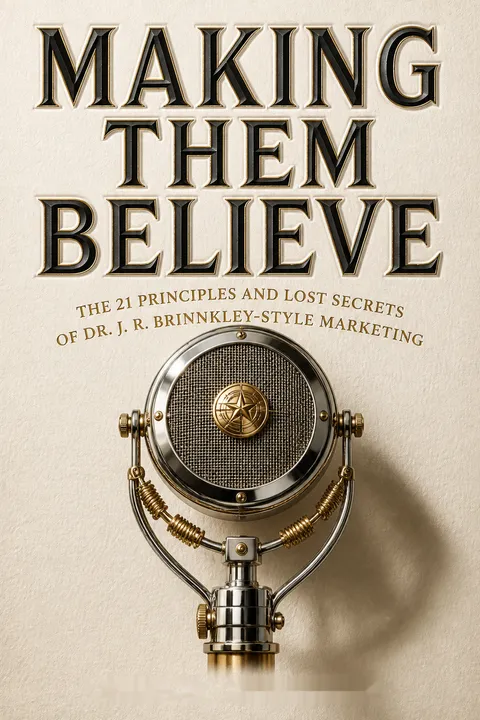
What is "Making Them Believe" by Dan S. Kennedy and Chip Kessler about?
- Historical Marketing Case Study: The book explores the marketing genius of Dr. John R. Brinkley, a controversial early 20th-century figure who became famous (and infamous) for promoting goat gland transplants as a cure for male sexual dysfunction.
- Dissection of Brinkley’s Methods: It analyzes how Brinkley used audacious, innovative, and sometimes ethically questionable marketing strategies to build a multimillion-dollar medical empire.
- 21 Principles of Brinkley-Style Marketing: The authors extract and explain 21 core marketing principles and "lost secrets" from Brinkley’s career, translating them into actionable lessons for modern entrepreneurs.
- Blend of History and How-To: The book combines historical narrative, marketing analysis, and practical advice, making it both a biography and a marketing manual.
Why should I read "Making Them Believe" by Dan S. Kennedy and Chip Kessler?
- Learn from a Master Marketer: Brinkley’s story is a masterclass in persuasion, branding, and media manipulation, offering lessons that are still relevant today.
- Actionable Marketing Insights: The book breaks down Brinkley’s tactics into clear principles that can be applied to any business or profession.
- Entertaining and Educational: The narrative is engaging, filled with colorful anecdotes, and reads like a novel while delivering practical business wisdom.
- Understand the Power of Audacity: It demonstrates how boldness, authority, and storytelling can create massive business success—even in unlikely circumstances.
What are the key takeaways from "Making Them Believe" by Dan S. Kennedy and Chip Kessler?
- Authority and Positioning Matter: Presenting yourself as an authority figure is crucial for trust and influence.
- Focus and Specialization: Narrowing your message and offering to a specific audience or problem increases impact and credibility.
- Media Mastery: Leveraging and even owning media channels multiplies your reach and reinforces your message.
- Emotional Triggers: Successful marketing taps into deep emotional needs, such as confidence, certainty, and the desire to belong or be elite.
- Relentless Follow-Up and Systems: Systematic, persistent follow-up and structured processes are essential for converting interest into sales.
Who was Dr. John R. Brinkley, and why is he central to "Making Them Believe"?
- Controversial Medical Entrepreneur: Brinkley was a self-styled doctor who gained fame in the early 1900s for transplanting goat testicles into men as a supposed cure for impotence.
- Marketing Pioneer: He was a trailblazer in using radio, direct mail, and publicity stunts to build his brand and attract patients nationwide.
- Master of Authority and Audacity: Brinkley’s ability to present himself as an authority, make audacious promises, and create a larger-than-life persona made him a marketing legend.
- Cautionary and Inspirational Figure: While his methods were often fraudulent, his marketing strategies are studied for their effectiveness and boldness.
What are the 21 Principles of Brinkley-Style Marketing outlined in "Making Them Believe"?
- Authority and Specialization: Present yourself with authority and focus on a specific niche.
- Action and Focus: Convert ideas into focused, decisive action.
- Personal Promotion: Relentlessly promote yourself and your unique story.
- Promise a Cure: Offer bold, clear solutions to pressing problems.
- Deeper Meanings: Sell confidence, certainty, and emotional benefits, not just products.
- Media Leverage: Use and own media to multiply your influence.
- Prepared Prospects: Prepare and pre-sell your audience before the sales pitch.
- Desire to Believe: Inspire people to want to believe in your solution.
- Dramatic Testimonials: Use powerful, real-life success stories as social proof.
- Audacity and Big Ideas: Make bold promises and stand out with audacious ideas.
- Price Elasticity and Elitism: Command premium prices and offer exclusive options.
- Newsworthiness and Timing: Make yourself newsworthy and be of your time and place.
- Resilience and Systems: Respond creatively to setbacks and build systematic follow-up processes.
How did Dr. Brinkley use authority and specialization to build trust, according to "Making Them Believe"?
- Self-Created Credentials: Brinkley adopted the title "Doctor" and later purchased a medical degree, understanding that perceived authority builds trust.
- Specialized Solutions: He moved from generic patent medicines to specialized remedies for specific ailments, increasing his credibility.
- Environmental Cues: Brinkley controlled his environment—stage, clinic, media—to reinforce his authority.
- Lesson for Marketers: The book encourages readers to create and promote their own credentials and to specialize for maximum impact.
What role did media play in Dr. Brinkley’s marketing success, as described in "Making Them Believe"?
- Pioneering Radio Use: Brinkley was among the first to use radio as a direct-response marketing tool, hosting his own programs and later owning stations.
- Multi-Media Strategy: He used books, films, direct mail, and live events to reinforce his message and reach different audiences.
- Celebrity and Entertainment: Brinkley brought in entertainers and celebrities to his radio shows, increasing his appeal and authority.
- Modern Application: The book highlights the importance of not just using, but owning and controlling media channels for business growth.
How does "Making Them Believe" explain the importance of emotional triggers and deeper meanings in marketing?
- Selling Confidence and Certainty: Brinkley’s real product was not surgery, but restored confidence and hope for his patients.
- Agitating Pain Points: His marketing agitated feelings of inadequacy, shame, and desire for vitality, making his solution emotionally irresistible.
- Testimonials as Emotional Proof: Dramatic success stories, like the birth of "Billy Jr.," provided living proof and fueled the desire to believe.
- Universal Lesson: The book teaches that tapping into deep emotional needs is more powerful than selling features or benefits alone.
What does "Making Them Believe" reveal about pricing strategies and creating exclusivity?
- Premium Pricing: Brinkley charged high fees, justified by his unique authority, the exclusivity of his procedure, and the emotional value delivered.
- Elitism and Scarcity: He offered even more exclusive (and expensive) options, like human gland transplants, to affluent clients.
- Supply and Demand Manipulation: Brinkley created the perception of limited availability and selectivity, increasing demand and willingness to pay.
- Modern Takeaway: The book encourages marketers to create tiered offerings and use exclusivity to command higher prices.
How did Dr. Brinkley handle setbacks and criticism, according to "Making Them Believe"?
- Turning Adversity into Opportunity: Brinkley used attacks from the medical establishment and media as proof of his outsider status and as publicity.
- Reinvention: When challenged or shut down, he reinvented his procedures, messaging, and even relocated his operations to stay ahead.
- Public Fights as Positioning: He positioned himself as a champion of the common man, fighting against powerful enemies, which increased his appeal.
- Lesson for Readers: The book emphasizes resilience, creative response to setbacks, and the strategic use of controversy.
What systems and follow-up processes did Dr. Brinkley use, as detailed in "Making Them Believe"?
- Lead Generation and Nurturing: Brinkley collected names through offers of booklets and followed up with multi-step, increasingly urgent mailings.
- Structured Sales Choreography: He carefully prepared prospects before in-person consultations, making the sale easier and more likely.
- Relentless Follow-Up: His follow-up letters became progressively more direct, using social pressure and deadlines to prompt action.
- Modern Application: The book stresses the importance of systematic, disciplined follow-up and process-driven marketing for sustained success.
What are the best quotes from "Making Them Believe" by Dan S. Kennedy and Chip Kessler, and what do they mean?
- "Accepted authority can trump all other factors." – Emphasizes the power of perceived expertise in influencing decisions.
- "What successfully sells the incredible can be used even more effectively to sell the credible." – Suggests that bold, audacious marketing tactics can be applied to legitimate products for even greater success.
- "People are not looking for prevention; they are looking for the cure!" – Highlights the importance of offering clear, immediate solutions rather than abstract benefits.
- "The marketplace pretty much accepts you as you position and present yourself, especially if you put yourself forward forcefully and aggressively enough." – Underlines the value of self-promotion and confident positioning.
- "Extreme success is never an accident. It is almost always the product of going to extremes in everything combining for that success." – Encourages readers to embrace boldness, persistence, and comprehensive effort in their marketing and business endeavors.
About the Author
Other books by Dan S. Kennedy





Download PDF
Download EPUB
.epub digital book format is ideal for reading ebooks on phones, tablets, and e-readers.








