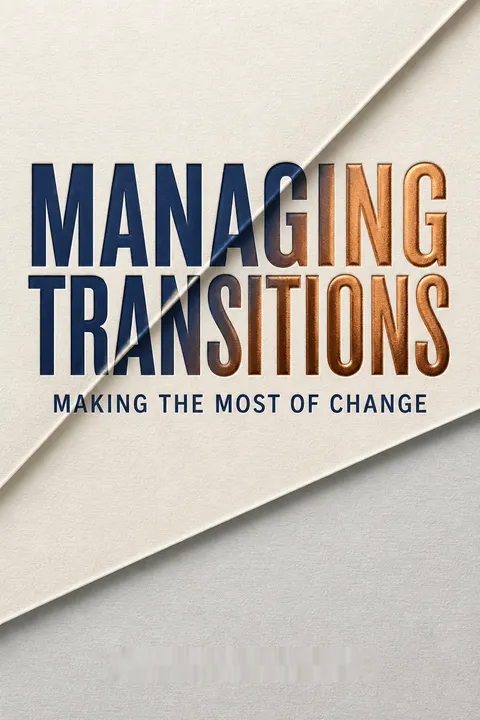


Key Takeaways
A change succeeds only when people make the inner journey it requires
Change is external. A new leader, office, or reporting structure is a situational change. Transition is the psychological work of adjusting identity and behavior to that new reality. It typically involves releasing the old, navigating an unsettled middle, and committing to a new way of working. Without that inner process, an organization may look different while people keep operating by the old rules.
Benetton missed the human cost. The company spent almost $1 billion buying sporting-goods brands, then combined teams and moved Rollerblade staff from Minnesota to New Jersey. Many employees had built their identity around skating and the brand. Of 21 Rollerblade employees who made the move, 20 returned to Minnesota under the company’s offer. Benetton’s US operation shifted from a $5 million profit to a $31 million loss. The planned business change had happened, but the people had not made the transition.
The distinction is useful because it separates implementation from adoption. A company can install software, redraw reporting lines, and announce a strategy on schedule; none of those actions proves that people understand or trust the new arrangement. The Rollerblade example makes identity visible as an operational factor, not a sentimental extra. This also resembles the difference between formal compliance and internalized practice in sociology. Still, not every reluctance should delay a necessary decision. The practical test is whether leaders have addressed the real losses and provided a credible path to new behavior, not whether everyone feels enthusiastic.
Name what people lose before asking them to embrace what comes next
Map the losses. Before presenting a solution, identify who will lose what: status, familiar colleagues, autonomy, competence, location, or confidence in promises made by the organization. A change can trigger secondary losses beyond the obvious ones. A plant closure, for example, may also end a community’s shared history and employees’ belief that their jobs are secure. Such losses are subjective, but that does not make them trivial.
Listen without correcting feelings. Bridges recommends asking people what has become harder or what they miss, then acknowledging what they say instead of arguing that the change is objectively beneficial. When a company laid off staff but avoided discussing their losses, employees began considering sabotage. Another organization turned resistant supervisors into trainers, restoring expertise and status even though their management roles had changed. Compensation need not mean money; it can restore control, recognition, or a meaningful role.
This approach echoes organizational justice: people judge not only outcomes, but whether they were treated with respect and given a fair process. Naming a loss does not require agreeing that every preferred arrangement can remain. It signals that leaders understand the human price of a decision and are willing to discuss it honestly. The model also wisely avoids treating grief as a neat sequence. People can feel anger, relief, fear, and sadness at once, and unresolved earlier losses may intensify a new reaction. Empathy is not a substitute for clear limits, but limits are more credible when the loss itself is not denied.
Treat the messy middle as both a risk and a laboratory
Expect the in-between. The neutral zone is the period after familiar arrangements have weakened but before the new way feels workable. People can become anxious, distracted, polarized, or tempted to leave. In one merger described in the book, managers estimated that effectiveness in several departments had fallen by half. At a bank cutting staff, absenteeism tripled. These are not signs that a transition is imaginary; they are reasons to support it deliberately.
Add structure without restoring the past. Set short-term goals, clarify temporary decision rights, protect time for training, and create regular channels for questions. A Transition Monitoring Team, or TMT, gathers confidential feedback from across the organization and reports patterns to leaders. The uncertain interval can also loosen old routines enough to make experimentation possible. Leaders can invite practical trials, learn from setbacks, and keep useful ideas from disappearing into silence.
The dual description of this period is particularly strong: ambiguity drains attention, yet it can also loosen habits that block invention. Research on cognitive load helps explain the danger. When people must continually guess priorities and roles, less attention remains for judgment and problem-solving. Temporary rules and short feedback loops reduce that burden. At the same time, experimentation needs boundaries. A vague call to innovate can feel like another demand piled onto an already overloaded workforce. Small, reversible trials offer a better balance between psychological safety and accountability.
Give every new beginning a reason, a picture, a route, and a role
A start is not a beginning. A new computer can arrive on Monday while staff still rely on the old system. A reorganization can take effect on paper while people continue seeking advice from former managers. A genuine beginning occurs when people understand and commit to the new way, not simply when the announced date arrives.
Cover the Four P’s. Bridges’ framework says people need a purpose, or why the change matters; a picture of what the future will look and feel like; a plan for the steps ahead; and a part to play in the work and outcome. Different people lean on different elements. A vivid future image may motivate one employee, while another needs practical training dates and a defined responsibility. Leaders often announce the destination but omit the route or the individual’s place in it. The resulting silence invites rumors and makes participation difficult.
The Four P’s translate a broad vision into the ingredients of sensemaking. People need to connect the rationale to observable consequences, understand what happens next, and see themselves as participants rather than objects being moved. This has a useful connection to self-determination theory, which emphasizes agency and competence as conditions for motivation. The framework also guards against a common leadership bias: decision-makers have lived with an idea for months, while employees may be hearing it for the first time. A picture can inspire, but if it is implausible or intimidating, it may increase fear rather than commitment.
Tell the truth early, repeatedly, and in language people can use
Explain the problem first. People are unlikely to support a remedy if they do not recognize the problem it addresses. Leaders should show the evidence, explain what happens if nothing changes, and invite people close to the work to describe what they see. In the software-service example, staff understood the need for teamwork more clearly when customers’ complaints became visible to them, rather than remaining solely the manager’s concern.
Communicate what is known and unknown. A single memo rarely resolves threatening news. Repeat information through direct conversations and other channels, say what remains undecided, and give a date for the next update. If that date slips, explain why. In the Apex case, the CEO’s earlier optimism conflicted with sudden layoffs and plant closures. A cheerful message or false promise would deepen the credibility problem. Candor may cause short-term distress, but silence gives rumors more room to grow.
This is more than a communications tactic. It is a way to make shared diagnosis possible, reducing the divide between leaders who see a problem and employees who are asked to accept a solution without context. Repeated, consistent updates also reduce uncertainty, even when they cannot eliminate it. The caution is that transparency does not mean publishing every sensitive detail immediately. Legal, privacy, and competitive constraints can be real. The useful standard is to distinguish what cannot yet be disclosed from what leaders simply find uncomfortable to say, and to avoid presenting uncertainty as certainty.
Make new behavior real through leaders’ actions, rewards, and quick wins
Align the signals. Employees watch what leaders do, what the organization rewards, and what gets time on the calendar. A leader who praises teamwork while managing each direct report as an isolated individual weakens the message. So does a company that asks for collaboration but continues to reward individual output alone. In the service-unit case, regular team meetings helped establish a new group identity before the office layout was changed. Moving from individual to team-based targets could reinforce the same shift.
Reinforce progress visibly. Small, achievable successes can restore confidence after a period when people feel less capable. Symbols and ceremonies can also help people recognize a new identity. In one merger, employees argued over which legacy company’s badge color to keep; a new color representing the combined organization ended the dispute. Symbols matter most when backed by fair policies, practical support, and leaders who model the behavior they ask of others.
The emphasis on consistency captures a basic feature of organizational learning: people infer the real rules from consequences, not slogans. Rewards can steer attention, but poorly designed metrics create gaming. A team bonus tied only to call volume, for example, might encourage speed at the expense of customer resolution. Quick wins should therefore demonstrate the desired behavior, not merely produce an attractive number. Symbols can help people mark a shared identity, but they cannot repair inequity or compensate for missing training. A badge can represent a new team; it cannot make the team function.
When growth changes the job, yesterday’s winning culture may become today’s obstacle
Organizations have developmental stages. The book maps a path from an initial idea, through a loosely run venture and formal organization, into established success and institutional status. Organizations can then turn inward, lose touch with their environment, and decline. These are not fixed ages or an inevitable fate; they are a way to notice when yesterday’s methods no longer fit the organization’s needs.
Success can create the next problem. A small company may thrive on improvisation, but growth brings customers, complexity, and a need for reliable systems. The informal practices that helped launch the business can then obstruct its next phase. Mature organizations face the reverse challenge: rules that once protected quality can become barriers to new ideas. The US Navy’s early rejection of a more accurate method of aiming ship guns illustrates how established procedures can dismiss evidence that threatens familiar assumptions. Renewal may require revisiting the organization’s purpose and entrepreneurial energy.
The life-cycle model helps distinguish a temporary operational snag from a deeper mismatch between an organization’s habits and its environment. Its most provocative claim is that the capability behind past success can become a liability when conditions change. That insight fits theories of organizational inertia: routines preserve knowledge, but they can also make adaptation costly. The stages should be used as diagnostic prompts, not as a precise prediction of corporate destiny. Organizations do not all mature in the same way, and external shocks, governance, and power struggles can redirect their path. Still, asking what stage-specific behavior has outlived its usefulness is a sharper question than simply demanding more innovation.
Turn continuous change into coherent adaptation, not a pile of initiatives
Connect the changes. When several changes overlap, identify the larger purpose that links them. Otherwise, staff experience a series of unrelated disruptions. Postpone optional initiatives while a major transition is underway, and prepare alternatives for plans that may fail. Forecasts are unreliable because complex systems react to the very predictions used to guide them; planning for plausible setbacks is often more practical than pretending to know the future.
Treat problems as prompts. The book uses Athens’ response to depleted farmland as an example: instead of relying on the old agricultural pattern, the city developed olive production and related trade. The broader lesson is to let a challenge generate a response, then let that response reveal the next challenge. This works at multiple levels of an organization. A clear enduring purpose gives teams a stable reference point while methods, structures, and objectives adjust around it.
The distinction between purpose and current objective is especially valuable under volatility. A team can change its tools or customer offer while preserving the reason it exists, which provides continuity without demanding sameness. This resembles adaptive-systems thinking, where local units respond to conditions while remaining linked by shared constraints. The Athens story illustrates creative adaptation, but it should not imply that every setback contains a hidden advantage. Some problems require loss reduction, not reinvention. Coherence also depends on leadership limiting the number of simultaneous demands; calling every initiative part of a grand strategy does not make an overloaded workforce less overloaded.
Support the survivors, whose guilt and anxiety can quietly sabotage recovery
The people who stay are affected too. Layoffs and closures leave more than departing employees in need of support. Remaining workers may feel guilt, resentment, anxiety, self-absorption, and stress, which the book groups as GRASS. These reactions can drain attention from customers and colleagues just when the organization depends on them to rebuild. Managers may also carry guilt and face the same uncertainty as their teams.
Plan for recovery, not just departure. Provide clear information, rebuild damaged team relationships, and give employees help adapting their careers and skills. When a Forest Service shift reduced demand for timber specialists and increased work in recreation, conservation, and wildfire management, career renewal programs helped employees consider emerging roles. Support for people leaving can also shape how those who remain judge the organization. Transition management is incomplete if the exit package is handled carefully but the continuing workload, trust, and capability of the remaining workforce are ignored.
GRASS is a memorable prompt for noticing the human costs that can hide behind a successful head-count reduction. It also points to a difficult ethical truth: survivors are not automatically beneficiaries of restructuring. Yet an acronym is not a measurement tool, and it should not turn structural causes into individual emotional problems. Excessive workload, opaque selection decisions, and unequal sacrifice require organizational remedies, not only counseling or morale events. The strongest response combines humane support with fair procedures and a credible redesign of work. That combination protects both employee dignity and the organization’s capacity to function.
Analysis
Managing Transitions is a business and leadership book built around a practical psychological model, illustrated through organizational cases and extended to personal and institutional change. Its central contribution is not the familiar claim that people dislike change. It is the more precise argument that a change in circumstances and a transition in identity are different processes, and that the second cannot be commanded into existence by announcing the first. This distinction changes the manager’s task: implementation is only the visible half of the work.
The book’s strongest move is to make loss a legitimate part of management analysis. Status, competence, trusted relationships, and a sense of belonging can disappear even when no job is eliminated. Treating these as real helps explain why a rational plan can produce irrational-looking behavior. Its neutral-zone concept is also unusually useful because it names a period many organizations otherwise misread as failure. The same disorder that threatens productivity can loosen routines and create room for experimentation, provided people receive enough structure and support.
The model’s clarity is also its limitation. Three phases and four communication needs make a useful map, but actual transitions overlap, recur, and differ across people. The framework cannot determine whether a change is strategically sound or ethically justified. Empathy may improve a harmful decision’s implementation without making the decision fair. Nor should leaders treat every objection as grief: employees may be identifying a genuine design flaw, an unequal burden, or a broken promise. The book is strongest when it pairs listening with candor, not when its stages risk becoming a script.
Its broader lesson is therefore about governance as much as psychology. Change succeeds when leaders attend to identity, incentives, information, and power together. A transition plan is not a softer version of a business plan; it tests whether the proposed future can be inhabited by actual people. The memorable discipline is to ask what must end, what support the uncertain interval requires, and what concrete evidence would make a new way believable.
Review Summary
Managing Transitions: Making the Most of Change is widely praised as an essential guide for leaders navigating organizational change. Readers appreciate Bridges' insights on the psychological aspects of transition, including the three phases: ending, neutral zone, and new beginning. Many find the book practical and applicable across various sectors. Some criticize its corporate focus and dated examples, while others wish they had read it earlier in their careers. The book's emphasis on the human side of change and its tools for managing transitions are consistently highlighted as valuable.
People Also Read








Glossary
Transition
Psychological adjustment to changeThe internal process through which people adapt to a changed situation. In the book, transition is distinct from an external change such as a new structure, leader, or technology. It involves releasing familiar identities and practices, navigating an unsettled period, and developing a new orientation. A change can be completed on a schedule while the transition remains unfinished.
Neutral zone
The unsettled middle periodThe in-between period when an old arrangement has lost its hold but a new one is not yet familiar or fully effective. People may feel confused, anxious, or less productive. Bridges presents this period as both risky and potentially creative: leaders can reduce uncertainty with temporary structures while making room for reflection and experimentation.
Four P’s
Ingredients of a new beginningA framework for helping people commit to a new way of working. It includes purpose, the reason the change matters; picture, an understandable view of the intended future; plan, the practical route toward it; and part, a meaningful role for each person. The framework addresses different needs that a broad announcement or inspiring vision alone may leave unmet.
Transition Monitoring Team
Employee transition feedback groupA small, cross-organizational group that gathers information about how people are experiencing a transition and conveys patterns to leaders. It monitors rather than manages the change, helping identify confusion, rumors, overlooked groups, and practical obstacles. Its credibility depends on broad representation, clear confidentiality expectations, access to decision-makers, and visible responses to the issues raised.
Seven stages of organizational life
Map of organizational developmentA developmental map moving from an initial idea through venture formation, organization-building, established success, and institutional status, then toward inward closure and decline. The stages are not fixed laws or a timetable. They help leaders recognize when behaviors that suited an earlier period no longer fit the organization, and when renewal may require recovering earlier entrepreneurial energy.
GRASS
Costs borne by transition survivorsAn acronym for guilt, resentment, anxiety, self-absorption, and stress, the emotional and behavioral costs that may follow poorly managed change. The book uses it especially to draw attention to employees who remain after layoffs or restructuring. These reactions can reduce morale, attention, cooperation, and willingness to contribute, making recovery harder even after the formal change is complete.
CUSP
Needs during the neutral zoneA leader’s checklist for what people may lack during an unsettled transition: control, understanding, support, and clear priorities. The framework directs attention to practical and emotional needs, such as giving people a voice, explaining events, maintaining support systems, and clarifying which work matters most while familiar arrangements are changing.
Transition-worthiness
Capacity to navigate transitionsThe degree to which an organization’s structures, policies, culture, resources, and leadership help or hinder people moving through transition. Flexible roles, cross-functional connections, reliable communication, and learning support can make transitions easier to manage. Rigid structures, isolated teams, and punitive responses to mistakes can make adaptation slower and more disruptive.
Challenge and response
Adaptation through creative responseA way of understanding change in which a difficulty prompts a new response, and that response creates further opportunities or demands. The book uses historical examples, including Athens shifting toward olive production and trade after agricultural decline, to show how disadvantage can spur adaptation. The idea encourages organizations at every level to solve problems actively rather than wait for instructions.
FAQ
What's "Managing Transitions: Making the Most of Change" about?
- Focus on Transition: The book emphasizes the difference between change and transition, highlighting that transition is the psychological process people go through to adapt to change.
- Three-Phase Process: It introduces a three-phase process of transition: ending, neutral zone, and new beginning, which helps individuals and organizations manage change effectively.
- Practical Guidance: The book provides practical advice and strategies for leaders to guide their teams through transitions, ensuring that changes are successfully implemented.
- Human Side of Change: It stresses the importance of addressing the human side of change, recognizing the emotional and psychological impacts on individuals.
Why should I read "Managing Transitions: Making the Most of Change"?
- Understanding Change vs. Transition: It clarifies the often-overlooked distinction between change (situational) and transition (psychological), which is crucial for effective change management.
- Actionable Strategies: The book offers actionable strategies and tools for managing transitions, making it a valuable resource for leaders and managers.
- Real-World Examples: It includes real-world examples and case studies that illustrate the concepts and provide insights into successful transition management.
- Timeless Relevance: The principles and strategies discussed are applicable to various types of changes, making the book relevant across different industries and times.
What are the key takeaways of "Managing Transitions: Making the Most of Change"?
- Transition Phases: Understanding the three phases of transition—ending, neutral zone, and new beginning—is essential for managing change effectively.
- Importance of Endings: Recognizing and managing the endings that come with change is crucial, as people need to let go of the old before embracing the new.
- Neutral Zone Opportunities: The neutral zone, though challenging, is a time for creativity and innovation, offering opportunities for growth and development.
- Role of Leadership: Leaders play a critical role in guiding their teams through transitions by providing clarity, support, and a vision for the future.
How does William Bridges define transition in "Managing Transitions"?
- Psychological Process: Transition is defined as the psychological process people undergo to come to terms with new situations brought about by change.
- Three-Phase Model: It involves three phases: letting go of the old ways, navigating the neutral zone, and embracing a new beginning.
- Focus on Human Experience: Unlike change, which is situational, transition focuses on the human experience and emotional adjustments required.
- Essential for Success: Successful change management requires understanding and managing transitions, as they are key to achieving desired outcomes.
What is the "neutral zone" in "Managing Transitions"?
- In-Between Phase: The neutral zone is the in-between phase where the old ways are gone, but the new ways are not yet fully operational.
- Time of Uncertainty: It is a time of uncertainty and confusion, where people may feel lost and disoriented.
- Opportunity for Innovation: Despite its challenges, the neutral zone is a fertile ground for creativity and innovation, allowing for new ideas and solutions to emerge.
- Critical Management Period: Managing the neutral zone effectively is crucial for ensuring a smooth transition and successful implementation of change.
How can leaders effectively manage transitions according to "Managing Transitions"?
- Acknowledge Endings: Leaders should acknowledge and address the losses and endings that come with change, helping people let go of the old ways.
- Communicate Clearly: Clear and consistent communication is vital to keep everyone informed and engaged throughout the transition process.
- Support Through Neutral Zone: Provide support and temporary structures to help people navigate the neutral zone, encouraging creativity and innovation.
- Facilitate New Beginnings: Help people embrace new beginnings by clarifying the purpose, providing a vision, and defining roles and responsibilities.
What role does communication play in managing transitions in "Managing Transitions"?
- Essential for Clarity: Communication is essential for providing clarity and understanding about the change and the transition process.
- Builds Trust: Open and honest communication helps build trust and reduces anxiety and resistance among employees.
- Addresses Concerns: It allows leaders to address concerns and questions, ensuring that everyone feels heard and valued.
- Facilitates Engagement: Effective communication keeps people engaged and motivated, helping them navigate the transition more smoothly.
What are some practical strategies from "Managing Transitions" for dealing with nonstop change?
- Normalize Change: Help people understand that change is a constant and normalize it as part of the organizational culture.
- Focus on Purpose: Clarify the organization's purpose and align changes with this purpose to provide direction and meaning.
- Encourage Flexibility: Foster a culture of flexibility and adaptability, encouraging people to embrace change and seek innovative solutions.
- Build Resilience: Develop resilience in individuals and teams to handle the emotional and psychological impacts of continuous change.
How does "Managing Transitions" address the emotional impact of change?
- Acknowledges Emotions: The book acknowledges the emotional impact of change, including feelings of loss, anxiety, and confusion.
- Grieving Process: It recognizes that people go through a grieving process during transitions and provides strategies to support them.
- Empathy and Support: Leaders are encouraged to show empathy and provide support to help individuals cope with the emotional challenges.
- Focus on Well-being: Emphasizing the importance of well-being, the book suggests creating a supportive environment to reduce stress and anxiety.
What are the best quotes from "Managing Transitions" and what do they mean?
- "It isn’t the changes that do you in; it’s the transitions." This quote highlights the importance of managing the psychological process of transition rather than just focusing on the situational change.
- "Every beginning is a consequence. Every beginning ends something." It emphasizes that new beginnings require letting go of the past, acknowledging the endings that precede them.
- "Chaos often breeds life, while order breeds habit." This suggests that the uncertainty of the neutral zone can lead to creativity and innovation, offering opportunities for growth.
- "The only joy in the world is to begin." It reflects the excitement and potential that come with new beginnings, despite the challenges of transition.
How does "Managing Transitions" suggest organizations handle resistance to change?
- Understand Resistance: Recognize that resistance is often due to the losses and endings people experience, not the change itself.
- Address Concerns: Address concerns and fears openly, providing information and support to help people adjust.
- Involve Employees: Involve employees in the change process, giving them a sense of control and ownership over the transition.
- Provide Training: Offer training and resources to help individuals develop the skills and confidence needed to embrace the new ways.
What is the significance of the "Four P's" in "Managing Transitions"?
- Purpose: Clarifying the purpose behind the change helps people understand the reasons and benefits, aligning their efforts with organizational goals.
- Picture: Providing a clear picture of the desired outcome helps individuals visualize the future and feel more comfortable with the transition.
- Plan: A detailed plan outlines the steps and timeline for the transition, offering guidance and reducing uncertainty.
- Part: Defining each person's role in the transition process gives them a sense of involvement and responsibility, fostering engagement and commitment.

Download PDF
Download EPUB
.epub digital book format is ideal for reading ebooks on phones, tablets, and e-readers.








