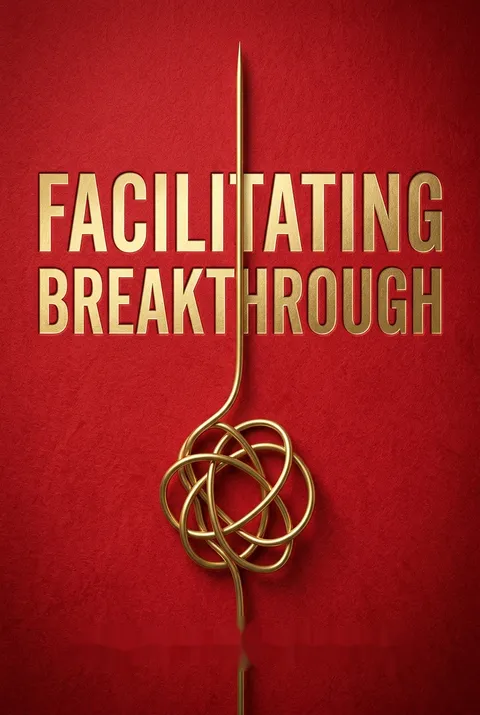


Key Takeaways
Stop pushing collaboration; remove what blocks people from contributing together.
Clear the blockage. In 2017, a Colombian workshop brought together politicians, business leaders, community activists, and former guerrillas after a 52-year war. One businesswoman had once delivered ransom money to a former guerrilla commander. Now they were meeting to help prevent such violence from recurring. The facilitator’s task was not to make them cooperate by force, but to shape conditions in which they could begin to do so: equal speaking time, small mixed groups, shared meals, and personal conversations.
Three foundations matter. The approach aims to clear barriers to contribution, connection, and equity. People need room to bring their abilities, relationships that let them work across difference, and fair conditions for both. The book’s central image is a blocked stream: the facilitator cannot command it to flow, but can help dislodge what is obstructing it.
This reframes facilitation as environmental design rather than persuasion. The distinction matters: people often have reasons to cooperate but face practical or political barriers that make cooperation costly. Small choices, such as who speaks first or whose expertise counts, can either reproduce exclusion or make participation possible. The metaphor also has limits. Some conflicts are sustained by material interests, not merely poor process. Removing conversational barriers cannot substitute for changing rules, resources, or incentives that keep one side dominant.
Facilitate only when people want change and need one another.
Check the conditions. Facilitation is useful when people see their situation as unsatisfactory and believe they need to work with others to change it. If participants are content with the status quo, a process cannot manufacture durable commitment. If they can achieve their aims alone, they may choose to act unilaterally instead.
Notice the alternatives. The book names three common solo responses: forcing others to accept one’s preferred outcome, adapting to an unwanted situation, or exiting it. Collaboration is a fourth option, appropriate when no single person or group can make sufficient progress alone. In South Africa’s transition from apartheid, leaders from opposing political and social camps came together because they could neither resolve the country’s future separately nor simply impose a lasting solution.
This is a useful test against the assumption that every tense meeting needs better facilitation. A process has little leverage if participants lack either motivation or interdependence. The distinction resembles collective-action problems: people must have a shared stake and some reason to coordinate, even when their interests differ. Still, willingness is not always freely expressed. People may attend because a superior requires it, or because refusing carries risk. A facilitator should distinguish genuine readiness from compliance dressed up as consensus.
Use authority and autonomy in turns, before either hardens into failure.
Each pole solves one problem. Vertical facilitation uses hierarchy, expertise, and direction to align a group around common work. It can produce coordination, but overuse breeds rigidity and domination. Horizontal facilitation protects participants’ independence and differences. It can unlock initiative, but overuse leaves people fragmented or stuck in endless discussion.
Shift when the cost appears. Transformative facilitation cycles between these modes rather than choosing one as the correct philosophy. When senior voices are narrowing the conversation, make room for independent perspectives. When each person is pursuing a separate agenda, clarify shared priorities and coordinate action. In a logistics company, a cross-level team used participatory exercises to challenge a strong command culture while still working within an agreed project and organizational purpose.
The book treats authority and autonomy as interdependent capacities, not moral opposites. That is a strong corrective to management fashions that promise either control through hierarchy or innovation through flatness. The practical question is not which structure is best in the abstract, but which imbalance is currently suppressing useful action. Yet the two poles do not always have equal legitimacy: in settings with entrenched inequality, calls for unity can silence people with less power. Alternation must be guided by equity, not just convenience.
Treat five recurring questions as navigation, not a fixed agenda.
Keep returning to the essentials. Any collaboration must work out what is happening, what counts as success, how to proceed, who will do what, and what role each person has in the situation. These are not boxes to check once at kickoff. New information, conflict, or changing conditions can reopen any of them.
Switch the group’s mode. For each question, facilitators need contrasting responses: test claims while inviting inquiry; make provisional agreements while allowing work to continue; plan while experimenting; give direction while supporting self-chosen action; and step back to observe while recognizing personal involvement. These are navigation choices, not a recipe. A facilitator may revisit them repeatedly during one meeting, or across a long project.
The five questions function like a diagnostic map: they help identify whether a group is confused about reality, outcomes, process, roles, or responsibility. That is more useful than interpreting every difficulty as interpersonal friction. The recurring-question idea also fits adaptive systems, where decisions change as feedback arrives. One caution is that a map can become another authority if treated mechanically. Groups differ in culture, history, and power, so the questions should prompt attention, not impose a standardized sequence.
Make attention your instrument; notice the room before choosing your intervention.
Read the signals. A facilitator cannot select the right move from a fixed script. The work requires noticing what is happening among participants, in the surrounding system, and within the facilitator. Signs of trouble include a few people dominating, everyone speaking from fixed positions, or a group planning confidently despite evidence that its plan is failing.
Return when distracted. Kahane describes attention as a practical skill that includes listening to words, noticing gestures, and recognizing one’s own fear, irritation, or defensiveness. He recalls how easily a facilitator can miss what someone says while rehearsing a response internally. The goal is not perfect calm. It is to notice distraction and regain enough presence to respond to what is actually happening, rather than to an imagined version of the room.
Attention here is both a perceptual skill and an ethical one. A facilitator who misses quiet dissent may unintentionally validate the most powerful speakers. This connects to research traditions in mindfulness and human factors, where noticing signals early can prevent small deviations from becoming system failures. The standard should not be intuition alone, however. A facilitator’s impressions can reflect bias as easily as insight. Checking observations with participants and colleagues helps turn private hunches into accountable judgment.
Let relationships carry disagreement when consensus would stop useful work.
Agreement is not always the next step. At the first Sustainable Food Laboratory workshop, participants disagreed about what sustainability meant. Rather than force a shared definition before trust had developed, they continued working together. Over more than fifteen years, the group contributed to efforts involving water, emissions, food waste, supply chains, and smallholder farmers.
Choose what needs settling. Some decisions require agreement, especially when a group must make a clear public commitment. Others can remain unresolved while participants take useful next steps. In a Colombian peace process, former president Juan Manuel Santos learned that people who might never agree could still work together. Collaboration depends not only on shared conclusions, but on relationships strong enough to support action amid disagreement.
This distinguishes consensus from coordination, a distinction central to pluralistic democracy and durable coalitions. In practice, people can cooperate around limited commitments without pretending that deeper disagreements have disappeared. That often protects trust better than a forced declaration of unity. But continuing without agreement can also preserve an unfair arrangement, especially when powerful participants benefit from ambiguity. The important question is who gets to define which disputes can wait, and who bears the cost while they do.
Plan enough to act, then revise when reality answers back.
Plans meet surprises. During the first Possible Mexicos workshop, participants became frustrated with the planned process. The facilitation team revised the next day’s agenda, prompting an argument about whether the change was a thoughtful adjustment or mere improvisation. The conflict exposed a central tension: a plan provides direction, but a complex group cannot know in advance exactly what will work.
Learn through experiments. The book’s practical cycle is to try an action, observe its effects, and adjust. In a group exercise, one participant had to discover a sequence of actions through consistent feedback from the others. The same principle applied to education teams trying systemic reforms: they began with a plan, met unexpected obstacles, and revised their approach. Changing course in response to evidence is not proof that planning failed. It is part of planning responsibly.
This is a compelling argument for adaptive practice: plans coordinate attention, while feedback keeps them connected to reality. The approach resembles iterative design, in which a small test can reveal assumptions that discussion alone cannot expose. But experimentation is not automatically wise. In high-stakes settings, failed trials can harm people, and participants may not share equal power to absorb the consequences. Good adaptation therefore requires bounded experiments, transparent learning, and a clear account of who bears the risk.
Direct process without taking ownership away from participants.
Direction can serve agency. A facilitator sometimes needs to set the process firmly, clarify decisions, or keep a group moving. At other times, the facilitator needs to support participants’ own choices and initiatives. The challenge is to do both in service of the group, not to become its hidden leader.
Trust makes the difference. In Ethiopia, organizers convened leaders from opposing political camps amid serious violence. One opposition politician arrived fearing for his safety, but after working with a government counterpart, chose to travel back with him. The facilitation team had earned trust through patient organizing and visible commitment to the participants’ work. The book also recounts a Thai prime minister’s complaint that only 500 of 50,000 orders had been implemented, a reminder that issuing commands is not the same as enabling action.
This insight separates procedural leadership from substantive control. A facilitator may structure the conditions for action while leaving the purpose and choices with the people affected. That resembles servant leadership, but it also raises a governance question: who evaluates whether the facilitator is genuinely serving? A claim of service can conceal manipulation. Transparency about decisions, permission to challenge the process, and clear boundaries on facilitator authority help distinguish support from control.
Stand inside the injustice you want to change, not only above it.
Distance and involvement both matter. An outsider can help a group see patterns that participants immersed in conflict may miss. But distance can become arrogance if the facilitator treats the situation as something other people must fix. In a Manitoba First Nations health project, participants rejected several familiar workshop exercises as culturally inappropriate and connected to painful history. The facilitator recognized that importing a proven method without adapting it repeated the very imbalance the project was meant to address.
Connect agency with fairness. Kahane links power to people’s ability to realize their capacities, love to connection, and justice to the structures that make both possible. These are expressed in group work as contribution, connection, and equity. The facilitator must help participants examine both the system around them and their own part in reproducing it.
The shift from observer to participant challenges the comforting fiction of neutral expertise. In systems marked by colonial or racial power, methods carry histories, and an apparently universal process can reproduce exclusion. At the same time, self-implication should not collapse into guilt or false equivalence between participants with radically different exposure to harm. Responsibility is not evenly distributed. A useful practice combines self-scrutiny with attention to who controls resources, whose knowledge is recognized, and who can refuse the process.
Analysis
The book’s central contribution is a theory of facilitation as adaptive work on the conditions of collective action. Its starting point is not that a skilled facilitator can persuade antagonists into agreement, but that people who need one another may already possess enough motivation to act, if structural obstacles are reduced. The Colombian postwar gathering gives this argument human scale: former adversaries do not become identical, but carefully designed encounters make it possible to hear, contribute, and begin working together.
The framework is strongest where it treats familiar oppositions as productive tensions. Authority can coordinate, but also suppress; autonomy can release initiative, but also fragment effort. Similar tensions recur in planning and improvisation, distance and involvement, and agreement and continued action. The facilitator’s skill is therefore less like operating a checklist and more like regulating a changing system through attention and feedback. The book’s stories show how small procedural choices can influence larger dynamics, especially when the group reflects the divisions of the society it hopes to change.
The account also makes a consequential ethical move by placing justice beside connection and agency. Collaboration is not inherently good: groups can cooperate to preserve privilege, and calls for harmony can silence those challenging an unjust order. Fairness must shape both participation and the intended changes. The Manitoba example demonstrates why local legitimacy and cultural knowledge matter, and why a method successful elsewhere cannot simply be transplanted.
The framework’s main limitation is the risk of overestimating process. Facilitation can create opportunities for voice, trust, and coordinated action, but it cannot by itself redistribute land, money, legal authority, or safety. Nor can every conflict be reconciled through dialogue. The book is most persuasive when understood not as a universal solution, but as a disciplined approach for situations where people recognize interdependence and have some room to choose how to work together. Its enduring test is practical: do participants gain more capacity to act, connect, and shape fairer conditions, or does the process merely make disagreement feel more manageable?
Review Summary
Facilitating Breakthrough receives high praise for its insightful approach to transformative facilitation. Readers appreciate Kahane's clear framework for addressing complex challenges, bridging differences, and fostering collaboration. The book is lauded for its thought-provoking content, practical tools, and real-world examples. Reviewers find it valuable for facilitators, leaders, and anyone involved in group dynamics. While some note the density of information, most consider it a powerful resource for creating positive change and moving forward together in diverse settings.
People Also Read





Glossary
transformative facilitation
unblocking collaborative changeAn approach to helping a group work across differences to change a situation. Instead of relying only on top-down direction or individual autonomy, the facilitator shifts between both, paying attention to what the group needs. The aim is to remove barriers to people contributing, connecting, and participating equitably.
vertical facilitation
direction from aboveA facilitation approach that emphasizes the group’s shared purpose, expert knowledge, hierarchy, and coordinated action. It can help people align around a common task, but overuse can produce rigidity, domination, and pressure to suppress individual concerns for the group’s stated good.
horizontal facilitation
autonomy among participantsA facilitation approach that emphasizes each participant’s independence, equal standing, and freedom to decide what to do. It can make room for diverse views and self-directed action, but overuse can leave people disconnected, unable to coordinate, or caught in indecision.
presencing
sensing what is emergingA mode of attention and conversation in which participants try to notice what is arising across the whole group or system, rather than listening only from their own perspective or another individual’s. It requires being present, open, and attentive to possibilities that are not yet fully formed.
negative capability
tolerating unresolved uncertaintyA term from poet John Keats that Kahane applies to collaboration. It describes the capacity to remain with uncertainty, disagreement, or ambiguity without rushing to impose an answer. This patience can give a group time to discover which issues require agreement and which can remain open while useful work proceeds.
power, love, and justice
agency, connection, and fair structureKahane uses these three ideas to describe what transformative collaboration needs. Power is the drive to realize capacities and contribute. Love is the drive toward connection and unity. Justice is the structure that enables people to exercise power and connection fairly, rather than allowing some participants’ agency to suppress others.
FAQ
What's "Facilitating Breakthrough" by Adam Kahane about?
- Purpose of the book: "Facilitating Breakthrough" is about helping people collaborate to transform problematic situations by removing obstacles, bridging differences, and moving forward together.
- Focus on facilitation: The book introduces transformative facilitation, an approach that cycles between vertical and horizontal facilitation to enable groups to achieve breakthroughs.
- Practical guidance: It provides a framework for facilitators to help groups work through five basic collaboration questions, using ten specific moves and five inner shifts.
- Broader implications: The book also explores how transformative facilitation can contribute to creating a more just, equitable, and sustainable world.
Why should I read "Facilitating Breakthrough"?
- Learn transformative facilitation: The book offers a unique approach to facilitation that can help you effectively manage complex and conflictual situations.
- Improve collaboration skills: It provides practical tools and strategies for facilitating collaboration across diverse groups, which is valuable in both professional and personal contexts.
- Address systemic challenges: The insights can be applied to tackle larger societal issues, making it relevant for those interested in social change.
- Enhance personal growth: By understanding the dynamics of love, power, and justice, you can develop a deeper awareness of your role in collaborative efforts.
What are the key takeaways of "Facilitating Breakthrough"?
- Transformative facilitation: This approach involves cycling between vertical and horizontal facilitation to remove obstacles and enable breakthroughs.
- Five collaboration questions: Facilitators should help groups address how they see their situation, define success, plan their route, decide roles, and understand their responsibilities.
- Ten moves and five shifts: The book outlines specific moves and inner shifts facilitators can use to guide groups effectively.
- Love, power, and justice: These are fundamental drives that need to be balanced to achieve transformative change.
How does Adam Kahane define transformative facilitation?
- Cycling between approaches: Transformative facilitation involves alternating between vertical and horizontal facilitation to harness the strengths of both.
- Removing obstacles: The focus is on removing structural barriers to contribution, connection, and equity within groups.
- Dynamic balance: Facilitators must maintain a dynamic balance, similar to cycling, to keep the group moving forward.
- Enabling breakthroughs: The ultimate goal is to enable groups to achieve breakthroughs in complex and conflictual situations.
What are the five basic collaboration questions in "Facilitating Breakthrough"?
- Understanding the situation: How do we see our situation? This involves advocating and inquiring to gain a comprehensive understanding.
- Defining success: How do we define success? Facilitators help groups cycle between concluding and advancing.
- Planning the route: How will we get from here to there? This involves mapping and discovering the path forward.
- Deciding roles: How do we decide who does what? Facilitators guide groups in directing and accompanying.
- Understanding responsibilities: How do we understand our role? This involves standing outside and inside the situation.
What are the ten moves and five shifts in "Facilitating Breakthrough"?
- Ten moves: These include advocating, inquiring, concluding, advancing, mapping, discovering, directing, accompanying, standing outside, and standing inside.
- Five shifts: Facilitators need to make inner shifts such as opening, discerning, adapting, serving, and partnering to effectively guide groups.
- Purpose of moves and shifts: They help facilitators cycle between vertical and horizontal facilitation to address the five collaboration questions.
- Dynamic application: Facilitators must apply these moves and shifts fluidly and as needed to maintain group progress.
How does "Facilitating Breakthrough" address love, power, and justice?
- Three fundamental drives: Love, power, and justice are essential for transformative facilitation and must be balanced.
- Love: Defined as the drive toward unity, it manifests as connection among participants.
- Power: Defined as the drive toward self-realization, it manifests as contribution to the collaborative effort.
- Justice: Provides the structure that enables love and power, ensuring equity within the group and in the situation.
What are some practical examples of transformative facilitation in action?
- Colombia project: Facilitators helped diverse leaders collaborate to address regional challenges post-conflict, focusing on removing obstacles to contribution, connection, and equity.
- Education Lab in Mexico: Initiative teams worked on systemic reforms, cycling between mapping and discovering to adapt to challenges.
- Guatemala peace process: Participants connected deeply through storytelling, enabling them to collaborate on national initiatives post-conflict.
- Haiti project: Despite political unrest, facilitators guided a diverse group to collaborate on national transformation efforts.
What are the best quotes from "Facilitating Breakthrough" and what do they mean?
- "You are removing the obstacles to the expression of the mystery!" This quote highlights the essence of transformative facilitation: enabling the natural flow of collaboration by removing barriers.
- "Pay attention; the rest is interpretation. Go practice." This emphasizes the importance of attentiveness in facilitation, suggesting that practice and presence are key to mastering the approach.
- "Power at its best is love implementing the demands of justice." This quote underscores the need to balance love, power, and justice to achieve transformative change.
How can I apply the concepts from "Facilitating Breakthrough" in my own work?
- Assess your situation: Identify if your situation is problematic and if collaboration is the best approach to address it.
- Engage diverse stakeholders: Consider who needs to be involved in the collaboration and how to enroll them.
- Use the five questions: Guide your group through the five collaboration questions to structure your facilitation efforts.
- Practice the moves and shifts: Develop fluency in the ten moves and five shifts to effectively facilitate group progress.
What challenges might I face when implementing transformative facilitation?
- Balancing drives: Maintaining a balance between love, power, and justice can be challenging, especially under stress.
- Dynamic application: Applying the ten moves and five shifts fluidly requires practice and attentiveness.
- Resistance to change: Participants may resist new approaches, requiring facilitators to be adaptable and patient.
- Complexity of situations: Facilitators must navigate complex and conflictual situations, often with limited control.
How does "Facilitating Breakthrough" contribute to creating a better world?
- Enabling collaboration: The book provides tools and strategies to help diverse groups work together effectively on complex challenges.
- Addressing systemic issues: By focusing on love, power, and justice, transformative facilitation can contribute to systemic change.
- Promoting equity: The approach emphasizes removing obstacles to equitable contribution and connection, fostering inclusivity.
- Inspiring action: By demonstrating the possibility of moving forward together, the book encourages individuals and groups to take action for positive change.
About the Author



Download PDF
Download EPUB
.epub digital book format is ideal for reading ebooks on phones, tablets, and e-readers.








