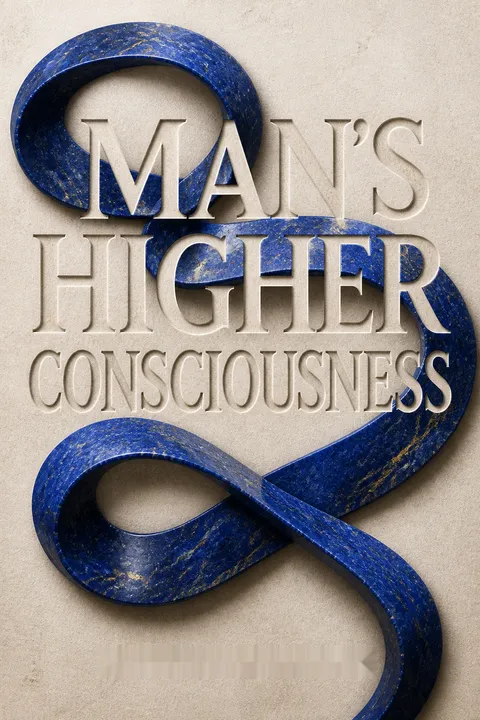


Key Takeaways
Hotema says civilization dimmed humanity's spiritual powers by estranging it from nature.
A story of decline. Hotema’s central argument is that humans once lived in a spiritually complete state, sustained by air and cosmic forces. He calls this Breatharianism and imagines a long descent through liquid, fruit, plant, and animal foods, accompanied by lost vitality and awareness. In his account, modern civilization deepens the fall through artificial wants, polluted surroundings, and habits that pull people away from nature.
A spiritual destination. Higher consciousness means recovering contact with an inner spiritual reality, not simply becoming more knowledgeable. Hotema connects that recovery to fewer wants, healthier surroundings, and a return to what he regards as humanity’s original way of living. The narrative is sweeping, joining bodily health, social criticism, and mystical belief into one explanation.
The book’s most coherent feature is the way it joins personal habits to a larger account of society. Its language of a fall from nature gives readers a memorable frame for asking whether convenience, consumption, and urban life carry costs. That question remains useful even without accepting the proposed ancient history. The difficulty is that a moral or spiritual story is not evidence of a biological past. The alleged transition from air-only existence to eating humans is not established, and the narrative can make unsupported medical claims feel like part of a single, persuasive system.
Protect clean air, but never treat breathing as a substitute for nutrition.
Air is essential. Hotema makes breathing the book’s central physical function. He points out that people cannot survive for long without air and argues that polluted, stale air harms health. He urges attention to ventilation, bedrooms, workplaces, and smoke-filled homes, and presents outdoor air and higher elevations as more life-giving than city air.
Where the argument leaps. Hotema goes far beyond the sound observation that respiration matters. He claims air supplies nearly everything the body needs, and that people can ultimately live without food or water. The book also attributes many illnesses to polluted air. These are not reliable health instructions: breathing is essential, but it does not replace food, water, or medical care.
The focus on air quality is one of the book’s most practically relevant themes. Ventilation, smoke exposure, and outdoor pollution can affect respiratory and cardiovascular health, making the author’s environmental attention worth retaining. But importance is not exclusivity. Human cells use oxygen while also depending on water and nutrients, and respiration cannot supply the energy and essential materials that food provides. The distinction matters because Hotema’s sound concern about air is used to support a dangerous claim of air-only survival.
A body can accommodate harmful habits without making them harmless.
Adjustment has a cost. Hotema’s specialized term Vital Adjustment describes the body adapting to an unhealthy habit or environment, which he argues happens by reducing vitality. He uses smoking as an example: a novice may feel sick at first, then become accustomed to tobacco. He also cites a bell-jar story in which a bird accustomed to polluted air survives longer than a newly introduced bird.
Tolerance is not proof of safety. The book applies this logic to food, drugs, and city air, claiming that apparent immunity means a weakened capacity to react. It cautions against abrupt lifestyle changes, too, because the body may have adapted to old habits. The underlying lesson is narrower: getting used to a substance does not establish that it is safe.
This framework captures a real distinction between tolerance and benefit. Repeated exposure can alter a person’s response to a substance, and a familiar exposure may feel less noticeable without becoming harmless. That insight also applies to noise, stress, and environmental irritants. Hotema’s account, however, turns nearly every adaptation into evidence of declining vitality, a claim that requires more than anecdotes. Modern physiology distinguishes specific adaptations, which can be protective or harmful depending on the exposure, rather than treating all accommodation as one degenerative process.
Do not turn fasting anecdotes into a starvation prescription.
Fasting as a cure. Hotema presents fasting as a way to clear the body, restore health, and reduce reliance on food. He recounts press reports of people said to have fasted for extraordinary lengths of time, including a singer who reportedly went 101 days with water. Another story describes a young woman who, under a doctor’s care, reportedly consumed orange juice for six months and felt better.
Anecdotes are not protocols. These accounts are not controlled evidence that fasting cures disease or that people can live without adequate nourishment. Hotema’s claim that food only stimulates the body, rather than sustaining it, is false. Prolonged fasting can cause serious harm. The book’s stories should be read as historical claims, not as a reason to stop eating, drinking, or following medical advice.
The stories work because they turn an abstract theory into a dramatic transformation: the suffering person changes a habit, then reports relief. Yet personal testimony cannot establish what caused an improvement, whether the account is accurate, or whether the same approach is safe for others. Fasting has specific uses in some medical settings, but those are distinct from prolonged starvation and require clinical judgment. The book’s refusal to distinguish these cases makes its most vivid anecdotes among its most hazardous material.
The book favors fruit while distrusting nearly every conventional food.
A hierarchy of foods. Hotema argues that fruits and nuts are less damaging than animal foods, vegetables, and especially grains and cereals. He blames salt and mineral-rich foods for hardening tissues and contributing to aging. The book uses Captain Diamond, who reportedly recovered after changing from a grain-heavy vegetarian diet to fruit, and Ludovico Cornaro, who described eating sparingly, as examples of restraint improving health.
A radical conclusion. Hotema treats food mainly as stimulation and says the body receives its real support from cosmic sources. He also recounts a six-month orange-juice diet as a striking recovery story. These anecdotes do not establish that fruit-only diets are complete or that ordinary foods are poisons. The book’s dietary ranking is its own theory, not a balanced guide to nutrition.
The useful thread here is moderation: a person’s eating pattern can affect health, and a simple diet may be preferable to excess. Hotema also notices that food advice often reflects strong prior commitments, a fair warning against uncritical diet fashions. But his own claims are no less in need of scrutiny. Grains and vegetables are not inherently degenerative, and the body does require essential nutrients. A sweeping rejection of food groups can produce deficiency, especially when readers interpret a historical anecdote as a menu to copy.
Treat spectacular longevity records as stories, not proof of a lifespan formula.
A gallery of claims. The book collects accounts of people said to have lived far beyond a century. Its most dramatic example is Li Chung-Yun, whom Hotema reports died at 256. The prologue also repeats a claim that Numas De Cugna reached 370. Other stories describe people who supposedly grew new teeth or regained their youthful appearance after fasting.
The proposed explanation. Hotema links these reports to frugal eating, outdoor life, fresh air, and closeness to nature. But he offers no consistent method for verifying ages, and the anecdotes do not prove that diet or breathing produced exceptional longevity. Treat them as evidence of the book’s convictions and historical milieu, not as reliable records or a practical formula for living longer.
Longevity stories have enduring appeal because they give a face to the hope of extending healthy life. They can also prompt useful questions about activity, diet, and environment. Their evidentiary weakness is substantial: without dependable birth records and independent corroboration, extreme ages cannot support causal conclusions. Modern research on aging relies on verified records and population-level evidence, not on the vividness of a biography. The book’s compilation is valuable as a record of longevity lore, but not as proof that humans can routinely reach two or three centuries.
Improve harmful surroundings before blaming individuals for every symptom.
Environment matters. Hotema treats civilization as a health hazard, especially its smoke, vehicle exhaust, crowded housing, and stagnant indoor air. He describes cities as places where pollution accumulates and argues that people adapt to poor conditions rather than resist them. His advice to seek cleaner air and ventilate homes follows from this environmental critique.
A broad diagnosis. Hotema also claims that polluted air causes colds, influenza, cancer, and many other illnesses, often dismissing germs and conventional medicine. Those claims go beyond what the examples in the book can show. Air pollution is a genuine health concern, but it is not a universal explanation for disease. The useful point is to examine environmental risks without treating one factor as the cause of every symptom.
The shift from individual blame to shared conditions is a powerful contribution. Poor ventilation, smoke, and industrial pollution are not merely personal choices; they reflect housing, workplace, and regulatory decisions. This connects the book’s environmental argument to public health, where prevention often depends on changing exposure across whole communities. Its limitation is explanatory overreach. Once pollution becomes the answer to every illness, other causes disappear from view, and readers may delay appropriate diagnosis or treatment. Environmental awareness works best alongside, not instead of, medical evidence.
Use the body as a doorway to spirituality, not a map of cosmic anatomy.
The inner kingdom. Hotema rejects a purely material account of human life and argues that spiritual intelligence exists within the body. He calls the sinuses the Spiritual Chambers, claiming they receive higher intelligence through the breath. He also interprets the skull, glands, and other bodily structures through mystical symbolism, presenting the human being as a miniature universe.
Meaning and mechanism differ. The book’s spiritual claim is that consciousness can reach beyond ordinary sensory experience. Its anatomical claims, including the sinuses as centers of cosmic communication, are not established by the evidence it presents. Readers can take seriously its invitation to explore inner life without treating mystical interpretation as physiology or using it to replace medical understanding of the body.
Hotema’s insistence that a person is more than a machine built from chemistry gives the book emotional and philosophical force. Contemporary debates about consciousness also recognize that subjective experience is not easily reduced to a list of bodily components. That does not validate a particular mystical anatomy. A productive distinction is between metaphor, spiritual practice, and testable biological mechanism. The body can serve as a setting for reflection and meaning without every cavity or gland being assigned a hidden cosmic function.
Question systems that profit from dependence, while demanding evidence for cures.
A political critique. Hotema argues that civilization creates artificial wants and economic dependence. He cites a business leader’s public claim that education helps create markets, then uses it to accuse commercial institutions of encouraging consumption. In his view, health advice that reduces consumption threatens powerful interests, so unconventional ideas are suppressed.
Suspicion needs scrutiny. The book’s critique invites readers to ask who benefits from a policy or a product. But it often treats disagreement as proof of suppression and presents commercial motives as an explanation for medical claims it rejects. That reasoning is not evidence that its alternatives work. The strongest takeaway is to examine incentives and evidence together, rather than assuming either institutions or outsiders are automatically trustworthy.
Following money is a sensible habit in public life. Commercial incentives can shape education, advertising, research priorities, and access to care, so institutional claims deserve scrutiny. But suspicion becomes self-sealing when every challenge is interpreted as censorship and every marginal anecdote as suppressed truth. A sounder standard asks whether a claim can be independently tested, replicated, and corrected. That standard applies equally to established medicine and to a writer promising extraordinary longevity through air, fasting, or spiritual regeneration.
Analysis
Man’s Higher Consciousness is best read as a fusion of spiritual philosophy, alternative-health polemic, and social criticism. Its narrative binds these strands together: humanity supposedly began in a pure, air-sustained state, declined through acquired habits and artificial environments, and can recover higher awareness by returning toward nature. Hotema’s concepts of Vital Adjustment and Spiritual Chambers make the narrative feel like a unified science of body and soul.
The book’s strongest observations are narrower than its conclusions. Breathing is indispensable, indoor and outdoor air quality matter, excessive consumption can be harmful, and tolerance does not prove that an exposure is safe. These concerns give the work a recognizable environmental and ethical force. Yet the reasoning repeatedly turns analogy and anecdote into biological proof. Reports of extreme fasting or ages are accepted without rigorous verification, and the author interprets bodily adaptation as evidence of a universal decline in vitality. His rejection of germ theory, vaccination, and ordinary nutrition is not supported by the evidence presented and can encourage dangerous decisions.
Modern physiology shows why the distinction matters. The body needs oxygen, but also water, calories, and essential nutrients. Prolonged food deprivation can damage organs and cause death; stories of people living for years without food or water do not establish that such survival is possible. Likewise, air pollution poses real risks, but it does not explain every infection or chronic illness. These questions call for evidence that can distinguish one cause from another.
The book’s lasting value is therefore interpretive rather than prescriptive. It asks readers to notice how surroundings shape health, to examine consumption, and to consider whether human life has dimensions not captured by material description alone. Its failure is treating a compelling spiritual story as a proven account of anatomy, history, and medicine. Read critically, it offers questions worth keeping, but its health claims should not guide fasting, dietary restriction, or decisions about medical care.
People Also Read


Glossary
Breatharianism
air-only subsistenceHotema’s name for a supposed original human state in which the body received all needed sustenance from air and cosmic forces, without food or drink. He presents it as both a lost physical condition and a sign of spiritual perfection. The book offers anecdotes in support, but this is not a medically established or safe way to live.
Vital Adjustment
adaptation through diminished vitalityHotema’s account of how the body becomes accustomed to harmful habits or environments. He argues that this accommodation reduces vitality, allowing a person to tolerate conditions that would provoke a stronger reaction in someone unaccustomed to them. He applies the idea to smoking, food, drugs, and polluted air. The term reflects his theory, not an accepted general law of physiology.
Cosmic Radiation
cosmic source of bodily matterHotema’s term for a universal stream of energy and substance that he believes animates cells and supplies the minerals and material used to build the body. In his account, food mostly stimulates bodily activity while cosmic radiation provides real nourishment. The book mixes this spiritual idea with scientific vocabulary, but does not establish that cosmic radiation can replace nutrients from food.
Spiritual Chambers
alleged inner spiritual centersHotema’s name for the sinuses and associated structures in the skull, which he claims receive higher intelligence through the breath. He describes them as spiritual organs that are damaged by polluted air and linked to unusual perception. This interpretation is central to his spiritual anatomy, but the sinuses are not recognized by medical science as channels for cosmic intelligence.
Etheric Body
subtle planes behind physical formHotema’s term for four invisible levels that he says transmit spiritual force and vitality to the physical body. He describes them as the Reflection, Light, Life, and Chemical Ether, each with a different role in thought, blood, generation, or bodily animation. The framework is an esoteric model, not a physiological structure demonstrated by the evidence in the book.
Download PDF
Download EPUB
.epub digital book format is ideal for reading ebooks on phones, tablets, and e-readers.








