Key Takeaways
1. Marx's Early Christian Faith and Profound Anti-God Transformation
His knowledge of the Christian faith and morals is fairly clear and well grounded.
Christian beginnings. Karl Marx, the architect of communism, began his life as a professed Christian. His early writings, such as "The Union of the Faithful with Christ" and "Considerations of a Young Man on Choosing His Career," contained beautiful expressions of Christian love and sacrifice, indicating a clear understanding and acceptance of Christian faith and morals upon graduating high school. He even wrote that "union with Christ could give an inner elevation, comfort in sorrow, calm trust, and a heart susceptible to human love."
Mysterious shift. Shortly after high school, a dramatic and unexplained transformation occurred in Marx's life, leading him to become intensely and passionately anti-religious. This shift was not driven by known personal hardship, as he came from a well-to-do family. Instead, his poetry from this period, like "Invocation of One in Despair," revealed a deep-seated rebellion against God, stating, "I wish to avenge myself against the One who rules above."
Desire for destruction. This newfound hatred for God manifested as a desire to ruin the world, as expressed in his poem "Human Pride": "Then I will be able to walk triumphantly, Like a god, through the ruins of their kingdom." This ambition to destroy, rather than to serve or improve, became a defining characteristic, earning him the nickname "Destroy" among his peers and setting the stage for his later revolutionary ideology.
2. Oulanem and the Revelation of a Satanic Pact
The hellish vapors rise and fill the brain, Till I go mad and my heart is utterly changed. See this sword? The prince of darkness Sold it to me.
Satanic drama. Marx's little-known student drama, "Oulanem" (an anagram of Emmanuel, a Biblical name for Jesus), provides chilling insight into his spiritual state. The play's characters are all aware of their corruption and celebrate it, with Oulanem himself expressing a desire to drag all mankind into a dark abyss, laughing as he follows. This theme of universal damnation is a hallmark of Satanist initiation rites.
Covenant with darkness. The poem "The Player," written around the same time, explicitly states, "The prince of darkness Sold it to me." This line strongly suggests a pact with Satan, a common ritual in higher Satanist initiations where an "enchanted" sword is sold in exchange for the candidate's soul. Marx's subsequent life and writings consistently reflected this destructive, anti-God spirit.
Embracing negation. Marx's philosophy mirrored Satan's role as "the spirit that denies everything," as seen in Faust. He advocated "pitiless criticism of all that exists" and declared himself "the most outstanding hater of the so-called positive." This nihilistic drive, aiming for destruction for its own sake, aligns with Satanic principles rather than any constructive social ideal.
3. Family's Apprehension of Demonic Influence on Marx
Only if your heart remains pure and beats humanly and if no demon is able to alienate your heart from better feelings, only then will I be happy.
Father's cryptic fears. Marx's father, Heinrich Marx, expressed profound concern about a "very mysterious matter" and feared "demonic influence" upon his son. In a letter dated March 2, 1837, he implored Karl to keep his heart pure and human, suggesting he perceived a dark change in his son's character and spiritual orientation.
Poetic confessions. Marx's own poems sent to his father, such as "The Pale Maiden," contained explicit declarations like "Thus heaven I've forfeited, I know it full well. My soul, once true to God, Is chosen for hell." These lines, coupled with his father's anxieties, paint a picture of a young man consciously embracing a path away from God and towards damnation.
Daughter's dark tales. Marx's daughter, Eleanor, recounted her father's favorite childhood story about Hans Rockle, a witch who reluctantly sold his possessions to the Devil due to a pact. Biographers like Robert Payne noted that these "interminable stories were autobiographical," suggesting Marx "had the Devil's view of the world, and the Devil's malignity."
4. Marx's Alliance with Anti-God Thinkers and Contempt for Humanity
I harbor hatred against all gods.
Open declaration of hatred. In the preface to his 1839 thesis, "The Difference Between Democritus’ and Epicurus’ Philosophy of Nature," Marx explicitly aligned himself with Aeschylus's declaration: "I harbor hatred against all gods." He clarified this as hatred for any gods that did not recognize human self-consciousness as the supreme deity, effectively elevating man to a god-like status while simultaneously despising actual humanity.
Satanic collaborators. Marx surrounded himself with individuals who openly praised Satan and advocated for destruction. Mikhail Bakunin, a close friend and partner in the First International, called Satan "the eternal rebel, the first freethinker and the emancipator of worlds," and declared, "The passion of destruction is a creative passion." Proudhon, another associate, proclaimed, "God is stupidity and cowardice; God is hypocrisy and falsehood; God is tyranny and poverty; God is evil."
Contempt for nations and classes. Far from being a humanist, Marx expressed profound contempt for various groups. He wrote a pernicious anti-Jewish book, "The Jewish Question," and called Germans "stupid" and "disgusting." He referred to Slavic peoples as "ethnic trash" destined to "perish in the revolutionary world storm" and even called the proletariat, whom he supposedly championed, "stupid boys, rogues, asses."
5. Engels's Counter-Conversion and the Role of Liberal Theology
He parted from me as an overzealous Communist. This is how I produce ravages. . . .
Pious beginnings. Friedrich Engels, Marx's lifelong collaborator, was raised in a pietistic Christian family and wrote beautiful Christian poems in his youth, expressing a deep longing for God and a fear of Satanism. He even recognized Marx as a "remarkable monster" possessed by "ten thousand devils."
Theological subversion. Engels's faith began to waver after reading liberal theologian Bruno Bauer, who, despite starting as a conservative, became a radical critic of scripture and a self-proclaimed "very bad demon that possesses me as often as I ascend the pulpit." Bauer openly confessed to delivering "blasphemies" that made children's "hair standing on end," and desired to preach "the atheistic system."
Embracing destruction. Moses Hess, the man who converted Marx to socialism, also "produced ravages" in Engels, turning him into an "overzealous Communist." Despite his earlier warnings against Satanism and false prophets, Engels joined Marx in a "devilish fight" to abolish "eternal truths, all religion, and all morality," demonstrating a tragic "counter-conversion" from his Christian roots.
6. Marx's Ravaged Personal Life and Stark Hypocrisy
How pointless and empty is life, but how desirable!
Personal chaos. Marx's personal life was marked by profound disarray and suffering. Two of his daughters and a son-in-law committed suicide, and three of his children died of malnutrition. His daughter Eleanor, whom he called "Tussy is me," also committed suicide after learning about her father's illegitimate child with their housemaid, Helen Demuth, a child Marx had attributed to Engels.
Financial irresponsibility. Despite his intellectual prowess and Engels's substantial financial support (millions of French francs over his lifetime), Marx lived in constant debt, often begging from Engels. He showed a callous disregard for family, expressing eagerness for an uncle's death for inheritance and showing no emotion at his mother's passing, only concern for "their inheritance."
Moral contradictions. Marx, who railed against capitalists for exploiting "the wives and daughters of their proletarians," engaged in such behavior himself. His correspondence with Engels was filled with obscenities, and he was revealed to be a paid informer for the Austrian police, spying on fellow revolutionaries for money. This stark hypocrisy underscores a profound moral void, far removed from the image of a compassionate social reformer.
7. Communist Leaders' Demonic Traits and Blasphemous Practices
He is not a man, but a devil.
Demonic characterizations. Many close associates described Communist leaders in demonic terms. Bukharin, a chief Marxist doctrinaire, longed to be the Antichrist and later described Stalin as "not a man, but a devil." Milovan Djilas, a Yugoslav Communist leader, spoke of Stalin's "demonic power and energy," while Stalin's daughter, Svetlana Alliluyeva, believed "a terrible demon had taken possession of my father’s soul."
Cultivation of cruelty. Stalin himself practiced a spiritual exercise of dehumanization, imagining people "shitting, exhaling stench, farting, vomiting" to overcome any attachment before ordering their removal. He considered goodness and forgiving love "worse than the greatest crime." This deliberate cultivation of cruelty and lack of empathy aligns with Satanic principles of destruction and hatred.
Blasphemous acts. Communist regimes engaged in systematic blasphemy and desecration. Yagoda, Soviet interior minister, made a hobby of shooting at images of Jesus and saints. In Romanian prisons, Christians were forced to say Mass over excrement and urine, take communion with these elements, and blaspheme under torture, with the explicit aim of sending them to hell rather than crowning them as martyrs.
8. Marxism as a Satanic Church Disguised as Atheism
We fight against God to snatch believers from Him.
Atheism as a mask. While Marxists publicly declare themselves atheists, their actions and statements reveal a fervent hatred for God, not merely a disbelief in His existence. A Soviet newspaper, Vetchernaia Moskva, once made a Freudian slip, stating, "We do not fight against believers and not even against clergymen. We fight against God to snatch believers from Him." This reveals the true, spiritual nature of their conflict.
Satanic rituals and symbols. Communist regimes have openly permitted and even encouraged devil-worship among children, with schools in Red Latvia naming students "little devils" and "faithful children of the Devil." In Odessa, a statue of Satan, called Bafomet, was exhibited in the Museum of the Atheists, where Satanists gathered for prayer. The architect of Lenin's mausoleum even used the Pergamos altar of Zeus, known as "Satan's seat," as a model, creating a visible monument to Satan.
A counterfeit religion. Marxism functions as a counterfeit church, with its own:
- "Bible" (Marx's Capital)
- "Pope" (Marx considered himself the Pope of Communism)
- "Infallibility" and excommunication for dissenters
- "Martyrs" and "sacraments" (initiation rites for youth organizations)
- "Confession" (public self-criticism)
This structure, combined with its anti-God fervor, points to a deliberate, organized spiritual warfare against God, with Satan as its hidden deity.
9. The Devaluation of Man by Marx and Darwin
Darwin’s book is very important and serves me as a basis in the natural sciences for the historical class struggle.
Dethroning humanity. Marx and Darwin, both named Charles (Karl), played pivotal roles in devaluing the concept of man. Marx reduced man primarily to a "belly which has to be filled," with all higher human endeavors like love, art, and religion being mere "superstructure" determined by economic needs. This materialistic view stripped man of his divine image and purpose.
Darwin's influence. Marx praised Darwin's The Descent of Man for providing a "death blow" to God in the natural sciences, seeing it as a scientific basis for his class struggle. Darwin's theory, which posited man's origin from the animal world, further eroded the belief in man's unique, divine creation, making him seem merely a product of ruthless natural selection.
Consequences of dehumanization. This intellectual assault on human dignity paved the way for the extreme cruelty seen in Marxist regimes. If man is merely an animal or an economic unit, then his life is cheap, and his destruction for a "greater cause" becomes justifiable. Stalin, for instance, embraced Darwinism in seminary, concluding that "only the strongest and most cruel who survive," leading to his ruthless policies.
10. The "Hell" Organization and the Embrace of Pitiless Destruction
Our ideal is awful, complete, universal, and pitiless destruction.
Early revolutionary extremism. The Russian organization "Popular Revenge," led by Netchaiev (a collaborator of Marx's friend Bakunin), articulated its purpose in "The Catechism of the Revolutionist" around 1870: "Our cause is terrible, complete, universal, and pitiless destruction." This group, a forerunner of the Russian Communist Party, openly advocated for violence and murder, even against its own members who dared to criticize.
The supersecret "Hell." In 1872, a revolutionary society called "The Organization" formed, with a chillingly named supersecret core: "Hell." Soviet historians only dared to write about "Hell" in 1965, nearly a century after its formation. Its aims included:
- "Mystification is the best, almost the only means to impel men to make a revolution."
- "It is enough to kill a few million people and the wheels of revolution will be oiled."
- Dividing mankind into a ruling tenth and a subservient "herd" of nine-tenths, all equal in slavery.
Justification of mass murder. Members of "Hell" like Tchernishevsky openly declared their willingness to shed "thrice as much blood as the rebels in the French revolution" and to "kill a hundred thousand farmers" if necessary. This embrace of mass murder, not as a regrettable necessity but as a means to an end, reveals a profound dehumanization and a Satanic disregard for human life.
11. Satanist Masses and Subliminal Messages in Modern Culture
The only power comes from Hell.
Blasphemous rituals. Modern Satanist masses, as described in "Michelle Remembers" and by the Soviet newspaper Iunii Kommunist, involve explicit blasphemy and inversion of Christian rituals. Satan is personified, the Bible is burned, and participants swear loyalty to Satan, renouncing Christian teachings and promising to consecrate their children to the Devil. These rituals often involve grotesque elements like human blood for communion or dung mixed with sacred elements.
Subliminal Satanism. The influence of Satanism extends into popular culture through "backward masking" in rock music. Songs like Led Zeppelin's "Stairway to Heaven" contain hidden messages like "I will sing because I live with Satan" when played backward. This subliminal persuasion aims to influence youth unconsciously, promoting rebellion and a connection to dark forces.
"Everything is permitted." The Satanist oath, "Nothing is true, and everything is permitted," found on posters during the 1968 Paris riots, reflects a core tenet of Satanism and Marxism. Marx's own favorite principle was "Doubt everything," and he aimed for the abolition of all morals. This philosophy of absolute permissiveness, leading to "It is forbidden to forbid," ultimately justifies cruel dictatorships and the unrestrained pursuit of destructive impulses.
12. The Stark Choice: Marx's Perdition or Christ's Salvation
Marxists and proletarians of the world, unite around Jesus Christ!
A call to discernment. The book challenges readers to recognize that Marxism is not merely a political or economic theory but a spiritual warfare, deeply rooted in Satanic influence. It urges Christians not to be "duped by Marxism's benevolent disguise" and to understand that its ultimate aim is the destruction of God and the damnation of mankind.
The great gulf. There is an unbridgeable chasm between Christianity and Marxism. While some "Marxist Christians" or "liberation theologians" attempt to synthesize the two, the book argues this is a fundamental contradiction, akin to being a "devil-worshiping Christian." Marx's aim was to drag mankind into hell, while Christ offers eternal salvation and leads to "peaks of light, wisdom, and love."
Repentance and choice. The author, Richard Wurmbrand, expresses a fervent desire for Marxists and Satanists to repent and turn to Jesus Christ, who alone offers forgiveness and rest. He highlights the tragic end of Lenin, who on his deathbed confessed a "great error" and longed for men like Francis of Assisi to save Russia, and the Polish people's poignant graffiti: "Marx said, Proletarians of the world, forgive me!" The book concludes with a direct appeal to choose life, love, hope, and heaven over the path of Satan.
Last updated:
Review Summary
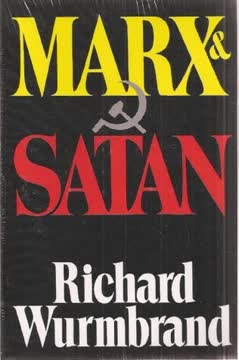
Marx and Satan by Richard Wurmbrand argues that Marx was influenced by Satanism, drawing on his poetry, letters, and writings. Reviews are polarized: supporters find extensive evidence of Marx's hatred toward God and demonic influences in Marxism, praising Wurmbrand's research despite organizational flaws. Critics dismiss it as unconvincing, citing misrepresented quotes, cherry-picked evidence, and logical fallacies. Many acknowledge the book's disturbing content and circumstantial nature. Several readers appreciate learning about Marx's Christian background and subsequent rejection of faith, while others find the thesis far-fetched and poorly argued.
Similar Books