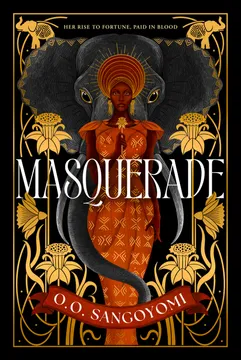


Plot Summary
Thunder Takes Timbuktu
In a rain-lashed market, nineteen-year-old Òdòdó watches Yorùbá conquerors execute Timbuktu’s Songhai general through a ritual verdict attributed to Ṣàngó. The crowd returns to trade, but Òdòdó goes home troubled by how quickly violence becomes ordinary. She and her mother, Okóbí, belong to a women’s blacksmith guild, where a sick worker receives little medicine and the women fear dying at their forges.
Òdòdó makes metal daffodils and sings a fragment taught by a passing trader, keeping the flower’s story alive after the real one withered. A ragged stranger hears her song over the compound wall, accepts a daffodil, and asks what she knows about the Aláàfin.
The opening makes conquest a public spectacle and daily commerce its immediate erasure. Òdòdó’s attention to the executed man’s fear, and then to the guild’s untreated illness, marks her as someone who notices the human cost beneath official ritual. Her flower-making is not escape from work so much as a private craft within it: she transforms metal, the material of weapons, into something meant to survive through memory. The stranger’s interest in the Aláàfin binds this fragile private world to the empire’s immense power before Òdòdó understands what that connection will cost.
A Cup to the Desert
Okóbí arrives before the stranger can explain himself and pulls Òdòdó away, then strikes her for speaking to an unfamiliar man. The next day, Yorùbá soldiers enter the forge, assault one of the blacksmiths, and order the women to work for their new rulers. Okóbí sends her daughter to sell flowers rather than risk her staying near them.
At the market, the same broad soldier offers Òdòdó a drink, drugs her, and leaves her unconscious at an oasis. Two desert nomads seize her when she tries to flee, then she wakes inside a luxurious palanquin. Its route leads not north to the feared salt mines, but south through the gates of Ṣàngót, the Aláàfin’s royal city.
The sequence overturns Òdòdó’s narrow understanding of danger. Her mother’s harshness is meant to keep men away, yet it cannot protect her from a soldier acting with state power. The drugged drink turns ordinary exchange into a trap, while the nomads’ capture shows how easily a person can become cargo in a world organized around trade. The palanquin’s luxury offers no reassurance: she is being moved without consent, and comfort itself becomes evidence of how thoroughly someone else has arranged her fate.
The King Behind Rags
Servants bathe and dress Òdòdó for a wedding she never agreed to, and the tailor, Ìgbín, finally explains that she is to become the Aláàfin’s bride. At the ceremony ground, the ragged stranger reappears in royal finery and identifies himself as Àrmọ, ruler of Yorùbáland.
He insists on parading Òdòdó through Ṣàngót on the back of Ajá, his elephant, while courtiers scramble to prepare a feast. His royal griot, Gassire, objects to the sudden announcement, but Àrmọ proceeds. At dinner, the hostile general Ọmóṣẹwà condemns the match. Hidden cowpeas in Òdòdó’s food make the marriage a divine test; she eats them, and the storm passes without lightning.
The public ritual converts coercion into apparent consent. Because the cowpea trial once condemned a conquered general, Òdòdó understands that her survival depends on a sign she cannot control. Yet she chooses to eat the beans rather than surrender the possibility of escape from forge labor. Àrmọ’s charm and the parade’s spectacle complicate her fear without removing it: the same man who offered her a flower’s worth of attention now determines her future before an audience. The scene establishes the novel’s recurring tension between personal choice and the state’s power to stage that choice.
A Home with Conditions
After the feast, Àrmọ tells Òdòdó that a dream and her song seemed to answer his long-standing hunger for a soul made to fit his own. He offers her the royal life she once imagined, but she refuses marriage unless Okóbí can come too. Àrmọ promises to find her mother and says he will not force the wedding before she gives her blessing.
Òdòdó stays, drawn by the chance to save them both from the forge. The Aláàfin’s mother, Mama Aláàfin, greets her with contempt and assigns lessons and exercise as if she were a poorly trained servant. On the field, Òdòdó meets Kl, Àrmọ’s first wife, whose warmth offers her a first companion in the palace.
Òdòdó’s condition is an early attempt to make intimacy answerable to obligation. She will not accept a better life if it requires abandoning the person who raised her, even though Okóbí’s affection has often arrived as discipline and blame. Àrmọ’s response sounds generous, but his promise is backed by the authority that brought Òdòdó here without permission. Kl offers a different kind of recognition: she treats Òdòdó as a person rather than a political acquisition. The chapter’s comfort is therefore provisional, built inside a household where affection and power remain difficult to separate.
The Price of Protection
As Òdòdó learns the palace’s rules, she discovers that women’s exercise is meant to prepare them for childbirth, while eunuch guards monitor their movements. At a garden party, Captain Kiigba, Àrmọ’s second-in-command, corners and assaults her. Àrmọ intervenes, wounds Kiigba, then kills him publicly and disguises the execution as a lesson about drunken soldiers.
Afterward, he promises to teach Òdòdó how to defend herself, despite the rule that Aláràá women do not fight. He also explains that Kiigba served as his unofficial source of court information. With her own access to women’s conversations, Òdòdó begins passing useful gossip to Àrmọ, becoming an adviser as well as his intended wife.
Protection here is inseparable from violence. Àrmọ responds to an assault on Òdòdó by punishing Kiigba, but he also turns the killing into a political performance that warns everyone watching. His private lessons give Òdòdó a measure of agency, though he still decides the limits of her training. Her intelligence work grows from a social position others dismiss: women’s conversations contain information the generals overlook. The episode thus links bodily self-defense to political perception, while showing that Àrmọ’s care can be genuine and possessive at once.
The Hammers Fall Silent
Blacksmiths across Yorùbáland begin abandoning their forges, and the royal city’s guild disappears too. Before leaving, the young smith Dígí tells Òdòdó she will remain nearby and offers a hidden refuge. Òdòdó cannot explain the strikes, but she needs Dígí’s network to find Okóbí.
Her palace life grows more divided: she trains at night, studies with Gassire, gathers court intelligence, and crafts a bronze flower bouquet for Àrmọ. While helping Kl send gifts to her family, Òdòdó finds spearheads concealed in the cloth. She leaves them behind, believing they were packed by mistake. The weapons are an unsettling clue that Kl’s generosity may be connected to the kingdom’s growing shortages.
The strikes turn a profession treated as marginal into a force the empire cannot ignore. The guilds’ absence deprives the kingdom of tools and weapons, while exposing how dependent its power is on women it has stigmatized. Òdòdó’s position is increasingly contradictory: she enjoys security and privilege, yet her former sisters are withdrawing their labor to demand a life beyond the forge. The hidden spearheads give that conflict a physical form. She has not yet connected them to Kl, but the episode plants evidence that domestic gifts may be carrying a political cargo.
The Burning District
When enslaved people revolt in Ṣàngót’s wealthy Gilded District, Àrmọ gathers young trainees and several generals to suppress them. Òdòdó joins the battle to help find Kl, who is trapped with other noblewomen. She fights beside Àrmọ until a woman’s scream draws her away. General Ọmóṣẹwà threatens her with an arrow, then she wounds him and reaches the burning house.
After helping him free the women, Òdòdó follows Kl upstairs. Kl knocks her backward through a window and escapes as the house collapses. Òdòdó is buried in the wreckage with one hand crushed beneath stone. A vision of the òrìṣàs sends her back to life, but the falling debris leaves her trapped and badly injured.
The revolt exposes the violence beneath the palace’s polished order, while forcing Òdòdó to act within it. Her decision to search for Kl is personal, but the battle makes that loyalty dangerous. Kl’s sudden attack reverses the trust that had helped Òdòdó endure palace life. The collapsed house then literalizes the cost of believing that proximity to power means safety. Òdòdó survives a divine encounter, but survival is not a miracle that restores her unchanged. She is left alone with an injury that will require a brutal choice and a world already prepared to mourn her.
The Funeral She Walks Into
With the fire still burning overhead and a slab pinning her hand, Òdòdó cannot reach the opening in the rubble. She uses her machete to cut off the trapped hand, then crawls out after the rain extinguishes the flames. Aboveground, soldiers have mistaken a charred woman for her and carried the body away.
Òdòdó follows a corpse wagon through the empty city and reaches her own funeral, where Gassire is preparing to sacrifice her handmaids as servants for the dead. Her appearance stops the execution. During recovery, the royal babaláwo calls her paranoid when she accuses Kl, and medicine clouds her mind. The twins, Táíwò and Khìndé, sneak in, believe her, and help her refuse the drugged food.
Òdòdó’s survival is physical, social, and epistemic. She must sever part of her body to escape, then walk into a ceremony that has already assigned her a death and a meaning. The funeral reveals how quickly the court can turn a woman into a legend without hearing her account. Her later confinement repeats that silencing in a more intimate form: her claim about Kl is dismissed as illness. The twins matter because they offer belief without demanding proof she cannot yet provide. Their trust allows Òdòdó to begin recovering not only her strength, but confidence in her own memory.
Mother at the Door
Once the babaláwo accepts a false account of the house’s collapse, Òdòdó can leave her hut again. She slips into the city to meet Dígí, who has helped her search for Okóbí but has not reunited them. Later, Okóbí appears in a storehouse disguised as a slave and offers to smuggle her daughter away.
She explains that a man assaulted her when she was young, shaping her belief that an unmarried woman is safest outside a man’s control. Òdòdó rejects the escape and insists she has chosen the royal city. She returns to Àrmọ, only to learn he planted a spy among her attendants. He detains Òdòdó, then stages a public trial in which she is ordered to kill Okóbí as proof of loyalty.
The reunion forces Òdòdó to confront two incompatible definitions of freedom. Okóbí’s caution comes from lived violence, not mere bitterness, while Òdòdó’s desire for palace life is not simply vanity: she wants power, safety, and the chance to stop their shared exhaustion. Yet Àrmọ’s surveillance and the public loyalty test reveal the price of that refuge. The mother-daughter conflict is made cruelly literal when the state turns their private disagreement into an execution. Òdòdó’s choice to stay has not protected her from being controlled; it has placed her inside a larger system of coercion.
A Friend Unmasked
After killing Okóbí under the crowd’s pressure, Òdòdó is scheduled to marry Àrmọ. Before the wedding, the twins bring her a message Kl has passed to a courier, revealing that hidden ivory is being moved to another camp. Òdòdó confronts Kl and learns that the woman she knew was an Ahosi soldier from y, not its princess.
She had supplied weapons to the slave revolt and helped move ivory to weaken Àrmọ’s empire. Rather than face capture, Kl swallows poisonous castor seeds and dies. Òdòdó tells Àrmọ where to search; prisoners from his earlier raid confirm the second camp. He leads a force to seize the ivory, kills its leader, and returns having accepted Òdòdó’s loyalty.
The revelation reframes friendship as a political instrument without making its emotional history false. Kl’s kindness helped Òdòdó survive, but it also served a mission rooted in y’s long conflict with Ṣàngót. Her deception is not a simple personal betrayal; she sees herself as a soldier acting within a history of conquest and enslavement. Òdòdó’s discovery depends on the information networks she has patiently built, especially the twins’ access to adult conversations. Her success restores Àrmọ’s trust, but his killing of the camp leader makes clear that the same imperial violence remains intact.
Wedding Before War
After the ivory operation, Òdòdó marries Àrmọ in a lavish ceremony that makes her his official wife. That night, the Songhai attack Gao, and Àrmọ rides out with soldiers to reinforce the front. While he is away, Mama Aláàfin poisons Òdòdó, hoping to prevent her from bearing an heir and preserve her own influence.
Òdòdó survives the illness but withdraws from palace life, while Dígí visits and admits she delayed finding Okóbí so the blacksmith strikes could gain strength. A month after the wedding, a battered messenger reports that Àrmọ’s party was intercepted by forces from y and held near the Niger. Òdòdó refuses to wait for the generals and assembles a rescue party with Rótìmí.
The wedding promises belonging, but the immediate departure reveals how little control Òdòdó has gained over the terms of marriage. Mama Aláàfin’s poisoning makes the domestic sphere another site of political violence, directed at Òdòdó’s reproductive future. Dígí’s confession adds a second betrayal to the losses surrounding her, though her motive is collective survival rather than private malice. The messenger’s news finally converts Òdòdó’s long experience of being acted upon into an urgent decision of her own. She does not wait for royal permission to recover the person who has shaped her life.
Ajá Leads the Rescue
Òdòdó rides Ajá at the head of Rótìmí’s small force and finds the enemy camp beside the Niger. Outnumbered four to one, she uses deception: the soldiers attack from three directions and leave an apparent escape route, making the defenders believe a larger force has surrounded them. Her speech gives the men a reason to fight for the people waiting at home.
Amid the assault, she finds Àrmọ chained with the other captives and frees him. Back in Ṣàngót, the injured king is kept from her while he recovers. Òdòdó returns to her duties, advises the generals, and takes a place in Àrmọ’s chair during meetings. When he is well enough to see her, he rejects her request to become his second-in-command.
Òdòdó’s rescue is the clearest proof that she has learned to use power on her own terms. She adapts Gassire’s lesson in deception and Àrmọ’s understanding of military morale, but makes the plan her own. Yet victory does not dissolve the hierarchy she has challenged. Once Àrmọ is back in safety, the court restores familiar roles: she is treated as a wife, not a strategist, even after saving the king. The distinction exposes the limits of exceptional recognition. Her competence is welcomed when it serves the throne, then discounted when she asks to share its authority.
The Crown Costs Blood
After Àrmọ leaves on another campaign, Òdòdó governs in his absence, holding court and consulting the generals. She reconnects with Dígí and promises the blacksmiths fair treatment if they return to work. When Àrmọ comes back, she asks again for an official role in government; he dismisses the idea and treats her as a wife whose beauty should satisfy her.
Òdòdó accepts his affection, then cuts his throat with the gilded dagger he once used to force her loyalty. She tells Dígí to gather guild leaders and offers the blacksmiths a place in the kingdom’s future. Mama Aláàfin, confronted with her son’s death, calls Òdòdó an àbíkú. In the war room, the generals see the crown and bloody blade, then acknowledge Òdòdó as queen.
The final choice is neither a simple liberation nor a clean moral victory. Òdòdó kills the man she loves because his affection cannot accommodate her political personhood; tenderness has repeatedly coexisted with surveillance, coercion, and the denial of authority. The dagger links her accession to the execution that made her marriage possible, turning the instrument of forced loyalty against the ruler who wielded it. Her promise to the blacksmiths points toward a different basis for power, grounded in labor and reciprocal obligation. But she takes the same imperial crown, leaving the question of whether she can reshape its violence deliberately unresolved.
Analysis
Masquerade binds personal desire to the machinery of empire. Òdòdó wants a life beyond the forge, and the Aláàfin’s palace seems to offer it: safety, abundance, and a position from which she might protect her mother. Yet each stage of her ascent exposes another form of control. Her body is drugged, displayed, monitored, trained for childbirth, and finally used as proof of loyalty. The novel refuses the easy distinction between oppressive poverty and liberating privilege. Òdòdó’s palace life is genuinely better in some ways, but it is still structured around what powerful men and their families expect her to provide.
Crafting makes that tension tangible. Òdòdó’s flowers and her lost hand both emerge from the same history of metalwork, yet one represents chosen expression and the other the bodily cost of survival. Her remembered song insists that art can preserve a self through upheaval, while the blacksmith strikes demonstrate that skilled labor can become political power when workers act together. The court’s dependence on smiths undermines its contempt for them, just as Òdòdó’s strategic insight undermines the assumption that women have nothing to contribute to governance.
Love is equally complicated. Àrmọ’s devotion is sincere, but sincerity does not erase the coercion with which he brings Òdòdó to his court or the authority he refuses to share. She loves him without mistaking that love for justice. Her final act is therefore both intimate and constitutional: killing him ends a relationship that has offered tenderness and repeatedly denied her agency, while taking his crown gives her a chance to alter the state that produced their conflict. The ending grants Òdòdó power, not moral purity. Her rule begins inside the empire’s inherited violence, with the promise that laborers may be treated differently. Whether she can transform the crown rather than merely inherit it remains the novel’s sharpest question.
Review Summary
Masquerade receives mostly positive reviews, averaging 3.89/5. Readers praise its rich West African historical setting, strong feminist themes, and the protagonist Òdòdó's compelling character arc. The audiobook narration by Ariel Blake is frequently highlighted as exceptional. Common criticisms include loose fantasy elements despite fantasy marketing, pacing issues in the first half, and concerns about the Stockholm syndrome-adjacent romance. Many note the Hades and Persephone retelling is very loose. The ending receives widespread praise, often described as surprising and satisfying.
People Also Read






Characters
Òdòdó
Blacksmith turned queenA young blacksmith from Timbuktu, Òdòdó is observant, imaginative, and hungry for a life beyond the forge. She makes flowers from metal and remembers a song taught by a traveler, practices of creation and memory that contrast with her labor making weapons. Her first instinct is often to defer to people with more power, but she notices details others dismiss and learns to turn that attention into practical judgment. She wants safety and dignity for herself and her mother, yet she is also drawn to the authority and abundance represented by the Aláàfin’s court. Her central psychological conflict is not simply choosing between love and independence. It is learning whether a life offered by another person can become genuinely her own.
Àrmọ
Conquering, devoted kingThe Aláàfin of Yorùbáland is a charismatic ruler whose warmth can feel startlingly intimate, even as his political instincts are ruthless. He has built an empire through military discipline and believes expansion is a path to prosperity. A dream and Òdòdó’s song persuade him that she can satisfy a hunger he cannot explain, and he pursues her with gifts, attention, and declarations of devotion. He can listen, adapt, and show real tenderness, but he is accustomed to having his wishes obeyed. That assumption shapes his courtship as much as his rule. His relationship with Òdòdó tests whether he can recognize her as more than the beloved person he wants beside him.
Okóbí
Protective blacksmith motherÒdòdó’s mother is a formidable blacksmith whose strength and leadership have kept her guild working under harsh conditions. She disciplines her daughter sharply and distrusts men, the state, and promises of rescue. Beneath that severity is a history of gendered violence that has taught her to regard independence from men as a woman’s safest condition. Okóbí wants to protect Òdòdó, but protection becomes entangled with control: she struggles to accept that her daughter might choose a different life. Her character gives the novel’s argument about freedom an intimate counterweight. She knows the dangers of male power firsthand, while Òdòdó is trying to imagine whether power can be used without surrendering herself.
Kl
The Aláàfin’s first wifeKl is introduced as a princess from y and Àrmọ’s politically married first wife. Tall, athletic, and socially perceptive, she welcomes Òdòdó into a court where women are ranked by marriage and watched by guards. Her humor and generosity make her a rare source of ease for the new arrival, while her talk of home carries a persistent undertow of loss. Kl understands the constraints placed on royal women and knows how to navigate them with poise. Her relationship with Òdòdó is shaped by a shared awareness that affection, status, and political obligation rarely align neatly.
Dígí
Blacksmith organizerDígí is a young smith in the Aláàfin’s city and one of the few women Òdòdó meets who shares her trade and age. Her quiet expression conceals a steady conviction about the blacksmiths’ worth and their right to refuse degrading work. She treats Òdòdó as a sister rather than a royal curiosity, and she has the practical nerve to find refuge and build networks beyond the forges. Dígí’s activism is rooted in collective survival, though she can justify withholding information when she believes the movement needs it. She forces Òdòdó to consider whether personal loyalty and solidarity with an exploited group can always be reconciled.
Rótìmí
The listening generalRótìmí, general of gold-rich Wúràkmi, is a composed officer whose dry humor often masks private grief. He questions the Aláàfin’s relentless expansion and sees the value in maintaining the kingdom’s existing territories. Unlike many men at court, he takes Òdòdó’s observations seriously and becomes a reliable ally. His loyalty to his soldiers and second-in-command reveals a more personal ethic than the state’s usual calculations. He understands both strategic patience and the emotional cost of military service.
Ọmóṣẹwà
The brilliant hostile generalGeneral Ọmóṣẹwà is a superb archer and hunter whose striking beauty makes his anger all the more unnerving. He distrusts blacksmiths and initially sees Òdòdó as a threat to the court’s order. His pride is bound to his skill and to the authority of the Ẹgb-Ọdẹ clan, which gives him a strong sense of who belongs. He is dangerous, disciplined, and capable of loyalty, but his contempt for what he cannot control makes him an unpredictable presence around Òdòdó.
Gassire
Keeper of royal memoryGassire is the Aláàfin’s griot, historian, and public voice. He preserves political memory, announces the king’s decisions, and teaches Òdòdó literacy, strategy, and the stories that shape Yorùbáland’s identity. His pride in his inherited role can make him impatient with students who do not meet his expectations. Yet his lessons give Òdòdó tools she later applies beyond the classroom. Gassire understands that power depends not only on armies, but also on which histories a people are taught to remember.
Mama Aláàfin
The king’s ambitious motherÀrmọ’s mother is a wealthy, exacting woman who measures security through proximity to her son and command of the royal household. She treats etiquette and luxury as forms of authority, and she is quick to judge women who threaten her influence. Her hostility toward Òdòdó is sharpened by a recognition of her own past in the younger woman’s position. She is not merely a disapproving in-law; she is a political actor who understands that heirs, marriages, and access to the king determine who can shape the future.
Táíwò and Khìndé
Twin messengersThe young twins are enslaved siblings who have survived the destruction of their home and years of being moved between households. They speak in overlapping fragments, move with a shared ease, and are quick to test whether Òdòdó will treat them as people rather than property. Their friendships with noble children give them access to information adults assume they cannot use. They bring playfulness into Òdòdó’s recovery, but their usefulness also exposes how much political knowledge circulates through the lives of children and servants.
Kiigba
The king’s second-in-commandKiigba is a high-ranking soldier whose confident manner and easy access to court make him seem more capable than his military record warrants. He relies on experience, family ties, and social familiarity to remain influential. His position shows that power in the Aláàfin’s court is not always earned by battlefield excellence; information and alliances can matter just as much.
Ìgbín
The royal tailorÌgbín is the precise tailor responsible for clothing the women of the royal city. She speaks carefully, works quickly, and respects boundaries without pretending not to notice the secrets around her. Her craft gives Òdòdó a visible place in court, though the repeated measurements and daily outfits also show how thoroughly the palace manages women’s presentation. Ìgbín’s loyalty is expressed through competence rather than intimacy.
Bámidélé
The youngest traineeBámidélé is a young trainee who carries urgent news and hopes to earn glory in battle. His eagerness reflects the ambitions the Aláàfin’s army cultivates in boys long before they become full soldiers. He is brave, but still young enough for the dangers of war to exceed his understanding.
Captain Ìlérí
Rótìmí’s trusted strategistÌlérí is Rótìmí’s second-in-command, a clever strategist with an easy rapport that softens the general’s reserve. Their teasing familiarity shows how military partnerships can become intimate forms of trust. His importance to Rótìmí also reveals the personal bonds that official rank cannot neatly measure.
Ajá
The Aláàfin’s elephantAjá is Àrmọ’s powerful elephant companion, feared by handlers and fiercely responsive to the king. He is not simply a royal ornament: his moods and loyalty affect ceremonies, travel, and battle. Òdòdó learns to ride him and gradually earns his tolerance, creating a bond that reflects her growing ability to move through spaces designed for men.
Plot Devices
The metal daffodil
Memory made to endureThe daffodil begins as a gift from a traveler to Òdòdó, whose name means flower. She recreates it from gold, silver, and bronze, singing the imperfectly remembered song that accompanied the original. The flower connects her life at the forge to her relationship with Àrmọ, who keeps the first one she gives him. Its repeated making lets the story ask what survives when bodies, homes, and political arrangements are damaged. Craft is not an escape from history here; it is a way of carrying memory through change.
The sacred cowpea
Divine judgment in publicThe Yorùbá use a cowpea in a public ritual that tests whether Ṣàngó approves a person’s fate. After lightning, a verdict may be read as condemnation, making the bean a tool of religious authority and political theater. Òdòdó has already witnessed the ritual used against Timbuktu’s defeated general before she faces it herself at Àrmọ’s court. Her experience establishes how belief can be used to validate decisions powerful people have already forced into motion.
The beaded crown
A ruler beyond one lifetimeThe Aláàfin’s tall bronze crown and veil of beads hide the wearer’s face, making the ruler appear continuous across generations. Subjects encounter a title and office more than an individual body. This device supports Àrmọ’s public authority, keeps his private identity separate from his ceremonial role, and becomes a practical means for Òdòdó to appear in his place. The crown asks whether rule belongs to a person, a lineage, or the institution that survives both.
The blacksmith strikes
Labor becomes leverageBlacksmiths across Yorùbáland abandon their forges, withholding the tools and weapons on which farming, trade, and the army depend. Their withdrawal turns an occupation that society has stigmatized into a source of collective political leverage. Òdòdó’s escape from the forge becomes a story other smiths hear and interpret as proof that departure is possible. The strikes connect her personal desire for a different life to a wider movement, while forcing the Aláàfin to confront the material limits of conquest.
Children’s rumor network
Small ears find the truthTáíwò and Khìndé play with children from influential households, hearing details adults do not consider worth hiding from them. Their reports give Òdòdó access to court gossip, shifting military concerns, and eventually a message that helps her identify Kl’s role in the ivory trade. The device turns the palace’s assumptions about children into a political blind spot. Information does not move only through official messengers and generals; it travels through servants, playmates, and ordinary conversation.
Download PDF
Download EPUB
.epub digital book format is ideal for reading ebooks on phones, tablets, and e-readers.








