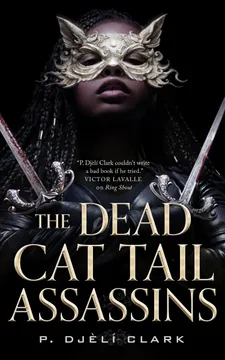


Plot Summary
The Festival Contract
During Tal Abisi’s crowded Festival, Eveen, an undead assassin, signs a hurried contract to kill someone hidden in a wealthy family’s tower. Her handler, Fennis, gives her an old Festival coin to locate the target and warns that the job must be finished before dawn. Eveen slips past the guards, climbs the tower, and draws back the bed curtains, expecting an elderly victim.
Instead, she sees a young woman whose face triggers the first memory Eveen has had since resurrection: she once saw that same face in a mirror. The woman wakes and screams, bringing guards running. Eveen knocks them down without killing them, then helps the stranger escape by disguising her beneath a magical cloak and drawing the guards’ attention to herself.
The job begins as familiar work, but its first breach is inward: a face restores a piece of Eveen’s erased past. Her decision to protect the target makes the contract more than a professional problem, because she must act against the rules that give her undead existence structure. The tower’s armed guards establish that the prisoner is not simply a protected heir, while Eveen’s restraint in fighting them shows that her violence has limits. Her first recovered memory does not explain who she was. It gives her a person she cannot bring herself to kill.
A Face in the Tower
At the night market, Fennis finally notices the young woman Eveen brought with her. Before he can explain the situation, she hears that Eveen was hired to kill her and tries to flee. Eveen stops her, admits the contract, and explains that the woman’s face matches the one from her sudden memory.
The prisoner identifies herself as Cyanna, usually called Sky, and tells them she was taken during the Festival after catching a coin bearing the name of a long-dead Grand Patriarch. That clue places her decades outside Eveen’s present. Eveen explains that she is dead, then describes the memory: she saw Sky’s face in a mirror because it was her own. Sky does not remember meeting her, leaving them with a likeness neither can explain.
The market makes the rescue morally complicated: Sky learns that the woman who freed her was hired to kill her. Trust is not immediate, and Eveen’s explanation cannot repair the danger she represents. Yet the coin and the face give the pair a shared puzzle more powerful than their fear. Eveen’s identity has been built around the absence of memory, so recognizing herself in another person destabilizes her more than the threat of being punished. Sky’s insistence on being treated as a person, not a contract or a mystery, also begins to challenge Eveen’s habit of reducing people to jobs.
Two Souls, One Pattern
Eveen takes Sky and Fennis to Ennis, Fennis’s half-brother and a thaumaturgy scholar. His experimental device lets the women experience one another’s memories: Eveen sees Sky’s childhood and adult life, while Sky encounters the seven years Eveen has spent killing and living without a past.
The experience confirms that their auras are identical, though the device nearly draws them into a single body before Ennis shuts it down. Fennis warns that Eveen’s accepted contract cannot simply be ignored. Sending Sky back might make the agreement void, but Ennis cannot perform the necessary time magic. Eveen decides she needs answers from Baseema, the guild boss, despite Fennis’s warning not to visit her.
The machine converts resemblance into evidence, but its near-merger exposes the danger of treating identity as sameness. Each woman can enter the other’s memories, yet neither becomes the other. For Eveen, seeing Sky’s life supplies what her own erased past withheld, but it also makes her violence newly legible as a possible future rather than an unrelated existence. The contract’s rules turn this personal discovery into a collective risk: breaking it could endanger the guild. Eveen’s choice to seek Baseema instead of waiting for a legal solution shows that she responds to uncertainty through action, even when action makes her less safe.
Baseema’s House of Teeth
Baseema confirms the danger of Eveen’s broken contract and explains that the goddess Aeril punishes entire guilds when an assassin refuses a job. She orders Eveen to kill Sky, then sends four undead sisters to capture her when Eveen refuses. Eveen survives the attack by turning their weapons and Baseema’s reanimated bird, Tick-Tick, against them.
Baseema finally gives her the anonymous client’s name: Pol Oranus, a Patriarch. She also gives Eveen a head start, though other assassins will keep hunting them. Fennis finds a legal clause suggesting that a contract may fail if its target no longer exists in the present. Returning Sky to her own time might therefore save both women and the guild, but the method remains unknown.
Baseema’s ultimatum makes visible the conflict between personal conscience and institutional survival. She is not simply an enemy: she attempts to enforce the guild’s rules, then gives Eveen a narrow chance because the scheme threatens her entire organization. Eveen’s fight with the sisters is an argument made in action. She will not let other people decide that Sky’s life is a necessary expense. The contract clause offers a technical path out, but it also reveals how law can become a weapon when powerful people know how to exploit its wording.
Fire Beneath the Safehouse
At Eveen’s hidden safehouse, Rejik, an assassin who controls silver strands, traps Eveen and Sky and destroys the magical cloak. Eveen sends Sky through an old smuggler tunnel, then frees herself by setting flammable supplies alight and collapsing the passage behind them.
The escape costs her the refuge she had carefully built. In the Wheelbarrow, surgeon Tamu repairs Eveen’s severed fingers while Mama Birgini, a local power, explains why residents honor Eveen as the Angel of the Barrow.
Years earlier, Eveen broke another assassin’s vow to stop a killer who murdered children; saving survivors cost her an extra century of service. Mama Birgini points them toward Mael, the last of three illicit sorcerers who may know how Sky was brought to Tal Abisi.
The safehouse is both shelter and self-portrait: Eveen has filled it with handmade glass creatures and the books she loves, evidence of a private life beyond killing. Rejik’s attack burns that fragile world and forces Eveen to rely on the community she once served. Mama Birgini’s account changes the meaning of Eveen’s reputation. The city calls her an angel because she accepted a punishment to protect children, while Eveen herself remembers the ones she failed to save. That gap between how she sees herself and what others owe her becomes important when she must decide whether she deserves help.
The Reaper’s Hidden Patron
Mael admits that he and two fellow sorcerers studied the child-killer Eveen once stopped, hoping to uncover his forbidden search for immortality. They found a magically protected journal and brought its secrets to Pol Oranus, who hired them to perform a spell that pulled Sky into the present and arranged Eveen’s contract.
Mael says the killer was Aban Oranus, Pol’s son, and that Pol concealed his crimes while seeking immortality himself. With his fellow sorcerers dead, Mael offers to reverse the spell using power from the Shimmer, Tal Abisi’s dangerous field of lingering magic. Eveen and Sky agree to risk the attempt. They head east before dawn, carrying the equipment that can draw power from the Shimmer’s strange resonance.
Mael’s account replaces a baffling coincidence with a chain of exploitation. Pol Oranus used the sorcerers’ ambition, his son’s crimes, and the assassin guild’s binding rules to stage revenge while concealing his own history. Yet Mael is not a clean source of justice: he admired the killer’s work and helped build the spell without grasping its human cost. Eveen’s fury is sharpened by the discovery that her earlier act of protecting children created the grievance Pol now uses against her. The Shimmer offers a possible escape, but its power comes from the same catastrophe that shaped the city’s history.
Giants Facing the Wrong Way
Inside the Shimmer, the ruined Smuggler’s District appears frozen in daylight, and nine clockwork giants still guard the shore. Sky notices that the giants face the wrong direction according to the Festival story she remembers.
Eveen knows a different version, and the discrepancy suggests that Sky’s home is not simply Tal Abisi sixty years earlier. Before they can investigate, Valesh, another undead assassin, kills Mael and attacks Eveen, insisting that the contract must be obeyed.
The Shimmer briefly makes Eveen bleed and breathe, but it also prevents her body from healing. Sky uses one of Mael’s resonance forks to overload Valesh with chaotic magic, destroying his body. Eveen and Sky escape the shore, but lose their only apparent way to return Sky home.
The giants provide a precise clue: a shared legend has changed in a way that time alone cannot explain. The detail is easy to dismiss until the women compare what each regards as ordinary history. Meanwhile, Valesh embodies a competing answer to Eveen’s crisis. He has stripped away his humanity and treats obedience as virtue, while Eveen’s pain and fear reveal that she still values the fragile body he despises. The Shimmer makes that conflict literal by briefly restoring sensation to her, then withholding the healing she depends on. Sky’s intervention saves Eveen, turning their strange connection into practical trust.
The Old Man’s Game
On the road beyond the Shimmer, a necromancer seizes control of Eveen’s undead body and forces her to hold Sky at knifepoint. Eveen can resist only in tiny movements until the guild’s childlike veteran assassin, the Old Man, appears. He has poisoned the necromancer, weakening his control enough for Eveen to release Sky.
The Old Man explains that he has watched the night’s events unfold and wants the scheme brought to its conclusion. He leaves the necromancer alive for punishment and allows Eveen and Sky to go. Remembering Baseema’s warning about a visitor from out of town, Eveen recognizes that the necromancer was meant to be a final obstacle. Rather than keep fleeing, she decides to confront Pol Oranus and surrender herself.
The necromancer turns Eveen’s body into an instrument against her own judgment, making the book’s concern with agency physical rather than abstract. Her resistance begins with a finger, a tiny act that matters because it is hers. The Old Man’s intervention is not conventional rescue: he has watched the ordeal as a game and cares about seeing its design completed. His attitude is unsettling, but it gives Eveen enough freedom to choose her next move. Surrender is not passivity here. It is a deliberate shift from escaping Pol’s scheme to forcing him to face it publicly.
Two Goddesses, One Contract
At Pol Oranus’s estate, Eveen asks for divine arbitration instead of obeying the contract. Aeril rules that the agreement remains binding, so Eveen reveals the crucial clue: Sky’s Festival history differs because she comes from another world, not Eveen’s past.
Sky invokes the Aeril who claims her soul, and that goddess arrives. The two immortals nearly fight until Eveen persuades them that Pol has manipulated both their laws. They burn the contract. Sky then hires the guild to kill Pol, offering Baseema a unique Festival coin as payment, while the Patriarch’s guards abandon him.
Sky asks Aeril to remove the extra century from Eveen’s service, and the goddess agrees. Together, Sky and Eveen use the surgical tools to punish Pol before Sky returns home with no memory of their night together.
The ending resolves the story through a succession of choices, not a sudden defeat of power. Eveen proves that Sky is outside the first Aeril’s world, while Sky claims protection from her own goddess. Their intervention exposes a contradiction the goddesses cannot ignore: each has authority, but neither can treat another world’s person as uncomplicated property. The invented Asheel tale gives Eveen a way to make the immortals see their shared predicament without force. Sky’s final decisions extend that agency: she rewards Eveen, recruits the guild, and chooses a form of justice that answers Pol’s violence without pretending the night can be remembered by both women.
Analysis
The novella turns a fantasy-assassin premise into a test of how much a person owes to the rules that define her. Eveen’s contract is not just a job: it is the institution that gave her a body, purpose, and place among the dead. When she refuses to kill Sky, she risks the guild that shelters her, so mercy becomes an action with material costs rather than a private feeling.
The story’s central question is whether resemblance cancels difference. Eveen and Sky share a face, memories, and an aura, yet Sky’s altered history eventually establishes that she is not simply Eveen at an earlier age. Their connection creates intimacy, but the plot refuses to make one woman a disposable version of the other. Eveen must choose Sky’s life without treating her as a route back to her own past. Tal Abisi’s contracts, political hierarchy, and divine laws all promise order, but Pol Oranus manipulates each system for private revenge. His power depends on others believing the rules are neutral. Eveen’s final strategy exposes the weakness in that belief: laws gain meaning from the people and authorities who uphold them, and even immortal power can be maneuvered into recognizing its own contradictions.
The ending also complicates justice. Sky returns to her own world without remembering the night, while Eveen keeps its emotional consequences. Their shared final act cannot erase the violence that preceded it, but it gives both women a choice inside a system designed to deny them one. Eveen’s hard-won humanity is not a recovered memory. It is the pattern of decisions she makes when obedience would be easier.
Review Summary
The Dead Cat Tail Assassins is widely praised for its rich world-building, sharp wit, and breakneck pacing, with many readers highlighting Clark's ability to craft an immersive fantasy world within a compact page count. Eveen, the undead assassin protagonist, is largely beloved for her humor and competence. Common criticisms include some readers feeling emotionally disconnected from the characters, occasionally excessive descriptive detail, and a jarring dialect introduced late in the story. Most reviewers found it highly entertaining and expressed hope for a continuation of the series.
People Also Read
Characters
Eveen
Undead contract killerEveen is an undead assassin in Tal Abisi, resurrected without memories and bound to the goddess Aeril by a strict employment contract. Her practical skill and irreverent humor help her navigate danger, while her distrust of sentiment protects her from the vulnerabilities of a life she cannot remember. Yet she is not indifferent to suffering: she has accepted serious consequences to protect people who could not protect themselves. She fills her sleepless hours with food, pulp adventures, and animated glass figurines, small pleasures that make a world of dulled sensations feel inhabited. Her central tension is between the identity imposed by her work and the stubborn moral instincts that keep disrupting it.
Sky
Aspiring surgeonSky is a nineteen-year-old medical student whose training has taught her to observe carefully and ask direct questions. She is frightened when events strip away the ordinary life she expected, but fear does not erase her curiosity or her sense of responsibility. Her interest in healing provides a sharp contrast to Eveen’s work, though the two share humor, tastes, and a talent for speaking plainly. Sky resists being treated as a mystery or a piece of evidence; she insists on being recognized as a person with her own judgment. Her steady attention helps draw Eveen out of defensive detachment and into a more reciprocal relationship.
Fennis
Assassin guild handlerFennis manages contracts for the Dead Cat Tail Assassins and serves as Eveen’s dependable, if cautious, professional contact. His love of food and paperwork gives him an unassuming presence, but he understands the legal and divine rules that govern their work. He tends to search for solutions in records before taking risks, a temperament that complements Eveen’s improvisation. Though he initially thinks of their relationship as strictly professional, the crisis reveals how much trust has grown between them.
Baseema
Guild boss and survivorBaseema leads the Dead Cat Tail Assassins with a mix of hard calculation and earned authority. A former sailor who built wealth and influence through experience, she understands that a guild survives through contracts, alliances, and carefully managed risk. Her affection for the guild is real, but she does not confuse it with softness: she can threaten Eveen and still give her a chance when the danger extends beyond one failed job. Baseema’s stories and collections suggest a person who remembers the past as both warning and possession.
Pol Oranus
Powerful city patriarchPol Oranus is a wealthy Patriarch accustomed to having institutions and people bend around his interests. His influence comes not only from money but from his command of reputation, political access, and the people who carry out his wishes. He presents himself as controlled and authoritative, yet that composure rests on the assumption that no one can challenge his version of events. Pol’s ambition makes him willing to involve specialists in dangerous work while keeping his own hands clean. He is the story’s human example of power that treats lives, laws, and even family as instruments.
Ennis
Thaumaturgy scholarEnnis, Fennis’s half-brother, teaches applied mechanical thaumaturgy and approaches the world through experiments. His laboratory is full of devices and magical organisms, and his curiosity makes him willing to test ideas others would avoid. He is more interested in what a machine can reveal than in preserving conventional explanations. That openness makes him useful to Eveen and Sky, though his fascination can cause him to underestimate the emotional danger of his experiments.
Mael
Ambitious illicit sorcererMael is one of three self-styled experimental sorcerers who seek forbidden knowledge beyond the sanctioned colleges. He is clever enough to recognize patterns and help build powerful magic, but ambition makes him susceptible to a patron who flatters his talent. His fascination with the notorious killer Eveen once stopped clouds his moral judgment. When confronted with the consequences, he becomes frightened and tries to bargain his way to safety.
Valesh
Unyielding undead assassinValesh is a fellow assassin who has remade his body into a many-armed skeleton and sees flesh as a weakness to be discarded. He treats contractual obedience as the highest virtue and regards Eveen’s compassion as proof of failure. His certainty makes him dangerous: he does not experience doubt as a reason to pause. Valesh embodies the discipline Eveen might have embraced if she had mistaken emotional distance for strength.
The Old Man
Child-faced master assassinThe Old Man is an assassin whose small, childlike appearance disguises a long history and formidable patience. He studies targets carefully and favors poisons over spectacle. He approaches dangerous events as games whose outcome interests him as much as their immediate stakes. That playful manner can turn chilling without warning, leaving others unsure whether they have been helped, tested, or both.
Aeril
Matron of assassinsAeril is the goddess who governs the Dead Cat Tail Assassins’ resurrection and contracts. Her authority is expressed through binding words, terrifying hounds, and a presence that makes mortal law seem small. She is not merely a patron who grants power; she defines the conditions under which that power may be used. Her rules create security for the guild while also placing its members under immense pressure. Aeril’s identity as both assassin deity and keeper of contractual order makes her a powerful, unpredictable force in Eveen’s life.
Rejik
Silver-strand assassinRejik is a Dead Cat Tail assassin who uses thin, responsive strands to track and restrain his targets. He favors theatrical language and elaborate explanations, pairing genuine danger with an eccentric need to define his own persona. His methods turn ordinary spaces into traps, making him an especially unsettling pursuer.
Mama Birgini
Wheelbarrow community elderMama Birgini is an influential elder in the Wheelbarrow, where she runs entertainment and gambling businesses and commands the loyalty of residents. She speaks with the authority of someone who has seen powerful outsiders take advantage of the poor. Her warmth toward Eveen comes from a debt rooted in the community’s survival, not from naïveté. She shares information carefully and expects people to understand the obligations attached to her help.
Tamu
Wheelbarrow surgeonTamu is a skilled surgeon who treats people in the Wheelbarrow, including Eveen when her undead body needs repairs. His good humor and confidence make his workroom feel less like a place of crisis. He respects practical skill in others and responds warmly to Sky’s medical knowledge. His place in the community reflects a kind of care that is often absent from the city’s formal institutions.
The four sisters
Guild’s brutal enforcersOoni, Mimi, Ipi, and Ini are four undead sisters employed for the guild’s most violent work. Their weapons and temperaments differ, but together they enjoy intimidation and physical dominance. Their taunts reveal how readily they treat suffering as entertainment. They function as a dark mirror of guild loyalty, showing the kind of obedience Baseema can command when persuasion fails.
Plot Devices
Aeril’s death contracts
Rules that bind the assassinsThe Dead Cat Tail Assassins accept jobs under three divine vows: contracts must be just, only the named target may be killed, and an accepted contract must be completed. Breaking the most important vow can bring punishment not only to the assassin but to the guild. The rules make Eveen’s decision to spare Sky immediately consequential, turning a private act of mercy into a danger to everyone around her. They also shape the eventual conflict by making law itself a weapon that can be challenged only through equally binding terms.
The Festival token
A coin that locates its ownerThe old Festival coin serves first as the Find that leads Eveen to Sky’s tower. Its engraving later dates Sky’s arrival to a time before Eveen’s present, and its rarity makes it valuable enough to become payment for a new contract. The same object therefore connects the kidnapping, the mystery of Sky’s identity, and the final confrontation. It is a practical clue whose meaning changes as the characters learn more.
Ennis’s aura machine
A device for shared memoriesEnnis’s experimental apparatus links two people’s auras, allowing them to experience one another’s memories. The device proves that Eveen and Sky share an identical aura, while its near-merger warns that evidence of connection can threaten the very distinction between individuals. It gives them knowledge no ordinary interview could provide, but does not by itself explain the difference between their lives. That remaining uncertainty keeps the mystery alive until the story’s final revelation.
The Shimmer
A dangerous reservoir of magicThe Shimmer is the magical residue of a catastrophe in Tal Abisi’s past. Its power has frozen the old Smuggler’s District in an uncanny daylight and can be gathered with Mael’s resonance forks. The same unstable energy makes Eveen briefly bleed and breathe, but prevents her undead body from healing. The Shimmer offers the means to undo the time spell while making every step of the attempt more dangerous.
The parallel Tal Abisi
A world that resembles, but differsSmall discrepancies between Sky’s remembered city and Eveen’s reveal that the two women do not simply occupy different points in the same timeline. The most important clue is the story of the clockwork giants, whose direction differs between their versions of Tal Abisi. This possibility changes the legal and divine stakes: Sky’s presence concerns another world and another Aeril, not merely an altered past. The device lets the story explore identity without reducing either woman to a copy of the other.
About the Author

Download PDF
Download EPUB
.epub digital book format is ideal for reading ebooks on phones, tablets, and e-readers.








