

Key Takeaways
A blockchain is a shared ledger whose history changes only by network agreement.
Agreement replaces a central owner. A blockchain is a peer-to-peer ledger where transactions are grouped into blocks, linked to earlier blocks by cryptographic hashes, and accepted through a consensus process. Each participant can hold a copy, so no single administrator controls the authoritative record. Altering an old entry means rebuilding the links that follow it and convincing the network to accept the replacement.
Consistency takes time. The book frames blockchain through distributed-systems problems: nodes may fail, networks may split, and some participants may act maliciously. In public chains such as Bitcoin, participants can temporarily disagree about the newest record. The system converges over time, a property called eventual consistency, rather than guaranteeing that every copy is instantly identical.
What's striking is that blockchain does not abolish trust so much as relocate it. Participants rely less on one record keeper and more on shared rules, software, cryptography, and incentives. That can help groups that do not want a single organization to control their ledger. It also makes governance harder: when software rules produce a harmful result, the network still needs a way to decide whether rules or outcomes take priority. Distributed agreement is a technical achievement, not a substitute for institutional judgment.
Decentralize only the point of trust your system cannot afford to centralize.
Start with the trust bottleneck. The book distinguishes removing an intermediary from making service providers compete. A money transfer between countries could avoid a bank through direct peer-to-peer settlement. Alternatively, a smart contract might choose among several data providers based on reputation. The first removes the middleman; the second limits any one provider's control without removing intermediaries entirely.
Ask four design questions. Before building, identify what needs decentralizing, how much decentralization is needed, which blockchain fits, and what security mechanism protects it. A payment system might seek full disintermediation on Bitcoin, with atomicity ensuring that a transaction either completes or does not. The book also warns that decentralization can create new hazards, including lost private keys and buggy code.
This is a useful corrective to the idea that decentralization is automatically virtuous. Organizational design routinely distributes authority when local knowledge matters, yet central coordination can be faster and more accountable in emergencies. The choice is not simply centralized versus decentralized. It is where control sits, who can challenge it, and how mistakes are repaired. The four questions turn an ideology into an engineering decision, though they still require an explicit account of who bears the cost when the system fails.
Bitcoin makes strangers agree on payment order by pricing dishonest history.
Computing work secures the record. Bitcoin combines public-key cryptography, a peer-to-peer network, and Proof of Work. Miners gather valid transactions and repeatedly hash a block header, changing a nonce until the hash falls below a network-set target. Finding a valid result is costly; checking it is comparatively easy. This makes rewriting old payment history expensive and helps prevent double spending, where the same digital funds are spent twice.
The design has costs. New blocks appeared roughly every ten minutes in the book's 2017 account. Miners received newly created bitcoin and transaction fees, while the reward was scheduled to halve every 210,000 blocks. Bitcoin transactions spend unspent transaction outputs, or UTXOs, rather than drawing from a single account balance. The book describes six confirmations as a common practical threshold for confidence in a payment.
Bitcoin's key achievement is not merely digital money. It demonstrates how an open network can order transactions without appointing a permanent central operator. This resembles a costly lottery whose rules are publicly checkable. But the cost is also a policy choice: energy and specialized mining equipment can concentrate influence among those able to afford them. A security mechanism should therefore be judged not only by resistance to attack, but also by who can realistically participate in maintaining it.
Cryptography proves who authorized data, not whether its claims are true.
Keys establish control. A private key creates a digital signature, and a corresponding public key lets others verify that the signature matches. Hash functions turn data of any size into fixed-length fingerprints; changing even a small part of the input changes the result. Merkle trees combine transaction hashes into a single root, allowing efficient checks that a transaction belongs to a block without sending every transaction.
A public record is not secret. These tools help protect integrity, authentication, and proof of authorization. They do not automatically hide transaction details or establish the real-world identity behind an address. Bitcoin is pseudonymous, and analysis can sometimes connect transaction patterns to users. Nor does a valid signature establish that a reported fact, such as an asset's condition, is accurate.
The distinction between a valid signature and a true statement is fundamental well beyond blockchains. A cryptographic seal can show that a particular key approved a record; it cannot establish that the key holder was honest, competent, or authorized in the legal sense. This is why secure systems need trustworthy identity practices and reliable sources of information alongside cryptography. Transparency can support auditing, but it can also expose sensitive behavior, so public verifiability and privacy must be designed together.
Ethereum turns ledger updates into programmable rules, paid for operation by operation.
Contracts execute on a shared machine. Ethereum was designed to run programs called smart contracts, not just transfer currency. Its Ethereum Virtual Machine executes contract code as transactions change the network's state. Because every participating node must reach the same result, contract behavior needs to be deterministic. Ethereum's gas system charges for computation, limiting wasteful or endless execution and making users specify how much work they are willing to pay for.
Automation can make errors durable. Contracts can coordinate payments and business rules, but they cannot directly inspect outside events without an oracle, a service that supplies external data. The DAO, an investment project built from Ethereum contracts, suffered a major exploit in 2016. A hard fork was used to recover funds, while participants who rejected that intervention continued the original chain as Ethereum Classic. The episode exposed a conflict between code-based enforcement and collective governance.
Smart contracts make a powerful shift: rules that normally require repeated human coordination can execute as shared software. Yet automation magnifies both precision and error. A contract can faithfully follow flawed instructions, while a human institution can sometimes pause, interpret, or appeal a decision. The DAO dispute shows that even communities committed to code may need a political process when code and expected outcomes diverge. Good design therefore includes testing, clear authority, and a plan for exceptional cases, not just working software.
Permissioned ledgers trade open participation for privacy, speed, and known participants.
Not every network needs anonymous miners. Public blockchains allow broad participation, while private or permissioned ledgers restrict access to approved people or organizations. When participants are known, a network may use agreement protocols instead of energy-intensive mining. The book presents Hyperledger Fabric as a modular system with configurable consensus, identity, and privacy services. It describes Corda as a financial-services platform that shares transaction data only with relevant parties and uses notaries to check transaction uniqueness.
Different designs solve different problems. Ripple and Stellar focus on payments and consensus among trusted or selected validators. Ethereum can also be configured for private settings. Corda is notable because it is not a conventional chain of blocks, despite sharing features such as signed transactions and consensus. These examples show that blockchain technology is a family of design choices, not a single architecture.
Permissioned systems are best understood as coordination infrastructure for organizations that already have identities and rules, rather than as trustless public networks. This can make confidentiality and governance more practical. The trade-off is that restricting participation may recreate some of the power structures that public blockchains were meant to avoid. The decisive question is whether participants can independently verify the rules and challenge administrators. A shared database becomes meaningfully decentralized only when control is distributed as well as storage.
Keep large files and outside facts off-chain, and verify their fingerprints on-chain.
A ledger is not a storage warehouse. Blockchains are suited to ordered transactions and compact records, not large images or documents. The book discusses systems such as IPFS for distributing files, with their content hashes serving as identifiers. An application can store a file elsewhere and record its hash or reference on the blockchain, creating a way to detect whether the file has changed without placing the entire file on-chain.
External facts need a bridge. Smart contracts cannot independently fetch live information such as a share price or weather report. Oracles provide that information, sometimes with a digital signature or evidence of its source. But an oracle becomes a trust point: a contract can verify that a data feed was signed, yet still depend on whether the provider supplied accurate information.
This architecture resembles a familiar separation of concerns: keep large, frequently changing data in systems built for storage, and use a ledger for shared verification and coordination. It can reduce cost and avoid bloating every participant's copy of the chain. The harder issue is availability. A hash proves that a retrieved file matches a recorded version, but cannot make the file retrievable if every host disappears. Likewise, oracle signatures establish provenance, not truth. Systems need plans for both data integrity and data continuity.
Use blockchains where organizations need one auditable record but lack a trusted owner.
Look for costly reconciliation. The book points to finance as a candidate because separate organizations often maintain separate records, then spend time matching them. A shared ledger could give trading partners a common view of a transaction and potentially simplify post-trade settlement, which traditionally involves execution, clearing, and settlement. Other proposed applications include tracking high-value goods, managing insurance claims, sharing verified customer information, and recording government documents.
Some uses are more speculative. In an Internet of Things example, a Raspberry Pi listens for a smart-contract event and switches on an LED, demonstrating how a digital rule could trigger a physical action. The same idea could automate a device-to-device purchase or access decision. But practical systems still depend on secure devices, accurate inputs, legal recognition, and a way to handle disputes.
The strongest use cases share a structure: several parties need to update or inspect a record, but no single party is accepted as its neutral owner. This is a narrower and more defensible claim than saying every industry needs a blockchain. Ordinary databases are often simpler when one trusted operator already exists. A good evaluation compares the cost of shared governance with the cost of reconciliation, intermediaries, and disputes. The technology earns its place only if that comparison favors a shared ledger.
Treat throughput, privacy, and contract safety as design constraints, not footnotes.
Public verification has limits. In the book's 2017 account, Bitcoin handled roughly three to seven transactions per second, and a typical block took about ten minutes. Increasing block size or shortening block intervals could raise capacity, but may also increase storage demands or the risk of competing chains. Proposed approaches include sharding, which divides work among partitions, and state channels, which let participants transact off-chain before recording a final result.
Privacy and software safety need separate solutions. Zero-knowledge proofs can verify claims without revealing the underlying information. Confidential transactions and mixing schemes aim to obscure amounts or transaction links. Smart contracts face bugs such as re-entrancy, where a contract can be called again before an earlier operation finishes. Formal verification and analysis tools can help find faults, but cannot compensate for incomplete specifications.
The trade-offs are structural, not cosmetic. A system that replicates every record across many machines gains resilience and auditability, while paying for redundancy in storage, bandwidth, and coordination. Privacy technologies can limit disclosure, but often add complexity and computational cost. Similarly, formal verification checks whether code satisfies a specification; it cannot guarantee that the specification captures what users actually need. The most credible engineering approach is layered: state the threat model, test assumptions, and measure performance under realistic conditions.
Choose a narrow, governed use case before promising a decentralized future.
The landscape is evolving, not settled. The book's 2017 outlook describes application-specific and enterprise blockchains, research consortia, standards efforts, and blockchain-as-a-service offerings. It highlights interoperability as a barrier: separate ledgers do not automatically communicate. Modular projects such as Hyperledger aim to let organizations select components for their needs, while proposals such as Qtum seek to bridge features associated with Bitcoin and Ethereum.
Adoption requires more than a prototype. Privacy, security, regulation, integration with existing systems, key management, and recovery all affect whether a design can work in practice. Immutability can help preserve an audit trail, but it can also make harmful or unlawful data difficult to remove. The practical lesson is to define the parties, failure modes, and governance process before choosing a chain or writing a contract.
The book's most durable contribution is its map of a young technical field, rather than its period-specific forecasts. Its 2017 predictions should be read as a snapshot of expectations, not as evidence that broad adoption was inevitable. Standards and interoperability matter because decentralized networks still need shared interfaces and decision procedures. A narrow pilot can reveal whether a ledger reduces reconciliation or improves auditability. Without measurable benefits and explicit governance, decentralization risks becoming an expensive label attached to an ordinary database.
Analysis
The book's organizing idea is that blockchain combines older components into a new coordination system. Distributed computing supplies the problem of agreement among fallible nodes. Cryptography supplies signatures, hashes, and data structures that make records verifiable. Bitcoin joins these tools to solve the double-spending problem without a central issuer, and later platforms extend the ledger into programmable contracts and organizational workflows.
Its most useful intellectual move is to separate decentralization from mere distribution. A system can replicate data across servers while remaining controlled by one authority. Conversely, a genuinely shared ledger changes who can validate updates and who has power over the record. That distinction prevents the word blockchain from doing too much explanatory work. It also makes the book's survey of public, private, and hybrid systems more than a catalog: each design embodies a different answer to who may participate, what information they can see, and what kind of agreement is required.
The book is also strongest when it treats technology as a collection of trade-offs. Proof of Work can resist certain attacks while consuming substantial resources. Public transparency supports audit but complicates confidentiality. Smart contracts can automate routine enforcement while making software defects consequential. Permissioned ledgers may improve performance and privacy, but depend on governance among known participants. These are not temporary nuisances around an otherwise perfect technology. They define the operating conditions of the system.
Because the text dates to 2017, its product details, technical status reports, and forecasts are historically situated. The durable value lies in the conceptual toolkit: ask what trust problem exists, identify the parties and adversaries, distinguish on-chain rules from outside facts, and compare the cost of distributed agreement with simpler alternatives. A blockchain is compelling when independent parties need a common, verifiable record and cannot or will not delegate control to one party. Outside that setting, replication alone rarely justifies the extra machinery.
Review Summary
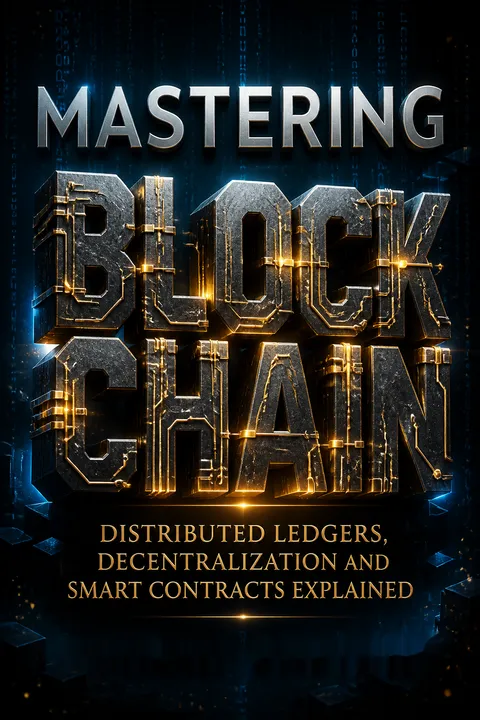
Mastering Blockchain receives high praise from readers, with an average rating of 4.38 out of 5. Reviewers commend its comprehensive coverage of blockchain technology, from basics to advanced topics. Many consider it the best book on the subject, suitable for beginners and IT professionals alike. Readers appreciate its technical depth, clear explanations, and inclusion of mathematical concepts. Some criticize its occasional lack of clarity and dated information. Overall, it's widely recommended as an essential resource for understanding blockchain technology, with many using it as a textbook or reference guide.
People Also Read









Glossary
Distributed consensus
Shared agreement among nodesDistributed consensus is the process by which multiple network participants agree on a proposed value or shared state, despite communication delays, failures, or malicious behavior. In a blockchain, consensus determines which transactions are accepted and how the ledger is updated, allowing participants to maintain a common record without one central database owner.
Proof of Work
Computational proof for blocksProof of Work is a consensus method in which participants repeatedly compute hashes to find a result that satisfies a network-set target. Finding a valid result requires computational effort, while other nodes can check it quickly. Bitcoin uses this method to select block producers, order transactions, and make rewriting accepted history costly.
UTXO
Unspent transaction outputA UTXO is a transaction output that has not yet been spent. In Bitcoin, a new payment uses one or more existing UTXOs as inputs and creates new outputs for recipients or change. The wallet's balance is calculated from spendable outputs associated with its keys, rather than being stored as a single account balance.
Ethereum Virtual Machine
Ethereum contract execution engineThe Ethereum Virtual Machine is the shared execution environment that runs Ethereum contract bytecode. Network nodes process the same instructions and update the ledger's state according to the same rules. Each operation consumes gas, which limits the computation a transaction can perform and helps prevent unbounded execution from consuming network resources.
Gas
Meter for contract computationGas measures the computational work required to execute operations on Ethereum. Each instruction has an associated gas cost, and a transaction specifies a limit and a price. The sender pays for the work performed; if execution exhausts its gas limit, state changes are reverted, though the transaction's consumed fee is not returned.
Smart contract
Automated agreement in codeA smart contract is a program that encodes rules or business logic and executes when specified conditions are met. On a blockchain, network participants can verify its execution and resulting state changes. Contracts can automate transfers and other actions, but their behavior depends on correct code and, when they use external facts, trustworthy data sources.
Oracle
External data bridgeAn oracle supplies information from outside a blockchain to a smart contract, such as a price, weather observation, or device reading. It can deliver data by request or publish it to a contract, and may sign the information to establish its source. The contract still depends on the oracle's accuracy and integrity.
Ricardian contract
Human and machine-readable agreementA Ricardian contract is a digitally signed document designed to be understandable to people and parseable by software. It links legal prose and machine-readable terms through a secure identifier, commonly derived from a hash. This lets operational transactions refer back to a document describing the agreement's meaning and conditions.
State channel
Off-chain transaction pathwayA state channel lets participants conduct multiple interactions away from the main blockchain while a contract locks the relevant funds or state. Once the participants agree on a final result, they submit that state to the blockchain and close the channel. It can reduce on-chain workload, but relies on participants following the channel's rules.
Zero knowledge proofs
Proof without revealing informationA zero knowledge proof allows a prover to convince a verifier that a statement is true without disclosing the underlying information beyond what the proof establishes. A sound system should accept true claims, resist convincing proofs of false claims, and reveal no additional information. The book discusses these proofs as a way to support privacy in blockchain transactions.
FAQ
What is "Mastering Blockchain" by Imran Bashir about?
- Comprehensive blockchain guide: The book offers a thorough introduction to blockchain technology, covering both theoretical foundations and practical applications, including distributed ledgers, consensus mechanisms, and smart contracts.
- Wide-ranging coverage: It explores major blockchain platforms like Bitcoin, Ethereum, and Hyperledger, and delves into cryptography, development tools, and real-world use cases in finance, IoT, and government.
- Balanced for learners and professionals: Designed for readers with basic computer science knowledge, it serves as both a reference for developers and a textbook for blockchain courses.
- Focus on current and future trends: The book discusses industry challenges, ongoing research, and the evolving landscape of blockchain technology.
Why should I read "Mastering Blockchain" by Imran Bashir?
- In-depth technical foundation: The book equips readers with a solid understanding of blockchain’s core concepts, from cryptography to consensus algorithms and smart contracts.
- Practical development guidance: It provides hands-on advice for setting up blockchain environments, writing and deploying smart contracts, and using tools like Truffle and OpenSSL.
- Industry relevance and future outlook: Readers gain insights into current platforms, enterprise solutions, and emerging trends, preparing them for real-world blockchain projects.
- Accessible yet detailed: The book balances technical depth with clear explanations, making complex topics approachable for both beginners and experienced developers.
What are the key takeaways from "Mastering Blockchain" by Imran Bashir?
- Blockchain fundamentals: Readers learn about distributed systems, consensus mechanisms, cryptographic security, and the structure of blockchains.
- Smart contracts and applications: The book explains the definition, history, and implementation of smart contracts, highlighting their transformative potential.
- Ethereum and beyond: It provides a deep dive into Ethereum’s architecture, account models, gas mechanism, and development tools.
- Challenges and future directions: Key issues like scalability, privacy, and security are discussed, along with solutions and predictions for blockchain’s evolution.
What are the best quotes from "Mastering Blockchain" by Imran Bashir and what do they mean?
- On smart contracts: "A smart contract is a secure and unstoppable computer program representing an agreement that is automatically executable and enforceable." This emphasizes the automation and reliability of smart contracts.
- On blockchain’s core: "Blockchain at its core is a peer-to-peer distributed ledger that is cryptographically secure, append-only, immutable (extremely hard to change), and updateable only via consensus or agreement among peers." This highlights blockchain’s security and decentralized nature.
- On decentralization: "Decentralization is a core concept and benefit of blockchain. There is no need for a trusted third party or intermediary to validate transactions; instead a consensus mechanism is used to agree on the validity of transactions." This underscores the trustless, consensus-driven model of blockchain.
How does "Mastering Blockchain" by Imran Bashir explain the fundamental concepts of blockchain?
- Distributed systems and consensus: The book introduces blockchain as a decentralized system that uses consensus mechanisms to achieve agreement among nodes, addressing challenges like Byzantine faults.
- Blockchain structure: It describes blockchains as linked lists of blocks containing transactions, secured by cryptographic hash pointers.
- Types and features: Blockchains are categorized into public, private, semi-private, sidechains, tokenized, and tokenless, with features like immutability, transparency, and distributed consensus.
- Key components: Addresses, transactions, nodes, and smart contracts are explained as essential elements of blockchain networks.
What is the role of cryptography in blockchain according to "Mastering Blockchain" by Imran Bashir?
- Cryptographic foundations: The book covers symmetric and asymmetric cryptography, hash functions, digital signatures, and elliptic curve cryptography (ECC) as the backbone of blockchain security.
- Practical cryptography: Readers are guided through hands-on examples using OpenSSL for encryption, decryption, key generation, and digital signatures.
- Advanced techniques: Topics like zero-knowledge proofs, blind signatures, and homomorphic encryption are introduced, showing their importance for privacy and security.
- Security implications: The book explains how cryptography ensures data integrity, authentication, and non-repudiation in blockchain systems.
How does "Mastering Blockchain" by Imran Bashir describe Bitcoin and its underlying technology?
- Bitcoin as a pioneer: The book details Bitcoin’s history, its solution to the double-spending problem, and its use of Proof of Work (PoW) for decentralized consensus.
- Transaction structure and scripting: It explains how Bitcoin transactions are constructed, verified, and confirmed, including the use of scripting languages and multi-signature transactions.
- Mining and network: The evolution of mining hardware (CPU, GPU, FPGA, ASIC), mining pools, and network synchronization are covered in depth.
- Operational ecosystem: The roles of nodes, miners, and the process of block creation and validation are thoroughly explained.
What are alternative coins (altcoins) and how does "Mastering Blockchain" by Imran Bashir cover them?
- Definition and examples: Altcoins are described as cryptocurrencies developed after Bitcoin, including Namecoin, Litecoin, Primecoin, and Zcash.
- Innovations in consensus: The book discusses alternative consensus mechanisms like Proof of Stake, Proof of Storage, and hybrid models, as well as ASIC-resistant algorithms.
- Privacy and scalability: Privacy-focused coins like Zcash and scalability solutions are highlighted, illustrating the diversity and evolution of the cryptocurrency landscape.
- Security and challenges: The book addresses the unique challenges and innovations brought by altcoins in terms of security and network design.
How does "Mastering Blockchain" by Imran Bashir define and explain smart contracts?
- Smart contract definition: A smart contract is described as a secure, unstoppable program that automatically executes and enforces agreements without intermediaries.
- Historical context: The origins of smart contracts are traced to Nick Szabo, with comparisons to Ricardian contracts that blend legal prose and code.
- Implementation details: The book covers smart contract templates, domain-specific languages like Solidity, and the use of Oracles for external data.
- Security and challenges: Real-world incidents like The DAO hack are discussed to highlight the importance of smart contract security.
What is Ethereum and how does "Mastering Blockchain" by Imran Bashir explain its architecture?
- Ethereum’s innovation: Ethereum is presented as a blockchain platform with a Turing-complete language for complex smart contracts and decentralized applications.
- Core components: The book details Ethereum clients (geth, parity), the Ethereum Virtual Machine (EVM), account models, transactions, and the gas mechanism.
- Consensus and execution: Ethereum’s use of the GHOST protocol for consensus and the stack-based EVM for contract execution are explained.
- Development tools: Tools and frameworks for Ethereum development, such as Solidity, Truffle, and Remix, are introduced for practical application.
How does "Mastering Blockchain" by Imran Bashir explain Ethereum’s account model, transactions, and gas mechanism?
- Account types: The book distinguishes between Externally Owned Accounts (EOAs) controlled by private keys and Contract Accounts (CAs) with associated code.
- Transaction validation: Transactions are validated for syntax, signatures, nonce, gas, and balance, with invalid transactions being rejected and fees still paid.
- State transitions: Valid transactions update account balances, execute contract code, and consume gas, with state changes rolled back if gas runs out.
- Gas as computational fuel: Gas measures computational work, prevents network abuse, and is paid in ether, with detailed examples of gas costs and fee calculations.
What are the main challenges and future directions for blockchain technology according to "Mastering Blockchain" by Imran Bashir?
- Scalability and privacy: The book identifies scalability and privacy as major hurdles, discussing solutions like sharding, state channels, zero-knowledge proofs, and confidential transactions.
- Security and smart contract risks: Vulnerabilities such as transaction malleability, eclipse attacks, and smart contract bugs are highlighted, with formal verification tools introduced for mitigation.
- Standardization and research: Ongoing research in cryptography, consensus algorithms, and programming languages is emphasized to improve blockchain robustness.
- Industry adoption and trends: The book predicts growth in enterprise blockchains, convergence with IoT and AI, and blockchain’s integration into daily life and industry.
Download PDF
Download EPUB
.epub digital book format is ideal for reading ebooks on phones, tablets, and e-readers.








