

Key Takeaways
Treat the PhD as training in research, not merely a thesis.
The degree is only part. The thesis matters, but the work also teaches planning, problem-solving, communication, collaboration, and how to recover when a project goes wrong. Former doctoral students cited in the book often found these skills more useful in their careers than the thesis subject itself. The real task is to learn how to make complex work move forward with other people, imperfect information, and limited time.
The painting makes this concrete. Chemist Isabel, physicist Yousef, and art historian Peter investigate why a fifteenth-century painting’s once-pink robe has faded to white. Each holds only part of the answer. Their shared project depends on translating evidence across disciplines, coordinating work, and adapting when results disappoint. The PhD is not a solo swim test. It is practice in doing consequential work together.
The book’s most useful reframing is that doctoral education produces both research and researchers. This resembles an apprenticeship: the visible output is a thesis, while the less visible output is judgment about uncertainty, coordination, and evidence. Those capacities travel across fields more readily than specialized facts. There is a tension, though: calling the PhD a broad training experience can excuse programs that provide little mentoring or career preparation. The strongest version of the argument is not that hardship itself teaches resilience, but that structured reflection and support turn difficult work into transferable learning.
Choose a lab for its human system, not its prestige alone.
The group shapes the work. A new professor’s start-up lab may offer close contact and room to build, but can bring ambitious plans, weak infrastructure, and uncertain authorship norms. A large, famous group may have equipment, expertise, and backup projects, yet offer little access to the professor and may be fiercely competitive. A small established group can be either deeply engaged or quietly coasting. The label matters less than the people and their habits.
Look beyond the project description. Ask how often students meet the supervisor, who provides day-to-day guidance, how credit is assigned, and whether people help one another. In the painting project, the researchers belong to separate groups, so their ability to cooperate matters as much as the quality of any single lab. If the fit is poor, identify available support, seek help beyond the group, and focus first on problems that actually block progress.
This is an unusually practical correction to prestige-driven academic choice. A lab is not just a source of equipment and reputation; it is a small workplace with its own power structure, norms, and channels for help. Organizational research often finds that local climate affects learning and collaboration, which makes the book’s emphasis on group chemistry persuasive. Still, prospective students rarely have equal access to honest information, and a polished interview can conceal poor management. Speaking privately with current and former students is therefore not gossip; it is due diligence.
Plan in monthly increments, then let evidence revise the plan.
Make the long job visible. A doctorate is too large to manage as one distant goal, but daily task lists alone cannot show whether the research is advancing. The book’s Monthly Progress Monitor asks four questions: What mattered in last month’s results? Where did the plan change, and why? What are next month’s priorities? What could block them, and how can those obstacles be handled? Comparing intentions with actual progress reveals recurring problems, such as overplanning or spending weeks on low-value work.
Use a calendar as a learning tool. Track activities for a week to see where time goes and when energy is strongest. Break vague ambitions into specific actions, rank them, and plan around realistic constraints. The authors also invoke the 80/20 rule: a small share of effort may account for much of the progress. That is a prompt to inspect priorities, not a promise that research outcomes divide neatly into percentages.
The monthly review works because it creates a feedback loop: plan, act, compare, and adjust. This is closer to adaptive project management than to rigid scheduling, an important distinction in research where the result cannot be promised in advance. A written record also reduces the distortions of memory, especially the tendency to remember effort more vividly than outcomes. The caution is that productivity cannot be measured only by thesis progress. Training, collaboration, and exploration may be valuable even when they do not yield immediate data, so the monitor should clarify priorities rather than turn every month into a performance audit.
Design experiments to distinguish explanations, not merely produce data.
A useful test can prove you wrong. Start by stating the question and hypothesis, then design an experiment whose possible results separate competing explanations. Replicate the procedure, control relevant variables, and use measurements that are reliable. Accuracy means closeness to the true value; precision means consistency across repeated measurements. A method can be precise but inaccurate, as with a miscalibrated balance that gives the same wrong reading every time.
Protect the reasoning from bias. Record raw observations and unexpected problems, rather than keeping only results that fit the expected story. The book recalls Aristotle’s unsupported claim that women had fewer teeth than men as a warning against substituting assumption for testing. Isabel’s paint analysis illustrates the better approach: she develops explanations for the faded material, then selects analytical methods to test them. Negative results can eliminate possibilities and guide the next experiment.
The central discipline here is making the logic of a study inspectable. Controls and replication do more than improve technique; they let other people see whether the interpretation follows from the observations. This is closely related to preregistration and open-science practices, which try to reduce flexibility in how results are explained after the fact. Yet no checklist can remove judgment from research. Exploratory work may begin without a sharply discriminating hypothesis, and a failed replication can reflect changing conditions rather than a flawed idea. The goal is not mechanical certainty, but transparent uncertainty.
Treat failed experiments as evidence, not verdicts on your ability.
Research does not move smoothly. Equipment breaks, samples become contaminated, calculations turn out wrong, and promising results may not repeat. The authors urge students to describe the setback plainly, separate the event from their self-worth, and look for a concrete next move. That can mean checking measurements, reviewing the procedure with a more experienced researcher, changing the design, or taking a short break before returning to the problem.
Isabel and Yousef react differently when their analysis of the painting fails to deliver the hoped-for results. Isabel initially takes it as a judgment on her competence; time with friends helps her regain perspective. Yousef draws up a new plan, while Peter reads more about the material so he can stay engaged. If doubts about the field persist, consider whether the problem is a temporary setback or a mismatch with the career itself. A PhD can lead beyond bench science, and leaving can also be a valid choice.
Separating a failed method from a failed person is a basic but powerful form of cognitive reappraisal. It protects the attention needed to diagnose what happened, and it makes help-seeking less threatening. The book also treats rest and social support as part of recovery rather than rewards for finishing work, a humane correction to the lab’s long-hours mythology. But persistence should not become an obligation to endure a harmful environment. Distinguishing project failure from structural neglect matters: a student cannot solve inadequate supervision or unsafe conditions through better attitude alone.
Build a support network; no single supervisor can meet every need.
Get guidance from more than one source. A supervisor directs the research, but may not be the best person for career advice, technical troubleshooting, or emotional support. A mentor can offer perspective, model professional choices, and introduce useful contacts, while peers provide practical knowledge and companionship. The student should be clear about what help is wanted and respect the mentor’s time. The book also encourages students to build community by sharing knowledge and mentoring junior researchers.
Different working styles can complement each other. The authors use the Myers-Briggs Type Indicator, or MBTI, to describe preferences such as thinking aloud versus reflecting first, focusing on detail versus possibility, and preferring plans versus flexibility. In the painting team, Isabel, Yousef, and Peter use their differences to improve collaboration. The framework is best treated as a conversation aid, not a fixed diagnosis. When one star student monopolizes attention, request regular meetings and make progress visible without turning the relationship into a rivalry.
The strongest idea is not that personality can be sorted into neat boxes, but that colleagues often need different conditions to contribute. Teams benefit when someone notices details, someone develops the larger interpretation, and someone keeps the work organized. This resembles cognitive diversity in group problem-solving. The MBTI itself has limited value as a precise predictor of performance, and labels can harden into stereotypes. Its useful role here is modest: give people language for discussing work preferences, then verify those preferences through observation rather than assuming a four-letter type explains a person.
Make communication produce agreed actions, not just reassuring conversations.
Prepare for supervisor meetings. Ask for regular, short, face-to-face discussions, especially if the supervisor is difficult to catch. Bring a brief update, no more than a few priority questions, and possible solutions rather than a vague request for direction. Take notes, confirm decisions afterward by email, and make responsibilities and deadlines explicit. A pleasant informal chat can build trust, but it does not replace a structured conversation about progress and expectations.
Choose the channel deliberately. Email is useful for clear requests and records; a phone call allows rapid clarification; face-to-face conversation is better for sensitive or complicated topics. After sending a message, check that it was understood and acted on. The point is not to create paperwork for its own sake. In a PhD that depends on collaborators, equipment, approvals, and supervisor feedback, an unspoken assumption can quietly become a serious delay.
Communication is framed here as coordination infrastructure, not a personality trait. A clear request with an owner and a time frame reduces ambiguity, while a written recap prevents different people from leaving the same meeting with different memories. This connects to the broader practice of closing the loop in high-reliability workplaces. There is also a power imbalance: the student often has to initiate structure with a busy supervisor. That can be effective, but institutions should not treat student initiative as a substitute for supervisors’ responsibility to provide timely guidance.
Translate research for readers, from the first literature search onward.
Build the argument before the manuscript. A careful literature search helps locate the project in its field, identify foundational work, and avoid repeating experiments already done. Review articles can provide an overview, while original research papers show methods and evidence. Keep concise notes on each source so the bibliography and thesis do not become a last-minute scavenger hunt.
Every research format has a reader. A presentation needs one central message, enough background for its audience, and rehearsed delivery. A paper should distinguish methods, results, and interpretation, and its figures should be legible and honest about uncertainty. A thesis is more than a pile of published papers: it needs a coherent structure, sufficient methodological detail, and an introduction that explains why the work matters. Peter’s first department talk overwhelms listeners with specialist details; feedback helps him make the next one clearer and more useful.
The book links communication to scientific quality: a claim that cannot be explained clearly is difficult to evaluate, reproduce, or use. This is not merely a stylistic preference. Audience adaptation is a form of reasoning, because deciding what a reader needs forces the researcher to distinguish central evidence from background noise. The caution is that simplicity should not mean overselling. A vivid title or clean graph can make weak evidence look stronger than it is. Good scientific communication makes the limits as understandable as the result.
Use a countdown plan to protect the thesis from endless new projects.
Inventory before you sprint. Near the end of the PhD, list completed work, unfinished analyses, and every remaining step needed for the thesis. Agree with the supervisor on a table of contents, estimate the time each task requires, and include buffers for delays and institutional procedures. The countdown list turns a vague promise to finish into a sequence of work that can be discussed and revised. If an uncertain project depends on a sample or method that may not arrive, prepare an alternative route and decide in advance when to switch.
Yousef’s project makes the stakes clear. His ambitious work depends on difficult sample preparation. He and his supervisor agree to pursue it for ten more weeks, then move to Plan B if it still fails. For writing, an outline breaks the thesis into manageable sections; the defense requires rereading the work critically, anticipating questions, and practicing clear answers rather than bluffing.
A countdown plan makes hidden work visible, especially the administrative and coordination tasks that students often omit from optimistic estimates. It also turns a disagreement about ambition into a negotiation about time, evidence, and alternatives. In project-risk terms, Plan B is not pessimism; it is a way to keep one uncertain dependency from controlling the entire degree. Such plans should remain revisable, since research changes. Their purpose is to preserve a credible path to completion, not to pretend that every week can be predicted.
Start career exploration before the thesis deadline narrows your options.
A PhD does not dictate one destination. Academic research is one route, but graduates also work in corporate research and development, consulting, government laboratories, regulatory organizations, education, and nonprofits. Corporate research tends to connect work to products, costs, and schedules; nonprofits center a mission but may offer lower pay or fewer advancement paths. Government and educational work can use scientific expertise without requiring a traditional academic career.
Explore the work, not just the label. Talk with former students and people inside organizations, assess the culture, and translate doctoral experience into skills such as analysis, project management, writing, teaching, and presenting. The authors advise beginning a job search before the defense, since employers often plan ahead. Isabel’s path from paint analysis to forensic science shows how identifying favorite tasks, rather than clinging to a narrow topic, can reveal an unexpected fit.
Career choice becomes less intimidating when treated as a set of hypotheses to test rather than a permanent identity decision. Informational conversations, short placements, and careful questions about daily work can reveal whether a role fits better than its prestige or mission statement suggests. The book’s emphasis on transferable skills is particularly valuable for PhDs whose research subject has few direct job matches. Its sector examples, however, reflect a particular period and job market. Salary, visa rules, hiring cycles, and local conditions can change sharply, so current evidence should supplement its durable decision-making advice.
Analysis
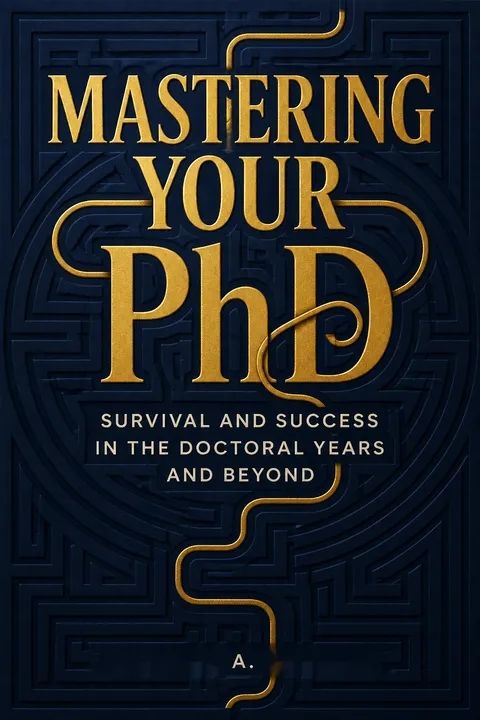
Mastering Your PhD is best understood as a practical operating manual for research under uncertainty. Its recurring lesson is that scientific progress depends not only on intellectual ability, but on a system of habits: selecting a workable environment, translating distant aims into near-term tasks, testing explanations rigorously, maintaining relationships, and communicating decisions clearly. The Old Master painting project gives that system narrative continuity. Isabel, Yousef, and Peter repeatedly encounter a truth that academic training can obscure: specialized expertise is necessary, but progress happens where expertise meets coordination.
The book is strongest when it converts vague advice into repeatable practices. The monthly review, prepared supervisor meetings, literature notes, and final-year countdown plan make invisible work discussable. That is a substantial contribution because graduate students often receive detailed instruction in methods but little explicit guidance on managing projects or relationships. The advice also resists the myth that failure is exceptional. Experiments fail, supervisors are busy, and projects can exceed their original scope.
Its limits reflect both its era and its managerial orientation. The book can make students responsible for creating structure in settings where supervisors or institutions should provide it. Proactive communication is useful, but it cannot compensate for abusive behavior, chronic underfunding, or impossible workloads. Its discussion of group personality types is more useful as a prompt for conversation than as a scientific account of stable character. Career descriptions and named employers are also time-sensitive, while the underlying principle of exploring options early remains sound.
The most durable takeaway is therefore not simply to work harder or plan more. It is to build a feedback system that helps distinguish controllable problems from structural ones, revise plans when evidence changes, and seek help before a bottleneck becomes a crisis. A successful PhD should produce a defensible body of research and a more capable person, without treating needless suffering as proof of merit.
Review Summary
Mastering Your PhD receives mixed reviews, averaging 3.65 out of 5 stars. Readers appreciate its practical tips and insights into PhD life, covering topics from planning to thesis defense. Many find it helpful for new PhD candidates, praising its comprehensive approach and real-life examples. However, some criticize its focus on exact sciences and general advice. The book is seen as a useful reference, particularly for those starting their PhD journey, though experienced researchers may find parts redundant.
People Also Read



Glossary
Monthly Progress Monitor
Monthly research reviewA short recurring review for comparing research results with intentions. It asks what mattered in the previous month, why work differed from the plan, what the next priorities are, and what obstacles may interfere. Used consistently, it helps reveal unrealistic planning, recurring delays, and opportunities to adjust a project before problems accumulate.
Countdown list
Thesis completion scheduleA final-stage planning document that combines a proposed thesis structure with the tasks and estimated time needed to complete it. It lists finished and unfinished research, writing, analysis, approvals, and defense preparation. Students can use alternative versions to account for uncertain dependencies and agree with supervisors on a practical route to completion.
SMART
Test for usable goalsA goal-setting checklist in which objectives should be specific, measurable, attainable, realistic, and time-related. In the book, it helps turn broad intentions into actions that can be evaluated within a defined period. Its purpose is to make plans testable and achievable, rather than ambitious statements with no clear way to judge progress.
MBTI
Personality preference frameworkThe Myers-Briggs Type Indicator is a framework that describes preferences across four pairs: introversion or extroversion, intuition or sensing, thinking or feeling, and judging or perceiving. The combinations produce sixteen profiles. The book uses the model to discuss differences in teamwork and communication. It is most responsibly used as a conversation prompt, not a definitive measure of ability or character.
Scientific method
Evidence-based inquiry processA process for investigating questions by observing phenomena, proposing hypotheses, testing them through experiments, and building explanations that account for the evidence. The book emphasizes that hypotheses must be tested rather than accepted as obvious, that contrary data should not be ignored, and that explanations remain open to revision when new evidence appears.
80/20 rule
Effort and output heuristicA heuristic associated with Vilfredo Pareto: inputs and outputs are often unevenly distributed, so a relatively small portion of effort may produce a large share of results. The book applies it to identifying high-value research tasks and useful professional relationships. It is a prompt to examine priorities, not a precise law or guaranteed ratio.
FAQ
What's "Mastering Your PhD" about?
- Comprehensive Guide: "Mastering Your PhD" by Patricia A. Gosling and Bart Noordam is a guide designed to help PhD students navigate the challenges of their doctoral studies and prepare for their future careers.
- Non-Scientific Skills Focus: The book emphasizes mastering non-scientific skills such as time management, communication, and teamwork, which are crucial for success in academia and beyond.
- Practical Advice: It provides practical advice and strategies for dealing with common issues faced by PhD students, from choosing a research group to defending a thesis.
- Career Preparation: The book also offers insights into career opportunities post-PhD, helping students transition smoothly into the next phase of their professional lives.
Why should I read "Mastering Your PhD"?
- Holistic Approach: The book offers a holistic approach to PhD studies, focusing not just on research but also on personal and professional development.
- Real-Life Scenarios: It includes real-life scenarios and examples, such as the "Saving an Old Master Painting" project, to illustrate key concepts and strategies.
- Expert Insights: Written by experienced professionals, it provides insights and tips that are both practical and applicable to various fields of study.
- Supportive Resource: It serves as a supportive resource for PhD students, offering guidance and encouragement throughout their doctoral journey.
What are the key takeaways of "Mastering Your PhD"?
- Importance of Planning: Effective planning and time management are crucial for successfully navigating the PhD process.
- Communication Skills: Developing strong communication skills is essential for collaborating with peers, mentors, and supervisors.
- Dealing with Setbacks: The book emphasizes the importance of resilience and learning from setbacks as part of the research process.
- Career Exploration: It encourages students to explore various career paths and prepare for life after their PhD.
What are the best quotes from "Mastering Your PhD" and what do they mean?
- "If you fail to plan, you plan to fail." This quote underscores the importance of planning and setting goals to achieve success in your PhD journey.
- "Science is a way of thinking much more than it is a body of knowledge." This highlights the importance of adopting a scientific mindset, focusing on problem-solving and critical thinking.
- "Success is not the key to happiness. Happiness is the key to success." This suggests that finding joy and satisfaction in your work can lead to greater success and fulfillment.
- "The aim of science is not to open the door to infinite wisdom, but to set a limit to infinite error." This emphasizes the role of science in refining our understanding and minimizing errors.
How does "Mastering Your PhD" help with choosing a research group?
- Understanding Group Dynamics: The book discusses different types of research groups, from start-ups to established empires, and their dynamics.
- Evaluating Fit: It provides criteria for evaluating which group might be the best fit based on your research interests and working style.
- Potential Pitfalls: The authors highlight potential pitfalls in group selection, such as overly ambitious projects or lack of mentorship.
- Long-Term Impact: Choosing the right group is emphasized as a decision that can significantly impact your PhD experience and future career.
What advice does "Mastering Your PhD" offer for getting started in a PhD program?
- Orientation and Networking: The book advises taking time to orient yourself with the department and network with key personnel.
- Setting Goals: It emphasizes the importance of setting short- and long-term goals to guide your research and personal development.
- Lab Notebook Practices: Maintaining a detailed and organized lab notebook is highlighted as crucial for tracking progress and ensuring research integrity.
- Managing Expectations: The authors discuss managing expectations and dealing with the initial ups and downs of starting a PhD program.
How does "Mastering Your PhD" address setbacks during a PhD?
- Normalizing Setbacks: The book normalizes setbacks as a common part of the research process and an opportunity for growth.
- Identifying Problems: It provides strategies for identifying the root causes of setbacks and addressing them constructively.
- Seeking Support: The authors encourage seeking support from mentors, peers, and supervisors to overcome challenges.
- Resilience Building: Building resilience and maintaining a positive outlook are emphasized as key to navigating setbacks successfully.
What does "Mastering Your PhD" say about the importance of mentors?
- Role of Mentors: Mentors are described as crucial for providing guidance, support, and professional development throughout the PhD journey.
- Finding a Mentor: The book offers advice on how to find and approach potential mentors, both within and outside your research group.
- Mentor-Mentee Relationship: It discusses the importance of establishing clear goals and expectations in the mentor-mentee relationship.
- Long-Term Benefits: Having a mentor can significantly impact your career trajectory and personal growth, both during and after your PhD.
How does "Mastering Your PhD" suggest improving communication skills?
- Structured Meetings: The book emphasizes the importance of regular, structured meetings with your supervisor to discuss progress and challenges.
- Active Listening: Active listening and understanding different communication styles are highlighted as essential for effective collaboration.
- Feedback and Adaptation: It encourages seeking feedback and being open to adapting your communication style to suit different audiences.
- Presentation Skills: Developing strong presentation skills is also discussed as crucial for sharing your research and engaging with the academic community.
What strategies does "Mastering Your PhD" offer for time management?
- Goal Setting: Setting specific, measurable, attainable, realistic, and time-related (SMART) goals is recommended for effective time management.
- Prioritization: The book advises prioritizing tasks based on their importance and urgency to maximize productivity.
- Energy Management: Understanding your energy levels and scheduling tasks accordingly is emphasized for maintaining focus and efficiency.
- Avoiding Multitasking: It suggests avoiding multitasking and instead focusing on one task at a time to improve concentration and output.
How does "Mastering Your PhD" prepare students for their thesis defense?
- Preparation is Key: The book stresses the importance of thorough preparation, including familiarizing yourself with the formalities and potential questions.
- Understanding Your Work: It advises re-reading your thesis with a critical eye to anticipate questions and prepare answers.
- Practice and Poise: Practicing your defense with peers and maintaining composure during the actual defense are highlighted as crucial for success.
- Viewing as a Rite of Passage: The defense is framed as a rite of passage, marking the culmination of your hard work and dedication.
What career advice does "Mastering Your PhD" provide for post-PhD opportunities?
- Exploring Options: The book encourages exploring various career paths, including academia, industry, and non-profit organizations.
- Networking: Building and leveraging a professional network is emphasized as key to discovering job opportunities and making informed decisions.
- Skill Transfer: It highlights the transferability of skills acquired during a PhD, such as problem-solving and project management, to diverse career fields.
- Proactive Job Search: Starting the job search early and being proactive in seeking opportunities are recommended for a smooth transition post-PhD.
Download PDF
Download EPUB
.epub digital book format is ideal for reading ebooks on phones, tablets, and e-readers.








