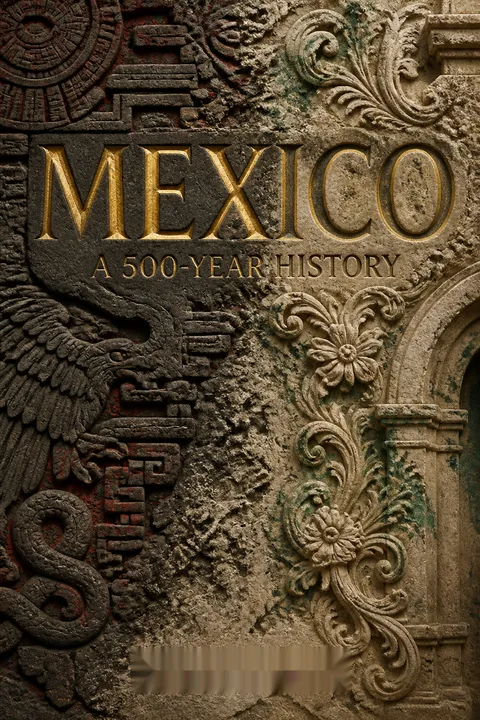


Key Takeaways
Tell Mexico's origin as a meeting of worlds, not a single conquest.
A hybrid beginning. The book opens with two shipwrecked Spaniards, Jerónimo de Aguilar and Gonzalo Guerrero, whose lives diverged after capture by Maya communities. Aguilar later helped Cortés as an interpreter; Guerrero married into Maya society and fought the Spanish. Their stories point toward a country formed through contact, conflict, and adaptation, not by one founding event.
Many Mexicos. Indigenous peoples, Iberians, Africans, and Asians met in the colonial world. The author distinguishes this long-running social mixture from mestizaje, the later nationalist claim that all Mexicans should be understood as one mixed-race people. That ideology could celebrate mixture while erasing indigenous identities and autonomy.
The opening works as a useful corrective to origin myths: societies do not usually begin when a flag is planted, but through relationships that later histories simplify. Guerrero and Aguilar also show that cultural identity can be made through language, family, and political allegiance, not ancestry alone. The caution is that hybridity can become its own tidy story. It should not obscure the very different power available to a captive woman, a Maya leader, or a Spanish soldier.
Credit indigenous coalitions, not a handful of Spaniards, with defeating the Mexica.
An alliance changed the balance. Cortés arrived in 1519 with roughly 450 Spanish soldiers, but the Mexica Empire already faced resistance from recently conquered peoples and independent rivals. The Tlaxcalans first fought the newcomers, then allied with them after weighing the threat and opportunity. Their armies helped turn a small expedition into a much larger coalition.
A civil war, too. Indigenous forces from across central Mexico joined the siege of Tenochtitlán, while other communities abandoned or opposed the Mexica. Disease, famine, and Spanish weapons mattered, but they do not explain the outcome alone. The capital fell in 1521 after a brutal siege. The decisive force was a changing alliance of indigenous peoples, many of them former subjects or enemies of the Mexica.
This account shifts attention from heroic biography to coalition politics. Empires are often less stable than their capitals suggest: subjects may obey while the balance of power favors the center, then defect when a rival offers a better bargain. The Spanish were formidable brokers of those divisions, but their success depended on local actors pursuing their own interests. Calling the war a civil conflict clarifies agency, though it must not soften the violence of foreign invasion.
Treat conquest as a century-long process, accelerated by disease and resistance.
Microbes transformed the balance. Smallpox arrived in 1520 and spread beyond the Spanish advance. Later epidemics, including the illness called cocoliztli, struck communities with little prior exposure. Estimates vary, but central Mexico may have lost about three-quarters of its population in the century after contact. The deaths weakened communities and disrupted families, food production, and political life.
The conquest stayed incomplete. Spanish authority was strongest in central highlands and major towns; elsewhere it relied on fragile outposts, indigenous allies, and negotiated arrangements. Maya regions remained substantially autonomous for centuries, while resistance in the North continued long after independence. The Yaqui were still fighting Mexican rule in the twentieth century. The fall of Tenochtitlán began a conquest; it did not finish one.
The combination of epidemic disease and political resistance makes conquest a process rather than a date. This is a broader lesson in historical causation: dramatic events often depend on slower forces, including population change, logistics, and the ability of communities to maintain autonomy. Population estimates remain contested, so the exact scale should be treated cautiously. The central claim is sturdier than any single number: Indigenous societies endured profound loss without becoming uniformly conquered or culturally erased.
Look beneath colonial titles to see indigenous governments preserving local power.
Old authorities adapted. Spanish rulers built new institutions, but many indigenous communities continued to govern local affairs through familiar leaders, councils, and communal practices. A pueblo might acquire a Spanish name and a Christian patron saint while keeping its boundaries, language, markets, and local leadership. Even Mexico City, built over Tenochtitlán, remained substantially shaped by indigenous people and institutions.
Law could be a tool. Indigenous communities used courts to defend land and privileges, and the Crown created the Juzgado General de Indios to hear cases involving indigenous people. Racial rules were real, but their enforcement was uneven; people crossed occupational and social boundaries more often than official categories allowed. Colonial society was hierarchical, yet it was not a perfectly sealed racial system.
The distinction between formal sovereignty and everyday governance is essential. A distant state can rename institutions without replacing the relationships that make them work. Local continuity was not simply resistance or consent; communities adapted, negotiated, and sometimes used colonial law against colonial interests. The court system offered meaningful protections, but access required knowledge, time, and resources. Its existence should not be mistaken for equal justice.
Follow silver around the world, then ask why it failed to industrialize Mexico.
A global currency. Silver discoveries at Zacatecas in 1546 and Guanajuato in 1550 helped make Mexico a major source of the metal. The peso circulated widely, and Mexican silver linked American mines to European merchants and Asian markets. It helped finance trade in goods that Europe could not yet produce competitively, including silk, porcelain, spices, and cotton.
Wealth did not guarantee transformation. Mining depended on mercury, including the labor-intensive patio process, and the trade generated immense profits. But silver did not automatically create broad industrial development. Spanish elites relied on imports, foreign finance, and the proceeds of extraction; much of Mexico’s economy remained agricultural and local. The mines connected Mexico to the world economy without ensuring that ordinary Mexicans shared the gains.
Silver is a sharp example of the difference between economic integration and development. A country can become indispensable to global trade while remaining dependent on outside manufacturers and finance. The book resists a simple resource-curse explanation by showing that institutions and political choices shaped where the wealth went. A further question is who had the power to redirect it: extraction created opportunity, but not the political coalition needed to distribute gains widely.
Independence ended Spanish rule before it created a governable nation.
A negotiated break. The independence struggle began in 1810 with Miguel Hidalgo’s uprising, whose diverse recruits included workers, peasants, and townspeople. It was not initially a unified movement for independence. In 1821, former royalist Agustín de Iturbide and insurgent Vicente Guerrero joined forces around a plan that promised independence, Catholicism, and political union.
A state without settled foundations. The new country inherited debt, damaged mines and farms, regional divisions, and weak control over its borders. Between 1821 and 1855 the national executive changed hands forty-eight times. In 1848, after war with the United States, Mexico lost a vast northern territory. Independence created sovereignty, but not agreement about who should rule, how the country should be governed, or what territory the nation could defend.
Independence is often treated as the finish line of national formation. Here it is a new problem: the removal of a distant authority exposes disputes that empire had managed, however imperfectly. The scale of post-independence instability also cautions against assuming that shared language or history automatically produces a functioning state. Yet the persistence of local political communities complicates the picture: national weakness did not mean that politics disappeared everywhere.
Count Porfirian railways alongside the communities and lands they displaced.
Modernity arrived visibly. Under Porfirio Díaz, railways, factories, electric lights, and urban entertainments made Mexico look prosperous and connected. Foreign investment helped expand mining and industry, and towns that had been distant became accessible. The government also promoted a national identity that celebrated indigenous antiquity and mixed-race identity, even as it pursued rapid development.
The costs were rural. Laws allowing communal and untitled lands to be privatized helped landowners and companies expand. By 1910, only about one person in fifty owned land, and much of the rural population lived on haciendas. In Naranja, the Noriega brothers drained a lake and took land that had sustained a Purépecha community. Modernization produced real infrastructure, but its gains and losses were distributed very unevenly.
The railway is both a development tool and a political instrument: it moves goods, but also strengthens those who control routes, land, and investment. The book’s emphasis on dispossession prevents infrastructure from standing in for shared prosperity. At the same time, not every community lost, and some ranchers and towns prospered. The sharper question is not whether modernization happened, but who could shape its terms and who paid for it.
Separate the Revolution's political victory from its delayed social reforms.
A coalition, not one ideology. The 1910 revolt against Díaz joined local ranchers, miners, peasants, and political reformers. Francisco Madero called for effective elections, while Emiliano Zapata and Pancho Villa drew support from communities with more immediate demands. Their different aims helped topple the old regime, then contributed to further civil wars. Fighting from 1910 to 1920 cost about 1.4 million lives, largely through disease and hunger rather than battlefield deaths.
Reform came later. The 1917 Constitution promised land redistribution, labor rights, and state control of natural resources, but much remained unrealized in the 1920s. Under Lázaro Cárdenas, from 1935 to 1940, the government redistributed about 46 million acres, extended credit, and nationalized oil. The reform was flawed and uneven, yet it changed who could claim land and what the state owed workers.
The separation between political and social revolution is a valuable way to read revolutionary outcomes. A new constitution can declare a new order without immediately changing ownership or daily life. Cárdenas’s reforms mattered because they moved resources, not simply because they used radical language. Still, state-led redistribution brought new forms of dependence and local boss rule. Social change can widen agency while simultaneously creating fresh institutions of control.
See PRI rule as negotiated authoritarianism, until state violence broke its bargain.
A soft-edged monopoly. From 1946 to 2000, the PRI governed through a single dominant party, civilian presidents, and regular elections that were often manipulated. For a time, local contests and party primaries gave voters real leverage, while public spending and economic growth helped secure consent. The book calls the mid-century arrangement a dictablanda, a hybrid of dictatorship and democracy.
The bargain hardened. The 1968 Tlatelolco massacre, in which soldiers fired on student demonstrators and civilians, made the state’s violence impossible to ignore. Rural counterinsurgencies and disappearances continued beyond the capital. The PRI still delivered services and permitted some opposition, but its ability to mix limited competition with repression eroded. Mexico’s transition was not a sudden democratic awakening; it was a long loss of the party’s authority and legitimacy.
The phrase negotiated authoritarianism captures a regime that was neither fully democratic nor simply controlled from above. Local elections, social benefits, and protest could influence outcomes, while national power remained tightly managed. This mixed arrangement helps explain both its durability and its eventual fragility. The danger is that describing bargaining can understate the fear involved. Tlatelolco and the Dirty War show that consent and coercion operated together.
Read Mexico's population boom as a public-health achievement with unequal costs.
A rapid demographic turn. Mexico grew from about 13.6 million people in 1900 to roughly 100 million by 2000. Better sanitation, vaccination, medical services, and education helped reduce deaths, especially among infants. Life expectancy rose from about thirty-seven years in 1930 to fifty-nine in 1960. The country also urbanized rapidly: by 1960, more Mexicans lived in towns and cities than in the countryside.
Growth became governable. In the 1970s, the government expanded access to contraception through clinics, public information, and even popular television. Fertility fell from about 6.7 children per woman in 1970 to 2.7 by 1996. This was a major change achieved largely without coercion. Yet the boom’s benefits were unequal: rural poverty, overcrowded cities, and migration north reflected the failure to distribute land, jobs, and services evenly.
Demography is not just a background statistic: falling mortality, women’s education, and access to contraception alter family life, labor, and political demands. Mexico’s experience also complicates the idea that population control requires coercion; public health and family planning can support voluntary change. The unequal geography matters, though. A national average can conceal communities that received fewer schools, clinics, and secure livelihoods, and whose members migrated because staying offered too little.
Treat Mexico's democratic transition as a long contest, not one election night.
Crisis opened political space. The 1985 Mexico City earthquake exposed official incompetence and corruption while residents organized rescue and relief themselves. Those networks helped widen opposition politics. In 1988, the leftist Cuauhtémoc Cárdenas appeared to be winning the presidential vote before the count abruptly failed. The disputed result deepened distrust and helped push the PRI toward electoral reform.
Power changed hands in stages. New institutions gained authority, opposition parties won local offices and Congress, and in 2000 Vicente Fox defeated the PRI candidate. The transition was not simply a consequence of one charismatic challenger. It depended on organizers, journalists, local voters, and a president, Ernesto Zedillo, who accepted defeat rather than overturning the result. The PRI’s loss ended its monopoly, but not inequality or political violence.
The election of 2000 matters partly because it depended on a choice by incumbents not to use every available coercive tool. That makes institutional restraint as important as voter demand. The earthquake offers another model: civic capacity can emerge when official systems fail. Still, electoral turnover is not the same as social transformation. Democracy changes who can compete, but it cannot by itself resolve the economic and security problems that weakened the old regime.
Drug prohibition fragmented trafficking networks while American demand kept trade profitable.
A small domestic market, a powerful export trade. Mexico was not a major consumer of drugs when the modern War on Drugs began. US demand, prohibition, and the profits of cross-border smuggling made the trade far more consequential. Eradication campaigns and arrests disrupted particular routes and leaders, but traffickers adapted, shifted crops, and reorganized. The Guadalajara Federation was a loose network, not the single corporate hierarchy suggested by the popular word cartel.
Decapitation can multiply violence. From 2006 to 2020, the War on Drugs killed more than 200,000 Mexicans and left roughly 100,000 disappeared. Removing prominent leaders did not reliably stop supply; it often fragmented organizations and intensified contests for territory. The state itself was compromised by officials, police, and soldiers linked to trafficking. Mexico’s violence cannot be understood without the cross-border market that kept the business profitable.
The drug war is a case study in policy feedback: enforcement changes the market it is meant to suppress. Removing leaders may weaken coordination while leaving demand, profit, and recruitment intact. That does not mean enforcement is irrelevant; it means enforcement alone cannot solve a market sustained by consumers, prohibition rents, and corrupt institutions. The book’s focus on US demand also usefully resists treating Mexican violence as a self-contained national pathology.
Analysis
Gillingham’s most useful argument is methodological as much as historical: Mexico cannot be explained by a single national storyline. The country is repeatedly approached through different scales, from a Nahua village defending land to a transoceanic silver circuit, from a presidential succession to a local riot. This shifting focus reveals a durable pattern: central authorities claim broad sovereignty, but their practical power depends on bargains with communities, regional bosses, soldiers, workers, and foreign actors.
That pattern helps connect episodes that are often kept apart. Tlaxcalan alliances in the conquest, village litigation under Spanish rule, nineteenth-century municipal politics, revolutionary militias, and modern electoral organizing all show local actors translating larger systems into local opportunities. Their agency is real, but never exercised on equal terms. Epidemics, land seizures, debt, military force, and later drug markets repeatedly narrow the choices available to ordinary people.
The book also questions the neat distinction between progress and its costs. Silver, railways, oil, public health, and industrial growth made Mexico more connected and, in important ways, healthier and wealthier. Yet those changes could rely on dispossession, cheap labor, foreign finance, or political exclusion. The result is neither a simple story of colonial victimhood nor a triumphal national epic. It is a history of partial gains secured through negotiation, conflict, and uneven access to power.
One tension remains especially important: the same state that distributed land, built clinics, and expanded education also censored, co-opted, or killed its opponents. Treating that state as either wholly benevolent or wholly predatory misses how it worked. Mexico’s history instead suggests that legitimacy is assembled through material benefits and meaningful local influence, then strained when those benefits are withdrawn or when coercion becomes too visible. The democratic transitions and drug violence of the recent period are not separate stories; both expose the limits of a state whose reach often exceeds its accountability.
People Also Read







Glossary
mestizaje
National ideology of mixtureMestizaje describes the mixing of indigenous and European peoples, but the book emphasizes its political meaning as well as its social reality. Twentieth-century nationalists used it to portray Mexicans as one blended people. That claim could celebrate cultural mixture while minimizing distinct indigenous identities, ongoing racism, and communities’ demands for autonomy.
encomienda
Colonial grant of tributeAn encomienda was a Crown grant assigning a Spanish holder authority to collect tribute and labor from an indigenous community. It was not formally ownership of the people, but it enabled severe exploitation. The Crown tried to limit the system, while population collapse, indigenous legal action, and changing labor arrangements gradually weakened it.
república de indios
Indigenous legal communityThe república de indios was the colonial legal and administrative category for indigenous peoples, distinct from the república de españoles. It reflected the Crown’s effort to govern different populations through separate rules and authorities. In practice, indigenous communities often retained local leaders and used their recognized status to defend land, political privileges, and internal autonomy.
patria chica
Local homelandPatria chica means a person’s local homeland, such as a village, region, or home state. The book uses it to explain why loyalties to local communities often outweighed attachment to a distant national government. These loyalties could support local democracy, resistance to outside control, and alliances that shifted with political circumstances.
pronunciamiento
Publicly announced rebellionA pronunciamiento was a political uprising announced through a public declaration, often by military officers or local leaders. It could use a familiar script of grievances, manifestos, and negotiations, with limited fighting and the possibility of compromise. After independence, pronunciamientos became a recurring way to challenge governments without necessarily seeking social revolution.
ejido
Communal agricultural holdingAn ejido is land granted to a community for collective or family use, rather than unrestricted private ownership. Under Cárdenas, ejidos became the main instrument of large-scale land redistribution. Members could farm and benefit from the land, but they generally could not sell it as ordinary private property. Results varied greatly in quality and economic viability.
dictablanda
Soft-edged authoritarian regimeDictablanda is a blend of words meaning dictatorship and soft. The book applies it to the mid-century PRI regime, which combined tightly controlled national power with regular elections, some local political competition, and social benefits. It was not a full democracy, but neither did it rely on continuous, overt repression to maintain rule.
Guerra sucia
Dirty War counterinsurgencyGuerra sucia, or Dirty War, refers to the Mexican state’s counterinsurgency against rural and urban guerrilla movements, especially from the 1960s into the early 1980s. Security forces used clandestine detention, torture, killings, and disappearances. The term also points to the secrecy and denial that made the scale and responsibility for abuses difficult to establish.
kingpin strategy
Target top trafficking leadersThe kingpin strategy targets senior figures in drug-trafficking organizations in hopes that removing leaders will disrupt the trade. The book argues that this often fails because trafficking networks can replace individuals and reorganize. In Mexico, arrests and killings sometimes fragmented groups, intensifying competition and violence without reducing the underlying demand for drugs.
Download PDF
Download EPUB
.epub digital book format is ideal for reading ebooks on phones, tablets, and e-readers.








