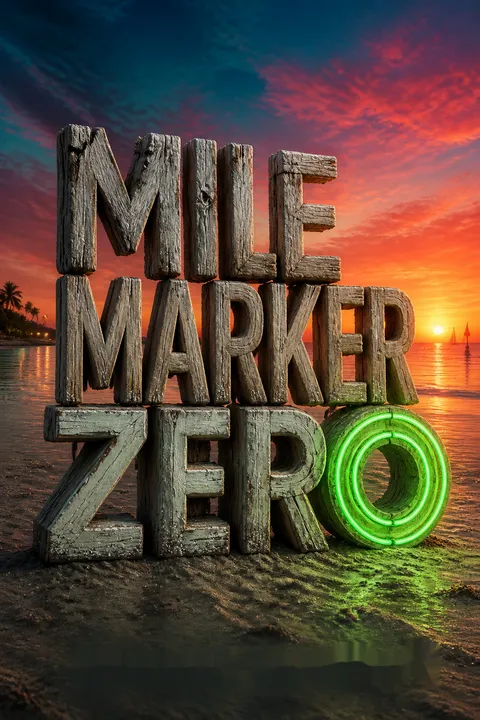


Key Takeaways
Treat a place as permission to become someone your old life could not imagine
A detour became a life. In 1968, Navy officer Tom Corcoran expected a short training assignment in Key West, then a conventional future as a writer or professor. Instead, he left the Navy, returned with his friend Jon Hilton, and stayed. He sold tacos from a three-wheeled bicycle, supported his pregnant girlfriend, and made a life among people who had also drifted from the mainland’s expectations. The taco cart was not a grand career plan. It was a way to earn money and meet the people who made the island feel possible.
The island changed the options. The book follows artists, writers, musicians, and locals who found room to test different lives in this small, isolated community. Key West did not guarantee success, but it made reinvention feel ordinary.
What's striking is how little reinvention begins as a master plan. Corcoran’s path changes through a chain of modest choices: accept housing off base, take a job, meet the locals, and stay another day. This resembles the idea of a “possible self,” the version of a person that becomes imaginable when daily surroundings change. Place can expand identity, but access matters: precarious work and cheap housing made this experiment possible for some, while others could not afford to remain.
Key West's tolerance grew from isolation, but its lawlessness carried a price
A history of reinvention. The island’s identity was shaped by its distance from the mainland and its repeated economic shifts. It moved through wrecking, sponging, cigar making, railroad tourism, the Navy, and, by the 1970s, marijuana smuggling. Its past included pirates and disputed ownership, while its small scale made local relationships unusually influential. People who might have been outsiders elsewhere could find room to live differently here.
Not everyone was equally welcome. The relaxed social code coexisted with racial tension, suspicion of hippies, and a local power structure that favored insiders. Gay business owners sometimes used their influence to protect young hippies from police harassment. The book’s portrait is not of universal acceptance, but of an unusual community where people often left one another alone, provided they understood the local rules.
The island illustrates a useful distinction between tolerance and equality. A community can allow visible differences without distributing power or safety evenly. Its distance from formal oversight can create freedom, but it can also let informal networks decide who belongs and whose behavior is punished. The comparison with other small, remote communities is instructive: close social ties can make mutual aid immediate, yet the same ties can protect insiders and marginalize people who lack local connections.
Use Hemingway's shadow as a launchpad, not a costume
A literary pilgrimage. Ernest Hemingway arrived in Key West in 1928 expecting a brief stop. The island’s quiet mornings, fishing, and new friendships kept him there for years. He wrote major work in Key West, including A Farewell to Arms and To Have and Have Not. Decades later, aspiring writers still came to confront his reputation. For some, Hemingway’s model of fishing, drinking, and masculine bravado offered a template for the life of a writer.
The template had limits. Thomas McGuane was repeatedly labeled Hemingway’s successor, and his novels shared settings and themes that invited comparison. Yet his language and ambitions were his own. The book shows how a literary tradition can open a door while also narrowing the expectations placed on the writer who walks through it.
A predecessor can function as both permission and pressure. Hemingway made it easier for writers to imagine serious work outside the literary capitals, but his fame also encouraged a performance of the author as rugged, male, and self-destructive. This is a familiar problem in artistic fields: a successful model gives newcomers a recognizable path, then risks turning originality into imitation. The most useful inheritance is not a costume, but a method, a place to work, and permission to develop a distinct voice.
Build art where bars, jobs, and conversation collide
The scene was social infrastructure. Corcoran’s taco bicycle introduced him to Tennessee Williams, James Harrison, and McGuane. Later, as a bartender at the Chart Room, he worked in a place where writers and painters mixed with shrimpers, lawyers, politicians, and local business owners. The bar’s music, gossip, and arguments made it a meeting ground, not merely a place to drink. Corcoran also wrote for the underground magazine Solares Hill, drawing on what he heard around him.
Friendship created momentum. Harrison urged the famously solitary McGuane to leave his house and encounter the island. McGuane, in turn, connected Harrison, painter Russell Chatham, and sportsman Guy de la Valdene. Their conversations, fishing trips, and meals formed a loose creative network that crossed between Key West and Montana.
The Chart Room resembles what urban sociologists call a third place: somewhere outside home and work where people meet repeatedly, exchange information, and form ties across social groups. Its value was not simply inspiration. It linked writers to local experience and linked people who might otherwise never have met. Such settings can generate creative opportunity without formal institutions, although the book’s circle was largely male and socially selective. A lively scene is not automatically an inclusive one.
Fame can turn an artist's public identity into a private prison
Success changed the terms. McGuane’s novels drew acclaim, film deals, and the burden of being called Hemingway’s heir. He entered Hollywood, directed 92 in the Shade, and lived through a period of heavy partying, complicated relationships, and public attention. The film’s production became entangled with personal drama, and its release was overshadowed by gossip and critical disappointment. McGuane eventually recognized that film work offered money but did not give him the creative concentration he found in fiction.
Thompson faced another trap. Hunter S. Thompson arrived in Key West during a painful divorce and a long writing block. Friends offered a quieter life, but his public image as a drug-fueled provocateur followed him. The island gave him some relief, not a cure. He died by suicide in 2005, decades after his Key West stay. The book resists treating either fame or place as a simple explanation for a life.
The distinction between a person and a marketable persona is central here. Public recognition can reward a vivid identity, then make departure from that identity feel like failure. This echoes role theory, which examines how social expectations shape behavior and self-understanding. Yet biography cannot prove that fame alone causes distress, and Thompson’s death should not be reduced to a single factor. The more careful lesson is that attention can become a demand: the audience wants the character, while the artist still needs room to change.
Let a place supply the details that make your art unmistakably yours
A failed singer found his subject. Jimmy Buffett arrived in Florida in 1971 after a discouraging start in Nashville. His first album had sold only 324 copies, and his second was not released. Jerry Jeff Walker and Murphy brought him to Key West, where he found a culture of bars, boats, fishing, and people living beyond familiar categories. He began turning those surroundings into songs rather than trying to fit the country image his record label had assigned him.
Local life became a distinctive sound. Buffett’s early Key West albums mixed comic songs with stories of longing and island life. “Margaritaville” eventually reached number one on Billboard’s Adult Contemporary chart and helped build a devoted audience. The song made Key West famous, then helped turn its atmosphere into a tourist brand.
Buffett’s shift shows how creative identity can emerge through close attention to a particular environment. Specific settings supply vocabulary, characters, rhythms, and contradictions that are harder to manufacture from a generic concept. The commercial success also reveals the double edge of place-based art: a song can make a local world legible to outsiders, but mass appeal can convert the world itself into a product. The art remains personal even as the image becomes scalable.
When smuggling becomes ordinary work, a town inherits its risks
The trade felt routine. Marijuana entered the Keys through small planes and fishing boats, and smugglers called bales thrown overboard to avoid capture “square groupers.” Some residents treated the trade as seasonal income, a way to support families when legal work paid poorly. Nelson Jamardo, known as Ping-Ping, held a construction job while running a large marijuana operation. In 1980, he and twenty-eight others were arrested during a delivery involving an estimated 36,000 pounds.
The drug changed the danger. Several locals described marijuana smuggling as a handshake business, but they distinguished it sharply from cocaine, whose dealers and stakes brought greater violence. Some officials looked away, and some participated. That blurred boundary between ordinary commerce and crime helped normalize the trade, but its profits also drew more enforcement, greater risk, and heavier consequences.
The account is strongest when it treats smuggling as an economic system rather than a colorful local quirk. When legitimate work is limited and illegal profit appears routine, moral judgment can be shaped by necessity and familiarity. That context explains participation without excusing it. The contrast between marijuana and cocaine also complicates the romantic pirate image: an informal market may seem stable to insiders, but it depends on trust that can collapse when the product, profits, or enforcement pressure changes.
A paradise can price out the people who made it distinctive
The island’s success changed its residents’ lives. The Navy’s departure threatened local businesses, then Jimmy Buffett’s fame and growing tourism brought new customers. By the end of the 1970s, the island was attracting visitors seeking bars, beaches, and the mood of the songs. The 1980 Mariel boatlift brought thousands of Cubans to Key West, adding another abrupt change to a community already in transition.
Prosperity had a human cost. Rents rose, the town became more focused on visitors, and service workers increasingly had to live elsewhere and commute. Corcoran and Judy decided to leave because they wanted a safer childhood for their son and better economic prospects. Later, during a return visit, Judy drowned in a boating accident. The book does not present leaving as a guarantee against tragedy, only as a choice made amid a town that no longer fit their needs.
This is the familiar paradox of a successful destination: attention produces income, but also raises the cost of belonging. Tourism can preserve a place’s architecture and sell its stories while displacing the people who created its culture. The shift is not simply a matter of nostalgia versus progress; residents need livelihoods, too. The harder question is who captures the gains and who absorbs the costs. Corcoran’s departure makes that conflict personal rather than merely urban.
Leave when your home no longer fits the life you must protect
The era was brief, not repeatable. By the late 1970s, McGuane, Harrison, Chatham, and de la Valdene were spending less time in Key West. McGuane left its drinking culture behind, stopped drinking, and built a more settled life in Montana. Corcoran also moved, first to Alabama, then back to Florida, where he eventually built a career writing mysteries rooted in Key West. He preserved photographs and friendships, not the fantasy that the island could stay unchanged.
The losses were real. Corcoran’s wife Judy died after their move, and Thompson’s later death makes clear that a refuge cannot protect anyone from every private struggle. Still, the friendships and artistic work outlasted the scene that formed them. Key West remained a source of memory and material, even for people who chose not to live there.
The book’s ending distinguishes attachment from permanence. A place can matter profoundly without remaining the right home, and leaving does not erase what was learned there. This is a more durable idea than the nostalgic claim that a golden age can be restored. Communities change through migration, markets, and memory; individuals change as well. The account also refuses a neat redemption story: work, friendship, and sobriety can sustain a life, but they cannot undo grief or guarantee safety.
Analysis
Mile Marker Zero is a braided cultural history, not a conventional account of a single movement. Its narrative follows Tom Corcoran, then expands into the lives of McGuane, Harrison, Buffett, Williams, and Thompson, while the island’s history supplies the conditions that let their paths cross. The book’s central subject is a temporary social ecology: a small place where cheap living, geographic isolation, bars, fishing, and local tolerance gave artists unusual room to work, fail, experiment, and find collaborators.
Its most persuasive insight is that creativity here was not produced by solitude alone. The writers needed audiences, bartenders, friends, boats, meals, and local characters. Corcoran’s taco cart and the Chart Room matter because they connect art to ordinary exchange. The island’s distinctiveness came from contact between people with different trades and assumptions, not simply from scenery or intoxicants.
The history also complicates its own romance. Key West’s tolerance was uneven, its political order favored insiders, and its informal economy could expose participants to serious legal and physical risks. The book sometimes leans into the boys’ stories of sex, drinking, and smuggling, which risks making a community’s exclusion and labor less vivid than its celebrated artists. Yet it records racial tension, the economic dependence on illicit trade, and the displacement created by tourism. These details keep the setting from becoming a frictionless paradise.
The book’s oral-history form adds immediacy but also means memories differ and sometimes contradict one another. That instability suits a story about people who built identities through performance, storytelling, and myth. The resulting portrait is less a blueprint for an artistic utopia than a study of what temporary freedom can produce, and what happens when success, money, and time alter the conditions that made it possible.
Review Summary
Mile Marker Zero explores Key West's literary scene in the 1970s, focusing on writers like Thomas McGuane, Hunter S. Thompson, and Jimmy Buffett. Readers appreciate the book's colorful anecdotes and insights into the island's wild past, though some find the writing disorganized and repetitive. Many enjoy the nostalgic portrayal of Key West before commercialization, while others criticize the excessive focus on debauchery. Overall, the book appeals to those interested in Key West's history and literary connections, despite its flaws in structure and depth.
People Also Read

Glossary
Conch
Key West native or residentA local term for residents of Key West, drawn from the large sea snails found in nearby waters. The name became part of the island’s self-image and its distinction from mainland Florida. In the book, Conch identity can refer to long-established locals, while newcomers may be accepted socially without having the same local standing.
Bubba system
Local insider networkAn informal web of relationships among Key West officials, business owners, police, and other influential locals. People who knew the right person could get help or avoid trouble, and members often protected one another. The system fostered mutual support, but it also favored insiders and could blur the boundary between civic authority and private interest.
square grouper
Discarded marijuana baleA bale of marijuana tossed overboard by smugglers trying to avoid arrest or the seizure of a boat. The packages floated in the sea, resembling square-shaped fish to people who encountered them. The term captures how common the trade became in the Keys during the 1970s, when marijuana moved through fishing boats and coastal waters.
Club Mandible
Informal party circleA joking, loosely organized group of friends associated with McGuane and his Key West circle. Members wore purple shirts with comic nicknames and gathered to drink and socialize. It had no formal purpose or exclusive membership; being present was enough. The club’s absurdity reflected the group’s appetite for treating partying as its own kind of ritual.
Gonzo
Immersive, subjective journalismA style of reporting associated with Hunter S. Thompson that places the writer inside the events being described. It favors personal presence, strong voice, and subjective experience over the pose of detached observation. The book presents Thompson’s public image as a wild, provocative version of this approach, while also showing the serious writer and private person beneath it.
Parrotheads
Jimmy Buffett's devoted fansThe name for Jimmy Buffett’s committed audience, who turned concerts into communal celebrations of tropical escape. Fans often wore bright island-themed clothing and brought the relaxed party atmosphere of the songs into arenas. The term reflects how Buffett’s music created not just listeners, but a recognizable audience and shared lifestyle identity.
Download PDF
Download EPUB
.epub digital book format is ideal for reading ebooks on phones, tablets, and e-readers.








