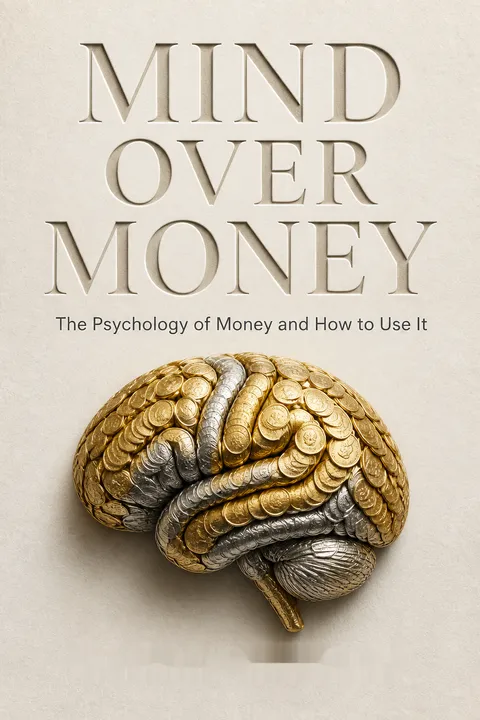


Key Takeaways
Treat money as a tool you steer, not a force that steers you.
Money is more than paper. In 1994, the British band KLF burned £1 million in banknotes as an artwork. The act provoked fury, not simply because valuable paper went up in flames, but because the money’s unrealized possibilities went with it: food, businesses, help for others, and freedom from debt. Money has no inherent value, yet shared trust lets it unlock real goods and choices.
A double-edged reward. Research described in the book finds that receiving money can activate brain reward systems associated with pleasure. Claudia Hammond presents money as both a tool for obtaining what matters and an object that can attract us for its own sake. That pull helps explain why money can dominate attention, even when people claim to despise it.
The opening story makes an abstract idea tangible: money is valuable partly because it represents a future that has not yet happened. That perspective connects personal finance to collective trust, since a currency works only while people expect others to accept it. The brain findings add texture, but they should not be mistaken for proof that money is literally addictive. Neural reward activity is a clue about motivation, not a diagnosis. The practical question is not whether money has power, but whether its power serves chosen ends.
Pay in ways that make the cost feel real before temptation takes over.
Formats change behavior. People often treat cash, cards, and balances on a screen as if they were different kinds of money. In an experiment involving coveted basketball tickets, students bidding with cash offered an average of $28, while those told they could pay by card offered $60. The amount was identical in purpose, but card payment made spending feel less immediate.
Numbers can mislead. When European countries adopted the euro, people struggled to judge prices in an unfamiliar currency. In one study, Swedish participants tended to see euro prices as cheaper because the numbers were smaller than prices in their familiar currency. For everyday purchases, cash can make the trade-off easier to feel. Before using credit, pause and imagine handing over the same amount in notes.
Payment methods act like part of the decision environment. Cash provides immediate feedback, while a card creates distance between the choice and its consequence. That distance can be useful for convenience, but costly when someone is prone to impulse spending. Currency conversion shows a related problem: people rely on simple cues when calculation takes effort. A cash-only rule is not a universal solution, since cards can offer security and record-keeping. Its value is as a deliberate guardrail for purchases where friction would help.
Give every pound a job, but check which mental account is fooling you.
Our budgets are partly imagined. Mental accounts are the categories people use to assign money different purposes, such as everyday needs, treats, or a particular trip. They can make spending manageable. Someone might happily pay more for a drink on holiday than for a bottle at home because the expenses belong to different mental accounts.
The categories can distort. In a classic example, people were more willing to buy replacement theatre tickets after losing cash than after losing the tickets themselves. The first loss came from a general pool of money; the second felt like paying twice for entertainment. The same thinking makes extra airline booking fees feel like a penalty, even if a slightly higher all-in price would have seemed acceptable. Set budgets, but judge the total cost rather than the label attached to it.
Mental accounting is a useful compromise between psychological reality and financial neatness. Separate pots can protect rent money from being casually spent, even if combining accounts might be mathematically more efficient. The key is to notice when categories become excuses: calling a cost a holiday expense does not change its effect on the household budget. Good budgeting should create clarity, not obscure the total. A periodic review of actual balances can correct the gap between the money someone feels available and the money they really have.
Protect yourself from losses you feel more sharply than equal-sized gains.
Losses carry extra weight. Loss aversion is the tendency for losing a sum to feel more powerful than gaining the same amount. The book describes experiments suggesting the aversion to a loss can be more than twice as strong as the attraction to an equal gain. That helps explain why someone may gamble to avoid accepting a loss, even when stopping would be wiser.
Ownership distorts value. In a study, students who received a coffee mug asked roughly twice as much to sell it as other students were willing to pay. Simply owning the mug made giving it up feel like a loss. Capuchin monkeys in a trading experiment showed a similar reluctance to exchange food they already possessed. When making a decision, compare the available outcomes from the same starting point, rather than letting ownership or regret set the terms.
Loss aversion explains why the same financial choice can feel different depending on whether it is framed as gaining or surrendering money. That makes it a powerful tool for understanding behavior, but not a reason to call every cautious choice irrational. People can reasonably value security or dislike uncertainty. The more useful distinction is between protecting something genuinely important and clinging to an earlier decision merely to avoid admitting a loss. A pre-set rule for when to sell, switch, or stop can reduce the influence of regret in the moment.
Treat price as a persuasive cue, not proof of quality or value.
Expensive can taste better. Wine trader Rudy Kurniawan fooled experts by selling blends of cheaper wine in bottles dressed up as rare vintages. Price and presentation shaped what tasters expected to taste. In a brain-scanner study, volunteers reported greater pleasure when they believed a wine was expensive, even when the same wine was presented as cheaper on another occasion.
Choice is shaped by context. The compromise effect describes how a middle-priced option can seem sensible when surrounded by a luxury option and a bargain option. Anchoring is the tendency for an initial number, such as a seller’s asking price, to influence later judgments. Before shopping or negotiating, decide what the item is worth to you and compare like with like. A high price may alter the experience, but it does not establish quality.
Price is not merely a label attached to a product. It can shape expectation, attention, and even reported enjoyment, as the wine experiment illustrates. That does not mean all quality differences are imaginary; some expensive goods really are better made. The difficulty is separating evidence from expectation when comparison is weak. Consumers can reduce that ambiguity by using independent criteria: ingredients, performance, durability, or a price range set before browsing. The same discipline matters in negotiations, where an opening number can quietly become the standard for what feels reasonable.
Pay for clear effort, not outcomes people cannot control.
Incentives need a target. A financial reward can help with a clear task, especially when the person can directly control the effort. In a Dallas school project, children earned money for each book they read, and their reading improved. Other school programs paid for grades, with patchier results: students could want the reward without knowing what actions would secure it.
Rewards can change the meaning of work. Research on intrinsic motivation finds that promised payments can reduce interest in an enjoyable activity, while sincere, appropriately scaled praise may support it. In addiction treatment, small vouchers tied to drug-free tests helped some participants stay engaged, but the structure and staff support mattered too. Before adding an incentive, ask whether the task is clear, controllable, and sustainable, and whether payment could crowd out a more meaningful reason to act.
Incentives are not simply fuel that can be poured onto any behavior. They communicate what an activity is for. Payment can make tedious, measurable work easier to organize, while turning a valued activity into a transaction may weaken its original appeal. The book’s examples also highlight a fairness question: rewarding outcomes can penalize people facing obstacles outside their control. A strong incentive design therefore rewards achievable steps, preserves autonomy where possible, and considers what happens when the reward ends. The immediate response is only part of the result.
Treat scarcity as a cognitive load, not a character flaw.
Worry consumes attention. Sugar-cane farmers in Tamil Nadu took cognitive tests before and after harvest. When money was tight before harvest, their average IQ scores were nine to ten points lower than after they had been paid. The researchers argued that pressing financial concerns occupied mental bandwidth that would otherwise be available for other tasks.
Urgency narrows the view. People under financial strain can focus intensely on the immediate shortfall while struggling to weigh longer-term costs. This helps explain why an expensive short-term loan may seem like a practical bridge to payday, even when repeated borrowing compounds the debt. The point is not that every decision made under pressure is wrong. It is that scarcity can make planning harder, so judging a person’s choices without considering their constraints misses an important part of the problem.
This account shifts the question from whether people in poverty are prudent to what conditions allow prudent thinking. When attention is monopolized by urgent needs, the future becomes harder to evaluate. That has implications for policy and for everyday interactions: predictable support and simpler choices may help more than lectures about willpower. The evidence still requires care. A change in test scores does not prove that every poor person experiences the same cognitive effect, and it cannot settle every cause of poverty. It does undermine the easy assumption that bad outcomes reveal bad character.
Spend for lasting experiences and purpose, not merely a richer image.
We adapt to upgrades. Lottery winners in an early study were not much happier a year after winning than comparison groups, and they reported less enjoyment of some ordinary pleasures. Sudden wealth can bring security, but people also adjust to new comforts. The book notes that research on the link between income and happiness remains debated, especially about how much additional income helps once basic needs are met.
Choose what money enables. Studies described by Hammond find that people often get more enduring satisfaction from experiences than from possessions. A weekend away may remain a vivid memory after a purchase has become obsolete. Tony Holmes, once a high earner and later living on a very tight budget, preserved pleasure by spending selectively on excellent ingredients and cooking. The lesson is not to reject objects, but to spend on what genuinely supports enjoyment, connection, or a valued way of living.
The distinction between objects and experiences is useful because it asks what a purchase does in a life, rather than how impressive it looks. A material item can still be worthwhile if it enables time with others or an activity someone loves. Conversely, an experience can be wasteful if it is bought to keep pace with other people. Tony’s example is particularly revealing: constraints did not erase pleasure, but forced priorities into sharper focus. The income-happiness relationship is not settled by a single lottery study, so spending choices should reflect individual needs, not a universal formula.
Give in ways that preserve trust, dignity, and genuine public value.
Giving can feel good. In an experiment, people given money to spend on someone else or donate to charity reported greater happiness than people told to spend it on themselves. Public recognition can also encourage donations: online fundraising studies found that a larger gift often prompted later donors to give more. Generosity, then, may include both concern for others and the pleasure of being seen to help.
Motives shape the response. People can react badly when charitable work appears to enrich the person doing it, even if that person has raised substantial funds. Meanwhile, an experiment found that participants’ brains showed reward activity both when they gave voluntarily and when they paid a tax directed to a food bank. Giving works best when the destination is clear and the arrangement is transparent. Public praise may encourage generosity, but perceived exploitation can undermine trust.
Generosity need not be perfectly selfless to matter. Recognition, belonging, and personal satisfaction can reinforce actions that benefit others. The harder issue is legitimacy: people want to know that a contribution serves its stated purpose and is not simply a vehicle for private gain. This explains why transparency matters as much as emotional appeal. It also cautions against treating every paid nonprofit worker as suspect. Professional work costs money, and judging an organization only by whether its staff are unpaid can confuse visible sacrifice with actual impact.
Make saving automatic, specific, and difficult to raid.
Do not rely on future willpower. People commonly expect to save more once life is easier, but their spending often rises with income. In Richard Thaler’s Save More Tomorrow plan, workers agreed to raise their savings contributions when they received future pay increases. Participants’ average savings grew to about four times their initial level after four raises, without an immediate cut in take-home pay.
Build a reachable target. In a Philippine study, a restricted account that held money until a target date or balance was reached increased savings by 82 percent. In Kenya, simple locked boxes helped families save for bed nets, with savings for that purpose rising by 66 percent. Specific goals make the future concrete, while a barrier reduces the temptation to withdraw. Start with an amount and target that are realistic, then automate the contribution or place it somewhere less convenient to spend.
Saving is partly a design problem. A plan that assumes people will repeatedly resist easy access to money asks for self-control at exactly the moments it is most likely to fail. Automatic contributions, restricted accounts, and visible goals convert intention into structure. The strongest designs also leave people with a realistic degree of access, since locking away too much can create hardship when circumstances change. A savings device is useful when it supports a person’s priorities, not when it imposes an idealized version of financial discipline.
Analysis
The book’s central argument is that money is neither morally pure nor inherently corrupting. It is a shared instrument whose effects depend on how human attention, emotion, and social expectations interact with it. The same currency can feel like a promise, a threat, a reward, a status signal, or a source of safety. That psychological flexibility explains why simple financial advice often fails: a pound in a bank account, a pound in cash, and a pound mentally reserved for a holiday may be economically equivalent, yet they do not feel equivalent to the person deciding what to do.
The book’s strongest contribution is its insistence that financial choices are made inside contexts, not by detached calculators. Price labels, payment methods, deadlines, social comparison, and anxiety all alter what seems sensible. Its practical recommendations follow from that view: create friction where impulse is costly, make savings concrete, and design incentives around actions people can actually control. The account of poverty is especially important because it connects private decision-making to material conditions. If scarcity absorbs attention, telling people to plan better without reducing the pressure may be ineffective and unfair.
The evidence is necessarily mixed in strength. Some studies involve real purchases and consequential behavior; others rely on small samples, hypothetical choices, or laboratory tasks. Brain scans can show that a region responds during a decision, but they cannot by themselves establish why the person made it. The book is most persuasive when it presents research as a pattern of clues rather than a universal law. Its own examples repeatedly show variation: rewards help in some contexts and backfire in others; wealth sometimes accompanies generosity and sometimes entitlement.
The lasting lesson is not to outsmart every bias, which is impossible, but to notice where a decision’s framing is doing the thinking. A useful money system makes values visible, consequences legible, and future intentions easier to keep. That is a more realistic form of control than pretending emotion can be removed from financial life.
Review Summary
Mind Over Money explores the psychology of money through numerous studies and experiments. Readers found it informative but sometimes overwhelming with research details. Many appreciated the insights into human behavior around finances, though some wanted more practical advice. The book covers topics like mental accounting, loss aversion, and poverty's impact on decision-making. While some found it engaging and thought-provoking, others felt it lacked cohesion or clear takeaways. Overall, it offers an intriguing look at our complex relationship with money, even if not always delivering on practical applications.
People Also Read







Glossary
Money as Tool, Money as Drug
Money’s two psychological rolesA perspective developed by psychologists Stephen Lea and Paul Webley: money functions both as a tool for obtaining goods and achieving goals, and as an object that can be desired for its own reward. The distinction helps explain why people may pursue money even when they have no clear plan for spending it.
financial socialisation
Learning money through family lifeThe process through which children develop knowledge and attitudes about money, often by watching how parents earn, spend, save, and compare prices. Direct conversations can contribute, but observation is important: children notice what adults buy, what they refuse, and how they respond to financial limits.
mental accounts
Psychological categories for moneyThe informal categories people use to assign money different purposes, such as bills, savings, entertainment, or a particular trip. These categories can help people control spending and make quick decisions, but they can also distort judgment. A cost may feel acceptable in one account and excessive in another, even when the same money is being spent.
loss aversion
Losses outweigh equal gainsA tendency for people to feel the pain of losing money more strongly than the pleasure of gaining the same amount. It can lead people to take risks to avoid admitting a loss, hold onto possessions, or fear regret. The book describes research estimating that losses can have more than twice the psychological impact of equivalent gains.
endowment effect
Ownership raises perceived valueThe tendency to value something more highly once it is owned. In experiments, people given an ordinary object often demand more to sell it than others are willing to pay. The effect can arise quickly, even without sentimental attachment or a long period of ownership, because giving the object up feels like a loss.
euro illusion
Currency numbers distort price judgmentsA mistake in which people judge prices by the numbers displayed in an unfamiliar currency rather than by the actual purchasing power. During the euro transition, people sometimes saw prices as cheaper when the numerical amount was smaller, or struggled to compare values while still thinking in their former currency.
compromise effect
The middle option seems saferA choice pattern in which adding an expensive and a cheap option makes a middle-priced product seem like the sensible compromise. The middle option may be selected not because it best fits the buyer’s needs, but because it appears to avoid the disadvantages associated with either extreme.
anchoring
An initial number steers judgmentA bias in which an initial number influences later estimates or decisions, even when the number is arbitrary or only loosely relevant. Asking prices, suggested repayments, and earlier bids can become reference points. People often adjust away from an anchor less than they realize, including when they know it may be misleading.
crowding out
Payment displaces another motiveA change in which introducing money alters or weakens a nonfinancial reason for acting, such as civic duty, generosity, or enjoyment. In the book’s examples, a fine made parents treat late pickup as a paid service, while small payments reduced some students’ charitable effort. Financial incentives can motivate, but they can also change what an action means.
tunnelling
Urgent needs narrow attentionA narrowed focus on an immediate shortage or problem that makes other concerns, especially future consequences, harder to consider. People under financial pressure may concentrate on obtaining cash now while paying less attention to the costs of a loan later. Tunnelling describes a cognitive effect of scarcity, not a lack of intelligence or concern.
temporal discounting
Future rewards feel less valuableThe tendency to value a reward less when it is delayed. Someone may prefer a smaller amount now to a larger amount later, particularly when immediate needs are pressing. This makes saving difficult, because saving requires giving up present spending for a future benefit. The strength of the preference varies among people and circumstances.
contingency management
Rewards support behavior changeA treatment approach that links a reward to a clearly defined behavior, such as producing a drug-free test. The reward can provide an immediate, visible sign of progress and help sustain participation. In the examples described, vouchers operated alongside testing, structure, and staff support, rather than serving as a stand-alone cure.
experience-stretching hypothesis
Wealth can dull simple pleasuresThe idea that greater wealth and access to premium experiences may make ordinary pleasures seem less satisfying by comparison. Research discussed in the book found that money cues could reduce people’s attention to simple enjoyable experiences. The hypothesis helps explain why luxury does not guarantee greater enjoyment of everyday life.
FAQ
What's Mind Over Money about?
- Explores psychology of money: Mind Over Money by Claudia Hammond examines how our psychological relationship with money influences our behavior, decisions, and emotions.
- Focus on human behavior: The book investigates psychological concepts like loss aversion and mental accounting to explain irrational financial decisions.
- Practical applications: Hammond provides strategies for gaining control over financial decisions, promoting a healthier relationship with money.
Why should I read Mind Over Money?
- Gain financial insight: The book offers a unique perspective on money, helping readers understand psychological factors driving financial behaviors.
- Applicable to everyday life: Concepts are relevant to anyone, making it valuable for a broad audience to improve financial decision-making.
- Engaging storytelling: Real-life examples and research studies make the book both informative and enjoyable.
What are the key takeaways of Mind Over Money?
- Money as a psychological construct: Money is not just physical but a mental construct we invest with meaning and value.
- Loss aversion principle: We fear losing money more than we enjoy gaining it, leading to irrational decision-making.
- Mental accounting: How we categorize money influences spending behavior, leading to inconsistencies in valuing money.
What is loss aversion, as defined in Mind Over Money?
- Fear of losing more: Loss aversion is the phenomenon where losing money feels more painful than gaining the same amount feels pleasurable.
- Impact on decision-making: It can lead individuals to avoid risks, even when potential gains outweigh losses.
- Real-life examples: The book illustrates loss aversion's influence through examples like reactions to late deliveries or financial losses.
What is mental accounting in Mind Over Money?
- Categorizing money: Mental accounting involves categorizing and evaluating financial resources based on subjective criteria.
- Influence on spending: People treat money differently based on its source, affecting their willingness to spend.
- Practical implications: Recognizing mental accounting helps manage finances more effectively, ensuring rational decisions.
How does Mind Over Money explain the endowment effect?
- Value of ownership: The endowment effect is the tendency to assign greater value to items we own compared to those we don't.
- Psychological attachment: Emotional attachment to possessions can cloud judgment regarding their true market value.
- Real-world examples: Examples illustrate the endowment effect's impact on financial decisions, helping individuals make more objective choices.
What are some practical tips from Mind Over Money?
- Be aware of biases: Recognize psychological biases like loss aversion and the endowment effect when making financial decisions.
- Use mental accounting wisely: Manage mental accounts consciously to ensure rational financial choices.
- Focus on experiences over possessions: Spending on experiences rather than material goods tends to bring more lasting happiness.
How does Mind Over Money relate to financial decision-making?
- Understanding psychological influences: Insights into psychological factors like biases and mental accounting affect financial decisions.
- Encouraging rational choices: Concepts like loss aversion and the endowment effect highlight the importance of rational financial choices.
- Practical applications: Lessons can be applied to everyday financial situations, empowering readers to take control of their finances.
What are some specific concepts discussed in Mind Over Money?
- Temporal Construal Theory: Explains how time perception affects financial decisions, influencing saving behavior.
- Tainted Altruism: Discusses skepticism about charitable actions when motives are questioned.
- Hyperbolic Discounting: Describes preference for immediate rewards over larger, delayed ones, affecting saving behavior.
How does Mind Over Money address the relationship between poverty and decision-making?
- Cognitive Load of Poverty: Financial scarcity can impair cognitive function, making sound decisions harder.
- Impact on Self-Control: Poverty can lead to impulsive decision-making, prioritizing immediate needs over future savings.
- Need for Supportive Structures: Advocates for systems that help individuals in poverty save and manage finances better.
What strategies does Mind Over Money suggest for improving saving habits?
- Commitment Devices: Use savings accounts that restrict access to funds to help save more effectively.
- Setting Clear Goals: Specific savings goals can motivate individuals to save, enhancing commitment.
- Simplifying Savings: Fewer accounts and straightforward goals make it easier to track progress and stay motivated.
What are the best quotes from Mind Over Money and what do they mean?
- “Money is a mental construct.” Highlights the importance of understanding psychological aspects of money.
- “We fear losing money more than we enjoy gaining it.” Reflects loss aversion, emphasizing mindfulness in financial choices.
- “The way we use money can lead to a good life or a bad one.” Underscores the complex impact of money on well-being, encouraging a healthier mindset.
About the Author



Download PDF
Download EPUB
.epub digital book format is ideal for reading ebooks on phones, tablets, and e-readers.








