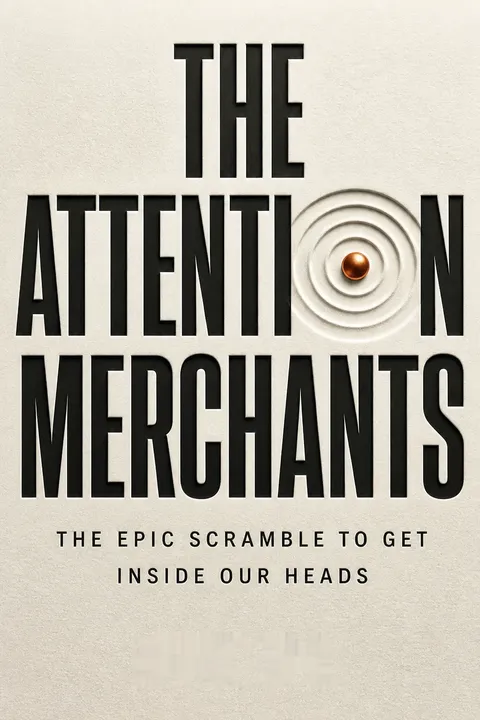


Key Takeaways
Treat attention as the currency that buys the life you actually experience
Attention is always spent. Tim Wu's central claim is that attention is not merely a resource we occasionally direct. At every moment, awareness is occupied by something, whether chosen deliberately or captured by whatever is most compelling. Attention merchants gather that awareness, package it into an audience, and sell access to advertisers in exchange for content or convenience.
The bargain reaches everywhere. In 1833, Benjamin Day sold the New York Sun for a penny, relying on advertisers rather than readers to cover costs. Nearly two centuries later, a cash-strapped California school district accepted ads aimed at its students. Each deal can look reasonable in isolation. Together, they redraw the boundaries of private life and shape what people experience, remember, and want.
What's striking is the shift from asking whether a service costs money to asking what it asks people to give up. Attention has an opportunity cost: an hour absorbed by one thing cannot be spent on another. Unlike an ordinary purchase, however, the exchange is often buried inside a platform's design and repeated habits. The book's economic metaphor clarifies who benefits, though attention is not perfectly measurable like a commodity. Its value also depends on the person, the moment, and what that person hoped to do.
Design for deliberate attention, not the reflexes advertisers can trigger
Some attention is automatic. Wu distinguishes controlled attention, which people direct toward a chosen task, from automatic attention, which a vivid or unexpected stimulus grabs without invitation. The distinction explains why bright colors, movement, sexual imagery, and startling headlines work so well. The late nineteenth-century Paris posters of Jules Chéret used bold color and implied motion to seize the gaze of passersby, even when they were simply waiting or wandering.
Ignoring is a human strength. The brain filters an immense stream of sensory information so that people can focus on a small portion of it. Attention merchants compete to interrupt that filtering. Their challenge is not only to make something attractive, but to pull awareness away from its current object. A practical test follows: notice whether a message serves a chosen purpose or merely hijacks a moment of inattention.
This distinction connects the history of advertising to interface design. A flashing sign and an autoplaying clip differ in technology, but both exploit the mind's readiness to orient toward change. That does not make every vivid message unethical. A warning signal should interrupt; a useful discovery can earn attention. The harder question is whether the interruption serves the viewer's goal or the seller's. The book is strongest when it treats attention capture as a contest over agency, rather than assuming that every involuntary glance produces lasting persuasion.
Expect attention contests to reward spectacle until audiences lose trust
Competition pushes toward excess. When publishers depend on attention, they have an incentive to make each next offering harder to ignore. In 1835, the New York Sun ran a fabricated series claiming that astronomer John Herschel had found life on the moon. The story helped propel the paper's claimed circulation to nearly 20,000. The paper's rivals had already made murder and scandal effective draws; factual restraint was no match for sensation.
Audiences eventually push back. Paris's poster boom provoked campaigns to limit commercial clutter. Patent medicines faced a more consequential backlash after journalist Samuel Hopkins Adams documented false claims and dangerous ingredients. His reporting helped build support for truth-in-labeling laws, while public skepticism drained the industry's appeal. Wu calls gradual loss of novelty the disenchantment effect, and a stronger public rejection a revolt. Both can force attention merchants to change their terms.
The pattern resembles a trust problem in finance: short-term gains from exaggeration can weaken the credibility that makes future claims valuable. Backlash is therefore not simply an audience's irritation. It can be a rational response to repeated evidence that the bargain is misleading. Still, the historical examples do not prove that every market inevitably races downward. Journalism, professional standards, and regulation can constrain the incentive. The useful lesson is to watch for the gap between a medium's promise and its actual conduct, because that gap is where disenchantment begins.
Propaganda gains power by occupying every channel of public attention
Repetition builds a shared frame. In 1914, Lord Kitchener's recruiting campaign used posters, speeches, rallies, and films to urge Britons to enlist. More than 750,000 men joined in the campaign's first two months. During World War I, George Creel's American committee used newspapers, films, posters, and volunteer speakers to spread a single case for entering the war. These efforts showed governments that attention could be converted into action, not just sales.
Control can erase alternatives. Nazi Germany went further, distributing inexpensive radios, broadcasting political messages, and using party loyalists to monitor listening. The distinction matters: commercial persuasion competes against other options, while authoritarian propaganda can suppress competing voices and make alternatives seem unthinkable. The historical lesson is not that every mass broadcast is propaganda. It is that concentrated, repeated messaging becomes dangerous when people cannot freely encounter or assess opposing accounts.
The chapter's most important political insight is that freedom depends partly on what people can notice, not only on what the law permits. A choice that has been concealed or made unimaginable is formally available but practically absent. At the same time, shared attention is not inherently oppressive. Public-health campaigns, collective mourning, or common political debate can coordinate people around legitimate needs. The decisive safeguards are plural sources, open disagreement, and the ability to turn away. Attention infrastructure deserves scrutiny because it can support either civic coordination or coercive conformity.
Advertisers can sell a product by inventing the insecurity it promises to cure
Demand can be manufactured. Early twentieth-century advertising moved beyond explaining what a product did. Claude Hopkins promoted orange juice as essential for babies despite weak evidence, while Listerine popularized halitosis as a social threat. Listerine's annual earnings rose from $115,000 in 1922 to more than $8 million in 1929. The campaign made a private uncertainty feel like a public problem, then offered the bottle as relief.
Products also sell identities. Advertisers built brands around qualities such as dependability, beauty, or status, giving consumers a way to express who they hoped to be. Campaigns aimed at women paired products with fears of rejection and promises of desirability. Later, Lucky Strike marketed cigarettes as weight control and female freedom, despite the health risks. Advertising can inform people about genuine options, but it can also shape wants and anxieties to serve commercial demand.
This is a useful distinction between information and preference formation. Markets need information for people to compare available choices, but advertising can alter the desires that shape those choices. That process is not automatically sinister: a campaign can introduce a genuinely useful product or make an overlooked need visible. The ethical test is whether the claim is truthful, whether the problem is real, and whether the consumer can judge the proposed solution. The examples also show how commercial messages can reinforce social pressures while presenting themselves as personal empowerment.
Free entertainment quietly turns private time into a scheduled advertising market
Radio made time saleable. Pepsodent backed the serial Amos 'n' Andy after its manager noticed families stopping to listen. At its height, the program reportedly reached about 40 million listeners in a country of 122 million. Broadcasters learned to sell not just an ad, but a recurring place in people's routines. Evening listening became prime time, and daytime serials carried products into the household.
Television intensified the bargain. By the 1950s, television had entered most American homes and regularly gathered enormous audiences around a few programs. Ratings turned viewers into measurable inventory, sharpening pressure to maximize audience size. The system still produced valuable journalism, including Edward R. Murrow's reporting, but commercial demands could push difficult coverage aside. When quiz shows were exposed as fixed, the scandal revealed how readily entertainment's promise of fair competition could be sacrificed to keep audiences and sponsors.
A schedule is a powerful commercial asset because routine lowers the effort required to return. This resembles habit formation: a familiar time and setting cue repeated behavior, while a favorite program supplies the reward. Ratings then translate that habit into a price for advertisers. Measurement can help fund ambitious programming, but it can also narrow decisions toward what is easily counted. The key tension is not simply commercial versus artistic content. It is whether audience numbers serve as one useful signal or become the definition of value.
Expect each attention revolt to produce a more personal commercial bargain
Resistance can be absorbed. The remote control offered viewers a small way to escape television commercials. The 1960s counterculture went further, urging people to reject mainstream media, but companies such as Pepsi attached rebellion and individuality to their products. Advertisers learned to sell the feeling of resisting consumer culture through consumption itself. Cable then offered more tailored channels, and reality television made ordinary people into inexpensive, attention-grabbing content.
The bargain keeps changing. The shift from mass audiences to narrower tastes created new opportunities for advertisers to address particular identities. PRIZM, a system that sorted neighborhoods into lifestyle clusters using census and geographic data, helped companies tailor marketing to different groups. More choice could mean better-fitting content, but it also made audiences easier to classify and target. A revolt can change what people tolerate without ending the business model that seeks their attention.
This history complicates the idea that consumer resistance must be either futile or victorious. Opposition can change language, formats, and standards, even when commercial institutions survive. The counterculture's influence on advertising is not proof that its ideals were meaningless; it shows that cultural values are contested and reusable. The more difficult question is who controls the adaptation. A message of freedom may broaden genuine expression, or it may become a label attached to another product. Tracking that difference helps separate cultural change from its commercial packaging.
Social platforms monetize the relationships and identities users build for themselves
The computer's lure was social. Email encouraged frequent checking because rewarding messages arrived unpredictably, a pattern psychologists call variable reinforcement. AOL made communication and chat rooms central to its appeal, while Facebook turned real-world networks into visible profiles, friend counts, and updates. Users supplied the activity and personal information that made the service valuable to advertisers.
The self became part of the product. Instagram made the smartphone camera a tool for constructing a public image, with likes offering rapid social feedback. Some users gained sponsorships; most invested time without earning money. The broader exchange is striking: platforms sell access to people by organizing the relationships and self-presentations those people create. Their social value is real, but so is the commercial use of the data and attention generated through connection.
Social platforms combine two powerful motives: maintaining relationships and monitoring status. That combination helps explain why their pull can feel more personal than television's. A user is not only watching content, but checking how friends respond and how the user's own presentation compares. This can support community and self-expression, especially for people with limited offline connection. It can also make approval feel quantifiable and scarce. The relevant question is not whether online relationships are real, but whether platform incentives strengthen connection or turn it into continuous performance.
Clicks reward shareable emotion, even when attention yields little truth or profit
Virality favors strong reactions. Jonah Peretti's early experiments helped reveal how easily a simple, provocative idea could spread through social sharing. BuzzFeed later refined the approach with attention-grabbing headlines and metrics such as viral lift, which measured how many readers a shared link brought in. Content that provoked awe, anger, or anxiety often traveled farther than material that required patient explanation.
More traffic does not mean more value. The web's amateur publishing boom widened access to public expression, but commercial sites increasingly competed through celebrity gossip, listicles, and clickbait. Some generated huge audiences without strong profits, while tracking systems collected detailed information about readers and native ads blurred the line between editorial and promotion. A click shows that something prompted a response. It does not establish that the content was accurate, useful, or worth the time it took.
The distinction between reach and value is essential. Sharing can signal enjoyment, but it can also express outrage, alarm, or a wish to signal group membership. In each case, circulation measures behavior more readily than understanding. The same tools that let an independent voice find an audience can reward simplification and emotional escalation. That is not an argument for restoring a few gatekeepers as the sole arbiters of public speech. It is a reason to treat engagement metrics as evidence of attention, not as a proxy for truth or public benefit.
Protect deep attention with deliberate boundaries, not another promise of frictionless choice
A different bargain is possible. Netflix's subscription model rejected advertising and offered longer, immersive stories such as House of Cards. The service's release of full seasons encouraged binge watching, a form of sustained attention unlike rapid channel surfing. Meanwhile, ad blockers gave users a practical way to avoid intrusive, tracking-heavy web advertising. Both examples suggest that people may pay, or change their habits, for a more focused experience.
Make protected space intentional. Wu argues for a kind of zoning: deciding which places and periods should be less open to commercial intrusion. Individuals can set aside time for family, work, reading, or a digital Sabbath. Schools, homes, and shared civic spaces can also be treated as more than advertising inventory. The measure is not whether technology disappears, but whether its use serves the life people mean to lead.
The contrast between grazing and immersive storytelling suggests that attention quality matters alongside quantity. Deep focus can support learning, craft, and emotional engagement, while constant switching makes those experiences harder to sustain. Yet commercial-free access often requires a subscription, so it is not equally available to everyone. Individual boundaries help, but they cannot substitute for fair privacy rules and public choices about shared spaces. The book's zoning idea is useful because it turns a vague demand for less distraction into a concrete question: where should commercial access stop?
Analysis
The book's great achievement is to make media history legible as a history of bargains. Benjamin Day's penny newspaper, Kitchener's recruiting campaign, network television, AOL, Google, Facebook, and BuzzFeed look like unrelated industries until the recurring transaction becomes visible: offer an attraction, gather attention, and convert access to that attention into revenue or influence. New technologies do not simply add channels. They make previously protected time, places, and relationships commercially reachable.
Wu also avoids a simple villain story. Advertising can help people discover products, and mass media can create shared experiences or sustain serious journalism. The danger emerges from structural incentives: when growth depends on capturing more attention, the pressure to intrude, intensify, measure, and personalize is continuous. The historical cycles of overreach and revolt show that audiences have agency, but that agency is often exercised after the bargain has become intolerable. Merchants adapt faster than public norms do.
The argument is most persuasive when it distinguishes commercial persuasion from authoritarian propaganda. Both rely on repeated messages and limited attention, but coercion, censorship, and commercial influence are not interchangeable. The book's broad arc sometimes risks making a diverse history look like a single, steadily expanding machine. Audiences use media for pleasure, knowledge, solidarity, and creative work, purposes that cannot be reduced to their sale value. Nor does every attentive moment have a fixed price.
Still, the central question survives those qualifications: who sets the defaults governing what people notice? Personal responsibility matters, but design and ownership matter too. A person cannot meaningfully choose what to ignore when a service hides its incentives, floods the screen, or makes participation socially compulsory. Reclaiming attention therefore has two scales. People can protect time and space in daily life, while institutions can establish rules for privacy, disclosure, and commercial access. Attention is not only an individual discipline. It is also a condition of culture and democratic choice.
Review Summary
The Attention Merchants is a comprehensive history of advertising and media, tracing the evolution of attention capture from newspapers to social media. Wu explores how advertisers and media companies have commodified human attention, often at the expense of privacy and autonomy. While some readers found the book informative and thought-provoking, others felt it lacked depth in certain areas. The book's strengths lie in its historical context and analysis of how technology has shaped our attention economy, though some found the later chapters less engaging than earlier ones.
People Also Read








Glossary
attention merchants
Resellers of audience attentionBusinesses or institutions that attract people's awareness with content, services, or experiences, then sell access to that audience or use its attention to generate value. Newspapers, broadcasters, search engines, and social platforms can all fit the term, despite using different technologies and business models.
disenchantment effect
Familiarity drains attentionThe gradual loss of an audience's interest in a once compelling way of capturing attention. Repeated exposure can make a stimulus familiar and easy to ignore. For attention merchants, disenchantment threatens the value of an established format and encourages new tactics, content, or technologies.
revolt
Public rejection of overreachA broader backlash that occurs when audiences believe attention merchants have overloaded, deceived, or manipulated them. Unlike gradual indifference, a revolt can produce lasting commercial damage, changes in industry practice, or regulatory action. Consumer resistance to patent medicine claims is one example in the book.
demand engineering
Creating consumer desireAdvertising practices that cultivate demand for products people might not previously have wanted, or make an existing concern feel urgent enough to motivate a purchase. Campaigns can associate products with a promised cure, a manufactured anxiety, a desirable identity, or a social aspiration.
prime time
Scheduled mass attentionThe recurring period when large audiences tune in to broadcast entertainment, especially in the evening. Radio serials helped establish the habit, and television made it a national ritual. For broadcasters, the synchronized audience became valuable inventory to sell to advertisers.
check-in
Repeated digital checkingThe habit of returning to email or online services to see whether anything new has arrived. Because the result may be useful, amusing, or disappointing, users cannot predict the reward before checking. The habit helped make email and later social platforms regular destinations for attention.
variable reinforcement
Unpredictable rewards sustain behaviorA learning pattern in which an action is rewarded inconsistently rather than every time. The uncertainty can keep behavior going because the next attempt might bring a satisfying result. Wu uses this idea to explain why people keep checking email despite frequent uninteresting messages.
para-social interaction
One-sided media intimacyA viewer's sense of personal closeness to a media figure who does not know the viewer. Television can create this feeling through familiar speech, first names, small talk, and close-up presentation. The perceived relationship helps explain why audiences follow celebrities and hosts beyond their work.
microfame
Small-scale internet celebrityA form of fame concentrated within a limited online audience, created through direct interaction among a personality, followers, and participants who circulate or respond to their work. Unlike traditional celebrity, microfame can be measured through digital networks and cultivated by ordinary users.
hyperserial
Long-form serialized storytellingA television narrative whose plot develops across episodes and seasons, with events and character changes carrying lasting consequences. Unlike older episodic programs that reset after each installment, a hyperserial rewards sustained viewing and is difficult to understand when entered midway.
FAQ
What's The Attention Merchants about?
- Exploration of Attention Economy: The book examines how human attention has been commodified from the 19th century to the present, focusing on the rise of the attention industry.
- Historical Context: Tim Wu provides a narrative that links the evolution of advertising and propaganda with societal changes, highlighting key figures and events.
- Impact on Society: It discusses the implications of attention commodification on individual autonomy and societal norms, questioning how this affects our daily lives.
Why should I read The Attention Merchants?
- Understanding Modern Distractions: The book offers insights into the mechanisms behind modern distractions and the pervasive nature of advertising.
- Critical Perspective: Wu encourages readers to reflect on their media consumption habits, promoting informed choices in a media-saturated environment.
- Relevance to Current Issues: The themes are increasingly relevant in today's digital age, where attention is a currency, empowering readers to reclaim their focus.
What are the key takeaways of The Attention Merchants?
- Attention as a Commodity: Attention is likened to valuable resources like oil, with industries capturing and monetizing it.
- Historical Evolution: The book traces the evolution of attention capture from penny newspapers to social media platforms.
- Societal Implications: Wu discusses the potential for manipulation and loss of individual agency, urging readers to understand these dynamics.
What are the best quotes from The Attention Merchants and what do they mean?
- “You are the product.”: Highlights the transactional nature of digital interactions, where users trade attention and data for free services.
- “Attention is the new oil.”: Emphasizes the value of attention in the digital economy, akin to a precious resource.
- “The web has become a marketplace of attention.”: Critiques the prioritization of sensationalism over substance in online content.
How does Tim Wu define "attention merchants" in The Attention Merchants?
- Definition of Attention Merchants: Entities that capture and sell human attention for profit, often manipulating content to maximize engagement.
- Historical Examples: Traces from early newspapers to modern tech companies like Google and Facebook, showing the evolution of methods.
- Cultural Implications: Discusses ethical considerations and societal impacts, questioning the long-term effects on autonomy and discourse.
How did advertising evolve according to The Attention Merchants?
- From Print to Broadcast: Traces advertising from 19th-century print media to 20th-century radio and television, each introducing new techniques.
- Scientific Advertising: Discusses the application of psychological principles to create demand, allowing for more effective consumer manipulation.
- Branding and Loyalty: Highlights the development of branding, creating emotional connections with consumers that transcend product quality.
What role does technology play in the attention economy as discussed in The Attention Merchants?
- Advancements in Media: Technological advancements like radio and television transformed attention capture, providing new advertising opportunities.
- Data and Analytics: The digital age's data analytics allow for tailored advertising strategies based on user behavior.
- Impact on Privacy: Raises concerns about privacy and surveillance, warning of manipulation and loss of autonomy as companies gather more data.
How does The Attention Merchants address the concept of consumer behavior?
- Manipulation of Desires: Argues that advertising shapes consumer behavior by creating artificial desires, engineering demand for unnecessary products.
- Psychological Insights: Explains how advertisers tap into emotions and instincts, crafting resonant messages.
- Resistance and Agency: Encourages readers to recognize their agency, suggesting informed choices by understanding attention merchants' tactics.
What is the "disenchantment effect" mentioned in The Attention Merchants?
- Loss of Appeal: Refers to audience indifference to advertising due to overexposure, diminishing engagement.
- Need for Innovation: Attention merchants must innovate to maintain interest, or face declining effectiveness.
- Historical Context: Provides examples of disenchantment, showing how public backlash can force changes in advertising practices.
How does The Attention Merchants suggest we reclaim our attention?
- Awareness and Education: Emphasizes understanding attention merchants' tactics to make conscious engagement choices.
- Mindful Consumption: Advocates for critically evaluating media messages and their impact on our lives.
- Collective Action: Suggests that demanding better practices from companies can influence the attention economy positively.
What is the significance of the "Torches of Freedom" campaign in The Attention Merchants?
- Cultural Shift: Aimed to normalize women smoking in public, reflecting broader societal changes regarding women's rights.
- Advertising Techniques: Exemplifies how advertising can shape cultural norms and perceptions, redefining behaviors.
- Commercialization of Feminism: Critiques the co-opting of feminist ideals for profit, questioning authenticity and motives.
How does The Attention Merchants relate to mental health and well-being?
- Attention Fragmentation: Discusses how constant information and distractions lead to fragmented attention, impacting mental health.
- Social Comparison: Highlights psychological effects of social media, leading to feelings of inadequacy and lower self-esteem.
- Need for Mindfulness: Advocates for mindful media consumption, encouraging intentional engagement to reclaim attention.

Download PDF
Download EPUB
.epub digital book format is ideal for reading ebooks on phones, tablets, and e-readers.








