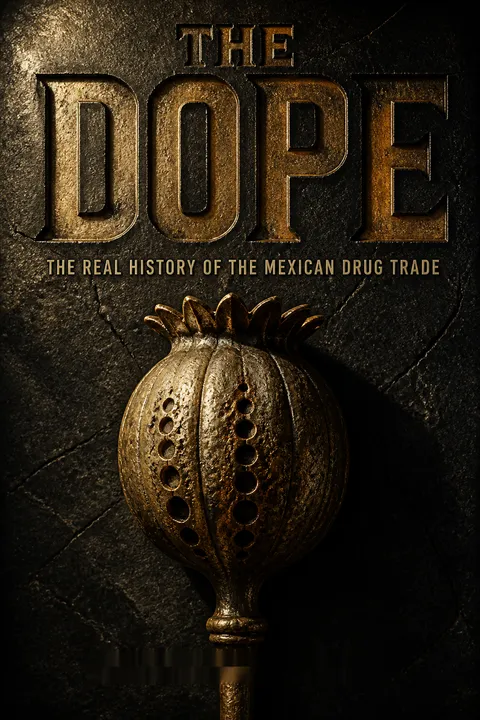


Key Takeaways
Read the Mexican drug trade through demand, state power, and myth.
A life inside the trade. The book opens with Cruz, a poor Michoacán child recruited at seven as a lookout for his family’s drug stash. He watched the merchandise shift from cocaine to marijuana, then methamphetamine and heroin, while control moved from local police to armed traffickers. After fleeing to the United States, he was deported and portrayed as a violent cartel criminal. His experience exposes the gap between stock villain stories and the lives of people trapped at the trade’s lowest levels.
A history against stereotypes. Smith traces the trade from the early twentieth century to 2020, arguing that American demand, Mexican poverty, political protection, and punitive policing shaped it more than a timeless criminal culture did. The same myths that simplify the story have also helped justify coercive policies.
What's striking is how the opening makes historical argument personal without pretending one testimony represents every participant. Cruz’s account gives scale and consequence to abstractions such as recruitment, migration, and deportation. It also invites a useful distinction between explanation and excuse: recognizing economic coercion does not erase harm, but it changes which policies seem plausible. A limitation of any single life story is that it cannot establish how typical a path is. The book’s archival comparisons are therefore essential, not decorative.
U.S. demand and Mexican poverty made tiny crops economically irresistible.
A powerful price gap. The United States, not Mexico, was the main consumer across much of this history. The book estimates that, over fifty years, selling about 700 grams of marijuana, 18 grams of heroin, or 66 grams of cocaine in the United States could equal a Mexican worker’s average annual wage. These are comparisons, not claims that farmers routinely sold directly to American users. They show why even a small role in cultivation or transport could compete with badly paid legal work.
A narrow set of choices. In the 1970s, a poor farmer could earn several times more from a small poppy plot than from ordinary crops. Many grew drugs to buy food, land, a vehicle, or schooling. The trade’s appeal came from the enormous difference between U.S. prices and Mexican wages.
The comparison is valuable because it puts illegal income beside the real alternative, rather than treating participation as a sudden moral failure. This resembles a basic economic model of opportunity cost: choices depend on the options actually available, not on an imagined menu of safe, well-paid jobs. Still, price comparisons cannot account for every decision or capture the risks borne by growers and couriers. They explain why the market recruits people; they do not make its unequal rewards fair.
Treat corruption as an organized protection system, not a cultural trait.
Protection had rules. Smith uses drug protection rackets to describe arrangements in which officials took fees or a share of profits in return for shielding favored traffickers and selectively enforcing the law. Before the 1970s, local officials generally controlled these arrangements. Some proceeds funded public works, as when Baja California governor Esteban Cantú used vice and drug revenue to build roads and schools. This did not make the system just, but it makes the word corruption alone too blunt to explain how it operated.
Control moved upward. In the 1970s, federal police took over many local rackets and called their zones plazas. In the 1990s, traffickers increasingly controlled these arrangements themselves, a shift political scientists call state capture. The institutional level of control changed, as did who collected the money and who set the rules.
This account turns corruption from a national stereotype into a question about institutions: who collects, who distributes, and who can punish noncompliance? That framing is useful beyond drug history because informal payments can sometimes sustain public services while also weakening accountability. The danger is romanticizing an arrangement simply because it built a school. Public benefits do not cancel coercion, unequal access, or the long-term damage caused when private protection displaces impartial law.
Trace violence to fights over protection and policing, not drugs alone.
Cooperation came first. For much of the trade’s first half-century, traffickers often relied on family, friendship, and local political ties. Violence was not absent, but disputes between dealers were less common than the image of a permanently violent cartel culture suggests. Early bloodshed often followed a change in officials, as new authorities tried to seize the protection racket by removing established traffickers and installing their own.
Policing raised the stakes. From the 1970s, raids, torture, long sentences, and informant recruitment made cooperation dangerous. Traffickers turned on associates to avoid punishment, and suspected informants were killed. Operation Condor, a large military campaign against drug crops, brought this violence into rural villages. The result was not simply enforcement against drugs, but a struggle over who controlled the trade and its protection.
The book’s strongest corrective is to treat violence as political and institutional, not as a chemical property of narcotics or an inevitable feature of criminal personalities. That distinction helps explain why violence varies across places and periods. It also suggests a feedback loop: coercion can produce information and arrests while simultaneously destroying trust and encouraging preemptive killing. The account does not claim prohibition is the sole cause of every murder. It shows why policy choices can amplify conflicts already rooted in power.
Judge drug policy by human harm and demand, not seizure totals.
A different experiment. In 1940, psychiatrist Leopoldo Salazar Viniegra helped establish Mexico City dispensaries that provided registered morphine users with controlled doses at low prices. The aim was not immediate abstinence. It was to reduce the black market’s profits, keep users working, and connect them with medical care. More than 500 people visited during the first week. The United States restricted morphine exports to Mexico, and the program closed within months.
Supply campaigns displaced supply. Later eradication drives could briefly reduce Mexican production, but other sources replaced it and American drug use did not reliably fall. The book calls this the balloon effect: pressure on one source shifts production elsewhere. Seizures and crop destruction can produce impressive figures while leaving demand intact and imposing severe costs on farmers and communities.
Salazar’s proposal makes a neglected policy question concrete: what changes when authorities compete with an illicit market instead of trying only to punish it? The experiment linked public health, price, and work rather than equating treatment with forced abstinence. Its short life does not prove it would have solved addiction, and the book cannot offer a controlled comparison. It does show that alternatives were imaginable, and that foreign pressure helped close one before its longer-term effects could be tested.
Consumer booms turned scattered growers into professional, adaptive supply chains.
The market changed scale. In the 1960s, American marijuana use surged, and Mexico became a major supplier. What had been a small trade expanded into a far-flung business involving peasant growers, bilingual intermediaries, border wholesalers, and American smugglers. Buyers began demanding cleaner, stronger varieties, including sinsemilla, the seedless tops of unpollinated female plants. Product quality and branding became part of the business, not just cultivation.
Heroin followed the same logic. After French Connection supplies collapsed, Mexican brown heroin filled the gap. Production spread beyond the Golden Triangle, and chemists improved quality for different buyers. The trade learned to shift between marijuana, heroin, and cocaine as demand changed. Pressure from enforcement also encouraged new routes, packaging, and transport methods.
The account shows illicit markets responding to consumer preferences much like legal industries: they differentiate products, invest in logistics, and recruit specialists. That connection helps explain why a crackdown on one commodity or route rarely ends the underlying enterprise. It can instead reward better organized suppliers. The analogy has limits, since illegal firms cannot use courts to enforce contracts and can rely on violence. But treating the trade as an economy, rather than a succession of villains, clarifies its durability.
The Guadalajara Cartel was a useful label, not one unified cartel.
A label simplifies a network. The DEA popularized the name after the 1984 Búfalo Ranch bust, where authorities found thousands of acres of marijuana cultivation and large numbers of workers. The group commonly called the Guadalajara Cartel was not a single corporation with fixed membership, formal rules, or one unquestioned boss. It was a shifting alliance of Sinaloa traffickers, gunmen, and officials who sometimes cooperated and sometimes fought.
Protection was the connective tissue. The DFS, Mexico’s secret service, took over much of the federal drug protection business in the 1980s. Its agents guarded fields, transport, and traffickers. The 1985 murder of DEA agent Enrique Camarena prompted a major crackdown, the collapse of the DFS, and a new rise in U.S. enforcement power. The book also treats competing explanations of the murder cautiously, rather than accepting a simple official story.
The correction matters because labels can make loose networks look more unified and more vulnerable than they are. Once officials name an enemy, the public can imagine that removing its leader will dismantle the whole market. This is a familiar problem in organizational analysis: visible leadership does not necessarily mean centralized control. The book’s skepticism is persuasive, although its account of the Camarena case also demonstrates how difficult it is to distinguish documented fact from claims shaped by institutional self-interest.
When traffickers inherited the plazas, protection fees spread beyond drugs.
Power changed hands. In the 1990s, cocaine profits grew as Mexican groups took on more of the risk and responsibility for moving Colombian product into the United States. At the same time, Mexico’s political system and security forces fragmented. Traffickers gained enough money and leverage to take control of parts of the protection rackets once run by police and officials. The taxed had become the tax collectors.
Extortion outgrew trafficking. Groups such as the Zetas extended plaza fees from drug routes to other illegal and legal businesses, including shops, transport, and farming. Isela, whose family ran a small shop in Acapulco, was forced to pay increasingly large fees and eventually lost her brother to gunfire. For many residents, organized crime’s most immediate threat was no longer drug trafficking, but coercive control of ordinary commerce.
This shift helps explain why crime can spread even where a town is not a major production or smuggling hub. Once an armed group has local power, it can monetize businesses that have nothing to do with narcotics. The same logic appears in political economy: control of territory creates opportunities to tax economic activity. The term tax is descriptive, not legitimizing. Unlike public taxation, extortion offers no dependable public service and leaves victims with little recourse.
Count violence and adaptation, not kingpin arrests, to judge success.
Leadership arrests can fragment networks. The kingpin strategy targets prominent traffickers to disrupt organizations. The book argues that captures often instead trigger succession fights, encourage informants, and split alliances. During the 2006 to 2012 drug war, estimates reached 65,000 drug-related deaths. Meanwhile, groups adapted to new enforcement and changing American tastes, moving among drugs and methods rather than abandoning the market.
The human measure is local. By the 2010s, many small gangs used cartel names and weapons but made money through kidnapping, fuel theft, and extortion. In Acapulco, Isela’s family faced threats even though, she said, neighbors were not drug users. Such cases complicate the claim that more arrests equal less harm. The trade’s ability to adapt, and the violence imposed on ordinary people, belong in any measure of policy success.
A campaign’s arrest count measures activity, not whether people are safer or whether supply and demand have changed. The book encourages a broader scorecard that includes deaths, displacement, extortion, and the market’s capacity to reorganize. That is a valuable shift from output metrics to outcomes. Yet causal assessment remains difficult: several forces, including gun availability, weak courts, and new local drug markets, contribute to violence. A better measure should acknowledge those factors rather than crediting or blaming one policy alone.
Analysis
The book’s central achievement is to replace the familiar morality play of virtuous enforcers against monstrous cartels with a history of changing relationships among demand, poverty, officials, and illicit markets. Its chronological structure makes that argument legible: small medicinal and criminal markets became export networks, local protection arrangements became federal rackets, and traffickers eventually took control of parts of the state’s protection business. Drug names and famous kingpins change; the incentives and political contests persist. The most useful conceptual move is treating protection as the connective tissue between commerce and government. It explains why the trade could be relatively cooperative in one period and violently contested in another. It also prevents corruption from becoming a lazy cultural explanation. A mayor, a state police force, the federal police, the secret service, and traffickers could each occupy different positions in the same system. Their competition over fees and authority helps account for violence that a simple cartel-versus-state model cannot.
The book is also unusually attentive to evidence as a political product. Official statistics, police reports, confessions, and press accounts are not neutral windows. They are shaped by bureaucratic incentives, coercion, and the need to tell stories the public recognizes. The author’s archival method, comparison of sources, and caution about the Camarena case make this skepticism central to the history rather than a side note.
The argument is strongest when it identifies mechanisms, such as raids that disrupt cooperation or crackdowns that displace supply. It is less conclusive when assigning responsibility for particular episodes or estimating hidden markets and deaths, problems the author openly acknowledges. Nor can the book’s account reduce all violence to prohibition: weak courts, firearms, retail markets, and criminal expansion matter too. Its larger conclusion remains compelling. Enforcement can alter who controls a market and how violent it is, without removing the economic demand that sustains it. That distinction is essential for evaluating policy by its human effects, not its public relations or seizure totals.
Review Summary
The Dope receives mostly positive reviews for its comprehensive history of the Mexican drug trade spanning over a century. Readers praise Smith's meticulous research, engaging writing style, and ability to connect historical events to current issues. Many find the book enlightening, offering insights into the complex dynamics of drug trafficking, government corruption, and U.S.-Mexico relations. Some criticize the dense information and occasional narrative disruptions. Overall, reviewers appreciate the book's thorough examination of a crucial topic, despite its challenging subject matter.
People Also Read




Glossary
drug protection rackets
official protection for paymentArrangements in which officials or law enforcement actors take a fee or share of drug profits in exchange for protecting selected traffickers from enforcement. The arrangement can include punishing those who refuse to pay. In the book, these rackets shift from local authorities to federal police and, later, to traffickers themselves.
state capture
traffickers control state functionsA political science term for private interests gaining control over parts of the state and shaping how those functions operate. In the book, it describes the shift in some regions where traffickers, rather than officials, set the terms of drug protection arrangements. It does not mean that traffickers took over the entire Mexican state.
plaza system
regional protection zonesThe arrangement under which federal police commanders controlled regional zones, or plazas, and favored traffickers paid for permission and protection to move drugs through them. The term suggests a coordinated system, but the book stresses that the arrangement was unstable, contested, and often enforced through extortion and violence.
Operation Condor
militarized rural eradication campaignA Mexican counternarcotics campaign that began in the mid-1970s and combined military deployments, crop eradication, aerial herbicide spraying, arrests, and U.S. assistance. It reduced Mexican drug supply for a time, but also brought torture, killings, displacement, and disruption of local protection arrangements.
amparo
constitutional legal protectionA Mexican legal procedure intended to protect people from government actions that violate constitutional rights. Drug traffickers used amparos to challenge arrests and avoid imprisonment, often through well-connected lawyers and judges. During the 1970s, authorities restricted their use in drug cases, reducing one route for release.
balloon effect
supply shifts under pressureThe displacement of drug production or trafficking when enforcement suppresses one source or route, prompting supply to emerge elsewhere. The book uses the idea to explain why crop eradication and border pressure can produce temporary shortages without reducing American demand or addiction over the longer term.
sinsemilla
seedless, potent marijuana topsMarijuana made from the resin-rich tops of unpollinated female plants. The book describes it as a higher-value product that gained popularity as American buyers began demanding stronger, cleaner, more differentiated cannabis. Its production encouraged investment in cultivation techniques, irrigation, and more organized trafficking.
Tehuacanazo
waterboarding with sodaA form of water torture used by Mexican law enforcement, named for Tehuacán mineral water. A prisoner was restrained while liquid was poured into the nose or mouth, creating the sensation of drowning. The practice became part of a broader repertoire of coercive interrogation used in drug policing.
FAQ
What is The Dope: The Real History of the Mexican Drug Trade by Benjamin T. Smith about?
- Comprehensive historical overview: The book traces the evolution of the Mexican drug trade from the early 20th century to 2020, examining how narcotics production, trafficking, and enforcement have shaped Mexico and its relationship with the U.S.
- Focus on state-criminal interplay: Smith explores the complex interactions between traffickers, Mexican state institutions, and U.S. agencies, highlighting the roles of corruption, protection rackets, and violence.
- Societal and political impact: The narrative delves into how drug trafficking has influenced Mexican society, politics, and violence, including the rise of narco-culture and the militarization of drug enforcement.
Why should I read The Dope by Benjamin T. Smith?
- Myth-busting and nuance: The book dismantles common myths about Mexican drug trafficking, offering a nuanced, evidence-based account that goes beyond sensational headlines.
- Rich primary research: Smith draws on archival research, interviews, and classified documents, providing rare insights into the inner workings of the drug trade.
- Context for current issues: Readers gain a deeper understanding of the historical and structural causes of today’s drug violence and policy failures, making it essential for those interested in drug policy, Latin American history, or international relations.
What are the key takeaways from The Dope by Benjamin T. Smith?
- Economic incentives drive trade: U.S. demand and Mexican poverty created powerful incentives for drug production and trafficking, shaping the industry’s growth.
- Corruption and protection rackets: The drug trade has long been intertwined with political corruption, with officials running protection rackets and traffickers eventually taking control.
- Violence linked to prohibition: Drug-related violence stems more from prohibition and political struggles over protection rackets than from the drugs themselves.
- Policy failures and consequences: Hardline drug policies often failed, leading to unintended consequences like increased violence and the spread of criminal activity.
How did U.S. demand and policy shape the Mexican drug trade according to The Dope by Benjamin T. Smith?
- Demand-driven shifts: Changes in U.S. drug preferences—from marijuana and cocaine to opiates and fentanyl—directly influenced Mexican production and trafficking patterns.
- Policy failures and displacement: U.S. interdiction efforts, such as Operation Intercept and the kingpin strategy, often displaced trafficking routes or fragmented organizations without reducing supply or demand.
- Cross-border complicity: The book highlights U.S. agencies’ involvement in covert operations and the complicity of some U.S. officials in corruption and extrajudicial actions.
What is the role of corruption and protection rackets in The Dope by Benjamin T. Smith?
- Longstanding system: Corruption and protection rackets have been central to the Mexican drug trade for nearly a century, involving officials at all levels.
- Shift from state to traffickers: Over time, traffickers increasingly took over these rackets, using their own armed groups to enforce payments and eliminate rivals.
- Economic scale and impact: By the 1990s and 2000s, bribes and payoffs reached hundreds of millions annually, permeating government and security forces and undermining law enforcement.
Who were the “barbarians of the north” and what was their significance in The Dope by Benjamin T. Smith?
- Federal Judicial Police dominance: In the 1970s and early 1980s, the PJF, known as the "barbarians," took over drug protection rackets with brutal violence and impunity.
- Centralization of rackets: They attempted to consolidate local and regional protection rackets into a national system, charging traffickers fees to operate in specific zones.
- Escalation of violence: Their reign saw increased torture, assassinations, and suppression of honest officials, deepening corruption and undermining law enforcement credibility.
How does The Dope by Benjamin T. Smith describe the evolution of the Mexican drug trade from the 1910s to the 2020s?
- Early origins: The trade began with morphine, heroin, and cocaine diverted from medical use, with early traffickers protected by corrupt officials.
- Rise of organized crime: Groups like the Grey Automobile Gang and figures like Ignacia “La Nacha” Jasso and José del Moral played key roles in expanding the trade.
- Militarization and cartelization: The 1970s onward saw militarized enforcement, the rise of major cartels, and traffickers taking over protection rackets, leading to today’s fragmented and violent landscape.
What was Operation Condor and what were its consequences according to The Dope by Benjamin T. Smith?
- Militarized eradication campaign: Launched in the mid-1970s, Operation Condor combined aerial herbicide spraying, military occupation, and intensified policing to eradicate opium poppies and marijuana.
- Human rights abuses: The campaign was marked by widespread atrocities, including torture, extrajudicial killings, and destruction of peasant livelihoods.
- Limited long-term success: While initial eradication numbers were high, the campaign failed to reduce overall addiction rates or supply, and drug cultivation spread to new areas, increasing corruption and violence.
How does The Dope by Benjamin T. Smith explain the rise and significance of the Guadalajara Cartel?
- Loose alliance, not a formal cartel: The Guadalajara Cartel was a coalition of Sinaloa traffickers, ex-paramilitaries, and secret service agents controlling major routes in the 1980s.
- Vertical integration and innovation: They pioneered large-scale marijuana production and expanded cocaine trafficking through partnerships with Central American dealers.
- Violent protection rackets: The cartel’s protection system, run by the DFS, led to turf wars and high-profile murders, escalating violence in Guadalajara and beyond.
What is the significance of Enrique “Kiki” Camarena’s murder in The Dope by Benjamin T. Smith?
- Turning point in drug war: Camarena’s 1985 murder led to the breakup of the Guadalajara Cartel, the dismantling of the DFS, and a surge in arrests and violence.
- DEA’s martyr narrative: His death became a foundational story for the DEA, increasing its budget and influence and shaping U.S. drug policy.
- Contested conspiracy: The book explores alternative theories involving CIA complicity and highlights flawed investigations and ongoing mysteries.
How did the Mexican drug trade change in the 1990s and 2000s according to The Dope by Benjamin T. Smith?
- Shift in power dynamics: Traffickers gained control over protection rackets as the Mexican state weakened, leading to the rise of major cartels.
- Economic boom and diversification: Mexican traffickers took on more risk and profits, expanding into new criminal activities like extortion and fuel theft.
- Escalation of violence: The militarized crackdown under President Calderón fractured cartels, sparking turf wars and increasing violence and insecurity.
What does The Dope by Benjamin T. Smith suggest about the future of the Mexican drug trade and drug war?
- Persistent trade despite enforcement: The drug trade continues to adapt to changing markets, technologies, and enforcement tactics, remaining resilient.
- Fragmentation and new criminal groups: Hundreds of smaller gangs now operate, diversifying into crimes beyond drugs and increasing insecurity for ordinary Mexicans.
- Calls for policy change: The book notes recent shifts toward less militarized approaches and social programs but highlights ongoing challenges like U.S. pressure, corruption, and entrenched incentives of prohibition.
Download PDF
Download EPUB
.epub digital book format is ideal for reading ebooks on phones, tablets, and e-readers.








