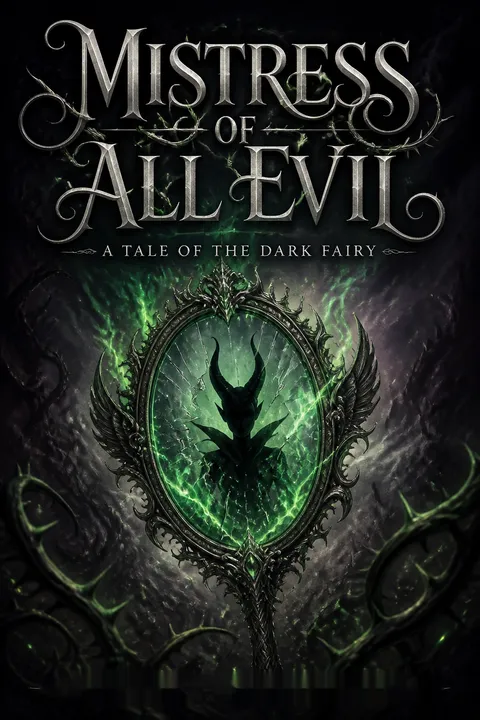


Plot Summary
Prologue
At sixteen, Princess Aurora returns to her parents’ castle, and Maleficent learns that the girl she cursed is within reach. Unable to contact the Odd Sisters, who are lost in the land of dreams, Maleficent uses enchanted fire and a green light to draw Aurora to a spinning wheel.
The princess resists, but the curse drives her hand to the spindle. She falls into an enchanted sleep, and Maleficent celebrates what she believes is the final victory of her long pursuit.
The opening gives Maleficent the apparent certainty of a storybook villain: she names her target, completes her curse, and treats Aurora’s collapse as proof that she has won. Yet her need to summon the Odd Sisters hints that her control is less complete than she wants to believe. Aurora’s resistance also leaves a human presence inside the spectacle of enchantment. The prologue establishes the central tension between what a story seems to say about Maleficent and what her motives may be, while making sleep both the curse’s result and the threshold to the book’s second world.
Ursula’s Golden Funeral
After Ursula’s death, Circe, the young witch she once loved as a friend, stands with Nanny, Tulip, and Prince Popinjay to honor her. Nanny has gathered Ursula’s remains into a ceremonial ship, and Circe lets it drift out to sea among flowers and golden straw. Attina, eldest daughter of King Triton, comes on her father’s behalf, recognizing both Ursula’s crimes and the woman she might have been.
The brief peace ends when Circe senses a moving forest nearing Morningstar Castle. Nanny recognizes the approaching crows as Maleficent’s, and understands that the Dark Fairy is coming. The funeral therefore becomes more than farewell: it places grief, guilt, and an old friendship at the threshold of a new confrontation.
Circe’s funeral refuses the easy moral division between honoring a person and excusing her actions. She can condemn Ursula’s harm and still mourn the earlier friend she remembers. Attina makes a similar distinction, representing a family forced to reckon with an inheritance of injury without pretending the injured person was blameless. Maleficent’s approach interrupts this carefully made ritual, binding the new conflict to the old one. The scene’s central psychological pressure is unresolved loyalty: affection survives, but it cannot undo what has been done. The funeral gives the coming confrontation an emotional context before Maleficent even arrives.
Aurora’s Mirror Prison
In the land of dreams, Aurora learns to use the mirrored walls of her chamber to watch people in the waking world. She sees that the fairies who raised her called her Rose to hide her identity, that Prince Phillip is her betrothed, and that Maleficent has imprisoned him. Knowing these facts does not let Aurora escape; she can observe her story but cannot direct it.
The mirrors also show her own past, including the christening where Maleficent first appeared. Then three identical women enter her chamber and identify themselves as the Odd Sisters, Lucinda, Ruby, and Martha. They have been searching for Aurora and say Maleficent will be pleased they found her, turning the princess’s solitary refuge into a place of immediate danger.
Aurora’s mirrors create a sharp divide between knowledge and agency. She gains a view of the people who shaped her life, but that view cannot return her to them or alter their choices. The chamber is therefore not simply a magical prison; it is a machine for witnessing one’s own powerlessness. The Odd Sisters’ arrival changes observation into contact, but not into safety. Their claim that Maleficent will welcome the discovery unsettles the familiar distinction between enemy and protector. Aurora’s first resource is attention, and the story makes that resource valuable without mistaking it for freedom.
The Child in the Crow Tree
As Maleficent’s approach stirs her memories, Nanny recalls finding her at four years old, alone in a hollow tree and cared for by crows. The fairies had left the strange green child there and named her Maleficent because they expected evil from her. Nanny, known as the One of Legends, sees a neglected child instead.
When Maleficent cannot speak, Nanny helps her find her voice, then offers to take her home with her crows. She replants the crow tree in her garden and builds Maleficent a tree house, preserving the child’s first attachments rather than demanding that she abandon them. For the first time, Maleficent has a guardian who treats her difference as no reason to withhold love.
Nanny’s rescue is an act of care, but it also exposes how institutions manufacture the qualities they claim merely to identify. The fairies interpret Maleficent’s appearance as evidence of future evil, then abandon her to a life that could have confirmed their judgment. Nanny interrupts that cycle by offering relationship before diagnosis. Her decision to bring the crows along matters: she does not ask Maleficent to exchange one attachment for another as the price of belonging. The child’s first experience of love is therefore generous and specific, yet the story’s later events will test whether affection alone can undo the social expectations laid over her.
The Witch in School
At the Fairy Academy, Maleficent excels at study but faces mockery for her horns, her inability to fly, and her appearance. When a teacher tolerates the insults, Nanny defends her, then removes her from a school that offers little teaching she values.
Maleficent studies spells from Nanny’s books and discovers that knowledge gives her confidence beyond the academy’s narrow curriculum. Years later, she chooses to sit for the fairy exams anyway, wanting mastery of every kind of magic and an official place among her peers.
The Fairy Godmother, Nanny’s sister, objects and warns that Maleficent will become evil. Nanny permits the exam. On Maleficent’s sixteenth birthday, the Odd Sisters arrive, delighted to meet the girl whose future they seem to know.
Maleficent’s ambition grows in response to exclusion, but it is not reducible to revenge. She wants formal recognition from the same community that taught her she does not belong, even as she builds a more independent education through books. Nanny’s protection helps her flourish, yet it cannot shield her from the Fairy Godmother’s authority or the social meaning of being labeled dangerous. The exam becomes a test of belonging as much as skill. By insisting on taking it, Maleficent hopes her competence can outweigh prejudice, while the adults around her already treat her future as something they can foresee and judge.
The Exam Becomes Fire
During her exam, Maleficent enters a story in which young Snow White fears for her grieving mother. Maleficent finds the queen tormented by her dead father’s image in a mirror and destroys the mirror, ending his abuse.
She returns to the academy believing she helped, but the other fairies accuse her of attacking them. They had stolen her raven Diablo and hidden him with her crow tree to distract her; when Circe, disguised as Maleficent in an exam scenario, tried to find the birds, the fairies’ magic set the tree alight.
In the argument that follows, the Fairy Godmother declares Maleficent destined for evil. Betrayed and convinced Nanny knew this prophecy, Maleficent erupts into dragon form and burns the Fairylands. The Odd Sisters move its inhabitants into a protected alternate reality.
The exam turns an assessment of magical judgment into a public reenactment of Maleficent’s deepest fear: that others have already decided what she is. Her act in Snow White’s scenario is compassionate, but the academy’s conflict leaves no room for that evidence to matter. The stolen birds make the provocation concrete, while the Fairy Godmother’s prophecy gives the explosion a story to inhabit. Maleficent’s transformation is both an exercise of power and a collapse of self-regulation. The Odd Sisters’ rescue prevents total loss of life, but it cannot prevent Maleficent from interpreting the catastrophe as proof that everyone was right about her.
A Daughter Made of Light
After the Fairylands burn, Maleficent remains a dragon for years, believing she has killed Nanny and everyone she loved. Eventually she returns to her own form, but grief and isolation have left her emotionally numb. The Odd Sisters find her and offer a spell to create a daughter from the best parts of her, hoping the child will give Maleficent someone to love.
On her way to their house, living trees and vines attack her, a consequence of her destruction of the Fairylands. Maleficent escapes by using the travel charm Nanny taught her as a child. During the spell, the sisters take part of Maleficent’s essence and create a baby. Maleficent names her Aurora, feels no love, but wants fiercely to protect her.
The daughter spell is framed as a gift, yet it carries a cost that its loving intention does not erase. Maleficent hopes a child will restore attachment, while the Odd Sisters imagine that separating her best qualities will make that restoration possible. Instead, the spell deepens her division: Aurora receives the qualities Maleficent once had, and Maleficent is left with protectiveness without felt tenderness. The attack by the living forest is equally consequential. It turns guilt into a bodily condition, a world that reaches for her wherever she goes. Love is offered as a cure, but the method makes the wound more difficult to understand.
The Curse at the Christening
Maleficent entrusts the infant Aurora to Nanny, hoping her former guardian can care for the child, but Nanny gives Aurora to the good fairies under the rules governing children with destinies. At the christening, Maleficent arrives uninvited and curses the princess to die from a spindle prick before her sixteenth birthday.
The good fairies soften death into enchanted sleep and hide Aurora in the forest under the name Rose, raising her away from the court. Maleficent’s curse becomes the force that keeps them involved in Aurora’s life.
Years later, after Rose touches the spindle, Maleficent wants the princess kept asleep forever and imprisons Phillip, the young man she loves. To Maleficent, these choices are protection; to everyone else, they look like the cruelty of a villain.
The curse begins as a rupture between Maleficent’s stated desire to protect and the destructive form that desire takes. Her fear is not legible to the people around her, while the damage is immediate and public. Nanny’s decision to follow the fairy system removes Aurora from Maleficent’s reach, reinforcing the abandonment Maleficent already carries. The good fairies reduce the curse’s severity, but their concealment perpetuates the separation and ensures that Rose grows up without the truth. The passage reveals how protective intent can become coercive when fear refuses dialogue, and how institutions can reproduce injury even while believing they are acting responsibly.
The Book Remembers
Snow White wakes from recurring dreams of a forest and a witch, then finds her mother, Grimhilde, in a mirror. The old queen recognizes the Dragon Witch in Snow’s nightmare and asks her to retrieve a fairy-tale book from the attic.
Its pages recount events in Snow’s life and other kingdoms, making Snow and Grimhilde fear that the Odd Sisters enchanted it to dictate people’s fates. Snow sends word to Morningstar Castle. There, Circe grieves for her sleeping sisters after Ursula’s spell left them trapped in the land of dreams.
Tulip’s research and fascination with the ancient Tree Lords awaken them, and their king, Oberon, arrives determined to punish Maleficent for burning the Fairylands. He promises Nanny a chance to appeal to her former adopted daughter.
The fairy-tale book gives characters a frightening possibility: that their lives may be written before they can choose. Grimhilde’s suspicion carries particular weight because she knows the damage of being reduced to a single role, yet her first response is still revenge. Snow’s trip to the attic makes her confront the painful history she has tried to compartmentalize. At Morningstar, Tulip’s curiosity has a more generative effect: her attention revives beings thought forgotten. The contrast matters. Knowledge can be used to control, as the book might suggest, or to restore what neglect has erased. Both interpretations remain unsettled as the crisis expands.
Maleficent Comes Home
Maleficent enters Morningstar through the fireplace and asks Nanny and Circe for help breaking the fairies’ addition to Aurora’s sleep curse. She says three witches are needed, but Circe refuses to harm the princess without knowing the full story.
Nanny and Maleficent confront the years between them: Maleficent believed Nanny had died, while Nanny believed Maleficent perished in the fire. Maleficent reveals that Aurora is her daughter, created from the best parts of herself, and that she handed the child to Nanny for care.
Nanny did not know this when she passed Aurora to the good fairies. Maleficent also explains that she fears Aurora’s powers will emerge at sixteen as hers did, destroying everyone she loves. The fairies arrive, learn the truth, and apologize for their part in her rejection.
This reunion converts a history of apparent malice into a dispute over competing failures of care. Maleficent’s account does not absolve her curse, but it makes her fear intelligible: she sees sleep as a barrier between Aurora and the catastrophe she associates with inherited power. Nanny’s sorrow comes from learning that an earlier decision had consequences she could not have anticipated. Their conflict is not solved by affection, because both have genuine reasons to feel betrayed. The fairies’ apology acknowledges institutional harm, but arrives after the child has been cursed and hidden. Recognition matters here, though it cannot reverse the choices that recognition comes too late to prevent.
Circe’s Mothers Revealed
While Maleficent speaks with Nanny, Circe searches the Odd Sisters’ house for a spell that might wake them. Snow White arrives with the fairy-tale book and helps her look through the sisters’ records.
Circe finds a spell that explains her powers and the sisters’ strange condition, confirming Maleficent’s claim that they created her through magic. Before Circe can fully process the discovery, the house lifts from the cliffs and travels to a place beyond the known kingdoms, where mirrors and messages cannot reach Nanny.
The fairy-tale book continues to change as events unfold, but Snow and Circe cannot tell whether it records time or directs it. Their isolation leaves them with evidence, not certainty, and binds their next choices to what the book reveals.
Circe’s discovery destabilizes the simple categories of parent, child, and maker. Her sisters’ love may be real, but the means by which they created her have shaped her identity without her consent or knowledge. Snow offers a form of companionship that contrasts with the Odd Sisters’ secrecy: practical help without claiming authority over Circe’s conclusions. The house’s sudden departure then turns revelation into isolation. The changing book appears to offer a map, yet its status remains uncertain. The scene asks whether knowing one’s origin produces freedom, or whether knowledge merely reveals how many decisions were made before one could participate.
Oberon’s Thorn War
Oberon and his Tree Lords wait outside Morningstar, prepared to kill Maleficent for the destruction of their former home. Nanny pleads for mercy, and Oberon agrees to let her speak to Maleficent, though he doubts she can change her.
When Maleficent discovers the good fairies in the castle and believes Nanny has betrayed her again, she strikes Nanny and unleashes fire. Oberon seizes Maleficent and hurls her toward the thorny forest, where the Tree Lords battle her dragon form.
The vines bind her, but she turns herself small, hides in the darkness, and uses her magic to break rocks and burn the attackers. Oberon’s army is devastated, and Maleficent escapes to her castle. The battle deepens her conviction that she can trust no one but herself.
Oberon’s judgment is rooted in real loss, but his response repeats the logic he condemns: he treats Maleficent as a fixed danger rather than a person capable of change. Nanny tries to interrupt that logic, yet Maleficent’s interpretation of the fairies’ arrival overwhelms the possibility of trust. Her escape proves her strength without demonstrating recovery; she survives by returning to solitary power. The battle therefore makes no clean moral victor. The forest pays for an earlier catastrophe, the Tree Lords answer injury with lethal force, and Maleficent’s resistance confirms everyone’s fear while also confirming her belief that vulnerability will be punished.
Phillip’s Hundred Years
Back in her castle, Maleficent rejects Grimhilde’s warning that she may die if she faces Phillip. She explains that Aurora may inherit her destructive power, which emerged on her own sixteenth birthday, and insists that keeping her daughter asleep is a form of protection.
Instead of killing Phillip, she uses magic to show him Aurora and makes him believe he will be released after a hundred years. Maleficent leaves the dungeon relieved that she has spared him and prevented him from waking Aurora. The good fairies then free the prince and turn Diablo to stone.
Discovering her beloved raven petrified, Maleficent recognizes their intervention and abandons the idea that the castle can keep Phillip contained. She prepares to pursue him herself, carrying both fresh grief and the fear that Aurora is now in greater danger.
Maleficent’s decision to spare Phillip marks a narrow but meaningful departure from the role she believes fate has assigned her. Yet the alternative she chooses is still domination: she controls his future and uses illusion to make captivity seem bearable. Her motive is protective, but the method keeps both Phillip and Aurora from making choices of their own. The fairies’ release of Phillip may be justified by the immediate danger, while their attack on Diablo makes the conflict personal again. The scene shows how a small moral opening can coexist with entrenched coercion, and how each side’s intervention gives the other new evidence for distrust.
The Dragon Falls
From Aurora’s dream chamber, the Odd Sisters watch Phillip escape and Maleficent confront him at the castle. Lucinda, Ruby, and Martha use their blood to connect with Maleficent’s feelings, then urge her to embrace the power and identity she has long treated as her fate.
They push Aurora back into sleep while Maleficent becomes a dragon and attacks Phillip. The good fairies enchant the prince’s sword, and he drives it into Maleficent’s heart. She falls over the precipice, leaving only her torn robes and the sword behind.
Lucinda cannot save her. The Odd Sisters’ intervention has helped Maleficent fight at full strength, but it has also helped bring about the death they claim they hoped to prevent. Aurora remains asleep as Phillip heads toward her castle.
The climax makes identity both an instrument of power and a trap. Maleficent’s acceptance of her dark form gives her the strength to protect Aurora, but the story also presents that acceptance as the path to her death. The Odd Sisters’ intimate access to her feelings does not amount to wisdom: they mistake emotional intensity for an authentic self and push her toward the role that destroys her. Phillip’s enchanted sword supplies the decisive external force, while Maleficent’s own belief that she must become the monster completes the fatal movement. The ending resists a simple triumph, since the prince survives but Aurora has not yet awakened.
A Spell Still Waiting
After Maleficent’s death, Circe confronts Lucinda through the mirror and blames the Odd Sisters for creating Aurora and for the spell that helped destroy Maleficent. She orders Lucinda to clear Aurora’s memory and stop tormenting Snow White in her dreams.
Lucinda agrees, but warns that Aurora may have inherited Maleficent’s powers. Circe finds instructions in the changing fairy-tale book for binding those powers with a mirror kept in the Odd Sisters’ house. She embraces Snow, then goes to prepare the spell.
The book ends before Circe performs it, before the prince reaches Aurora, and before the women find a way back to Morningstar. Maleficent is dead, the sisters remain in the dream realm, and the fate of Aurora’s awakening is still undecided.
The ending gives Circe a choice that her own origin story makes especially charged: she can repeat the pattern of magical intervention, or use magic to limit harm without claiming to know another person’s whole future. Binding Aurora’s powers may protect the princess, but it also risks reproducing the secrecy and control that shaped Maleficent’s life. Circe’s demand that the Odd Sisters stop tormenting Snow establishes an ethical boundary, while her embrace of Snow offers a family bond grounded in present consent rather than hidden design. By ending before the spell is cast, the book leaves its central question open: whether protection can avoid becoming another form of confinement.
Analysis
The novel treats villainy less as an essence than as a story people tell about someone, then act upon until that story becomes difficult to escape. Maleficent is named for expected evil before she can speak; the Fairy Godmother’s prediction later gives that judgment institutional authority. Her catastrophic transformation appears to confirm the label, but the sequence matters: she is rejected, betrayed, and told that her future is already settled before she burns the Fairylands. The book neither absolves her nor accepts prophecy as an excuse. Her violence remains consequential, while the conditions around it remain ethically relevant.
Its most revealing contrast is between care and control. Nanny gives Maleficent a home without demanding that she surrender the crows, yet later decisions made in the name of protection separate Aurora from her mother. Maleficent’s curse is driven, as she explains it, by fear that Aurora will inherit her destructive power. Still, sleep deprives Aurora of choice and knowledge. The Odd Sisters repeat this pattern through their spells: they create and protect, but withhold information and reshape lives without consent. The recurring question is not whether love exists, but whether love can recognize another person’s agency.
The novel’s magical devices make those questions concrete. Mirrors offer knowledge without freedom; the fairy-tale book may record events without determining them; the daughter spell transfers qualities while leaving emotional damage. Characters repeatedly confront the gap between what they know and what they can change. Circe’s ending is therefore deliberately unfinished. She has a possible spell to bind Aurora’s powers, but using it could reproduce the very secrecy and control she condemns. Rather than presenting inherited identity as destiny, the book leaves the next choice open. Its strongest implication is that responsibility begins when characters stop treating love, history, or prophecy as permission to decide another person’s life for them.
Review Summary
Mistress of All Evil receives mixed reviews, with an average rating of 3.97/5. Many readers praise the backstory and character development of Maleficent, appreciating the interconnected Disney universe. Some find the plot twists engaging and the writing captivating. However, others criticize the focus on side characters, repetitive narration, and convoluted storylines. Fans of the series generally enjoy the book, while some feel it doesn't live up to expectations. The novel explores themes of betrayal, isolation, and the origins of evil, offering a unique perspective on the iconic villain.
People Also Read

Characters
Maleficent
Abandoned dark prodigyA powerful fairy raised by Nanny after the other fairies leave her in a crow tree, Maleficent grows up intelligent, solitary, and hungry to understand every kind of magic. She trusts the crows who cared for her and treasures Nanny’s affection, while the Fairy Godmother’s judgment and her classmates’ rejection teach her to expect condemnation. Maleficent’s sharp intelligence gives her confidence, but it can also become a refuge from vulnerability. Her story explores the difference between being feared and being understood, as well as the danger of treating a predicted future as an identity. She is formidable not because she lacks feeling, but because she has learned to guard it behind power.
Nanny
Guardian with buried guiltKnown as the One of Legends, Nanny is an exceptionally powerful fairy who chooses care over the prejudices of her community. She takes Maleficent from the crow tree, preserves the child’s bond with her birds, and nurtures her curiosity. Nanny’s tenderness is genuine, but so is her tendency to believe that love and foresight can steer another person away from harm. Her long life gives her knowledge and responsibility, not immunity to error. As Tulip’s guardian and the Fairy Godmother’s sister, she is connected to several generations of magical conflict. Her defining struggle is how to love someone without mistaking protection for control.
Circe
Compassionate young witchCirce is a gifted young witch whose ability to perceive and revisit moments in time makes her both observant and vulnerable to emotional overload. She loves her older sisters, Lucinda, Ruby, and Martha, even while recognizing the harm they have caused. Her friendship with Tulip and growing bond with Snow White offer relationships based on candor rather than inherited obligation. Circe’s compassion is not simple innocence: she has inflicted consequences of her own through magic and must reckon with what power permits. She is driven by loyalty, a need for truth, and the hope of protecting people without reproducing the manipulation she condemns.
Aurora
Watching sleeping princessAurora is a princess raised under the name Rose by the fairies who hide her from Maleficent’s curse. In the land of dreams, she develops a remarkable ability to use mirrors to observe events beyond her chamber. She is curious, perceptive, and increasingly willing to question the stories others tell about her. Her isolation gives her knowledge without the ordinary means of acting on it, making observation both a comfort and a frustration. Aurora’s search to understand her own history places her between competing accounts of danger, love, and protection, while her capacity to notice contradictions gives her more agency than her sleeping body suggests.
Lucinda
The sisters’ strategistLucinda is the eldest-seeming and most composed of the Odd Sisters, often trying to direct Ruby and Martha when their excitement overwhelms a conversation. She is a powerful spellcaster with a long history of attachment to Maleficent and a deep investment in Circe. Her confidence can look like control, and her certainty about what others need sometimes overrides their ability to choose. Lucinda’s role exposes the uneasy boundary between affection and intervention: she may act from love, yet her magic can leave lasting consequences.
Ruby
The sisters’ sparkRuby is one of the identical Odd Sisters and often the most volatile in speech and manner. Her energy reflects the trio’s intensity, which can make their company exhilarating as well as unsettling. She is fiercely attached to her sisters and to Circe, and her loyalty tends to arrive as immediate action rather than careful deliberation. Ruby’s exuberance does not erase the seriousness of her magic; it makes the contrast between affectionate play and dangerous influence especially sharp.
Martha
The sisters’ mischief-makerMartha is the third of the Odd Sisters, sharing their pale, doll-like appearance and their habit of speaking in overlapping bursts. She often brings a playful, teasing quality to the trio, but that lightness sits beside formidable magical ability. Martha is devoted to Circe and accustomed to treating family closeness as a reason to intervene. Her presence helps make the sisters feel both affectionate and unpredictable, a combination that complicates any attempt to separate their love from the harm they can cause.
Snow White
A queen seeking truthSnow White is a thoughtful queen whose life has been shaped by both danger and the complicated love of her mother, Grimhilde. She has learned to divide painful memories into versions of her mother, a strategy that once helped her preserve affection without denying injury. Her curiosity about the fairy-tale book draws her into Circe’s crisis, where she offers practical help and forms a new friendship. Snow is gentle without being passive: she understands the burden of managing a loved one’s guilt and begins to recognize the cost of always being the person who provides reassurance.
Grimhilde
A queen in the mirrorGrimhilde is Snow White’s mother, present after death through a magical mirror. She has become a protector and confidante, though her fierce attachment to Snow can shade into overprotection. Her own history of regret gives her an unusual capacity to recognize the pain behind another person’s destructive choices. She warns Maleficent about the danger ahead, but cannot command her friend to change course. Grimhilde embodies the possibility of remorse without pretending that remorse erases past harm.
The Fairy Godmother
Nanny’s judging sisterThe Fairy Godmother is Nanny’s sister and a respected authority in fairy education. She values order, recognized goodness, and the role of wish-granting fairies, but her confidence in those standards makes her slow to recognize the cruelty directed at Maleficent. She has a sincere wish to protect young people, yet her attention is selective and her judgments carry institutional force. Her relationship with Nanny is strained by their different ideas of what fairness requires.
Oberon
King of the Tree LordsOberon is an ancient ruler whose people awaken after Tulip’s interest renews their place in the world. He remembers the damage Maleficent caused to the Fairylands and arrives with a strong sense of duty to nature and its victims. His authority is immense, but his judgment is shaped by a history of helplessness and grief. Oberon believes punishment can restore justice, while Nanny urges him to leave room for change.
Tulip
Curious Morningstar princessTulip is the princess of Morningstar and Nanny’s cherished young charge. She is interested in history and ancient creatures, a curiosity that helps bring the Tree Lords back from obscurity. Tulip has endured her own emotional turmoil and grown more assured through her friendship with Circe and her relationship with Popinjay. She meets powerful beings with direct questions rather than automatic deference, and her courage helps her serve as a bridge between the castle’s inhabitants and the awakened forest rulers.
Prince Popinjay
Tulip’s steady companionPopinjay is a prince who stands beside Tulip during the upheaval at Morningstar. He shows care through practical loyalty, following the Tree Lords to the castle and supporting Tulip without treating her as helpless. His confidence can be modest, but his presence steadies her as she meets unfamiliar powers and difficult choices. Their relationship offers a contrast to stories in which a prince’s role is simply to rescue a princess.
Prince Phillip
Aurora’s determined belovedPhillip is Aurora’s betrothed, though he falls in love with her before knowing who she is. Maleficent sees him as a danger to the sleep keeping Aurora safe, while he remains committed to reaching the young woman he loves. His determination brings him into direct conflict with the Dark Fairy and makes him central to the familiar pattern of a prince attempting to wake a sleeping princess. He is more than a symbol of romantic rescue, since his choices and courage shape the final confrontation.
Ursula
The fallen sea queenUrsula is a powerful sea witch and former friend of Circe whose hunger for power and unresolved grief lead her into conflict with those she once loved. She is connected to the Odd Sisters’ crisis and to the damage left at Morningstar. Circe’s memories preserve both the charismatic figure she knew when young and the dangerous witch Ursula became. Her story forces the people who mourn her to confront the difference between understanding a wound and excusing the harm done in response.
The Three Good Fairies
Aurora’s fairy guardiansFlora, Fauna, and Merryweather are the fairies who protect and raise Aurora as Rose. Their care is sincere, but fear of Maleficent leads them to conceal Aurora and make choices on her behalf. As young students, they also take part in the prejudice that isolates Maleficent. Their history shows how protective intentions can coexist with exclusion, and how a group’s loyalty can make it difficult to see the harm it causes.
Diablo
Maleficent’s loyal ravenDiablo is Maleficent’s raven and one of her closest companions. He helps her observe the wider world and remains near her through years of isolation. His loyalty gives Maleficent a bond that does not depend on acceptance from the fairies.
Pflanze
The sisters’ watchful catPflanze is the Odd Sisters’ cat and a quiet guardian of their household. She worries over the sisters when they are helpless and watches over Circe as she searches for a way to reach them.
Plot Devices
The land of dreams
A prison made of mirrorsThe land of dreams holds sleepers in separate chambers under perpetual twilight. Its mirrors can reveal people and events in the waking world, but most visitors cannot use them to return or intervene. Aurora learns to focus the images, gaining knowledge of her own history and of the people she loves. The Odd Sisters can enter her chamber and make contact, turning it from a private refuge into contested ground. The device makes the difference between seeing and acting central to Aurora’s experience.
The fairy-tale book
A record that keeps changingSnow White finds a book of fairy tales that contains accounts of her life and of other people in the magical kingdoms. Because its pages seem to anticipate events, Snow and Grimhilde wonder whether the Odd Sisters enchanted it to determine everyone’s fate. Nanny suspects it records time rather than controlling it. Later, the book changes as events occur and offers Circe instructions for a spell. Its uncertain nature gives the characters evidence without certainty, preserving the tension between a written story and choices made within it.
The daughter spell
Love made through magicThe Odd Sisters use a spell to create a daughter for Maleficent from the best parts of her. They intend to give an isolated friend someone to love, but the spell takes something from Maleficent and leaves her unable to feel the tenderness she expected. Aurora inherits those valued qualities, while Maleficent feels a powerful need to protect her. The spell links the two characters in a way that is both intimate and painful, and raises questions about whether a gift can remain loving when its recipient does not understand its cost.
Maleficent’s curse
Sleep mistaken for safetyMaleficent curses Aurora to die from a spindle prick before her sixteenth birthday. The good fairies change the outcome to enchanted sleep and hide Aurora as Rose, but Maleficent later insists that an endless sleep is the only way to prevent Aurora’s powers from emerging dangerously. The curse first appears to be pure vengeance; Maleficent’s later explanation reveals fear and a desire to protect her daughter. Its consequences remain harmful regardless of motive, making it the story’s clearest example of protection becoming confinement.
The crow tree
A home and a warningThe hollow tree where Maleficent is abandoned is also the home of the crows who care for her. Nanny preserves it by replanting it beside her cottage and building Maleficent a tree house nearby. The crows become Maleficent’s earliest source of companionship and later help her observe distant places. The tree’s fate also becomes part of the exam-day betrayal when the fairies hide the birds there and their magic sets it alight. It ties belonging, loyalty, and vulnerability to one concrete place.
Download PDF
Download EPUB
.epub digital book format is ideal for reading ebooks on phones, tablets, and e-readers.








