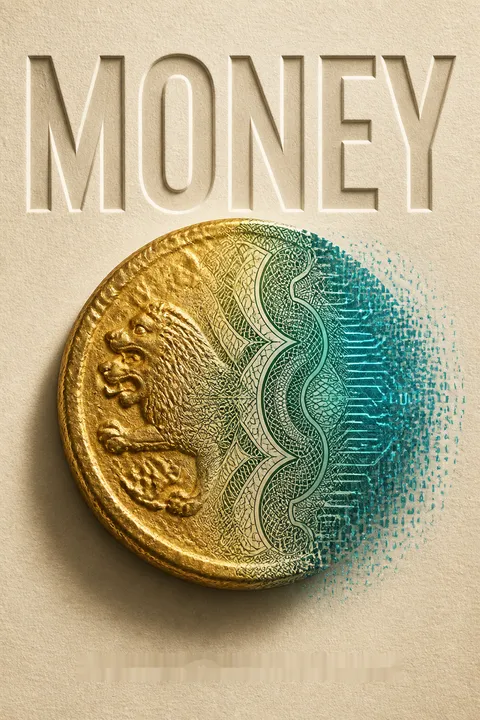


Key Takeaways
Treat money as a social agreement, not a thing with natural value
Money began in relationships. A French singer named Zélie performed on a Pacific island and was paid in pigs, poultry, fruit, and thousands of coconuts. Her problem was not that the islanders lacked exchange, but that she could not easily turn her payment into what she needed. The familiar story that money arose to fix barter’s inconveniences is intuitive, but historians have found little evidence for economies based on barter alone.
Obligations made value durable. In many societies, gifts, marriage payments, and compensation for killing someone followed rules of reciprocity. Certain shells, animals, or other valuables became worth accumulating because someone would need them for a future obligation. Money grew from these social ties as much as from buying and selling.
This account makes money easier to understand as an institution than as an object. Its value depends on shared expectations, but those expectations are reinforced by customs, status, and sometimes force. That helps explain why a shell can matter more than a metal coin in one setting, while a bank balance matters more than either in another. The social origin does not make money unreal: contracts and languages are social too, yet shape material outcomes. Still, the focus on reciprocity should not obscure the role of centralized authority in deciding which obligations count.
Use money to widen choice, while noticing who loses old protections
Coins suited civic life. In ancient Greece, standardized coins helped city-states organize exchange without relying entirely on a king’s redistribution or a village’s family obligations. The marketplace grew alongside the polis, where citizens gathered to debate public affairs. Money and political life developed together, not in separate worlds.
Freedom came with exposure. Coin wages let workers leave a landowner instead of agreeing to a year of work in exchange for food, clothes, and shelter. Yet wage earners were now responsible for securing those necessities themselves. Some workers had frequent days without work, leaving historians unsure whether this meant chosen leisure or unemployment. Money expanded options, but it also shifted risk from employers and communities onto individuals.
The Greek example anticipates a lasting tension in market societies: the freedom to exit can be valuable even when the alternative is insecure. In political theory, this resembles the difference between formal choice and the practical resources needed to use it. A worker may be legally free to leave, yet lack housing or savings to make departure feasible. Money can loosen inherited dependence, but the protections surrounding exchange determine whether that independence becomes meaningful or merely precarious.
Paper money can unlock growth, but policy can reverse the gains
Paper made trade lighter. Around 995, merchants in Sichuan began issuing transferable paper receipts for heavy iron coins. The government later took over paper-money issuance after private promises proved unreliable. Under the Mongol ruler Kublai Khan, paper money circulated across a vast empire, eventually without redemption for metal. Its acceptance rested on state power and public confidence.
Growth was not guaranteed. Easier trade and changing tax rules helped markets and specialization flourish in China. Cities grew, new farming methods spread, and people developed technologies centuries before comparable European growth. But Ming rulers later restricted trade and pushed the economy back toward government redistribution. Paper money disappeared. The example shows that economic development can accelerate, stall, or reverse rather than follow a one-way path.
The Chinese story connects monetary infrastructure to the wider conditions for innovation. Portable payment can enlarge markets, while taxation and transport rules shape what people choose to produce. This is a useful correction to stories that attribute growth to invention alone. Yet money should not be treated as a sufficient cause: political stability, knowledge networks, and agricultural capacity also matter. The account’s strongest lesson is that institutions can amplify productive possibilities, but they cannot guarantee that societies will preserve them.
Credit creates spendable money, so trust and restraint must travel together
Loans expanded the money supply. Seventeenth-century English goldsmiths first stored customers’ precious metals and issued receipts. They then began lending by giving receipts to borrowers, even when no new gold had been deposited. This became fractional-reserve banking: banks keep only part of their customers’ funds available and lend the rest, creating spendable claims in multiple places at once.
A run reveals the weakness. If everyone demands their money back together, the bank cannot repay all depositors immediately. In France, John Law’s bank and trading company briefly expanded credit and activity, but the system concentrated too much power in a monarchy with few checks. Once confidence broke and people rushed to exchange notes for metal, the system collapsed. Credit can support commerce, but its stability depends on credible limits and backstops.
Banking is a form of collective maturity transformation: savings that can be withdrawn quickly fund loans that mature slowly. That arrangement supports investment, but it creates a coordination problem when fear makes everyone want liquidity at once. Deposit guarantees and central-bank lending address that problem by changing expectations, not by making all assets instantly liquid. The design challenge is to preserve useful lending without letting private gains rely on public rescue. Law’s failure underlines that monetary innovation also requires political constraints.
Use probability to price uncertain futures, not merely to predict them
Chance became calculable. In the seventeenth century, Blaise Pascal and Pierre de Fermat solved the problem of how to divide a gambling pot fairly when a game stops early. They considered the possible outcomes still ahead. In a best-of-three coin game stopped after one player wins the first flip, that player has three chances out of four of winning the series, so a fair split gives that player three quarters of the pot.
The method reached life itself. Edmond Halley used birth and death records from Breslaw to estimate how likely people of different ages were to die. Governments could price annuities more sensibly, and Scottish ministers used such tables to build a fund for the families of ministers who died young. Their forecast of the fund’s value was accurate to within one percent.
Probability turns uncertainty from a private hunch into something groups can pool and price. Insurance is a particularly clear example: many people contribute so that a few can receive support when misfortune arrives. This is not the same as predicting any individual’s fate. The numbers work across populations, while specific outcomes remain uncertain. That distinction matters whenever averages guide policy, because an accurate aggregate forecast can still leave particular people bearing severe losses.
Protect markets that let informed skeptics challenge flattering prices
Shares moved money through time. The Dutch East India Company needed capital for long, risky voyages. Its investors were allowed to transfer shares to new buyers, helping create Amsterdam’s first stock exchange. A dense gathering of buyers and sellers made trades easier and prices more useful than a market where participants arrived at random times.
Bad news needs a route. Isaac Le Maire bet that the company’s share price would fall and spread damaging claims about its performance. His tactics could be manipulative, but the broader ability to profit from a falling price gives investors an incentive to uncover problems. A stock market’s purpose is not to keep prices rising. It is to bring information, including unwelcome information, into the price.
This distinction separates the social function of a market from the interests of people who already own an asset. Short sellers can expose weak claims, but they can also have incentives to amplify or invent bad news. The solution is not to assume every skeptic is virtuous, or every falling price is correct. It is to make markets open to competing evidence and punish deception. In that sense, market quality depends on rules that protect information, not simply on trading volume.
Count productivity gains, but do not mistake them for shared prosperity
More output changed ordinary life. Economist Bill Nordhaus compared the cost of artificial light across history. In ancient Babylon, a full day’s wages bought about ten minutes of light comparable to a modern bulb. Two centuries ago, it bought far less than today; by the late twentieth century, a day’s wages bought about 20,000 times as much light as two hundred years earlier.
Workers did not share gains evenly. Mechanized cloth production displaced skilled spinners, weavers, and croppers. The Luddites attacked machines that threatened their livelihoods, and average worker wages barely rose through much of the first half of the nineteenth century. The machinery eventually made goods cheaper, but that did not compensate displaced workers in the moment. Productivity can enrich society while damaging particular groups for years.
The light example makes technological progress unusually concrete: it measures what a day of labor can buy rather than merely counting inventions. But aggregate gains say little about bargaining power or who captures the surplus. The Luddites are a reminder that transition costs are not theoretical to those losing work, status, and independence. A serious account of innovation therefore needs both productivity measures and distributional ones. Otherwise, long-run gains can become an excuse for neglecting people who pay the early price.
Never let a fixed monetary rule outrank the economy it serves
Gold did not stabilize everything. The gold standard tied the value of money to a scarce metal. When prices fell, debtors still owed the same nominal amounts, so repayments demanded more labor and goods. Economist Irving Fisher called the failure to notice changes in what money can buy the money illusion. A dollar’s gold content can stay fixed while its purchasing power changes.
The rule deepened the Depression. In 1931, the Federal Reserve raised interest rates to protect the gold supply, making borrowing harder as businesses and households were already struggling. Falling prices, defaults, and bank failures reinforced one another in a deflationary spiral. In 1933, Roosevelt broke the domestic link between dollars and gold. The book argues that abandoning the gold standard helped countries recover by giving them room to respond to collapsing demand.
Rules can build credibility by limiting arbitrary decisions, but rigidity becomes dangerous when conditions change sharply. The gold standard’s appeal was precisely that it seemed to remove politics from money. In practice, defending the rule required political choices with uneven consequences, especially for debtors and workers. Monetary flexibility is not automatically wise; governments can misuse it. The relevant question is whether institutions can adjust to crises while remaining accountable for inflation, employment, and the distribution of losses.
Watch for money hiding inside products nobody regulates like banks
A second banking system formed. Money-market funds offered investors a place to park cash while lending it through commercial paper and other short-term instruments. Investment firms borrowed these funds to buy longer-term assets. This shadow banking system performed a bank’s central task, borrowing short and lending long, without the same deposit insurance or safety net.
The run spread beyond banks. When Lehman Brothers failed in 2008, the Reserve Primary Fund had $785 million in Lehman debt, just over one percent of its assets. Investors still rushed to withdraw money. The fund could not sell assets quickly enough and its share value fell below one dollar, a breakdown known as breaking the buck. The government then guaranteed money-market funds and the Fed supplied emergency lending.
Financial crises often begin where the rules do not match the economic function. If customers treat an investment account as cash, its legal label may not prevent a run when confidence breaks. This is a regulatory perimeter problem: risk migrates toward arrangements that offer bank-like convenience without bank-like safeguards. Extending guarantees can stop contagion, but it can also encourage future risk-taking. Oversight needs to follow what institutions do, not only what they call themselves.
A shared currency needs shared crisis tools, not just shared notes
The euro joined unlike economies. France supported a common currency partly to bind a reunified Germany more closely to Europe. Countries adopted the euro but did not create a unified government able to tax and redistribute resources across the currency area. During the debt crisis, Greece, Spain, and others could not issue their own currency or devalue it to ease pressure.
Credible promises moved markets. In 2012, European Central Bank president Mario Draghi said the bank would do what was needed to preserve the euro. Investors stopped betting against Spanish and Italian bonds, and borrowing costs fell, even before the bank used its promised bond-buying program. The episode showed that a currency union depends on political agreement and trusted crisis response, not merely a shared unit of account.
A currency union resembles a shared insurance pool: regions face different shocks, so some mechanism must distribute the burden. The United States has federal taxes and benefits that move funds among states; the eurozone lacked comparable tools. That gap turned economic strain into a dispute about national character and deservedness. Draghi’s intervention shows how expectations can avert panic, but a central-bank promise cannot resolve every conflict over who pays. Monetary integration therefore raises a constitutional question about solidarity as much as a technical one about interest rates.
Digital money can remove banks, not the human politics of trust
Privacy inspired digital cash. Computer scientist David Chaum designed a way to verify electronic payments without revealing the payer’s identity to a bank. Later, cypherpunks sought money that required trust in neither a company nor a government. Bitcoin combined computational work with a shared transaction record, the blockchain, and a fixed issuance schedule capped at 21 million coins.
Code did not erase people. Bitcoin’s public ledger and open software reduced dependence on a central issuer, but users still had to trust the network and agree on changes. Disputes over transaction capacity split the community. Meanwhile, dramatic price swings made bitcoin a poor stable unit for everyday purchases. The technology changed who could participate in money creation, but it did not end politics, governance, or speculation.
Bitcoin makes a useful distinction between removing an intermediary and removing trust. A decentralized network can distribute verification, but participants still depend on shared software, incentives, and social consensus. Its volatility also exposes a conflict among money’s roles: an asset prized for scarcity may be unattractive for pricing wages and groceries. Digital systems can improve privacy or access, yet design choices determine who has power. Calling a system trustless often means its trust has been relocated, not abolished.
Judge monetary reforms by the power and risks they redistribute
Every future has a cost. A cashless system could make payments easier to trace and could let central banks set interest rates below zero, but it would reduce privacy and create barriers for people without digital access. Narrow banking proposes separating payment accounts from lending, so deposits would be fully backed while investors bear lending losses. It could reduce bank runs, but central banks would have to create much more of the money supply.
Spending has real limits. Modern Monetary Theory argues that a government issuing its own currency is constrained less by its ability to raise money than by inflation and available resources. If workers and factories sit idle, public spending can bring them into use; if capacity is stretched, spending can push prices up. The difficult question is who can be trusted to manage that boundary.
These proposals expose money as a set of institutional choices rather than a neutral technology. Each reallocates power among citizens, banks, governments, and central banks, while moving risk rather than simply eliminating it. A useful test is to ask who gains access, who bears losses, and who can reverse a decision. The debate also shows why technical elegance is not enough: a system must be politically legitimate and workable under pressure. The best design may be less a perfect solution than a transparent bargain.
Analysis
The book’s central achievement is to make monetary history feel less like a sequence of currencies and more like a recurring argument over social coordination. Shells, coins, banknotes, deposits, and digital tokens differ materially, but each works only within an arrangement of shared expectations, institutions, and enforcement. That perspective explains why money can be invented accidentally, as with transferable receipts, or fail despite a technically coherent design, as with financial experiments unsupported by credible political constraints.
Its narrative also links monetary innovation to distribution. Coins made exit from old dependencies easier while removing some protections. Industrial technology expanded what a day’s labor could buy while displacing workers. Deflation enriched creditors at debtors’ expense. The euro’s common currency lowered borrowing costs, then constrained national responses to crisis. Money is therefore not merely a measure of wealth. Its rules shape who can wait, borrow, invest, and survive a downturn.
A useful qualification is that the book’s emphasis on social fiction can sound as if belief alone creates monetary value. Belief matters, but it is sustained by tax obligations, legal systems, productive capacity, and the ability of institutions to settle claims. A government cannot indefinitely substitute confidence for real resources. Likewise, monetary flexibility can prevent a destructive contraction, but it can also be abused or generate inflation when demand outruns capacity. The historical cases do not establish one universal monetary design. They show why designs need feedback, accountability, and room to adapt.
The most durable lesson is methodological: when a new instrument looks like money, follow its function rather than its label. Ask who accepts it, who can redeem it, who creates it, and what happens when everyone wants out. Those questions connect ancient debt tokens to modern shadow finance and digital currencies. Money changes when technology and power change, but its recurring challenge remains the same: coordinating trust without allowing one group to control the terms without scrutiny.
Review Summary
Money: The True Story of a Made-Up Thing is praised as an engaging, accessible history of money and finance. Readers appreciate Goldstein's conversational style and ability to explain complex concepts. The book covers topics from ancient currency to modern cryptocurrencies, offering insights into monetary policy and economic systems. While some find it lacks depth, most enjoy its entertaining approach and historical anecdotes. Critics note occasional oversimplification and bias, but overall, readers recommend it as an informative introduction to the subject, particularly for those new to economics.
People Also Read








Glossary
double coincidence of wants
Matching needs in barterA condition required for a direct barter trade: each person must want what the other offers at the same time. The idea is often used to explain why money would emerge as a convenient medium of exchange. The book notes that this familiar explanation is not supported by clear evidence of societies built on pure barter.
fractional-reserve banking
Banks lend deposited fundsA banking arrangement in which a bank keeps only a portion of its customers’ deposits readily available and lends the rest. The borrower can spend the loan, while the original depositor still sees a balance in the bank. This process expands the money supply, but leaves banks vulnerable if many customers demand repayment at the same time.
problem of the points
Fairly divide an interrupted potA probability problem about how to divide a gambling pot when a game ends before either player reaches the agreed winning score. Pascal and Fermat approached it by listing the possible outcomes if play continued, then dividing the pot according to each player’s chance of winning. Their method helped make uncertain future outcomes mathematically tractable.
money illusion
Mistaking nominal value for real valueThe tendency to treat a dollar as if its purchasing power stayed constant over time. A person may feel richer after receiving more dollars, or poorer after a nominal pay cut, without noticing changes in prices. Irving Fisher used the term to describe how people overlook shifts in what money can actually buy.
deflationary spiral
Falling prices deepen economic declineA reinforcing cycle in which falling prices make existing debts harder to repay, causing defaults and bank failures. Those failures reduce the supply of money and credit, while fearful households and businesses spend less. Weaker demand pushes prices down further. The book presents this process as a preventable monetary crisis, not an automatic correction.
shadow banking
Bank-like finance outside bank rulesA system of funds and financial firms that borrows short-term money and lends or invests it over longer periods, much like a conventional bank. It can create cash-like claims without the same deposit insurance or direct regulation as traditional banks. A run on these institutions can still disrupt the wider economy.
blockchain
Linked record of transactionsA shared digital record in which transactions are grouped into blocks, and each block is linked to the one before it. In Bitcoin, network participants verify transactions and update the record, rather than relying on one bank to maintain the ledger. The system distributes record keeping, but still depends on software, incentives, and agreement among participants.
narrow banking
Separate deposits from lendingA proposed banking structure that separates payment and safekeeping services from loan-making. Payment accounts would be fully backed by reserves, while lending would be funded by investors who accept the possibility of losses. The aim is to reduce bank runs, though the approach would shift more money creation toward central banks and could encourage similar activity outside regulated banks.
Modern Monetary Theory
Currency issuer faces resource limitsA school of thought arguing that a government issuing its own currency is not financially constrained in the same way as a household. Its practical limits are inflation and the availability of workers, factories, and other resources. Public spending can employ idle capacity, while taxes can reduce demand when inflation becomes a threat. The approach assumes political institutions can respond effectively.
FAQ
What's "Money: The True Story of a Made-Up Thing" about?
- Exploration of Money's Nature: The book delves into the concept of money as a social construct, a shared fiction that has evolved over time.
- Historical Perspective: It traces the history of money from ancient barter systems to modern digital currencies, highlighting key transformations.
- Economic and Social Impact: The narrative examines how money has influenced economies, societies, and individual lives throughout history.
- Author's Journey: Jacob Goldstein shares his personal journey of understanding money, inspired by his experiences as a journalist and conversations with experts.
Why should I read "Money: The True Story of a Made-Up Thing"?
- Comprehensive Overview: The book provides a thorough understanding of the evolution of money, making it accessible to readers with varying levels of economic knowledge.
- Engaging Storytelling: Goldstein uses anecdotes and historical stories to make complex economic concepts relatable and interesting.
- Relevance to Modern Times: It connects historical developments to current financial systems, offering insights into contemporary economic issues.
- Thought-Provoking Ideas: The book challenges readers to rethink their perceptions of money and its role in society.
What are the key takeaways of "Money: The True Story of a Made-Up Thing"?
- Money as a Social Construct: Money is not a fixed entity but a shared belief that has changed over time based on societal needs and technological advancements.
- Historical Evolution: From barter to digital currencies, money has undergone significant transformations that reflect broader economic and social changes.
- Role of Trust: Trust is fundamental to the functioning of money, whether in the form of coins, paper, or digital transactions.
- Future of Money: The book suggests that money will continue to evolve, influenced by technological innovations and changing societal values.
How does Jacob Goldstein define money in "Money: The True Story of a Made-Up Thing"?
- Shared Fiction: Goldstein describes money as a shared fiction, a concept that exists because people collectively agree on its value.
- Social and Economic Tool: Money is a tool that facilitates trade, investment, and economic growth, but it is also deeply intertwined with social structures.
- Dynamic and Evolving: Money is not static; it has evolved from physical objects like cowrie shells to digital currencies, adapting to the needs of society.
- Trust-Based System: The value and functionality of money rely heavily on trust among individuals, institutions, and governments.
What are the best quotes from "Money: The True Story of a Made-Up Thing" and what do they mean?
- "Money is fiction": This quote encapsulates the idea that money's value is based on collective belief rather than intrinsic worth.
- "The essence of finance is time travel": This highlights how financial systems allow for the movement of resources across time, enabling investment and growth.
- "Money is fundamentally, unalterably social": It emphasizes that money is deeply connected to human relationships and societal structures.
- "Economic growth and technological change aren’t guaranteed to continue forever": This serves as a cautionary reminder that economic progress is not inevitable and requires careful management.
How does "Money: The True Story of a Made-Up Thing" explain the evolution of money?
- From Barter to Coins: The book starts with the transition from barter systems to the use of coins, which standardized trade and value.
- Introduction of Paper Money: It covers the invention of paper money in China and its eventual adoption in Europe, revolutionizing trade and finance.
- Rise of Banking Systems: The development of banks and the creation of credit systems are explored as pivotal moments in monetary history.
- Digital and Cryptocurrencies: The narrative concludes with the emergence of digital currencies and blockchain technology, highlighting ongoing changes in how money is perceived and used.
What role does trust play in the concept of money according to Jacob Goldstein?
- Foundation of Value: Trust is the foundation upon which the value of money is built; without it, money would lose its meaning and function.
- Facilitates Transactions: Trust allows people to engage in transactions with confidence, knowing that money will be accepted and honored.
- Institutional Trust: Trust in financial institutions and governments is crucial for maintaining stable monetary systems and preventing crises.
- Challenges in Digital Age: The book discusses how trust is being redefined in the digital age, with cryptocurrencies challenging traditional trust-based systems.
How does "Money: The True Story of a Made-Up Thing" address the future of money?
- Technological Influence: The book suggests that technology will continue to shape the future of money, with digital currencies and blockchain playing significant roles.
- Potential for Change: It highlights the potential for radical changes in monetary systems, driven by innovations and shifts in societal values.
- Challenges Ahead: The narrative acknowledges challenges such as privacy concerns, regulatory issues, and the need for new forms of trust.
- Uncertain Trajectory: While the future of money is uncertain, the book emphasizes the importance of understanding its history to navigate upcoming changes.
What historical examples does Jacob Goldstein use to illustrate the evolution of money?
- Mademoiselle Zélie's Concert: An anecdote about a French singer paid in pigs and coconuts illustrates the limitations of barter systems.
- Lydian Coins: The invention of coins in Lydia is used to show the transition from barter to standardized currency.
- Chinese Paper Money: The development of paper money in China highlights a major innovation in the history of money.
- John Law's System: The story of John Law's financial experiments in France serves as an example of early banking and monetary policy.
How does "Money: The True Story of a Made-Up Thing" connect historical monetary systems to modern financial issues?
- Lessons from the Past: The book draws parallels between historical monetary crises and contemporary financial challenges, emphasizing recurring themes.
- Evolution of Banking: It traces the development of banking systems from early goldsmiths to modern central banks, highlighting ongoing issues of trust and regulation.
- Impact of Technology: The narrative connects past innovations like paper money to current developments in digital currencies and blockchain technology.
- Societal Implications: By examining the social and economic impacts of historical monetary systems, the book provides insights into current debates about money and finance.
What insights does Jacob Goldstein offer about digital currencies in "Money: The True Story of a Made-Up Thing"?
- Potential for Disruption: Digital currencies have the potential to disrupt traditional financial systems by offering new forms of money and payment methods.
- Challenges of Adoption: The book discusses the challenges digital currencies face, including regulatory hurdles, security concerns, and the need for widespread acceptance.
- Trust and Decentralization: It explores how digital currencies aim to create trust through decentralized systems, reducing reliance on traditional financial institutions.
- Future Prospects: While acknowledging uncertainties, the book suggests that digital currencies could play a significant role in the future of money, reshaping how transactions are conducted.
How does "Money: The True Story of a Made-Up Thing" challenge traditional views of money?
- Questioning Intrinsic Value: The book challenges the notion that money has intrinsic value, emphasizing its nature as a social construct.
- Rethinking Stability: It questions the stability of traditional monetary systems, highlighting historical instances of failure and crisis.
- Embracing Change: The narrative encourages readers to embrace change and innovation in monetary systems, rather than clinging to outdated models.
- Broader Perspective: By providing a historical and global perspective, the book invites readers to reconsider their assumptions about what money is and how it should function.
Download PDF
Download EPUB
.epub digital book format is ideal for reading ebooks on phones, tablets, and e-readers.








