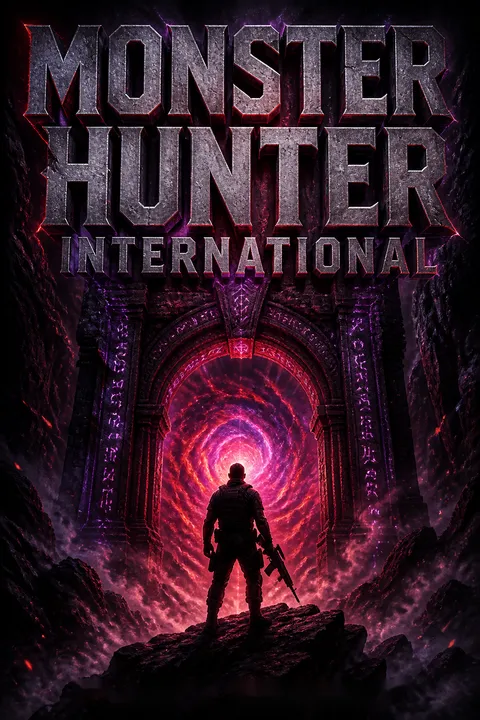


Plot Summary
The Boss Becomes a Beast
Owen Pitt, a young accountant in Dallas, expects another late night under Cecil Huffman, the incompetent manager who has made him the department’s whipping boy. Instead, Huffman appears naked in his dark office beside a severed hand, then changes into a werewolf. Owen fires his concealed revolver, but the creature heals and pursues him through the office.
Wounded and nearly out of ammunition, Owen uses a fire extinguisher, a pocketknife, and whatever furniture he can reach. He finally breaks Huffman’s neck, then shoves the werewolf and a heavy desk through the window. The fall kills the monster, but leaves Owen gravely injured and his ordinary career in pieces.
The transformation makes Owen’s workplace grievance literal: Huffman’s resentment becomes physical predation, while the office’s rules and furniture prove useless against it. Owen survives not through a clean heroic victory but through improvisation, stubbornness, and a capacity for violence he has tried to suppress. His accountant identity is not false, yet it cannot contain the skills that the crisis demands. The inciting incident therefore unsettles both his world and his self-conception. What appears to be a freak emergency exposes a buried aptitude, while the cost of survival makes a return to routine impossible.
A Bounty and a Calling
Owen wakes in a hospital with hundreds of stitches and federal agents waiting to execute him if tests show that Huffman infected him. The FBI confirms that the creature was a werewolf and that Owen killed it, but keeps the supernatural world secret and Hansen Industries fires him for bringing a gun to work.
Earl Harbinger, an experienced Hunter, assures Owen that he is not infected and leaves a Monster Hunter International card. After recovery, Earl and MHI recruiter Julie Shackleford visit Owen’s apartment. They give him the fifty-thousand-dollar bounty for Huffman and explain that MHI hunts monsters for profit. Owen accepts a place in training, drawn by the work and the chance to use his abilities for a purpose.
Owen’s rescue comes with a second threat: the government treats him as a possible contamination risk rather than a person who survived an attack. The bounty turns an otherwise concealed act of survival into a recognized job, and MHI offers the first institution that values his competence without demanding that he pretend to be ordinary. Yet his acceptance is not pure certainty. He is broke, fascinated, and susceptible to Julie’s conviction, while still wary of surrendering control to another boss. The choice begins his movement from accidental violence toward deliberate service, but the company’s secrecy and mortality rates prevent the new vocation from becoming a simple escape.
Training Among the Hunters
At MHI’s Alabama compound, Owen joins dozens of recruits who have survived monster encounters. Company chief Raymond Shackleford III recounts MHI’s history and the deadly 1995 shutdown, while Earl warns that training will eliminate anyone unfit for the work. Owen excels with guns but struggles with endurance and the fear that his old fighting instincts could hurt the wrong person.
After he injures a trainee during sparring, roommate Trip Jones persuades him not to quit. Owen also clashes with Grant Jefferson, a polished Hunter dating Julie, and recognizes that envy is feeding his hostility. Julie remains busy and guarded, but her skill and commitment draw Owen toward her and toward the life he is unsure he deserves.
Training converts Owen’s latent abilities into disciplined practice, but its harder curriculum is moral rather than technical. He must learn that strength is not the same as self-control, especially after anger harms a fellow recruit. Trip offers a countermodel to Owen’s father: guidance without humiliation, grounded in faith and concern for others. Grant, meanwhile, makes Owen’s insecurity visible. Owen resents the confidence and social ease he lacks, then has to recognize that his jealousy is his own responsibility. His attraction to Julie intertwines with his career choice, creating a risk that personal longing will distort professional judgment.
The Dream Names a Threat
Owen dreams of an old man, a black storm, and an armored presence called the Cursed One. The same night, the whole compound wakes from a shared disturbance, and Earl orders a mission to a missing French freighter. Owen is assigned to the boarding team despite Grant’s objections.
On the ship’s ladder, Owen recognizes its name from his dream and warns that seven Master vampires and winged monsters may have left it. A message from a trapped French Hunter confirms survivors are sealed below, so the operation becomes a rescue. Owen’s vision has changed the mission from routine clearance to an uncertain race against an enemy whose movements he has somehow witnessed.
The dream gives Owen information without giving him mastery. He can recognize a name and sense danger, but cannot explain why he knows or reliably predict what comes next. That partial knowledge tests MHI’s doctrine of flexible thinking: the Hunters must treat an accountant’s vision as possible intelligence without confusing it with certainty. The shift to rescue also establishes the group’s practical ethics. They accept additional risk because people are trapped aboard, not because the job promises a larger bounty. Owen’s unusual perception begins to matter to the team, yet his status remains precarious and contested.
The Ghost Ship Turns
The crew finds the freighter crawling with wights, undead whose touch can paralyze, and vampires that coordinate rather than attack blindly. Owen’s small team fights on deck, where he is paralyzed and falls into the ocean; his armor’s emergency flotation brings him back, and Holly helps pull him aboard.
Inside, the team kills a young vampire and reaches the engine room, where French Hunter Jean Darné has turned and holds survivors hostage. Owen distracts Darné long enough for the others to escape, then climbs toward safety as wights pursue him. Grant sees him trapped and closes the hatch instead of helping. Earl kills Darné, and Owen later punches Grant overboard. Hunter Jeremiah Roberts is mourned and decapitated to prevent his return.
The freighter tests MHI’s teamwork under conditions where competence does not guarantee safety. Owen’s return from the water depends on equipment and Holly’s quick response, making survival a collective achievement rather than a solo triumph. Grant’s decision is more complicated than simple villainy: fear and tactical calculation may explain it, but they do not erase the betrayal Owen experiences. Owen’s retaliation exposes the danger of his temper, and Earl’s reprimand makes clear that Hunters cannot impose private justice whenever they feel wronged. Roberts’s funeral gives the violence a human cost and shows the grim procedures the company uses to protect the living.
A Scholar’s House Is Torn
After the freighter, MHI finds seven coffins packed with soil from different homelands and evidence that a powerful creature escaped by boat. Owen and Earl trace the landing to Dr. Jonas Turley’s coastal home.
The scholar and his wife have been murdered, his research on ancient American sites scattered, and his computer destroyed. Before MHI can investigate further, Agent Myers and the Monster Control Bureau arrive with armed teams, seize the Hunters’ weapons, and beat Owen when he challenges them.
They force MHI to leave the case, though Harbinger suspects the government is hiding something. Back at the compound, Julie connects Turley’s research to the mysterious place the enemy is seeking, while Owen’s visions offer fragments rather than a usable location.
The investigation reveals an adversary interested not only in feeding but in historical knowledge. Turley’s ruined study turns scholarship into evidence: the past contains practical coordinates for a present catastrophe. The federal raid then complicates the Hunters’ mission by making institutional authority another obstacle. Myers may believe he is protecting the public, but his forceful secrecy repeats the very logic that leaves survivors isolated and uninformed. Owen’s beating also shows how his instinct to challenge authority can carry real costs. The scene establishes the central conflict between MHI’s imperfect, hands-on response and a government apparatus that possesses greater resources but little trust.
The Elf Queen’s Warning
Seeking answers, Owen, Trip, Holly, and Milo visit the Elf Queen, who lives in a shabby trailer park rather than a storybook realm. She recognizes the Cursed One as a once-human conqueror who made a bargain with ancient powers to reverse time for a lost love. She warns that a hidden place of power may be involved and identifies Owen as a dreamer who must not fail.
Meanwhile, MHI’s archivist Albert Lee finds references in an old Hunter journal to a guardian and an artifact tied to the Nazis. The team realizes that Julie’s father, Ray Shackleford, may know more than anyone. Julie reluctantly agrees to visit him at the asylum, despite her family’s refusal to discuss the disaster that drove him there.
The Elf Queen punctures fantasy’s polished surfaces without denying that wonder exists. Her trailer-park setting makes the supernatural ordinary, even shabby, while her warning raises the stakes beyond a conventional monster hunt. Trip’s disappointment at the Queen’s appearance is part of his search for a benevolent counterweight to evil; the orc community will later give that hope a more credible form. Meanwhile, Lee’s archival work and the Queen’s oral knowledge show two distinct ways of knowing the past. Together they direct Julie toward a painful family source, forcing her to weigh personal injury against the possibility of preventing another catastrophe.
Gargoyles at Appleton
At Appleton Asylum, Owen sees patients struggling to make sense of monster trauma, including a former Hunter broken by what he witnessed. Julie meets her father, Ray, in the secure ward, but three enormous gargoyles attack the building before they can resolve their past.
Owen and the retired Doctor Lucius Nelson fire at the creatures while patients flee; one gargoyle kills a patient, and another pursues Julie, Ray, and Owen through the collapsing asylum. They escape in an ambulance, with Ray at the wheel until Owen knocks him unconscious to prevent a collision with a train. Julie wakes and directs Owen to the old Shackleford estate, where MHI allies can treat her wound and keep her father hidden.
Appleton makes the psychological aftermath of monster encounters visible rather than treating survivors as disposable casualties. The patients’ suffering exposes the danger of secrecy: conventional institutions can mistake truthful testimony for delusion. The attack then turns that theme into immediate action, as the Hunters must protect people who cannot defend themselves. Ray’s erratic driving makes the family’s trauma physical and dangerous, while Owen’s decision to incapacitate him is an uneasy form of care. Julie’s return to the ancestral estate offers refuge, but also brings her into the space where family history and present danger can no longer be kept separate.
Susan Comes Through the Window
At the estate, Ray reveals that the Cursed One is seeking a shifting place of power and will act at the next full moon. Julie’s mother, Susan, enters disguised as a loving visitor, then attacks Owen and tries to take Ray. The Hunters drive her off with guns, a sacred charm from the orc healer Gretchen, and fire, but Susan escapes with Jaeger, the Cursed One’s vampire lieutenant.
Ray tells Julie that the true location is in Mississippi before dying from his wounds. Federal agents arrive and clash with MHI; Harbinger forces a truce and agrees to work with them. Julie identifies Natchy Bottom as the likely site, while the Hunters hide the orc clan from the government and prepare to enter the swamp.
Susan’s return weaponizes intimacy. She uses the appearance of a mother to disarm Julie and Owen, then turns family reunion into coercion. Ray’s confession arrives too late to repair their relationship, but it gives the Hunters the location they need. Julie must hold grief, anger, and duty at once, refusing the easy fiction that a family bond automatically makes someone safe. The federal standoff repeats the conflict over trust, but Harbinger’s negotiated truce shows that cooperation can be tactical without becoming affectionate. The orcs’ hidden community offers a contrasting model: a family built through loyalty and mutual protection rather than blood alone.
The Swamp Reverses Time
MHI reaches Natchy Bottom with federal agents and meets the Wendigo, who warns that something beyond his power is waiting. The party walks into an ambush by alien, insectlike soldiers that launch bone spines and arrive through brief rifts. The Hunters and agents are overwhelmed; Milo, Trip, Holly, Lee, Sam, and others die, and Owen is pierced through the heart while shielding Julie.
Outside his body, Owen sees the Cursed One observing the battle and realizes the artifact’s power remains limited. He reaches it and wills time backward. Everyone awakens five minutes earlier, alive, while the demons vanish. The reversal saves the team but confirms that the Cursed One can alter reality, and the entire world feels the missing interval.
The battle converts the book’s escalating danger into a collective catastrophe, not a test Owen can win through marksmanship alone. His decision to shield Julie repeats his instinct to protect others, but this time it costs him his life. Outside the body, he sees that the artifact’s power has limits and chooses to interfere, though he does not yet understand the price or implications. Reversing time saves his friends while making the threat global and undeniable. The episode shifts Owen from useful witness to active participant in the central mystery, and it makes survival itself feel contingent rather than deserved.
Byreika Finds the Cavern
Back at MHI, Owen’s visions reveal more of Lord Machado’s past: he was a cruel conquistador who sought power, lost his priestess, and was transformed by the Old Ones after a failed ritual. The Old Man, now identified as Hunter Mordechai Byreika, enters the Cursed One’s memories to find his present location.
He discovers the captive Grant and a hidden cavern, but Machado detects them. Byreika attacks the vampire lieutenant to free Owen, then is destroyed by the Cursed One. Owen wakes with the image of a large cave, a metal entrance tunnel, and a costumed conquistador mascot. Milo recognizes the mascot as Friendly Fernando at DeSoya Caverns, giving MHI a destination before the full moon.
The recovered history distinguishes Machado’s original ambition from the power that later consumes him. His tragedy is real, but it does not excuse his choices or make him harmless. Byreika’s final act also clarifies mentorship as a transfer of responsibility: he cannot defeat the enemy for Owen, but he can give him the knowledge needed to act. The mascot clue is deliberately mundane, linking a mythic threat to a family-friendly tourist site. Owen’s visions become useful only when joined to communal knowledge, especially Milo’s memory. The discovery therefore depends on shared interpretation rather than supernatural insight alone.
The Cavern’s Bloody Gate
MHI mobilizes every available Hunter and attacks DeSoya Caverns before the full moon. On the road, modern weapons destroy several Masters who had underestimated their human opponents. One vampire survives long enough to throw Trip’s tomahawk into Lee’s leg and threaten the convoy. Owen senses its next move, races to a newly opened rift, and finds Grant bound inside the cavern.
He brings Grant out as Lee’s machine gun and grenades hold back wights. The remaining Master attacks outside; Harbinger reveals his werewolf form and engages it, ordering the others onward. Owen, Julie, Sam, Milo, and Holly enter the cave through the portal, leaving the wounded behind and following the route toward the hidden place of power.
The assault turns MHI’s accumulated expertise into force: reconnaissance, specialized ammunition, teamwork, and willingness to adapt defeat enemies who have mistaken age for invulnerability. Rescuing Grant complicates Owen’s rivalry with him. Owen risks himself for a man who once left him behind, choosing the Hunter code over personal resentment. Harbinger’s transformation reveals the discipline behind his authority, not merely another supernatural surprise. Yet the team’s entry through the rift is costly and uncertain. Their victory outside does not resolve the threat; it only carries a smaller, damaged group into the enemy’s domain.
The Choice at the Pyramid
Inside the pocket world, Jaeger beats Owen nearly to death while Julie is held as the Cursed One’s sacrifice. The artifact recognizes Owen as the prophesied mortal and grants him immense power; he kills Jaeger and wounds Machado. When the priestess Koriniha threatens Julie to make Owen open the gate, he recognizes that anger and possessiveness would complete the Old Ones’ design.
Machado turns on Koriniha, and the guardian Thrall uses his last magic to restore Julie’s life. Owen refuses the final offer, while Machado and Koriniha are drawn into the collapsing sphere. The pocket world breaks apart, and Skippy’s helicopter catches Owen and Julie on a chain ladder. Owen survives, scarred no longer, but the artifact is lost.
The climax makes power inseparable from temptation. Owen’s strength can stop immediate violence, but the prophecy has shaped his identity toward precisely the grandiosity that would open the world to invasion. His deepest test is not whether he can kill Machado; it is whether he can refuse the role that promises to make every personal loss reversible. Thrall’s sacrifice preserves Julie without requiring Owen to claim ownership over life and death. The victory is therefore communal and morally bounded. Owen survives with extraordinary power behind him, yet the artifact’s disappearance prevents the ending from pretending that every danger has been mastered.
A Hunter’s New Beginning
Back in the ordinary world, MHI buries fifteen Hunters and tends to the wounded. Owen learns that Trip, Holly, Sam, Milo, and Julie survived the battle, while Lee may lose a leg. Harbinger returns alive, and Julie accepts that her mother may still be out there. A later letter from Susan and Ray confirms that they are together as vampires; Susan offers Julie a future transformation while warning her to stay away.
Owen and Julie refuse to let that threat dictate their lives. At a later gathering, Owen and Julie become engaged, and Owen accepts his place among MHI’s Hunters. The company mourns its losses, repairs its teams, and continues its work against the monsters still hiding in the world.
The resolution refuses a clean restoration. The fallen remain dead, Lee faces lasting injury, and Susan and Ray persist as a threat beyond the immediate victory. Yet Owen’s repaired body and engagement with Julie create a future that is chosen rather than granted by supernatural power. The funerals insist that courage has consequences; the party later makes room for pleasure without erasing grief. Owen’s identity has shifted from a man trying to flee violence to a Hunter who accepts discipline, responsibility, and attachment. His new family is not free of danger, but it is built through mutual commitment rather than prophecy.
Epilogue
MHI’s victory does not prevent the government’s nuclear contingency. A five-kiloton bomb, ordered by Special Agent Myers to penetrate the cavern, passes through the open rift into the Old Ones’ world. It devastates their troops and singes their immense Overlord before the portal closes.
Enraged by the attack, the Overlord orders its remaining servants to identify the human responsible. They blame Owen Pitt and send a warning through their hidden channels: he is to be found and destroyed.
The epilogue widens the story’s consequences beyond the Hunters’ immediate victory. Myers’s order, intended as a practical safeguard, becomes an act of aggression in a world humanity barely understands. The Overlord’s response turns a local battle into a continuing vendetta, while its distorted account of events shows how little either side comprehends the other. Owen is now marked not because he sought greatness, but because his choices disrupted forces that operate on a scale beyond human politics. The ending preserves triumph while denying closure: the world survives, but its secret war has acquired a new and powerful enemy.
Analysis
Monster Hunter International begins by making violence both absurd and practical: Owen’s boss transforms in an office, and survival depends on a hidden revolver, a fire extinguisher, and improvisation. From there, the novel widens its scale without abandoning the physical work of hunting. The supernatural becomes a field problem, handled through training, archives, teamwork, and equipment, yet every plan remains vulnerable to fear and incomplete knowledge.
Owen’s development turns on the difference between violence and responsibility. He has spent years trying to become ordinary because he distrusts his own capacity to hurt people. MHI does not erase that danger; it gives him a context in which force can protect others, while insisting that pride and uncontrolled anger remain threats. His conflict with Grant and his attachment to Julie test whether he can follow a code even when resentment or love tempts him to act alone.
The novel’s many families offer competing models of loyalty. The Shacklefords inherit a history of service and catastrophe, while Ray’s grief shows how devotion can become a justification for risking everyone. Susan uses family intimacy as leverage. By contrast, Trip, the orcs, and the Hunters build kinship through repeated acts of protection. Owen’s eventual refusal to open the gate matters because he will not confuse saving Julie with possessing the power to control her life or the world.
The book also treats secrecy as a form of harm. Government suppression leaves survivors doubting their memories and makes cooperation difficult precisely when it is most needed. MHI’s rough independence is not presented as flawless, but its willingness to believe witnesses and act on local knowledge repeatedly matters. The ending therefore offers victory without safety: the immediate invasion is stopped, but the artifact is lost, Susan and Ray remain unresolved, and the Overlord has learned Owen’s name. The Hunters have saved the world for now, not made it safe.
Review Summary
Monster Hunter International receives mixed reviews. Many praise its action-packed plot, engaging characters, and humorous tone. Fans enjoy the monster-hunting premise and creative world-building. However, some criticize the excessive gun descriptions and right-wing political undertones. The protagonist, Owen Pitt, is generally well-liked for his wit and skills. While some find the book predictable or overly long, others appreciate its entertainment value. The series has a dedicated fanbase, though some readers struggle with the author's controversial views.
People Also Read
Characters
Owen Zastava Pitt
Reluctant accountant hunterOwen begins as a CPA who has chosen a conventional life partly to contain his talent for violence. He is physically imposing, unusually skilled with firearms, curious to the point of recklessness, and uncomfortable with the authority of institutions. His humor helps him endure terror, though it can also mask insecurity and poor judgment. Owen’s relationships with Trip, Earl, and Julie force him to distinguish aggression from courage and self-control from passivity. He is drawn to work that makes his abilities useful, yet remains wary of becoming the kind of person who enjoys hurting others. His central tension is whether he can accept his capacity for violence without letting it define his moral identity.
Julie Shackleford
Heir to a hunting dynastyJulie is a skilled Hunter, historian, negotiator, and member of the Shackleford family that built MHI. She combines intellectual rigor with practical courage, and she is most comfortable when a problem can be researched, planned, and acted upon. Her devotion to the company is not merely inherited; she believes its work protects people abandoned by secrecy and bureaucracy. Julie is guarded about her family and private life, partly because grief has taught her how quickly attachments can become liabilities. Owen’s unpolished sincerity unsettles her, but also offers a kind of loyalty she can trust. She wants intimacy without surrendering independence, and leadership without pretending that she is untouched by fear.
Earl Harbinger
Hard-edged field commanderEarl directs MHI operations and leads the company’s most trusted team. He is blunt, strategic, and deeply protective of the people under his command, although he rarely expresses care in gentle terms. Decades of experience have made him suspicious of bureaucracy and alert to the gap between a plan and the conditions on the ground. Earl values discipline because he knows how quickly one uncontrolled choice can cost a team its life. His dry humor and casual manner conceal a formidable presence. He is willing to take responsibility for difficult decisions, but expects Hunters to accept the same burden rather than act from pride or personal grievance.
The Old Man
Owen’s mysterious guideThe Old Man appears to Owen in dreams and leads him through fragments of the Cursed One’s past. His speech is halting, his manner alternates between tenderness and impatience, and his knowledge is constrained by what he can remember and safely reveal. He treats Owen as both a student and an exasperating younger relative, correcting his pride while trusting his instincts. The Old Man’s guidance never removes Owen’s need to choose; instead, it supplies context that helps him recognize the consequences of those choices. His most important lesson is that courage without restraint can serve the very evil it opposes.
Lord Machado
Cursed conquistador warlordLord Machado is an ancient adversary whose ambitions reach beyond ordinary conquest. His presence links the current vampire crisis to the history of European expansion in the Americas and to powers older than humanity. He treats people as instruments, interpreting loyalty, love, and sacrifice according to what they can secure for him. That strategic coldness coexists with a stubborn belief in his own destiny, making him susceptible to promises that flatter his ambition. Machado is terrifying not only because of his supernatural strength, but because he can make a personal grievance seem like a cosmic entitlement.
Ray Shackleford IV
Brilliant haunted researcherRay is Julie’s father and a former leader of MHI whose grief and scholarship have isolated him from the family. His intelligence is formidable, but he can mistake knowledge for control and devotion for justification. The people who care about him remember both his courage and the damage caused by his choices. Ray’s history shapes Julie’s mistrust of grand solutions and her fear that love can become an excuse for recklessness.
Susan Shackleford
Julie’s hunter motherSusan is Julie’s mother, a former Hunter whose absence has shaped the Shackleford family for years. Julie remembers her as a beloved, courageous woman and feels the pull of that memory even when circumstances become painful. Susan’s history is bound to MHI’s most traumatic period, and her relationship with Julie carries both affection and unresolved grief. Her presence forces Julie to confront the difference between remembering someone and knowing who they have become.
Raymond Shackleford III
Scarred family patriarchThe president of MHI is an elderly, physically damaged Hunter with the authority of a man who has led from the front. He is proud of the company’s history, fiercely protective of its people, and impatient with political interference. His Southern manner can seem theatrical, but his judgment is grounded in long experience. He carries family grief without allowing it to eclipse the practical demands of leadership.
Mordechai Byreika
Spectral mentor hunterA former Hunter from Eastern Europe, Mordechai guides Owen through dreams and memories connected to the ancient threat. He is resourceful, compassionate, and willing to risk himself for someone he has only recently come to know. His limited memory makes his help incomplete, and his old-fashioned manner often collides with Owen’s impatience. Mordechai’s loyalty rests on a belief that the person he guides can still choose what is right.
Grant Jefferson
Golden-boy rival hunterGrant is a talented, polished Hunter from a privileged background who has quickly become one of MHI’s rising stars. His confidence can read as arrogance, and his relationship with Julie makes him a focus of Owen’s jealousy. Grant is competitive and capable, but his sense of himself as the best can be tested when the situation leaves no room for performance. He wants recognition and control, though he is not simply the persona he presents to others.
Trip Jones
Faithful teacher turned fighterTrip is a former chemistry teacher whose encounter with zombies pushed him into MHI. He is warm, religious, and more physically capable than his mild manner suggests. As Owen’s roommate and friend, he offers counsel without judgment, reminding Owen that concern about misusing strength is itself meaningful. Trip’s faith does not make him naïve about danger; it gives him a reason to keep helping people when the work is frightening.
Holly Newcastle
Unflinching survivor hunterHolly is a former exotic dancer who approaches Hunter training with discipline and a sharp sense of humor. She absorbs monster lore quickly, learns firearms despite limited experience, and refuses to be reduced to her appearance or past work. Her bluntness can seem cruel, but it often protects a more private tenderness. Holly understands how fear and humiliation can strip people of dignity, and she is especially alert to the cost of treating victims as helpless.
Milo Anderson
Inventive armorer and believerMilo is MHI’s engineer, weapons designer, and practical problem-solver. His workshop is full of improvised devices that range from clever to spectacularly dangerous. He is friendly, eccentric, and loyal to the company that became his family after personal tragedy. Milo’s religious convictions inform his sense of responsibility, but he is also willing to improvise when conventional tools fail. His faith and technical skill are complementary parts of the same impulse: to protect people with whatever is available.
Sam Haven
Veteran weapons instructorSam is a former Navy SEAL who teaches weapons and tactics with a loud voice, a large mustache, and little patience for incompetence. His humor is coarse, but his standards come from genuine concern for survival. Sam believes preparation matters because he has seen what happens when a team is caught unready. He values loyalty and action, and his practical confidence steadies younger Hunters when their fear threatens to overwhelm them.
Albert Lee
Librarian demolition expertLee is a former Marine demolitions specialist who later worked as a librarian. His analytical habits make him valuable in MHI’s archives, while his military training gives him a practical understanding of explosives and firearms. He is observant, methodical, and often more comfortable among books than in a firefight, but he does not shrink from danger. Lee’s unusual combination of skills makes him a bridge between research and field work.
Skippy
Orc pilot and allySkippy is an orc pilot and mechanic who serves MHI with deep loyalty. His formal manners and distinctive speech can make him seem comical to newcomers, but he is a capable aviator and a proud member of his people. He values honor, family, and shared work. His devotion to heavy metal and to MHI gives him an unexpectedly warm place between his clan and the Hunters.
Edward
Orc warrior and swordsmanEdward is Skippy’s brother, an orc warrior who favors swords over firearms. He is quiet, disciplined, and deeply committed to his clan. His sense of honor is expressed through action rather than explanation, making him a steady presence among the orc allies.
Gretchen
Orc healer and mysticGretchen is an orc healer whose medicines and rituals draw on knowledge unfamiliar to the Hunters. She is quiet, self-possessed, and careful about when she shares her clan’s customs. Gretchen’s abilities make her an invaluable ally, but she is not simply a service provider; she belongs to a community with its own rules, loyalties, and sources of authority.
Special Agent Myers
Bureaucratic monster agentMyers leads the government’s Monster Control Bureau during the crisis. A former MHI Hunter, he understands the dangers but has chosen the authority and resources of federal service. He prioritizes secrecy and centralized control, often treating MHI’s independence as a threat. Beneath his bureaucratic manner is a capable administrator bearing responsibility for decisions with national consequences.
Agent Franks
Implacable federal enforcerFranks is a physically formidable MCB operative who communicates sparingly and follows orders with unnerving focus. He trusts force and procedure more than persuasion, making him a dangerous adversary for Owen and an effective leader in the field. His bluntness conceals a strict personal code, though the line between duty and cruelty is often difficult for others to see.
Nathan Shackleford
Eager young ShacklefordNate is Julie’s younger brother and a young member of the Shackleford family. He is eager to become a Hunter and fiercely protective of the relatives he still has. His enthusiasm is genuine, though older Hunters know that experience must temper it.
Dorcas
Armed compound matriarchDorcas runs MHI’s reception desk and is a retired Hunter with a prosthetic leg and a formidable revolver. Her cheerful, grandmotherly manner does not soften her sharp tongue or her confidence with a weapon. She represents the company’s long memory and its refusal to treat age as a reason to become harmless.
Jean Darné
French hunter commanderDarné is a respected French Hunter whose reputation precedes him. He is experienced, disciplined, and accustomed to working in dangerous conditions. His presence aboard the freighter helps establish that the crisis exceeds the ability of even a highly trained team to manage alone.
The Wendigo
Swamp guardian spiritThe Wendigo guards Natchy Bottom and the strange beings that live there. It communicates with Harbinger according to rules that outsiders do not understand, and it is not interested in serving either humans or the government. Its warning signals that the threat in the swamp exceeds the power of the local supernatural order.
Plot Devices
PUFF Bounties
Funds the hidden huntThe Perpetual Unearthly Forces Fund pays rewards for killing dangerous supernatural creatures. It gives MHI a financial basis for work that cannot be advertised and helps turn Owen’s accidental killing of Huffman into a possible career. Bounties also reveal the uneasy partnership between private Hunters and the government: officials rely on their results while trying to control who may act. The scheme makes monster hunting a business without making it safe or impersonal. Each payment is tied to a threat that has usually already harmed people, so profit and public protection remain entangled throughout the novel.
Hunter Equipment
Makes preparation tacticalMHI’s protective suits, specialized ammunition, radios, explosives, and improvised weapons are designed around the specific ways monsters kill. Silver can interrupt regeneration, stakes immobilize vampires, and fire can destroy creatures that shrug off ordinary gunfire. Milo’s inventions, including Owen’s Abomination shotgun, make the Hunters’ technical ingenuity part of their identity. Equipment never guarantees victory; it buys seconds, creates openings, or lets a team survive long enough to improvise again. The gear also emphasizes the company’s practical worldview: folklore may identify a weakness, but preparation and teamwork are what let a Hunter exploit it.
The Ancient Artifact
Turns prophecy into a choiceThe small stone object called the Kumaresh Yar is linked to the Old Ones and can affect time, space, and matter. Machado seeks to use it at a place of power, while generations of Hunters and guardians have tried to keep it from the wrong hands. Its prophecy identifies a mortal capable of using it, making Owen’s history and abilities part of the threat’s design. The artifact’s power can save lives, but it can also open the world to forces humanity cannot contain. It functions as both weapon and temptation, forcing Owen to distinguish protecting someone from claiming control over their fate.
Owen’s Visions
Connects clues across centuriesOwen’s recurring encounters with the Old Man let him witness fragments of Machado’s past and glimpse present dangers. The visions are incomplete, physically and psychologically costly, and sometimes expose Owen to the Cursed One’s attention. Their clues become useful only when joined to ordinary evidence: the freighter’s name, a researcher’s work, an archival journal, and the memory of a tourist attraction. This structure makes supernatural insight dependent on investigation and collaboration. Owen does not receive a complete map of the plot; he has to interpret what he sees and accept help from people whose knowledge differs from his own.
The Hunter’s Code
Limits violence with loyaltyMHI’s informal code asks Hunters to work as teams, control their tempers, and protect people even when personal grievances make that difficult. It shapes Owen’s response to Grant’s abandonment, his decision to rescue him, and his refusal to let anger dictate the final choice around the artifact. The code is not a perfect rulebook: Harbinger must make hard decisions, and Hunters sometimes act impulsively. Its importance lies in giving them a standard by which to judge themselves. In a profession built around killing, restraint becomes as practical as marksmanship.
Download PDF
Download EPUB
.epub digital book format is ideal for reading ebooks on phones, tablets, and e-readers.








