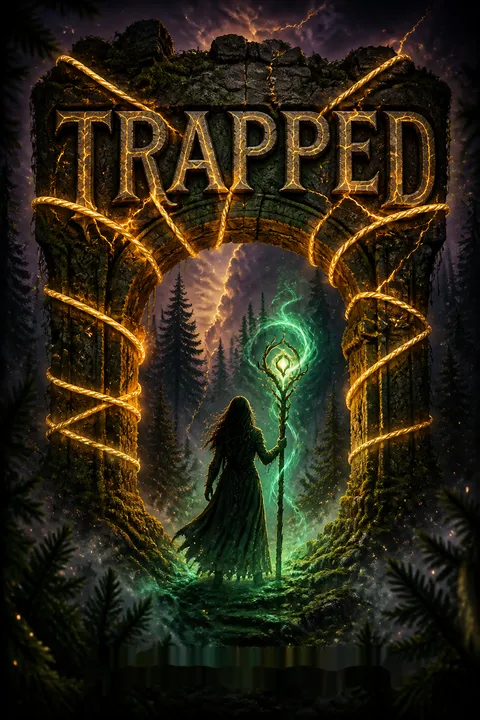


Plot Summary
Loki Burns the Slavic Plane
On the Kaibab Plateau, Atticus is preparing to bind Granuaile, his apprentice of twelve years, when the earth shudders beneath him. The elemental Kaibab warns that a distant plane is burning and a god is coming. Perun, the Slavic thunder god, crashes into the meadow, fleeing Loki, a Norse god newly escaped from captivity.
Atticus distracts Loki with a false identity and threats against Loki's family, then shifts himself, Granuaile, Oberon the talking Irish wolfhound, and Perun to safety. Perun's plane has been devastated, and no one knows who freed Loki. Atticus also fears an old prophecy: thirteen years after a white-bearded man ate hare and heard a sea-serpent tale, the world would burn. By his reckoning, they have one year left.
The disaster arrives in the middle of a rite meant to secure Granuaile's future, making private responsibility and cosmic danger collide from the first pages. Atticus responds with deception rather than force, a practical skill shaped by centuries of surviving stronger beings. Yet the prophecy gives his improvisation a limit: he cannot know whether his choices are delaying catastrophe or helping produce it. Perun's panic also breaks the easy hierarchy of divine power. A god can be displaced, frightened, and dependent on a mortal's judgment.
Brighid's Court of Knives
Brighid, ruler of the Fae Court, summons Atticus to explain why he faked his death. Before the audience can settle, the Morrigan arrives carrying Fragarach, a sword Atticus had returned to her years earlier. She delivers it to its rightful owner, Manannan Mac Lir, while needling Brighid into a public show of anger.
Atticus uses the quarrel to negotiate protection for Granuaile and a temporary secret around his return. He warns the court that Loki has destroyed Perun's plane.
The Fae reveal that most European routes between planes have stopped working, leaving Olympus as the only accessible region in Greece. Manannan privately explains that dark elves have been asking after Atticus. Divination confirms that Granuaile's binding must happen near Olympus, where an enemy may be waiting.
The court is less a place of justice than a stage where status, memory, and danger are negotiated in public. Brighid's reaction to the Morrigan shows how personal humiliation can distort political judgment, while Atticus survives by tracking those distortions and bargaining around them. His concealed return is no longer just self-protection: it threatens alliances and exposes Granuaile to danger. The route failure narrows his choices physically, turning the landscape itself into a political instrument. The court's hospitality is conditional, and every promise must be read for its loopholes.
Olympus Becomes a Bottleneck
Atticus takes Granuaile through Faerie's Time Islands, where historical moments hang in separate currents of time. She is shaken by the sight of Amelia Earhart still approaching her fatal crash, while Atticus sees preserved wonder. On Olympus, the pair search for a hidden camp and meet Agrios, a vulture that transforms into a bear-bodied monster.
Granuaile's knives and Atticus's enchanted sword bring him down, but the fight leaves her troubled by the reality of mythic creatures. Frigg then arrives with a warning: Hel has freed Loki, armed an army of draugar, and may begin Ragnarok. She demands that Atticus help kill Fenris. He refuses to risk Granuaile before her binding is complete, despite the debt he owes the Norse.
Granuaile's reaction to the Time Islands marks an ethical difference between teacher and student. Atticus treats preserved danger as spectacle, while she sees the trapped people inside it. The Agrios fight then turns the mythic world from a curated marvel into a physical threat she must survive. Frigg's demand sharpens the conflict: Atticus's past obligations are real, but so is his responsibility to the person currently in his care. His refusal is not free of self-interest, yet it is the first time he openly ranks Granuaile's safety above divine urgency.
A Steak Leads to Blades
In Litochoro, Atticus confronts a vampire who attacks rather than answer questions about Theophilus, the ancient vampire he hopes to find. The encounter convinces him that someone is watching them, but he and Granuaile proceed to a secluded cave and begin the earth-binding ritual.
Atticus tattoos Gaia's protective pattern onto Granuaile's foot, and the first rush of the earth's consciousness leaves her unconscious. Weeks later, Oberon discovers a carefully placed, poisoned steak on his patrol route.
Atticus investigates and is shot by an unseen archer. Five yewmen close in, while a faery assassin attacks Granuaile inside the cave. Atticus roots the yewmen with help from the local elemental; Granuaile fights the faery, but poison drops her. They escape to Mag Mell to heal.
The binding makes Granuaile more powerful by making her vulnerable first. Its slow, painful method requires both Druids to remain exposed for months, so the ritual's intimacy becomes a tactical weakness. The poisoned steak targets Oberon's appetite, not his strength, and reveals that the attackers have studied the group's habits. Granuaile's first magic arrives under pressure, not ceremony. She can act, but she cannot yet heal herself or match supernatural opponents. The retreat to Mag Mell preserves the ritual's possibility while making clear that neither good intentions nor careful preparation can guarantee its safety.
Smoke and Fire in Thessaloniki
After Bacchus and his Bacchants find the cave by scenting the binding magic, Atticus carries Granuaile out of Olympus as a stag. They reach Thessaloniki seeking supplies and answers, but Leif Helgarson, a vampire who once betrayed Atticus, arrives with a warning.
Theophilus is forcing Leif to help hunt the Druids. While Theophilus distracts Atticus by phone, dark elves disguised as clowns surround them. Granuaile shoots several; Atticus fights with Fragarach, but the elves douse him in lighter fluid and set him ablaze.
Granuaile's ambush saves him, and Leif destroys the pursuers. Atticus learns that a power in Tír na nÓg is coordinating enemies. He identifies Faunus's pandemonium as the force blocking Europe's routes, used to trap them on Olympus.
The threat expands from a local ambush into a coalition, and every apparent source of help carries a cost. Leif assists the Druids while still pursuing his own advantage, so Atticus must use information without mistaking it for loyalty. The dark elves' fire attack is particularly revealing: Atticus's magical defenses do not protect him from ordinary physics, and survival depends on Granuaile's independent action. The explanation of pandemonium changes the meaning of the earlier travel restrictions. What looked like collateral damage from Loki's destruction is actually a deliberate confinement strategy.
Dryads Become Leverage
To draw Faunus back to Olympus, Atticus and Granuaile temporarily separate six dryads from their trees and place them in a nearly motionless current on the Time Islands. The threat works: Faunus ends the pandemonium, and Europe's routes reopen.
The Druids return each dryad safely to her tree, despite one promising future retaliation. Atticus then takes Granuaile to a hidden cavern in the Pyrenees, where they can finish her binding beyond the Olympians' immediate reach.
During the long tattooing, Granuaile confronts Atticus about the love he keeps denying. He admits that past loss makes him afraid to begin a relationship before she is safe. They agree to wait until her binding is complete, and he stops pretending their bond is only professional.
Atticus's tactic is ethically uncomfortable because it turns the dryads' bodies into bargaining chips, even though he preserves them in time and restores them unharmed. The book does not erase that cost; one dryad's anger remains a counterweight to his claim of necessity. The episode also exposes a shift in Atticus's approach. He has been trying to protect Granuaile by withholding emotional truth, but she reads the bonds between them more clearly than he does. Their intimacy grows not from rescue or idealization, but from her insistence that fear be named rather than disguised as discipline.
The Last Knot
After months of patient work in the Pyrenees, Atticus finishes the final tattoos on Granuaile's arm and hand. Gaia recognizes her as a full Druid, giving her access to healing, shape-shifting, and travel between planes.
Granuaile's relief breaks into tears, then she kisses Atticus and begins the relationship they had postponed. They soon test her new forms in Tanzania, where she discovers a chestnut horse, a black jaguar, a peregrine falcon, and a sea lion.
Her first attempts at flight are clumsy, and her jaguar's acute sense of smell overwhelms her near rhino dung. The awkward practice lets her and Atticus learn together rather than teacher and student. Her new status also means that future choices, including the dangers ahead, belong to her.
Completion changes more than Granuaile's magical abilities. The formal end of apprenticeship removes the authority structure that let Atticus call emotional restraint a professional necessity. Her initiation is therefore both bodily and relational: she gains power through painful marks, then chooses the shape of her adult life. The comic failures in her first transformations keep competence from becoming instant mastery. Granuaile's future strength will depend on practice and judgment, not merely on receiving a title. Atticus, meanwhile, must accept a partner who can decide for herself, rather than a student whose safety he can define alone.
A Staff for the New Druid
In Tír na nÓg, the craftsmen Goibhniu and Luchta present Granuaile with Scáthmhaide, a staff that stores magic, carries iron and silver for different enemies, and can make her truly invisible. Flidais supplied its unusual concealment enchantment. Granuaile tests the staff in a sparring match with Ogma, a veteran champion.
She loses the contest overall, but uses invisibility to evade the promised clothing wager and earns the court's respect. Atticus also asks Goibhniu to organize a bounty on Italian vampires, striking back at the old Roman campaign that nearly erased the Druids. Before the gathering can celebrate, Hermes and Mercury arrive with an ultimatum: return the dryads to Olympus by nightfall or face the gods' anger.
The staff is a gift, but also a public statement that Granuaile has entered a world where power is judged by how it is used. Her sparring match tests both skill and social intelligence; she cannot outlast Ogma, but she finds a way to refuse the terms imposed on her. Atticus's vampire bounty makes his defensive posture more aggressive and risks widening the conflict. The Olympian ultimatum forces the couple to confront the consequences of their earlier tactic. Their new strength brings agency, but it does not remove responsibility for the beings caught in their strategies.
Bacchus Falls Through Time
Atticus and Granuaile leave the court and retrieve the six dryads from the Time Islands before the deadline, restoring each to her tree without lasting harm. Bacchus and his maenads are waiting. A dryad's presence blocks the nearest route away, so the Druids must fight. Granuaile draws the maenads off with Scáthmhaide, while Atticus uses speed and misdirection against Bacchus, whose strength exceeds his skill.
When Bacchus pins Atticus and tears his shoulder from its socket, Granuaile breaks the god's arm. Atticus then binds Bacchus's clothing to the tree and kicks him through a portal into a time current where he will fall for centuries. Cut off from their master, the maenads begin to recover their minds and humanity.
The rescue fulfills the bargain, but it does not dissolve the conflict because Bacchus has made the dryads a pretext for revenge. Atticus and Granuaile succeed by dividing the fight according to their strengths: she controls the crowd, while he exploits Bacchus's impulsiveness. Their victory is not a killing but an act of containment, using the same temporal mechanism that earlier protected the dryads. That symmetry matters. The portal can imprison as easily as preserve, and its ethical character depends on who controls it and why. The freed maenads provide a consequence beyond the duel.
Fenris Pays the Blood Price
Frigg brings the dwarf Fjalar to Atticus. His account reveals that Loki's arrival in Nidavellir led Hel's army to kill thousands of dwarves while searching for her father. Atticus accepts Odin's demand that he kill Fenris, partly to repay the dwarves for deaths caused by his deception. Granuaile chooses to go with him; Oberon stays behind.
In Hel, Freyja guides them and the Black Axes into battle. Granuaile wounds Fenris with poisoned knives, while Atticus cuts through Gleipnir, the binding on the wolf's leg. The freed Fenris nearly kills them, but their attacks weaken him enough for Atticus to sever his spine. They rescue the badly injured Freyja and escape as Hel grieves and the dwarves fight their way back.
The Fenris mission turns guilt into action without pretending that one heroic act can settle every debt. Atticus's careless lie helped set a catastrophe in motion, and the dwarf casualties give that old pattern a human scale. Granuaile's decision to join him shows that partnership does not mean being protected from risk; it means choosing risk with full knowledge. Their victory depends on coordination, not on Atticus's ancient power alone. Yet Hel's grief and the surviving army ensure that killing Fenris is a setback for Ragnarok, not a final resolution.
Epilogue
After recovering, Atticus and Granuaile begin a tour of old cave routes into Tír na nÓg, hoping to make Granuaile difficult to corner. In Transylvania, an earthquake seals their cave and the Morrigan warns that Olympian gods have blocked the routes across Europe. Hermes and Mercury demand Bacchus's return.
When Atticus refuses, Artemis and Diana attack from the air. The Morrigan shields the Druids from their arrows and orders them to run west toward Britain while she holds the huntresses back. Atticus, Granuaile, and Oberon flee on foot, with two immortal goddesses pursuing them.
The ending converts the lovers' new security into another pursuit. Atticus's choice to contain Bacchus has not merely angered one god; it has given the Olympians a reason to coordinate against him. The blocked routes reverse the mobility that once let Druids evade divine power, leaving running as their only immediate defense. The Morrigan's intervention complicates her earlier reputation for self-interest, but does not erase the danger she represents. Most importantly, Granuaile now runs as a full Druid beside Atticus, not as a student he can leave behind. Their partnership begins under pressure rather than in safety.
Analysis
Trapped repeatedly asks whether protection can remain ethical when it becomes a means of control. Atticus begins by keeping Granuaile's return secret, refuses to let her face the Norse war before she is ready, and tries to suppress their mutual love under the language of professional duty. Each choice is defensible in isolation, but together they reveal his central limitation: he confuses care with deciding for other people. Granuaile's resistance forces him to recognize that trust includes allowing another person to assess danger and choose.
The novel gives that personal conflict a political counterpart. Gods and factions turn access to forests, hospitality, prophecy, and even time into instruments of leverage. The Druids survive not by possessing the greatest force, but by noticing how power is routed and by combining different capacities. Granuaile's knives, Atticus's knowledge, Oberon's senses, and the elementals' influence each matter where another form of strength fails. Their victories are therefore collaborative, although the book refuses to make every tactic innocent. The dryads are preserved, yet used as bargaining pieces; the vampires are resisted through a bounty that risks broadening the violence.
Atticus's guilt gives the action its moral weight. His past decisions contributed to the Norse crisis and the dwarves' losses, but the story challenges the fantasy of repayment as a clean ledger. Killing Fenris helps the living and answers a debt, but Hel's grief and the continuing threat of Ragnarok remain. The title's trap is thus both geopolitical and psychological: enemies narrow the characters' choices, while old habits narrow them further. Granuaile's initiation offers the counterforce. She becomes powerful without becoming a copy of Atticus, and their relationship improves when he stops treating her independence as a danger to manage. The ending refuses comfort, but it leaves them moving together.
Review Summary
Trapped, the fifth book in the Iron Druid Chronicles, received mixed reviews. Many readers enjoyed the action, humor, and character development, particularly Granuaile's growth as a druid. Oberon's witty commentary remained a highlight. However, some felt the plot was disjointed and the time jump jarring. Critics noted a decline in the series' quality, citing repetitive storylines and excessive mythology lectures. The romance between Atticus and Granuaile garnered mixed reactions. Despite criticisms, fans appreciated the continuity and consequences of previous actions, eagerly anticipating the next installment.
People Also Read


Characters
Atticus O'Sullivan
The hiding Iron DruidAn ancient Druid who has survived by treating secrecy, humor, and tactical misdirection as essential tools. Atticus is fiercely protective of Granuaile and Oberon, but his instinct to manage danger for others can become a way to avoid trusting them with the truth. He carries guilt for earlier choices that harmed the Norse and dwarves, and he measures himself against obligations that no single person could fully discharge. His knowledge of gods and magic makes him resourceful, not invulnerable. The story repeatedly tests whether he can move from solitary calculation toward shared responsibility.
Granuaile MacTiernan
The apprentice becoming equalAtticus's apprentice of twelve years, Granuaile is disciplined, physically capable, intellectually curious, and increasingly unwilling to accept explanations that conceal the real cost of a choice. She questions the gods, objects to the suffering displayed in Faerie, and insists that Atticus acknowledge their emotional bond. Her training gives her a fighter's patience, but she has her own instincts and moral judgments rather than merely copying her teacher. The earth's magic will open new forms of action for her, yet her defining strength is already visible in her capacity to challenge authority and choose her own commitments.
Oberon
The irreverent houndAtticus's Irish wolfhound can speak mind to mind because Atticus taught him language. Oberon is devoted, perceptive, food-motivated, and cheerfully irreverent, often noticing danger or emotional tension before the humans admit it. His jokes provide relief, but his instincts are not comic decoration: he scouts the woods, detects the poisoned bait, and protects the group when violence begins. He values affection and companionship as directly as he values sausage, which makes him a sharp contrast to Atticus's habit of complicating every bond with fear and obligation.
Loki
The freed Norse tricksterA dangerous Norse god whose long confinement has left him physically and psychologically altered. Loki is volatile, destructive, and difficult to predict, but his release is bound up with Hel's longing for his approval. His presence makes old prophecies newly uncertain and forces other pantheons to prepare for catastrophe. He can be manipulated briefly, but Atticus understands that misdirection only buys time against a force this powerful.
Perun
The displaced thunder godThe Slavic god of thunder arrives in panic after Loki destroys his plane and turns to Atticus for help. Perun is powerful, direct, and more emotionally open than the gods who surround him. His long periods as an eagle have left him disconnected from events and human language, but not from loyalty or gratitude. His presence gives the catastrophe a personal face: the loss of a world is not an abstract omen to him.
Brighid
The guarded Fae rulerFirst Among the Fae and a formidable goddess of fire and poetry, Brighid rules through a mixture of authority, spectacle, and carefully chosen threats. She has a long, complicated history with Atticus and resents being deceived, yet she can recognize the value of training a new Druid. Her court is divided by old loyalties, making her power less secure than its ceremonial display suggests. Brighid is not simply an antagonist or patron; she is a ruler balancing personal grievance against the survival of her realm.
The Morrigan
The battle crowThe Irish goddess who chooses the slain, the Morrigan is sharp, proud, and comfortable using provocation as a weapon. Her rivalry with Brighid shapes the politics of Tír na nÓg, while her connection to Atticus mixes old intimacy with a hard expectation that he defend himself. She can be dangerous without being irrational, and she often understands political consequences before others do. Her oath to Atticus carries weight precisely because she does not offer tenderness easily.
Manannan Mac Lir
The sea god hostA sea god, psychopomp, and generous host, Manannan is one of Atticus's most trusted contacts among the Tuatha Dé Danann. He values hospitality but understands that good manners in Faerie must be explicit, lest generosity become a binding obligation. His curiosity about the mortal world makes him unusually willing to listen and learn. He helps Atticus navigate court politics and shares knowledge that could otherwise remain hidden, though his loyalty does not make him reckless.
Flidais
The unpredictable huntressThe Irish goddess of the hunt is skilled, sensual, and politically difficult to read. Flidais moves easily between wilderness and court, and her past actions have taught Atticus not to assume that charm means trust. Her connection to Granuaile is both familial and uneasy. She understands how power works among the Fae, yet her independent motives leave even allies wondering which loyalties matter most to her.
Leif Helgarson
The calculating vampireA powerful vampire and former ally of Atticus, Leif is a survivor who treats every crisis as an opportunity to improve his position. He has betrayed Atticus before and does not seek easy forgiveness. When their interests align, he can provide useful intelligence, but his help is always entangled with ambition. Leif's calm manners conceal a ruthless understanding of power, making him both a potential resource and a continuing danger.
Theophilus
The ancient vampireAn extremely old vampire whose influence reaches through the vampire hierarchy. Theophilus sees the Druids as a threat because their magic can unbind vampires, and he prefers to make demands from a position of apparent courtesy. His history connects the present hunt to the Roman persecution of the Druids. He is patient enough to use intermediaries and distractions rather than expose himself directly.
Bacchus
The Olympian wine godA Roman god of wine and madness, Bacchus draws followers into ecstatic dependence and enjoys the power their cravings give him. He can appear composed and alluring, but beneath that surface he is vindictive and physically formidable. His feud with Atticus turns the need to bind Granuaile into a trap. Bacchus represents pleasure separated from responsibility, an appetite that demands others surrender their judgment.
Hel
The army-building daughterLoki's daughter and ruler of Niflheim, Hel commands the dead and has spent years preparing for a war against the Norse realms. Her desire for her father's approval complicates her strategic ambitions. She is capable of patience, cruelty, and large-scale planning, but her personal attachments can redirect her military choices. Hel's presence makes the danger of Ragnarok intimate as well as political.
Frigg
Odin's determined envoyOdin's wife and a composed strategist, Frigg approaches Atticus with the Norse pantheon's urgent need for help. She is willing to press old debts and understands the importance of timing, but she also recognizes that a mission must be shaped around the people who can carry it out. Her calm presentation masks a hard resolve. She is more diplomatic than Odin, not necessarily more forgiving.
Freyja
The warrior guideA formidable Norse goddess and veteran fighter, Freyja is assigned to guide Atticus and Granuaile into Hel. Her pride and history with Atticus make their cooperation strained, but she accepts responsibility for the mission. She is a warrior accustomed to leading from the front, and her presence links the personal cost of Atticus's past actions to the Norse effort to prevent Ragnarok.
Fjalar
The grieving runeskaldA dwarf craftsman and runeskald, Fjalar has lost family in the fighting between his people and Hel's army. He transforms grief into ritual mourning and an account of the battle, insisting that Atticus understand the consequences of his earlier deception. His craft joins poetry, engineering, and warfare, and his anger gives the Norse conflict a cost beyond divine strategy.
Faunus
The keeper of disorderThe Roman counterpart of Pan, Faunus has the power to disrupt natural order through pandemonium. His control over that force becomes entangled with the Olympians' effort to restrict the Druids' movement. He is not often seen directly, but his influence changes which forests can serve as doorways between worlds.
Gaia
The living earthThe consciousness of the earth, Gaia is the source of Druidic power and the being to whom a new Druid must be bound. Her presence is immense enough to overwhelm a human mind, so the binding tattoos act as a filter as well as a channel. Gaia is not a distant abstraction in the story: the elementals speak for parts of her, and the state of the land registers the consequences of divine conflict.
Plot Devices
The earth-binding tattoos
Power through painful ritualA Druid's tattoos are created through a prolonged ritual that joins the initiate to Gaia and grants access to magic. The markings regulate the flood of the earth's consciousness, then encode practical abilities such as magical sight, enhanced speed, healing, and shape-shifting. Granuaile's binding requires months of work and leaves her vulnerable to interruption, making the magical system a source of both empowerment and plot danger. It also gives the rite emotional meaning: Atticus cannot make Granuaile a Druid without trusting her to endure pain and eventually act independently.
Tree tethers
Routes between living worldsCertain trees connect the mortal world to Tír na nÓg and other planes. Druids can follow the magical patterns of these connections to travel quickly, but the routes depend on the state of the land and can be blocked or disrupted. When Faunus's pandemonium closes most European paths, Olympus becomes a trap and Granuaile's binding is forced into dangerous territory. The tethers turn geography into infrastructure: whoever controls access to forests can control who escapes, who arrives, and which conflicts remain local.
The Time Islands
Preservation and imprisonmentThe islands in Faerie's river occupy different time currents, so a person on one island may experience seconds while much more time passes elsewhere. Atticus first shows Granuaile historical moments suspended in this strange geography. Later, the Druids use a slow current to hold dryads away from their trees while pressuring Faunus to end the disruption. The islands are not merely scenery or a transport shortcut. They make time itself a tool, capable of preserving the vulnerable or confining an enemy, depending on the user's purpose.
Cold iron aura
A natural defense against FaeAtticus's long exposure to cold iron gives him an aura that can destroy many Fae on contact and prevents certain forms of magical influence. It helps him survive in the Fae Court and makes him a dangerous target for anyone relying on glamour or iron-sensitive magic. It does not protect him from every weapon: ordinary fire can burn him, and Granuaile must still fight without the same defenses. The aura establishes a useful limit on magical protection, preventing one powerful advantage from becoming a universal shield.
Pandemonium
Disorder as a strategic trapFaunus can disturb the natural order on a scale that disrupts the routes through Europe's forests. The effect initially appears to be fallout from the destruction of Perun's plane, allowing the Olympians to conceal their role in trapping Atticus and Granuaile near Olympus. Once Atticus recognizes the power behind the disruption, he uses the dryads as leverage to make Faunus stop. Pandemonium functions as both mythic ability and political camouflage: a natural-seeming disorder can hide a deliberate campaign against the Druids.
The Iron Druid Chronicles Series
About the Author
Other books by Kevin Hearne
Download PDF
Download EPUB
.epub digital book format is ideal for reading ebooks on phones, tablets, and e-readers.








