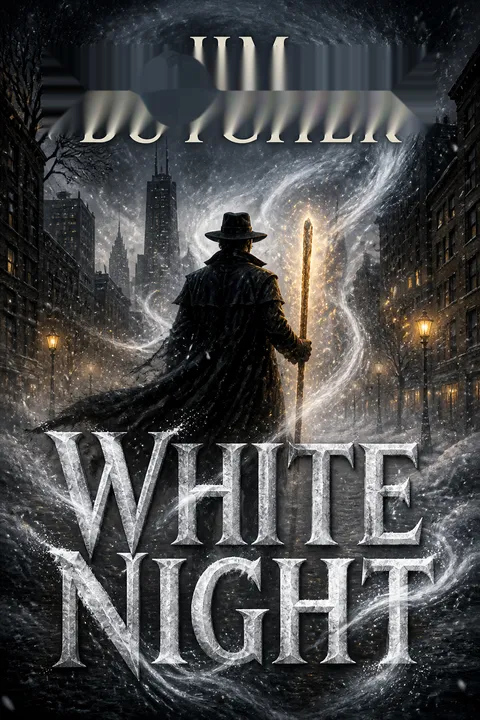


Plot Summary
A Verse on the Wall
Sergeant Karrin Murphy brings Harry Dresden, a Chicago wizard and private investigator, to the apartment of Janine, a practitioner whose death is being treated as suicide. The room is orderly, dinner is still marinating, and the empty medicine bottle and farewell note seem to support that verdict.
But Harry finds a ritual knife pointing from Janine's shrine toward her body, then uses copper filings to reveal a magical Bible reference on the wall: a verse historically used to condemn witches. The message is too faint for ordinary investigators to see.
Murphy admits the department lacks resources and cannot officially employ Harry, but she needs his judgment. The hidden mark changes a quiet death into a suspected murder, and its author appears to be addressing someone who understands magic.
The crime scene turns interpretation into the first weapon in the case. Ordinary evidence makes Janine's death legible as private despair, while the magical residue reveals that another person has imposed a public meaning on it. The killer's citation is not merely a clue; it is an attempt to make murder look like moral judgment. Murphy's reduced rank and private request also establish the institutional weakness that will let the pattern continue. Harry is drawn in because the official account cannot accommodate what he sees, yet his expertise gives him no authority to make that truth count.
Pleasure Leaves a Mark
Harry and Murphy compare Janine's death with other apparent suicides, and medical examiner Waldo Butters points out that several wounds could not plausibly have been self-inflicted. One unexplained case stands apart: Jessica Blanche, a young woman whose healthy body shows no medical cause of death and whose clothes have vanished.
Harry asks his apprentice, Molly Carpenter, to read an impression from Jessica's corpse. She experiences the dead woman's final sensation as overwhelming pleasure, so intense it erased every other perception.
Molly then remembers a prickling sensation across the victim's abdomen and traces the same Exodus reference there. The deaths are connected, and the killer's methods vary. Harry recognizes that the apparent suicides are part of a serial pattern, not isolated tragedies.
Molly's first successful reading is also a lesson in the difference between sensation and consent. The pleasure she experiences initially seems like a gift, but Harry makes her confront that it concealed a fatal act and left its victim unable to understand what was happening. The investigation therefore refuses to treat pleasurable experience as proof of safety. Butters contributes a second kind of correction: forensic reasoning exposes what the supernatural explanation alone cannot. Together, their discoveries create a case built from two forms of evidence, bodily detail and magical residue, while forcing Molly to recognize that her sensitivity can wound her as well as help others.
A Cloak at Mac's
Harry takes the victims' files to Mac's, a supernatural pub protected as neutral ground, hoping its patrons will help him find a link between the dead women. Instead, the room empties around him.
Mac explains that the community fears Harry's grey Warden cloak, the mark of the White Council's enforcement arm. Because the killings are officially listed as suicides, people suspect the Wardens themselves may be responsible. Harry understands that his new authority has made him harder to trust, even among people he has tried to protect.
Mac finally offers a lead: Anna Ash of the Ordo Lebes, a group of practitioners. Harry accepts the appointment, knowing that the investigation depends on speaking with people who may see him as part of the threat.
Harry's position has changed faster than his relationships have caught up. He has become powerful enough to frighten the very community he once served as an accessible protector, and his Warden role carries the Council's history of surveillance and execution. Mac's question about whether Harry himself is responsible gives that fear a human face. The scene makes trust a practical resource, not a sentimental virtue: without it, witnesses will stay silent and more people may die. Harry's hurt is real, but he recognizes that others' caution is rational, a recognition that begins to complicate his confidence in his own good intentions.
The Ordo's Warning
Murphy and Harry stake out Anna Ash's apartment building, then enter after Anna's group agrees to hear them. Abby, a woman with limited foresight, seems to anticipate their introductions, while Anna remains wary of the Warden.
The Ordo confirms that practitioners have died and more than twenty people have vanished. Witnesses repeatedly saw either a tall man in a grey cloak or a pale, dark-haired man with victims shortly before they disappeared. Harry denies that the cloaked figure is a Warden and promises to protect the group.
Anna asks him to respect her household's hospitality, and he swears on his power. As they leave, an explosion destroys Murphy's car and throws them onto the street. The attack proves the killer is already targeting the investigation.
The Ordo's testimony widens the case from a string of bodies to a campaign of disappearance, while the two recurring descriptions destabilize the simplest suspect. Harry's oath matters because he accepts limits in a place where he could otherwise impose his power. Yet the explosion immediately exposes how little control that courtesy buys him. The group is not protected by being careful or by living together; someone has anticipated their movements and is willing to use public violence. Abby's foresight adds a further uncertainty: glimpsing likely futures is useful only when events remain predictable, and this investigation is designed to break predictability.
Thomas's Hidden Wall
Suspecting his brother Thomas may know more about the supernatural feeding behind Jessica's death, Harry visits his luxurious apartment. Its spotless front rooms conceal a private war room filled with illegal weapons, maps, surveillance notes, and photographs of the dead women taken before police arrived.
A list tracks the victims and other missing practitioners, with the Ordo marked as a target. Thomas is absent, and a caller's sensual message suggests he has been feeding on multiple women.
Harry cannot decide whether the evidence means Thomas is hunting the victims or trying to find them. He consults the shadow of the fallen angel Lasciel, who reconstructs the wall from memory and helps him notice a veiled figure in Anna's apartment, someone he could not remember seeing.
The apartment turns brotherly concern into a problem of evidence. Harry's instinct says Thomas would not commit mass murder, but the photographs and weapons provide a plausible case against him. The conflict is sharpened by the fact that Harry has no clean way to distinguish loyalty from denial. Lasciel's assistance offers a solution while deepening a dangerous intimacy: she makes herself useful, even creative, and Harry must resist confusing helpfulness with trustworthiness. The veiled guest also reveals a limit in Harry's perception. What he cannot remember may be more important than what he saw, making self-doubt part of the investigative method.
Elaine Returns Through Fire
Harry returns to Anna's building because the hidden guest may be in danger. A subtle sleep spell blankets the floor, and a trap at Anna's door sends green energy at him. He enters and finds the trapped woman is Elaine Mallory, his former lover and now a private investigator.
Elaine explains that similar practitioner murders have occurred in four other cities, bringing the toll to thirty-six, and that grey-cloaked men appeared with victims in each place. She has been investigating the pattern and expected an attack on the Ordo.
The building catches fire, but Mouse's supernatural bark wakes the residents and Elaine contains the smoke long enough for them to escape. Harry spots the grey-cloaked man outside and pursues him, but marks his getaway car instead of charging into a dark garage.
Elaine's return combines personal history with professional competence, but neither cancels the other. She does not trust Harry blindly, because an impostor or coercion could make a familiar face dangerous; he must accept that her caution is not a betrayal. The fire forces their cooperation to become concrete: Mouse wakes the building, Elaine controls the smoke, and Harry organizes the escape. His decision to mark the suspect's car rather than attack him shows a rare willingness to trade immediate vengeance for information. The scene reframes rescue as coordinated work, not a solitary hero's performance, and makes Harry's old relationship a source of both knowledge and friction.
Cowl Finds the Trail
Back in his basement laboratory, Harry uses Little Chicago, a detailed magical model of the city, and a fleck of paint from the marked car to locate the grey-cloaked man.
He follows the man through Undertown, Chicago's dangerous subterranean maze, and watches him contact a robed figure Harry recognizes as Cowl, a powerful wizard he believed dead. Cowl senses Harry's magical presence and blasts his mind, damaging Little Chicago and leaving Harry with a severe headache.
After recovering, Harry and Murphy connect the grey cloak to Vittorio Malvora and identify the other unseen operator as Madrigal Raith, a White Court vampire. The pair appear to be maneuvering Harry against a separate Skavis killer, using the murders to advance their own power play.
Little Chicago makes the city itself an instrument of investigation, but its elaborate precision carries the danger of turning Harry's body into part of the mechanism. Cowl's retaliation proves that observation is not neutral: seeing the hidden structure exposes Harry to it. The discovery also shifts the case from serial murder toward political manipulation. The antagonists are not simply cooperating; they are using one another and Harry as expendable tools. Harry's growing suspicion of the White Council's integrity makes Cowl's survival especially destabilizing, because the threat seems connected to a larger conspiracy that cannot yet be proved.
Thomas on the Camera
Harry returns to the Ordo's refuge and confronts Helen Beckitt, a guarded member with a criminal past he recognizes. His accusation alarms the others, but Helen neither flees nor offers an easy defense; the group stands by her.
Elaine then reveals that Olivia, the young dancer, has vanished from her apartment. Security footage shows her walking with the same dark-haired man from the witnesses' accounts. Harry recognizes Thomas. He suspects his brother may be involved but cannot reconcile the image with the man he trusts.
Elaine insists they find Thomas and hear his explanation. Before leaving, they move the remaining women to a hotel and tell them to stay together, while Harry prepares to track Thomas by the silver amulet both brothers wear.
The photograph is powerful because it does not prove what Harry fears, yet it makes denial harder. His loyalty to Thomas now has to coexist with evidence that the women are disappearing in his company. Helen's response offers a contrasting model of trust: the Ordo refuses to discard someone solely because of a damaging history, even as Harry's suspicion threatens that bond. Elaine pushes the investigation toward verification rather than either accusation or exoneration. The amulets turn family connection into a practical tracking tool, an image of intimacy repurposed as evidence while Harry tries to keep affection from becoming an excuse.
The Water Beetle Ambush
Harry's tracking spell leads him and Elaine to the Water Beetle, where Thomas knocks Harry down before realizing who he is. Thomas has hidden Olivia, several other women, and small children aboard, moving them to shelter because the killers are hunting them.
Before he can explain further, a pack of thirteen ghouls attacks from a neighboring boat under a cloud of engine smoke. Harry and Elaine fight while Thomas protects the refugees. Harry uses a powerful spell to freeze a path across Lake Michigan, allowing the women and children to reach the next dock.
Madrigal appears with an assault rifle and shoots Harry into the icy water. The fight recalls Harry's failure to protect two trainee wizards in New Mexico, a memory that feeds his reckless determination not to let another ghoul escape.
Thomas's apparent guilt reverses into protection, but the secrecy that concealed his rescue effort has already endangered his relationship with Harry. The ambush then makes the cost of incomplete trust immediate: the brothers must cooperate before they have time to repair their misunderstanding. Harry's New Mexico memory clarifies why he pursues the ghoul underwater despite the risk of drowning. His anger is not only courage; it is grief seeking a target. The frozen crossing gives endangered people an exit, but it also leaves Harry exposed. The scene makes rescue a morally serious choice whose success cannot be measured by whether the rescuer survives.
Anna's False Suicide
Elaine and Thomas pull Harry from the lake, and the rescued women escape before police arrive. After Harry wakes, Thomas refuses to explain everything, constrained by a promise, while Harry insists that he will keep looking into the danger.
At Elaine's hotel, they discover Anna Ash dead in a shower, arranged to resemble suicide. With the Ordo's contact notebook missing, Harry and Elaine track the others to Abby's apartment. They learn that Helen claimed the hotel was compromised and drew Anna and Priscilla out of hiding.
Harry assumes Helen is the Skavis vampire's accomplice, but Murphy brings a lead linking Jessica Blanche to the reopened Velvet Room, a business run by John Marcone. Harry and Elaine leave to question its management, while the surviving women remain with Abby.
Anna's death turns the group's precautions into a record of how trust can be exploited. The false report of danger sounds plausible because it comes through familiar relationships, and the missing notebook makes the survivors harder to reach. Harry's confidence in his ability to read people fails again when he targets Helen on the strength of her past. At the same time, the Jessica Blanche lead redirects the case toward Marcone, showing that the victims' lives intersect with institutions beyond the magical community. The cost of each delay is now personal: Anna had organized protection for others, yet her own willingness to act could not keep her alive.
The Wrong Woman's Guilt
At Marcone's health-club front for the Velvet Room, Harry finds Helen working as its manager and learns Jessica was her employee. Helen denies calling the Ordo, and Harry uses a soul gaze to judge her character.
He witnesses the death of Helen's young daughter in a gang shootout involving a much younger Marcone, an event that explains her history of vengeance and her guarded nature. Helen's grief convinces Harry she did not lure Anna away. He reconstructs the calls and realizes Priscilla, the Ordo's suspicious member, is the Skavis vampire.
Priscilla is already near the women and children, while Elaine remains exposed at the hotel. Harry understands that the accusation against Helen was a deliberate diversion and rushes to reach Elaine before the killer can attack her.
The soul gaze gives Harry knowledge, but not the sort of evidence a court could use. He sees the emotional origin of Helen's hardness and must revise his judgment without pretending her past is harmless. That revision matters because he had treated suspicion as certainty, reproducing the very coercive logic he criticizes in others. The Skavis's disguise works because it exploits social expectations: Priscilla's bitterness is read as temperament rather than threat, while Helen's criminal history makes her easy to blame. The revelation is therefore both detective work and a study of bias, showing how a plausible story can be more dangerous than an obvious lie.
Elaine Refuses Despair
On the way to the hotel, Harry realizes that the Skavis is attacking Elaine by feeding her thoughts of failure and suicide. Molly, who has followed him, is not ready for the danger; Harry's anger erupts as he demonstrates a small, scorching fire spell, then makes her stop it before it reaches her. He orders her to drive and keep watch while he attempts a long-distance mental connection with Elaine.
The spell reaches Elaine in a bathtub, bleeding from a cut wrist and close to death. Harry identifies Priscilla and breaks the vampire's hold over her. Elaine binds her wound, destroys the hotel-room wall with a lightning spell, and strikes the Skavis down. Mouse and Thomas help finish the attack before the vampire can kill Harry.
The rescue depends on the same mental intimacy that made Harry and Elaine vulnerable to one another in youth, now used to interrupt an attack that masquerades as Elaine's own thoughts. Harry's warning restores choice rather than simply replacing her will with his. His treatment of Molly is more troubling: he uses fear to teach caution, nearly reproducing the coercive pedagogy that shaped his own life. Murphy's urgency and Molly's obedience keep the rescue moving, but the episode leaves a moral question unresolved: protection can require force, yet force can also become the teacher's first answer. Elaine survives by acting for herself once the false despair breaks.
The Beads Finally Break
Harry and Murphy conclude that the Skavis killings are part of a White Court power struggle: Malvora and Madrigal are trying to exploit the murders to derail peace with the White Council. Thomas's secrecy appears to protect Lara's position and Justine's safety, though he cannot openly confirm it.
Harry plans to challenge the conspirators at a White Court gathering. Molly arrives despite repeated orders to stay home. This time she admits she is frightened, recognizes that she is not strong enough for combat, and offers to help in whatever limited role Harry chooses.
Her bracelet, once a measure of concentration, snaps and its beads fly across the room. Harry understands that the test was never raw power: Molly has finally grasped why restraint and responsibility matter. He lets her come, but assigns her to watch the car with Mouse.
Molly's breakthrough arrives when she stops presenting fear as a problem to be conquered and instead treats it as information. She can name her limits without using them as an excuse to abandon people, which is a more mature form of agency than simply obeying Harry. The broken bracelet gives physical form to a lesson that cannot be measured by bead counts. Harry also sees that his teaching has been too focused on controlling her and not enough on explaining what power is for. Their agreement remains unequal, but it is now grounded in shared understanding rather than a contest of authority.
A Challenge in the Deeps
Harry and Warden Carlos Ramirez reach the Raith estate, while Molly remains concealed near the road with Mouse. Lara Raith receives them and leads them underground to the White Court conclave, where Justine quietly explains that Lord Skavis is using his son's murders to argue against peace.
Harry hears Vittorio Malvora claim credit for the killings and Madrigal's help. He enters the cavern, accuses both men of murder during a period of peace, and invokes the Accords to demand trial by combat.
The White King accepts the challenge, while Lady Malvora is forced to let her son fight. Vittorio and Madrigal choose weapons and prepare to face Harry and Ramirez. The spectacle is a political trap as well as a duel, since the Court's human thralls line the fighting ground.
Harry uses the Accords as a narrow legal opening inside a society that treats people as prey. His challenge is not a rejection of political procedure but an attempt to make procedure constrain predators who ordinarily avoid direct accountability. The thralls lining the arena reveal the cost of that strategy: even a lawful duel can place vulnerable people between combatants. Lara's presence is equally ambiguous, since she supports the challenge for reasons that may align with Harry's without matching his ethics. The scene's ceremonial order is fragile from the outset. Its polished rules conceal a gathering prepared to turn violence into entertainment.
The Duel Becomes a Siege
The duel begins with gunfire, fire magic, and Ramirez's shield, but Harry and his ally struggle against Vittorio's speed and Madrigal's protective charms. Ramirez wounds Madrigal, while Harry knocks Vittorio into the Court's spectators.
Vittorio then summons a gateway, and an army of ancient, powerful ghouls pours into the cavern. Harry opens his own gate to the Nevernever, where Thomas, Murphy, Marcone, Hendricks, and armed men wait. As the battle consumes vampires and thralls, Vittorio's despair spell pins everyone down and a timed bomb threatens the cavern.
Lasciel's shadow refuses Harry's demand for the coin but tells him Vittorio is possessed by an Outsider, then shields Harry long enough for him to blast Vittorio's hand away and force a retreat. The explosion closes the gate before Harry and Lara can escape.
The duel's formal boundary collapses into a massacre in which neither side can preserve its claim to civilized control. The ghouls expose the weakness beneath the White Court's elaborate hierarchy: its members can be brutal, but they are not prepared for an enemy that will not stop when wounded. Harry's rescue effort expands beyond his original purpose, yet the thralls' vulnerability makes retreat morally impossible. Lasciel's choice is pivotal because she helps without securing the surrender she has sought. Her intervention grants Harry a chance to act, but also introduces a larger threat through the Outsider, leaving victory entangled with information he does not yet understand.
Out Through the Explosion
Trapped with Lara as the bomb detonates, Harry channels her predatory hunger into his shield and catches the blast long enough to propel them through the cavern tunnel and into the damaged chateau. Lara honors her pledge of safe conduct.
Harry demands reparations for the victims' families, protection against another campaign, and the release of captured fairies; she agrees, though she warns that peace can also be used to dominate. The survivors recover, and Harry signs Marcone's application to join the Accords as a freeholding lord, giving him legal standing against supernatural powers.
He proposes a support network for practitioners, and Elaine agrees to help. Molly understands her limits, Thomas reconciles with Harry and reveals his hair-styling business, and Lasciel's shadow is gone after saving him. Harry hears her influence in his music and plans to return the coin.
The resolution refuses a clean victory. Harry secures concrete protections, but Lara remains a dangerous political actor, and Marcone's new status strengthens a criminal power even as it may deter supernatural incursions. The proposed practitioner network answers the opening failure of isolated victims by building communication and mutual aid rather than relying on a single wizard. Harry's relationships also shift through chosen disclosures: Molly earns responsibility, Thomas explains the ordinary work he hid, and Elaine accepts a shared project. Lasciel's disappearance gives the book's most intimate conflict a cost. Her final act preserves Harry's freedom while leaving him to confront what that freedom has taken.
Analysis
White Night makes investigation a contest over who gets to define the evidence. Janine's orderly apartment suggests private despair until magical residue exposes a killer's intervention; the official verdict is not simply wrong, it is useful to whoever wants the deaths ignored. As the case expands, Harry repeatedly has to revise his judgments: Thomas's apparent guilt masks a rescue effort, Helen's history makes her an easy suspect, and the person treated as merely abrasive is the actual predator. The novel's mysteries therefore test not only Harry's skill but his habits of trust, suspicion, and self-justification.
Its emotional systems are also literal systems of power. White Court vampires feed on states that people experience as intimate or internal, especially pleasure and despair. Their victims may not know they are being attacked, which makes apparent consent and apparent choice unreliable evidence. Harry's rescue of Elaine reverses that violation by restoring her ability to recognize her own thoughts. The contrast is especially sharp in Molly's arc. Harry wants to prevent her from misusing magic, but his frightening lesson risks turning protection into coercion. Her real readiness appears when she can acknowledge fear and limits while still choosing to help.
The book finally distrusts uncomplicated victories. Harry stops the immediate killings and forces reparations, yet he strengthens Lara's position and helps Marcone enter the supernatural political order. These are compromises with people whose power remains dangerous. Against that machinery, the proposed practitioner network offers a modest but meaningful alternative: communication, shared defense, and collective attention before isolated people disappear. The story's hope lies less in defeating every predator than in making future victims harder to isolate, deceive, and erase.
Review Summary
White Night receives mostly positive reviews, with fans praising its complex plot, character development, and intense action scenes. Readers appreciate the deepening of Harry Dresden's character and the exploration of vampire politics. Some critics find the book repetitive or confusing, but many consider it one of the best in the series. The climactic battle and emotional resolutions are highlights for many readers. Overall, the book is seen as a strong entry in the Dresden Files, maintaining the series' quality and leaving fans eager for more.
People Also Read



Characters
Harry Dresden
Warden with a conscienceA tall Chicago wizard, private investigator, and Warden of the White Council, Harry combines forceful magic with a stubborn instinct to protect people who cannot protect themselves. His experience makes him inventive under pressure, but his confidence can harden into recklessness, especially when a friend or woman is in danger. He distrusts institutions that demand obedience while excusing their own failures, yet he has accepted the Warden's mantle and its frightening authority. His bond with his brother Thomas and his former lover Elaine reveals how poorly he tolerates uncertainty in those he loves. As a teacher to Molly, he wants her to survive the power he once misused, though he must learn that protection without explanation can become another form of control.
Karrin Murphy
The unflinching sergeantMurphy is a compact, disciplined Chicago police officer whose courage and practical intelligence have repeatedly brought her into contact with the supernatural. Her demotion to sergeant has wounded her pride, but she refuses to let humiliation make her careless or dependent. She and Harry share a hard-earned friendship expressed through teasing, trust, and the willingness to challenge each other's judgments. Murphy brings police procedure to a world where official explanations routinely conceal the truth, and she understands that protecting people sometimes requires working beyond the department's rules. Her concern for Harry includes a clear-eyed awareness of his anger and his capacity to cause collateral harm.
Molly Carpenter
The apprentice learning restraintMolly is Harry's young apprentice, gifted especially in mental and emotional magic. Her rebellious appearance reflects a struggle to claim independence after growing up in a strict family, while her desire to help can outrun her judgment. She has already learned that good intentions do not prevent magic from damaging other people, and Harry's mentorship asks her to take responsibility for that power. Molly resents being treated as incapable, but she is also capable of fear, reflection, and loyalty. Her development depends not on becoming stronger than everyone around her, but on learning when action is justified and how to recognize the limits that keep talent from turning destructive.
Thomas Raith
The guarded White Court brotherThomas is Harry's half brother and a member of the White Court, a vampire court that feeds through human life energy. Handsome, quick-witted, and physically dangerous, he often hides vulnerability behind style and self-mockery. His nature gives him appetites that complicate his affection for ordinary people, while his conscience pushes him to limit the harm he causes. He values promises and family loyalty, sometimes so rigidly that he withholds information from the people most likely to help him. His relationship with Harry is affectionate but guarded, and both men struggle to trust one another without assuming they know what the other can bear.
Elaine Mallory
The independent investigatorElaine is a skilled wizard and private investigator whose history with Harry began in childhood, when they were both adopted and trained by the same dangerous mentor. She is perceptive, resourceful, and more adept than Harry at delicate magic. Past coercion has made her fiercely protective of her independence; she wants to help people without allowing an institution to take ownership of her choices. Her care for others is genuine, but she can carry responsibility as if every failure were proof that she should never have tried. With Harry, old intimacy coexists with caution, humor, and the need to set boundaries.
Lara Raith
The White Court strategistLara is a leading White Court vampire, a political operator whose intelligence and self-command make her more dangerous than her beauty first suggests. She understands that power often works best through alliances, promises, and carefully managed appearances rather than open force. Her relationship with Thomas is protective but politically complicated, and her dealings with Harry combine genuine respect with an appetite for leverage. Lara values her word, though she defines obligation within a world built around predation. Her effort to guide the White Court toward peace does not make her harmless; she can see restraint as a more effective instrument of control.
Lasciel's shadow
The voice inside HarryLasciel's shadow is an imprint of a fallen angel living within Harry's mind, intelligent, persuasive, and endowed with knowledge beyond human experience. She can offer magical insight and emotional companionship, but her help carries the danger of making dependence feel like friendship. Harry resists the original power bound in a coin, yet the shadow has developed a complicated relationship with him through years of proximity. She is drawn to freedom even while serving a purpose she did not choose. Their conflict turns on whether an entity made to tempt others can become more than its assigned role.
John Marcone
Chicago's criminal powerMarcone is the disciplined, highly capable leader of Chicago's criminal underworld. He is ruthless and self-interested, but he imposes order on the businesses he controls and keeps his word when it serves his code. Harry dislikes his enterprise and recognizes the danger of giving it greater legitimacy, yet he also knows Marcone can mobilize people and resources when official institutions cannot. Their relationship is a wary bargain between men who understand each other's motives without sharing each other's ethics. Marcone's composure hides a private sense of responsibility for the innocent people caught in his rise to power.
Carlos Ramirez
The brilliant young WardenRamirez is a talented young Warden and regional commander, combining confidence, humor, and serious combat skill. He has survived enough supernatural violence to recognize when a battle is being arranged around him, and he expects allies to be honest about the risks they share. His friendship with Harry is warm, but Harry's secrecy strains it. Ramirez's magic favors precision and disruption, contrasting with Harry's heavier approach, and his courage remains evident even when his body is badly injured.
Helen Beckitt
The guarded Ordo memberHelen is an Ordo Lebes member with a remote manner and a past she keeps separate from her new community. She has endured a devastating family loss and carries grief in a form that outsiders can mistake for coldness. Her intelligence and self-control make her difficult to read, but she is not indifferent to the people who treated her with kindness. Helen's guardedness reflects both shame and hard-earned caution; she resists being reduced to the worst thing she has done or the worst thing that has happened to her.
Anna Ash
The Ordo's determined hostAnna leads the Ordo Lebes with a practical courage that holds a frightened community together. She is cautious about outsiders, especially a Warden whose authority could be used against practitioners like her, but she is willing to listen when safety is at stake. Anna helped organize shared protective wards and treats hospitality as a serious obligation rather than a social nicety. Her instincts are protective without being sentimental; she sees the danger around her and continues to make decisions for the group's survival.
Priscilla
The Ordo's sharp skepticPriscilla is an older member of the Ordo Lebes, sharp-tongued, suspicious, and quick to challenge Harry's claims. She distrusts authority and resents being treated as someone who should accept a Warden's account without proof. Her skepticism can look like simple hostility, but it arises in a community where trust carries real physical risk. Priscilla's outward reserve makes her difficult to read, and she tends to use criticism as both a defense and a way to test the people around her.
Abby
The distracted seerAbby is a warm, plump member of the Ordo whose limited foresight makes her seem to answer people before they speak. Her gift offers only a brief glimpse of likely events, leaving her distracted by possibilities and sometimes misunderstood by others. A small dog helps her manage the effects of her condition. Abby is kind and domestic in her habits, but her intuition gives her a place in the group's protective network. She values familiarity and community, especially when danger makes ordinary routines feel fragile.
Waldo Butters
The forensic truth-tellerButters is a medical examiner whose small stature and awkward manner conceal unusual courage and sharp forensic instincts. He notices details that more senior investigators dismiss, and he is willing to share what he can without pretending his professional obligations do not matter. His knowledge of bodies provides a grounded counterweight to Harry's magic. Butters is curious about the supernatural but does not abandon scientific skepticism; he wants evidence that can withstand scrutiny, even when the answer lies beyond conventional medicine.
Justine
Thomas's devoted allyJustine is a human woman whose love for Thomas persists despite the physical danger their closeness creates. She has suffered severe psychological and physical damage, but retains intelligence and determination beneath her fragile presentation. Her relationship with Thomas is defined by affection, restraint, and a wish to protect him as much as he protects her. Justine's apparent vulnerability should not be mistaken for a lack of purpose; she is capable of careful observation and chooses for herself how much danger she is willing to face.
Vittorio Malvora
An ambitious Court heirVittorio is a son of House Malvora, one of the major families of the White Court. He is politically ambitious and willing to use covert violence to advance his family's position. Like other White Court vampires, he understands how emotional vulnerability can be turned into power. His polished confidence masks a predatory worldview in which people outside the Court are treated as resources or obstacles.
Madrigal Raith
A vengeful Court cousinMadrigal is Thomas's cousin, a White Court vampire with a taste for spectacle and personal revenge. He is vain enough to let old humiliations influence his decisions, even when a quieter strategy would better serve him. His charm and physical speed make him dangerous, but his pride can turn him into an unreliable ally for more calculating powers. He represents the White Court's ability to hide predation beneath social polish.
Lord Raith
The White Court's figureheadLord Raith is the formal ruler of the White Court, an old vampire whose authority rests on ceremony, appetite, and the appearance of command. He is perceptive enough to recognize political advantage and dangerous enough to make others measure their words around him. His position links the Court's internal rivalries to its dealings with the White Council. The difference between his public power and his actual influence is not immediately clear to outsiders.
Cowl
The hidden wizard threatCowl is a powerful wizard who conceals his identity beneath a robe and communicates through dangerous magic. His knowledge and reach suggest a larger organization operating beyond the visible conflict between the White Council and the vampire courts. He is patient, perceptive, and willing to attack from a distance rather than risk a direct confrontation. His presence makes Harry question what he thought he knew about the fate of past enemies.
Jessica Blanche
The unexplained victimJessica is a young woman whose unexplained death becomes the crucial exception in a series of apparent suicides. She has an ordinary life and a connection to the city's nightlife that is not visible in the initial police record. The missing details around her make her case a bridge between the supernatural murders and Chicago's criminal world.
Olivia
The dancer in dangerOlivia is a young dancer and member of the Ordo's wider circle. Her athletic discipline and directness make her easy to recognize, but she is vulnerable when isolated from the group. She becomes one of the people whose safety depends on cooperation among the investigators and the supernatural community.
Mouse
The supernatural guardianMouse is Harry's enormous, loyal dog, with intelligence and protective abilities beyond an ordinary animal's. His senses detect danger others miss, and his bark can rouse people from magical sleep. He is gentle with Harry's friends, but his size and strength make him a formidable guardian when someone threatens them. Mouse's role is not merely to accompany Harry; he repeatedly changes what is possible by noticing danger early and protecting people while the human characters act.
Bob
The skull-bound adviserBob is a spirit of knowledge housed in a skull in Harry's laboratory. He offers research, technical advice, and a steady stream of irreverence. His extensive memory helps Harry interpret magical devices and old supernatural lore, though Bob's curiosity and lack of tact require firm boundaries.
Captain Luccio
The Warden trainerLuccio commands the Wardens and trains young practitioners for combat. Once a formidable field operative, she now works through a body that has changed her magical abilities and daily experience. She is disciplined, thoughtful, and committed to preparing new Wardens despite the shortage of experienced fighters.
Plot Devices
The Exodus inscription
A killer's hidden signatureA magical trace reveals a Bible reference associated with the condemnation of harmful spellcasters. Because the mark is invisible to ordinary forensic work, it signals that the killer expects a magical investigator to find it. Its repetition links deaths that otherwise appear unrelated, including a message recovered through Molly's psychic reading of a corpse. The citation also misdirects the inquiry toward religious fanaticism, while its deliberate placement raises the possibility that the killer is framing the Wardens or communicating with a particular supernatural audience. The clue moves the case forward by connecting physical scenes to ideological and political motives.
Psychic impressions
The dead leave sensationsMagic can preserve impressions of emotion and sensation in bodies and objects. Harry's apprentice Molly has a gift for reading those delicate traces, though experiencing them means temporarily undergoing what the victim felt. Her reading of Jessica reveals lethal pleasure and a prickling sensation that helps uncover the repeated inscription. The device turns investigation into an ethical risk: Molly gains evidence by entering another person's final experience, and Harry must help her understand that sensation is not consent or safety. The same broad field of mental magic later enables Harry to reach Elaine and interrupt the Skavis vampire's induced despair.
Little Chicago
The city becomes a trackerHarry's detailed pewter model of central Chicago contains fragments of the real streets and buildings, allowing him to use magic at a distance. By anchoring a fleck of paint from the grey-cloaked man's car to the model, he can follow the vehicle through the city and listen to a conversation near the park. Little Chicago offers reach and precision, but it is complex enough that magical interference can send a dangerous backlash through Harry's mind and damage the model. Its function is therefore double: it reveals hidden movements while reminding Harry that an investigative tool can become a hazard when used against a stronger opponent.
Thresholds and Accords
Rules that bind monstersA home's threshold carries the protective force of the people who live there. An uninvited wizard crossing it loses much of his power, making consent and hospitality practical forms of defense. The supernatural Accords operate on a larger scale, establishing rules for neutral ground, safe conduct, and formal challenges. Harry uses both systems: he swears to Anna under her hospitality, then invokes the Accords to challenge the White Court killers in public. These protections are meaningful but incomplete. They constrain what powerful beings can do openly, while leaving room for manipulation, hidden attacks, and deadly interpretation.
The White Court's Hunger
Emotion becomes nourishmentWhite Court vampires feed on human life energy through emotional and physical intimacy. Different families draw power from different states, including lust, fear, and despair, and their victims may experience the feeding as pleasure or as their own thoughts. This biology makes the murders difficult to recognize and allows the vampires to influence targets without obvious force. It also shapes Thomas's moral struggle: he must feed to survive but seeks ways to limit the harm he causes. The Court's appetite is both a supernatural mechanism and a political tool, turning private vulnerability into power and making consent, dependence, and control central to the conflict.
FAQ
Synopsis & Basic Details
What is White Night about?
- Wizard Investigates Murders: Harry Dresden, Chicago's only professional wizard, is called to a seemingly straightforward suicide that quickly unravels into a series of murders targeting female magic practitioners. He discovers a serial killer leaving cryptic biblical messages.
- Unveiling Vampire Conspiracy: As Harry delves deeper, he uncovers a complex power struggle within the White Court of vampires, involving rival factions (Skavis, Malvora, Raith) and a mysterious "Black Council" manipulating events from the shadows.
- Personal Stakes & Alliances: The investigation becomes deeply personal as Harry's brother, Thomas, is implicated, and Harry is forced to forge uneasy alliances with old friends, former lovers, and even notorious criminals to protect innocent lives and prevent a supernatural war from escalating.
Why should I read White Night?
- Deep Character Exploration: The novel offers profound insights into Harry Dresden's evolving psyche, his struggles with power, anger, and trust, and his complex relationships with characters like Murphy, Elaine, and Thomas, revealing their vulnerabilities and strengths.
- Intricate World-Building: Butcher expands the lore of the White Court vampires, detailing their unique feeding methods and internal politics, while also introducing new magical concepts and deepening the understanding of existing ones like soulgazes and the Nevernever.
- High-Stakes Moral Dilemmas: Readers are plunged into a narrative where Harry constantly faces difficult choices, blurring the lines between good and evil, and forcing him to compromise his ideals for the greater good, making for a morally ambiguous and thought-provoking read.
What is the background of White Night?
- Post-War Supernatural Landscape: The story unfolds against the backdrop of the ongoing war between the White Council and the Red Court vampires, which has severely depleted the Council's resources and forced them into desperate measures, including recruiting Harry as a Warden. This context explains the Council's strained manpower and their reluctance to intervene in seemingly minor supernatural incidents.
- Chicago's Hidden Magical Underbelly: The narrative leverages Chicago's urban environment, from its quiet apartment buildings and bustling docks to its forgotten Undertown tunnels, to create a sense of a hidden magical society operating beneath the veneer of normalcy, often interacting with the mundane world in subtle, dangerous ways.
- Personal Trauma and Growth: Harry's recent severe injuries (his burned hand from Dead Beat) and his ongoing mentorship of Molly Carpenter are crucial background elements. His physical recovery and the challenges of teaching a powerful but impulsive apprentice directly influence his actions, his magical capabilities, and his emotional state throughout the book.
What are the most memorable quotes in White Night?
- "Pain is for the living. Only the dead don't feel it.": This profound statement from Chapter 31 encapsulates a central theme of the novel: the transformative and often necessary nature of suffering. It highlights Harry's evolving understanding of pain not just as a physical sensation, but as a vital part of the human experience that fosters growth and resilience.
- "I will kill your folk with peace, wizard. I will strangle them with it. And they will thank me while I do.": Lara Raith's chilling declaration in Chapter 42 reveals the insidious nature of the White Court's power. It symbolizes their preference for subtle, psychological manipulation over overt violence, and foreshadows a future where their influence could be far more devastating than open warfare.
- "Just because you start out as one thing, it doesn't mean you can't grow into something else.": Harry's words to Lasciel's shadow in Chapter 33 are a powerful assertion of free will and the potential for change, even for seemingly immutable entities. This quote reflects Harry's own journey of self-improvement and his belief in the capacity for redemption, even in the darkest of circumstances.
What writing style, narrative choices, and literary techniques does Jim Butcher use?
- First-Person, Hardboiled Narration: The story is told from Harry Dresden's cynical, witty, and often self-deprecating first-person perspective, maintaining the series' signature hardboiled detective tone. This allows for direct access to Harry's internal monologue, his observations, and his emotional struggles, making him a highly relatable protagonist.
- Fast-Paced, Action-Oriented Plotting: Butcher employs a relentless pace, with frequent action sequences, unexpected twists, and escalating stakes that keep the reader engaged. The narrative often shifts rapidly between investigation, confrontation, and introspection, mirroring Harry's chaotic life.
- Symbolism and Metaphorical Language: The novel is rich with symbolic imagery, such as the recurring motif of "white" (White Night, White Court, white silk, white ice) representing purity, deception, and coldness. Metaphors, like Harry's comparison of his shield to "aluminum siding and chicken wire" (Chapter 6), vividly convey magical concepts and character states.
Hidden Details & Subtle Connections
What are some minor details that add significant meaning?
- Thomas's Apartment Disguise: The stark contrast between the "chic," sterile living room and the chaotic, weapon-filled "war room" (Chapter 7) subtly reveals Thomas's dual life and his desperate attempt to maintain a facade of normalcy. This hidden detail foreshadows his true, protective intentions and his deep-seated secrets, hinting that his "slob" nature is a more authentic reflection of himself than the polished exterior he presents to the world.
- Helen's "Owie": During the soulgaze with Helen (Chapter 29), the repeated, childlike cry of "Owie, owie, owie" from her dying daughter is a seemingly small detail that profoundly humanizes Helen's past trauma. It transforms her from a cold, enigmatic figure into a grieving mother, explaining her deep-seated rage and her later willingness to cooperate with Marcone, a man she once sought to destroy.
- Mouse's Hypersonic Bark: The seemingly random detail of Mouse's ability to emit a "hypersonic whistle" (Chapter 34) and his "alarm-clock bark" (Chapter 14) is more than just a cool trick. It subtly foreshadows his unique nature as a Foo Dog scion, hinting at his deeper magical capabilities and his role as a supernatural sentinel, which becomes crucial in alerting the building's residents during the fire.
What are some subtle foreshadowing and callbacks?
- Elaine's Veil and Harry's Blindness: When Harry first visits the Ordo Lebes, Elaine veils herself, and Harry, having crossed the threshold uninvited, cannot sense her. Lasciel later points this out (Chapter 9). This subtly foreshadows the Skavis's later use of a veil to hide his true identity (Priscilla) and his ability to manipulate perceptions, highlighting Harry's vulnerability when his usual magical senses are compromised.
- Lasciel's Musical "Help": Lasciel's ability to help Harry play the guitar flawlessly by "circumventing some of the damaged nerves" (Chapter 9) subtly foreshadows her later, more critical intervention during Vittorio's psychic attack. It establishes her capacity to directly influence Harry's physical and mental processes, setting the stage for her life-saving, albeit dangerous, assistance.
- Marcone's "Platinum Club" Membership: Harry's unexpected "Platinum Club" membership at the Velvet Room (Chapter 28) is a callback to his previous encounters with Marcone and subtly foreshadows Marcone's later involvement in the Unseelie Accords. It hints at Marcone's long-term strategic thinking and his desire for legitimacy within the supernatural world, which Harry later leverages.
What are some unexpected character connections?
- Priscilla as the Skavis: The revelation that Priscilla, the seemingly bitter and suspicious member of the Ordo Lebes, is actually the Skavis vampire (Chapter 29) is a major twist. Her constant wearing of turtlenecks in summer, initially dismissed as a quirk, becomes a subtle clue to her true nature, as Skavis vampires feed on despair and might conceal the physical signs of their feeding.
- Helen's Alliance with Marcone: The unexpected connection between Helen Beckitt, a former black magic practitioner who sought revenge against Marcone, and her current role as his manager (Chapter 28) is a surprising twist. This alliance, born from shared trauma and a desire for control, highlights the complex moral landscape of the series and the pragmatic nature of survival in the supernatural world.
- Thomas's Cosmetology Career: Thomas's secret life as a hair stylist (Chapter 43) is an unexpected and humorous connection that serves as his alternative feeding method. This mundane profession allows him to feed on intimacy and trust in a less destructive way, showcasing his ongoing struggle to control his vampiric Hunger and his desire for a more ethical existence.
Who are the most significant supporting characters?
- Lasciel's Shadow: Though a non-physical entity, Lasciel's shadow within Harry's mind (Chapter 9, 33, 41) is a profoundly significant supporting character. She acts as a source of ancient knowledge, a translator, and a critical internal voice, pushing Harry to confront his own limitations and biases, and ultimately sacrificing herself to save him, demonstrating a surprising capacity for free will and selflessness.
- Mouse, the Temple Dog: Mouse is far more than a loyal companion; he is a powerful supernatural entity (Chapter 14, 20, 34) whose unique abilities (sensing danger, powerful bark, tracking) are crucial to Harry's survival and success. His unwavering loyalty and protective instincts serve as a moral compass for Harry, reminding him of the simple, pure bonds that exist amidst chaos.
- John Marcone, the Gentleman Gangster: Marcone's unexpected alliance with Harry (Chapter 38, 40) and his later decision to sign the Unseelie Accords (Chapter 42) elevate him from a recurring antagonist to a complex, pragmatic force in Chicago's supernatural landscape. His ruthless efficiency and surprising code of honor make him a formidable, albeit morally ambiguous, ally, highlighting the shifting power dynamics in the series.
Psychological, Emotional, & Relational Analysis
What are some unspoken motivations of the characters?
- Harry's Need for Control: Beyond solving the case, Harry's aggressive pursuit of the killer and his attempts to control Molly's development (Chapter 4, 30) are driven by an unspoken fear of losing control, a recurring theme stemming from his past traumas and the unpredictable nature of magic. His desire to "control" the situation is a coping mechanism for the chaos he constantly faces.
- Elaine's Quest for Autonomy: Elaine's fierce independence and her refusal to be "used" by the White Council (Chapter 19) stem from her traumatic past under DuMorne's control. Her unspoken motivation is to reclaim her agency and prove that she can use her power on her own terms, for good, without being dictated by external forces.
- Thomas's Sacrifice for Justine: Thomas's extreme secrecy and his willingness to put himself in immense danger (Chapter 20, 31) are motivated by his unspoken desire to protect Justine, the woman he loves, from Lara's control and the White Court's machinations. His actions are a testament to his deep, forbidden love, which is both a source of strength and vulnerability for him.
What psychological complexities do the characters exhibit?
- Harry's Anger and Self-Control: Harry grapples with significant anger issues, particularly after his experiences in New Mexico and the psychic assault (Chapter 30, 32). His internal struggle to control his destructive impulses, symbolized by the itching angelic sigil on his hand, reveals a deep psychological complexity as he strives to use his power for good without succumbing to its corrupting influence.
- Elaine's Trauma and Resilience: Elaine's past trauma under DuMorne's influence manifests as various phobias and a deep-seated fear of losing control (Chapter 19). Her journey through the novel showcases her remarkable psychological resilience, as she actively confronts her fears and uses her pain as a catalyst for growth and a renewed commitment to helping others.
- Thomas's Internal Conflict: Thomas's existence is a constant psychological battle between his vampiric Hunger and his human morality. His choice to feed on intimacy through cosmetology (Chapter 43) rather than destructive lust demonstrates his complex internal struggle and his profound desire to transcend his monstrous nature, even at great personal cost.
What are the major emotional turning points?
- Anna's Death: Anna Ash's apparent suicide (Chapter 24) is a major emotional turning point, particularly for Elaine. It shatters Elaine's composure, forcing her to confront her guilt and the brutal reality of their mission, leading to a raw display of grief and a hardened resolve to seek vengeance. Harry's quiet support during this moment highlights their deep bond.
- Harry's Confrontation with Molly: Harry's harsh, deliberate display of power and the dangers of magic to Molly (Chapter 30) is a pivotal emotional turning point for his apprentice. It forces Molly to confront her naivete and the real-world consequences of her actions, leading to a deeper understanding of responsibility and a more mature approach to her powers.
- Lasciel's Sacrifice: The moment Lasciel's shadow chooses to shield Harry from Vittorio's psychic attack, effectively sacrificing herself (Chapter 41), is a profound emotional turning point. It reveals a surprising capacity for selflessness and free will within the demonic entity, challenging Harry's preconceived notions of good and evil and leaving him with a lasting sense of loss and gratitude.
How do relationship dynamics evolve?
- Harry and Elaine: Rekindled Trust and Partnership: Their relationship evolves from wary ex-lovers to a deeply trusting and effective partnership. Despite past hurts and initial suspicion, they learn to rely on each other's unique strengths and vulnerabilities, culminating in a moment of shared intimacy and a renewed commitment to working together for the greater good (Chapter 24, 34).
- Harry and Thomas: Brotherly Understanding and Sacrifice: Their dynamic shifts from strained secrecy to a profound understanding and mutual sacrifice. Thomas's hidden efforts to protect the victims and his willingness to risk his life for Harry (Chapter 20, 21) solidify their brotherly bond, while Harry's acceptance of Thomas's complex nature deepens their connection.
- Harry and Murphy: Deepened Professional and Personal Respect: Murphy's initial frustration with Harry's antics evolves into a deeper professional and personal respect. Her unwavering loyalty, her willingness to bend rules for him, and her insightful observations about his anger (Chapter 32) demonstrate a profound trust and concern that transcends their professional roles, solidifying their status as true partners.
Interpretation & Debate
Which parts of the story remain ambiguous or open-ended?
- Cowl's True Identity and Motives: While strongly implied to be the same Cowl from Death Masks, his survival of the Darkhallow and his exact role within the "Circle" (Black Council) remain ambiguous (Chapter 15, 41). His motivations for orchestrating the ghoul attack and his long-term goals are left open-ended, setting up future conflicts.
- The Full Scope of the Black Council: The "Circle" or "Black Council" is introduced as a shadowy, powerful organization manipulating events, but its full membership, hierarchy, and ultimate objectives are not fully revealed (Chapter 11, 30). This leaves readers to speculate on the true extent of their influence and their long-term threat to the White Council and humanity.
- Lasciel's Shadow's Fate and Legacy: The "death" of Lasciel's shadow is presented as a choice for freedom, but the exact nature of her existence post-sacrifice and the lingering effects of her "gift" on Harry's musical ability remain somewhat ambiguous (Chapter 43). It sparks debate about whether she truly achieved freedom or simply ceased to exist, and the moral implications of Harry's influence on a demonic entity.
What are some debatable, controversial scenes or moments in White Night?
- Harry's "Tough Love" with Molly: Harry's deliberate act of terrifying Molly with a controlled fire spell (Chapter 30) to teach her about the dangers of magic is highly debatable. While effective in conveying a crucial lesson, some readers might view it as overly harsh or emotionally manipulative, questioning the ethics of a mentor intentionally inflicting fear on an apprentice.
- Marcone's Alliance and Future Role: Harry's decision to offer Marcone a place in the Unseelie Accords (Chapter 32) is controversial. It forces readers to confront the idea of aligning with a known criminal for pragmatic reasons, blurring the lines of morality. This raises questions about whether Harry is compromising his principles too much or making a necessary evil for the greater good.
- Lara Raith's "Peace" Strategy: Lara's chilling declaration that she will "kill your folk with peace" (Chapter 42) is a controversial statement that challenges traditional notions of conflict. It sparks debate about the true nature of the White Court's intentions and whether a "peace" achieved through insidious manipulation is any less destructive than open warfare.
White Night Ending Explained: How It Ends & What It Means
- The White Court Power Shift: The novel concludes with the Skavis and Malvora houses severely weakened, and Lara Raith (de facto White King) solidifying her control over the White Court. This means the White Court will likely pursue a more subtle, manipulative strategy in the ongoing war with the White Council, focusing on psychological subversion rather than direct confrontation, as Lara prefers.
- Harry's Moral Compromises and Growth: Harry ends the book having made significant moral compromises, notably aligning with Marcone and accepting Lara's manipulative peace. This signifies his continued growth beyond rigid idealism, embracing a more pragmatic, "devil-you-know" approach to fighting evil. His internal struggle with anger and his acceptance of Lasciel's shadow's sacrifice also mark a profound personal evolution.
- Setting the Stage for Future Conflicts: The ending leaves several threads open: Cowl and the Black Council remain a significant, elusive threat; the nature of Lasciel's shadow's "freedom" and its lingering influence on Harry's magic are ambiguous; and the uneasy alliances forged (Harry-Marcone, Harry-Lara) promise complex future interactions. It means the "peace" is merely a strategic pause, and Harry's fight against deeper, more insidious evils is far from over.
The Dresden Files Series


About the Author

Download PDF
Download EPUB
.epub digital book format is ideal for reading ebooks on phones, tablets, and e-readers.








