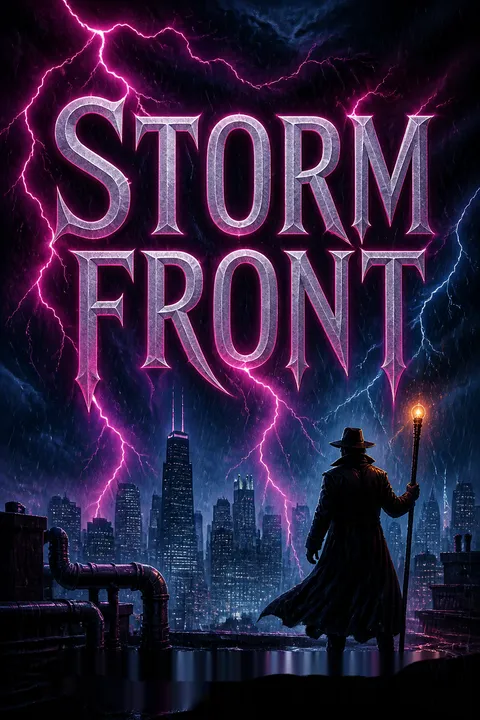


Plot Summary
Two Hearts Explode
Short on rent and short on clients, Harry Dresden, Chicago's openly practicing wizard and police consultant, agrees to meet a nervous woman calling herself Monica about her missing husband.
Before she arrives, Lieutenant Karrin Murphy summons him to a hotel room where two lovers lie dead, their hearts torn through their chests. Dresden reads the scene as a deliberate magical murder, probably powered by personal hatred and a ritual link to the victims.
Murphy identifies the woman as Jennifer Stanton, an escort, and the man as Tommy Tomm, bodyguard to crime boss Johnny Marcone. Dresden realizes the killings may draw the White Council, the secretive wizard authority, onto his trail. Racing back to his office, he is intercepted by Marcone's men.
The opening ties Dresden's material vulnerability to a threat that is moral and institutional. He needs paid work, so he accepts a missing-person case, but Murphy's crime scene immediately makes his expertise dangerous: understanding the murder may require him to study a forbidden act. The lovers' bodies turn intimacy into evidence of violence, while Dresden's insistence on distinguishing ritual murder from ordinary crime establishes his professional ethic. Yet he is already compromised by his precarious standing with the White Council. The mystery begins not with a clean choice between good and evil, but with overlapping obligations that make every useful action look suspicious to someone.
The Mobster's Quiet Offer
Marcone offers Dresden two weeks of generous pay to stay away from Murphy's investigation. Dresden refuses, though a soul gaze reveals the crime boss as controlled, ruthless, and more complicated than his courteous manner suggests.
At his office, Dresden finally meets Monica, who says her husband Victor Sells disappeared after losing his job and taking an interest in magic. She fears the police will dismiss him as a man who left his family, and pays Dresden a five-hundred-dollar retainer. Monica gives him a photograph, a phone number, and a dried scorpion pendant Victor owned.
Dresden suspects the charm may focus harmful magic. He also arranges a date with Susan Rodriguez, a sharp reporter whose curiosity has already led her to Dresden's work. With two cases and a deadline, he heads for Victor's lakeside house.
Dresden's refusal of Marcone's money is an early test of independence, but it is not uncomplicated heroism: the offer is substantial, and his overdue rent makes refusal costly. The soul gaze complicates the easy category of gangster, exposing a man whose discipline is inseparable from violence. Monica's retainer then gives Dresden a second, apparently unrelated mystery, while the scorpion pendant quietly introduces the material logic of ritual magic. Susan's date adds a human obligation that Dresden has little skill managing. These threads begin as competing claims on his time, but their proximity invites the reader to suspect that the cases may not stay separate.
Names Beneath the Moon
At Victor's locked lake house, Dresden finds empty trash cans returned to the property and senses that someone has been there recently. He lays a circle with bread, milk, honey, and his own blood, then traps Toot-toot, a tiny faery, and bargains for information.
Toot reports that a pizza delivery came to the house during a gathering where people were enjoying themselves. Before Dresden can follow the lead, Morgan, the White Council's armed Warden assigned to watch him, confronts him over summoning and binding a faery.
Morgan also suspects Dresden of the hotel murders because Dresden once killed his own murderous mentor in self-defense and remains under the Council's sentence of probation. After Morgan leaves, Dresden works with Bob, a spirit housed in a skull, to brew an escape potion and a love potion for his date with Susan.
The faery bargain shows that Dresden's power depends less on spectacle than on rules, names, and reciprocal obligation. Toot is not simply a magical informant; the circle lets Dresden exploit his appetite, so their relationship contains coercion as well as familiarity. Morgan makes that ambiguity politically dangerous by treating a technical breach as evidence of character. His suspicion is shaped by Dresden's past, revealing how institutions turn precedent into a lens through which new facts are interpreted. The potions bring the same question into private life. Dresden means to prepare for danger, but also permits Bob to help manufacture desire, a shortcut that makes his romantic insecurity materially consequential.
Bianca's Beautiful Mask
After learning that Bianca, a powerful vampiress who runs the Velvet Room escort service, employed Jennifer, Dresden visits her mansion despite Murphy's warning. Bianca attacks when he names Jennifer's murder. Dresden releases stored sunlight and forces her back, exposing the monstrous body beneath her human beauty.
He lowers his protective pentacle only after Bianca promises to talk. She says she knew Jennifer and Tommy as people, not merely clients, and points Dresden toward Linda Randall, Jennifer's former roommate and close friend.
Bianca cannot identify the killer, but her anger at being seen without her disguise makes the meeting volatile. Dresden leaves with Linda's number and a threat of future retaliation. Outside, Bianca's assistant Paula gives the vampire her wrist to drink from, revealing how appetite and dependency shape the household's loyalties.
Bianca's attack converts a polite interview into a contest over who controls appearances. Dresden's stored sunlight is practical preparation, but his use of it strips away the very beauty on which Bianca's status depends. Her vulnerability is not innocence; she remains dangerous, yet the scene shows that humiliation can wound power as surely as a weapon. Paula's willing submission further complicates the vampire's hold over others, suggesting that desire may be both chosen and conditioned. Dresden's formal courtesy keeps the exchange from becoming a fight, but it also leaves him negotiating with a predator whose promise is the only protection he has.
The Photographer's Shadow
Linda Randall refuses to speak over the phone, so Dresden finds her at the airport. She admits Jennifer invited her to reunite on Tommy's birthday, but conceals something behind her flirtatious act.
A pizza delivery driver then recalls taking food to Victor's lake house, where he glimpsed a black-clad photographer taking pictures through a window. He is frightened enough to assume Dresden is part of the party. That night, an unseen attacker ambushes Dresden outside his apartment and warns him to stop asking questions.
Dresden suspects Marcone, but cannot be sure. After an all-night attempt to reconstruct the murder spell, he goes to the police station to brief Murphy. His growing fear is sharpened by the knowledge that a stolen lock of hair could let a sorcerer target him remotely.
The investigation advances through partial witnesses who are each afraid for different reasons. Linda uses sexual performance to control the airport conversation; the delivery driver mistakes Dresden for someone implicated in the party; the attacker turns knowledge of magical links into a bodily threat. Information therefore arrives contaminated by self-protection. The stolen hair raises the stakes from professional exposure to intimate vulnerability: Dresden's own body can become evidence and weapon in another person's ritual. His effort to calculate the murder spell is also a moral risk, since the same technical knowledge that may save him could resemble the forbidden practice that once placed him under sentence.
ThreeEye Opens the Sight
At the station, a terrified ThreeEye user breaks loose and runs screaming down the hall. Dresden tackles him before he can tumble down the stairs. The man recognizes the supernatural mark Dresden carries from an earlier encounter and sees a presence called He Who Walks Behind, although he is no trained wizard.
Dresden realizes the new drug may genuinely open the Third Sight, a power that exposes hidden spirits and can drive ordinary users toward madness. He then explains his reconstruction of the hotel murders to Murphy: the killer used thaumaturgy, linking victims to a ritual focus, and an enormous supply of energy.
A group could supply that power, but the ThreeEye trade offers a more likely connection. Dresden suspects the drug's producer is also targeting Marcone, while Murphy orders him to stay out of the investigation.
ThreeEye changes the meaning of the case. The drug is not merely a criminal product but a technology for forcing perception open, with psychological consequences its users cannot control. The addict's recognition of Dresden's hidden mark validates the supernatural while making the truth socially unusable: police can see a man in crisis, but not what he sees. Dresden's explanation to Murphy shows his talent for translating magical mechanics into practical investigative hypotheses. Yet Murphy's boundary and his own compromised status remain. Their partnership works because each can interpret what the other cannot, but neither fully trusts the other's judgment.
A Date Turns Demonic
When Susan arrives for their date during a thunderstorm, Dresden is still recovering from a beating and nearly forgets she is coming. A toadlike demon forces its way through the threshold and spits corrosive acid at them. Dresden shields the pair, but the love potion he made for Susan has been mistaken for his escape potion.
She drinks it and becomes dangerously uninhibited. Bob, the skull spirit, sends the correct bottle across the lab, and Dresden and Susan use it to flee through the storm. Outside, the demon's unseen master appears through a magical image and declares both humans targets.
Susan becomes too sick from the mixed potions to run. Rather than escape alone, Dresden draws lightning from the storm and destroys the demon's physical form. The exertion leaves him exposed to arrest and a looming Council hearing.
The attack makes Dresden's private foolishness part of the survival problem. The potion error is comic in its origin but ethically serious in its effect, since Susan's apparent desire has been chemically imposed. Dresden recognizes the danger and tries to escape rather than exploit it, while Susan's later intervention with the gun shows her agency returning through action. His choice to stay with her, then use the storm's power, binds responsibility to risk. The storm is both the enemy's resource and Dresden's weapon, an unstable force that rewards courage while threatening to consume the person who channels it.
Linda's Final Call
After the demon attack, police take Dresden to Linda's apartment, where Murphy has found her murdered in the same ritual manner as Jennifer and Tommy. Linda had called emergency services, saying she knew who was responsible, before the spell struck.
Dresden recognizes his business card among the evidence and understands that she had planned to see him. Murphy connects Linda to the case and presses him for the truth. Afraid that revealing the connection will expose Linda's withheld information, draw the killer toward Murphy, or worsen his own legal danger, Dresden lies about knowing her.
Murphy sees the blood-speckled card and asks him to come to the station the next morning. Dresden leaves without telling her what Linda had tried to share, carrying guilt alongside the urgent need to find the killer.
Linda's death transforms withheld information from a tactical choice into a human cost. The card in the evidence bag proves a connection Dresden cannot explain away, while her last call confirms that the investigative lead was alive until the killer silenced it. Dresden's reasons for lying are not frivolous: he fears for Murphy and himself, and suspects the police cannot protect either. But his secrecy removes Murphy's ability to judge those risks for herself. The scene marks a fracture in their working relationship because protection and control have become difficult to distinguish. His guilt is heightened by the fact that Linda had chosen to trust him.
A Haircut Starts a War
Outside Linda's building, a man Dresden recognizes as one of Marcone's followers beats him and cuts off a lock of his hair. Dresden grapples with the attacker but cannot recover all of it. Using blood from the struggle, he casts a short-lived tracking spell and follows the man's scent to the Varsity, a club owned by Marcone.
Dresden blows the front door from its hinges, silences the club's jukebox with magic, and clears the customers from the room. He accuses the attacker, Gimpy Lawrence, of working for Marcone's rival and stealing the hair for a ritual.
When Gimpy draws a gun, Marcone's bodyguard Hendricks shoots him dead. Marcone denies involvement and confirms that his own people fear the mysterious ThreeEye supplier. Dresden leaves without his hair or a name for the killer.
Dresden's entrance at the Varsity is both a tactical choice and a public declaration. He wants the hair back, but the spectacle forces Marcone to respond in front of witnesses and turns a private threat into a challenge to criminal authority. Gimpy's death confirms that Dresden's magic cannot control the human violence it brings into the room. Marcone's composure contrasts with Dresden's fury, yet neither man has the information the other needs. Their temporary alignment is pragmatic rather than trusting: the hidden supplier threatens both the wizard's life and the mobster's control, but each still measures how much cooperation will cost.
The Film Under The Bed
With no answer from Marcone and no confidence that he can survive the coming storm, Dresden walks through the night and returns to Linda's apartment after sunrise. Under her bed he finds a red film canister matching the one he picked up at Victor's lake house.
Photographer Donny Wise arrives searching for the film, and Dresden corners him with his police consultant badge and a display of magic. Wise explains that Linda hired him to photograph an orgy at the lake house, hoping to gain leverage over someone there.
Dresden burns the undeveloped film after hearing his account, preventing Wise from selling it. The party, Linda's connection to Jennifer, and Victor's house now meet in a single chain. Dresden realizes Monica may have brought him into the case deliberately.
The film canister is a small physical object that joins two investigations more convincingly than speculation has. Its movement from Victor's property to Linda's apartment reveals a chain of observation, secrecy, and intended leverage. Dresden destroys the film rather than let Wise profit from exposure, an action consistent with his protective impulse but also a choice to discard evidence. His realization about Monica reframes the retainer: the missing-person case may have been a way to make him visible to Victor. The discovery restores momentum, but it does not make Dresden safer. It gives him a direction by showing how deliberately someone has arranged his involvement.
Monica Names Her Fear
Dresden confronts Monica at home, where he learns she has two children and will not let him near them. A brief soul gaze shows that fear for her family drives her. She admits Jennifer was her younger sister and that her husband, Victor, killed her.
Victor first pursued magic after frustration at work and grew increasingly violent as his experiments advanced. He gave Monica ThreeEye to force her Third Sight open, then learned to use the fear, lust, and other emotions of people in ritual work.
The Beckitts financed him in exchange for revenge against Marcone, whose gang had killed their daughter. Victor drew Jennifer and Linda into the gatherings, used the energy they generated, and began looking at his own children as possible sources of power. Monica sent Dresden to the lake house hoping Victor would notice him.
Monica's confession exposes the domestic life beneath the occult conspiracy. Victor's rise does not begin as a sudden transformation into a stranger; Monica remembers work, frustration, intermittent kindness, and escalating abuse, which explains why she struggled to name the danger. ThreeEye makes her perception both clearer and more traumatic, while Victor's use of emotional states turns other people's inner lives into fuel. Monica's decision to hire Dresden is an act of desperate protection, but it also places him in danger without his consent. Her motive is understandable without being harmless, and the children make the consequences of inaction impossible to abstract.
The Scorpion In The Office
Dresden learns that Murphy has gone to his office with a warrant, so he calls her and warns her not to open the desk drawer containing Victor's scorpion charm. She opens it before he can explain. The charm erupts into a rapidly growing magical scorpion that stings and poisons Murphy.
Dresden reaches the office, but Murphy, confused by the venom, handcuffs herself to him as she tries to arrest him. He drags her into an elevator while the creature tears through the building.
When the elevator stops, Dresden summons a column of wind that drives the car upward, crushing the scorpion against the shaft roof. The car then falls; he cushions the impact with a shield. EMTs take Murphy for treatment, and Dresden slips away before police arrive, still responsible for getting to Victor before the storm peaks.
The office attack makes the costs of distrust immediate and physical. Murphy searches because Dresden withheld the truth; Dresden's warning comes too late, and she interprets his rescue through the suspicion he helped create. The handcuffs bind them literally at the moment their partnership is most strained. Dresden's improvised elevator spell shows that survival depends on practical creativity, not simply greater force. Yet his escape from the arriving authorities repeats the pattern of withholding and flight. He saves Murphy's life but cannot remain beside her, because the case has made secrecy feel like the only path to protecting anyone.
Morgan Blocks The Road
Injured and out of equipment, Dresden reaches Mac's pub and asks to borrow the owner's car. Morgan arrives, convinced Dresden has used the storm to murder his victims, and orders him to stay put for the White Council.
Dresden tries to explain that Victor Sells is the killer, but Morgan refuses to listen. Dresden knocks him unconscious with a chair, then leaves in Mac's TransAm. At the lake house, he opens his Third Eye and sees the building saturated with violent magical residue and possible death.
The sight also shows him the seduction of Victor's power: enough force to destroy the house and everyone inside. His mother's pentacle steadies him, and Dresden chooses restraint over vengeance. With no tools left but his training and judgment, he enters the house.
This section makes Dresden's ethical crisis more than a contest with Victor. Morgan's certainty demonstrates how institutional suspicion can become self-sealing: evidence of Dresden's past matters more to him than Dresden's present warning. The chair assault is a breach that makes Dresden look guilty, even as it gives him a chance to stop the actual killer. At the lake, the Third Sight turns temptation into a vivid possibility, not an abstract moral lesson. The pentacle recalls an inherited standard of restraint, but the choice remains Dresden's. He goes forward without the equipment that usually contains his power, relying on the discipline that keeps power from becoming identity.
The Lake House Breaks
Inside, Dresden finds Victor conducting a storm-powered ritual with the Beckitts, his stolen hair, and a stockpile of ThreeEye. He burns the stereo feeding the ceremony, then breaks Victor's spell circle with the film canister, scattering its power and disrupting the Beckitts' ritual.
Victor attacks with fire, guns, and growing scorpions. Wounded and trapped, Dresden uses a broom spell to sweep the creatures away, then speaks the toad demon's true name and breaks Victor's control over it. When the demon turns on its summoner, Victor tries to escape.
Dresden cannot kill him with magic, but prevents him from fleeing; the demon and scorpions tear Victor apart. Morgan enters the burning house and sees Dresden has fought without breaking the Laws. He pulls Dresden from the fire and saves his life.
The final confrontation pays off objects and principles introduced throughout the investigation: the film canister becomes a counter to the circle, the demon's name reverses Victor's control, and the ordinary broom becomes useful where raw force would fail. Dresden does not win by matching Victor's willingness to kill. He breaks the ritual and releases the demon without claiming authority over it, accepting a dangerous outcome rather than violating the Law against binding. Victor's own system of exploitation then consumes him. Morgan's rescue matters because he witnesses the distinction between Dresden's power and Dresden's use of it, a distinction the Council's accusation had erased.
The Doom Is Lifted
The Beckitts are arrested, and police find the ThreeEye stock in the ruined lake house. Murphy remains critically ill for nearly three days but survives; she later resumes working with Dresden, though their easy trust has not returned.
Morgan reports the truth to the White Council, which lifts Dresden's Doom for his conduct during the case. Marcone's club burns, and rumors credit Dresden with removing the ThreeEye supplier, which helps keep further pressure off him. Susan visits Dresden in hospital with her story and accepts another date.
Dresden sends Toot-toot and the other faeries regular pizza in return for their help. He returns to work still aware that the power that tempted him remains within reach. The case is closed, but his vigilance against becoming like Victor is not.
The resolution repairs institutions and relationships only partially. The Council reverses its judgment because Morgan reports what he saw, yet the underlying suspicion of Dresden remains. Murphy survives, but the note that their joking has stopped gives emotional weight to the consequences that no official case outcome can undo. Dresden's promises to the faeries and renewed date with Susan restore ordinary obligations after the crisis, while Marcone's rumor demonstrates how easily public narratives can simplify complicated actions into criminal mythology. The book ends with a provisional rather than triumphant self-understanding: Dresden has resisted Victor, but knows that power and temptation will remain part of his daily work.
Analysis
Storm Front builds its murder mystery around the question of what power does to ordinary human relationships. The killings are not random displays of sorcery: the ritual uses intimacy, desire, fear, and bodily traces as instruments. Victor's magic turns emotions into fuel, while ThreeEye makes supernatural perception available as a commodity. Both practices promise access to something extraordinary, but strip control from the people who participate. The victims and Monica are therefore not simply caught in a wizard's crime. Their private vulnerabilities become the infrastructure of his power.
Dresden's counterpoint to Victor is not purity or superior strength. He lies to Murphy, mishandles a potion, and makes choices that endanger others. What distinguishes him is his recurring effort to accept limits: he prepares, bargains, improvises, and fights, but resists using magic to dominate or kill. The White Council's laws give that restraint a public framework, although Morgan's early certainty shows how rules can become unjust when enforcement stops listening. Dresden's eventual vindication depends on Morgan witnessing the actions that his suspicion had prevented him from imagining.
The story also treats trust as a practical condition of survival. Monica's attempt to protect her children draws Dresden into danger; Dresden's secrecy alienates Murphy; Linda's willingness to approach him comes too late to save her. These consequences prevent the novel from presenting secrecy as automatically wise or honesty as automatically safe. Each person acts with incomplete knowledge, and protection can become another form of control.
The ending does not erase that damage. Murphy survives, the Council lifts Dresden's sentence, and the ThreeEye operation is exposed, but friendship remains strained and Dresden remains aware of his own capacity for dangerous power. His achievement is not that he has become immune to temptation. It is that, under pressure, he chooses what his strength is for. The book's moral center rests in that repeated, imperfect choice to protect without claiming ownership over the people or forces he protects.
Review Summary
Storm Front receives mixed reviews, with many praising its entertaining blend of urban fantasy and detective noir. Readers enjoy Harry Dresden's character, his magical abilities, and the witty humor. However, some criticize the book for weak plotting, underdeveloped secondary characters, and outdated gender stereotypes. Many note that while this first installment has flaws, the series significantly improves in later books. Overall, it's considered a fun, if imperfect, introduction to the Dresden Files universe.
People Also Read







Characters
Harry Dresden
Reluctant city wizardHarry is a tall, cash-strapped wizard who advertises his abilities openly and works as a supernatural consultant for Chicago police. His distrust of machines, dry humor, and old-fashioned manners make him seem eccentric, but beneath the habits is a trained practitioner who understands that magic amplifies the person using it. His history with the White Council leaves him under suspicion and makes even investigative work legally dangerous. Harry is driven by a stubborn refusal to leave people undefended, especially when authorities cannot recognize the threat. He can be impulsive, proud, and secretive, often believing he must carry danger alone. His central struggle is to use formidable power without letting fear, anger, or resentment decide what kind of man he becomes.
Karrin Murphy
Unusual-crimes lieutenantKarrin Murphy leads Chicago Police Special Investigations, the unit given cases that ordinary police methods cannot easily explain. Compact, athletic, and disciplined, she has earned her position in a department that often treats her work as evidence of eccentricity. Murphy trusts evidence, but she is willing to consider supernatural causes when experience demands it. She relies on Dresden's knowledge while insisting that he respect her authority and the limits of a police investigation. Her bluntness conceals a strong protective instinct, and her competence makes her an equal partner rather than a sidekick. She is frustrated by Dresden's secrecy because she knows that hidden information can endanger people, yet she also understands the loneliness of carrying an unpopular responsibility.
Monica Sells
A frightened motherMonica is a careful, domestic woman who approaches Dresden because she believes her husband's unexplained disappearance may involve magic. She is cautious with names and eye contact, habits born from fear rather than simple superstition. Her attention is focused on keeping her children safe, and she has learned to manage danger by appeasing, waiting, and avoiding confrontation. That survival strategy makes it difficult for her to speak plainly, even when silence carries its own risks. Monica is neither a fool nor a passive emblem of victimhood; she observes changes in her household and makes a desperate choice to seek help from someone she barely knows. Her gentleness sits beside a capacity for determination that emerges when her children's safety is at stake.
Victor Sells
A missing husbandVictor is Monica's husband, a former SilverCo employee whose interest in magic deepens after professional disappointment. As described by Monica, he once worked hard to provide for his family and could be kind, but frustration increasingly shaped his temper and his private life. His fascination with occult practice appears to offer control where ordinary work has failed him. Victor's family knows only fragments of what he studies and what happens behind the locked attic door, creating an atmosphere of unease around his absence. He represents the danger of treating power as a substitute for self-understanding: a person may begin with a desire to improve his circumstances and still become consumed by the means he chooses.
John Marcone
Chicago's controlled crime bossJohn Marcone is the organized-crime leader who has consolidated power in Chicago by limiting disorder and keeping his operation efficient. He presents himself as courteous and reasonable, but Dresden's soul gaze reveals a man capable of calculated violence and unusually firm self-control. Marcone's authority depends on reputation as much as force, so public challenges and disloyalty matter to him as business problems. He is pragmatic enough to recognize that supernatural threats can affect his territory, yet he does not want police or wizards interfering in his affairs. A hidden regret complicates his otherwise disciplined self-image. He is a counterweight to Dresden: both are strategic and forceful, but they draw different boundaries around the use of power.
Susan Rodriguez
Ambitious paranormal reporterSusan reports for the Chicago Arcane, a publication that covers paranormal stories with varying degrees of credibility. She is intelligent, attractive, persistent, and unusually willing to use charm as an interviewing tool. Her professional curiosity is not a pose: she wants access to the facts, and she knows how to keep pressing when Dresden tries to evade her. Their attraction is genuine but tangled with her desire for a story, making their relationship a negotiation between intimacy and information. Susan is bold enough to pursue danger and resourceful when confronted with it, though she enters the supernatural world without Dresden's training. She challenges his instinct to retreat into isolation and forces him to reckon with how much of his life he can safely share.
Morgan
The Council's hard-edged WardenMorgan is the White Council's Warden assigned to monitor Dresden and enforce the Laws of Magic. He carries a sword that represents the Council's authority and treats his duty with severe, almost inflexible seriousness. His suspicion of Dresden is shaped by the wizard's history of using lethal magic, and he tends to interpret ambiguity as evidence of danger. Morgan is not merely cruel: his loyalty to law is sincere, but his certainty narrows his capacity to consider alternatives. His conflict with Dresden exposes the tension between due process and institutional fear.
Bob
A skull-bound spiritBob is a spirit of intellect who inhabits a human skull and serves as Dresden's storehouse of magical knowledge. Centuries of working with wizards have made him experienced, boastful, and irrepressibly interested in sex. He can advise on potions and obscure magical principles, but his help often comes with demands of his own. Bob's humor lightens Dresden's solitary life while also exposing how badly Harry's plans can go when he delegates without checking details.
Toot-toot
A hungry little faeryToot-toot is a tiny faery with silver wings, a bright appearance, and an appetite for human food. Dresden can summon him by name and trap him with a carefully drawn circle, but their exchanges depend on bargaining and promises. Toot is quick to complain and easily distracted, yet he can gather information through the wider network of lesser faeries. His childlike manner disguises a real supernatural capacity and a sharp sense of when a mortal is trying to cheat him.
Bianca
The Velvet Room's vampire ownerBianca is a powerful vampiress who runs the Velvet Room, an elite escort service. She uses elegance, hospitality, and beauty as instruments of control, and her human appearance conceals a predatory form. Her response to danger is swift and violent, but she also remembers the people who work for her and values clients who treat them well. Being seen without her carefully maintained disguise unsettles her, revealing how deeply status and appearance matter to her.
Linda Randall
Jennifer's old confidanteLinda worked at the Velvet Room and shared a close friendship with Jennifer Stanton, including a period when they lived together. She is quick-witted, openly sensual, and skilled at using flirtation to control a conversation. Beneath the practiced persona are loneliness and self-disgust, which she recognizes as part of a pattern of dependence on sex and attention. Her history with Jennifer gives her a personal stake in the events surrounding the hotel murders.
Jennifer Stanton
A Velvet Room escortJennifer is an escort employed by Bianca and the younger sister of Monica Sells. Monica remembers her as a rebel who left home to pursue a life of her own, while Linda recalls a warmth that made people feel better about themselves. Jennifer's connections cross the worlds of the Velvet Room, Marcone's organization, and Monica's family. Her choices are not reducible to the work she does; the people around her remember her as a sister and friend as well as a professional.
Tommy Tomm
Marcone's trusted bodyguardTommy is Marcone's bodyguard, a physically tough man whose private kindness surprises those who know him through his job. Bianca says he treated the women he hired as people and was unusually considerate toward them. His position connects Marcone's criminal world to the Velvet Room, making his murder a challenge to the power structure around him as well as a human loss.
Ron Carmichael
Murphy's skeptical partnerCarmichael is Murphy's police partner and an experienced investigator who doubts Dresden's supernatural explanations. His sarcasm and untidy appearance can make him seem shallow, but he is observant, intelligent, and persistent about evidence. His skepticism reflects the institutional pressure Murphy faces: unusual cases are easier to dismiss than to explain. He is willing to challenge Dresden even when that antagonism is inconvenient.
Mac
A quiet pub keeperMac owns a pub frequented by people who live near the boundaries of the supernatural. He speaks sparingly, builds the space with deliberate protections, and treats Dresden with the steady familiarity of an old friend. His understated gestures, including lending his car when Dresden needs it, carry more weight than long explanations. Mac offers refuge without pretending that refuge can solve every problem.
Greg and Helen Beckitt
Grieving parentsThe Beckitts are a wealthy couple whose daughter was killed in crossfire involving Marcone's organization. Their grief has hardened into a desire for revenge, leaving them vulnerable to promises that magic can correct what the courts failed to repair. They are not merely investors in a scheme; they are parents trying to give unbearable loss a target and a purpose.
Paula
Bianca's devoted assistantPaula works for Bianca and tends to her after Dresden exposes the vampire's true form. Her intimate familiarity with Bianca suggests a bond shaped by dependence, loyalty, and supernatural influence. She is a reminder that Bianca's household runs on more than business.
Donny Wise
A freelance photographerDonny takes adult photographs and accepts a job from Linda to capture a private gathering at Victor's lake house. He is self-interested and evasive, but becomes frightened when he realizes the people in his pictures are connected to murder. His testimony supplies a crucial link between Linda and the Sells property.
Lawrence
Marcone's disloyal enforcerKnown by the nickname Gimpy, Lawrence is one of Marcone's men and has a damaged knee. His insecurity and poor judgment make him vulnerable to pressure from a rival operation. His actions show how criminal loyalty can be tested through money and fear.
Jenny Sells
A watchful daughterJenny is Monica's daughter and Billy's older sister. She is observant beyond her years and senses the danger in her family before the adults explain it to her. Her concern for her mother gives the domestic stakes a clear, child-sized urgency.
Billy Sells
Monica's younger childBilly is Monica and Victor's young son, who appears briefly with his sister during Dresden's visit. His presence makes Monica's fear concrete: she is trying to protect children who cannot understand the full danger surrounding their home.
Plot Devices
Thaumaturgic links
Distance through resemblanceThaumaturgy lets a practitioner reproduce a small symbolic act on a linked object and magnify it into a distant effect. A sample such as hair, blood, or fingernails can connect the ritual to a person. Dresden uses this principle to infer how the hotel victims were killed and recognizes that his stolen hair could make him a target. The device turns identity and bodily traces into practical vulnerabilities, linking the mystery's forensic clues to its magical danger.
The Laws of Magic
Power under judgmentThe White Council's Laws regulate what wizards may do with magic, including killing and binding other beings. Dresden's past use of lethal magic has left him under the Doom of Damocles, making his investigation dangerous even when he acts to stop a murderer. Morgan's surveillance and the threat of a Council hearing turn legal interpretation into part of the suspense. The Laws also shape Dresden's choices in the final confrontation, where he must defeat an enemy without simply reproducing the enemy's methods.
ThreeEye
A drugged open eyeThreeEye is a street drug said to provide supernatural vision. Its users suffer frightening experiences, and Dresden's encounter with an addict suggests the drug can open the Third Sight rather than merely cause hallucinations. The drug connects the criminal market to magical practice, while its manufacture depends on Victor's larger operation. It also gives a person a lasting view of hidden entities and appearances, with consequences that can outlive the high.
Storm energy
Nature as a power sourceWizards can draw energy from natural forces, but storms are volatile and difficult to direct. The killer exploits the electrical power of spring thunderstorms to strengthen attacks, which makes the weather a deadline as well as a weapon. Dresden discovers that the same energy can be redirected in desperation. The device raises the cost of every spell: raw power can overcome a stronger opponent, but without discipline it can destroy the caster or the people nearby.
Circles and true names
Boundaries and identityMagic circles focus power and can restrain supernatural beings, while a true name creates a precise connection to its bearer. Dresden uses a circle to trap Toot-toot, and his knowledge of the toad demon's name later lets him challenge Victor's control over it. These devices operate through exactness rather than brute force: a flawed circle can scatter power, and a name must be known and spoken correctly. Together they establish that supernatural power depends on relationships, limits, and knowledge.
FAQ
Synopsis & Basic Details
What is Storm Front about?
- Wizard detective investigates murders: Harry Dresden, a wizard and private investigator, is drawn into a case involving gruesome murders linked to dark magic.
- Unraveling a magical conspiracy: He navigates Chicago's supernatural underworld, encountering vampires, faeries, and a power-hungry black wizard.
- Fighting for justice and survival: Harry must use his wits and magic to stop a dangerous drug operation and a demonic threat, while also clearing his name.
Why should I read Storm Front?
- Unique blend of genres: It combines urban fantasy, mystery, and noir elements into a compelling narrative.
- Compelling protagonist: Harry Dresden is a flawed but relatable character with a strong moral compass.
- Fast-paced and action-packed: The story is filled with suspense, magic, and thrilling confrontations.
What is the background of Storm Front?
- Modern urban setting: The story is set in contemporary Chicago, where magic exists hidden beneath the surface of everyday life.
- Supernatural underworld: A hidden world of vampires, faeries, and other magical beings operates alongside the mundane world.
- Magical law and order: The White Council governs the use of magic, imposing strict rules and consequences for violations.
What are the most memorable quotes in Storm Front?
- "I'm a wizard, not a miracle worker.": This quote encapsulates Harry's pragmatic approach to magic and his limitations.
- "The building was on fire, and it wasn't my fault.": This line highlights Harry's tendency to find himself in chaotic situations, often not of his own making.
- "It's not the power that corrupts, it's the fear of losing it.": This quote speaks to the core theme of the novel, exploring the dangers of unchecked ambition and the corrupting influence of power.
What writing style, narrative choices, and literary techniques does Jim Butcher use?
- First-person perspective: The story is told from Harry's point of view, providing an intimate and often humorous look into his thoughts and experiences.
- Fast-paced and action-oriented: Butcher uses short, punchy sentences and vivid descriptions to create a sense of urgency and excitement.
- Noir-inspired dialogue: The dialogue is often witty, sarcastic, and filled with subtext, reminiscent of classic detective novels.
Hidden Details & Subtle Connections
What are some minor details that add significant meaning?
- The mailman's skepticism: The mailman's initial disbelief in Harry's profession foreshadows the general public's ignorance of the supernatural world.
- The scorpion talisman: Monica's description of the scorpion talisman hints at Victor's involvement in dark magic and his connection to the demon Kalshazzak.
- The pizza delivery: Toot-toot's mention of a pizza delivery at Victor's lake house is a seemingly minor detail that leads Harry to Linda Randall, a key informant.
What are some subtle foreshadowing and callbacks?
- Harry's past violation: The constant mention of Harry's past violation of the Laws of Magic foreshadows the White Council's scrutiny and Morgan's initial distrust.
- Marcone's offer: Marcone's offer to Harry to stay out of the investigation foreshadows his deeper involvement in the drug trade and his willingness to use any means to protect his interests.
- The handcuffs: The handcuffs used to arrest Harry are later used by Harry to restrain Victor, highlighting Harry's resourcefulness and the cyclical nature of conflict.
What are some unexpected character connections?
- Bianca and Jennifer Stanton: The connection between Bianca and Jennifer Stanton reveals a deeper layer of the supernatural underworld and its influence on the murders.
- Linda Randall and the victims: Linda's connection to both Jennifer and Tommy suggests a network of secrets and hidden relationships that Harry must unravel.
- Victor and Marcone: While not explicitly stated, the implication is that Marcone is a client of Victor's, adding another layer to Marcone's criminal enterprise.
Who are the most significant supporting characters?
- Karrin Murphy: Murphy's role as a skeptical but ultimately supportive ally highlights the tension between the mundane and supernatural worlds.
- Johnny Marcone: Marcone's presence as a powerful and morally ambiguous figure adds complexity to the investigation and foreshadows future conflicts.
- Morgan: Morgan's role as a representative of the White Council introduces the theme of magical law and order and the challenges Harry faces in navigating it.
Psychological, Emotional, & Relational Analysis
What are some unspoken motivations of the characters?
- Harry's need for validation: Harry's desire to prove his worth as a wizard and his need for acceptance from the White Council drive his actions.
- Murphy's internal conflict: Murphy's struggle to reconcile her skepticism with her reliance on Harry's expertise reveals her internal conflict between logic and the supernatural.
- Marcone's desire for control: Marcone's actions are motivated by his desire to maintain power and control over Chicago's criminal underworld.
What psychological complexities do the characters exhibit?
- Harry's self-doubt: Despite his confidence, Harry often struggles with self-doubt and the fear of failing to protect those he cares about.
- Victor's descent into madness: Victor's transformation from a family man to a power-hungry sorcerer reveals the corrupting influence of dark magic and his own psychological instability.
- Morgan's rigid adherence to rules: Morgan's unwavering adherence to the White Council's laws highlights his internal struggle between duty and personal judgment.
What are the major emotional turning points?
- Harry's encounter with the corpses: The gruesome discovery of the victims' bodies solidifies Harry's commitment to solving the case and bringing the killer to justice.
- Harry's confrontation with Bianca: The violent encounter with Bianca forces Harry to confront the dangers of the supernatural world and his own vulnerability.
- Morgan's rescue of Harry: Morgan's decision to save Harry, despite his initial distrust, marks a turning point in their relationship and Harry's standing with the White Council.
How do relationship dynamics evolve?
- Harry and Murphy's strained partnership: Their relationship evolves from a professional partnership to a grudging respect, despite their differing views on the supernatural.
- Harry and Morgan's reluctant alliance: Their relationship shifts from animosity to a reluctant alliance, highlighting the complexities of duty and personal judgment.
- Harry and Monica's client-investigator dynamic: Their relationship is marked by Monica's initial reluctance and Harry's determination to uncover the truth, showcasing the challenges of trust.
Interpretation & Debate
Which parts of the story remain ambiguous or open-ended?
- Marcone's long-term plans: Marcone's ultimate goals and his future role in the supernatural underworld remain ambiguous, leaving room for future conflicts.
- The full extent of the White Council's knowledge: The White Council's awareness of the events and their true intentions regarding Harry remain unclear, creating a sense of unease.
- The nature of the demon Kalshazzak: The demon's true nature and its potential for future appearances are left open-ended, hinting at the ongoing threat of dark magic.
What are some debatable, controversial scenes or moments in Storm Front?
- Harry's use of magic: Harry's methods, while effective, often push the boundaries of the Laws of Magic, raising questions about his ethical choices.
- Murphy's reliance on Harry: Murphy's dependence on Harry's expertise, despite her skepticism, sparks debate about the role of faith and logic in solving supernatural crimes.
- The White Council's judgment: The White Council's initial condemnation of Harry and their subsequent acceptance of his innocence raise questions about their fairness and effectiveness.
Storm Front Ending Explained: How It Ends & What It Means
- Victor's demise and the demon's freedom: Victor's gruesome death at the hands of the demon he summoned highlights the dangers of unchecked ambition and the unpredictable nature of dark magic.
- Harry's vindication and new beginning: Harry's exoneration by the White Council and his renewed sense of purpose signify a new chapter in his life, but also the ongoing challenges he will face.
- The lingering threats and unresolved conflicts: The unresolved conflicts with Marcone and the lingering threat of dark magic suggest that the battle for justice is far from over, setting the stage for future installments in the series.
The Dresden Files Series







About the Author


Download PDF
Download EPUB
.epub digital book format is ideal for reading ebooks on phones, tablets, and e-readers.








