


Plot Summary
Prologue
Before Nancy arrives, Eleanor West has spent decades collecting children who returned from other worlds and were told their experiences were delusions. She once crossed into a world of her own, and the passage still calls to her, but she stays behind to give other travelers the understanding she never received.
When parents bring her a child, Eleanor assures them the school can help their daughter recover, even though she knows the students may never want to return to ordinary life. Her careful deception keeps the school open and gives the children somewhere they can be believed.
Eleanor’s work begins in a painful contradiction: she shelters children by misleading the adults who control their lives. Her lie is not a claim that the travelers are sick, but a protective disguise that lets her reach them. Because she once experienced the same rupture, her care is more than professional sympathy; it is an attempt to build the refuge she lacked. The prologue also establishes the book’s central conflict between a family’s desire to restore a child and the child’s need to be recognized as changed. Eleanor can offer belonging, but she cannot promise a return.
The Girl from the Halls
At seventeen, Nancy Whitman reaches Eleanor West’s boarding house seven weeks after returning from the Halls of the Dead. Her parents sent her there because they believe her years among the dead were delusions; to them, she vanished for only six months.
Eleanor recognizes a traveler rather than a patient and gives Nancy a dim room suited to the Underworld. Nancy still expects the Lord of the Dead to let her return once she has proved she is sure.
Her roommate, Sumi, meets that certainty with irreverent scorn, while Nancy’s suitcase reveals that her parents replaced her dark clothes with bright childhood outfits. Sumi recognizes the hurt beneath Nancy’s anger, takes the suitcase, and leads her toward the attic, where another student may help.
Nancy’s distress is not simply homesickness. She experiences her ordinary life as an imposed identity, while her parents’ loving effort to restore their former daughter feels like erasure. Her stillness, dark clothes, and sparse eating are adaptations to a world where patience and quiet once gave her purpose. Sumi’s bluntness disrupts Nancy’s private certainty, but it also offers a rare recognition: she treats Nancy’s attachment to another world as emotionally real, not as a symptom to be corrected. The scene frames the school as a refuge that cannot erase grief, and hope as both a source of endurance and a possible wound.
Four Directions, Forty Exiles
In the attic, Kade, a trans boy who once lived in a rule-bound Fairyland, replaces Nancy’s unsuitable clothes with black and white garments. At dinner, Nancy meets Jack and Jill, identical twins shaped by very different lives in a Gothic world, then hears other students describe their own strange destinations.
Lundy, an eight-year-old therapist aging backward after a bargain in a Goblin Market, explains that portal worlds fall along directions such as Nonsense and Logic. During orientation, Nancy learns that most doors open only once and that the school teaches students to move forward, not to reopen them. The lesson gives her a map of the travelers’ worlds, but no reliable route back to the Halls of the Dead.
The compass offers classification where the students crave certainty, but its tidy categories cannot measure what a world means to the person who lived there. Nancy assumes that a place with laws must be morally wrong for her, while her classmates show that emotional belonging can survive rejection, danger, and even exile. Lundy’s explanation makes institutional realism another form of grief: the odds are against return, though nobody can prove it impossible. Kade’s clothing exchange also models care as practical recognition. He does not ask Nancy to become ordinary; he helps her dress for the self she is trying to preserve.
Sumi’s Hands Are Gone
The next morning, Nancy follows screams into the hall and finds Sumi dead, her hands severed. The girl whose restless gestures had filled every room is suddenly beyond reach, and Nancy struggles to reconcile this violence with her memories of the dead as peaceful.
Students glance toward the newcomer from an Underworld, while Jack’s history of anatomical experiments makes her another easy target. After a classmate humiliates Jack at dinner, Nancy publicly condemns the cruelty, then joins Jack and Kade in boxing Sumi’s belongings.
In a shoebox, Nancy finds photographs of a solemn child who once knew how to disappear into the background. Kade preserves the pictures beside one of Sumi’s recent portraits, giving the school a way to remember her beyond the murder.
Sumi’s death converts the school’s shared estrangement into suspicion. The students have learned to understand one another through unusual histories, yet fear makes those same histories look like evidence of danger. Nancy’s grief is sharpened by her belief that the dead may be easier to understand than the living; Sumi’s absence forces her to confront death as an irreversible loss, not a welcoming destination. The photographs complicate the image of Sumi as pure chaos. They reveal a child who had once survived by being overlooked, making her later exuberance feel less like whimsy than a hard-won freedom. Nancy’s defense of Jack marks her first public choice of solidarity over safety.
Loriel’s Missing Eyes
Before dawn, Loriel Youngers is found on the lawn with her eyes removed. Jack examines the injuries and concludes that Loriel was alive when the attacker took them, a precision that makes the killing look like harvesting rather than a random assault.
Nancy and Christopher, who knows how to call skeletons through his silent bone flute, help Jack prepare Loriel’s remains; Christopher then guides the dancing bones beneath the earth. Later, Eleanor admits that she cannot protect everyone and offers students suited to Nonsense a chance to pass through her own door.
Nancy learns that the offer is limited and frightening, not a simple rescue. With Sumi’s hands and Loriel’s eyes taken, the survivors begin to suspect that the murderer wants something specific from each traveler.
The second murder changes the meaning of the first. Sumi’s hands and Loriel’s eyes are not interchangeable trophies; they are parts associated with each girl’s distinctive capacities. Jack’s clinical attention supplies evidence, while Nancy and Christopher insist that the remains still deserve care. Their different rituals challenge the school’s tendency to treat strange experience as either pathology or spectacle. Eleanor’s offer of passage reveals the cost of leadership: she can open a door for some students, but doing so risks dividing those who can use it from those who cannot. Safety now depends not only on finding the killer, but on understanding what the victims were selected for.
The Brain in the Grove
That night, Nancy, Kade, and Christopher find Lundy dead beneath the trees, her brain removed. Angela arrives with other students and accuses them of hiding Seraphina, a beautiful traveler who has disappeared since Eleanor offered an escape through her door.
Eleanor sends everyone back inside, but Jack appears outside bleeding from a stab wound. Nancy has seen Jill pass by with blood on her hands, moving calmly through the dark. Once Jack can speak, she recognizes the pattern: her twin sister has been taking the traits that made particular travelers fit their worlds.
Jill is assembling what she believes will be a key capable of opening the way back to the Moors. Seraphina is still alive, and the others race to find her before Jill takes another part.
The stolen brain makes the pattern impossible to dismiss as a sequence of unrelated crimes. It also gives the mystery a disturbing psychological shape: the attacker is reducing people to the qualities that made them feel at home, treating identity as material that can be collected and recombined. Nancy’s stillness, once a private defense, becomes crucial when it allows her to witness Jill without being noticed. Jack’s recognition carries a different burden. She knows the person behind the violence intimately, so solving the case means admitting that family loyalty cannot excuse the harm being done. The offer of escape heightens the pressure, since the school’s most vulnerable students now have reason to scatter.
Jill’s Skeleton Key
In the attic, the group finds Jill beside Seraphina, bound on the worktable, with jars holding the stolen parts. Jill explains that she is constructing an ideal girl whose beauty, intelligence, strength, and speed will persuade every world to welcome her. She means to use that composite body to return to the Moors and her former vampire master.
Nancy tries to make Jill recognize the dead as people, but Jill values her own return above their lives. While Kade and Nancy keep Jill’s attention, Jack circles behind her and stabs her with scissors. Jack then cuts open a doorway to the storm-dark Moors, lifts Jill’s body, and carries her through, intending to revive her there. Seraphina is freed, but Jack leaves the school behind.
Jill’s plan literalizes a desperate wish shared by the school: to recover the world that once made life intelligible. Her mistake is to treat belonging as something that can be engineered from other people’s best attributes. The composite body would cross thresholds, but it could not repair the relationship or the violence that led Jill to leave. Jack’s decision to kill her sister is neither a clean moral victory nor a simple act of revenge. It joins love to refusal: Jack stops Jill from taking another life, then carries her toward the one world that may still claim them both. The opened door resolves the immediate crisis while preserving the emotional cost.
Epilogue
After the killings, the students bury Lundy with Sumi’s hands and Loriel’s eyes, and the police eventually close their investigation without finding the murderer. Eleanor slowly recovers, while Kade begins helping her run the school. Nancy prepares to visit her parents for the holidays, knowing they still want the daughter they remember.
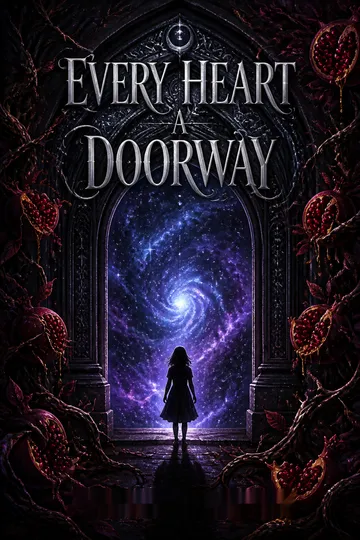
Kade gives her the bright suitcase they had taken from her, and inside she finds a note Sumi left behind, urging Nancy to claim her own story. A door appears where the basement stairs should be. Nancy opens it and steps into the pomegranate grove of the Halls of the Dead, no longer waiting for someone else to decide where she belongs.
The ending does not make Nancy’s return a cure for the pain of exile. Instead, it changes the source of her movement: she opens the door after accepting that her story belongs to her, not because Eleanor, her parents, or the Lord of the Dead has certified her choice. Sumi’s note continues the friendship beyond death, transforming a message written for a frightened newcomer into permission to act. The suitcase that once embodied her parents’ attempt to restore her former self becomes a prop she can leave behind. Her return is therefore both homecoming and self-authorship, a choice rather than a summons.
Analysis
Every Heart a Doorway begins with a conflict over who has the authority to describe a child’s life. The returning travelers know that another world was real because they lived there, but their families see disappearance, delusion, or a problem to be corrected. Eleanor’s school offers recognition without pretending to erase the rupture. Its students do not simply miss extraordinary scenery. They miss a place that gave their particular temperaments meaning.
The portal system makes identity relational. A door appears because a child and a world fit one another, and the school’s compass offers a language for those different forms of fit. But the categories cannot settle whether a world was good, or whether a traveler should want it back. Jack’s experience in the Moors, Nancy’s life among the dead, and Kade’s expulsion from Fairyland all resist easy moral sorting. Their attachments remain meaningful even when the worlds that shaped them were dangerous or rejecting.
The murders turn this emotional premise into physical horror. Sumi’s hands, Loriel’s eyes, and Lundy’s brain are not chosen at random. Jill treats the travelers as sources of traits that might unlock every world, reducing a person’s history to a part that can be removed. Her plan is an extreme version of the same demand Nancy faces from her parents: become the person someone else believes you should be. The distinction is that her parents act from misplaced love, while Jill acts from desperate self-interest, but both imagine identity can be restored or assembled from the outside.
Nancy’s ending rejects both forms of control. She does not return because a parent has decided she is ready or because a former home has summoned her. She chooses the door after absorbing Sumi’s reminder that her future is hers to shape. The story does not equate healing with forgetting, nor does it treat every homecoming as safe. It argues instead that recognition begins when a person can name where they belong and make that choice for themselves.
Review Summary
Every Heart a Doorway receives overwhelmingly positive reviews for its unique premise, diverse characters, and beautiful prose. Readers praise the exploration of identity, belonging, and acceptance. The novella's short length is both appreciated and criticized, with some wishing for more world-building. The murder mystery plot divides opinions, with some finding it weak or predictable. Many reviewers highlight the book's representation of asexual and transgender characters. While a few readers found the story underwhelming, most consider it a captivating and important work in the fantasy genre.
People Also Read






Characters
Nancy Whitman
Underworld’s quiet returneeNancy is a seventeen-year-old traveler who spent years serving in the Halls of the Dead before being returned to her birth world. She prizes stillness, restraint, and the dark clothes that fit the place she considers home. Her parents love her, but they interpret her transformation as damage and try to restore the girl they remember. Nancy is asexual and has no interest in the romantic or sexual expectations her peers take for granted, though she can recognize beauty and feel closeness. Her difficulty adapting comes from more than culture shock: ordinary life asks her to deny an experience that gave her a sense of belonging. Her careful attention to the dead makes her unusual among students and offers a different way of seeing their losses.
Eleanor West
The travelers’ sheltering headmistressEleanor West is the elderly founder of the home for children who return from portal worlds. She knows firsthand how painful it is to have an extraordinary life dismissed as illness, so she builds a school where travelers can speak without pretending. Her public explanations to parents conceal the school’s true purpose, a deception she accepts because it lets her protect the students. Eleanor is warm, theatrical, and deeply invested in the children, but her affection does not make her omnipotent. She understands that the students may never recover the worlds they lost, and she must balance their need for hope against the danger of promising too much. Her own past gives her care both authority and private cost.
Sumi
A whirlwind from NonsenseSumi is Nancy’s quick-moving roommate, a traveler shaped by a high-Nonsense world where constant motion helped her survive. She speaks in playful tangles, ignores ordinary conventions, and can shift suddenly from comic mischief to unnerving clarity. Beneath her apparent frivolity is a sharp awareness of how painful hope can become when it keeps someone attached to an unreachable past. Sumi makes room for others by refusing to treat their strangeness as a flaw, though she does so in her own invasive and unpredictable fashion. Her life before the portal was quieter and more constrained than her exuberance suggests. She carries a complicated mix of affection, loss, and resistance to growing into the person this world expects.
Kade
The school’s steady caretakerKade is a trans boy who traveled to a highly ordered Fairyland and was expelled when its rulers rejected his identity. He helps manage the school’s clothing exchange, offering practical support to students whose parents have packed for the children they used to be. His sharp memory of the world he lost makes him reluctant to forget, even though he knows he cannot simply return. Kade is observant, warm, and willing to take responsibility for people around him, but his generosity is shadowed by the knowledge that his parents would accept him only if he became their imagined daughter again. He understands that a chosen community can become a home, even when it cannot replace the world that first made him feel understood.
Jack
A moorland medical apprenticeJack is Jill’s identical twin and a trans boy whose years in the Moors made him a capable, unsentimental student of anatomy. He apprenticed to Dr. Bleak, a scientist who treated death as a problem knowledge might solve, and remains fascinated by the body’s possibilities. Jack’s formal clothes and sharp manner help keep others at a distance; beneath them is a person deeply shaped by rejection and wary of being misunderstood. He resists sentimental accounts of the worlds students visited, especially when others dismiss his as too frightening to value. His loyalty to his twin is tangled with their shared past, while his medical curiosity gives him a way to make sense of experiences that most classmates would rather avoid.
Jill
A twin drawn to the MoorsJill is Jack’s identical twin, a traveler whose years in the Moors were shaped by a powerful vampire lord and the promise of a place beside him. She favors pale, elaborate dresses and speaks with a gentleness that can conceal how firmly she holds to her desires. Her attachment to the Master reflects a deep longing to be cherished and chosen, especially after a childhood in which her family assigned her a role before asking who she wanted to be. Jill and Jack remember their shared journey differently, and their contrasting memories complicate their bond. She is both a survivor of a dangerous world and someone still organized around its promises.
Lundy
The reverse-aging therapistLundy is a licensed child therapist whose body resembles that of an eight-year-old, though her manner and judgment are unmistakably adult. She made a bargain in the Goblin Market and now grows younger as time passes. At the school, she tries to give students a practical framework for understanding their travels and their uncertain futures. Her professionalism is tempered by personal knowledge of what it means to break a world’s rules and lose the life one expected. Lundy can be compassionate without offering easy reassurance, a quality that helps and sometimes unsettles the students she guides.
Christopher
The keeper of dancing bonesChristopher is a quiet student who traveled to a country inhabited by skeletons and carries a bone flute that the living cannot hear. He can use its music to call skeletons into motion, a skill he treats with reverence rather than showmanship. His peers sometimes ridicule the world he visited, leaving him defensive and isolated. Christopher is more socially perceptive than his reserve first suggests, and he can challenge Jack’s abrasive behavior without dismissing her knowledge. He approaches death through the customs of his former home, where bones are not frightening remains but members of a community deserving care.
Loriel Youngers
The traveler with sharp eyesLoriel is a student who found a tiny doorway into the Webworld, a realm of small kingdoms and intricate dangers. She served among its miniature societies and returned with unusually keen vision, which she manages with special lenses. Her memories are bound to a place where she was offered a lasting role, and she believes that careful searching may lead her back. Loriel is intelligent and persistent, but her certainty can make it difficult for her to accept how much of her life now depends on forces she cannot control. Her story gives the school a clear example of how a seemingly insignificant doorway can lead to an enormous world.
Seraphina
The school’s striking beautySeraphina is a traveler whose extraordinary beauty draws attention from nearly everyone around her. She visited a world aligned with Nonsense and Wickedness, and her experience left her with a reputation for sharpness as well as glamour. Other students respond to her appearance before they know her well, giving her unusual social power and making genuine connection harder to distinguish from admiration. Seraphina’s presence illustrates how a trait that becomes a gift in one world can complicate life in another. She belongs to the school’s larger community of travelers, each carrying a mark of the place that once welcomed them.
Angela
A fearful rainbow runnerAngela is a student whose travels involved running along rainbows in enchanted shoes. She is frightened by the murders and quick to suspect classmates whose histories seem dangerous or unfamiliar. Her accusations reveal how the school’s fragile solidarity can give way when students fear for their own safety. Angela also shows that a world remembered as bright and wondrous may contain dangers its visitors never fully understood.
Plot Devices
Portal doors
Passage into belongingHidden doors carry children from ordinary places into worlds that resonate with something in their nature. Many open only once, leaving travelers who return to their birth world uncertain whether they can ever go back. The doors shape the story’s central tension: a return can feel like rescue to the traveler and like loss to the family left behind. Eleanor’s persistent passage offers a rare refuge, while Nancy’s final doorway makes return depend on her own readiness. Portals are not merely routes between settings; they make belonging tangible, unpredictable, and sometimes painfully temporary.
The Great Compass
Maps worlds by natureThe travelers classify portal worlds through directions such as Nonsense, Logic, Virtue, and Wickedness, with lesser directions branching from them. The system helps students compare places that cannot be mapped by ordinary geography, and gives Nancy a vocabulary for worlds her classmates already know how to discuss. Yet the compass describes a world’s underlying rules, not whether a traveler experiences it as kind or cruel. Its limits matter: categories can organize experience, but they cannot decide what counts as home for the person who lived there.
Traveler affinities
Traits that open worldsEach traveler seems to possess a quality that made a particular world recognize or welcome them. Nancy’s practiced stillness, Sumi’s restless hands, Loriel’s keen eyes, and Seraphina’s beauty suggest that these affinities can be embodied as well as emotional. The murders turn that idea into a clue: the killer is taking parts associated with what makes specific students distinctive. The device links identity, bodily autonomy, and the portal mystery, showing how a trait that once helped a traveler belong can become vulnerable to someone who sees people as collections of useful pieces.
Christopher’s bone flute
Music that moves skeletonsChristopher plays a flute made from bone, but its music is inaudible to living listeners. In the world he visited, that music can call skeletons into motion and guide them as they move. At the school, the instrument lets Christopher honor the dead according to the customs he learned, rather than treating bones as inert evidence or frightening remains. Its strange rules also bring him into contact with Jack and Nancy, whose own histories make them less likely to recoil from what he can do.
Wayward Children Series
About the Author
Other books by Seanan McGuire


Download PDF
Download EPUB
.epub digital book format is ideal for reading ebooks on phones, tablets, and e-readers.








