

Plot Summary
A Debt to Laksha
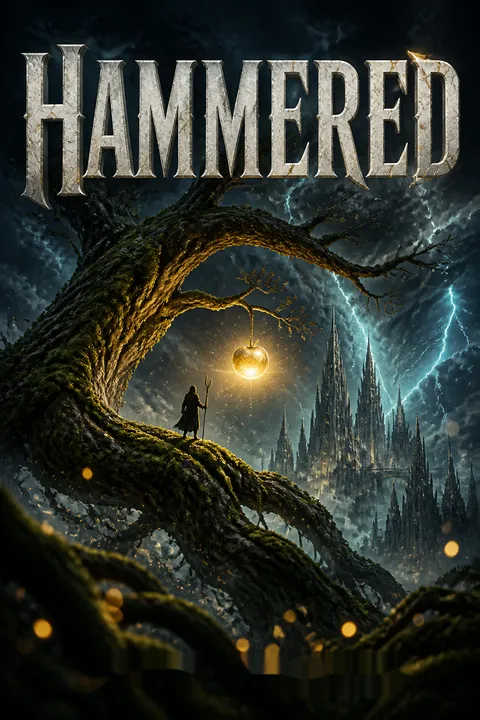
Atticus O’Sullivan, an ancient Druid living in Arizona, owes the witch Laksha a golden apple from Asgard. She has already fulfilled her side of their bargain by killing twelve Bacchants, so refusing the theft could bring her retaliation. His apprentice, Granuaile, doubts his theory that Ratatosk, the squirrel of the World Tree Yggdrasil, can carry him into Asgard without using the guarded Bifrost Bridge.
Atticus believes the tree’s roots connect to other planes, which his Druidic tattoos let him reach. In Siberia, he finds the root leading from the Well of Mimir and starts climbing. A squirrel the size of a truck appears above him, proving his theory about Ratatosk’s extraordinary size, and threatening to expose him to the Norse gods.
The mission begins as a debt, not a crusade. Atticus’s confidence in his loophole reflects a mind trained to survive by finding routes others overlook, while his promise to Laksha makes that ingenuity answerable to someone else. Granuaile’s skepticism also marks her as more than a spectator: she tests the boundaries of his knowledge even as she hopes to inherit it. The giant squirrel turns clever speculation into immediate danger, setting the book’s pattern of comic certainty colliding with lethal consequence.
Ratatosk's Fatal Welcome
Ratatosk catches Atticus on the root and demands to know why he is climbing toward Asgard. Atticus invents a story about a message from the dwarves warning that the Norns, keepers of fate, face an attack. He claims the Roman god Bacchus is coming for them, and Ratatosk believes him, carrying him quickly toward the upper world.
Near the exit, the Norns blast the squirrel into ashes and bone, then turn their attention to the hidden intruder. Their magic penetrates Atticus’s iron amulet enough to signal that it can still harm him. He binds their woolen clothes together, but they begin weaving a spell against him. To stop it, he draws his sword and kills all three. He buries their bodies and collects Ratatosk’s remains.
Atticus’s lie begins as a tool for avoiding danger, but it gives the Norns a reason to treat his arrival as a threat. Their attack makes his killing an act of self-defense, yet it does not erase the moral cost: Ratatosk dies because he trusted Atticus, and the guardians of fate are now dead as well. Atticus’s instinct is to act first and account for consequences later. Here that survival habit transforms a covert theft into a conflict with an entire pantheon.
The Golden Apple Caper
With the Norns dead, Atticus has only until the gods notice their absence to finish the job. He runs across Asgard toward Idunn’s remote hall, using Ratatosk’s directions to find the orchards near Freyr’s residence. Through an open window, he hears Idunn and her husband, the poet Bragi, hoping the Norns’ deaths might lift a curse that prevents them from having a child.
Their conversation confirms where the golden apples are kept. Atticus slips inside, steals one, and leaves a mocking note designed to make the gods blame Bacchus. He scatters plums by a river to suggest he escaped through the water, then buries his clothes and sword in the orchard. Shapeshifted into a camouflaged stag, he begins the faster run back to Yggdrasil.
The theft is built from observation and misdirection, but the overheard hope of Idunn and Bragi gives the mission an unexpected human tenderness. Their desire for a child contrasts with Atticus’s instrumental view of the apple as payment. His prankish note and false trail show how humor helps him manage fear, yet they also prolong the consequences of his earlier lie by steering suspicion toward someone else. Even a successful escape, the scene suggests, can leave other people carrying the confusion.
Odin's Spear Turns
As Atticus nears the root, Odin’s ravens appear overhead, followed by Odin on his eight-legged horse, Sleipnir, and a flight of Valkyries. Odin hurls Gungnir, his spear, whose magic is meant to ensure it hits its target. Atticus changes from stag to human at the last moment, disrupting the spear’s aim, then pulls it from the ground and throws it at Sleipnir.
The horse is struck in the throat and falls, while the Valkyries turn to Odin and the ravens drop from the sky. Atticus escapes through Yggdrasil’s root with the apple, leaving his sword buried in Asgard. Back on Earth, he delivers the damaged fruit to Laksha. She eats it, regains her youth, and receives the prize Atticus promised.
The escape looks like a triumph of improvisation, but every advantage carries a cost. Atticus defeats Odin’s targeting magic by changing what it is aimed at, then uses the spear against the horse, producing a wound that cannot be undone by cleverness. Returning the apple clears his obligation to Laksha, but it does not restore the balance he has broken in Asgard. His success therefore feels unstable: he has kept his word to one person while creating new enemies among the gods.
Granuaile Chooses the Earth
Back in Arizona, Atticus recognizes that he must leave Tempe before the Norse, the Roman god Bacchus, or human enemies find him. He explains to Granuaile that becoming a Druid will mean years of training, danger, and separation from her old life.
She refuses to abandon her apprenticeship. Atticus tells her how Druids draw power from the earth, why they cannot use that power to directly harm living creatures, and how their work depends on earning the trust of elementals.
He introduces her to Sonora, the Sonoran Desert elemental, and Ferris, an iron elemental. Sonora gives Granuaile a first task: remove invasive crayfish from the East Verde River. Atticus also arranges for his Druid books to be hidden and made available to her if he does not return.
Granuaile’s decision is not an escape into magical power so much as an acceptance of constraint and responsibility. Atticus makes the costs concrete, including the long training and risk to her family, but her choice remains her own. The elementals’ task grounds her new identity in ecological repair rather than combat. Atticus’s hidden books function as a practical expression of care: he prepares for his absence without admitting that he may not come back, trying to pass on knowledge while preserving her independence.
Tempe Begins to Empty
Atticus arranges new identities, leaves his bookshop in Rebecca Dane’s care, and asks his lawyer Hal Hauk to protect his rare books and provide for Granuaile if he dies. His witch ally Malina warns that the Hammers of God are returning and that Bacchus may soon come looking for him.
Atticus urges her coven to leave Arizona before a vampire power struggle begins. Leif Helgarson, a vampire and Atticus’s friend, prepares to join the next Asgard trip with Gunnar Magnusson, alpha of the local werewolf pack.
Before they leave, Leif attacks sixty-three rival vampires at a football stadium, killing them without killing any human spectators. The massacre makes headlines, while Atticus’s friends prepare for a journey that may cost them their homes and positions.
The preparations turn departure into a social event rather than a solitary escape. Atticus’s arrangements for Rebecca, Granuaile, and the hidden books show that he understands how many lives depend on his choices, even as he tries to disappear. Leif’s stadium massacre is both a defense of his territory and a public assertion of power, exposing the danger that follows him into the expedition. Each ally has a different reason to leave Tempe, but their needs converge around Atticus’s ability to reach Asgard.
Jesus at Lunch
On his last day in Tempe, Atticus meets Jesus, who warns him that killing Thor could set off consequences far beyond Asgard. Their conversation is interrupted when Rabbi Yosef Bialik arrives with the Hammers of God, a group of Kabbalistic witch hunters who believe Atticus is allied with demons. Their magic blocks his access to the earth, and their enchanted blows and silver knives leave him gravely wounded.
Jesus reveals his identity and persuades the hunters that Atticus has been fighting demons, not summoning them. After they withdraw, Jesus heals Atticus but insists that his earlier choice to kill the god Aenghus Óg helped bring him to this crisis. He warns that killing Thor may endanger both Atticus’s friends and the world.
Jesus’s warning makes the story’s central problem ethical as well as tactical. Atticus has repeatedly acted from loyalty and self-defense, but those motives do not prevent violence from multiplying. The Hammers’ certainty mirrors a danger in Atticus himself: both sides interpret incomplete evidence as permission to attack. Jesus intervenes to correct the hunters’ judgment, yet he does not simply erase Atticus’s pain. His insistence that consequences must be traced backward challenges the Druid’s habit of treating each crisis as isolated.
Bacchus Takes Chase
Before Atticus can leave Tempe, Bacchus arrives at his house with flying leopards and attacks the ivy around it. Leif drives Atticus and Gunnar east toward a forest that can serve as a route to the Fae plane Tír na nÓg. Bacchus catches them in the air, clawing at the car, but Atticus binds the god’s pinecone-tipped staff to a leopard’s head, forcing Bacchus to abandon his pursuit long enough for them to escape.
In Aravaipa Canyon, Bacchus catches up again. Sonora prevents the vines from restraining Leif, while Gunnar fights and disables the leopards. Leif throws Bacchus down the canyon, and Atticus taunts him before shifting the group to Tír na nÓg. They reach safety, but Bacchus remains an enemy.
The chase converts Atticus’s accumulating supernatural debts into immediate physical danger. Unlike the Norse gods, Bacchus cannot be defeated by simply outmaneuvering a weapon: the group survives by coordinating their separate strengths. Atticus’s reliance on Sonora also shows that his bond with the earth is reciprocal. The elemental helps because Atticus asks, not because nature is a resource he can command without limit. His final taunt offers a moment of defiance, though it also gives Bacchus another reason to pursue him.
Grievances Around the Fire
In Siberia, Atticus gathers Leif, Gunnar, the Slavic thunder god Perun, Finnish wizard Väinämöinen, and Chinese immortal Zhang Guo Lao. Each tells how Thor wronged him. Gunnar’s story reaches back to the werewolf pack and its leader Rannveig, whose loved ones were killed by Thor for refusing racial exclusion.
Väinämöinen recalls Thor murdering a curious sea serpent he had befriended. Zhang remembers Thor killing and abandoning his magical donkey. Perun blames Thor and Odin for helping the Norse gods eclipse other traditions through written stories.
Leif reveals that Thor killed his family a millennium earlier, prompting him to become a vampire and seek revenge. He also admits he befriended Atticus to gain a way into Asgard, though he now values their friendship.
The fireside stories turn a revenge mission into a coalition, but they also expose how differently each man understands justice. Gunnar speaks from the responsibility of leadership; Väinämöinen mourns curiosity destroyed by rash judgment; Zhang carries humiliation; Perun resents cultural erasure; Leif has shaped a millennium around personal loss. Atticus’s role is to learn who these men are well enough to carry them between planes. Leif’s confession complicates trust without nullifying genuine friendship, showing that affection can grow inside a relationship that began as an instrument.
Hrym Joins the Hunt
At the Well of Mimir, the party meets a frost giant named Suttung, who takes them to his leader, Hrym. Zhang Guo Lao demonstrates his strength by paralyzing Suttung with precise blows, earning the giants’ attention.
Atticus offers Hrym a chance to strike Asgard before the prophesied Ragnarok, arguing that the deaths of the Norns have made the future uncertain. Hrym doubts that anyone can withstand Thor’s lightning. Perun answers by giving the group fulgurites, glassy tubes formed by lightning strikes that shield whoever carries one from lightning.
He demonstrates their protection on the frost giants. Hrym agrees to supply warriors who can fly as eagles. The group plans to provoke the Norse gods into attacking them on the Plain of Idavoll, away from their full forces.
The alliance forms when Atticus can offer the frost giants something more tangible than vengeance: a way to survive the weapon that has kept them subordinate. Perun’s fulgurites make shared knowledge a military resource, and his demonstration turns possibility into trust. Atticus also reframes the Norns’ deaths as an opening in history, though the uncertainty that empowers the giants may equally imperil the world. Hrym’s agreement is therefore both a political choice and a wager on a future no one can reliably predict.
Gjallarhorn Sounds
The group reaches Asgard through Ratatosk’s passage, intending to lure Thor and Freyja away from their strongholds. Heimdall is already watching the root. He kills two frost giants as they change from eagles into warriors, then blows Gjallarhorn to warn Asgard before the others crush him.
The giants celebrate, but Atticus realizes the horn will summon every available Norse fighter. He searches through the snow and retrieves Moralltach, the Fae sword he buried on his first visit.
Odin’s spear kills Väinämöinen when Odin pierces the wizard through the group’s magical concealment. The concealment collapses, and Atticus warns the others to prepare for the full force of Asgard. The enemy now knows where they are, and their plan to control the timing has failed.
The horn marks the moment a planned raid becomes an open battle. Heimdall’s death is a tactical gain for the frost giants, but the sound he releases transforms that gain into a summons. Väinämöinen’s death makes the cost immediate, while the collapse of his concealment strips away the coalition’s protection. Atticus’s recovery of Moralltach gives him a weapon he will need, but it also places him back inside the conflict he had hoped to survive mostly as a guide.
Thor Pays in Blood
The Valkyries descend with Thor, and Atticus uses Perun’s fulgurite to survive repeated lightning strikes. He shifts forms to evade Mjöllnir’s tracking magic, then attacks the Valkyries with Fragarach while Leif fights beside him. Perun’s lightning kills the remaining shieldmaidens. When the Norse gods arrive, Freyr’s boar, Gullinbursti, fatally wounds Gunnar.
Atticus uses Odin’s spear against Freyr and later a raven, leaving Odin incapacitated. Leif continues fighting Thor and finally drives Moralltach into him, accepting Thor’s hammer blow to land the strike. Thor dies, but Leif’s head is destroyed. Zhang Guo Lao survives his duel with Týr, who is left alive, while the frost giants take Freyja captive before her flying cats rescue her.
The climax fulfills several grievances at once, but its victories refuse to feel clean. Atticus’s shapeshifting counters the Norse weapons only long enough to keep the others alive; Perun’s protection and the allies’ different skills make the assault possible. Gunnar’s death turns Atticus’s grief into rage, while Leif consciously trades his life for the blow that ends Thor. The campaign succeeds against its central target, yet it also costs the coalition its friends and leaves the surviving gods with powerful reasons to retaliate.
A Head Rebuilt in Snow
With Thor dead, Atticus stabilizes Leif’s body by binding the scattered remains of his head into a crude shape, hoping the vampire’s regenerative magic can rebuild him. He cannot tell whether the result will preserve Leif’s mind. The survivors leave Asgard with the bodies of Leif, Gunnar, and Väinämöinen, while the wounded Perun helps Atticus return to Siberia.
After removing an arrow from his own abdomen, Atticus heals in a trance as Perun keeps watch. They bury the dead, then transport the bodies back toward Arizona in wooden coffins. Atticus contacts Granuaile to meet him in Globe and calls Hal with the news. Hal already knows Gunnar is gone, and Atticus admits that both men got revenge but that he cannot say it was worth the price.
After the battle, Atticus’s task shifts from winning to caring for what remains. His improvised reconstruction of Leif is an act of hope, but it is also an admission that loyalty cannot guarantee restoration. The bodies carried home make the cost impossible to recast as a clean victory. Atticus has kept his oath, yet Hal’s loss and the uncertainty around Leif expose the gap between honor and good judgment. The book leaves Atticus responsible for consequences he cannot repair with magic alone.
Epilogue
When Atticus and Granuaile return toward Tempe, Oberon warns them not to approach the widow MacDonagh’s house. He believes the widow died in her bed several days earlier, then heard someone enter and saw her body rise again.
Since then, the figure in the house has fed him and let him outside but has not spoken or shown affection. Atticus accepts that Oberon’s instincts are right. He and Granuaile turn the car away from the house and leave town at once, with the widow’s identity and fate unresolved.
The final warning turns an intimate homecoming into another flight. The widow’s house had represented ordinary care: a porch, whiskey, conversation, and a safe place for Oberon. Now the familiar routines have become evidence that something is impersonating the person who once provided them. Oberon’s memory is imperfect, but his close knowledge of the widow lets him detect what appearances conceal. The ending reopens danger just as Atticus tries to gather his people, suggesting that survival will require trusting bonds of attention, not merely magical defenses.
Analysis
Hammered makes revenge look, at first, like a problem of access: Atticus can reach Asgard, and Leif, Gunnar, Perun, Väinämöinen, and Zhang each have a reason to confront Thor. Yet the story keeps widening the cost of that simple objective. Atticus’s original theft kills Ratatosk and the Norns; his companions’ histories reveal that Thor’s violence has damaged families, cultures, and relationships across centuries. Revenge becomes a coalition, but it does not become morally clean.
The book’s strongest tension lies between obligation and judgment. Atticus has built his identity around keeping his word, and that code makes him dependable. It also makes him vulnerable to promises made before he understands their full price. Jesus asks him to consider consequences beyond the immediate target, while the Morrigan urges him to honor the narrow terms of his oath rather than its expansive spirit. Atticus hears both warnings but cannot separate loyalty from action. The resulting battle fulfills the promises of the other men while exposing the difference between justice achieved and lives preserved.
Druidry offers a counterweight to divine power. Atticus cannot simply destroy living opponents through the earth; he must compete, improvise, and ask elementals for help. Granuaile’s first task, removing invasive crayfish, shows that this power is grounded in reciprocal care. Her future as a Druid suggests another way to use agency, one based on repairing a damaged ecosystem rather than settling an old score.
The book also treats stories as a form of power. Perun believes written traditions have helped some gods survive in human memory while others fade. The allies’ fireside histories make private injury legible to one another, creating the trust needed for their dangerous journey. By the end, the old myths have changed, but the human costs remain stubbornly present: Gunnar is lost, Leif may not return as himself, and Atticus must flee again. Victory, here, is real, but it cannot restore what revenge consumes.
Review Summary
Hammered receives mixed reviews, with praise for its humor, mythology, and action scenes. Some readers found it less engaging than previous books, citing issues with character development and pacing. The shift in tone and focus on Norse mythology polarized opinions. Many enjoyed the expanded worldbuilding and Atticus's character growth, while others criticized the revenge plot and felt disconnected from the story. Luke Daniels' narration is consistently praised. Overall, readers found it a transitional book in the series, setting up future installments.
People Also Read

Characters
Atticus O’Sullivan
The last Iron DruidAn ancient Druid living under a modern identity, Atticus can draw power from the earth, travel between planes, and change shape. His wit and resourcefulness help him survive encounters with gods, but he is not detached from the people he protects. Promises, debts, and friendships repeatedly pull him into dangers he would rather avoid. He teaches Granuaile while trying to conceal the costs of Druidry from her, and his long experience has taught him that immortality does not prevent grief. His central tension is between self-preservation and loyalty: he wants to outlast his enemies, yet he increasingly chooses to risk himself for people who depend on him.
Granuaile MacTiernan
The determined apprenticeGranuaile is Atticus’s apprentice, a former barmaid and philosophy student who meets the supernatural world with curiosity and a stubborn sense of her own direction. She listens carefully, questions his assumptions, and refuses to let his warnings decide her future for her. Her early connection with the desert elemental Sonora gives her a practical understanding of Druidry as stewardship, not simply power. Granuaile is emotionally candid and attentive to the lives around her, qualities that distinguish her from Atticus’s practiced evasions. Her relationship with him combines teacher and student, trust and friction, with an undercurrent of affection neither fully knows how to address.
Oberon
Atticus’s loyal houndOberon is Atticus’s Irish wolfhound companion, connected to him through a bond that lets them communicate mind to mind. He brings appetite, jokes, and blunt emotional clarity to situations dominated by ancient grudges. His canine priorities are comically direct, but his loyalty is serious: he watches over Granuaile when Atticus cannot and notices changes in the people who care for him. Oberon’s attachment to the widow MacDonagh makes him more than comic relief. He remembers her ordinary habits closely enough to recognize when the familiar figure in her home no longer seems to be the same person.
Leif Helgarson
The vampire with a vendettaLeif is an old Icelandic vampire, a polished lawyer, and the ruler of a vast territory. His controlled manners conceal a history of violence and a private purpose that shapes his long alliance with Atticus. He values discipline and honor, yet his patience can be as formidable as his physical strength. Leif’s friendship with Atticus grows through years of banter and shared danger, even as the two men struggle to determine what trust means when one of them began the relationship with an agenda. He is driven by grief, pride, and the hope that a carefully pursued reckoning can finally quiet the past.
Gunnar Magnusson
The pack's principled alphaGunnar leads the Tempe werewolf pack and carries himself with the authority of someone responsible for other people’s safety. He is physically imposing, proud, and sometimes wary of Atticus, whose age and abilities could unsettle the pack’s hierarchy. Beneath that reserve is a strong commitment to law and fairness, shaped by a long history of protecting a diverse community. Gunnar’s resentment of Thor is bound to that responsibility rather than to a simple taste for combat. He values loyalty, but he is also willing to stand beside allies whose methods and temperaments differ sharply from his own.
Thor
Asgard's feared thunder godThor is the Norse god of thunder, known to mortals as a heroic protector and feared by many supernatural beings as a force of caprice. He wields Mjöllnir and commands lightning, while his standing among the Æsir gives his actions political weight. Stories told by his enemies reveal a pattern of violence and contempt for those he considers beneath him. Thor’s reputation among humans differs sharply from the private experiences of the people who confront him, making him a figure whose public myth shields his personal conduct.
The Morrigan
The war goddess's hard counselThe Morrigan is an Irish goddess of battle who has an old, complicated connection with Atticus. She can cross planes and see possible futures, but her warnings are more often severe than comforting. Her relationship with Atticus mixes attraction, irritation, and genuine concern, expressed through blunt advice and sometimes physical correction. She understands the danger of divine politics and urges him to honor the letter of his obligations rather than pursue every impulse of loyalty. Her affection does not make her gentle, and her strategic caution contrasts with Atticus’s tendency to decide first and endure consequences later.
Jesus
The unexpected divine friendJesus appears to Atticus in a relaxed modern guise and approaches him as a friend rather than a supplicant’s distant deity. He is capable of miracles, but he prefers humor and conversation to ceremony. His warning about Thor is unusually grave: he sees potential futures in which Atticus’s choices endanger much more than himself. Jesus understands the Hammers of God’s religious language but rejects their violence, intervening when they attack Atticus. His combination of compassion and bluntness makes him one of the few beings able to challenge Atticus without competing for authority over him.
Laksha Kulasekaran
The witch who keeps accountsLaksha is an Indian witch who bargains with Atticus for a golden apple in exchange for killing twelve Bacchants. She is capable, self-possessed, and attentive to the terms of an agreement. Her interest in the apple is tied to youth and the possibility of growing a tree of immortality. She does not pretend that a completed bargain creates friendship, and Atticus likewise treats their relationship with formal caution. Laksha’s presence establishes the debt that launches Atticus’s dangerous journey into Asgard.
Bacchus
The furious Roman pursuerBacchus is the Roman god of wine and madness, a powerful immortal who pursues Atticus after being blamed for the events in Asgard. He rides a flying chariot drawn by leopards and can command plants, making him dangerous both in open country and in the built environment. His rage is more physical than strategic, but he is persistent enough to catch Atticus’s group more than once. Bacchus embodies the danger of a false accusation when it lands on someone already eager for vengeance.
Perun
The generous thunder godPerun is a Slavic thunder god whose open manner and enormous strength contrast with Thor’s arrogance. He is one of the last remnants of a tradition that has lost influence, and he understands that stories shape which gods remain vivid in human memory. Perun joins the expedition for his own reasons, then becomes an essential ally through his command of storms and his gift of lightning-resistant fulgurites. He enjoys vodka and fellowship, but his cheerfulness does not erase the grievance beneath it.
Väinämöinen
The singing Finnish wizardVäinämöinen is an ancient Finnish wizard, shaman, and culture hero whose music can alter perception and create concealment. His pride has been tempered by the fading of the tradition that once honored him, but he retains a strong sense of wonder and a deep bond with the natural world. He joins Atticus’s party because Thor destroyed a relationship that mattered to him. His long memory and eloquence make him both a formidable ally and a keeper of stories that might otherwise disappear.
Zhang Guo Lao
The agile immortal alchemistZhang Guo Lao is one of China’s Eight Immortals, an alchemist whose apparent frailty hides extraordinary agility and fighting skill. He travels with a magical donkey that can be folded into paper, and his calm courtesy persists even when he is preparing to fight. Zhang values ingenuity and self-command, qualities that let him meet brute force on his own terms. His grievance against Thor is personal, but he is also a cooperative member of the group, bringing practical wisdom, discipline, and an unexpectedly playful combat style.
Odin
Asgard's watchful AllfatherOdin is the Norse Allfather, a runecrafter who watches through his ravens Hugin and Munin and rides the eight-legged Sleipnir. His authority rests on knowledge, strategy, and the expectation that events will follow the prophecies surrounding Ragnarok. He is more calculating than Thor and responds to threats by mobilizing Asgard’s resources. Atticus’s first incursion puts Odin on alert, making him a central force in the conflict even when he is not directly confronting the Druid.
Hrym
The frost giant commanderHrym leads the frost giants of Jötunheim and is accustomed to waiting for the final battle foretold in Norse prophecy. He is cautious about risking his people against Asgard, having seen them lose before. Atticus must show him that the balance of power has changed before Hrym commits warriors to the campaign. Hrym’s command depends on practical confidence, not merely grand promises, and he measures the proposed alliance by whether it offers a credible chance to strike back.
Ratatosk
The trusting World Tree squirrelRatatosk is the enormous squirrel who travels along Yggdrasil, carrying insults between the eagle in its branches and the wyrm at its roots. Curious and eager to help, he trusts Atticus’s invented story about danger to the Norns and gives him a fast route into Asgard. His speed and good nature make him an unlikely guide through a hostile realm.
The Norns
The keepers of fateThe three Norns tend the Well of Urd and are associated with prophecy and the threads of fate. Suspicious of the unknown arrival carried by Ratatosk, they act decisively against what they believe is a threat. Their power makes them dangerous opponents, while their role in Norse destiny gives their presence unusual weight in Atticus’s mission.
Rannveig
Gunnar's pack matriarchRannveig is a werewolf whose early life is shaped by the limits imposed on women in rural Iceland. She longs for independence and a fuller life, yet she is deeply affected by religious ideas about sin and belonging. Her place within Gunnar’s history helps explain why he values a pack built on loyalty rather than exclusion.
Hal Hauk
The anxious pack lawyerHal is Atticus’s lawyer and the second-in-command of Gunnar’s werewolf pack. He prefers the security of a supporting role to the authority of leadership, even though circumstances may force him to assume it. Hal handles practical problems with a lawyer’s attention to detail and is candid about the supernatural consequences of Leif’s absence. His friendship with Atticus is warm but tested by the risks Atticus’s choices impose on the pack.
The widow MacDonagh
Atticus's beloved neighborThe widow MacDonagh is an elderly Irish neighbor who welcomes Atticus with whiskey, stories, and affection. Her humor and candor make her a source of ordinary human warmth in his dangerous life. She treats him as a young man despite his age and unusual habits, and her bond with Oberon gives the hound a second home.
Malina Sokolowski
The witch-coven leaderMalina leads the Sisters of the Three Auroras, a coven that has fought and later cooperated with Atticus. Politically alert and willing to use influence, she recognizes that the Hammers of God and an approaching vampire conflict make Arizona unsafe. Her dealings with Atticus remain wary but pragmatic, grounded in the survival of her coven rather than easy trust.
Rebecca Dane
The trusted bookshop keeperRebecca works in Atticus’s bookshop and is kind, capable, and well liked by its customers. Atticus trusts her to manage the store while he is away and leaves her with greater responsibility than she expected. Her ordinary decency offers a quiet contrast to the dangerous world gathering around the shop.
Rabbi Yosef Bialik
The Hammers' relentless leaderRabbi Yosef Bialik leads the Hammers of God, a group of supernatural hunters who believe Atticus has allied himself with demons. He is determined and forceful, but his certainty makes him vulnerable to misreading the evidence before him. His encounter with Jesus forces him to reconsider the target of the Hammers’ mission.
Plot Devices
Druidic bonds and plane tethers
Earth-powered passageDruids see and manipulate the bindings that connect living things, materials, and places. Atticus draws power from the earth, using it to run without tiring, camouflage himself, and travel to planes attached to forests or other earthly locations. The ability is not unlimited: he cannot use earth magic to directly harm living creatures, and travelling with other people requires a deep understanding of them. This system shapes both the mission and its risks. It lets Atticus reach Yggdrasil without the Bifrost Bridge, but the Norse plane’s distant connection to the earth makes his magic strained and his escape harder.
The cold iron amulet
A ward against magicAtticus wears a cold iron amulet that protects him from some forms of magical attack and divination. It can warn him when hostile magic reaches his defenses, but it is not an absolute shield. The Norns’ spell partly penetrates it, and the Hammers of God find other ways to hurt him. Its limits prevent the amulet from becoming a simple solution to every confrontation. Atticus also uses charms on his necklace as shortcuts for camouflage, night vision, healing, shapeshifting, and other bindings, making his equipment a compact store of practiced magic.
Laksha's golden apple
A bargain with a deadlineLaksha’s demand for one of Idunn’s golden apples gives Atticus a concrete reason to enter Asgard. The apple grants renewed youth to whoever eats it, making it valuable enough to justify a dangerous theft. The bargain is binding in the moral and practical sense: Laksha has already delivered twelve dead Bacchants, and Atticus knows that refusing to repay her would invite consequences. The apple also draws attention to Idunn and Bragi’s private hope for a child, briefly making the stolen object more than a magical prize. Atticus’s success closes one debt while opening a larger conflict with the Norse gods.
The Norns and Ragnarok
Fate loses its keepersThe Norns maintain the Norse connection to prophecy and the expected course of Ragnarok. Their predictions have given the gods and frost giants a framework for understanding the future, while their deaths create uncertainty about whether events will still unfold as foretold. Atticus and Hrym interpret that uncertainty differently: the Druid sees an opening to change the balance of power, while Hrym is unsure that prophecy can be escaped. The Norns’ role makes their deaths more consequential than the loss of three powerful enemies. Their absence destabilizes the assumptions that shape the battle and the Norse world.
Weapons of fate and the Fae
Magic with a lethal priceThe story’s enchanted weapons turn combat into a contest of rules. Odin’s spear, Gungnir, is designed to find its target; Thor’s hammer, Mjöllnir, also returns to its wielder and tracks its chosen victim. Atticus escapes that targeting by changing shape, while Perun’s fulgurites protect their bearers from lightning. The Fae swords offer different powers: Fragarach cuts through armor, and Moralltach delivers a fatal wound. These weapons make preparation and knowledge essential, but none guarantees safety. Their effects become especially important when Atticus and his allies face the Valkyries and Thor.
The Iron Druid Chronicles Series
About the Author
Other books by Kevin Hearne
Download PDF
Download EPUB
.epub digital book format is ideal for reading ebooks on phones, tablets, and e-readers.








