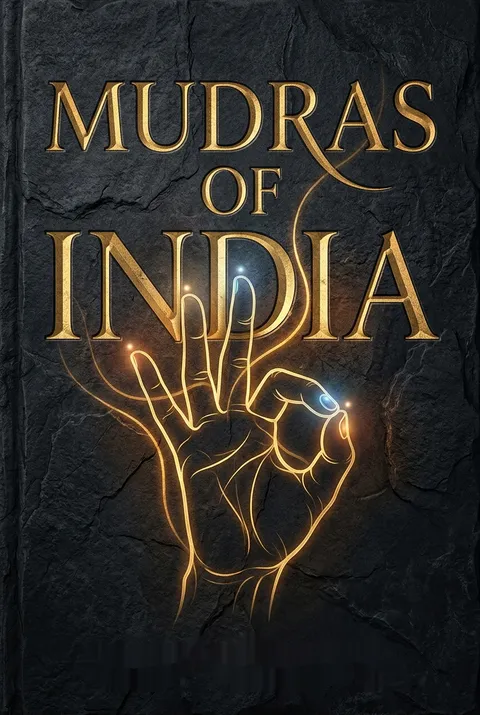


Key Takeaways
Treat the hand as a language, not a decorative pose
A gesture carries intention. Mudra means an attitude, gesture, or seal. A hasta mudra is specifically a hand gesture used in yoga, ritual, or Indian performance. The book presents hands as instruments for making, sensing, and communicating, not merely as shapes to copy. A raised palm in Abhaya Mudra signifies protection or fearlessness; Anjali Mudra, palms joined, conveys respect; Dhyana Mudra, hands resting in the lap, supports contemplative stillness.
Three settings, different work. Hand gestures appear in yogic practice, religious ritual, and classical Indian dance. The same basic idea can focus attention, express devotion, or help tell a story. Meaning depends on how a gesture is formed and where it is used.
What's striking is how a small movement can function at once as a bodily cue and a cultural symbol. Contemporary accounts of embodied cognition likewise treat thinking as something shaped partly by action and sensation, rather than confined to abstract reasoning. That makes a deliberate hand position a plausible aid to attention, even without accepting every traditional explanation of energy. The caution is that gestures are not a universal, self-explanatory code. A palm or finger arrangement may carry different meanings across communities, so learning the context is part of learning the gesture.
Read each mudra through its tradition before borrowing its meaning
One word, many uses. The authors note that hasta was the technical term for dance hand gestures, while mudra was historically more associated with ritual. Today, practitioners often use mudra for both. The book groups hand gestures by use: sacred images, ritual actions, yoga practice, and performance. It also distinguishes asamyukta hasta, a single-hand gesture, from samyukta hasta, a gesture formed with both hands.
Context changes meaning. A dance gesture can represent an object, a character, or an emotion; a yogic gesture may be held quietly during meditation; a ritual gesture may invoke a deity. Traditions and regional manuals do not always agree on a gesture's shape or name. The book therefore offers a broad reference, not a single universal dictionary.
This is a useful corrective to the way spiritual practices are often detached from their histories and repackaged as interchangeable wellness tools. The book's side-by-side treatment makes both shared inheritance and distinct purpose visible. In semiotics, a sign gains meaning through convention and context; a hand shape is not a fixed message independent of its audience. That perspective also suggests a respectful rule for borrowing: learn what a gesture does within its tradition before assigning it a convenient personal meaning. The authors acknowledge variation, though a large catalogue can never fully represent every living lineage.
Use finger contact as a traditional map for attention and balance
A five-element model. Yoga Tattva Mudra Vijnana is a traditional system that links each finger to one of the Pancha Maha Bhuta, or five great elements: thumb to fire, index to air, middle to ether or space, ring to earth, and little finger to water. Within this model, the way fingers meet is meaningful. Touching the thumb tip to another finger's tip is said to balance that element; touching the thumb to a finger's base is said to strengthen it; covering a finger with the thumb is said to quiet it.
A practical example. In Shunya Mudra, the middle finger folds toward the palm and the thumb covers it. The tradition associates this with quieting ether or space. The authors also note that other systems assign different elemental meanings.
The model offers a memorable way to notice the hands and give a meditation a clear focus. Its strongest practical value may be attentional: a specific arrangement gives the mind something concrete to sense and sustain. That is different from demonstrating that the fingers physically regulate elemental forces or cure illness. The book's acknowledgment that systems vary is important, because it prevents one symbolic map from being mistaken for universal anatomy. Readers can engage with the correspondences as traditional meaning while remaining clear about what the framework does and does not establish.
Let one deliberate gesture organize breath, attention, and intention
Start with comfort. The book recommends a relaxed posture, an upright spine, loose shoulders, and natural breathing. Prana means life force in yogic vocabulary; here, breathing is described as what animates a gesture. Practice can be seated, standing, or walking, provided the position allows easy breathing. A brief hand warm-up and gentle movement can make the fingers more comfortable.
Pay attention, not just shape. Beginners are encouraged to try a small group of gestures, slow down, and notice subtle sensations rather than rushing through a catalogue. The authors suggest both active fingers for physical conditioning and soft hands for subtler awareness. Their examples range from holding Abhaya Mudra while reflecting on fear to sensing the space between the hands in Vitita Mudra. Comfort and concentration matter more than perfect anatomical uniformity.
The practical advice keeps the method grounded in repeatable experience: settle the body, choose a gesture, breathe, and observe. This resembles attentional anchoring used in contemplative practice, where a stable sensory object can make distraction easier to notice. It also respects anatomical variation instead of treating every hand as an identical instrument. The recommendation to alternate firm and relaxed articulation is especially sensible for a practice involving joints and tendons. Still, the reported feeling of energy is subjective; it can be meaningful without being taken as proof of a particular invisible mechanism.
In Indian dance, a hand gesture steers the audience's emotional journey
Gesture becomes expression. Abhinaya is the art of guiding an audience toward meaning or feeling. The book describes four modes: spoken or sung language, bodily expression, costume and makeup, and inner mood conveyed especially through the face. Within that system, the hand can shape a story as well as a feeling. Nritta is technical dance without a specific narrative; nritya combines movement with expressive meaning.
Attention moves through the body. The dance tradition links hand, gaze, mind, emotional state, and rasa, the aesthetic or emotional essence experienced by the audience. A gesture is therefore not a frozen symbol: its direction, movement, placement, facial expression, and context all matter. Pataka, for example, has many possible applications, from a flag to a river or a blessing. The surrounding performance tells the viewer how to read it.
The dance material offers a sophisticated account of communication: movement directs attention, attention shapes interpretation, and interpretation helps produce feeling. That sequence connects naturally with performance studies, where meaning emerges through the interaction of performer, form, and audience rather than from a symbol alone. It also explains why copying a hand position without learning its timing or expressive setting can feel empty. The framework is not a mechanical guarantee of a particular audience response; viewers bring their own histories. Its value lies in treating emotion as crafted, embodied communication.
Learn mudras in sequences, because fluency comes from relationships
A practice can be a sequence. The Gayatri Mudras are a traditional set of thirty-two gestures used with Gayatri practice: twenty-four precede meditation or recitation, and eight follow it. The book presents them as a deliberate progression rather than thirty-two unrelated hand shapes. Performing a sequence slowly can coordinate movement, breath, attention, and devotional intent.
Dance has its own repertories. The Abhinaya Darpana describes twenty-eight asamyukta hastas, or single-hand gestures, and twenty-four samyukta hastas, or two-hand gestures. Other sets represent deities, planets, relationships, or Vishnu's incarnations. Students traditionally learn applications by reciting them while forming the gesture. The book recommends studying individual entries for detail and practicing established sequences to develop fluency.
Sequences turn a reference collection into a learnable skill. Motor learning generally benefits from structured repetition, and linking a form to a spoken name or intended meaning can give practice more retrieval cues than shape alone. The book's sets also reveal that gestures belong to larger systems of ritual and performance. Yet memorizing a sequence is not the same as understanding its history or expressive nuance. A useful approach combines repetition with context: learn the movement, its conventional application, and the variation allowed by the school or teacher.
Do not mistake every yogic mudra for a hand shape
Yoga uses five classes. In the book's account of Hatha Yoga, mudras include hasta, or hand gestures; mana, gestures involving the head's sensory openings; kaya, postural techniques; bandha, internal locks; and adhara, practices involving the pelvic base. These forms share a traditional aim of directing bodily energy, but they are not interchangeable techniques. The Gheranda Samhita, a seventeenth-century Hatha Yoga text, describes twenty-five mudras.
Know when guidance matters. Many hand gestures are comparatively easy to learn, but some postures, locks, and breath practices involve more complex actions. The authors advise learning certain techniques from a competent teacher. For readers drawn to mudras through meditation or dance, the distinction matters: the familiar finger gesture is one branch of a much larger practice, not the definition of the whole system.
This distinction prevents a common category error: assuming that every practice called a mudra is a simple arrangement of fingers. It also gives readers a sensible way to judge difficulty. A gesture held in the lap is not equivalent to a technique involving breath retention, muscular contraction, or a demanding posture. In physical disciplines, complexity and risk rise with the demands placed on the body, so instruction can be more than ceremonial. The book's five-part taxonomy clarifies the landscape, although it should not be mistaken for a complete account of every regional yoga lineage.
Keep traditional healing claims separate from proven medical treatment
The book makes extensive health claims. Its entries associate particular gestures with concerns ranging from digestion and anxiety to heart problems, cancer, and immune function. These are presented within a traditional energetic framework and, in some cases, draw on oral practice or the authors' experience. The book itself says mudras are not an exact science, and its guidance for acute heart trouble is to use a gesture only as temporary support while waiting for medical help.
Use care with serious symptoms. A comfortable hand position or quiet breathing may be part of a calming personal routine, but the text does not provide clinical trials establishing the listed treatments. Mudras should not replace diagnosis, medication, emergency care, or advice from a qualified health professional. The practical instructions also call for gentleness, especially when arthritis, injury, pregnancy, or other health conditions affect what the body can safely do.
The distinction between a meaningful contemplative practice and a demonstrated treatment protects both health and the tradition's credibility. A gesture may offer structure, comfort, or a sense of agency, but those benefits do not establish that it treats the disease named in a traditional account. The book's own caution around acute heart trouble is an important boundary. Its broad therapeutic lists deserve particularly careful interpretation, since readers may encounter them while vulnerable. The safest reading preserves the cultural and personal value of the practice without allowing it to delay evidence-based care.
Make the gesture an offering, not merely a private technique
A practice can turn outward. Several gestures in the book ask practitioners to dedicate the benefits of practice to all beings. In Nirvana Mudra, a concluding ritual gesture, the practitioner gathers the meaning of meditation or mantra practice and symbolically offers it beyond the self. Mandala Mudra similarly represents the universe, with the gesture serving as a physical focus for generosity and contemplation.
Intention changes the frame. This does not require a particular religious belief. Within the book's traditions, the gesture can express devotion, humility, compassion, or a commitment to use one's abilities for others. In dance, gestures can also carry stories and feelings from performer to audience. Across these settings, the hands do more than alter the practitioner's inward state: they give visible form to a relationship with other people, deities, or the wider world.
The outward turn gives a private exercise an ethical dimension. Practices are often judged by their effects on individual calm or concentration, but dedication asks what attention and skill are for. That question resonates with traditions of service and with modern accounts of prosocial behavior, where meaning often grows through connection rather than self-optimization alone. The gesture does not guarantee generosity, of course; intention needs expression in conduct. Its value is as a small, embodied reminder that an inward practice can be directed toward responsibilities beyond the self.
Analysis
Mudras of India is best read as both a practical catalogue and an argument about embodied meaning. Its central claim is that hand gestures are not decorative additions to yoga or dance. They can organize attention, carry ritual significance, and communicate emotional or narrative content. The book's unusual strength is its juxtaposition of traditions that share historical and philosophical ground while retaining distinct purposes. A gesture in meditation is not automatically equivalent to a gesture in a dance text or a deity's iconography, even when their shapes resemble one another.
The reference structure rewards selective use. The reader can learn a small number of accessible gestures, or explore formal repertories such as the thirty-two Gayatri Mudras and the dance sets described in the Abhinaya Darpana. Its basic practice advice is comparatively cautious: maintain comfort, breathe naturally, and avoid forcing the fingers. The discussion of hand gestures in dance is especially revealing because it explains meaning as an event. Form, movement, gaze, facial expression, and context work together to guide the audience's attention and feeling.
The book is less persuasive when it moves from traditional associations to specific medical outcomes. Its elemental correspondences and subtle-energy vocabulary can function as symbolic maps for practice, but the text does not supply clinical evidence for claims about treating cancer, cardiovascular disease, or other serious conditions. Those claims should not be confused with established medical care. That limitation does not erase the book's value as a cultural and contemplative guide. It defines the appropriate use: learn the forms, respect their traditions, observe their effects on attention and experience, and seek qualified medical care for health conditions.
Ultimately, the book invites a shift in scale. A hand gesture is physically small, yet its meaning can be social, devotional, aesthetic, or personal. Understanding mudras requires more than copying finger positions. It requires attention to the body, to inherited conventions, and to the purpose for which a gesture is made.
Review Summary
Mudras of India receives positive reviews for its comprehensive coverage, including unique Gayatri mudras. Readers appreciate its organization, concise information, and relevance for both dance and yoga practitioners. The book is praised for its pedagogical approach and its potential to improve mental and physical health. Some reviewers note the connection between yoga and dance. A minor criticism mentions dark photographs affecting clarity. Overall, the book is highly recommended for those interested in mudras, with an average rating of 4.34 out of 5 stars.
People Also Read

Glossary
Hasta Mudra
yogic hand gestureHasta Mudra refers to hand gestures used in yoga, spiritual practice, and related traditions. The book focuses on how particular finger and palm positions are formed, interpreted, and practiced. In yoga, they may support concentration or contemplative practice; in ritual, they can have devotional meanings; in dance, hand gestures help convey stories, actions, and emotion.
Yoga Tattva Mudra Vijnana
finger and element systemA traditional branch of yogic knowledge concerning the relationship between the fingers and the five elements. It uses this correspondence to explain how hand positions may be applied in healing and spiritual cultivation. In the book's account, finger contact can balance, strengthen, or quiet an element, according to the placement of the thumb and other fingers.
Pancha Maha Bhuta
five great elementsThe five elemental principles in the Indian cosmological system: fire, air, ether or space, earth, and water. The book describes them as a traditional way of understanding the body and its relationship to nature. In Yoga Tattva Mudra Vijnana, each element is associated with a finger, forming a symbolic basis for some hand practices.
Prana
life forceA central term in yoga for vital energy or life force. The book describes hand gestures as ways to focus or direct prana, often in conjunction with posture, breathing, and meditation. Prana is part of the traditions' subtle-body vocabulary and should not be confused with a measurable medical substance.
Pratyahara
turning the senses inwardA yogic practice of reducing attention to outward sensory stimulation and directing awareness inward. The book associates some mana mudras, which involve the sensory openings of the head, with this process. Shanmukhi Mudra is one example, using gentle contact around the eyes, ears, nose, and mouth as part of contemplative practice.
Abhinaya
dramatic expressionThe art of communicating meaning and feeling in Indian dance and drama. The book describes abhinaya through verbal or sung expression, bodily expression, costume and makeup, and inner mood expressed especially through the face. Hand gestures are one part of this broader expressive system, not isolated symbols.
Bhava
emotional stateA mood, feeling, or state of mind conveyed in Indian performance. The book describes the dancer's gesture and gaze as helping direct attention, which shapes the mind's response and supports the creation of bhava. Facial expression and performance context also contribute to the emotional state being communicated.
Rasa
aesthetic emotional essenceThe emotional or aesthetic experience evoked in an audience by a performance. In the book's explanation of Indian dance, rasa arises through the interaction of expressive gestures, gaze, attention, and bhava. It is not simply an emotion displayed by the dancer, but the sentiment the performance helps the viewer experience.
Gayatri Mudras
mantra-linked gesture sequenceA traditional set of thirty-two hand gestures associated with Gayatri practice. The book divides them into twenty-four gestures performed before meditation or recitation and eight performed afterward. The set presents mudras as a sequence connected with mantra and devotional practice, rather than as a collection of unrelated poses.
Asamyukta hasta
single-hand gestureA dance classification for a hand gesture formed with one hand. The Abhinaya Darpana lists twenty-eight such gestures, including Pataka, Tripataka, and Alapadma. Their applications can vary according to movement, facial expression, narrative context, and the dance tradition in which they are used.
Samyukta hasta
two-hand gestureA dance classification for a gesture formed with both hands. The Abhinaya Darpana lists twenty-four such gestures, including Anjali and Pushpaputa. These forms can represent objects, actions, relationships, or devotional meanings, and their interpretation depends on the performance context.
Nritta
technical dance movementThe technical or relatively pure movement aspect of classical Indian dance, not primarily focused on a specific story or emotional narrative. The book contrasts nritta with nritya, while noting that hand gestures can be important in both. In performance, rhythm, posture, and movement contribute to nritta.
Nritya
expressive danceThe expressive aspect of classical Indian dance, in which movement accompanies a story, lyrics, or meaning. Hand gestures and facial expression help communicate actions and emotional states. The book distinguishes nritya from nritta, the more technical movement aspect, while recognizing that gestures can participate in both.
FAQ
What's "Mudras of India" about?
- Comprehensive Guide: "Mudras of India" by Cain Carroll and Revital Carroll is a detailed exploration of hand gestures used in yoga and Classical Indian Dance.
- Cultural Significance: The book delves into the historical and cultural significance of mudras, tracing their origins and applications across various Indian spiritual and artistic traditions.
- Practical Application: It provides practical instructions on how to perform these mudras, along with their benefits for physical, emotional, mental, and spiritual well-being.
- Illustrations and Descriptions: The book includes illustrations and detailed descriptions to aid in understanding and practicing the mudras effectively.
Why should I read "Mudras of India"?
- Holistic Benefits: The book offers insights into how mudras can enhance physical health, emotional balance, and spiritual growth.
- Cultural Appreciation: It provides a deeper understanding of Indian culture and spirituality, enriching one's appreciation of these ancient practices.
- Practical Guide: With clear instructions and illustrations, it serves as a practical guide for anyone interested in yoga, dance, or self-care.
- Expert Endorsements: The book is praised by scholars and practitioners for its thorough research and beautiful presentation.
What are the key takeaways of "Mudras of India"?
- Language of Mudras: Mudras are a complete language in themselves, used for communication, healing, and spiritual practices.
- Therapeutic Uses: The book explores the therapeutic potential of mudras, including their ability to balance energy and promote healing.
- Integration in Practices: Mudras are integral to yoga and dance, enhancing meditation, storytelling, and emotional expression.
- Cultural and Spiritual Insights: It provides insights into the spiritual traditions of India, emphasizing the interconnectedness of body, mind, and spirit.
What are the best quotes from "Mudras of India" and what do they mean?
- Professor Ashish Mohan Khokar: He describes the book as a "seminal compilation" that brings aesthetic sensibilities to an academic subject, highlighting its cultural and artistic value.
- Amy Weintraub: She emphasizes the book's role in sustaining well-being by connecting hand, mind, and heart, underscoring its holistic benefits.
- Dr. David Frawley: He praises the book as the most detailed and best-organized guide on mudras, making the science accessible to everyone.
- Tias Little: He notes the book's value in accessing the subtle body, enhancing awareness and meditation practices.
How does "Mudras of India" define mudras?
- Definition: Mudras are described as "attitudes," "gestures," or "seals" used in yoga, spiritual rituals, and Indian dance.
- Cultural Context: The book explains that mudras have been used for centuries in India to convey meaning, evoke emotions, and facilitate spiritual practices.
- Types of Mudras: It categorizes mudras into five classes: hasta (hand), mana (head), kaya (postural), bandha (lock), and adhara (base).
- Spiritual Significance: Mudras are seen as tools for channeling energy, enhancing meditation, and connecting with the divine.
What are the therapeutic uses of mudras according to "Mudras of India"?
- Energy Balance: Mudras help balance the Five Elements (Earth, Water, Fire, Air, Ether) within the body, promoting overall health.
- Healing Powers: They are used to direct pranic energies, aiding in healing and changing energy patterns.
- Emotional and Mental Benefits: Mudras can calm the mind, reduce anxiety, and enhance concentration and emotional stability.
- Physical Health: Specific mudras are used for conditions like heart health, digestion, and respiratory issues.
How are mudras integrated into yoga and dance as per "Mudras of India"?
- Yoga Practices: In yoga, mudras are used alongside asanas, pranayama, and meditation to channel energy and deepen practice.
- Dance Expression: In Classical Indian Dance, mudras are essential for storytelling, emotional expression, and conveying symbolic meanings.
- Ritual and Devotion: Mudras are employed in rituals to communicate with deities and express devotion, often accompanied by mantras.
- Artistic Language: They form an artistic language of gesture and movement, enhancing the aesthetic and spiritual dimensions of dance.
What is the significance of the Five Elements in "Mudras of India"?
- Elemental Balance: The book emphasizes the importance of balancing the Five Elements (Earth, Water, Fire, Air, Ether) for health and well-being.
- Finger Associations: Each finger is associated with a specific element, and mudras manipulate these associations to influence energy flow.
- Healing and Harmony: By balancing the elements, mudras can address physical ailments, emotional disturbances, and spiritual imbalances.
- Cultural Roots: The concept of the Five Elements is deeply rooted in Indian cosmology and informs various traditional practices.
How does "Mudras of India" approach the teaching of mudras?
- Illustrated Guide: The book provides detailed illustrations and step-by-step instructions for performing each mudra.
- Cultural Context: It offers historical and cultural context, explaining the origins and significance of each gesture.
- Practical Tips: Practical advice is given for incorporating mudras into daily practice, including meditation and yoga sessions.
- Comprehensive Coverage: The book covers a wide range of mudras, including those used in dance, yoga, and ritual, making it a comprehensive resource.
What are the benefits of practicing mudras as outlined in "Mudras of India"?
- Physical Health: Mudras can improve circulation, digestion, and respiratory function, and aid in the healing of various ailments.
- Emotional Balance: They help reduce stress, anxiety, and depression, promoting emotional stability and mental clarity.
- Spiritual Growth: Mudras enhance meditation, deepen spiritual practice, and facilitate a connection with the divine.
- Holistic Well-being: Practicing mudras supports overall well-being by harmonizing body, mind, and spirit.
How does "Mudras of India" address the spiritual aspects of mudras?
- Connection to Divinity: Mudras are seen as a means of communicating with deities and accessing divine grace.
- Meditative Focus: They serve as tools for focusing the mind and preparing for meditation, enhancing spiritual awareness.
- Non-duality and Union: The book explores the concept of mudras as expressions of non-duality and the union of individual and universal consciousness.
- Ritual Significance: Mudras are integral to rituals, symbolizing offerings, invocations, and spiritual intentions.
What are the different classes of mudras in "Mudras of India"?
- Hasta Mudras: Hand gestures used in yoga and dance for energy regulation and expression.
- Mana Mudras: Head gestures that focus on the "seven openings" of the head for pratyahara (sense withdrawal).
- Kaya Mudras: Postural gestures combined with breathing techniques for chakra activation and kundalini awakening.
- Bandha Mudras: Interior locks used with asanas and breath retention for energy control.
- Adhara Mudras: Base or perineal gestures for stimulating the endocrine system and vital energy.
Download PDF
Download EPUB
.epub digital book format is ideal for reading ebooks on phones, tablets, and e-readers.








