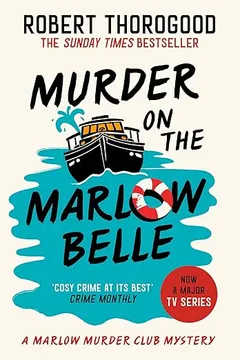


Plot Summary
A Cruise Ends in Blood
On the autumn equinox, seventy-nine-year-old Judith Potts walks the boundary of her riverside home, balancing her fierce independence against the companionship she has found with friends Becks Starling and Suzie Harris.
Her ritual is interrupted by Verity Beresford, whose husband Oliver has vanished after a celebration aboard the Marlow Belle, a pleasure boat hired for the return of Hollywood actor Lizzie Jenkins to her old amateur theatre group. Verity says the police will not investigate until forty-eight hours have passed, so Judith agrees to help.
Moments later, Verity receives a call: Oliver’s body has been found in the Thames. Judith takes her by punt to the riverbank, where the body’s bloodied clothes reveal two gunshot wounds. The disappearance is now a murder.
The opening makes Judith’s boundary-walking more than eccentric local colour: it shows how she makes safety by defining the limits of her own world. Verity’s arrival breaches that order and draws Judith into a case that begins in the very landscape she uses for comfort. The murder also turns a polished homecoming celebration into an unstable social space. Judith’s willingness to help, despite her instinct to keep people at a distance, quietly establishes the emotional cost and pleasure of friendship that will accompany the investigation.
Two Shots, One Riverbank
At the riverbank, Judith notices that Oliver’s stopped watch points to about six o’clock, while cuts on both wrists and a sliver of red-painted wood in his palm suggest a struggle. The wounds show he was shot twice, not killed by his own hand.
Detective Inspector Tanika Malik arrives and finds Judith already beside the body. Judith calls in her friends: Becks, the vicar’s wife, who knew Oliver through church productions, and Suzie, a dog-walker whose blunt instincts make her suspect Verity almost immediately.
Becks recalls Oliver humiliating children in the church nativity, giving the group an early picture of a domineering man with possible enemies. Tanika confirms the death is being treated as murder, but warns the friends that their curiosity does not give them official authority.
Physical evidence arrives before any reliable account of motive, forcing the investigators to distinguish what they can observe from what they merely suspect. The stopped watch offers a tempting timestamp, while the wounds and wood fragments point toward violence aboard a painted boat. Meanwhile, each friend brings a different way of knowing: Judith studies objects, Suzie reads people without much patience, and Becks remembers the harm Oliver caused in ordinary community life. Their competing approaches make the club effective, but also leave them vulnerable to turning first impressions into verdicts.
The Six O’Clock Invitations
The Marlow Belle belongs to Lance Goodman, a guarded boatbuilder and Suzie’s former partner. Lance says Oliver, Verity, Lizzie, theatre technician Duncan Wood and mechanic Toby Vincent were the only guests, and that an unreliable engine made intermittent bangs loud enough to confuse anyone expecting gunshots.
At Cookham Lock, the keeper, Andy Ford, remembers the other passengers but not Oliver. Police searches later find blood, two casings and wood matching the deck, placing the shooting on the boat.
During interviews at the Little Theatre, Toby, Duncan and Verity produce identical cards directing them to their cabins at six, each signed with Lizzie’s name. Oliver carried one too. Lizzie denies sending them. The notes remove everyone’s alibi, while their victim’s copy makes their purpose harder to understand.
The invitations convert a social gathering into a carefully arranged experiment in isolation. Each guest is moved out of view at the precise time the watch and later evidence place the shooting, but the victim’s card complicates the simplest explanation that someone merely cleared the deck. The faulty engine supplies a plausible reason for missed gunshots, yet it also makes the boat’s ordinary noise part of the mystery’s camouflage. The case’s theatrical setting matters here: people are accustomed to roles, cues and staged appearances, so a forged identity can pass as just another performance.
A Scarf in the Reeds
At the Little Theatre, senior MADS member Mary Eddingham reveals that Oliver and Lance had argued privately about the boat, then presses to take over Oliver’s role in the society’s next production. Judith volunteers to replace Mary as Miss Prism, giving herself a legitimate reason to remain near the suspects.
After hearing about Tanika’s probation, she promises not to interfere with the investigation. On the punt, however, the friends spot a tartan silk scarf caught in branches as the river level falls. Becks recognizes it from a photograph as Verity’s.
Unable to resist the clue, they take it to the police station. Tanika explains that Oliver died from a close-range wound followed by a fatal shot from farther away, and that he had terminal liver cancer. An identical cabin invitation was found on his body.
Judith’s promise to stand back is sincere in feeling but unstable in practice: she understands Tanika’s professional risk, yet cannot treat a clue as something she may simply leave untouched. The scarf carries several kinds of meaning at once. It is a personal possession, possible physical evidence and a link to the widow whose grief already seems difficult to read. Oliver’s cancer adds a moral complication: some suspects may have known he was dying, which changes the apparent logic of killing him. The unresolved invitation on his body confirms that the murder’s design is stranger than a simple effort to conceal a killer.
Marriage Behind the Curtain
As rehearsals begin, Judith watches Verity take charge of the production with a confidence she never showed beside Oliver. Verity later admits that their marriage had become a careful arrangement: Oliver travelled three days each week, while she filled her evenings with bridge and theatre.
His terminal cancer diagnosis brought shock, but also relief that her unhappy marriage would end without her having to leave. She denies killing him and says she believed his cryptic comments about going out dramatically might signal suicide.
Verity identifies Lizzie as the only passenger who seemed to share a charged, private understanding with Oliver. When the friends leave, Judith notices Duncan watching from his houseboat and a woman in a red jacket studying them from the lane. The woman disappears before Suzie can turn the van around.
Verity’s account destabilizes the easy equation between relief and guilt. She can feel freed by Oliver’s impending death without having caused it, a distinction outsiders often resist when judging an unhappy spouse. Her newfound authority in rehearsal also suggests that the marriage constrained abilities she can now use openly. The woman in red briefly turns Judith’s investigation into a question of perception: Suzie reads an omen into a figure who later proves to have an ordinary, hidden motive. The scene’s unease comes from how readily fear converts incomplete information into supernatural certainty.
Marlow’s Actors Have Motives
Judith questions Duncan on his houseboat and learns that his feud with Oliver began over a borrowed theatre book, then grew into petty retaliation over where Duncan could moor. Duncan says Verity was often the one who started arguments at home and claims she had called Oliver’s cancer punishment, a story she later denies.
At Platt’s garage, Toby recalls that Oliver discovered his stage talent, persuaded him to audition for RADA and helped him seek Lizzie’s financial support. Lizzie’s autobiography reveals poverty, addiction and a history with Oliver, whom she lived with as a teenager.
During rehearsals, Judith nearly gets struck by a falling theatre light while Duncan works above the stage. She also learns Oliver secretly disappeared for three days each week, despite having stopped working full-time.
The suspects’ histories create motives that are emotionally credible but not yet evidentially decisive. Duncan’s resentment is petty enough to seem harmless, yet his retaliatory habits make him difficult to dismiss. Toby’s gratitude toward Oliver looks like loyalty, though his dependence on a mentor also leaves room for humiliation. Lizzie’s memoir opens a buried history but does not explain why she omitted the MADS and Oliver. The falling light sharpens Judith’s sense of danger, while Oliver’s unexplained weekly absences shift the inquiry from who disliked him to what he concealed from the people closest to him.
Verity Under Threat
Verity calls Judith after someone smashes a window with a brick wrapped in a message accusing her of Oliver’s murder. The paper carries Oliver’s fingerprints, but Tanika finds no evidence that any suspect was near the house when it happened.
The scarf recovered from the river tests positive for residue from the murder weapon, deepening the case against Verity. Soon, a skinned rabbit pinned to her back door bears another accusation. Verity says she had not worn the scarf for months and believes someone stole it from her bedroom.
She also confirms that Oliver used a sports car for his unexplained weekly trips. Police discover the car received a speeding ticket near Burchett’s Green, giving Judith a direction to investigate. Tanika’s colleague Brendan Perry insists the detectives are closing in.
The threats make suspicion physical: the brick breaks a window, the rabbit turns private space into a display, and the scarf seems to connect Verity directly to the shooting. Yet the messages may be designed to punish or frighten rather than to establish guilt. Oliver’s fingerprints on the paper add a particularly unsettling layer, suggesting that someone close to him had access to material he handled. The sports car provides a counterweight to the emotional evidence. Instead of asking which suspect looks most guilty, Judith can now follow a repeatable route and test the geography of Oliver’s double life.
A Painting Remembers
At Marlow’s Art Trail, Judith recognizes the Marlow Belle in a painting by Rebecca Lewis, a retired science teacher who remembers what she sees with unusual precision. Rebecca recalls the boat passing shortly before six, with Oliver speaking to Lance inside the forward cabin.
She heard engine bangs but no gunshots, and saw no one on the rear deck. Her account contradicts Lance’s earlier claim that he had been alone in the driving position. Confronted, Lance admits Oliver visited him shortly before six and ordered him to stay hidden there because Lizzie supposedly had a surprise planned.
Lance still refuses to explain why Oliver was so anxious about the time. The painting supplies the missing witness the police could not find, but the meeting it records opens another gap.
Rebecca’s painting functions as evidence without being a photograph: it preserves a moment because its maker can reconstruct visual detail, not because a camera recorded it mechanically. That difference makes her testimony both valuable and psychologically complicated. The image catches a detail Lance omitted, but it cannot show what happened after the boat vanished around the bend. His revised story suggests a secret plan without identifying its author. The scene therefore rewards observation while warning against treating any single medium, whether a witness, object or image, as a complete account.
Oliver’s Other Household
Judith compares Oliver’s annual mileage with the speeding ticket and finds that his regular destination must have been about twelve miles from Marlow. Gravel trapped in his sports-car tyres narrows the search: white stones mixed with green ones.
Becks uses Street View, with help from Chloe’s boyfriend Hugo, to identify a matching driveway in Wargrave. Its owner, Joanne Dawkins, says Oliver visited her three days each week under the name Jack and married her two years earlier. He had told Jo that he worked for British intelligence and could not leave a digital trail.
Their young daughter, Jade, believes he is merely away. Jo admits she threw the brick and left the rabbit to frighten Verity, whom she believes killed Oliver. Verity later confirms Oliver had confessed to the second marriage shortly before his death.
A secret life emerges not from a dramatic confession by Oliver but from mundane traces: mileage, stones and a driveway visible online. The method suits Judith’s practical intelligence, turning a private routine into a map. Oliver’s invented identity gave Jo an explanation for every absence and deception, allowing the relationship to feel coherent from inside it. Verity’s knowledge complicates the apparent motive for murder, while Jo’s retaliation shows how grief can become punitive when its facts remain incomplete. The discovery also shifts the emotional centre of the case toward Jade, who has been protected from a truth that adults have repeatedly distorted.
The Missing Pistol
Police divers recover a nine-millimetre pistol from the Thames, and Judith recognizes its likely owner from Duncan’s photograph of his uncle, a Falklands War veteran. Duncan admits the weapon vanished from his boat.
He also reveals that he has thyroid cancer, probably linked to asbestos in the council building where he and Oliver first ran the MADS. Oliver had known of the risk, and Duncan’s illness gives him a powerful grievance, though he denies firing the gun. Separately, Judith discovers Toby never won a place at RADA and feels Oliver made him look foolish.
Suzie traces Toby’s cannabis to Lance, whose sideline with lock-keepers explains Oliver’s blackmail. Pressured, Lance admits seeing Lizzie shoot Oliver twice. He fears the drug investigation more than the murder case, but agrees to testify.
The case now appears to offer an almost theatrical motive for every suspect. Duncan has the gun and a devastating grievance; Toby has been humiliated; Lance has been blackmailed; and Lizzie has a history with Oliver. This abundance of plausible explanations is itself a warning: evidence may have been placed or arranged to make the cast look equally guilty. Lance’s silence, motivated by fear of exposure for drug dealing, shows how self-interest can distort a witness’s account without making him the murderer. The murder weapon intensifies suspicion, but its ownership alone cannot establish who used it.
The Painting’s Final Witness
At Danesfield House, Lizzie confesses that Oliver lured her to the rear deck and tried to kill her, accusing her of erasing his importance from her life. She wrestled away his gun, shot him twice and pushed him into the river, believing he was dead.
During the opening-night performance, Judith notices that Lizzie and Lance describe the shots in an order that conflicts with the forensic evidence: Lizzie’s first shot missed, and her second wounded Oliver in the side. Still alive, he reached Rebecca on the riverbank.
Judith identifies Rebecca as the youth leader who once discarded Lizzie’s RADA acceptance letter after the teenager bullied her. Haunted by the harm she caused, Rebecca took the gun and fired the fatal shot into Oliver’s heart. She confesses when old youth-club records corroborate Judith’s account, and Tanika arrests her.
The solution depends on separating three events that the witnesses and police initially compress into one: the missed shot, the wound inflicted by Lizzie and the fatal bullet fired downstream. Judith’s theatrical breakthrough comes from noticing that order matters, just as a misplaced object changes the meaning of a stage scene. Rebecca’s act grows from remorse, but remorse does not erase agency. She tries to repair an old injustice by committing a new one, treating lethal violence as a form of moral correction. Oliver’s elaborate murder plot is defeated by the unpredictable life it cannot control.
The Curtain Opens Again
Rebecca’s confession clears Lizzie of the fatal shot, and the audience abandons the play to watch Tanika take Rebecca away. Judith learns that her performance has become an impromptu murder inquiry, while Suzie finally admits that her tarot cards never predicted danger.
Before opening night, Chloe discovers that Hugo has disappeared with nearly eight thousand pounds from their charity crowdfunder after she questioned his secret phone. Becks and Colin comfort her and help her consider returning to university.
Judith cycles home exhausted, glad to retreat to her own rooms and familiar comforts. Then a Greek woman appears at her door, identifies herself as Judith’s stepdaughter and accuses her of murdering her father. The solved case ends; the accusation leaves Judith facing a danger rooted in her own past.
The resolution restores several forms of order without pretending that every wound has been repaired. Rebecca accepts responsibility, Lizzie’s account is vindicated, and Suzie relinquishes a supernatural explanation when evidence disproves it. Chloe’s crisis echoes the murder mystery on a smaller scale: a charming public persona hid a private betrayal, and the family must respond without turning shame into blame. Judith’s return to domestic safety appears earned after the performance and investigation, but the final visitor makes that refuge provisional. The ending pivots from solving another person’s history to confronting a charge against Judith herself.
Analysis
Murder on the Marlow Belle builds its mystery around the gap between a public role and a private life. Oliver is a theatre founder who turns people into characters in his own imagined story; the invitations, planted clues and staged alibis extend that impulse into the murder plot. Yet the elaborate performance fails because human beings do not stay within the roles assigned to them. Lizzie acts in self-defence, Rebecca makes a morally distorted attempt at restitution, and witnesses lie for reasons that range from self-protection to shame.
The novel’s detective work repeatedly privileges material particulars over confident narratives. A stopped watch, wood splinters, residue on a scarf, a painted boat, tyre mileage and gravel each offer partial knowledge. None is self-interpreting. Judith succeeds by revising her understanding when the sequence of shots contradicts the stories everyone has accepted. Her insight is not simply superior cleverness; it is a willingness to notice where an apparently coherent account requires an impossible action.
The domestic subplot with Jo exposes how deception can be made to feel like intimacy. Oliver’s invented identity gives Jo explanations that protect the relationship from inconvenient facts, while his second household demonstrates that charm can sustain more than one version of a life. Becks’s concern about Hugo echoes this danger in a gentler register: care becomes difficult when trust and suspicion both have consequences. The novel does not treat intuition as infallible. Suzie’s tarot reading and Becks’s unease may be emotionally meaningful, but only evidence can establish what happened.
The amateur theatre supplies a fitting frame because acting depends on attention, timing and the placement of objects, just as the mystery does. The final accusation at Judith’s door unsettles the comfort of the solved case. It suggests that no investigator stands wholly outside the stories she uncovers, and that Judith’s own carefully bounded world may now be entered by someone carrying an older, more personal grievance.
Review Summary
Murder on the Marlow Belle receives an overall positive reception, averaging 3.97 stars. Fans praise the charming trio of amateur sleuths—Judith, Suzie, and Becks—for their witty dynamic and entertaining chemistry. The locked-room mystery format, Agatha Christie-esque atmosphere, and theatrical setting are highlights. Many readers enjoyed the unexpected twists and cliffhanger ending, eagerly anticipating book five. However, some critics found the plot formulaic, pacing slow, and character development lacking compared to earlier installments. The audiobook narration by Nicolette McKenzie received particular acclaim.
Characters
Judith Potts
Riverside amateur sleuthA sharp-minded seventy-nine-year-old crossword enthusiast, Judith lives alone in a rambling riverside house and prefers the security of self-sufficiency. Her annual boundary walk expresses her need to define a world she can manage, but her friendships with Becks and Suzie have begun to make that world more porous. She notices physical details others overlook and tests stories against practical logic. Her curiosity can make her reckless, especially when police procedure threatens to keep her away from a puzzle. Yet beneath her theatrical wit is a woman who knows loss and distrusts easy intimacy, making her loyalty to her friends both a source of strength and a vulnerability.
Suzie Harris
Blunt local dog-walkerSuzie is a dog-walker and local radio presenter whose directness gives the Marlow Murder Club its bluntest instrument. She is quick to assign motives, impatient with evasions and unafraid to confront people who intimidate her friends. Her confidence coexists with emotional uncertainty, particularly around romance and the possibility that she has misjudged someone. She sometimes reaches for tarot and supernatural explanations when fear becomes difficult to contain, while Judith pushes her back toward evidence. Suzie’s loyalty is physical and immediate: she intervenes, drives, questions and protects. Her friendship with Judith and Becks gives her a place to bring both her fierce certainty and her less visible anxieties.
Becks Starling
Vicar’s wife and mediatorBecks is married to Colin, a vicar, and is mother to Chloe and Sam. Of the three sleuths, she is most likely to imagine the human cost of an accusation, and she often tries to steady Suzie’s temper or soften Judith’s approach. Her kindness is not the same as naivety: she recognizes when a person is being harmed and can ask difficult questions when compassion requires it. At home, she is still learning how to respect her children’s independence without abandoning her protective instincts. Her unease about Chloe’s boyfriend reveals how difficult it is to distinguish prudent concern from parental control.
Tanika Malik
Methodical investigating inspectorDetective Inspector Tanika Malik leads the formal investigation and must balance her instinct for decisive work with the procedural scrutiny placed on her after a previous case. She has a husband, Shamil, and a young daughter, Shanti, whose needs make professional risk more than an abstract concern. Tanika knows Judith and her friends can be extraordinarily useful, but their methods threaten the boundaries she has been ordered to respect. Her relationship with them is marked by affection, exasperation and genuine trust. She is neither a foil to their brilliance nor a passive recipient of it; she has to secure evidence that can withstand the demands of a real investigation.
Oliver Beresford
Flamboyant theatre founderOliver founded the Marlow Amateur Dramatic Society and has shaped its productions and its members for decades. A building surveyor by profession, he prefers to introduce himself through theatre, where his elaborate clothes, booming presence and appetite for attention can dominate a room. He can be an inspiring mentor, especially to people who doubt their own abilities, but his confidence often becomes control. He likes to imagine himself as the central figure in other people’s stories, sometimes mistaking the power to encourage someone for the right to direct their life. His influence continues to structure the relationships and rivalries around the MADS.
Verity Beresford
MADS secretary and directorVerity is Oliver’s wife and the Marlow Amateur Dramatic Society’s secretary. Thin, composed and initially shaken by her husband’s disappearance, she surprises the company when she takes charge of a production and proves both organized and knowledgeable about theatre. She has spent years adapting her life around Oliver’s forceful personality, cultivating routines and interests that gave her room to breathe. Verity is capable of warmth and tact, but her preference for control becomes visible when a rehearsal grows disorderly. She wants the MADS to function well, even when its members’ loyalties and old habits make that difficult.
Lizzie Jenkins
Hollywood actor from MarlowLizzie is an internationally known actor who grew up in Marlow and first performed with the MADS as a teenager. Her glamour does not make her conventionally polished: she drinks, smokes and speaks with a candour that unsettles people expecting celebrity manners. She has survived a chaotic childhood and years of addiction, and she has learned to manage public attention by keeping a portion of herself unreadable. Her return to Marlow is tied to gratitude, memory and a desire to face people from her past. She is intelligent about performance and about the stories others tell of her, even when those stories contain painful truths.
Duncan Wood
MADS technical directorDuncan is Oliver’s longtime friend and the technical force behind the MADS, responsible for lighting, sound and the physical machinery of its productions. He lives on a houseboat and often seems unwell, withdrawn and faintly amused by the people around him. He dislikes direct confrontation, preferring indirect tactics and grudges that can persist long after the original quarrel has faded. His friendship with Oliver reaches back to school and the society’s earliest days, giving their disagreements the intimacy of family disputes. Duncan’s work is essential to the theatre, though he can feel overlooked beside the more visible actors and directors.
Toby Vincent
Mechanic turned actorToby works at Platt’s garage and acts with the MADS, where Oliver’s encouragement helped him imagine a life beyond mechanics. Onstage he is intense, restless and eager to make every moment vivid. He takes direction personally because acting has become a test of whether he has anything special to offer. His ambition makes him vulnerable to promises that confirm his talent, while his loyalty to Oliver is bound up with gratitude for being noticed. Toby is more emotionally exposed than he likes to appear, and he uses bravado to cover the fear that he may have mistaken enthusiasm for ability.
Lance Goodman
Boatbuilder with secretsLance runs a ramshackle family boatyard and has spent years restoring the elegant Marlow Belle. A compact, muscular man with an instinct for self-preservation, he is proud of his craft and less careful about the rules governing his private life. He and Suzie once dated, and the breakup left enough unfinished irritation to make their conversations crackle. Lance is capable of charm, especially when discussing boats, but becomes evasive when questions touch on his past or livelihood. His connection to the river gives him practical knowledge of the Marlow Belle and the people who move through the local waterways.
Mary Eddingham
MADS theatrical veteranMary Eddingham is a long-serving MADS actor who sees herself as the company’s most experienced performer. She punctuates ordinary life with theatrical references and can turn an entrance into a small production. Her vanity is real, but so is her devotion to the society and her belief that performance deserves discipline. She resents being passed over and often mistakes attention for respect, yet her long memory preserves details about the MADS that others have forgotten.
Joanne Dawkins
Protective mother in WargraveJoanne lives in Wargrave with her young daughter, Jade, and describes herself as a practical woman who has had to raise a child largely on her own. She values affection and reliability more than status, which makes the attention of a charming, apparently devoted partner powerful. When her understanding of her family life is threatened, she responds with anger rather than quiet retreat. Her fierce protectiveness is genuine, though it can turn into certainty about people and events she does not fully understand.
Rebecca Lewis
Retired science teacherRebecca is a retired science teacher from Borlase who took up painting after leaving the classroom. Reserved and precise, she describes her art as careful craft rather than inspiration, and her visual memory lets her retain details that most people would lose. She has spent much of her life oriented toward service and helping young people, though the moral confidence of that vocation can make a past mistake especially difficult to live with. Rebecca is a quiet observer of Marlow and the river, more comfortable with exact images than with emotional display.
Chloe Starling
Becks’s searching daughterChloe is Becks and Colin’s daughter, a theology student at Exeter who is beginning to imagine a life beyond the route her parents expect. She is bright, idealistic and drawn to experiences that feel expansive rather than planned. Her enthusiasm can make her susceptible to a confident partner’s vision, but she is not simply passive: she wants to choose her own direction and dislikes being treated as a child. Her relationship with her mother is loving but strained by Becks’s protective instincts and Chloe’s need to make consequential choices for herself.
Hugo
Chloe’s polished boyfriendHugo is Chloe’s boyfriend, a Classics student from a wealthy family and an expensive boarding-school background. He is courteous, organized and attentive, with an ability to make plans seem reassuringly complete. He helps Chloe imagine travel and charitable work as a way to step beyond university routines. His polish impresses Colin and unsettles Becks, who senses that his charm sometimes conceals a calculating reserve. He embodies a kind of privilege that can make ambition look effortless while leaving other people to bear the risk.
Colin Starling
Marlow vicar and fatherColin is Becks’s husband and the vicar of Marlow. Formerly a high-flying banker, he brings practical connections and public standing to the community, though he has sometimes been less attentive to family responsibilities than Becks would like. He is proud of Chloe and wants to support her plans, but can underestimate the emotional work involved in parenting. When his daughter is distressed, a gentler and more capable side of him emerges, showing that his apparent distance is not the whole of his character.
Sam Starling
Becks’s wandering sonSam is Becks and Colin’s son, taking a gap year after mixed exam results. He has gone to Namibia with a charitable organization to help build a well. His choices frustrate his parents’ desire for a clear plan, but they also reflect his preference for action over conventional measures of achievement.
Shamil Malik
Tanika’s DJ husbandShamil is Tanika’s husband and a club DJ who is affectionate and easygoing, though he can leave household tasks for Tanika to finish. He cares about his family and steps in to look after Shanti when Tanika must leave for work, even if he does not always notice how much she is carrying.
Shanti Malik
Tanika’s young daughterShanti is Tanika and Shamil’s young daughter. She reads to a stuffed rabbit while the adults discuss work and home, grounding Tanika’s professional pressures in the ordinary tenderness of family life.
Andy Ford
Cookham Lock keeperAndy is the cheerful keeper at Cookham Lock, proud of doing a dependable public job and reluctant to leave his post during a shift. He knows the river community and is wary of assuming the worst about Lance, whom he regards as one of his own.
Rob Hooker
RADA theatre tutorRob teaches at RADA and is an old friend of Oliver’s, with expertise in Oscar Wilde and the traditions of performance. He is comfortable in exclusive male spaces and careful about professional confidentiality, but his past involvement with aspiring actors makes him relevant to the MADS’s ambitions.
Joshua Smith
Marlow Museum curatorJoshua runs the Marlow Museum and holds the town’s historical records, including old youth-club ledgers. His wrist surgery temporarily limits access to the archive, but he is willing to search for material that may help clarify the past.
Jade Dawkins
Joanne’s young daughterJade is Joanne’s school-age daughter. She is a child who trusts the adults around her and expects the family life they have described to be true, giving Joanne’s protective instincts much of their force.
Brendan Perry
Tanika’s skeptical sergeantBrendan is a detective sergeant on Tanika’s team. He is ambitious and exacting about procedure, and his professional disappointment has made him a source of pressure for Tanika. He believes the case should be handled through formal police channels, a position that can be sound in principle even when his manner is antagonistic.
Plot Devices
The six o’clock invitations
Manufactured alibisIdentical cards instruct several passengers, including Oliver, to retreat to their cabins at six o’clock. They bear a signature copied from Lizzie’s online profile, making them look like a message from the returning star while concealing the sender. Their timing isolates the guests and makes the shooting appear impossible to explain. Because Oliver carries a matching card, the clue later proves to have a more elaborate purpose than simply clearing the killer’s path.
The Marlow Belle
Floating crime sceneThe restored pleasure boat gathers the suspects, the victim and the witnesses in a confined setting where the engine’s erratic bangs can mask gunfire. Its low red-painted deck preserves blood, casings and wood fragments, while cabins and the enclosed driving position allow people to disappear from view. The boat’s movement also creates a crucial separation between the place of the first struggle and the later riverbank where Oliver’s death is completed.
The river evidence
Clues carried downstreamThe changing river level exposes Verity’s scarf, while the current carries Oliver away from the boat and eventually toward Rebecca’s painting spot. The scarf’s gunshot residue appears to implicate Verity, but the route of Oliver’s body shows that the boat is not the whole crime scene. The river first conceals evidence, then returns it in fragments, turning currents, distance and timing into part of the mystery’s logic.
Mileage and gravel
Map a hidden routineJudith uses the sports car’s yearly mileage and a speeding ticket to estimate Oliver’s repeated route from Marlow. Tiny white and green stones trapped in the tyres provide a physical match to a driveway found through Street View. The method turns an apparently untraceable three-day absence into a specific address, revealing that patient comparison of ordinary details can uncover a secret more effectively than dramatic interrogation.
The amateur production
Murder solved onstageJudith’s role as Miss Prism gives her access to the MADS and culminates in the opening-night performance. A moment in the play about putting things in the wrong order helps her recognize that the bullets were fired in a different sequence from the one the witnesses assumed. She interrupts the production to question the people present and reconstruct the fatal events. The theatre becomes both the setting of the community’s public life and the place where its carefully arranged appearances finally fail.
The Marlow Murder Club Series
Download PDF
Download EPUB
.epub digital book format is ideal for reading ebooks on phones, tablets, and e-readers.








