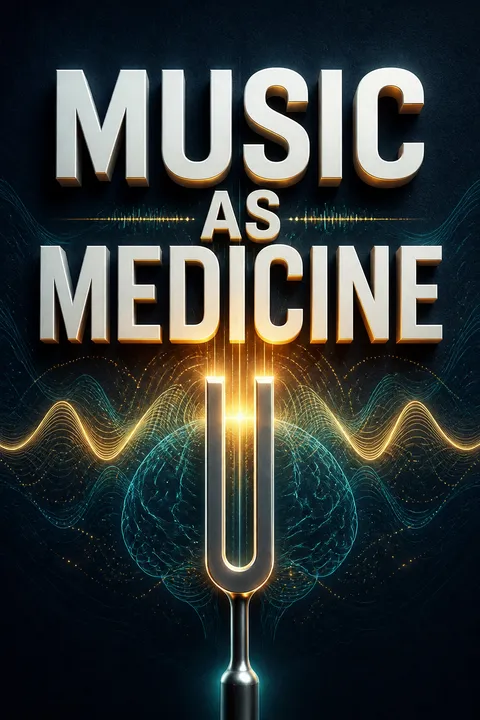


Key Takeaways
Treat music as medicine, tailored to the person, moment, and goal.
More than entertainment. The book’s central claim is that music can influence health because it engages connected systems for movement, memory, attention, emotion, and reward. In a San Francisco jazz club, Levitin becomes so absorbed in Art Blakey’s performance that a breaking glass is what snaps him back to the room. This kind of absorption, called experiential fusion, is a state of immersion in which awareness of oneself recedes. Music can also calm, energize, cue movement, or bring autobiographical memories within reach.
The clinical promise has limits. Music is not a substitute for appropriate medical care, and a moving personal story does not prove a treatment will work for other people. The book’s recurring prescription is to match the musical approach to the person and the health goal.
What's striking is the book's insistence that music is both a biological stimulus and a personal experience. That stance resembles a biopsychosocial view of health: bodily processes, individual interpretation, and social setting all matter. It also explains why the same song can soothe one listener and irritate another. The caution is equally important. Showing that music activates brain systems or changes mood does not, on its own, establish that it treats a specific disease. Clinical claims need outcome evidence, not just a compelling account of what music feels like.
Ask for controlled evidence before believing a musical cure.
Anecdotes are beginnings. People have used music in healing rituals for millennia, and historical physicians even assigned musical modes to particular ailments. But the book finds no good evidence that a precise tone frequency is the source of music’s therapeutic effects. More likely, several musical elements work together, including rhythm, melody, harmony, and timbre.
The Mozart story warns against hype. A 1993 study linked Mozart listening to a modest improvement on some spatial reasoning tasks. The popular claim that Mozart makes people smarter outran the evidence. Later studies failed to reproduce the effect reliably; the original comparison had left the control group sitting in a room with nothing to do. The broader lesson is to distinguish a promising result from a proven treatment.
This is a useful lesson in experimental design: the control condition can decide what a study actually shows. If music listeners do better than people left idle, stimulation or mood may explain the difference, not a special property of Mozart. The distinction matters beyond music, since plausible stories often harden into commercial claims before replication catches up. The book’s confidence is strongest when it separates personal benefit from population-level proof, and appropriately restrained when it describes areas with limited or inconsistent evidence.
Choose music for your state, not for a universal playlist.
Preference is part of the treatment. No single song works for everyone, and even a favorite can feel wrong at a particular moment. Music preference reflects a person’s history, culture, mood, familiarity, and the reason they are listening. Research described in the book finds that self-chosen music is especially useful for relaxation and pain relief, partly because choosing gives the listener a sense of control.
Keep adjusting the prescription. Music that helps today may become stale, irritating, or emotionally loaded tomorrow. The book notes that the songs people repeatedly love represent only a tiny fraction of the enormous catalogue available. A useful playlist is therefore not a fixed formula. It is a personal tool that can be tested, changed, and refreshed as circumstances change.
Personal choice here is more than a matter of taste. It is also a form of agency, which can make a therapeutic experience feel safer and less imposed. This connects music selection to shared decision-making in health care: the patient contributes knowledge that a clinician or algorithm may not possess. Automated recommendations could help make tailored music more accessible, but they raise a separate question: who controls sensitive listening and biometric data? Personalization works best when it improves care without quietly removing the listener’s ability to choose.
Use a song's structure as a spare key to memory.
Songs offer multiple cues. A remembered tune is not a single recording stored intact. Its melody, rhythm, lyrics, timbre, and associated memories provide overlapping routes to recall. In a famous Berlin performance, Ella Fitzgerald forgets the words to “Mack the Knife” but keeps the melody and timing, invents new lyrics, and holds the audience. Her performance shows how musical structure can remain available even when one part of memory fails.
A song can reopen a personal past. Researchers cited in the book find that music can evoke vivid autobiographical memories, and familiar songs may remain accessible to some people with advanced dementia. Yet memory is reconstructive, not a flawless playback. Music can offer a cue or emotional connection, but it cannot guarantee recall, and a memory that returns is not automatically accurate.
Music’s layered structure resembles redundancy in communication systems: when one signal is weak, another may still carry enough information to recover the message. That makes music a promising access route in rehabilitation and dementia care. The same principle suggests a practical approach: try different musical cues rather than assuming lyrics are the only doorway. But emotional vividness should not be confused with historical accuracy. A song can make a memory feel immediate while leaving its details incomplete or altered.
Let music reset attention, but do not confuse drift with focus.
The brain has different modes. The Default Mode Network, or DMN, is a connected set of brain regions active during inwardly directed thought, such as daydreaming, self-reflection, and recalling the past. Levitin and colleagues found that listening to music can help engage this network. Music may therefore offer a pause from demanding, externally focused work and a route to reflection or relaxation.
Immersion is not concentration. Attention is limited, and switching between tasks has a cost. Music can absorb a listener, but that does not mean it improves every kind of work. The book distinguishes passive daydreaming from deliberate focus and from flow, the immersed state often experienced during skilled performance. For many people, music is better suited to a break than to background during work requiring concentrated thought.
The distinction between restorative mind-wandering and distraction is useful because modern work culture often treats every unfocused moment as wasted time. Inward attention can support reflection, memory, and fresh associations, while complex tasks may need fewer competing inputs. The important variable is the goal, not whether music is inherently good or bad for productivity. A listener can notice whether music leaves them refreshed or fragments their attention, then place it accordingly. Brain-network explanations illuminate these states, but do not make them simple on-off switches.
Give impaired movement an external beat to follow.
Rhythm can supply timing. Rhythmic Auditory Stimulation (RAS) is gait training that uses a steady beat, often music, to help a person coordinate steps. The therapist selects a tempo suited to the individual’s walking pace. In Parkinson’s disease, where internal timing and movement can falter, the beat can help with walking speed, stability, and freezing. RAS has also been used in stroke rehabilitation, cerebral palsy, traumatic brain injury, and multiple sclerosis.
Sound can support speech, too. Some people who stutter speak more fluently while singing, especially with a steady rhythmic cue. In one study described in the book, adults who stuttered performed “Love Me Tender” with far fewer disruptions when a rhythmic cue guided their timing. These approaches can help, but benefits differ among individuals and should be guided by qualified care providers.
The striking idea is that sound can function as an external scaffold for timing, helping coordinate perception and action when internal timing is unreliable. This principle is practical because rhythm is portable and can be woven into ordinary movement, rather than reserved for a clinic. It also supports a broader rehabilitation lesson: an alternate pathway may help perform a task even when a familiar route is impaired. Still, positive results for one disorder or patient group should not be generalized to every movement condition. Matching tempo and tracking functional outcomes remain essential.
Use music to soften pain, not to replace medical care.
Pain responds to context. Music can redirect attention, improve mood, and engage brain systems involved in pain regulation. In one laboratory experiment, participants held a hand in ice water longer while listening to music than while listening to a spoken book or hearing nothing. The results suggested that distraction and mood both contributed, alongside possible effects on the nervous system.
Let the listener choose. Studies summarized in the book generally find greater pain relief with music chosen by the patient than with selections imposed by researchers. Music may reduce pain during recovery and sometimes help after listening ends, but effects vary. It does not reliably replace anesthesia, pain medication, or treatment of the underlying condition. Its strength is that it can be adjusted or stopped immediately, making it a flexible addition to care.
Pain is not simply a readout of tissue damage; attention, expectation, emotion, and setting also shape the experience. Music can work across several of these dimensions at once, which helps explain why it can complement conventional treatment. The ice-water experiment is valuable because it tests an observable outcome rather than relying only on testimonials. Yet the mechanisms remain mixed, and the book does not claim that music supplies drug-level analgesia. The sensible clinical position is neither dismissal nor miracle cure: offer it as a low-risk adjunct when the patient wants it.
Turn trauma into shared music only with choice and support.
Creation can give feelings form. Songwriting, improvisation, group drumming, and guided listening can help people approach difficult experiences through sound, metaphor, and collaboration. In a veterans’ program, one participant used original songs to communicate experiences he could not easily express in conversation, helping his wife understand what he had endured. Group music-making can also foster belonging and agency, particularly for people whose lives have been disrupted by trauma or displacement.
Music can also trigger distress. A song associated with combat, abuse, or a painful relationship may bring the associated fear back with it. The book describes music therapy as an addition to care, not a replacement for trained treatment. Evidence is not equally strong across conditions: music therapy may support mood and motivation in schizophrenia, for example, but reviews rate much of the evidence as limited.
Artistic distance can make difficult material more approachable without making it less real. Metaphor and shared creation allow expression without requiring a person to produce a polished verbal account on demand. That is a genuine therapeutic affordance, but it depends on consent and pacing. A familiar song is not automatically comforting, and exposure without adequate support can intensify distress. The strongest model is collaborative rather than prescriptive: the participant retains control, while a trained therapist helps keep the work emotionally tolerable and connected to broader care.
Make music actively to train the brain across a lifetime.
Playing recruits many systems. An instrument demands coordinated movement, listening, planning, memory, and error correction. In one randomized study of 156 older adults, participants assigned piano lessons showed improved fine motor control after a year compared with a music-listening group. In children with Williams syndrome, a genetic condition associated with significant cognitive and motor difficulties, researchers observed unusually strong engagement with music and musical abilities that contrasted with challenges elsewhere.
Value the activity itself. Music lessons correlate with some cognitive and academic advantages, but correlation does not prove that lessons caused them. Active music-making can be worthwhile for enjoyment, expression, and social connection without promising a higher IQ. The book also distinguishes amateur play from professional careers, which can bring financial insecurity, pressure, and elevated mental health risks.
Instrument practice is a rich example of embodied learning: knowledge develops through action, sensory feedback, and correction, not through abstract instruction alone. Its appeal across ages makes it a compelling lifelong activity, especially when practice is self-directed and enjoyable. The evidence supports some specific benefits, but sweeping claims about general intelligence require caution. Selective enrollment, family resources, and motivation can shape who receives lessons and who persists. The case for music is strongest when health benefits complement, rather than justify, its independent artistic and human value.
Bring music into shared life, but keep it out of demanding work.
Music can shape a room. A controlled experiment involving 31 families found that during a week with music playing aloud, family members spent more time together and reported fewer negative emotions. Music can also support exercise, group singing, and social bonding. In a classroom, it helped students settle and gave the instructor a shared point of connection with the group.
Match sound to the task. Repetitive work may feel easier with suitable background music, and music can help a long-distance driver stay alert. But sound competes for attention during many tasks that require concentrated thought. For office work, the book recommends listening between work periods rather than continuously in the background. The family findings are suggestive, not a universal rule: the sample was small, and the study had commercial sponsors.
Music is not only a private regulator of mood; it can also create a shared environment in which people coordinate attention and activity. That social function is easy to overlook when listening happens mainly through personal headphones. The family experiment gives the claim behavioral detail, while its small sample and disclosed commercial involvement call for proportionate interpretation. In workplaces, the central issue is cognitive load: sound that energizes one repetitive task may disrupt another that depends on verbal working memory. Context determines whether music connects or competes.
Treat musical meaning as a journey listeners help create.
Notes do not carry fixed messages. Musical meaning emerges through structure, expectation, performance, memory, culture, and the listener’s circumstances. The book compares this to pragmatics in language: a phrase can mean different things depending on who says it and what surrounds it. Beethoven’s Fifth Symphony repeatedly reshapes a short opening motif; in a concert experiment, more than half of first-time listeners could track its returns, and most recognized the tonal center after an extended musical detour.
Ambiguity invites participation. A song may connect with a listener’s grief, hope, or memory even when the composer intended something else. Shared music can build empathy and synchronize listeners, but it can also be used to exclude, intimidate, or rally hostility. Music’s power to connect is real, not automatic.
This account treats listeners as participants in meaning rather than passive recipients of a message. That idea helps explain how a familiar performance can change as a person’s circumstances change, and why ambiguity can be emotionally useful rather than a flaw. It also guards against romanticizing music as a universal force for good. Shared rhythm may create affiliation, but affiliation can be directed inward against outsiders. The social effect depends on the setting, the people involved, and the purpose for which music is used.
Analysis
The book’s most persuasive contribution is not the claim that music heals everything, but its account of why music can reach so many different parts of a person. Music is simultaneously temporal, sensory, motoric, emotional, autobiographical, and social. That combination makes it a versatile therapeutic medium, but also makes clean causal explanations difficult. A song that lowers distress may do so through attention, memory, agency, social connection, expectation, or several at once. The book is strongest when it treats this complexity as a research problem rather than pretending that one frequency or brain region explains the effect.
Its clinical argument also depends on a useful distinction: an intervention can be meaningful to one person without being a reliable treatment for everyone with the same diagnosis. Personal choice is therefore not a decorative extra. It is part of the intervention, and a reason that standardized playlists may fail. At the same time, personalization complicates clinical research: it becomes harder to compare treatment doses when the songs, histories, and goals differ. Future evaluation must preserve individual choice while measuring outcomes consistently.
The book’s examples range from robust applications, such as rhythmic cueing for gait, to promising areas where evidence remains uncertain. That range should not be flattened into a single verdict about music therapy. A plausible neural mechanism is not proof of clinical benefit, and a vivid recovery story cannot establish what caused improvement. The author’s discussion of the failed Mozart effect provides a useful standard: test against an appropriate comparison, replicate findings, and distinguish measurable health outcomes from enthusiasm.
Finally, the book makes an ethical case for music beyond medicine. Shared music can support belonging and imaginative perspective, but it can also be used coercively or politically. Its power is relational, not inherently virtuous. The most defensible practical conclusion is both modest and generous: use music as a flexible, person-led resource, respect its capacity to evoke distress, and keep artistic value from depending on medical proof.
Review Summary
Music as Medicine receives mixed but generally positive reviews, averaging 3.88/5. Readers appreciate its exploration of music's therapeutic benefits for conditions like Parkinson's, Alzheimer's, and PTSD, praising its research depth. However, opinions divide on balance: some find it too scientific, others not scientific enough. Many note its heavy focus on musical analysis over practical therapy applications. The included QR code for referenced music is appreciated. Most agree it suits music enthusiasts and those with neuroscience interest, but may overwhelm general readers.
Glossary
experiential fusion
Absorption in experienceA state of deep absorption in which a person is so engaged with an experience that awareness of the self as separate from it recedes. In the book, intense listening to live music can produce experiential fusion. An interruption may restore awareness of the surroundings and make the absorbed state noticeable in retrospect.
Default Mode Network (DMN)
Network for inward thoughtA distributed network of connected brain regions associated with internally directed thought, including daydreaming, self-reflection, autobiographical memory, and imagining the future. Activity in the network tends to increase when attention is not focused on an external task. The book describes music listening as one route that can help engage this inwardly oriented mode.
cue validity
Distinctiveness of a retrieval cueThe degree to which a feature helps identify one item among competing possibilities. A distinctive rhythm may identify a particular song quickly, while a common rhythm may fit many songs and provide little guidance. Cue validity depends on context: the same feature can be useful in one setting and unhelpful in another.
Rhythmic Auditory Stimulation (RAS)
Beat-guided movement trainingA rehabilitation technique that uses a regular auditory rhythm to guide the timing of movement, especially walking. A therapist selects a tempo suited to the individual’s gait, and the patient practices synchronizing steps to the beat. Music, a metronome, or recorded footsteps can provide the cue. The book describes its use in Parkinson’s disease and other neurological conditions.
Melodic Intonation Therapy (MIT)
Singing-based speech rehabilitationA therapy that uses melody and rhythmic speech patterns to help people with language difficulties produce words and phrases. Patients practice useful everyday expressions through singing or intoned speech, drawing on musical abilities that may remain accessible after language impairment. The book describes its use in stroke recovery and notes that it helped restore spoken language for some patients.
Therapeutic Music Capacities Model
Framework for music's therapeutic qualitiesA framework developed by William Forde Thompson for understanding how music may influence health and behavior. It identifies music as engaging, emotional, social, physical, personal, coordinating, and persuasive. The capacities operate together, like strands in a rope, rather than as isolated ingredients whose effects can always be separated.
iso principle
Music matched to moodA music therapy technique in which music initially matches a client’s current mood and then shifts gradually toward a desired emotional state. The progression is intended to meet the listener where they are before inviting change. The book describes it as one approach used in work involving mood, anxiety, and disordered eating.
flow state
Immersed, fluent performanceA state of complete engagement in an activity, commonly associated with ease, sustained absorption, and reduced awareness of time or self-monitoring. The term was coined by psychologist Mihaly Csikszentmihalyi. In musical performance, extensive practice can make complex actions feel more automatic, allowing the performer to respond fluidly rather than consciously plan every movement.
About the Author
Other books by Daniel J. Levitin

Download PDF
Download EPUB
.epub digital book format is ideal for reading ebooks on phones, tablets, and e-readers.








