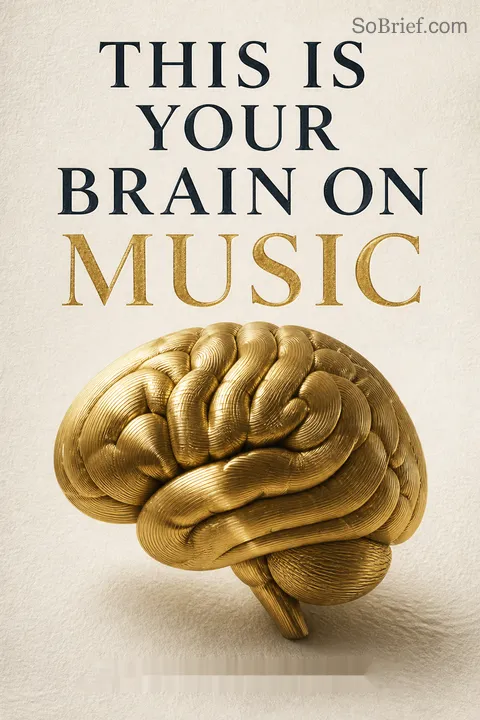


Key Takeaways
Treat music as organized sound your brain turns into movement, memory, and feeling.
Sound becomes music. Music is not just a sequence of notes. The brain combines pitch, rhythm, tempo, loudness, and timbre, the distinctive tonal color of a sound, into patterns such as melody and harmony. Those relationships create the experience of a coherent piece. Even silence matters: Miles Davis’s spacious solos show how gaps between notes can shape anticipation as strongly as the notes themselves.
Listening is not the only role. For most of human history, music making was an everyday group activity. When anthropologist Jim Ferguson told Sotho villagers he could not sing, they pointed out that he could talk. In their view, singing was no more a specialist skill than walking. Modern culture increasingly separates performers from audiences, though listeners still bring real musical abilities to recognition, memory, and beat tracking.
The book’s broadest insight is that music is an activity of perception and participation, not merely an object delivered by performers. That perspective challenges the consumer model in which musical worth is measured by technical polish or ticket sales. It also makes room for ordinary forms of musicianship, including singing together, dancing, and attentive listening. The Sotho encounter usefully exposes how cultural assumptions can masquerade as natural limits. Participation need not mean public performance; private listening can also be active, embodied, and socially meaningful.
Listen past the notes: timbre can identify a song before melody does.
Sound has a fingerprint. Timbre is the quality that lets listeners distinguish a trumpet from a piano playing the same pitch, or recognize a familiar voice from a few words. It arises partly from the different strengths of a sound’s overtones, the additional vibrations produced alongside its fundamental pitch. The initial attack and the way a sound changes over time also matter. Remove the opening instant from recordings of instruments, and listeners often struggle to identify them.
Recordings teach the ear. A brief musical excerpt can be recognizable from its overall sound, even when melody and rhythm offer little help. Listeners also learn the sonic character of performers, genres, and eras. Recording choices such as microphone placement and reverberation alter that character, creating impressions of space that can feel vivid even through headphones.
Timbre helps explain why musical identity is richer than a tune that can be hummed. It also clarifies how production becomes part of composition: a change in texture can redirect attention or emotion without changing the notes. This resembles visual recognition, where color and texture help identify an object before its details are inspected. The qualification is that timbre is not an isolated signal of identity. It works alongside context, familiarity, and expectation, so the same rough vocal tone may sound intimate to one listener and unpleasant to another.
A song moves you by rewarding prediction, then bending it at the right moment.
Expectation gives structure. Listeners absorb patterns from the music they hear and form a schema, a learned framework for what usually happens in a style. A familiar chord sequence can make a resolution feel inevitable. A deceptive cadence delays that resolution, while a surprising change in rhythm, phrase length, or instrumentation can renew attention. Haydn’s Surprise Symphony shifts from quiet, gentle strings to a sudden loud orchestral accent, overturning several expectations at once.
Surprise needs a baseline. The Beatles’ unusually short phrase in Yesterday is striking partly because many popular songs use phrases of four or eight measures. A surprise that violates every learned convention may feel confusing rather than exciting. Composers shape emotion by balancing reliable patterns with deviations, so the listener can sense both where the music is going and when it takes an unexpected turn.
This account connects musical emotion to prediction: pleasure can come from recognizing a pattern, anticipating its continuation, and noticing a meaningful departure. It explains why repetition need not make a piece dull; repetition builds the expectation that variation can then exploit. The model also resists a universal reading of musical meaning. A cadence that feels resolved to someone steeped in one tradition may not carry the same force for a listener trained in another. Surprise is partly in the sound, and partly in a listener’s history.
Your brain assembles music from incomplete clues, expectations, and remembered sounds.
Perception makes a best guess. The ear receives blended vibrations, not labeled sources. The brain separately analyzes features such as pitch, timing, and location, then combines them into a likely account of what is sounding. Bottom-up processing extracts information from the signal; top-down processing uses context and memory to interpret it. These processes interact, so listeners may hear a coherent sound even when part of it is missing.
The brain fills gaps. In an experiment described in the book, listeners heard a sentence interrupted by static but often could not locate the interruption because perception restored the missing speech. Music uses similar completion: the brain can infer a low fundamental pitch from its overtones. Processing is distributed across the brain, involving auditory, memory, movement, planning, and emotional systems rather than one isolated music center.
The brain’s constructive role makes musical hearing less like receiving a finished message and more like solving a fast, mostly unconscious inference problem. That helps explain why context can change what a sound seems to be, and why recordings can create convincing spaces that do not exist around the listener. The account is strongest when it treats perception as coordinated work across systems. Brain activation alone, however, does not explain the subjective quality of a musical experience or prove that one region causes a particular feeling.
Remember songs as both exact performances and flexible patterns.
Memory keeps more than gist. People can recognize a melody after its pitch, tempo, or instrumentation changes, suggesting that the brain retains its relational pattern. Yet Levitin asked nonmusicians to sing favorite pop songs from memory, and many reproduced pitches and tempos close to the familiar recordings. The brain appears to preserve both a flexible description of a song and details of particular experiences. Multiple-trace memory models describe memory as retaining many specific encounters that can also support general patterns.
Memory has structure. A tune can trigger memories of a time and place, especially when it has not been heard for years. Familiar music may also replay involuntarily as an ear worm, often a short fragment rather than a whole composition. Remembering is not perfect recording: expectations and competing memories can reshape what is recalled.
Music makes the tension between precise memory and useful abstraction unusually clear. A listener needs enough detail to recognize a familiar recording, but enough flexibility to recognize the same song in a new arrangement. This is a strong case for memory as layered rather than simply faithful or reconstructive. The account also explains music’s autobiographical force: a song can act as a cue to a broader episode. Still, vivid recollection is not proof of exact recall; emotional certainty and historical accuracy are different things.
Keep the beat steady enough to trust, human enough to surprise.
Groove lives in timing. Groove is the forward pull created by rhythmic patterns and their performance. A beat gives listeners a temporal landmark, but small variations in timing and emphasis keep the music from feeling mechanical. In Stevie Wonder’s Superstition, the high-hat pattern changes subtly while remaining recognizable, creating tension without losing the listener’s footing.
Movement and reward connect. The cerebellum helps track timing and coordinate movement; research discussed in the book also links it to emotional processing. Levitin and Vinod Menon describe a sequence in which music processing engages auditory and frontal regions, then reward-related areas including the nucleus accumbens. Dopamine is part of this reward system. The findings suggest that musical pleasure involves both prediction and reward, though they do not reduce every musical feeling to a single chemical event.
Groove offers a vivid example of how bodily timing can become an aesthetic experience. Listeners predict the beat, move or prepare to move with it, and notice expressive deviations against that internal pulse. This links music to coordinated action without requiring every listener to dance. The reward-system evidence gives a plausible biological account of pleasure, but it should be read as a map of contributing processes, not a complete explanation. A brain circuit can help explain how reward is possible without explaining why a particular song matters to a particular person.
Build musical skill through practice, and judge expertise by expression as well as accuracy.
Practice compounds into expertise. Studies across fields in the book associate world-class skill with roughly ten thousand hours of practice, often around three hours a day over ten years. The figure is not a guarantee, and people differ in motivation, opportunity, and how effectively they practice. Mozart’s early compositions show precocity, but the book notes that his first symphony came at age eight and that his most celebrated work followed years of training.
Technique is not the whole art. Frank Sinatra’s singing on Songs for Swinging Lovers bends timing and pitch in ways that serve the performance. Great musicians may make small technical mistakes yet communicate more than a flawless but lifeless rendition. Even brief music lessons can improve how people hear structure, while fame remains distinct from expertise and also depends on opportunity and luck.
The practice argument is valuable because it replaces vague talent worship with attention to effort, instruction, and access. But a memorable hour total can be mistaken for a universal law. Practice differs in quality, and the social conditions that make sustained training possible are unevenly distributed. The book’s broader definition of musicianship is also important: expressive interpretation, memory, and listening are forms of expertise, even when they do not produce virtuoso technique. A useful account of skill should explain both what practice builds and who gets the chance to practice.
Your earliest listening shapes musical taste, but it does not imprison it.
Exposure begins early. A study described by Levitin found that one-year-olds preferred music they had repeatedly heard during the final months of pregnancy over a matched unfamiliar piece. Infants also respond to features such as contour, the general up-and-down shape of a melody. These findings suggest that early experience helps build the musical expectations through which later sounds are understood.
Adolescence leaves a strong imprint. The book links the music many adults feel nostalgic for to their teenage years, when identity and emotional experience are especially salient. It argues that preferences are often largely formed by late adolescence, though new styles can still be learned. The famous claim that Mozart instantly improves intelligence is treated cautiously: the reported short-term advantage disappeared when researchers compared music listening with other mentally engaging activities.
The developmental story explains why music can feel like a marker of personal history rather than a neutral preference. Early familiarity supplies listening landmarks, while adolescent attachments tie songs to identity and emotion. That influence should not be confused with destiny. Exposure can broaden taste, and the same person may welcome novelty at one moment and seek familiar music at another. The caution about the Mozart effect is equally useful: music can matter profoundly without needing to justify itself as a shortcut to unrelated academic performance.
Choose music near your edge: familiar enough to follow, strange enough to reward.
Taste has a sweet spot. The book describes an inverted-U function: as music becomes more complex, liking often rises until the listener’s ability to follow it is exceeded, after which liking falls. Complexity is relative to experience. Jazz improvisation can sound chaotic until a listener learns that musicians are exploring a known melody and chord structure. A little familiarity can turn apparent disorder into a set of meaningful choices.
Preference is personal and social. Listeners vary in how much novelty they want, and music can signal group identity or connect a person to an artist’s image and values. Repeated positive encounters can make an initially unfamiliar voice or rhythm feel intimate. But musical trust matters too: a listener may resist music associated with beliefs or behavior that feel troubling, even when its sound is compelling.
The sweet-spot model offers a practical way to approach unfamiliar music: learn a few landmarks before deciding that the whole style is inaccessible. It also helps explain why recommendation systems that serve only known favorites can narrow rather than deepen listening. Yet the inverted-U is a tendency, not a universal law. Some listeners actively seek disorientation, while others value music for mood, social connection, or memory more than complexity. Musical preference is better understood as a shifting relationship between a sound, a listener, and a moment.
Music may be more than pleasure: rhythm can bind bodies and groups.
Origins remain contested. Steven Pinker argues that music may be an evolutionary by-product, a pleasurable activity that exploits systems developed for other purposes. Other accounts emphasize courtship, social bonding, and cognitive development. The book notes that music appears across known human cultures and that a bone flute from Slovenia is about fifty thousand years old. Those facts show music’s deep history, though they do not by themselves settle why it evolved.
Music is embodied. In many societies, singing and dancing are inseparable, unlike the modern convention of sitting quietly while specialists perform. Shared rhythm can coordinate movement and create a sense of group participation. The book also discusses musical display as a possible sign of fitness, while stressing that evolutionary explanations are hypotheses. Music’s history may involve several functions, not one origin that explains every form.
The evolutionary debate is most productive when it distinguishes music’s origins from the roles it serves now. A behavior can begin as a by-product and still become socially useful; widespread presence alone cannot tell those stories apart. The book’s emphasis on collective music making usefully counters the assumption that music is naturally a spectator art. At the same time, courtship, cohesion, and learning need not be rival explanations. Music is flexible enough to support several human purposes, and its cultural forms may amplify different ones.
Analysis
The book’s unifying move is to treat music neither as mysterious decoration nor as a collection of notes, but as a meeting point between sound, prediction, memory, movement, and social life. Its most persuasive demonstrations are often small and concrete: listeners singing familiar recordings near their original pitch, the brain restoring a missing fundamental, or a rhythmic performance feeling alive because it departs slightly from mechanical timing. Such examples make invisible cognitive work easier to grasp without requiring technical musical training.
The account also holds two scales together. At the close scale, pitch, timbre, and timing are analyzed as distinct features. At the human scale, those features become a coherent experience shaped by learning, culture, and personal memory. This avoids the simplistic idea that one hemisphere or one brain region is the seat of music. The brain evidence supports distributed participation, but a map of active areas is not a complete explanation of aesthetic meaning. The book is clearest when neuroscience constrains explanations rather than claiming to replace experience.
Some arguments deserve careful boundaries. The ten-thousand-hour figure is a useful challenge to effortless-genius myths, not a recipe guaranteeing mastery. Claims about prenatal exposure and adolescent preference illuminate how taste develops, but cannot fully account for individual change. Evolutionary accounts are more speculative still: music’s universality and antiquity make it important to explain, but do not prove that courtship or group bonding was its original function.
The lasting value is a richer model of listening. A listener is not a passive recipient, but an active predictor who learns a musical culture, detects patterns, and attaches sounds to embodied and autobiographical experience. This model makes technical understanding an invitation to deeper attention, not a solvent that dissolves pleasure.
Review Summary
This Is Your Brain on Music explores how music affects the brain, combining neuroscience and music theory. Readers appreciated Levitin's insights but found the writing uneven. Some praised its accessibility, while others felt it was too technical or basic. The book covers topics like musical expectation, memory, and evolution. Opinions varied on Levitin's personal anecdotes and musical references. Overall, readers found the content fascinating but had mixed reactions to the presentation, with some finding it enlightening and others struggling with its depth or organization.
People Also Read



Glossary
timbre
distinctive sound qualityTimbre is the quality that lets a listener distinguish sounds with the same pitch and loudness, such as a trumpet from a piano. It depends partly on the relative strengths of a sound’s overtones, its initial attack, and how its sound changes over time. Timbre helps identify instruments, voices, recordings, and musical styles.
schema
learned pattern frameworkA schema is a mental framework built from experience that organizes expectations about a familiar kind of thing. In music, schemas can include likely scales, rhythms, phrase lengths, chord progressions, and genre conventions. They help listeners understand new sounds by relating them to patterns already learned, and make meaningful surprises possible.
multiple-trace memory models
many detailed memory tracesMultiple-trace memory models propose that experiences leave many specific traces in memory, rather than being reduced either to a perfect recording or to a single abstract summary. A listener can compare a new experience with many stored encounters, allowing both detailed recognition and generalization. Retrieval can still be incomplete or distorted through interference and ordinary changes in memory.
groove
rhythmic forward pullGroove is the felt momentum of a musical performance, created through rhythmic patterns and their timing. It depends on a pulse listeners can follow, while small changes in emphasis, timing, and dynamics keep the performance from sounding mechanical. Groove is partly a quality of performance rather than a property fully specified by written notes.
absolute pitch
naming pitch without referenceAbsolute pitch is the ability to identify or produce a musical pitch without first hearing a reference tone. A person with this ability may name a piano note or recognize the pitch of a familiar environmental sound. It is uncommon, and the book distinguishes it from ordinary listeners’ strong memories for pitches in familiar recordings.
inverted-U function
liking peaks at moderate complexityThe inverted-U function describes a proposed relationship between complexity and liking. As a musical work becomes more complex, a listener’s interest may increase until the work exceeds what the listener can readily understand; beyond that point, liking may decline. The curve varies by person because experience and learned musical expectations affect what counts as simple or complex.
ear worms
involuntary musical repetitionEar worms are short musical passages that recur involuntarily in a listener’s mind. The book suggests that the neural patterns involved in hearing and imagining music overlap, which may help explain this experience. Often the repeated material is a brief fragment rather than a complete song, and simple melodies or jingles are especially likely to become stuck.
FAQ
What's This Is Your Brain on Music about?
- Exploration of Music and Brain: The book examines the relationship between music and the human brain, focusing on how music influences emotions, memory, and cognitive functions.
- Interdisciplinary Approach: It combines insights from neuroscience, psychology, and music theory to make complex concepts accessible to a general audience.
- Cultural and Evolutionary Context: Levitin discusses the evolutionary origins of music and its role in human culture, suggesting music is deeply embedded in our social and biological fabric.
Why should I read This Is Your Brain on Music?
- Unique Blend of Disciplines: The book offers a mix of music and science, appealing to both music lovers and those interested in psychology and neuroscience.
- Practical Applications: Readers can learn how music enhances learning, improves mood, and aids in therapy, making it relevant for everyday life.
- Engaging Writing Style: Levitin's narrative and anecdotes make complex scientific ideas relatable and enjoyable to read.
What are the key takeaways of This Is Your Brain on Music?
- Music as Organized Sound: Levitin defines music as "organized sound," emphasizing its structure distinguishes it from random noise.
- Emotional Connection: Music evokes emotions and memories, often triggering profound feelings and manipulating emotional states.
- Cognitive Processing: The brain processes music through different neural pathways, integrating sensory information to create a cohesive experience.
How does Daniel J. Levitin define music in This Is Your Brain on Music?
- Organized Sound Concept: Music is defined as "organized sound," distinguished from noise by its structure and arrangement.
- Elements of Music: Music is broken down into components like pitch, rhythm, loudness, and timbre, which interact to create meaning.
- Cognitive Processing: Music is processed in the brain through various cognitive mechanisms, highlighting the complexity of musical perception.
What role does emotion play in music according to This Is Your Brain on Music?
- Music Evokes Emotions: Music has the power to evoke a wide range of emotions, from joy to sadness, integral to human experience.
- Neural Mechanisms: Specific brain regions, such as the amygdala, process the emotional content of music, linking it to emotional responses.
- Cultural and Personal Context: Individual experiences and cultural backgrounds shape emotional responses to music, making them both universal and personal.
How does the brain process music according to Levitin?
- Neural Pathways: Music processing involves multiple brain regions, including the auditory cortex, frontal lobes, and cerebellum.
- Bottom-Up and Top-Down Processing: Music is processed through sensory input and expectations, creating a cohesive understanding.
- Integration of Features: The brain integrates musical features like melody and harmony to form a complete auditory experience.
What is the significance of rhythm in music as discussed in This Is Your Brain on Music?
- Foundation of Music: Rhythm is a fundamental element, driving musical expression and closely tied to movement and dance.
- Cognitive Processing: The brain processes rhythm through specialized neural circuits, allowing perception and anticipation of patterns.
- Cultural Variations: Different cultures have distinct rhythmic patterns, influencing how music is created and experienced.
How does This Is Your Brain on Music explain the relationship between music and memory?
- Music Triggers Memories: Music can evoke vivid memories and emotions, serving as a powerful cue for recollection.
- Neural Encoding: The brain encodes musical information, allowing recognition and recall of tunes.
- Impact of Familiarity: Familiarity with music enhances memory, as repeated exposure strengthens memory traces.
What are the implications of Levitin's findings for understanding musical preferences?
- Influence of Experience: Musical preferences are shaped by experiences and cultural context, influenced by societal factors.
- Cognitive Schemas: We develop schemas for musical genres, guiding expectations and preferences.
- Role of Emotion: Emotional responses to music significantly shape preferences, highlighting the connection between music and feelings.
How does Levitin address the concept of musical expectation in This Is Your Brain on Music?
- Expectation as a Key Element: Musical expectation creates anticipation and surprise, crucial for enjoyment.
- Deceptive Cadences: Techniques like deceptive cadences manipulate expectations, adding depth to experiences.
- Cognitive Processing: The brain predicts music based on learned patterns, fundamental to experiencing and appreciating music.
What is the significance of the cerebellum in music processing according to This Is Your Brain on Music?
- Timing and Coordination: The cerebellum is crucial for timing and coordinating movements, essential for playing instruments and dancing.
- Emotional Regulation: It is involved in emotional processing, influencing how we experience and express emotions through music.
- Neural Activation: Neuroimaging shows cerebellum activation when listening to enjoyable music, indicating its importance.
How does This Is Your Brain on Music address the evolutionary origins of music?
- Sexual Selection Theory: Music evolved as a courtship display, signaling genetic fitness to potential mates.
- Social Bonding: Music fosters social cohesion and bonding, advantageous for early human communities.
- Cognitive Development: Music may have enhanced communication and social interaction skills in early humans.
About the Author



Download PDF
Download EPUB
.epub digital book format is ideal for reading ebooks on phones, tablets, and e-readers.








