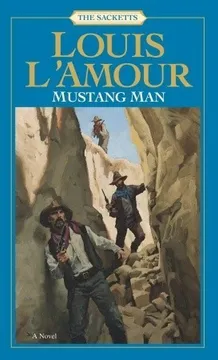


Plot Summary
A Horse for a Fugitive
Nolan Sackett is riding from a posse bent on hanging him when a wary old rancher lets him take a fresh horse. Its unfamiliar brand means nothing to Nolan yet. Farther across the plains, he spots a stranded wagon and a young woman waving beside it. He circles wide, discovers a young man hidden with a rifle, and realizes the pair meant to ambush him for his horse.
A third youth emerges when Nolan threatens to shoot. The travelers admit their teamster has taken the horses, leaving them without water in dangerous country. Nolan accepts their coffee only after watching the woman handle it, then dumps the first cup. When another unseen threat moves nearby, he forces the group to reveal who is waiting in the dark.
The opening makes survival a matter of reading small signs: tracks, a horse's ears, a stranger's movement. Nolan's competence protects him, but it does not make him morally neutral. He recognizes the travelers' attempted murder and still chooses not to abandon them, establishing the tension between his outlaw reputation and a private code of responsibility. The horse brand quietly plants a clue whose meaning will grow as the gold hunt gathers momentum.
Hooker Sells the Secret
Nolan makes Andrew surrender his rifle and learns the hidden youth is traveling with Sylvie and Ralph Karnes. Rather than leave them exposed, he follows their stolen team to a secret watering place.
There he catches Steve Hooker, the teamster who abandoned them, and binds him while recovering the wagon horses. Hooker explains that the Karneses hired him near Fort Griffin, asked questions about the country around Rabbit Ears, and planned to kill him once he had led them there.
He stole the outfit first, hoping to sell the animals and whatever was in their wagon. Nolan suspects the answer is gold, but Hooker never saw the wagon's contents. Nolan returns the team, leaves Hooker to fend for himself, and rides north with the mystery unresolved.
Hooker's account changes the stranded travelers from a simple rescue problem into the first visible edge of a treasure race. His betrayal is partly defensive, since he learned the Karneses meant to murder him, but greed turns his escape into another theft. Nolan refuses to excuse him or to make himself anyone's hired avenger. His decision to return the horses without joining the expedition preserves his independence, though the gold story has already begun to pull him toward it.
The Hume Inheritance
Riding north, Nolan recalls a Mexican traveler who entrusted him with a story about Nathan Hume, a Santa Fe trader whose pack train was massacred near Rabbit Ears. Hume had hidden roughly three hundred pounds of gold before the attack; the Mexican's grandfather escaped, but never returned for it.
At Borregos Plaza, innkeeper Pio warns Nolan about three travelers heading north: Jacob Loomis, a stern older man; Penelope Hume, a young woman; and Flinch, a quiet scout. Penelope's surname links her to Nathan. Though Nolan means to continue alone, Pio's concern for her and the danger of Comanche country persuade him to guide the party toward Romero. Loomis offers fifty dollars, and Nolan sets the terms: he chooses the route and the pace.
The gold enters the plot as inherited knowledge rather than a simple prize. Its history passes through survivors, family memory, and a story Nolan nearly left unused. The frontier's informal network of travelers makes private secrets hard to contain: a surname, a horse brand, or a campfire tale can draw strangers into the same contest. Nolan's decision to guide Penelope is practical and ethical at once, though his attraction to her complicates his claim that he acts only from duty.
The Road Is Watched
Once the party leaves Borregos Plaza, Penelope explains that her grandmother's letters identify Nathan Hume's gold. The Karneses overheard the will reading and have been pursuing her ever since. She once escaped Sylvie's attempt to drug her, which sharpens Nolan's suspicions about the coffee he refused at the wagon.
In the rain, Nolan spots two gunmen waiting beside the trail and diverts the buckboard before they can fire. Their shelter and prepared shooting lanes show they are professionals, not passing bandits. Nolan warns Loomis that someone has hired them, but Loomis is more concerned with reaching the gold than with who wants them dead. The near miss makes Nolan take control of the route and keep the travelers moving under cover.
Penelope's account reveals that the journey began with a theft of knowledge as much as a family dispute. The letters make her both the legitimate heir and a target whose safety depends on what she knows. Nolan's skepticism, initially a tool for staying alive, becomes protection against a threat that looks courteous until it is too late. Loomis's fixation on the destination exposes a dangerous asymmetry: he treats the expedition's risks as costs to be managed, while Penelope and Nolan must live inside them.
An Axe in the Reeds
Nolan tries to lose the hired gunmen by leaving a false campfire burning while the party slips through the night to a concealed slough. Before dawn, Loomis follows Nolan into the reeds carrying an axe and swings at him. Nolan dodges, pins Loomis with his knife, and makes him retreat without killing him. He now understands that the older man wants not only the treasure but control over Penelope.
Nolan continues guiding the party, changing their course to avoid predictable trails and campsites. Penelope challenges Loomis when he tries to command her, insisting that she will receive her share if they find the gold. Nolan backs her up, partly to protect her and partly because Loomis's conduct has made him impossible to trust.
The axe attack converts suspicion into direct evidence. Loomis's politeness and role as Penelope's protector cannot conceal the coercion underneath, and Nolan's restraint matters as much as his speed: he could kill Loomis but chooses a warning, preserving the group while withholding trust. Penelope's resistance also counters the assumption that her safety requires obedience. In this stretch, Nolan's protective impulse becomes more complicated, because defending her means opposing the very man who claims responsibility for her.
Fifty Dollars, Then Goodbye
At the Perico Creek ford, Hooker and two men from William Coe's outlaw gang block the buckboard. Nolan charges through the shallow water before they can organize a fight, knocking two men from their horses and wounding Hooker in the shoulder.
The party reaches Rabbit Ears, where Loomis pays Nolan the promised fifty dollars and says his services are no longer needed. Penelope also refuses his offer to stay, so Nolan turns away rather than force himself into her plans. He does not ride far.
From a concealed position, he watches the camp because he distrusts Loomis and fears the Karneses will return. The apparent dismissal frees Nolan from his contract but not from his concern for Penelope, leaving him close enough to intervene when danger finds him.
Nolan's fight at the ford shows how quickly he can turn violence into a practical tool, but the scene also marks the limit of his paid obligation. Once Loomis dismisses him, Nolan could leave without blame. Instead, he remains nearby, unable to make responsibility fit neatly inside a contract. His unspoken attachment is not yet trust or romance; it is a stubborn refusal to treat Penelope as someone else's problem, even when she herself tells him to go.
Penelope Takes Aim
As Nolan scouts alone, Ralph Karnes shoots him in the head and leaves him temporarily unable to move. Penelope appears with a rifle and prevents Ralph from coming closer, then helps Nolan reach his horse while firing at the attackers.
Nolan can barely keep hold of the saddle, but Penelope stays beside him until they reach cover. When Andrew searches the brush to finish the job, Nolan waits until the young man exposes himself, then shoots him. Penelope's steady aim and nerve overturn Nolan's picture of her as a city-bred woman who needs constant guarding.
She has saved his life, while he has killed one of her pursuers. Neither can now pretend their fates are separate, and Nolan's choice to remain in the contest becomes personal as well as protective.
The reversal is physical and psychological: the man who has repeatedly rescued others must depend on Penelope while his body fails him. Her skill is not a sudden transformation but a quality Nolan had underestimated, shaped by her experience in the woods. Their alliance becomes reciprocal rather than paternalistic. Nolan's killing of Andrew restores his agency, but it also binds him to the violence he hoped merely to navigate. Protection here is no longer a one-way role.
Mims Knows the Canyon
At Nolan's camp, a badly wounded old man arrives: Harry Mims, a relative of Nathan Hume who worked with him as a boy. Mims knows where the box canyon lies and believes the gold is still hidden there. He explains that the Karneses recognized the Hume brand on Nolan's borrowed dun, which helped them connect him to the old story.
Later, Penelope slips into camp to warn them that Sylvie has recruited three feared gunmen: Noble Bishop, Tom Fryer, and a knife fighter called Ferrara. Nolan and Penelope move with Mims toward the canyon before the new pursuers can close in. Mims's knowledge gives their search a destination, but his wounds and the canyon's reputation make the expedition more precarious than any of them admits.
Mims turns a tale of buried wealth into a living family claim. His battered body carries the cost of keeping knowledge from people willing to torture for it, while the horse's brand shows how an ordinary object can become evidence in a landscape without records. Penelope's night approach also revises Nolan's understanding of her: she can move unseen and assess danger herself. Yet their expertise cannot erase the risks created by injury, secrecy, and a destination feared even by experienced travelers.
Bishop Calls a Truce
Inside the box canyon, the horses grow restless, the air feels wrong, and Mims collapses before they can reach the cache. Nolan and Penelope get him outside, where he slowly recovers. As they approach the canyon again, Sylvie, Ralph, Hooker, and Bishop's men step from cover and demand the gold's location. Nolan refuses to surrender his weapons and argues that a shootout could kill them all before anyone finds anything.
Bishop agrees and lets the three travelers ride away, though the standoff settles nothing. Nolan's warning that the canyon holds old bones and an uncertain curse is partly tactic, partly instinct. With the enemy now close and Mims weakened, the group must return to the dangerous place before someone else reaches it.
The canyon's danger is first registered through bodies rather than explanation: horses balk, Mims faints, and the air itself seems to resist them. Bishop's decision to avoid a chaotic gunfight distinguishes calculation from restraint; he is no ally, but he understands the cost of an uncontrolled exchange. Nolan uses the canyon's reputation as leverage, turning local knowledge into a temporary shield. The truce buys time without resolving the central conflict, so every party remains poised to resume it.
The Canyon Catches Fire
At daybreak, Nolan and Mims find Hooker dead inside the canyon, his body swollen and unmarked. Following Mims's memory, they locate a scratched cross and clear the rocks beneath it, uncovering the gold. Nolan's head wound and the canyon's air make the work difficult, but the promise of escape keeps them moving. They load the ingots onto pack horses and climb a narrow trail Nolan discovered among the boulders.
A pursuer fires from below. The shot's muzzle flash ignites gas pooled in the canyon, and fire races through the low ground in a roaring explosion. Nolan is thrown down; Mims survives with the loaded horses. After they find each other, both ride west, shaken by the deaths and forced to think beyond simply possessing the treasure.
The treasure is real, but retrieving it exposes the limits of human control. The canyon's apparent haunting has a material cause, yet that explanation does not make the place less lethal; knowledge arrives only after it has nearly killed them. Hooker's body supplies grim evidence, while the explosion turns an ordinary gunshot into an environmental catastrophe. Nolan and Mims gain the gold at the cost of certainty about who survived, making possession inseparable from danger and grief.
The Burned Wagon
Nolan and Mims bury the gold in a sandy bank, then backtrack to search for Penelope. They find the buckboard burned and abandoned, with signs of a fight nearby. At a creek camp they discover Penelope facing Sylvie, Loomis, Bishop, and other survivors. Nolan tries to take Penelope and Mims away, but Sylvie blocks them; Penelope strikes her hard enough to break free and mounts her horse.
The three ride out together, then Nolan decides the loaded pack horses will draw pursuit. He sends Penelope and Mims toward a distant lava outcrop while he stays behind to mislead the enemy and rejoin them later. His plan gives them a head start, but separating the group leaves each traveler exposed.
The burned wagon strips away the expedition's last appearance of orderly travel. The creek confrontation makes the conflict intimate: Penelope does not wait for Nolan to rescue her, and her blow against Sylvie is an assertion of agency under immediate threat. Nolan's decision to divide them expresses care through strategy, but it also repeats his loner's instinct to absorb danger alone. The plan depends on the others reaching safety and on Nolan finding them again, conditions neither loyalty nor courage can guarantee.
Loma Parda's Last Ambush
At the agreed lava outcrop, Nolan finds Mims shot and the gold gone. Penelope is missing, but her tracks show that she outmaneuvered the pursuers, using a sheep herd to hide her trail and trading exhausted horses for fresh ones. Nolan follows her to Loma Parda, where she is sheltered by Slanting Annie. Penelope tells him that Flinch killed Mims, and Nolan's grief hardens into anger.
When Loomis tries to ambush him outside Annie's house, Nolan shoots him first. He then traces Penelope's route beyond town and finds the gold hidden beneath a fallen pine. Rather than flee alone, Nolan arranges passage in a freight wagon, planning to carry Penelope and the treasure away from the town's hungry eyes.
Penelope's escape converts the supposed rescue into a pursuit between equals: Nolan follows her trail by applying the same observational methods she learned from him. Mims's death removes the expedition's older witness and costs Nolan a companion whose endurance had briefly made survival feel communal. Loomis's attack confirms that the danger has followed them into town. Nolan's recovery of the cache does not settle who deserves it; instead, choosing a freight wagon makes departure and shared risk more important than simply winning the race.
Gold Rides in the Wagon
Nolan hides the recovered gold in the freight wagon, then sees Penelope leave a meeting with Sylvie, Bishop, and Ralph. At the cache, Sylvie attacks him with a knife; a burst of flame reveals Bishop and Ralph, and Nolan shoots both while Sylvie survives.
Penelope reaches the wagons, stunned that the gold has vanished. As the train moves out, Flinch stops Nolan, reveals his own claim to the treasure, and tries to take it by force. Nolan's knife kills him, though Flinch's bullet strikes Nolan's cartridge belt instead of his body.
Safe on the road, Nolan offers Penelope half the gold. The division gives her independence and lets him imagine a life built on more than fighting, though his bruised body and unshaven face remain unmistakably his own.
The final sequence makes trust a practical wager rather than a sentimental certainty. Nolan reads Penelope's meeting as possible betrayal, survives Sylvie's concealed attack, and still chooses to share the fortune with her. Flinch's claim exposes how ancestry and inherited grievance can be used to justify present violence, but his history does not excuse his choice to kill. The equal division answers the opening's scarcity with a form of mutual independence: neither character must become the other's dependent, and their connection can be chosen rather than purchased.
Analysis
Mustang Man makes the frontier a system of information as much as a wilderness. Nolan survives because he can read tracks, weather, animals, and the posture of armed strangers, but knowledge is unevenly distributed. Penelope has letters and inherited claims; Mims has memory; Flinch has local and family knowledge; the Karneses have overheard what they were never meant to learn. The plot turns on who can interpret these fragments before someone else acts on them.
Nolan's outlaw identity is not erased by his decency. He is capable of killing quickly, and he accepts violence as part of the country he inhabits. What distinguishes him is a limit: he will not leave a stranded woman to die, exploit Penelope's vulnerability, or confuse a paid obligation with the whole of his responsibility. That code is imperfect and often risks his life, but it gives his actions a consistency that formal law cannot provide in these remote places.
Penelope's arc challenges the rescue fantasy built around her. Nolan initially mistakes beauty and eastern manners for helplessness, then learns that she can track, shoot, deceive pursuers, and make decisions alone. Their bond gains credibility because she saves him as well as receives his aid. The equal division of the gold preserves that independence: wealth matters not as a romantic reward but as protection against coerced dependence.
The canyon's explosion brings the novel's material world into sharp focus. What seems supernatural is gas, but the distinction offers little comfort to those caught inside it. The land can kill without intention, while people choose whether to exploit that danger or protect one another from it. By the end, survival has not made Nolan gentle or safe. It has given him and Penelope the means to choose what comes next, without requiring either to surrender autonomy.
Review Summary
Mustang Man receives mostly positive reviews, with readers praising its engaging plot, well-developed characters, and fast-paced action. Many enjoy Nolan Sackett's character development and the western setting. Some criticize the predictable ending and occasional plot inconsistencies. Readers appreciate L'Amour's storytelling ability and find the book entertaining, particularly those who enjoy westerns. The novel is part of the popular Sackett series and is considered a solid entry, though not everyone's favorite.
Characters
Nolan Sackett
The hard-riding fugitiveA large, quick-witted Tennessee-born drifter, Nolan survives through an intimate knowledge of horses, tracks, weapons, and the habits of dangerous people. His reputation as an outlaw is less important to him than his private sense of what a decent man must do, though he is wary of sentiment and distrustful of easy promises. He would rather travel alone, yet repeatedly risks his safety when another person is stranded or outmatched. His humor and self-deprecation conceal a longing for stability and respect that he rarely admits. Penelope challenges both his assumptions about women and his belief that attachment is a liability, while the gold forces him to consider what he wants beyond simply escaping the next danger.
Penelope Hume
The capable heiressA young woman from New York, Penelope comes west because her grandmother's papers point toward a family treasure and offer her a chance to secure her future. She is observant, self-possessed, and more capable in the wilderness than Nolan first assumes; childhood experience in the woods has taught her patience and practical skill. Penelope does not confuse gratitude with obedience. She resists Loomis when he tries to govern her and makes difficult choices without waiting for a man to approve them. Her attraction to Nolan grows alongside a careful assessment of his character. She wants financial independence, but she also wants any future relationship to rest on affection rather than need.
Harry Mims
The battered family guideAn old relative of Nathan Hume, Mims worked with him as a boy and carries firsthand knowledge of the lost gold and the country around Rabbit Ears. He is wiry, stubborn, and hardened by years of setbacks, including earlier raids that cost him his outfit. His pride keeps him moving even when injury and age make the journey punishing. Mims's family loyalty is complicated by his own claim to the treasure and by his unwillingness to harm a woman, even when Sylvie has treated him cruelly. He offers Nolan and Penelope both practical guidance and a living connection to the story that brought them west.
Sylvie Karnes
The smiling predatorSylvie is Ralph and Andrew Karnes's sister and a distant relation by marriage to Penelope's family. Her beauty and social ease make her look safer than she is. She reads people quickly, uses charm as a tool, and treats violence as a practical solution rather than a moral threshold. Sylvie's appetite for the Hume gold is matched by her need to control who knows about it, which makes her dangerous even when she appears relaxed. She serves as Nolan's clearest test of whether appearances can be trusted, and as Penelope's most personal rival in the struggle to claim a future of her own.
Jacob Loomis
The controlling protectorAn older friend of Penelope's father and grandfather, Loomis joins the expedition as her escort and presents himself as a responsible guardian. His rigid manners and impatience with questions conceal an intense interest in the expedition's outcome. He expects deference from Penelope and resents Nolan's authority as guide, creating friction within the party before the trail's external dangers fully emerge. Loomis is a useful reminder that respectable social roles do not guarantee benevolent motives. He wants control over both the journey and the people around him, especially when their independent choices threaten his plans.
Flinch
The silent scoutA slight, middle-aged man of mixed Indigenous heritage, Flinch travels with Penelope and Loomis as a quiet, capable companion. He moves through brush with unusual stealth and notices more than he lets on. Nolan finds his silence difficult to interpret, especially because Flinch appears comfortable reading the country and tracking movement. His reserved manner places him on the edge of the party's conversations while keeping him close to its practical decisions. Flinch embodies the uncertain loyalties produced by a frontier where family histories, local knowledge, and claims to land or treasure rarely fit into one simple account.
Ralph Karnes
Sylvie's cold-blooded brotherRalph travels with his sister Sylvie and their younger companion Andrew in pursuit of Penelope's family secret. He looks polished beside Nolan's battered clothes, but his composure masks a readiness to kill anyone who interferes. Unlike a reckless brawler, Ralph often waits for an advantage before acting. His confidence depends on numbers and surprise, and Nolan's refusal to be intimidated frustrates him. Ralph's relationship with Sylvie is close enough to make their shared pursuit feel coordinated, though her ruthlessness often exceeds even his.
Andrew Karnes
The young armed followerA teenage companion of Ralph and Sylvie, Andrew carries a rifle and follows their lead into dangerous country. He is wary, watchful, and quicker than his soft appearance suggests. His presence gives the Karneses another armed hand, while his youth hints at how thoroughly their pursuit has drawn others into violence.
Steve Hooker
The treacherous teamsterA stocky former freight teamster, Hooker knows how to move horses and wagons across harsh country. He accepts work from the Karneses, then turns against them after overhearing that they plan to kill him once he has served his purpose. His fear is understandable, but his response is to steal their entire outfit and abandon them without water. Hooker gives Nolan the first credible hint that the party is chasing gold, yet he keeps enough information back to protect his own interests. His shifting alliances make him an example of how self-preservation can slide into predation.
Noble Bishop
The calculating gunfighterA feared professional gunman hired by Sylvie, Bishop is experienced enough to know that a fight is not always worth starting. He understands the risks of a close-range shootout and can restrain his allies when violence would leave the treasure no closer to their hands. Nolan regards him as a serious adversary, but also recognizes that Bishop's caution differs from the Karneses' appetite for cruelty. His presence raises the stakes because he combines lethal skill with the patience to wait for a better opportunity.
Pio
The watchful innkeeperThe Mexican innkeeper at Borregos Plaza offers Nolan food, shelter, and a sober reading of the travelers heading north. Pio trusts his judgment of character and understands how exposed a young woman can be in the open country. His gentle pressure helps Nolan recognize that refusing involvement is still a choice with consequences.
Ollie Shaddock
The generous freighterA Tennessee-born freight operator, Shaddock recognizes Nolan's family name and offers him a place on a wagon train. Cheerful but perceptive, he senses that Nolan's attachment to Penelope may put him in danger. His freight business provides a practical route out of Loma Parda, and his trust gives Nolan a rare moment of help without a demand for repayment.
Nathan Hume
The vanished trail masterPenelope's grandfather, Nathan Hume was a veteran Santa Fe trader whose pack train was attacked while carrying gold. He left behind clues that connect his family to a cache in the Rabbit Ears country. Though absent from the action, his decisions shape the journeys and loyalties of everyone who follows the story of his lost cargo.
Tex Parker
Coe's hired gunOne of the men who blocks Nolan's party at the Perico ford, Parker rides with William Coe's outlaw circle. He represents the hired muscle gathering around the treasure hunt, where a reputation and a gun can be exchanged for pay.
Charlie Hurst
Coe's trail enforcerHurst joins Hooker and Parker at the ford to stop Nolan's party. His role is brief but concrete: he helps make the road to Rabbit Ears a contested passage rather than a safe route.
Tom Fryer
The hired killerFryer is one of the experienced gunmen Sylvie brings into the contest. His reputation makes Nolan wary, and his presence shows that the Karneses can recruit professional violence beyond their own circle.
Ferrara
The knife fighterA dark, quiet gunman hired by Sylvie, Ferrara is known for using a knife as readily as a firearm. His skill makes him a threat at close range and adds another kind of danger to Bishop's armed party.
William Coe
The outlaw gang leaderCoe commands the outlaw gang whose men include Parker and Hurst. Nolan knows Coe's reputation and expects him to act with calculation rather than rush blindly into a fight. Though Coe remains offstage, his influence explains why a small creek crossing can suddenly become a serious confrontation.
Slanting Annie
Penelope's town refugeAnnie is an established presence in rough western towns and offers Penelope shelter in Loma Parda. She knows both Nolan and Penelope's family, and her home gives Penelope a private place to regroup amid a town where news and danger travel together.
Oscar Reinhardt
The freight wagon driverA trusted driver in Shaddock's freight outfit, Reinhardt is assigned to Penelope's wagon. He takes care of his team and remains alert when Nolan's plans grow suspicious, but he is not looking for a fight. His presence gives Nolan a dependable route away from Loma Parda.
The old horse owner
The unexpected benefactorA lean, hard-eyed rancher first encountered at a water stop, he could have stopped Nolan at gunpoint but chooses to lend him a fine horse instead. His brief act of trust begins Nolan's association with the Hume brand and the pursuit that follows.
Plot Devices
Nathan Hume's gold
Inheritance becomes baitA cache of roughly three hundred pounds of gold was hidden after Nathan Hume's pack train was attacked. Knowledge of it survives through family letters, a witness's memory, and rumors told along the trail. The gold motivates Penelope's journey, attracts the Karneses and hired gunmen, and tests Nolan's shifting sense of responsibility. Because its location is not immediately known, the treasure also supplies a practical mystery: characters must decide whom to trust before they can even reach the prize.
The Hume horse brand
A clue travels unnoticedThe borrowed dun carries a brand associated with Nathan Hume. Nolan initially values the horse for its strength and speed, not for its mark. The Karneses recognize the brand and use it to connect Nolan to the old treasure story, making the horse more than transport. It is a quiet example of how objects carry histories their owners may not know, and how practical choices can reveal a person to enemies before he understands why he is being watched.
Trail signs and terrain
The landscape keeps scoreNolan reads wagon ruts, horse tracks, water sources, windblown sand, and animal behavior to detect danger and navigate the Staked Plains. These details repeatedly determine whether the party reaches a camp safely, evades a shooter, or finds Penelope's trail. The land is not scenery around the conflict. Its scarcity of water and shelter shapes every decision, while expertise in reading it separates the experienced traveler from the person who can be lured into a trap.
The box canyon
A natural trap becomes tinderThe canyon's bones, lifeless pool, and frightened horses give it a reputation for being cursed. Mims knows it as the place where Hume's pack train fell, and the gold is hidden among its rocks. The strange air has a physical cause: gas collects in the low ground. When a gun is fired, its flash ignites the seepage, turning the canyon into a blast zone. The device joins folklore and material danger: the characters' fear is not proof of magic, but it is a useful warning about a threat they cannot see.
About the Author
Other books by Louis L'Amour



Download PDF
Download EPUB
.epub digital book format is ideal for reading ebooks on phones, tablets, and e-readers.








