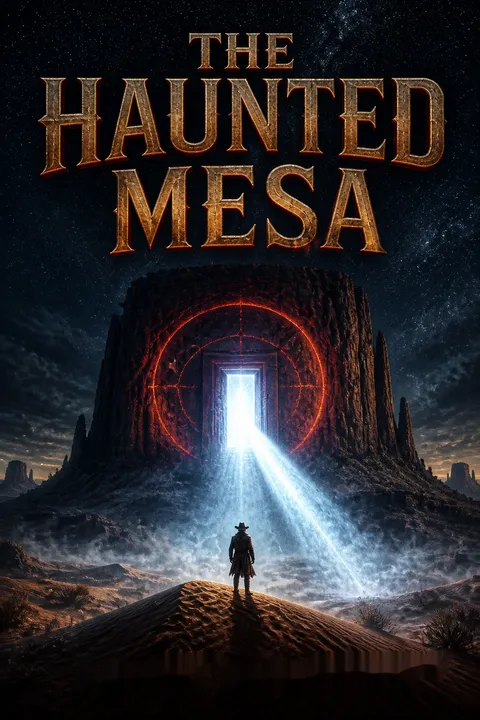


Plot Summary
The Mesa Flashes
Mike Raglan, a writer and investigator of unexplained events, drives into the desert to meet his old friend Erik Hokart, an electronics inventor whose hurried letter says he is in danger. An old cowboy’s warning about a hidden world has haunted Mike since youth, but he has never told Erik about it. Near the meeting place, a sudden flare lights the rim of a remote mesa.
Mike sees naked figures rush through the darkness and strike his car, then reaches his lodging to find Erik’s daybook delivered by a strange young woman. A broad-shouldered intruder soon breaks into Mike’s room to steal the package. Mike tricks him into taking a decoy book and keeps the daybook, proof that Erik’s trouble has already reached him.
The story begins with a skeptic whose expertise is built on separating fraud from fact, then immediately gives him evidence that refuses easy classification. The intruder’s attempt to retrieve the daybook turns a distant mystery into a present threat. Mike’s decision to keep the real notebook is small but consequential: he chooses investigation over the safety of treating Erik’s plea as someone else’s problem. The desert’s strange flare and the figures are not yet explanations. They are pressure on the boundaries of the rational world Mike has spent his career defending.
The Buried Kiva
In Erik’s notebook, Mike learns how the trouble began. Erik had chosen a remote mesa for the stone house he planned to build, then saw a red line appear on his blueprints and excavated the circular room it marked.
The kiva’s painted walls were unusually intact, and its niche held a dark, shifting substance instead of the customary symbolic opening. Someone took Erik’s pencil and left a tiny jar; later, his pencil returned with a sunflower, followed by a new sweater bearing the same emblem.
Then Chief, the huge mastiff Mike once gave Erik, leapt through the kiva’s cloudy opening after something and vanished. Erik heard the dog barking beyond it. The opening was no longer an archaeological curiosity. It had carried a living creature somewhere beyond the mesa.
The kiva makes the novel’s central impossibility material: a room built by an ancient culture becomes a functioning threshold. Erik’s careful notes matter because they make his experience testable rather than merely visionary. The exchanged objects also complicate the threat. Whoever is beyond the opening can take, return, and make gifts, suggesting intelligence and restraint alongside danger. Chief’s disappearance forces Erik toward action, while the sunflower hints at an unrecognized ally. The setting is not simply haunted; it is a contested border whose rules neither scientist nor investigator yet understands.
Kawasi's Warning
Erik’s account continues with a beautiful woman who enters through the kiva and orders him away from the mesa. Chief growls at her, and Erik refuses to follow. A young woman named Kawasi, wearing a sunflower, warns him that the visitor is a Poison Woman whose touch can kill. Kawasi says her people descend from the Anasazi and came from another world, where the rulers now hunt dissenters.
Erik and Kawasi hide, then steal away in his Jeep. At a café, Erik tries to obtain a gun, but their pursuers arrive and Kawasi disappears. The building erupts in a flash fire, leaving its owner badly injured and Erik’s Jeep behind. Kawasi later gets the daybook to Mike, while Erik is taken away.
Erik’s notebook changes from a record of construction into an emergency message, and its plural sense of danger acquires a human shape in Kawasi. The Poison Woman represents a weapon disguised as beauty, but Kawasi’s refusal to obey the rulers makes her a source of knowledge rather than a threat. Their escape fails because the pursuers control more than physical force: they can make people and evidence vanish, then disguise violence as an accident. The destroyed café gives Mike and Gallagher a real crime to investigate, even as the explanation behind it remains almost impossible to accept.
The Missing Witness
After reading enough of the daybook to understand that Erik may be missing rather than dead, Mike drives to the Utah town where the café burned. He finds Kawasi waiting there and recognizes her from the hotel clerk’s description.
Over breakfast, she explains that Erik has been taken to the world her people call Shibalba, ruled by a figure known as the Hand. The rulers want to suppress contact with Mike’s world and may exploit Erik’s technical knowledge.
Kawasi also reveals that her people fled Shibalba’s earlier evil, then some returned generations later and became subject to its rulers. Officer Gallagher questions both visitors, investigates the fire, and remains skeptical but attentive. Mike now has a witness, a missing friend, and a possible route to the place holding him.
Kawasi’s account gives the mystery a political structure: the danger is not a supernatural force alone but a society that controls information, movement, and water. Mike’s old talent for scrutinizing testimony becomes less useful than his willingness to act before proof is complete. Gallagher offers a grounded counterweight, treating the fire and disappearances as evidence even when the proposed explanation strains belief. Their uneasy cooperation matters because the story’s two worlds are not simply rational and magical. Each has forms of knowledge the other lacks, and neither can solve the crisis alone.
Eden's Marked Book
Gallagher takes Mike to meet Eden Foster, a cultured art dealer with influential local connections. Eden asks pointed questions about Erik and his planned home, while her Navajo employee, Mary, watches Mike without speaking. Mike notices that a paperback stolen from his room sits among Eden’s books, marked with his own distinctive ink.
He concludes that she is connected to the men seeking the daybook. Gallagher quietly investigates a nearby white van and the people associated with it, while Mike spots a watcher at Tamarron and later evades a car following him. Two men attack him outside his motel, but he defeats them before the police arrive. Their disappearance from custody confirms that the enemy can erase even tangible evidence.
Eden’s polished respectability makes her more unsettling than the anonymous intruders: she has learned how to inhabit local trust, not merely how to cross a border. Mike’s marked book is a modest physical clue, but it links the hotel burglary to her house and changes suspicion into strategy. The attackers’ disappearance deepens the asymmetry. Mike can win a fight, yet he cannot make that victory count in ordinary institutions. Gallagher’s investigation keeps public reality in view, while Mike recognizes that the hidden network is already using the town’s ordinary routines as cover.
Tazzoc at the Fire
Searching the canyon below Erik’s mesa, Mike encounters Tazzoc, a scholar from Shibalba who has come to warn him away. Tazzoc admits that he opened the kiva after finding an ancient record, and that Erik is now before the Hand.
He describes the Archives he guards: thousands of records that few people visit, in a society where the past has been deliberately neglected. Mike learns that the rulers’ guards, the Varanel, patrol the boundary, and that entering the forbidden citadel is nearly impossible.
On a later reconnaissance, Mike sees four Varanel appear through shimmering air, armed and searching. He hides as they flee the sight of an airplane overhead. The patrol proves Tazzoc’s account is not a private delusion, but it also shows how dangerous the crossing will be.
Tazzoc embodies the cost of a culture that has stopped asking questions. His archives preserve evidence, but their abandonment has made preservation almost indistinguishable from burial. By admitting that he opened the passage, he complicates the simple division between villain and victim: curiosity can be liberating, but it can also unleash consequences its seeker cannot control. The Varanel’s alarm at an airplane reveals how little Shibalba understands Mike’s world, despite its rulers’ desire to exploit it. Knowledge flows unevenly, and that imbalance is itself a source of power.
Gold from Elsewhere
With Erik still missing, Mike seeks help from an old western acquaintance, Volkmeer, who agrees to back him up. At Tamarron, retired banker Artemus Weston tells Mike that Volkmeer once paid for land with refined gold discs matching the treasure described by an old cowboy years earlier. Mike realizes the gold likely came from Shibalba, raising doubts about how Volkmeer acquired it and whom he serves.
Mike has also inherited the cowboy’s canvas map, which marks a crossing and a red cross in the rough country. He returns to Erik’s mesa and studies the map, while Gallagher follows the white van to Volkmeer’s hidden property. The evidence turns Mike’s supposed ally into an uncertainty, but the old map may offer a safer passage than the kiva.
Gold links the supernatural plot to ordinary motives: wealth, influence, and the temptation to exchange loyalty for security. Volkmeer’s sudden fortune does not prove betrayal, but it forces Mike to revise a friendship he had taken for granted. The map, by contrast, is a form of inherited knowledge whose meaning becomes clearer only when events demand it. The contrast is telling. Gold can buy comfort while concealing its cost; a map is valuable because it makes another person’s dangerous experience usable. Mike’s trust now has to be earned through evidence, not nostalgia.
Eden's Impossible Choice
Mike confronts Eden privately and gives her forty-eight hours to help return Erik. She denies having authority, then reveals that she is a Poison Woman, placed in Mike’s world to serve the Hand. Though she enjoys its sunlight and freedom, she says she is watched and cannot simply defect. She warns that the Hand possesses destructive weapons and has never faced resistance.
Mike tells her that if Erik is not released, he will cross over himself. Two of Eden’s men enter to seize him, but Mike uses a chair, a wine bottle, and a knife to disable them and escape. He returns to Gallagher, who has found signs that Volkmeer’s property may house the hidden network. Mike decides negotiation has failed and commits to entering Shibalba.
Eden’s confession is not a simple turn from enemy to ally. She is both an agent of the Hand and a person who recognizes that her assigned life has denied her choice. Her attraction to Mike’s world cannot erase the surveillance and coercion that shaped her. Mike’s ultimatum likewise binds him to action, though he is frightened and far from certain he can succeed. The brief fight gives him physical control where political persuasion fails, but it does not resolve the larger imbalance. He leaves with a decision, not a plan adequate to its risks.
The Last Openings
Back on the mesa, Mike meets Tazzoc again. The archivist agrees to supply a robe, turban, and directions to the portal he uses, but warns that the citadel is a maze of dangerous rooms. Kawasi returns and explains that the unstable crossings may close for decades when a disturbance in space occurs. That night, Mike feels the disturbance begin. If he waits, he may be stranded on either side.
He and Kawasi descend into the canyon and pass through a hidden opening. Mike lands on grass in Shibalba, where a Varanel patrol is camped nearby. Kawasi recognizes the place as close to her village and fears the patrol has found it. The crossing has succeeded, but Mike has arrived inside enemy territory just as the window of escape begins to shrink.
The spacequake turns an abstract deadline into a bodily event. Mike can no longer treat crossing as a future choice or postpone it until he feels ready. His partnership with Kawasi also shifts: she is not merely his guide but a leader returning to a community whose safety may already be compromised. The first sight of the Varanel encampment makes the crossing feel less like arrival than interception. The world’s unstable geography is not a convenient portal system; it imposes uncertainty on every promise of return.
Kawasi's Besieged Village
Kawasi leads Mike through a ravine to her hidden pueblo, where a network of irrigation channels sustains fields and roof gardens. She alerts the community that Varanel soldiers are near, and the residents gather to decide how to respond.
They have long avoided violence and believe the guards cannot be killed. Mike challenges that belief, pointing out that the soldiers’ armor leaves vulnerable areas exposed. A young man named Hunahpu volunteers to fight, and Mike urges Kawasi’s people to organize under him rather than wait for enslavement.
He studies the old canvas map and identifies a route toward the Forbidden, a vast black citadel. Although he wants Kawasi to leave with him, she remains with her people. Mike sets out alone to find the records and rescue Erik.
The village’s agricultural skill contrasts with Shibalba’s coercive order: its irrigation is collectively maintained, while the Hand turns control of resources into political submission. Yet the community’s preference for defense without retaliation leaves it vulnerable to an enemy that does not share its restraint. Mike’s advice is strategically sound but morally costly, since he asks people to risk lives while refusing to stay and lead them. His choice is not heroic self-sacrifice; it is divided obligation. He can help them see that resistance is possible, but he cannot make their decision for them.
Johnny and the Ruins
In the wild country above the village, Mike finds Johnny, the old cowboy whose warning and map have shadowed his life since youth. Johnny crossed into Shibalba decades earlier while chasing cattle and never found a route home.
He shows Mike the hidden vault of gold and a gold-plaque plan of the Forbidden, while warning that its guards use weapons that kill through a wound. Johnny also confirms that the citadel’s inhabitants rely on deception and cannot be trusted. Mike wears Tazzoc’s clothing and follows a forgotten path toward the building.
Inside its outer court, two guards overlook him. Near the Archives, an elderly dissident named Camha warns that the citadel contains lethal trap rooms, but cannot accompany Mike. Mike enters the Archives alone, carrying the burden of the map and the rescue.
Johnny turns the old cowboy story from folklore into lived history, and his decades of survival show how practical habits can outlast any theory of the crossing. The gold vault complicates the lure of treasure: it has been available, yet both men understand that taking more than necessary could become a trap of its own. Camha’s warning gives the architecture a psychological dimension. The citadel does not merely imprison bodies; it trains inhabitants to fear initiative until a wrong turn seems like personal failure. Mike’s disguise buys entry, but every step depends on interpreting a society he barely knows.
The Archives and the Maze
Tazzoc meets Mike inside the vast Archives and helps him find the old plan of the Forbidden. The chart marks rooms with sloping floors, traps designed to seal intruders inside, and suggests a route toward the Hand’s central quarters.
When Zipacna arrives, Tazzoc panics and orders Mike to leave; Mike escapes through an overlooked passage, taking a second, older map that shows the Archives’ former temple layout. In the maze, a woman offers to guide him to Erik, but Mike notices the trap at the doorway and pulls her back before it closes.
He follows the left wall, marks turns with chalk, passes through deceptive glass corridors, and reaches the prison cells. After overpowering a guard, he finds Erik unconscious in a sealed room and opens the door.
The rescue depends on reading systems rather than overpowering them. Mike’s memory, the two maps, and his attention to floor plans allow him to move through a structure designed to make knowledge fatal. Tazzoc’s retreat may be fear rather than betrayal, but it leaves Mike isolated at the crucial moment. The woman’s attempted guidance repeats the Poison Woman’s method of using trust as an entrance to danger. Mike’s decision to save her from the trap, despite her deception, suggests that his ethical habits persist even when they offer no tactical advantage.
The Hand's Tongue
Erik wakes as the prison door shuts behind Mike, leaving the two men separated for a moment. Mike forces the door open again, shoots two pursuing Varanel, and drags the weakened inventor into the Hand’s quarters. A booming unseen voice orders them to surrender.
They pass a carved idol whose hinged tongue recalls an altar of human sacrifice, then find a neglected tunnel leading from the citadel toward the old temple. The air grows foul, and both men nearly collapse before Mike forces open the tunnel’s stubborn exit.
They emerge behind the lattice screen in the Archives. Their route has avoided the guarded maze, but their escape is not complete: the Varanel have begun pursuit, Erik is barely able to walk, and the world’s shifting passages offer no certainty that the way back remains open.
The Hand’s unseen voice makes authority theatrical: it commands through architecture and sound, assuming that no one will disobey. Mike and Erik survive by refusing the performance and moving anyway. The idol’s sacrificial tongue gives the feared evil a concrete image, connecting the rulers’ present violence to older systems of domination. Yet the neglected tunnel undermines the citadel’s claim to total control. Its decay creates a passage the rulers have forgotten, just as the abandoned Archives preserve knowledge they no longer value. Escape becomes possible through the very history the regime tried to seal away.
The Red Cross Ambush
Mike and Erik flee the Forbidden with Johnny’s help, then discover the dead riverboat Iron Mountain, which vanished from the Mississippi in 1872. Its English-marked graves and abandoned cabin show that other people have crossed into this world and built lives here.
Erik reveals that Melisande, the last descendant of one of the boat’s passengers, escaped captivity and left the sunflowers for him. Kawasi returns with Melisande, and the group follows her toward an opening marked on the old map.
At the crossing, Volkmeer blocks their path with a rifle, admitting he has taken the Hand’s money. Mike shoots him, but Zipacna attacks before the others can escape. Mike knocks Zipacna down, then is struck from behind and dragged toward the threshold as Johnny and the others make their way through.
The Iron Mountain broadens the novel’s premise from an ancient Anasazi migration to a recurring human predicament: people arrive in an alien world and must decide whether to preserve old identities or adapt. Erik’s love for Melisande gives his rescue a personal urgency beyond his own survival. Volkmeer’s betrayal is the intimate cost of power, made sharper by Mike’s earlier trust and by their shared history. At the crossing, Mike’s courage does not guarantee control. His body is reduced to something dragged through the opening, and survival depends on the loyalty of those around him.
A Wall Closes Behind
Mike regains consciousness on No Man’s Mesa with Gallagher, Kawasi, Erik, Melisande, Johnny, and Chief around him. The spacequake has sealed the kiva’s opening, leaving Volkmeer’s head, shoulder, and arm embedded in the ancient wall; the rest of his body lies beyond, and he is dead. Eden has disappeared after giving her house to Mary.
Mike makes a simple fire-making bow and leaves it near the mesa for the Saqua, the hairy beings drawn to flame, then refuses Gallagher’s suggestion that he publicize the story. He and his companions leave the ruin together. Mike has rescued Erik and brought the others home, but the portal is shut and Shibalba remains beyond it, no longer a problem he can report as an ordinary case.
The ending resolves the immediate rescue while refusing the comfort of a complete explanation. Volkmeer’s body caught in the wall is the physical price of treating the threshold as a passage one can control; the spacequake has made the boundary absolute without making its laws intelligible. Mike’s gesture toward the Saqua is a quiet attempt at exchange rather than conquest, offering a tool instead of taking anything from them. His refusal to publish the story protects the survivors from disbelief and spectacle, but it also preserves the mystery. He returns with a changed circle of companions, not with proof the world will accept.
Analysis
The Haunted Mesa makes its central speculative premise serve a concrete political argument. Shibalba is not simply an uncanny parallel world; it is a society whose rulers have made ignorance a governing tool. The Hand’s people fear outside ideas, restrict travel, neglect their own archives, and treat obedience as proof of stability. Against that order, the mountain community’s cultivated fields and shared water offer a different model, but their reluctance to fight leaves them vulnerable. The novel therefore refuses to equate gentleness with safety. A community may value cooperation and still need organized resistance when another power is willing to enslave it.
Mike’s development is less a conversion from skepticism to belief than a change in what skepticism requires. He does not stop asking for evidence. He learns that evidence can be a diary, a pattern of tracks, a marked map, a strange weapon, or the behavior of a dog. His experience as a debunker helps him recognize manipulation, but his readiness to act depends on accepting uncertainty before proof becomes publicly persuasive. Loyalty to Erik is the personal force that carries him across the threshold; his decision to help Kawasi’s people, despite leaving them behind, reveals the limits as well as the value of his courage.
The novel also links historical memory to survival. The Archives and the Iron Mountain preserve stories that Shibalba’s rulers would prefer forgotten. The neglected records give Mike a route through the citadel, while the riverboat’s displaced passengers show how people can build lives from catastrophe. Knowledge is neither automatically liberating nor harmless: Tazzoc’s curiosity opens the kiva, with consequences he cannot manage. Yet suppressing inquiry leaves a society unable to adapt. The ending offers no public proof and no permanent reconciliation. Mike brings people home, the crossing closes, and his final gift to the Saqua imagines contact as an invitation rather than a conquest. The world remains larger than the explanations available to him.
Review Summary
The Haunted Mesa receives mixed reviews, with some praising its unique blend of Western and supernatural elements, while others criticize its repetitive narrative and slow pacing. Readers appreciate L'Amour's vivid descriptions of the Southwest and his exploration of Anasazi mythology. However, many find the protagonist's internal dialogue tedious and the plot development lacking. Despite its flaws, some fans consider it an interesting departure from L'Amour's typical Western novels, offering a blend of mystery, science fiction, and Native American lore.
Characters
Mike Raglan
Skeptic at the thresholdMike Raglan is a writer and investigator known for examining haunted places, mediums, and other claims of the unexplained. Orphaned young and forced to make his own education, he has built a life around curiosity, self-reliance, and the practical skills learned in rough settings. His skepticism is disciplined rather than dismissive: he looks for fraud first, but does not pretend that every experience has an easy explanation. Mike is capable in a fight and observant under pressure, yet his deeper struggle is whether loyalty to a friend can justify entering a reality he cannot control. His isolation makes him unusually free to act, but also means he has few personal ties to steady him when danger becomes real.
Erik Hokart
Inventor in perilErik Hokart is a wealthy electronics inventor who has retired from business to build a secluded stone home in the canyon country. Reserved and methodical, he prefers solitude because it gives him room to think and work. His technical aptitude makes him a practical problem-solver, not a believer in the occult, which gives his detailed notebook unusual credibility. Erik’s decision to investigate the strange kiva arises from curiosity and a desire to understand what has altered his plans. He and Mike have exchanged books and ideas for years, and Erik trusts Mike precisely because Mike can take an anomaly seriously without surrendering his judgment.
Kawasi
Mountain people's leaderKawasi is a young woman from a secluded Anasazi-descended community in Shibalba. She has learned some English from an older outsider and uses it to explain the customs and dangers of her world to Mike. As a leader, she is expected to advise rather than command, and her authority rests on judgment and the confidence of her people. Kawasi is cautious because she knows the Hand’s power and the cost of dissent, yet she has already chosen escape over obedience. Her attraction to the freer world Mike represents coexists with responsibility for the community she left behind, making every personal choice inseparable from political consequence.
Johnny
Stranded frontier survivorJohnny is a cowboy who crossed into Shibalba decades earlier while pursuing stray cattle and never found a reliable way back. He survives through practical intelligence, disciplined routines, hidden food caches, and a careful refusal to trust people who might betray him. His tailored clothes and orderly hideouts preserve his sense of self in a world where familiar social structures have vanished. Johnny’s long isolation has made him wary, but not indifferent to others in danger. He knows the wilderness and the Varanel better than Mike does, and his experience turns him into a vital guide without making him a conventional hero.
Tazzoc
Keeper of forgotten recordsTazzoc is the aging keeper of Shibalba’s Archives, a scholar whose access to ancient records has made him a custodian of knowledge that his society has largely abandoned. He is lonely and eager for conversation, yet fearful of the Hand and the Varanel. His curiosity led him to reopen the kiva, showing both intellectual courage and poor judgment about the consequences. Tazzoc hopes the Archives might be valued again, but his caution limits how much danger he will accept for that hope.
Gallagher
Local lawman, open-mindedGallagher is the local officer investigating Erik’s disappearance and the café fire. He begins from evidence and ordinary law, not from belief in parallel worlds, but he is intelligent enough to keep listening when Mike’s account resists easy dismissal. His knowledge of local people and his willingness to pursue the white van make him a useful ally on Mike’s side of the boundary. Gallagher’s skepticism is professional rather than stubborn: he needs facts, yet he understands that a good investigator must follow a disturbing possibility when the known explanations fail.
Eden Foster
Elegant, uneasy outsiderEden Foster is a sophisticated art dealer who has built a comfortable life and cultivated influential local relationships. Her intelligence shows in the questions she asks and in the care with which she observes Mike. She is accustomed to operating within a world of rules she did not choose, and her composure often masks conflict between assigned duty and personal desire. Eden’s familiarity with Mike’s world makes her difficult to read: she can imitate its social ease, but her understanding of its freedoms and consequences remains incomplete.
Melisande
Last riverboat descendantMelisande descends from passengers aboard the Iron Mountain, a steamboat displaced into Shibalba in the nineteenth century. Raised with her grandfather’s stories about the crossing and the possibility of return, she has learned to watch for signs that others overlook. Her life is shaped by isolation and practical demands, including the work of maintaining a home in a harsh landscape. Melisande’s connection with Erik grows from shared captivity and a mutual hope of escape, linking the riverboat’s lost history to Mike’s present rescue.
Zipacna
Powerful Varanel commanderZipacna is a tall, physically imposing figure associated with the Varanel and the Hand’s authority. He carries himself with the confidence of someone accustomed to obedience and regards resistance as an insult to the established order. His knowledge of Mike’s world and his influence among Shibalba’s factions make him more than a battlefield threat. Zipacna also understands that power can be enlarged by manipulating people’s fears and loyalties, which makes him dangerous even when he is not using force.
Volkmeer
Rancher with divided loyaltiesVolkmeer is an old rancher and former associate of Mike’s, a hard, capable man who has prospered after years of uncertain work. Mike remembers him as someone worth relying on, but the source of Volkmeer’s sudden wealth raises questions. His reserve makes his motives difficult to read, and his attachment to security competes with the obligations created by past kindness. Volkmeer represents the pressure exerted by material comfort: a person can know what loyalty demands and still find reasons to bargain it away.
Chief
Watchful mastiff companionChief is Erik’s enormous Tibetan mastiff, originally given to him by Mike. Fiercely protective and strongly attached to both men, he often senses danger before they can identify it. His behavior gives the human characters an animal measure of what is wrong: growling at hostile arrivals, resisting unsafe passages, and responding to people who treat him with care. Chief is more than a guard dog in the story. His loyalty crosses the boundary between worlds without requiring him to understand its politics.
Hunahpu
Young voice for resistanceHunahpu is a young man in Kawasi’s community who is willing to fight the Varanel when older residents fear resistance is impossible. His readiness gives the village a possible military leader, though he still needs the community to trust and organize around him. Hunahpu represents a break in inherited passivity, not because he has more power than the guards, but because he refuses to accept that their invulnerability is beyond question.
Camha
Quiet citadel dissidentCamha is an elderly man inside the Forbidden who remembers fragments of learning from the time when books and outside knowledge were permitted. He fears what the authorities may do to his family, especially his wife, yet he still warns Mike about the citadel’s trap rooms. His compassion survives within a society that rewards betrayal, though he is too afraid to join the rescue. Camha shows how private loyalties can endure even when public life has been shaped by fear.
Artemus Weston
Retired banker, keen observerArtemus Weston is a retired banker with a cowboy’s past and a long memory for the people who have passed through his town. His work taught him to notice how money moves and what sudden wealth may conceal. He gives Mike the clue connecting Volkmeer’s fortune to the refined gold discs described by the old cowboy. Weston’s quiet willingness to share what he has observed makes him an important source of local knowledge.
Mary
Eden's watchful employeeMary is a Navajo woman who works for Eden Foster while remaining close to her family. Gallagher recognizes her as intelligent and well educated, despite the assumptions others may make about her. Her watchful silence around Mike suggests she understands more than she openly says. Mary’s life connects Eden’s carefully cultivated local presence to the ordinary community around it.
Plot Devices
The kiva window
A doorway between worldsThe concealed opening in Erik’s mesa kiva connects the ordinary desert to Shibalba. Its permanence makes it more dangerous than the unstable crossings elsewhere, and its history explains why the room was deliberately filled in. Chief’s passage proves that living beings can cross it, while Mike’s return depends on a different, less reliable opening. The window turns archaeology into immediate action and gives the novel’s competing societies a shared border.
Erik's daybook and sunflowers
Evidence from the missingErik’s daybook preserves the sequence of discoveries that he could not safely explain in person: the red line on his plans, the excavation, the kiva, and the people who cross through it. Sunflowers appear as a quiet sign of contact from a person who cannot communicate openly. Together, the notebook and emblem give Mike evidence, establish a possible ally, and keep the missing characters connected across the divide.
The old canvas map
A guide through uncertaintyAn old cowboy gives Mike a hand-drawn map marking the desert, a crossing, and a red cross whose meaning is not immediately clear. Later, Mike recognizes that the map also points toward the Forbidden and uses it to orient himself in Shibalba. Its value lies not in offering a complete route but in preserving observations made by someone who survived the same country. The map turns inherited experience into a practical, if imperfect, means of navigation.
The Forbidden maze
Architecture as a weaponThe Hand’s citadel is an enormous complex of passages, glass corridors, and sealed rooms. Some doors open onto sloping floors and close behind anyone who enters, making a mistaken turn a death sentence. Mike studies the Archives’ plan, marks his route with chalk, and uses a forgotten tunnel to escape after finding Erik. The maze embodies a political system in which knowledge is restricted and disobedience is punished through structures designed to make escape seem impossible.
The Saqua and fire
A possible signal of trustThe Saqua are hairy, elusive beings drawn to fire, though the people of Shibalba know little about them. Mike sees them near flames and reasons that fire might offer a way to communicate. At the end, he leaves a simple bow-drill and tinder near the mesa, suggesting the creatures may be attracted to fire because they want it but cannot make it. The gesture leaves open the possibility of contact based on exchange rather than fear.
About the Author
Other books by Louis L'Amour

Download PDF
Download EPUB
.epub digital book format is ideal for reading ebooks on phones, tablets, and e-readers.








