

Key Takeaways
Train your body, not just your opinions, to interrupt racial reflexes.
The body acts first. Menakem argues that racism is not only a set of conscious beliefs. It also shapes automatic sensations and responses: tension, fear, vigilance, or an impulse to control. Because these reactions can arise before deliberate thought, discussions and good intentions alone may leave them untouched. His proposal is to notice what the body does, then practice responding with greater awareness rather than obeying its first alarm.
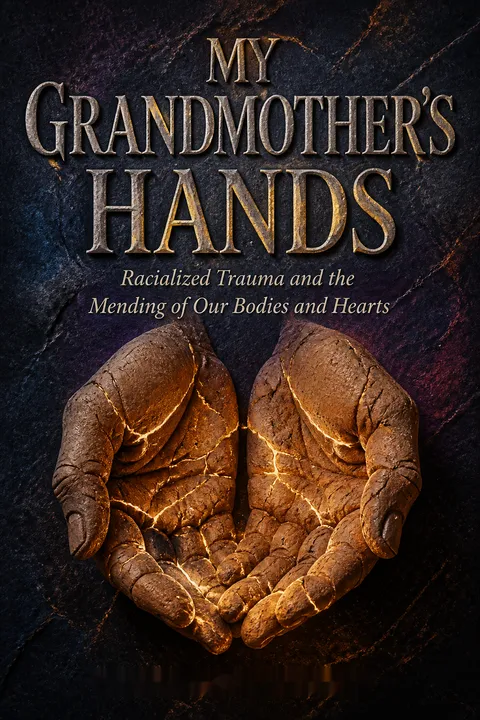
A family story anchors this claim. Menakem remembers his grandmother’s thick, callused hands. She explained that she began picking cotton at four, and the repeated injuries had changed her hands. For him, her body made history tangible: the past was not simply an idea, but an inheritance visible in a loved one’s flesh.
The insight usefully joins personal conduct to the fast, often unconscious processes studied in embodied cognition. A person can sincerely reject prejudice while still acting on learned associations, so observation and practice add something that belief statements cannot. The language of the body should not become a substitute for examining institutions, however. A tense feeling may reveal conditioning, but it does not explain every discriminatory outcome or decide what justice requires.
Treat trauma as a survival adaptation, not a character flaw or destiny.
Protection can outlast danger. Menakem defines trauma as the body’s protective response to an event or pattern it experiences as overwhelming. The response may involve fighting, fleeing, freezing, or other forms of constriction and avoidance. It can later be triggered by situations that resemble the original threat, producing reactions that appear excessive or inexplicable. The book also calls a persistent, hard-to-explain expectation of danger trauma ghosting.
This framing changes the question. Instead of asking what is wrong with someone, ask what their response once tried to protect. Menakem describes how unresolved reactions can ripple through relationships: one person’s fear or rage unsettles another, and repeated patterns can become family habits. The grandmother’s hands embody this inheritance, but they also testify to adaptation and endurance.
A survival lens can reduce shame and make change more possible. It resembles trauma-informed care, which asks what happened to a person rather than defining them by a troubling behavior. Yet explanation must not turn into absolution: understanding how a harmful response developed does not remove the need to stop harm or repair its effects. The frame works best when compassion for the injured body and accountability for its actions remain in view together.
Heal inherited wounds without mistaking epigenetics for a complete explanation.
Trauma travels through relationships. Menakem describes transmission through family behavior, social systems, cultural norms, and, possibly, changes in gene expression. He calls deep, intergenerational injury a soul wound. The book cites the Adverse Childhood Experiences Study, which followed about 17,000 people and linked multiple childhood adversities with higher risks of illness and social difficulties. In the study’s findings as presented here, people with four or more adverse experiences faced substantially elevated risks compared with those reporting none.
Inheritance is not a verdict. Stress and learned survival patterns can shape how children experience the world, but the book also emphasizes resilience: people and communities can pass on care, connection, and protective practices. Menakem urges readers to understand family history without treating present behavior as inevitable or reducing descendants to their ancestors’ injuries.
The social transmission of trauma is compelling and supported by research on childhood adversity and stress. Epigenetics adds a possible biological pathway, but evidence for specific, durable inheritance of trauma in humans is complex and should not be treated as settled proof that memories or racial trauma pass directly through genes. The strongest version of the argument does not need genetic determinism: caregiving, institutions, material conditions, and repeated exposure can transmit risk across generations on their own.
See whiteness as a political invention that redirected class conflict.
A boundary was constructed. Menakem traces how racial categories hardened in colonial America, arguing that whiteness was not an ancient or fixed identity. In his account, powerful landowners helped divide Black and white workers who had sometimes resisted together. Some poor white people received limited privileges and authority over Black people, while Black people were increasingly denied the possibility of freedom and property. The shift turned a conflict between workers and owners into a racial division that protected the powerful.
The bargain endured. Menakem points to the changing boundaries of who counted as white, including the later incorporation of Irish, Italian, German, and Jewish immigrants. He argues that racial belonging could offer status and a sense of inclusion while obscuring economic inequality and sustaining anti-Black control.
This history makes race legible as both an invented category and a material system, not a fiction with imaginary consequences. It also connects racial hierarchy to coalition-breaking, a useful lens for understanding how elites can stabilize power through unequal status. The account is deliberately broad, though, and does not capture every regional or historical variation. Its central insight remains valuable without treating one strategy or moment as the sole origin of American racial order.
Stop asking Black people to soothe white discomfort.
Discomfort is not proof of danger. Menakem describes white fragility as a defensive response to racial stress, which can appear as anger, withdrawal, tears, denial, or demands for reassurance. He argues that Black people are often expected to manage these reactions, even while facing the consequences of racial inequality themselves. His discussion of everyday slights includes a store employee who insisted she checked receipts randomly, though a Black customer observed her stopping Black shoppers and not others.
Notice the pattern, then act. The book recommends observing defensive impulses without immediately obeying them, and challenging discriminatory behavior with calm, direct interventions. It also asks Black readers to notice when soothing white people has become an automatic strategy for personal safety, rather than a freely chosen act of care.
The distinction between subjective discomfort and actual danger is crucial in settings where one person’s alarm can authorize control over another. The section also resists making antiracism a performance of personal innocence. Its practical challenge is to pair self-observation with action: noticing a defensive feeling matters, but changed behavior and institutional correction are the more consequential tests.
Make police wellness inseparable from accountability for harm.
Officers carry occupational stress. Menakem describes police who repeatedly encounter injury, death, and danger without adequate time or support to process what they see. He argues that trauma, militarized tactics, and an us-versus-them culture can increase risks for officers and residents alike. The book recounts the killing of Philando Castile during a traffic stop and other shootings of Black people, using them to examine how fear can prompt rapid, disastrous action.
Fear can explain, not excuse. Menakem calls for trauma education, body-regulation skills, recovery time after critical incidents, and organizational support for officers. He also rejects using a trauma response as a defense for killing. Better care for officers matters, but it must accompany fair policies, scrutiny of force, and responsibility to the people police serve.
This is strongest when it treats officer health and public safety as linked rather than competing concerns. Chronic stress can narrow attention and impair judgment, making prevention relevant to everyone. Still, a focus on nervous-system regulation cannot by itself correct unequal enforcement, weak oversight, or incentives that reward arrests over problem-solving. Wellness is a necessary workplace responsibility, not a replacement for accountability or structural reform.
Slow conflict down before your body turns fear into action.
A repeatable pause helps. Menakem’s Five Anchors are a body-centered method for meeting conflict without instantly reacting. In paraphrase, the sequence is:
1. Settle the body enough to think and stay present.
2. Notice sensations and emotions without acting on them immediately.
3. Allow manageable discomfort to be present and observe how it changes.
4. Respond to the unfolding situation from personal integrity, despite uncertainty.
5. Safely release remaining physical energy after the conflict.
Use the body’s early warnings. A tight jaw, sinking stomach, or tense shoulders may signal that a reflexive response is building. Menakem’s related Stop, Drop, and Roll practice asks a person to interrupt the current reaction, look at where the interaction is headed, and choose whether to change its course.
The sequence translates an abstract goal, self-regulation, into actions that can be practiced under pressure. It also treats discomfort as information rather than a command. The method is not a universal answer to danger: a person facing immediate threat may need to act quickly, and some traumatic memories require professional support. Used within those limits, the pause can create room between alarm and behavior.
Use communal rhythm and care to restore safety between bodies.
Regulation can be shared. Menakem describes humming, rocking, singing, drumming, call-and-response, and supportive touch as practices that can help people settle and connect. His grandmother hummed and rocked when she felt anxious; as a child, he sometimes joined in and felt safer. The point is not that one ritual suits everyone, but that repeated, trusted interactions can help people process distress together rather than alone.
Consent and choice matter. The book suggests simple practices among people who know and trust one another, including walking in step, singing together, or listening without interrupting or giving unsolicited advice. Settling is not the same as disengaging: sometimes a situation calls for calm, and sometimes it calls for mobilizing energy to protect someone or address injustice.
This emphasis broadens healing beyond individual willpower. Social support is a well-established buffer against stress, and shared rhythm can coordinate attention and movement in ways words sometimes cannot. The practices should remain invitations, not tests of trust or belonging. Touch, singing, and ritual carry different meanings across people and cultures, so a healing practice must make room for refusal as well as participation.
Build cultures that make belonging stronger than racial hierarchy.
Repeated practices become norms. Menakem argues that culture is carried through stories, rituals, symbols, role models, language, and daily behavior. Because belonging can make people feel secure, a harmful culture can offer real social connection while reinforcing exclusion. He therefore calls for cultural change alongside legislation and activism, including new stories, trusted elders, mentoring, and shared practices of care.
Different communities have distinct work. The book encourages African Americans to affirm Black history, challenge colorism and other harmful retentions, and pass on body-based practices. It asks white Americans to build their own culture of responsibility rather than expecting Black people to lead or reassure them. For police, it proposes a culture rooted in service and relationships with residents. These are parallel efforts, not a claim that the groups should remain isolated.
The argument that belonging is a powerful organizing force helps explain why moral appeals alone often fail to dislodge group identity. New norms need institutions and repeated practice, not just inspiring language. Cultural work also has to remain open to internal disagreement: no community is uniform, and elders or rituals can reproduce hierarchy as readily as challenge it. The test is whether belonging expands regard and shared responsibility.
Judge policing by neighborhood safety, not arrests or force.
Service is ordinary work. Menakem contrasts genuine community policing with a narrow focus on enforcement. He describes officers helping with neighborhood problems, speaking with residents, supporting local projects, and knowing the people they encounter beyond a uniform. A retired officer in the book argues that officers should have the authority and resources to solve local problems, rather than being evaluated mainly by arrest numbers.
Change the conditions of work. Menakem urges leaders to remove arrest quotas, reward crime reduction and community trust, recruit locally, and examine procedures that expose residents or officers to needless risk. He also recommends trauma education, psychological first aid, and sustained contact between officers and residents. Friendly relationships cannot erase the power police hold, so community engagement must be paired with transparent standards and consequences for misconduct.
This proposal shifts the measure of police success from activity to outcomes, a familiar reform in public administration: count problems solved, not merely tasks completed. Local relationships may improve information and reduce fear, but trust cannot be engineered through social events alone. Residents need meaningful influence over priorities, access to complaint processes, and evidence that misconduct has consequences. Community presence is most credible when power is also answerable.
Analysis
My Grandmother's Hands is part memoir, part historical argument, and part practical guide. Its organizing move is to treat racism not only as ideology or policy, but as something experienced through embodied threat, learned behavior, and social interaction. The grandmother's callused hands give this claim emotional force: history is not remote when it is carried through a family's bodies, habits, and stories. The book then widens its scope, tracing racialized trauma in Black communities, white communities, and police culture, before offering practices for personal regulation and collective change.
The framework's great strength is ethical and practical. It asks readers to notice what happens before they explain themselves, and it refuses to let compassion for trauma erase responsibility for harm. It also links individual healing to community conditions, challenging the idea that insight or better intentions alone can resolve entrenched injustice. Its attention to ritual, trusted relationships, and organizational culture gives social change a human scale.
Its physiological language is less secure than its moral insight. The division between a primitive survival brain and a rational brain is an oversimplification of how neural systems interact. The vagus nerve is important, but it is not a single channel carrying emotion or a literal seat of communal belonging. Likewise, epigenetics is a developing field, not proof that specific memories or racial histories are biologically inherited in a simple way. These claims need careful qualification, especially because biological metaphors can unintentionally make social categories sound natural.
The most durable reading therefore preserves the book's central distinction while resisting biological determinism: institutions and histories shape bodies, bodies shape behavior, and neither level can be understood alone. Somatic practices can support better attention and action, but they cannot substitute for policy, material repair, or oversight. The book is most persuasive when bodily awareness becomes a beginning of responsibility, not a rival to structural change.
Review Summary
My Grandmother's Hands explores racialized trauma and healing through a somatic lens. Many readers found the book insightful and transformative, praising its focus on body-centered approaches to addressing racism. However, some criticized the author's stance on policing and felt the book lacked nuance in addressing systemic issues. The breathing exercises and grounding techniques were widely appreciated. While some found the writing repetitive or oversimplified, others considered it a powerful resource for understanding and healing racial trauma.
People Also Read





Glossary
white-body supremacy
racial dominance embedded in systemsMenakem's term for white supremacy understood as more than explicit hatred or conscious belief. It describes a social system that centers white people and privileges whiteness, while also shaping habitual bodily reactions, institutional practices, and everyday expectations. The term emphasizes that people may reproduce racial hierarchy without intending to do so.
soul nerve
the author's name for the vagus nerveMenakem's accessible label for the vagus nerve and the bodily processes he associates with emotion, safety, and connection. He uses it to direct attention to sensations such as a tight stomach, quickened breathing, or a relaxed body. The term is the author's framing, not the name of a separate anatomical organ.
lizard brain
metaphor for rapid survival responsesMenakem's shorthand for fast, protective processes that can mobilize a person to fight, flee, or freeze before deliberate reflection. It is a metaphor, not a distinct reptilian brain that operates independently of the rest of the brain. The term helps explain why bodily reactions can precede conscious reasoning.
traumatic retention
an old survival pattern carried forwardA reaction or practice that began as an adaptation to danger but persists after its original context has faded. As people repeat and transmit the pattern, it may be mistaken for a personality trait, family norm, or cultural tradition. Menakem argues that healing involves identifying what once offered protection, keeping what remains useful, and changing what now causes harm.
trauma ghosting
a persistent sense of impending dangerMenakem's term for a recurrent or pervasive bodily expectation that something terrible is about to happen, even when the person cannot identify an immediate threat. The sensation may not make conscious sense, but it can reflect a protective response associated with unresolved trauma. It may shape vigilance, avoidance, or emotional reactions.
clean pain
discomfort that supports growthPain encountered while acting with integrity, facing uncertainty, or doing something difficult rather than avoiding it. Menakem uses the term for discomfort that can help a person process trauma and expand their capacity to respond. It does not mean that all pain is beneficial, or that someone should remain in an unsafe situation.
dirty pain
pain perpetuated through avoidance or blameMenakem's term for the suffering produced or extended by denial, avoidance, blame, cruelty, or reflexive attempts to escape discomfort. Such reactions may offer short-term relief but can deepen harm for the person and others. The distinction is practical rather than diagnostic: it asks whether a response helps address pain or passes it onward.
Five Anchors
a five-part method for meeting conflictMenakem's named practice for staying present through difficult situations. It moves from settling the body, to noticing sensations, allowing manageable discomfort, choosing a response aligned with integrity, and safely discharging leftover energy. The sequence aims to create a pause between a threat response and action. It is not meant to replace immediate protective action or professional trauma care.
Adverse Childhood Experiences Study
study linking childhood adversity with later risksA large study described by Menakem as involving about 17,000 people and conducted by the Centers for Disease Control and Prevention with Kaiser Permanente. It examined adverse experiences such as abuse, neglect, and household instability, and found associations between greater childhood adversity and increased health and social risks in adulthood. The findings are population-level associations, not predictions about any one person.
FAQ
What's My Grandmother's Hands about?
- Focus on Racialized Trauma: The book explores racialized trauma's impact on individuals and communities, particularly African Americans, emphasizing how trauma is stored in our bodies.
- Healing Through the Body: Resmaa Menakem argues for a body-centered approach to healing racial trauma, introducing practices to help individuals reconnect with their bodies.
- Intergenerational Impact: It discusses how trauma is passed down through generations, affecting entire communities, and highlights the need for collective healing.
Why should I read My Grandmother's Hands?
- Insightful Perspective: Offers a unique view on race relations, focusing on bodily experiences of trauma rather than just ideological discussions.
- Practical Healing Strategies: Provides exercises and strategies for healing that can be applied by anyone, encouraging engagement with the body and emotions.
- Cultural Relevance: Addresses ongoing discussions about race and justice, offering a framework for understanding racial trauma and pathways toward healing.
What are the key takeaways of My Grandmother's Hands?
- Trauma Lives in the Body: Emphasizes that trauma is physically stored in our bodies, not just an emotional or mental experience.
- White-Body Supremacy: Introduces the concept of systemic advantages experienced by white individuals, crucial for understanding race dynamics in America.
- Healing is Collective: Stresses that healing from racial trauma is a collective journey, requiring community efforts to address and heal wounds.
What are the best quotes from My Grandmother's Hands and what do they mean?
- “The body is where we live.”: Highlights the importance of the body in trauma and healing, emphasizing our physical presence in understanding emotional states.
- “White-body supremacy is always functioning in our bodies.”: Points to the pervasive nature of systemic racism, calling for awareness of these dynamics.
- “Trauma is not destiny.”: Reminds that while trauma shapes experiences, it does not define the future, emphasizing the possibility of healing and growth.
How does Resmaa Menakem define trauma in My Grandmother's Hands?
- Trauma as a Bodily Response: Defined as the body’s protective response to perceived danger, deeply embedded in our physical being.
- Wordless Stories: Described as a "wordless story" our bodies tell about safety and danger, highlighting the need to listen to our bodies.
- Intergenerational Transmission: Discusses how trauma is passed through generations, affecting families and communities, crucial for understanding racialized trauma's impacts.
What methods does Menakem suggest for healing racialized trauma?
- Body-Centered Practices: Advocates for practices like grounding exercises, breathing techniques, and mindful movement to reconnect with physical sensations.
- Community Engagement: Emphasizes communal healing, suggesting individuals support each other in their healing journeys for a sense of belonging.
- Mindfulness and Awareness: Encourages cultivating mindfulness and awareness of bodily experiences to process and release stored trauma.
How does My Grandmother's Hands address the concept of whiteness?
- Whiteness as a Social Construct: Discusses how whiteness evolved over time, often at the expense of other racial groups, essential for addressing systemic racism.
- Impact on White Bodies: Explores how white individuals also carry trauma related to their historical and cultural backgrounds, emphasizing healing for all bodies.
- Call for Reflection: Challenges white readers to reflect on their experiences and unconscious perpetuation of white-body supremacy, crucial for collective healing.
What is the concept of the "soul nerve" in My Grandmother's Hands?
- Definition of Soul Nerve: Described as a central part of the nervous system processing emotions and belonging, influencing interactions.
- Connection to Trauma: Explained as where trauma is felt and processed, crucial for understanding responses to stress and conflict.
- Role in Healing: By working with the soul nerve, individuals can relax their bodies and manage emotional responses, facilitating healing and connection.
How does Resmaa Menakem suggest we settle our bodies?
- Breath and Awareness: Recommends deep breathing and body scans to become aware of physical sensations and promote relaxation.
- Somatic Exercises: Provides exercises like humming, belly breathing, and gentle movements to connect with the body and release tension.
- Regular Practice: Emphasizes making these practices a regular part of life to build resilience and emotional regulation.
What are the five anchors mentioned in My Grandmother's Hands?
- Anchor 1: Soothe Yourself: Involves calming the mind and body to create safety and relaxation.
- Anchor 2: Notice Sensations: Encourages paying attention to bodily sensations without reacting, fostering awareness.
- Anchor 3: Accept Discomfort: Advises accepting discomfort as part of healing, rather than fleeing from it.
- Anchor 4: Stay Present: Emphasizes remaining in the moment and responding with integrity.
- Anchor 5: Discharge Energy: Focuses on safely releasing residual energy after stress to prevent trauma retention.
How does My Grandmother's Hands address the issue of white-body supremacy?
- Historical Context: Provides an overview of how white-body supremacy shaped societal structures and individual experiences.
- Call for Accountability: Urges white Americans to acknowledge privilege and systemic racism, encouraging responsibility for dismantling these structures.
- Cultural Transformation: Advocates for new cultural narratives and practices rejecting white-body supremacy, promoting healing and understanding.
How can I apply the concepts from My Grandmother's Hands in my daily life?
- Practice Somatic Techniques: Incorporate somatic exercises and settling practices into daily routines to enhance body and emotional awareness.
- Engage with Community: Foster community connections by participating in local events and building relationships based on trust.
- Reflect on Personal Trauma: Reflect on personal trauma experiences and their influence on interactions, using the five anchors to process and heal.
Download PDF
Download EPUB
.epub digital book format is ideal for reading ebooks on phones, tablets, and e-readers.








