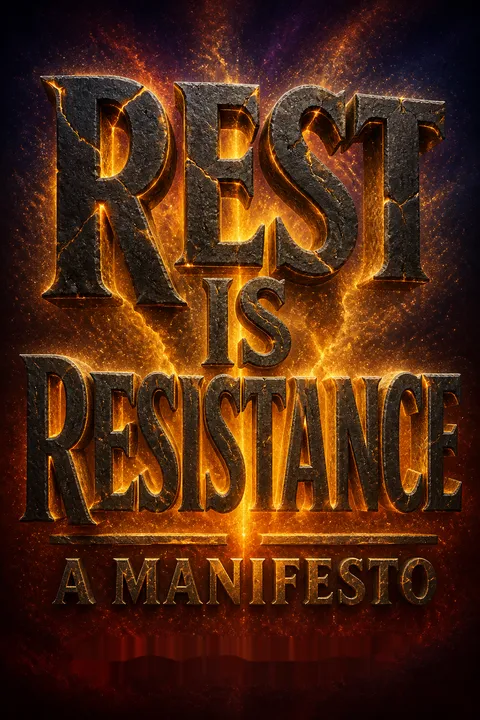


Key Takeaways
Treat rest as a right, not fuel for more work
Rest is not a reward. Tricia Hersey argues that rest resists a culture that measures human worth by output. It is not simply recovery time that makes someone more productive; it is a way to reclaim the body from systems that treat it as laboring equipment. Hersey developed this conviction while exhausted by graduate school, parenting, financial pressure, and work. Napping became a practice of survival, then the basis for The Nap Ministry, which frames rest as both personal care and political refusal.
Begin without earning it. Rest can mean sleep, silence, leisure, daydreaming, or slowing down enough to notice what the body needs. The central shift is from asking how rest will improve performance to recognizing that a person deserves care simply by being alive.
What's striking is the refusal to turn rest into another self-improvement assignment. Many wellness messages sell recovery as a way to return workers to peak performance, preserving the very standard that made them exhausted. Hersey instead asks readers to challenge that standard itself. This distinction echoes a broader debate in labor and health: individual coping skills can help, but they cannot substitute for humane workloads, income security, or time off. The argument is strongest when rest is understood as both an immediate need and a claim about how society should organize work.
Trace exhaustion to labor systems before blaming individual discipline
History changes the diagnosis. Hersey connects present-day overwork to a history in which Black and Indigenous people were forced to labor without control over their bodies or time. While studying firsthand accounts of enslavement, she read of workers denied adequate meals and compelled to work through injury. These records made contemporary demands to work through pain feel less like isolated bad management and more like part of a long pattern of treating people as instruments.
Family carries the story. Her grandmother Ora made time each day to sit quietly and rest her eyes. Her father worked a railroad job alongside years of church and community service, and died at fifty-five after serious health problems. Hersey sees his overwork as part of a larger culture that praises sacrifice while neglecting the body. The history is not an argument that every experience is identical; it is a way to see how ideas about labor endure.
This historical lens turns burnout from a private defect into a question about power, inheritance, and whose labor is taken for granted. It also resembles social epidemiology, which studies how institutions and living conditions shape health rather than treating illness as a matter of individual choice alone. The family stories make that abstraction vivid. At the same time, historical continuity should not flatten distinct experiences or imply that every worker faces the same risks. The framework is most useful when it sharpens attention to present-day conditions without treating the past as a complete explanation of them.
Trust bodily signals as knowledge, not interruptions to productivity
The body keeps information. Hersey argues that people learn to ignore hunger, fatigue, pain, and the need for a bathroom when institutions reward compliance and speed. She describes seeing a child in a classroom forced to wait to use the bathroom until he had an accident. In another example, her doctor pushed for an immediate cesarean because of concern about the baby's size; Hersey's son was born by cesarean and weighed exactly what she had predicted. She presents these experiences as illustrations of how professional urgency can override a person's embodied knowledge.
Practice listening. Rest, breathing, movement, or a pause can help restore attention to physical cues. Hersey's claim is not that intuition replaces expertise, but that people should not be trained to treat their own sensations and knowledge as irrelevant.
The section resonates with somatic approaches, which attend to how stress and emotion are experienced in the body, not only described in thought. Its practical value is the reminder that self-awareness can be a form of evidence, especially when institutions dismiss someone's account of their own needs. There is also an important limit: bodily intuition can inform decisions, but it does not always resolve medical uncertainty or replace clinical judgment. A careful reading holds both truths together: expertise matters, and expertise works best when it listens.
Protect daydreaming as rehearsal space for futures the present forbids
Imagination needs room. Hersey treats daydreaming as a kind of rest: time for the mind to wander, process grief, and imagine beyond current constraints. While grieving, she pictured a planet where people slept for long stretches and dreams helped sustain life. The vision soothed her because it offered a world radically different from the violence she was processing. As a child, she spent hours on her family's porch watching the sky and inventing stories, before school and adult demands narrowed the time available for that kind of attention.
Dreaming is not escape alone. Hersey sees imagined alternatives as beginnings of invention. If people cannot picture a life beyond relentless labor, it becomes harder to build one. A few minutes of gazing out a window or writing freely can create space for new thoughts without demanding an immediate plan.
The connection between imagination and political possibility is more than poetic. Before people can design different institutions, they need some way to conceive of them. This resembles speculative fiction's use of invented worlds to expose assumptions hidden inside the present. Daydreaming can also help people metabolize difficult experience, as Hersey's grieving vision suggests. Still, imagined futures do not automatically change material conditions. Their value depends partly on whether reflection connects to relationships, decisions, and collective efforts that can give an idea practical form.
Make rest a daily practice, not an expensive escape
Rest has many forms. Hersey rejects the idea that meaningful rest requires a retreat, a costly mattress, or a long vacation. It can be a short nap, a quiet shower, a walk, prayer, stretching, making music, or sitting without checking a phone. She suggests creating a not-to-do list and experimenting with small moments that fit a person's actual life. The point is not to follow a standard routine, but to find ways of slowing down and reconnecting with body and mind.
Access is a real tension. Hersey calls rest a human and divine right, while acknowledging that poverty, caregiving, disability, and demanding jobs can make time and quiet scarce. Her invitation is to claim available moments without pretending that a brief pause fixes unjust conditions. Rest practice and the fight for better conditions belong together.
This flexible definition avoids making wellness dependent on consumer spending. It also makes the idea more usable for people whose lives do not allow a week away or a silent room. The challenge is to avoid turning small pauses into a substitute for structural change: a breathing exercise cannot compensate for unsafe work or inadequate wages. Hersey's most persuasive position is both personal and political. Small practices can offer relief and restore agency, while collective demands address the conditions that make rest difficult to obtain.
Make rest collective so exhaustion is witnessed, not hidden
Rest can be shared. In 2017, Hersey held the first Collective Napping Experience in Atlanta. She expected about ten people; forty came to a room arranged with pillows, blankets, soft lighting, and music. People rested together, then shared what the experience brought up. Some cried when they realized how tired they were; one participant said the shared quiet eased her loneliness. The gathering showed Hersey that rest could be a communal practice, not merely a private escape.
Care needs structure. The Nap Ministry's events combine rest with learning and conversation, and are designed to work in settings such as libraries, churches, homes, and community spaces. This approach asks communities to make room for one another, rather than treating exhaustion as an individual problem to conceal or solve alone.
The gathering illustrates how a shared practice can make an invisible condition legible. In social psychology, being witnessed can reduce isolation and help people recognize that a struggle is not theirs alone. The format also turns rest into a communal resource rather than a luxury purchased individually. Yet collective care cannot mean that one person, especially someone already expected to provide care, must organize and supply it indefinitely. Sustainable community rest requires reciprocal labor, accessibility, and attention to who is doing the work of holding the space.
Set boundaries around work and screens before they consume recovery
Disconnection takes intention. Hersey recommends stepping away from social media, email, and phones because these can absorb attention and crowd out silence. She suggests beginning with a few hours offline, putting a device in another room, or deleting selected apps. Even a carefully curated feed can keep a person exposed to a constant stream of other people's demands and opinions.
A boundary is a practice. Hersey describes taking a thirty-day Sabbath from social media, events, email, and work-related requests. Despite announcing the break, people repeatedly contacted her with new requests. The experience showed how easily others can treat availability as permanent, particularly when they rely on someone's labor. A clear boundary may need to be stated, planned, and protected, rather than assumed to be understood.
The account connects personal boundaries to the design of digital platforms and the social expectation of constant availability. That matters because attention is not simply a private resource; workplaces, platforms, and relationships all make claims on it. A planned pause can reveal which requests are genuinely urgent and which merely benefit from immediate access. Still, not everyone can disconnect without consequences, especially workers whose jobs require constant contact. Boundary-setting is useful, but its fairness depends on the power people have to refuse.
Practice small refusals without waiting for systems to grant permission
Refusal can create room. Hersey draws on the history of American maroons, Black people who escaped enslavement and built communities beyond plantation control. Their pursuit of autonomy informs her idea that people can create temporary spaces of freedom even while oppressive systems remain in place. She calls these spaces a Third Space: a lived alternative where people practice agency and care rather than accepting the system's terms as the only possible reality.
Start where you are. A pause, a declined request, time outdoors, or a gathering organized around care can become a small act of refusal. Hersey does not present these gestures as a replacement for dismantling oppressive systems. They are ways to reclaim some control now, while building relationships and imagining different ways to live.
The maroonage analogy gives refusal a historical and communal dimension. It suggests that agency is not limited to winning formal permission; people can sometimes build alternatives within or alongside hostile structures. That is a powerful corrective to passive waiting. The analogy also requires care: contemporary workplace choices are not equivalent to the life-threatening conditions faced by enslaved people. Its value lies in the principle of collective self-determination, not in collapsing different histories into one.
Use imagination to make justice feel possible before it exists
A future can be rehearsed. Hersey brings Afrofuturism into her account of rest, drawing on artists and writers who imagine Black futures beyond present-day oppression. While teaching teenagers, she shifted from writing only about the hardships they knew toward science fiction and imagined worlds. Students began describing a Black planet without guns, hunger, or schooling designed around tests. Their visions made room for possibility without denying the violence around them.
Imagination guides action. Hersey argues that people need space to picture alternatives to poverty, racism, and relentless work before they can work toward them. Rest helps create that space by interrupting the constant demand to respond and produce. The book's closing invitation is not simply to sleep more, but to build lives and communities in which care, leisure, and collective possibility are ordinary.
The classroom story shows how imaginative work can change the questions young people are able to ask. Instead of describing only what hurts, they practice envisioning what could replace it. This connects artistic education to civic capacity: imagining alternatives can challenge assumptions that present arrangements are inevitable. The limitation is that hope can be asked to carry too much when institutions remain unchanged. Imagination is most powerful when it is paired with historical understanding, material resources, and opportunities for people to shape the future they have pictured.
Analysis
Rest Is Resistance is part memoir, part political theology, and part invitation to practice. Its organizing movement runs from rest, to dreaming, to resistance, to imagination. Hersey's personal history gives that sequence weight: her grandmother's daily quiet, her father's relentless service and early death, and her own exhaustion as a graduate student are not decorative anecdotes. They show how beliefs about work are learned within families and institutions, and how rest can become both an intimate act of survival and a challenge to inherited expectations.
The book's most distinctive contribution is its refusal to define rest as a productivity tool. That refusal matters because many contemporary wellness practices promise to restore people so they can return to the same demands with greater efficiency. Hersey instead places the question of rest inside histories of racialized labor, and insists that attention to bodily need has political meaning. The result is a framework that connects individual experience to structural critique without pretending that a nap alone can dismantle an economic system.
There is a productive tension between her insistence that rest is always a right and her recognition that material conditions can make it difficult to claim. Naming rest as a right can resist internalized shame; it cannot guarantee paid leave, safety, childcare, or freedom from financial pressure. The strongest reading keeps both scales in view: personal practices may restore connection and agency, while community organization and institutional change address who has time and power.
Hersey's use of spiritual language, ancestral memory, and Afrofuturist imagination also expands what counts as practical knowledge. Dreams and embodied intuition are not presented as technical solutions, but as sources of meaning and possibility that a culture of urgency suppresses. The book's central challenge is therefore not a tidy schedule. It is to notice how exhaustion becomes normalized, experiment with forms of care that fit real lives, and create collective spaces where a different account of human worth can be practiced.
Review Summary
Rest Is Resistance receives mixed reviews. Many readers appreciate its message about rest as a form of resistance against capitalism and white supremacy. They find the author's ideas powerful and necessary. However, numerous reviewers criticize the book's repetitive nature and lack of organization, feeling it could have been condensed into an essay. Some readers appreciate the repetition as intentional, while others find it frustrating. The book's spiritual elements and use of buzzwords are divisive. Despite criticisms, many readers still recommend the book for its important message about prioritizing rest and challenging grind culture.
People Also Read



Glossary
Rest Is Resistance
Rest as political refusalHersey's framework for treating rest as a way to reclaim the body and challenge systems that tie human worth to labor and productivity. It includes sleep, leisure, slowing down, and other practices of care. The framework rejects resting only to return to work more efficiently, and connects personal well-being to collective care and social justice.
DreamSpace
Restful imaginative spaceHersey's term for a mental, spiritual, or dreamlike space opened by rest, silence, and daydreaming. In DreamSpace, a person can process experience, imagine alternatives, and listen for knowledge obscured by exhaustion and constant activity. It is both an inward experience and a resource for envisioning lives beyond the limits imposed by oppressive systems.
grind culture
Normalized overwork and urgencyHersey's name for the social expectations and everyday habits that treat constant labor, speed, and productivity as proof of worth. She argues that people absorb these expectations through institutions and relationships, then reproduce them in their treatment of themselves and others. In her account, grind culture collaborates with capitalism and white supremacy to normalize exhaustion and disconnection.
Collective Napping Experiences
Communal rest gatheringsThe Nap Ministry's facilitated gatherings where participants rest together in a prepared space and may discuss their experiences afterward. Events can include blankets, pillows, music, and educational or reflective elements. The practice treats rest as a shared experience that can foster connection and make exhaustion visible, rather than as a private consumer service.
Third Space
Temporary space of autonomyHersey's term for a space of relative freedom created within or alongside an oppressive world. Inspired by American maroon communities, it describes people making room for autonomy, rest, and care without waiting for dominant institutions to approve. A Third Space can be physical, communal, or spiritual, and offers a way to practice alternative ways of living.
Rest as Reparations
Rest as restorative justiceHersey's framework connecting rest to the repair of harms caused by histories and systems that exploit bodies and deny people control over their time. It treats rest as more than individual recovery: reclaiming time and care can honor those whose labor was stolen and challenge ongoing assumptions that some people exist primarily to serve others.
Resurrect Rest School
Study paired with restA Nap Ministry program created to deepen engagement with the political and educational foundations of rest. Participants study and discuss liberation-focused texts, share ideas, and conclude with a collective nap. The format contrasts sustained study and embodied experience with quick, shallow exposure to ideas through social media.
FAQ
What's "Rest Is Resistance: A Manifesto" about?
- Core Message: "Rest Is Resistance: A Manifesto" by Tricia Hersey explores the concept of rest as a form of resistance against capitalism and white supremacy. It emphasizes the importance of rest for personal and collective liberation.
- Historical Context: The book draws on historical narratives, particularly the experiences of Black people, to highlight how rest has been used as a tool for survival and resistance.
- Personal Journey: Hersey shares her personal journey with rest, detailing how it saved her life and inspired the creation of The Nap Ministry.
- Call to Action: The book serves as a manifesto urging readers to reclaim rest as a radical act of self-care and community care.
Why should I read "Rest Is Resistance: A Manifesto"?
- Unique Perspective: The book offers a unique perspective on rest, framing it as a revolutionary act rather than a luxury or privilege.
- Cultural Critique: It provides a critical analysis of how capitalism and white supremacy have shaped our understanding of productivity and worth.
- Practical Guidance: Hersey offers practical advice on how to incorporate rest into daily life as a form of resistance and healing.
- Inspiration and Empowerment: The book is both inspiring and empowering, encouraging readers to challenge societal norms and prioritize their well-being.
What are the key takeaways of "Rest Is Resistance: A Manifesto"?
- Rest as Resistance: Rest is a form of resistance against oppressive systems that devalue human life and prioritize productivity over well-being.
- Historical Roots: The book highlights the historical roots of rest as a survival strategy for Black people, drawing on narratives from slavery and beyond.
- Personal Liberation: Embracing rest can lead to personal liberation, allowing individuals to reconnect with their bodies and spirits.
- Collective Healing: Rest is not just an individual act but a collective one, fostering community care and mutual support.
How does Tricia Hersey define rest in "Rest Is Resistance: A Manifesto"?
- Beyond Sleep: Rest is more than just sleep; it includes any activity that allows the body and mind to slow down and connect.
- A Divine Right: Hersey frames rest as a divine right, essential for human dignity and well-being.
- A Form of Protest: Rest is a protest against the dehumanizing demands of capitalism and white supremacy.
- A Path to Healing: Rest is a portal to healing, imagination, and liberation, offering a way to reclaim one's body and time.
What is The Nap Ministry, and how is it related to "Rest Is Resistance: A Manifesto"?
- Founding: The Nap Ministry was founded by Tricia Hersey as a platform to explore rest as a form of resistance.
- Mission: Its mission is to create sacred spaces for rest and to challenge the societal norms that equate worth with productivity.
- Activities: The Nap Ministry organizes Collective Napping Experiences, workshops, and social media campaigns to promote the message of rest.
- Connection to the Book: "Rest Is Resistance: A Manifesto" expands on the principles of The Nap Ministry, offering a deeper exploration of rest as a revolutionary act.
How does "Rest Is Resistance: A Manifesto" address capitalism and white supremacy?
- Critique of Systems: The book critiques capitalism and white supremacy for dehumanizing individuals and valuing them only for their productivity.
- Historical Context: It provides historical context on how these systems have exploited Black bodies and stolen their DreamSpace.
- Call for Disruption: Hersey calls for disrupting these systems by reclaiming rest as a form of resistance and liberation.
- Vision for Change: The book envisions a world where rest is prioritized, leading to a more just and equitable society.
What are the Tenets of The Nap Ministry mentioned in "Rest Is Resistance: A Manifesto"?
- Rest as Resistance: Rest disrupts and pushes back against capitalism and white supremacy.
- Bodies as Liberation Sites: Our bodies are sites of liberation, deserving of rest and care.
- Naps as Portals: Naps provide a portal to imagine, invent, and heal.
- Reclaiming DreamSpace: Our DreamSpace has been stolen, and we must reclaim it through rest.
How does Tricia Hersey incorporate personal stories in "Rest Is Resistance: A Manifesto"?
- Personal Journey: Hersey shares her personal journey with rest, detailing how it saved her life during a challenging period.
- Family Influence: She discusses the influence of her family, particularly her grandmother, in shaping her understanding of rest.
- Cultural Trauma: Hersey connects her personal experiences to broader cultural trauma, highlighting the impact of systemic oppression.
- Inspiration for Action: These stories serve as inspiration for readers to embrace rest as a form of resistance and healing.
What role does imagination play in "Rest Is Resistance: A Manifesto"?
- Imagination as Resistance: Imagination is framed as a powerful mode of resistance, allowing individuals to envision a world beyond oppression.
- DreamSpace: The book emphasizes the importance of reclaiming DreamSpace as a site for healing and liberation.
- Creative Possibilities: Imagination opens up creative possibilities for reimagining rest and challenging societal norms.
- Connection to Afrofuturism: Hersey draws on Afrofuturism to illustrate how imagination can be a tool for envisioning a liberated future.
What are some of the best quotes from "Rest Is Resistance: A Manifesto" and what do they mean?
- "Rest saved my life." This quote underscores the transformative power of rest in Hersey's personal journey and its potential for others.
- "Our bodies are a site of liberation." It highlights the idea that reclaiming rest is a way to liberate oneself from oppressive systems.
- "Rest is resistance." This phrase encapsulates the book's central message that rest is a radical act of defiance against dehumanizing systems.
- "We will rest!" A call to action, urging readers to prioritize rest as a form of self-care and community care.
How does "Rest Is Resistance: A Manifesto" address the concept of community care?
- Collective Rest: The book emphasizes the importance of collective rest as a means of fostering community care and mutual support.
- Interconnectedness: It highlights the interconnectedness of individuals and the need for communal healing and support.
- Community as Resistance: Community care is framed as a form of resistance against the isolating effects of capitalism and white supremacy.
- Practical Examples: Hersey provides practical examples of how community care can be integrated into daily life through rest and support networks.
What practical advice does "Rest Is Resistance: A Manifesto" offer for incorporating rest into daily life?
- Reimagine Rest: Readers are encouraged to reimagine rest beyond traditional notions of sleep, incorporating activities that slow down the mind and body.
- Create Rituals: Hersey suggests creating rituals and practices that prioritize rest, such as daydreaming, meditation, and setting boundaries.
- Detox from Technology: The book advises regular detoxes from social media and technology to create space for rest and reflection.
- Embrace Flexibility: Rest should be flexible and adaptable, allowing individuals to find what works best for them in their unique circumstances.
Download PDF
Download EPUB
.epub digital book format is ideal for reading ebooks on phones, tablets, and e-readers.








