

Key Takeaways
Build the future in miniature: your group's daily habits become its politics.
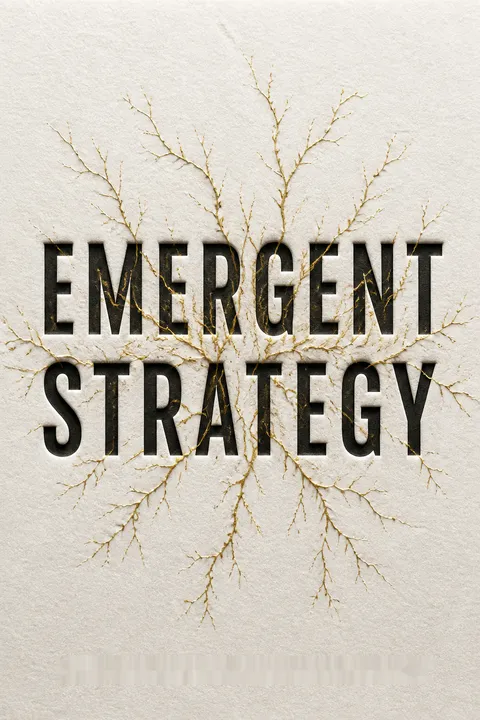
Small patterns scale. Emergent strategy is an approach to change that uses relatively simple interactions and strong relationships to grow complex collective patterns. Its fractal principle says that patterns practiced in small settings can reappear at larger scales. If a justice organization relies on overwork, one charismatic boss, and competition for funding, those habits can reproduce the very power structures it opposes.
Practice what you seek. Brown describes how she moved from burnout as an executive director toward more presence, collaboration, and honesty in daily life. The same principle shaped Ruckus Society: it shifted from spectacular actions led by outsiders toward sustained support for Indigenous organizers to lead work in their own communities. The point is not to perfect oneself before acting. It is to treat everyday relationships and organizational choices as the first places to practice a different world.
What's powerful here is the move from political ideals to observable behavior. Organizational research similarly finds that formal mission statements matter less when incentives, routines, and decision rights contradict them. The fractal image gives groups a practical audit: does the small-scale way of making decisions resemble the larger society being sought? The metaphor should not be mistaken for a law of nature, however. A caring team does not automatically transform a harmful institution. Funding, policy, and material power also shape outcomes. The idea is most useful when paired with structural analysis, not offered as a substitute for it.
Let your purpose steer through change without pretending the route is predictable.
Direction without rigidity. Brown calls the blend of adaptation and purpose intentional adaptation. Rather than treating a detailed plan as sacred, a group clarifies what it wants to create and adjusts its methods as conditions shift. She contrasts strategic plans, which can become outdated maps, with strategic intentions, which act as a durable directional guide. The group can then change tactics without losing sight of its values.
Respond, do not freeze. A story about Brown driving to the wrong address in Boston shows the approach at a human scale. After recognizing the mistake, she contacted organizers, accepted the delay, and stopped spending the journey attacking herself. Movement Generation's framework distinguishes sudden disruptions, such as disasters or uprisings, from slow-moving pressures, such as rising costs or sea levels. Different changes call for different responses, but both require preparation and flexibility.
This resembles adaptive management, a practice used in fields such as ecology where decisions are treated as revisable hypotheses rather than final answers. A clear purpose can reduce the cognitive load of choosing among changing tactics, especially when a group has distributed leadership. The useful tension is between flexibility and drift. Intentions can become so broad that they excuse indecision, while detailed plans can conceal assumptions that no longer hold. Groups need both: a shared direction and regular tests of whether current actions still serve it.
Replace heroic bottlenecks with relationships that let leadership travel.
Power can circulate. Interdependence means mutual reliance; decentralization means distributing authority and work rather than concentrating them in one center. Brown points to flocking birds, where each bird responds to nearby companions and the group moves together without a single bird directing every turn. In human groups, this requires shared purpose, clear communication, and relationships strong enough for people to act without constant permission.
Stars can weaken movements. Brown's account of charismatic leadership describes how celebrated organizers can become isolated, overburdened, and difficult to hold accountable. An organization can also struggle when too much knowledge or donor attention centers on its founder. BOLD, a leadership program for Black organizers, offers a contrasting emphasis: trust, mutual support, and space to be vulnerable. Distributed leadership does not mean everyone does everything. It means expertise can be recognized and used without making one person indispensable.
Network science helps explain the appeal of this model: distributed networks can keep functioning when one node is removed, while relationships allow information and support to travel. But decentralization is not automatically fair or effective. Informal networks can hide power, and decisions can become slow or confusing when responsibility is unclear. The book's emphasis on trust is strongest when joined to explicit roles, accountability, and access to resources. Resilience comes not from eliminating leadership, but from making leadership shareable, visible, and replaceable.
Turn conflict toward root causes, without asking people to surrender safety.
Justice should change conditions. Transformative justice is a community-led approach that seeks alternatives to state punishment and works to change the conditions that enable harm, not only address an incident. Brown encourages people in conflict to ask why the harm occurred, what can be learned, and what actions can improve the situation rather than intensify it. In her account, public shaming can feel decisive while leaving the underlying dynamics untouched.
Accountability needs boundaries. Transformative approaches are not a demand to remain in unsafe relationships. Brown stresses that people can step away, set limits, seek support, or decline a process they do not feel safe enough to enter. This distinction matters in abusive situations, where calls for compassion or reconciliation can pressure harmed people to stay. The goal is not to preserve every relationship. It is to pursue safety, agency, accountability, and changes that reduce future harm.
The strongest version of this argument joins restoration with survivor-centered practice. Restorative and transformative approaches can create accountability beyond punishment, but they require careful attention to power, coercion, and safety. Asking why someone caused harm can reveal conditions that need changing; it should not dilute responsibility or turn explanation into excuse. The book's insistence on boundaries helps prevent that confusion. A useful test is whether a proposed process increases the harmed person's agency and reduces the chance of repeated harm, rather than merely making the community feel morally resolved.
Treat setbacks as feedback, then change the next attempt.
Change loops back. Nonlinear and iterative change does not move in a straight line from plan to success. It unfolds through cycles, interruptions, reflection, and renewed attempts. Brown uses compost as an image for this process: work that does not succeed as intended can still leave knowledge for future efforts. The Occupy encampments and the Black Lives Matter movement appear as examples of movements that grew through experimentation, conflict, and adaptation rather than a single finished blueprint.
Learn without romanticizing loss. Brown urges groups to study what happened, adjust their methods, and avoid treating early messiness as proof that a movement has failed. Her facilitation practice includes building time for reflection, so people can understand disagreement and carry lessons into the next round. This does not mean every failure is secretly beneficial. Real harm and wasted effort matter. The practical lesson is to preserve learning, correct what can be corrected, and avoid repeating a mistake simply because no one made time to examine it.
This is close to the logic of iterative design: small trials produce information that a fixed plan cannot supply in advance. Reflection turns experience into usable knowledge, but only when groups are honest about outcomes and willing to revise assumptions. There is also a risk in treating every setback as valuable data. That language can minimize damage or place the burden of learning on people who were harmed. Iteration works best when evaluation includes who paid the cost, what changed, and whether the next experiment is safer and more effective.
Imagine many futures together before narrowing to a shared course.
Imagination is political work. Brown argues that societies act on images of who is dangerous, deserving, or capable. Those assumptions shape institutions and everyday choices. Collaborative ideation means bringing people into the process of imagining and shaping solutions early, rather than asking them to approve a plan already made. More perspectives can reveal needs a narrow planning group overlooks.
Practice alternatives in stories. Brown and co-editor Walidah Imarisha use visionary fiction, speculative stories centered on collective change and marginalized people, as a way to rehearse possible futures. Octavia Butler's fiction is a major influence because it portrays people adapting through relationship, shared vulnerability, and changing conditions. The goal is not to settle on one perfect utopia. It is to make more than one just possibility imaginable, then test those possibilities through collective work in the present.
The connection between imagination and politics is more than literary. Public policy depends partly on which futures people can picture as realistic, and stories can make unfamiliar arrangements feel thinkable. Collaborative imagination also counters the single-hero model by giving many people a role in shaping the outcome. Still, inviting many voices does not guarantee equal influence. Some participants have more time, status, or safety to speak. A genuinely shared future requires attention to who sets the terms of the discussion and whose needs survive when ideas become decisions.
Make justice sustaining and pleasurable, not just morally urgent.
Pleasure can sustain commitment. Brown uses pleasure activism for practices that affirm people's capacity for pleasure and make justice more compelling than shame or guilt alone. This does not mean avoiding difficult work. It means recognizing that joy, care, rest, and belonging can help people remain engaged in work shaped by grief and pressure. In BOLD, Black organizers build relationships through mutual support and shared celebration as well as political learning.
Care is part of the strategy. Brown describes meditation, somatic practice, friendship, and community as ways to notice feelings, recover agency, and stay connected to purpose. Somatics, as she uses the term, attends to the whole living person, including bodily sensations, emotions, beliefs, and relationships. A supportive online group for people shifting their relationship with sugar offers one example of change without a rigid, shame-based script. These practices make resilience collective rather than a private demand to endure more.
Behavioral science distinguishes motivation driven by fear or external pressure from motivation supported by autonomy, connection, and a sense of competence. The book's emphasis on pleasure fits the latter: people are more likely to persist when a practice also nourishes them. That insight challenges activist cultures that mistake exhaustion for seriousness. Yet pleasure cannot erase unequal workloads or replace material protections such as time off and adequate funding. Personal care is most politically useful when paired with collective changes that make care possible, rather than used to help individuals tolerate unsustainable conditions.
Design meetings so participants can shape the work, not just attend it.
Trust has a method. Brown presents facilitation as making it easier for people to work together. Instead of filling every minute with a prewritten agenda, a facilitator can clarify the meeting's purpose, invite participants to name priorities, and build a living agenda around the conversations that matter to the group. Enough time for discussion and reflection helps prevent the familiar pattern of people leaving unheard, then resisting work they never truly agreed to do.
Make decisions visible. Brown favors proposal-based consensus: first explore the issue, then draft a proposal reflecting the discussion, and finally review it together, allowing questions and amendments. Participants should be able to express real disagreement rather than say yes out of politeness. Consensus does not require identical expertise or status; it requires meaningful voice and clarity about commitment. Tools such as shared task lists, clear roles, and planned leadership transitions help a group act without depending on one person to remember everything.
Good facilitation is a form of institutional design: it determines who speaks, what information counts, and how consent becomes action. A participant-shaped agenda can surface knowledge that planners missed, while written proposals reduce ambiguity about who agreed to do what. Consensus also has costs. It can privilege people with more time or verbal confidence, and it can stall when every decision requires full agreement. Clear thresholds, accessible participation, and explicit delegation can preserve inclusion without making process itself the group's main activity.
Analysis
Emergent Strategy's central move is to treat social change not as a campaign imposed on people, but as a pattern cultivated through relationships, repeated practices, and adaptation. Its distinctive strength is the bridge between scales: how a person handles conflict, how an organization distributes authority, and how a movement imagines a future are connected questions. The book makes this argument through a deliberately mixed form, combining memoir, natural imagery, political reflection, interviews, poetry, and practical tools. That variety enacts its claim that knowledge can arise through many kinds of contact, not only formal analysis.
The intellectual lineage matters. Grace Lee Boggs supplies a demand to transform oneself while transforming society; Octavia Butler supplies a literature of adaptation, interdependence, and futures shaped by human choices. Brown brings these influences into conversation with biomimicry and complexity. Nature provides vivid models, such as flocks coordinating without a central director, but it is not a moral instruction manual. Natural systems include competition, exclusion, and collapse. Their value lies in suggesting design possibilities, not proving that any human arrangement is just. That distinction clarifies both the book's promise and its limits. Trust and collaboration cannot compensate by themselves for unequal wealth, entrenched institutions, or coercive power. Nor does every conflict become generative simply because participants intend it to. The book is strongest when its relational ethic is joined to concrete structures: transparent roles, community leadership, boundaries, shared resources, and repeated evaluation. Its insistence on pleasure and imagination also expands strategy beyond protest. A movement needs not only a diagnosis of what must end, but practices and stories that make a different life desirable and credible. The lasting question is practical: do the relationships, processes, and institutions being built increase the group's ability to learn, share power, and respond to harm? That question turns emergence from a beautiful metaphor into a test of collective practice.
Review Summary
Emergent Strategy receives mixed reviews, with praise for its innovative ideas on social change and criticism of its disorganized structure. Readers appreciate Brown's insights on community building, adaptability, and transformative justice, finding inspiration in her vision for a more just world. However, many struggle with the book's scattered format and abstract concepts. Some view it as a valuable resource for activists and organizers, while others find it lacking in concrete strategies. Despite its flaws, many readers consider it a thought-provoking and potentially transformative work.
People Also Read






Glossary
Emergent Strategy
Relational change through adaptationA way of intentionally shaping change by using relatively simple interactions, strong relationships, and ongoing adaptation to develop larger patterns and systems. In Brown's account, it applies insights from living systems to personal practice, organizational design, and movements for justice. Its aim is to help people build the capacity to embody the more just and liberated world they seek.
Fractal
Patterns repeated across scalesA pattern that resembles itself at different scales. Brown applies the idea to human systems: habits practiced in personal relationships or small organizations can echo through larger movements and institutions. The term encourages people to examine whether everyday behavior resembles the social conditions they hope to create, while recognizing that small-scale change alone cannot resolve every structural problem.
Strategic intentions
Purpose that guides adaptationShared priorities that help a group adapt its actions without losing direction. Unlike a detailed plan, which can become outdated as circumstances change, a strategic intention offers a durable guide for choices. A group identifies its vision and mission, determines what capacities and practices would support them, and uses those priorities to assess new opportunities and revise its work.
Transformative Justice
Changing conditions that enable harmA community-created approach to addressing harm that seeks alternatives to relying on the state and aims to change the root conditions that allow violence or injustice to continue. It includes accountability and healing, while recognizing that people harmed need safety, agency, and the right to set boundaries or leave a relationship. It is not one fixed procedure for every situation.
Visionary fiction
Stories rehearsing liberatory futuresA broad form of speculative storytelling that explores how change can happen collectively and from the ground up, often centering people marginalized in conventional narratives. Brown presents it as a way to imagine and practice possible futures, drawing on science fiction, fantasy, myth, and related genres. The stories are meant to be difficult and realistic as well as hopeful, rather than perfect utopias.
Pleasure activism
Making justice pleasurableA practice of affirming people's right to pleasure and treating pleasure, joy, and care as resources for personal and collective change. Brown argues that shame and guilt are limited motivations, and that justice can become more sustaining when people experience connection and meaning in the work. The term does not suggest avoiding struggle; it challenges movements to make room for well-being and desire.
Coevolution through friendship
Mutual growth through friendshipA way of describing relationships in which people support one another's development while remaining responsible for their own transformation. Friends share vulnerable reflection, ask curious questions, identify recurring patterns, and offer accountability. The relationship is mutual rather than one-sided advice or supervision, and it can help people practice new ways of being in community.
Somatics
Whole-person embodied practiceAn approach to change centered on the living person as a whole, including bodily sensations, emotions, beliefs, relationships, biology, and actions. Brown emphasizes that change involves more than thinking differently: people also need to notice what they feel and practice new responses. In generative somatics, this work is connected to social conditions and collective efforts toward justice.
Liberated Relationship
Authentic, power-aware relatingA relationship practice built on honesty, awareness of power differences, and respect for each person's full reality. Brown emphasizes speaking directly about needs and discomfort, noticing dynamics such as race, class, gender, and ability, and giving up the attempt to remake others into ideal partners or collaborators. The practice aims to replace avoidance and manipulation with greater agency and trust.
DARCI
Clarifies decision rolesA tool for identifying roles in a group's decisions: Decider or Delegator, Accountable, Responsible, Consulted, and Informed. It makes clear who has authority, who carries out the work, who answers for the result, and who needs to be included or updated. Brown recommends it to reduce confusion and make shared work less dependent on assumptions.
FAQ
What's Emergent Strategy: Shaping Change, Changing Worlds about?
- Focus on Change and Collaboration: The book explores how humans can learn from nature to shape change and foster collaboration, emphasizing small, intentional actions leading to significant societal transformations.
- Concept of Emergence: Emergence is defined as complex systems and patterns arising from simple interactions, highlighting interconnectedness and relationships as drivers of social change.
- Personal and Collective Growth: Adrienne Maree Brown shares insights on how individuals and communities can grow towards liberation and justice through adaptive practices.
Why should I read Emergent Strategy by Adrienne Maree Brown?
- Inspiration for Activists: It offers new strategies for social change, focusing on relationships and interconnectedness, making it valuable for activists and organizers.
- Accessible Writing Style: Brown's engaging writing combines personal anecdotes with theoretical frameworks, making complex ideas digestible for a broad audience.
- Practical Tools and Frameworks: The book provides tools and frameworks for implementing emergent strategies, encouraging experimentation and adaptation in various contexts.
What are the key takeaways of Emergent Strategy?
- Small Actions Matter: Emphasizes that significant change often starts with small, intentional actions, encouraging focus on immediate circles.
- Interdependence and Decentralization: Highlights the importance of interdependence and decentralized leadership, advocating for collaborative efforts over hierarchical structures.
- Embrace Nonlinearity: Encourages embracing the nonlinear nature of change, suggesting adaptability and resilience in the face of challenges.
What is the definition of emergent strategy according to Emergent Strategy?
- Definition of Emergent Strategy: Defined as ways for humans to practice complexity and grow the future through simple interactions, emphasizing adaptability and relational dynamics.
- Connection to Nature: Draws parallels between emergent strategy and natural systems, suggesting learning from ecosystems to create conditions conducive to life.
- Focus on Relationships: Prioritizes building authentic relationships and critical connections over seeking critical mass, fostering sustainable movement culture.
How does Emergent Strategy relate to social justice movements?
- Framework for Organizing: Provides a framework rooted in emergent strategy principles, focusing on relationships and adaptability rather than rigid structures.
- Emphasis on Collective Power: Highlights the importance of collective power, stating that the strength of movements lies in the strength of relationships.
- Learning from Nature: Draws lessons from natural systems to inform social justice practices, suggesting movements thrive by emulating interconnectedness and resilience.
What are some specific methods or concepts introduced in Emergent Strategy?
- Liberated Relationships: Emphasizes authenticity and radical honesty in interpersonal connections, encouraging true self-expression and mutual respect.
- Transformative Justice: Focuses on healing and accountability rather than punitive measures, providing guidance on navigating conflicts and creating dialogue spaces.
- Collaborative Ideation: Highlights the importance of groups brainstorming and developing ideas collectively, fostering creativity and inclusivity.
What are some practical tools mentioned in Emergent Strategy?
- Assessment Tools: Includes tools for individuals and groups to reflect on practices and identify growth areas, encouraging self-awareness and collective evaluation.
- Facilitation Techniques: Shares techniques for fostering collaboration and engagement in group settings, creating inclusive spaces for dialogue and decision-making.
- Workshops and Retreats: Encourages organizing gatherings around emergent strategy principles for experimentation, learning, and community building.
What are the best quotes from Emergent Strategy and what do they mean?
- "Transform yourself to transform the world.": Inspired by Grace Lee Boggs, this quote emphasizes personal responsibility in creating social change.
- "All that you touch you change; all that you change changes you.": From Octavia Butler, it highlights the interconnectedness of actions and their impact.
- "The peace we seek is seeking us.": Reflects the idea that justice and liberation pursuits are reciprocal, with efforts met by growth opportunities.
How can I apply the principles of Emergent Strategy in my life?
- Start Small: Identify small actions within your community that align with emergent strategy principles, focusing on building relationships and trust.
- Practice Active Listening: Engage in active listening to understand others' needs and perspectives, fostering deeper connections and collaborative problem-solving.
- Embrace Nonlinearity: Accept that change is not always linear and be open to adapting approaches as circumstances evolve, allowing for resilience and creativity.
What role does nature play in Emergent Strategy?
- Inspiration for Strategies: Nature serves as a source of inspiration, with parallels drawn between natural systems and social movements for organizing and collaboration.
- Understanding Interconnectedness: Emphasizes the interconnectedness of all living things, fostering a sense of responsibility for community and planetary well-being.
- Learning from Resilience: Nature's resilience provides lessons for social justice movements, encouraging adaptation to changing conditions while remaining committed to goals.
How can I apply the concept of transformative justice from Emergent Strategy?
- Create Safe Spaces for Dialogue: Foster environments for safe expression of feelings and experiences, prioritizing listening and understanding.
- Focus on Healing and Accountability: Shift focus from punishment to healing, encouraging responsibility for actions and support for affected individuals.
- Engage in Community Support: Build support networks to address issues collectively, organizing workshops and events promoting understanding and collaboration.
What are some signs of an abusive dynamic in movements, as discussed in Emergent Strategy?
- Broken Agreements: Consistently crossed or broken agreements indicate a lack of trust, creating a toxic environment.
- Lack of Accountability: Absence of accountability or acknowledgment of harm perpetuates feelings of isolation and frustration.
- Culture of Gossip: Avoidance of direct communication and prevalence of gossip signal an unhealthy environment, leading to misunderstandings and conflict.
About the Author
Other books by Adrienne Maree Brown


Download PDF
Download EPUB
.epub digital book format is ideal for reading ebooks on phones, tablets, and e-readers.








