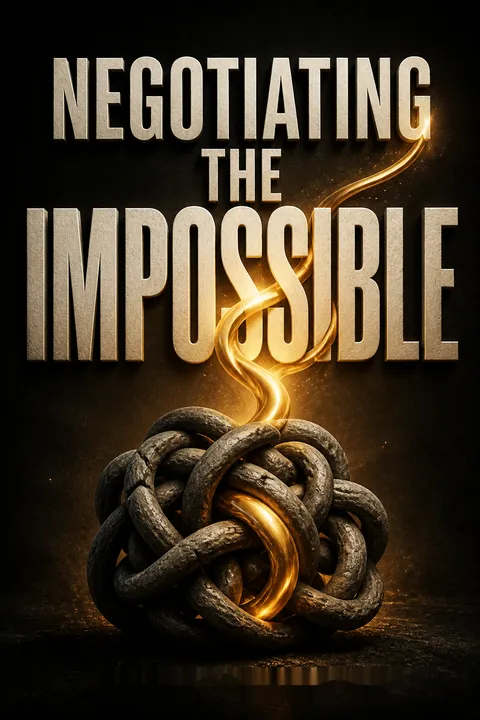


Key Takeaways
Treat deadlock as a design problem, not a demand for more leverage
Power has more than one source. Negotiation is any effort by people with different interests or perspectives to reach agreement, not just a contest over money. The Treaty of Kadesh, an ancient peace accord between Egypt and the Hittite Empire, illustrates the point. Its Egyptian and Hittite versions each claimed the other side had asked for peace. The disagreement let both leaders present peace as their own victory, preserving dignity while ending conflict.
Look beyond the demands. Malhotra organizes the alternative sources of leverage into framing, process, and empathy. These shape how people interpret an offer, how they reach a decision, and what they understand about each other's needs. The practical question is not only what can be conceded, but what could make agreement acceptable without an expensive concession.
The Kadesh example captures a real feature of collective decision-making: people need not share a single account of what happened to coordinate on what happens next. This resembles face-saving practices in diplomacy and conflict mediation, where a usable story can matter as much as a technically precise record. Such flexibility is most defensible when it helps parties accept a mutually beneficial outcome. It becomes dangerous when the story hides who bears the cost or conceals an unresolved dispute.
Change the deal's shape so both sides can accept the same value
Structure can unlock agreement. In the 2011 NFL labor dispute, owners and players were stuck over how to divide revenue. The eventual deal split revenue into three categories, with a different player share for each. The overall result remained roughly 47 to 48 percent for players, but the structure let each side emphasize a different apparent win to its constituents.
Separate value from appearance. In a commercial licensing negotiation, the parties disagreed over whether royalty rates should rise or fall over time. A schedule that considered both time and sales volume allowed the maximum rate to decline year by year while the actual rate could rise with sales. More broadly, negotiators can add issues, bundle terms, or divide one issue into parts. This makes room for trades and helps each party explain the outcome at home.
This is a negotiation version of mechanism design: changing the rules or categories of a choice can alter incentives without changing the underlying resources very much. The structure can be especially useful when a representative must defend a deal to people who were not in the room. But presentation is not automatically harmless. A clever format should make legitimate trade-offs visible, not obscure a poor outcome or mislead the constituencies who ultimately live with it.
Make your proposal feel normal before arguing that it is better
People ask what fits. The logic of appropriateness describes how people often decide by asking what someone like them would do in a situation like this, rather than calculating every cost and benefit. At Memorial Sloan Kettering, many patients with low-risk prostate cancer rejected active surveillance, a monitoring plan that could spare them the side effects of immediate treatment. Surgeon Behfar Ehdaie changed how he presented the option, including making it the starting point and noting how many similar patients chose it. Adoption rose from about 60 percent to 95 percent, while average counseling time fell from more than an hour to about 35 minutes.
Set the comparison carefully. Social proof, defaults, and reference points can make a sound proposal easier to consider. The same tools can backfire: emphasizing how unusual an option is may make people suspect it is unsafe or untested.
Defaults and social proof work partly because choices are made under limited attention and uncertainty. The medical example is powerful because the communication change supported a clinically appropriate option while reducing discussion time. Yet the ethical standard must be higher in medicine than in ordinary sales: patients need informed choice, not merely increased uptake. A trustworthy frame explains why a recommendation fits the person's situation and leaves room for questions, uncertainty, and genuine preference.
Use ambiguity to bridge presentation gaps, never unresolved substantive conflict
Ambiguity can buy room. In the 2008 US-India civil nuclear agreement, American lawmakers wanted a clear consequence if India tested a nuclear weapon, while India's leaders would not accept a written restriction on its right to test. The agreement used language open to more than one interpretation, allowing each government to describe its position favorably. The parties also understood that US law and political pressure would constrain future cooperation if India tested.
Do not confuse wording with agreement. The 2002 UN resolution on Iraq used imprecise language about inspection and force, even though the United States and France disagreed about when military action was justified. When that difference surfaced, both sides claimed the resolution supported their position, and the coalition went to war without a second Security Council vote. Ambiguity is safer when conduct is already constrained by shared interests or other enforcement mechanisms.
Ambiguity can function like a temporary bridge when parties agree in practice but cannot publicly endorse the same formulation. Its value depends on whether behavior remains predictable despite imprecise language. The Iraq example shows why that condition matters: if the central disagreement concerns what action is permitted, flexible wording can produce competing expectations rather than cooperation. In modern contracting, a useful test is whether each side can explain the ambiguity's likely consequences before signing.
Negotiate the route to agreement before bargaining over its destination
Process shapes the possible deal. James Madison arrived early at the 1787 Constitutional Convention and helped replace the Articles of Confederation as the starting point with a new proposal, the Virginia Plan. That shift changed what delegates debated. The ratification rules mattered too: approval by nine states, through special conventions rather than state legislatures, made adoption possible despite opposition.
Clarify how decisions happen. In 1983, Sun Microsystems founders Vinod Khosla and Scott McNealy believed they had agreed to a $10 million investment. When the investor's team reopened the main terms, Khosla refused to renegotiate substance until they clarified whether an agreement had been reached. The founders left without a deal, and the original terms were restored days later. Before making major concessions, establish who decides, what remains open, and what the next steps require.
Process is not administrative housekeeping. It distributes voice, sets defaults, and determines which proposals can survive implementation. Madison's example also shows that rules can enable reform while limiting who gets to reopen it, a reminder that process design is a source of power and should be scrutinized for legitimacy. In business, clarity about decision-makers and approval stages can prevent a handshake from being mistaken for a final commitment.
Protect future negotiations from today's clever but destructive victory
Short-term wins leave precedents. In 1992, NHL players waited until the playoffs were about to begin to strike, when owners stood to lose especially large revenues. The ten-day stoppage produced major player gains. In response, owners began locking players out at the start of later seasons, and subsequent disputes destroyed games and revenue. A tactic can succeed once and still make future cooperation harder.
Keep the channel open. The Congress of Vienna brought defeated France back into European diplomacy after the Napoleonic Wars. A century later, Germany was isolated after World War I. Malhotra argues that continued participation gave France a way to manage residual conflict, while exclusion left Germany outside the forums that might have contained it. In complex negotiations, parties can allow progress on individual issues without requiring unanimous support at every step, while reserving final approval for the complete agreement.
Repeated interaction turns reputation and precedent into part of the bargaining environment. A one-time advantage may therefore carry a hidden cost: it teaches the other side to expect exploitation and justify defensive tactics. At the same time, staying engaged should not mean tolerating abuse or treating every party as equally entitled to veto progress. Durable process requires both access to future discussion and rules that prevent obstruction from becoming the only source of leverage.
Empathy finds options by explaining behavior without excusing it
Understand the threat as they see it. During the Cuban Missile Crisis, President Kennedy's advisers initially favored attacking Soviet missile sites in Cuba. Kennedy chose a naval quarantine and diplomacy in part because he considered the Soviet view: the United States already had nuclear missiles near the Soviet Union, and US military superiority made Soviet leaders feel vulnerable. The settlement included Soviet removal of missiles from Cuba, a US pledge not to invade Cuba, and a private US commitment to remove missiles from Turkey.
Leave room for error and face. Kennedy also resisted immediate retaliation after a US spy plane was shot down, allowing for the possibility that the attack was not ordered by Soviet leadership. Empathy did not mean approving Soviet actions. It helped identify a deal, avoid escalation based on mistaken assumptions, and leave the other leader a way to accept it without public humiliation.
Perspective-taking is useful because it improves prediction, not because it guarantees goodwill. It resembles the practice of considering an opponent's model of the situation before choosing a response. That discipline can interrupt escalation driven by attribution error, the tendency to read hostile intent into ambiguous behavior. Still, restraint must be paired with credible boundaries. If one side repeatedly exploits the benefit of the doubt, flexibility without consequences can invite further coercion.
Map everyone affected, then target the real barrier, not the loudest demand
The table is larger than it looks. The negotiation space includes anyone who can influence a deal and anyone affected by it. During the Louisiana Purchase, the United States negotiated with France, but Britain's war with France, Spain's claims, and events in Haiti shaped Napoleon's decision to sell. Looking only at the two parties in the room would have missed the forces changing their alternatives.
Use ICAP to organize inquiry. For each relevant party, assess interests, constraints, alternatives, and perspective. In a separate business dispute, a Chinese partner delayed approval of a development milestone that affected the startup's valuation. Brainstorming revealed possible concerns about a delayed factory deadline and a coming payment, not only a hardball attempt to gain leverage. Addressing those concerns helped secure approval without conceding the commercial agreement.
Mapping stakeholders resembles systems analysis: outcomes often depend on relationships and constraints outside the immediate exchange. It also guards against treating an organization as a single mind, since different employees may face different incentives or risks. The method can become unwieldy if every remotely connected actor is treated as equally important. A practical map should distinguish parties who can change the outcome from those who mainly need protection, information, or a voice in implementation.
Turn adversaries into partners by finding value neither can create alone
Look for a missing combination. An entrepreneur named Sam was sued alongside a retailer and an overseas supplier over an alleged patent violation. After losing in court, he faced a $2 million judgment and had little leverage. Instead of focusing only on reducing the payment, he noticed that the retailer had lost a supplier and the manufacturer had lost access to the retailer. Sam could reconnect them because he still had the retailer's trust.
Build a better joint outcome. Sam proposed becoming the intermediary between the manufacturer and retailer, and the manufacturer's exclusive distributor for overseas sales. He also agreed to pay a few hundred thousand dollars toward legal costs. The arrangement gave the manufacturer a route back to a customer, the retailer a product source, and Sam valuable business. The dispute was no longer just a fight over who owed whom; it contained a possible collaboration.
This case illustrates the difference between dividing a fixed pie and identifying complementary assets. The parties had something the others lacked: product, customer access, or a trusted intermediary. A value-creating deal can make concessions easier because it increases what is available to share. But reframing an opponent as a partner should not erase accountability. The agreement worked because Sam identified a lawful, mutually useful role, not because the underlying allegations or power imbalance ceased to matter.
Respect the other side's history before asking it to surrender identity
People inherit different maps. The same territory can appear differently on national maps, and the Cuban Missile Crisis is remembered in the United States as a crisis over missiles in Cuba, in Russia as a Caribbean crisis, and in Cuba as the October Crisis. These names reveal different accounts of what mattered. In long conflicts, one side's foundational injustice may be absent from the other's history.
Work with the frame that exists. When Saudi King Ibn Saud faced religious opposition to telephones, he demonstrated that the technology could carry Quranic recitation. Rather than dismissing the religious lens, he used it to make modernization acceptable. In other conflicts, asking for sacred concessions before credible negotiations begin can close the door. The task is not to erase memory or adopt every claim, but to understand what each side treats as legitimate and build a path that can acknowledge it.
Historical narratives are not merely factual disputes; they help define group identity and the boundaries of acceptable compromise. Recognizing this can make negotiation more humane and more realistic. It also calls for care: acknowledging a narrative does not establish that every historical claim is accurate or that every demand is just. Strong dialogue can validate the significance of another group's experience while still testing evidence, protecting rights, and distinguishing recognition from endorsement.
Analysis
The book's central move is to redefine negotiation as a problem of human interaction rather than a contest over a single currency. Money and force matter, but deadlocks often persist because a party cannot accept the public meaning of a concession, distrusts the route to agreement, or understands the conflict through a different history. Framing, process, and empathy are therefore not soft substitutes for leverage. They are ways of discovering and shaping the conditions under which leverage can work.
The stories make this argument unusually concrete. NFL owners and players changed the presentation of a revenue split. Madison changed the constitutional starting point and ratification procedure. Kennedy widened his view of Soviet security concerns and found a face-saving exchange. Across cases, the recurring skill is diagnostic: identify whether the obstacle is material, reputational, procedural, psychological, or produced by absent stakeholders. Then choose a response that fits the obstacle instead of reflexively increasing pressure.
The strongest ethical insight is also the book's main warning. A frame can help parties reach a better agreement, but it can also disguise unresolved conflict or impose costs on people excluded from the room. The Iraq resolution illustrates how ambiguity can become a liability when it substitutes for substantive agreement. Likewise, a process that creates momentum may still be unfair if it silences affected groups. Good negotiation should be judged not only by whether those at the table sign, but by whether the agreement is understood, implementable, and defensible to those who bear its consequences.
The approach is optimistic without assuming that everyone is benevolent. It asks negotiators to search for explanations and possibilities before deciding that an opponent is irrational, while retaining the need for boundaries, credible commitments, and preparation. Its practical promise is not that every conflict can be solved quickly. It is that apparent impossibility is often a sign that the problem has been framed too narrowly, the process poorly designed, or the relevant people insufficiently understood.
Review Summary
Negotiating the Impossible receives high praise for its practical advice on resolving difficult conflicts. Readers appreciate the diverse case studies, historical examples, and actionable insights. The book's focus on framing, process, and empathy resonates with many, offering valuable tools for both personal and professional negotiations. While some find the structure repetitive, most consider it a must-read for anyone seeking to improve their negotiation skills. The book's emphasis on human interaction and creative problem-solving is particularly lauded.
People Also Read








Glossary
Strategic ambiguity
Deliberately open wordingLanguage in an agreement that intentionally allows multiple interpretations. It can help parties reach a deal when their practical expectations are compatible but explicit wording would create political or reputational problems. It is risky when parties disagree about the substance, or when no other incentives or mechanisms encourage compliance, because each side may later claim a different meaning.
Logic of appropriateness
Choice guided by perceived normsA model of decision-making associated with James March and Johan Olsen. Rather than weighing every cost and benefit, people may ask what someone like them would normally do in a particular situation. A proposal can therefore become more persuasive when it seems socially accepted, fits a person's role, or is presented as the normal or default course.
Negotiation space
All relevant parties and pressuresThe full set of people and forces relevant to a negotiation. It includes parties who can influence the outcome and parties who will be affected by it, whether or not they are present at the table. Mapping this space helps negotiators identify outside pressures, missing voices, changing alternatives, and possible sources of leverage beyond the direct relationship.
ICAP analysis
Four-part stakeholder assessmentA framework for examining each relevant party's interests, constraints, alternatives, and perspective. Interests reveal what a party values; constraints show what it can or cannot do; alternatives clarify its options if there is no deal; and perspective describes how it interprets the negotiation. The assessment should be updated as circumstances and relationships change.
Sufficient consensus
Enough support to keep movingA decision rule that allows negotiations to proceed when a substantial level of support exists, without requiring every participant to approve every proposal. It can preserve momentum and prevent individual parties from using veto power to demand disproportionate concessions. A final agreement can still require a higher level of approval or ratification.
Forward momentum
Deliberate progress toward agreementThe gradual work of reducing obstacles and building conditions that make eventual agreement possible. It can be damaged by short-term tactics that invite retaliation, destroy trust, or establish a destructive precedent. Preserving momentum does not require accepting every demand; it requires considering how today's choices affect future engagement.
Parasitic value creation
Table gains imposed on outsidersAn apparent win-win agreement for the negotiators that creates benefits for those at the table by shifting costs onto people outside it. The term warns that a deal can satisfy both negotiating sides without increasing overall welfare. Assessing an agreement therefore requires asking who is absent, who bears the consequences, and whether the apparent gains come from genuine cooperation or externalized harm.
FAQ
What's Negotiating the Impossible about?
- Conflict Resolution Focus: The book delves into strategies for resolving seemingly insurmountable conflicts and deadlocks in negotiations without relying on money or power.
- Three Key Levers: Deepak Malhotra identifies three crucial levers for successful negotiation: the power of framing, the power of process, and the power of empathy.
- Real-World Examples: It uses historical and contemporary case studies, such as the Cuban Missile Crisis and NFL negotiations, to illustrate negotiation strategies.
Why should I read Negotiating the Impossible?
- Practical Strategies: The book offers actionable strategies applicable in various contexts, from business deals to personal disputes.
- Engaging Stories: Malhotra uses compelling stories from history, sports, and diplomacy to make the content engaging and relatable.
- Optimism in Negotiation: It instills optimism by showing that even the toughest negotiations can lead to positive outcomes if approached correctly.
What are the key takeaways of Negotiating the Impossible?
- Leverage Framing: The way a proposal is framed can significantly influence its attractiveness and outcomes.
- Process Matters: Establishing a clear process before negotiations can prevent misunderstandings and conflicts.
- Empathy is Essential: Understanding the other party's perspective can lead to more effective negotiations and solutions.
What is the power of framing in Negotiating the Impossible?
- Psychological Influence: Framing acts as a psychological lens that influences how parties perceive each other and the issues at hand.
- Control the Narrative: Effective negotiators can control the frame to shape discussions and outcomes.
- Reframing for Success: Reframing can help break deadlocks by shifting focus from contentious issues to collaborative problem-solving.
How does Negotiating the Impossible define the power of process?
- Process Strategy Importance: Having a clear process strategy is essential for successful negotiations, including determining how negotiations will unfold.
- Implementation Matters: The process extends to how the deal will be implemented, ensuring alignment and preventing conflicts.
- Avoiding Misalignment: Ensuring all parties are aligned on the process can prevent misunderstandings and derailments.
What role does empathy play in Negotiating the Impossible?
- Understanding Interests: Empathy allows negotiators to understand the underlying interests and motivations of the other party.
- Building Trust: Demonstrating empathy can help build trust and rapport, crucial for successful negotiations.
- Facilitating Concessions: When parties feel understood, they are often more willing to make concessions.
What are some examples of successful negotiations from Negotiating the Impossible?
- NFL Revenue Sharing: Reframing issues led to successful outcomes, allowing both players and owners to feel victorious.
- Cuban Missile Crisis: Empathy and understanding were crucial in navigating this tense situation.
- US-India Civil Nuclear Agreement: Strategic ambiguity allowed both sides to reach an agreement without compromising core interests.
How does Negotiating the Impossible suggest handling ultimatums?
- Ignore Ultimatums: The book advises ignoring ultimatums to prevent the other party from feeling cornered.
- Rephrase Ultimatums: If ignoring is not feasible, rephrase ultimatums into less rigid language to create negotiation space.
- Focus on Collaboration: Maintain a collaborative atmosphere to encourage problem-solving and value creation.
What is the ICAP analysis in Negotiating the Impossible?
- Interests, Constraints, Alternatives, Perspective: ICAP stands for analyzing each party's interests, constraints, alternatives, and perspectives.
- Enhancing Negotiation Strategy: This framework helps tailor strategies to address specific needs and concerns.
- Dynamic Assessment: Encourages negotiators to continuously update their analysis as negotiations progress.
What are the best quotes from Negotiating the Impossible and what do they mean?
- “Empathy expands the set of options—for you.”: Highlights the strategic advantage of empathy in conflict resolution.
- “Never let fear dictate your response to the problems of human interaction.”: Encourages proactive problem-solving and collaboration.
- “What isn’t negotiable today may be negotiable tomorrow.”: Reflects the dynamic nature of negotiations, encouraging flexibility.
How can I apply the lessons from Negotiating the Impossible in everyday situations?
- Practice Empathy: Actively listen and try to understand others' perspectives in everyday interactions.
- Focus on Value Creation: Look for ways to create value for all parties involved in discussions.
- Establish a Process: Set a clear process for communication to manage expectations and facilitate smoother interactions.
What are the limits of framing and process in Negotiating the Impossible?
- Framing Misuse: While powerful, framing can lead to misunderstandings if used manipulatively.
- Process Overemphasis: Excessive focus on process can hinder substantive progress in negotiations.
- Strategic Ambiguity Risks: While beneficial, strategic ambiguity may lead to confusion if not managed carefully.
About the Author
Other books by Deepak Malhotra


Download PDF
Download EPUB
.epub digital book format is ideal for reading ebooks on phones, tablets, and e-readers.








