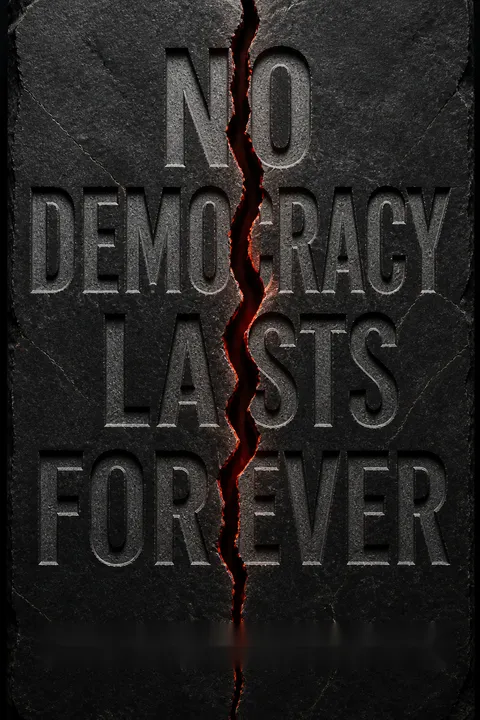


Key Takeaways
Treat the Constitution as a design choice, not a sacred object
A warning about design. Erwin Chemerinsky argues that American democracy is endangered not only by particular politicians, but by constitutional structures that can let a minority govern. Drafted in 1787 by a narrow elite, the Constitution restricted popular control, protected slavery, and gave states substantial power. Its effects have changed as population and party alignments have shifted, turning old compromises into more powerful obstacles to majority rule.
Trust is draining away. Pew measured confidence in the federal government at 77 percent in 1964 and 20 percent in 2022. In a 2023 poll, only 4 percent said the political system worked well. The 2020 election dispute and the January 6 attack exposed how fragile acceptance of election results can be. The book's central claim is that constitutional design is part of this crisis, not a neutral backdrop.
The argument is strongest when it connects several mechanisms rather than blaming one leader or one election. Institutions shape incentives: a rule that rewards obstruction or permits disproportional power can make conflict self-reinforcing. Yet constitutional design does not act alone. Political parties, voters, and officials still make choices within those rules. Treating the document as a cause invites useful scrutiny; treating it as the sole cause would obscure the responsibility of actors who exploit its openings.
Make the presidential winner the voter-selected winner
An electoral mismatch. The Electoral College gives each state electors equal to its House members plus two senators, so less populous states have more electoral influence per resident. The method also grew from compromises over slavery: enslaved people could not vote, yet their partial inclusion in population counts increased slave states' representation and electoral votes. Today, population changes and party realignment have made popular-vote reversals more likely.
Recent results show the risk. In 2000 and 2016, the popular-vote winner lost the presidency. In 2020, a shift of roughly 43,000 votes across Arizona, Georgia, and Wisconsin could have made Donald Trump president despite his national popular-vote loss of about seven million. Winner-take-all rules intensify the distortion by awarding every state elector to its narrow statewide winner.
The case for equal presidential voting power is intuitive: citizens expect a national election to count each vote comparably. The Electoral College instead directs campaigns toward a small set of competitive states, while many voters in safe states receive little attention. A direct popular vote would change that incentive, although it would not by itself settle disputes over election administration or recount standards. The deeper principle is that a system's legitimacy depends not only on who wins, but on whether citizens can recognize their participation in the result.
Stop letting a Senate minority veto ordinary governing
A second barrier. Each state has two senators, even though California has about seventy times Wyoming's population. The filibuster adds another hurdle: under modern Senate rules, supporters usually need sixty votes to end debate on legislation. Chemerinsky estimates that forty senators representing roughly one-fifth of the population can block bills supported by a national majority.
Rules changed the incentive. Until the 1970s, maintaining a filibuster usually meant occupying the floor and stopping other Senate business. A two-track system later allowed the Senate to work on other matters while a bill was blocked, and the burden shifted to supporters to find sixty votes. This quiet, low-cost version spread. Earlier filibusters, including a seventy-four-day effort against the 1964 Civil Rights Act, show how obstruction has also delayed civil rights legislation.
A minority veto can protect genuine dissent, but its design matters. When obstruction requires public effort, physical endurance, and the suspension of other business, the tactic carries visible costs. When a silent threat is enough, the cost shifts to everyone waiting for action, while the obstructing senators face less scrutiny. The book's criticism is not that deliberation has no value. It is that a routine supermajority rule can turn a safeguard into a default veto, especially in a chamber already tilted by population.
Put district maps beyond politicians' self-protection
Voters become the raw material. Partisan gerrymandering is the drawing of election districts to help the party controlling the mapmaking process. Politicians can pack opposing voters into a few districts or crack them across many districts, weakening their ability to win seats. Computers and detailed voter data let mapmakers compare thousands of maps and choose one with precise partisan advantages.
North Carolina illustrates the method. After a narrow statewide vote, Republican mapmakers used a computer to generate 3,000 possible congressional maps and selected one intended to elect ten Republicans and three Democrats. In 2016, Republicans received 53 percent of the congressional vote and won ten of thirteen seats. In 2019, the Supreme Court barred federal courts from deciding partisan-gerrymandering claims. Independent commissions, federal legislation, and state courts remain possible checks.
Map drawing exposes a basic accountability problem: officeholders can shape the electorate that later judges them. Independent commissions reduce that conflict, but independence is a matter of design, not a label. Appointment rules, transparency, and clear standards determine whether a commission is genuinely insulated from party control. Nor does neutral mapmaking erase every representational imbalance, since voters are geographically clustered. The practical test is whether maps preserve meaningful competition and fair representation, rather than whether they produce a perfectly proportional legislature.
Preserve judicial independence without granting justices generational power
Independence has a cost. Federal judges hold office during good behavior, which protects them from political retaliation but lets Supreme Court justices serve for decades. From 1789 to 1970, the average tenure of a justice was 15.2 years. Among justices appointed since 1970 who have left the Court, it was 27.6 years. Longer life spans and strategic selection of young nominees make each vacancy unusually consequential.
The Court shapes electoral rules. The book points to decisions that weakened the Voting Rights Act, protected unlimited independent campaign spending by corporations, and closed federal courts to partisan-gerrymandering challenges. It also describes the Purcell principle, under which courts are discouraged from changing election rules close to an election, even when a lower court finds a likely violation. These choices can leave disputed rules in force for an election.
Judicial independence is essential when courts protect rights that majorities may disregard. But independence and accountability are not the same as lifetime tenure, and a long vacancy-driven appointment cycle can make the Court's direction depend heavily on timing. Term limits could regularize turnover without making judges answer to daily opinion polls. Still, changing tenure is not a cure for every legitimacy problem: appointment politics, legal reasoning, and the Court's willingness to enforce rights matter too. Reform should protect impartial judgment while reducing the stakes of each vacancy.
Read racial inequality as a living consequence of founding bargains
Slavery shaped the structure. The Constitution's Three-Fifths Clause counted enslaved people as three-fifths of a person for apportionment, increasing slave states' representation without granting enslaved people political rights. The Constitution also delayed congressional action against the international slave trade and required the return of people who escaped slavery. These bargains strengthened the political power of slaveholding states and helped entrench a racial hierarchy.
The consequences outlasted slavery. Chemerinsky links those choices to later exclusion and racial inequality. In 2016, the typical white family's net worth was about $171,000, compared with $17,150 for the typical Black family. He also notes that legal equality arrived long after the founding, and that enforcement was repeatedly resisted. The point is not that one constitutional clause explains every present disparity, but that institutions built around exclusion can leave durable effects.
This history makes a useful distinction between formal legal change and accumulated advantage. Ending a discriminatory rule does not instantly undo differences in property, access, or political power that the rule helped produce. The book's constitutional focus clarifies how political structures can protect unequal arrangements, though racial inequality also reflects many later laws and social forces. That broader causal picture strengthens, rather than weakens, the case for reform: remedies must address present effects, not simply celebrate the removal of explicit discriminatory language.
Defend open speech without pretending viral falsehoods self-correct
Access cuts both ways. The internet lets people reach large audiences without owning a newspaper or holding a broadcast license. It also gives false claims, harassment, and foreign influence a fast, persistent route to voters. A 2018 MIT study cited in the book found that false news spread faster and reached more people than true stories. Russian operatives used social media in 2016 to inflame existing divisions and influence the election.
The legal dilemma is real. First Amendment decisions protect some false speech because giving government the power to define political truth could suppress legitimate criticism. But the usual answer, more speech, is unreliable when false claims spread quickly and voters retain them after correction. Chemerinsky argues for targeted limits on election deepfakes and stronger disclosure of who is speaking and spending money, while recognizing that broad speech regulation carries serious risks.
The chapter's tension is not simply free speech versus censorship. It is also a question of infrastructure: platforms determine what becomes visible, how quickly it travels, and whether corrections reach the same audience. A legal rule aimed at fabricated election media may be narrower than a general ban on false claims, but drawing the boundary still requires care. The relevant democratic aim is to preserve dissent and anonymity where they protect vulnerable speakers while making deliberate impersonation and hidden foreign influence harder to mistake for ordinary participation.
Use rules, statutes, and state commissions before waiting for amendments
Many repairs have nearer routes. The Senate can change its own rules to eliminate or limit the filibuster. Congress can expand the House, require independent commissions for congressional maps, and strengthen voting-rights protections. States can create their own redistricting commissions, and state courts can apply state constitutions against partisan maps. Chemerinsky also proposes stronger campaign-spending disclosure and narrowly targeted restrictions on election deepfakes.
Possibility is not probability. These measures often require officials to surrender advantages they currently enjoy. The same legislators protected by gerrymandered districts may oppose map reform; senators who benefit from a filibuster may resist removing it. Some judicial routes, such as treating the Electoral College as a violation of equal protection, are legally contested and politically unlikely. The practical lesson is to pursue available reforms while being clear-eyed about who has reason to block them.
This menu separates legal capacity from political feasibility, a distinction often lost in reform debates. A proposal can be constitutionally available and still have no coalition capable of passing it. That suggests a useful order of operations: pursue local and procedural changes where they can build public confidence, while preserving the larger constitutional debate. Incremental reform is not automatically sufficient, however. If each small adjustment leaves the same incentives intact, activity can become a substitute for changing the structure that produces the problem.
Begin constitutional redesign before dysfunction makes the choices for you
Amendment is a steep climb. Article V requires two-thirds of both houses of Congress to propose an amendment and three-quarters of the states to ratify it. The Constitution has been amended 27 times, including ten amendments adopted as the Bill of Rights. Equal state representation in the Senate is explicitly protected from amendment without a state's consent, making even that route unavailable for changing the Senate's basic allocation.
A new document is a harder, riskier idea. Chemerinsky proposes beginning a national discussion about a constitution better suited to a modern, diverse country. He imagines a convention whose delegates are not simply state representatives, followed by ratification in a national vote. The 1787 Constitution itself replaced the Articles of Confederation despite their stricter amendment rules. A new convention could correct flaws, but it could also produce a worse document or fail to win public consent.
The proposal's deepest insight is that constitutional change is partly a question of political imagination. Reverence can make an inherited arrangement seem inevitable, even when its original compromises are visible. But redesign requires legitimacy as much as technical skill. A national majority vote could avoid state-level vetoes, yet it could also leave regions or minorities feeling overruled. Any serious process would need transparent representation, public deliberation, and protections that make losing a vote different from losing the right to participate.
Treat secession talk as a warning light, not a governing plan
Disunion is already imaginable. A 2021 poll found that 41 percent of Biden voters and 52 percent of Trump voters somewhat agreed that the country should split by red and blue states. Chemerinsky does not advocate secession; he sees its growing appeal as a signal that people doubt the country can govern itself together. The Constitution says little about states leaving, and the Supreme Court's post-Civil War decision in Texas v. White leaves room for separation by consent of the states.
Separation need not mean war. The 1992 dissolution of Czechoslovakia, known as the Velvet Divorce, shows that a political union can end peacefully, though its circumstances differed sharply from America's. Chemerinsky also considers devolving most domestic authority to states while retaining a national government for defense and foreign affairs. Any version would raise difficult questions about federal programs, shared assets, trade, and international power.
Talking about separation can expose how much a political union depends on consent, not just law or habit. But it is dangerous to treat a poll's expression of dissatisfaction as a mandate for breakup. Secession could turn policy disagreements into permanent disputes over borders, rights, resources, and membership. The book's more constructive use of the idea is diagnostic: if many citizens imagine exit, leaders should ask what makes shared government feel intolerable and whether institutional reform can restore a sense of common stake.
Analysis
The book's central contribution is a causal story about how constitutional design interacts with political geography. The Electoral College and equal state representation in the Senate were compromises made when the country was smaller, less populous, and organized around state interests, including the preservation of slavery. Population shifts and party realignment changed the consequences of those structures. The filibuster and modern data-driven redistricting then added procedural mechanisms that can protect minority power from electoral correction. The Supreme Court, with long tenure and politically strategic appointments, can reinforce those arrangements. This account helps explain why democratic erosion need not begin with a dramatic seizure of power. It can occur through rules that repeatedly translate minority votes into durable governing control.
The analysis is persuasive in showing accumulation, but the causal chain should not be mistaken for inevitability. The same constitutional system has supported major expansions of voting rights and civil liberties, often through amendments, legislation, and organized political pressure. Institutional rules constrain choices, but they do not determine them. Party strategy, civic mobilization, state policy, and public acceptance remain active forces. The book's strongest implication is therefore not that the Constitution mechanically produces authoritarianism, but that it can lower the cost of anti-democratic behavior and make correction unusually difficult.
The remedies also involve competing democratic values. Majority rule offers electoral equality, while federalism and judicial independence can protect communities and rights from national majorities. Neither value automatically wins. The relevant question is whether institutional vetoes protect meaningful pluralism or entrench actors who cannot command broad support. Likewise, a new constitution might reduce inherited distortions, but a process that lacks broad consent could deepen the legitimacy crisis it aims to solve.
The book is most useful as a prompt to assess institutions by their real effects, not their symbolic prestige. A reform agenda should be judged across three tests: whether votes carry comparable weight, whether government can act while remaining accountable, and whether minorities retain enforceable rights. That standard keeps the argument focused on democratic performance rather than nostalgia for either the founding document or an imagined simpler past.
Review Summary
No Democracy Lasts Forever receives mixed reviews, with praise for its thought-provoking analysis of constitutional flaws and critiques of American democracy. Readers appreciate Chemerinsky's insights on issues like the Electoral College, gerrymandering, and unequal representation. However, some find the book repetitive and lacking practical solutions. Critics argue it's biased towards leftist views, while supporters see it as an important examination of systemic problems. Overall, the book sparks debate about the need for constitutional reform and the future of American democracy.
People Also Read







Glossary
Electoral College
State-based presidential selectionThe constitutional system for choosing the U.S. president through electors allocated to each state. A state's electors equal its number of representatives and senators, with three additional electors for the District of Columbia. Most states award all their electors to the statewide popular-vote winner. A candidate generally needs a majority of electoral votes to win.
Stealth filibuster
Silent legislative obstructionA Senate practice in which the threat of extended debate can prevent a bill from reaching the floor unless its supporters can assemble enough votes to end debate. Senators need not continuously speak or occupy the chamber. The term describes the modern form of the filibuster, which can block legislation while allowing the Senate to conduct other business.
Partisan gerrymandering
Districts drawn for party advantageThe practice of drawing electoral district boundaries to improve one political party's chances of winning seats. Mapmakers can concentrate opposing voters in a small number of districts or distribute them across many districts, reducing their influence elsewhere. Modern computing and detailed voter data make it possible to compare many maps and select those with strong partisan advantages.
Packing and cracking
Two map-rigging methodsPacking concentrates opposing-party voters in a small number of districts, limiting how many seats they can influence. Cracking divides those voters among many districts so they are unlikely to form a majority in any of them. Mapmakers often combine the two tactics to increase their own party's seats while reducing the other party's representation.
Purcell principle
Caution near election dayA judicial principle, associated with Purcell v. Gonzalez, that federal courts ordinarily should avoid changing state election rules close to an election. The book argues that applying this principle can leave rules in force even when a lower court finds they likely violate voting protections. The Supreme Court has not provided a precise definition of how close to an election the principle applies.
Section 5 preclearance
Advance review of voting changesA provision of the Voting Rights Act that required jurisdictions with histories of racial discrimination in voting to obtain federal approval before changing election rules. This advance review was intended to prevent discriminatory practices from taking effect while lengthy lawsuits proceeded. The Supreme Court invalidated the formula identifying covered jurisdictions, leaving Section 5 without its operative coverage system.
Three-Fifths Clause
Enslaved people counted for apportionmentA constitutional provision that counted three-fifths of each state's enslaved population when allocating seats in the House of Representatives and apportioning direct taxes. Enslaved people had no vote or political rights, but their partial inclusion increased the representation and electoral influence of slaveholding states. The provision became obsolete after slavery was abolished and the Constitution was amended.
Article V
Constitutional amendment procedureThe section of the Constitution that establishes methods for proposing and ratifying amendments. Congress may propose amendments with two-thirds approval in both houses, or two-thirds of state legislatures may call for a convention. Ratification requires approval by three-quarters of the states. Article V also protects equal representation of states in the Senate from amendment without a state's consent.
Download PDF
Download EPUB
.epub digital book format is ideal for reading ebooks on phones, tablets, and e-readers.








