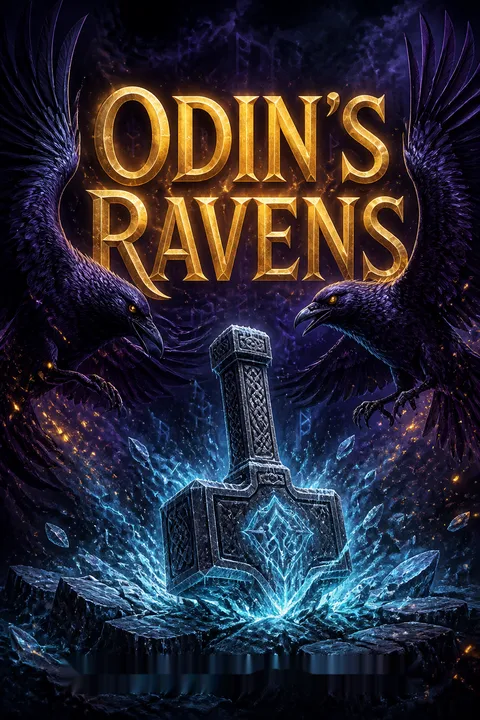


Plot Summary
The Jotunn Turns
A week earlier, Matt Thorsen’s greatest worry was school. Now he is crossing Hel with his friends Laurie and Fen, trying to reach their dead friend Baldwin before Ragnarök destroys the living world. Matt chooses a detour around a two-headed fire giant rather than risk a fight, but his Thor’s Hammer amulet suddenly flares and draws the creature after him.
When the Jotunn attacks, Matt’s hand releases a blast of ice that knocks it down. The giant recovers, however, and Matt escapes by falling into a deep fissure. His shield freezes over to deflect the fire, while Fen distracts the monster long enough for Matt to climb out. The new power gives Matt hope, but not an easy victory.
Matt’s first display of power arrives through danger rather than mastery. He does not plan a spectacular attack; his amulet reacts, and his body follows before he can understand what it can do. That distinction matters because his role as Thor’s champion has been assigned to him by adults and prophecy, while his decisions still belong to a frightened boy. His choice to avoid the giant is not cowardice but judgment, a lesson Fen resists. The scene establishes a central tension: heroism requires power, but it also requires knowing when power is not enough.
Helen’s One Exception
At Hel’s gates, the four-eyed dog Garm pins Matt down, but Matt recognizes that the guardian is doing his job rather than attacking without cause. Fen’s ability to speak with Garm helps him persuade the dog to guide them to Helen, ruler of the dead. In a pavilion filled with food, Helen summons Baldwin, who is cheerful but no longer breathes and believes death is permanent.
Fen explains that he and the others mourned him, changing the old myth that kept Balder in Hel. Helen agrees to release Baldwin, but her portal can return only as many people as entered. Matt refuses to leave anyone behind, so they all accept Helen’s map to another exit. Before vanishing, she warns them that Owen, Odin’s descendant, is captive.
Helen makes grief consequential without making it simple. The children’s mourning changes the conditions of an old myth, but it does not erase death’s authority; Baldwin himself has begun to accept his new state. Fen’s insistence that the group travel together also marks a shift from defensive hostility to responsibility for the team. Helen’s hospitality is deliberately double-edged: the feast tempts them toward comfort, while her rules force them to weigh one life against another. The map and Owen’s captivity turn a rescue into a larger mission, linking personal loyalty to the approaching conflict.
The Rooster Says Soon
Helen’s servant leads the group across a beach made of human bones, then leaves them to follow her wing-paper map. A huge red rooster swoops over burial mounds and speaks a single warning that Ragnarök is near. Fen considers killing it to delay the prophecy, but Matt insists that rescuing Baldwin may already have altered their fate.
Three dead Viking warriors then block the route, demanding Helen’s map because they believe it can free them from Hel. Matt refuses to fight them, recognizing their grievance: they died of old age after trying to pass themselves off as battlefield casualties. The children flee when the warriors seize for the map and reach a riverbank, where they discover that the water is a corrosive stew of the dead.
The rooster punctures the group’s first hope that one changed event can cancel the apocalypse. Matt’s response is telling: he clings to the possibility that saving Baldwin mattered, even as the warning unsettles him. The dead Vikings complicate the children’s easy division between monsters and allies. Their anger comes from an unjust rule about who earns a better afterlife, not from a desire to harm the living. Matt’s refusal to punish them preserves his developing sense of justice, while Fen’s frustration reflects the practical cost of compassion when the clock is running.
Across the Dead River
Baldwin tests the river and discovers that it eats through clothing, so the children search for a crossing and find a small longship. As Matt climbs aboard, a corpse rises from the water, grabs his foot, and drags him under. Fen and Baldwin refuse to abandon him: they use an oar to locate him and pull him back into the boat, though the water has stripped and burned his clothes.
Matt survives long enough to warn them that the river is crowded with dead Vikings. They row to shore as the corpses climb over one another toward them, then Fen and Baldwin hold the creatures back while Laurie and Matt reach the woods. The dead retreat once the group crosses a boundary. In a cave, Matt drives a bear into a glowing river, and they reach the exit.
The rescue reverses the emotional arrangement established in Hel. Baldwin, once the person they came to save, now helps pull Matt from danger, while Fen’s frantic persistence reveals that their team bond has become more than a mission. The river makes the afterlife physically invasive: Matt does not merely pass through a landscape of death, he is seized by it and must be carried back by friends. Their escape depends on coordinated limits rather than individual strength. Matt fights the bear only after Laurie and Baldwin are safely across, showing how leadership increasingly means managing other people’s risk.
A Stampede from Hel
Matt steps through the exit and finds himself directly in the path of a stampeding bison herd. He knocks Fen back into Hel to keep him from emerging into the stampede, then uses his amulet to divert charging animals while Baldwin and the others come through. A lightning strike clears a path, and Hildar, leader of the Valkyries, carries the group to safety in the Black Hills.
Matt assumes that saving Baldwin has broken the myth and stopped Ragnarök. Hildar corrects him: changing events can improve their chances, but the final battle cannot be prevented. She also says Owen is free, though he has lost an eye as fate requires. The news leaves the group relieved to have Baldwin and newly afraid of what the prophecy still demands.
The bison are absurdly ordinary beside Hel’s monsters, which makes their danger a sharp reminder that survival is not reserved for mythic threats. Matt’s lightning appears at the moment of panic, suggesting that his power is connected to emotion before he can summon it deliberately. Hildar then dismantles the group’s comforting interpretation of their rescue. Fate is neither a script they must obey exactly nor a door they can shut; choices change the odds without guaranteeing safety. Owen’s injury gives that uncertainty a human cost, particularly for Laurie, who understands that prophecy can leave scars even when someone survives.
Ghost Arrows and Goats
At the Valkyries’ camp, Laurie sneaks away with the bone bow Helen placed in her pack. Owen finds her and teaches her to draw it; when she releases the empty string, a real arrow appears and strikes a tree, then vanishes when removed. Owen explains that the weapon will answer only to her.
He also tells her he will fight beside the group, though his knowledge of possible futures limits what he can reveal. Later, Hildar takes Matt to a herd of magical goats, including the pair he can summon by name. Matt is embarrassed by the gift until Hildar explains that the goats will matter in the battle. She directs him to Saint Agnes cemetery, where his amulet can lead him to Mjölnir.
Laurie’s weapon changes her relationship to the group’s danger. She has often been the person who opens portals and finds routes, forms of help that can look secondary beside a shield or a sword. The ghost arrows make her agency unmistakable: the bow works through her own hands, not through a warrior who lends her power. Matt’s goats initially provoke embarrassment because he measures usefulness by familiar heroic symbols. Hildar asks him to trust an asset before he understands it. Both gifts challenge the children to recognize that significance may arrive in an unfamiliar shape.
The Sheriff’s Mistake
The group portals near Old Blackwell and approaches Saint Agnes cemetery, where Matt expects to find Mjölnir. Before they can enter, a hunter tranquilizes him and forces Laurie and Fen to carry him to a cabin. Matt’s grandfather arrives, speaks as though Fen killed Baldwin, and prepares to hand him to a police officer.
Fen and Laurie deny the accusation, but the mayor’s authority nearly turns the lie into an arrest. Baldwin arrives with several of Odin’s Berserkers and proves he is alive, so the officer releases Fen. The rescue does not free Matt, who remains in another room with the hunter. Through their intervention, though, the friends overturn the public story that blamed Fen and create a chance to reach Matt.
The cabin scene replaces mythic peril with institutional power. Fen can fight wolves, but an adult’s false account, a tranquilizer, and a police officer threaten to imprison him through ordinary procedures. The accusation exploits the Brekke family’s reputation, showing how inherited stigma can make a lie feel credible before anyone checks it. Baldwin’s reappearance breaks that machinery because his living body is evidence the adults cannot easily explain away. Yet Matt remains isolated, making clear that one truth corrected in public does not undo every harm already set in motion.
Grandfather Leads the Raiders
Matt’s grandfather tells him that prophecy makes his defeat inevitable and insists that Ragnarök will create a world where the Thorsens can survive. Matt refuses that logic and explains that Baldwin has returned from Hel, but his grandfather dismisses the account.
When Berserker Vance arrives to extract the children, the mayor’s hidden army becomes visible: Raiders and wolves surround the cabin, and Matt realizes his grandfather commands the enemy. The revelation turns Matt’s hurt into uncontrollable rage.
His Hammer strikes his grandfather, and the earth begins to split beneath the cabin. As the floor collapses, Matt sees the Midgard Serpent moving under the ground. Fen and Laurie reach the wreckage outside, but Matt and Baldwin remain trapped above the widening pit.
Matt’s betrayal is painful because it recasts affection as something his grandfather can use to manage him. The mayor may love Matt, but he has also accepted a political future in which the boy’s death is an acceptable cost. Matt’s anger therefore carries more than adolescent defiance; it is a response to discovering that care and sacrifice can coexist in the same person. His uncontrolled power makes this conflict physically consequential, waking the serpent before the planned battle. The catastrophe is not caused by a villain’s attack alone. It erupts through Matt’s understandable, but dangerous, loss of control.
The Goats Charge
Fen slips through the fighting between Raiders and Berserkers to retrieve the group’s magical packs. A hostile wolf named Hattie blocks him, but Matt’s grandfather unexpectedly knocks her aside with his Hammer and orders Fen to save Matt. Fen brings the packs back, and Laurie finds a rope inside hers. She and Fen pull Baldwin and then Matt from the crater as the serpent moves below them.
Outside, the mayor’s Raiders clash with Owen’s Berserkers, and Laurie fires ghost arrows to protect the group. Matt summons Tanngrisnir and Tanngnjóstr; the two white goats arrive with their herd and ram the Raiders, allowing the children to retreat toward camp. Matt is shaken by his grandfather’s attack on his own side, but the group escapes together.
Fen’s rescue effort gathers several forms of strength without making any one of them sufficient. He risks crossing the battle for the bags; Laurie finds and manages the rope; Baldwin and Matt climb; the goats turn the wider fight. Matt’s grandfather’s intervention is morally confusing rather than absolving. He helps save Matt even though he is directing the enemy, forcing the children to distinguish private attachment from public allegiance. The goats’ arrival also pays off a gift Matt had dismissed. Their usefulness is not symbolic alone: they physically change the balance of the fight and give the group a way out.
The Twins Face Nykurs
While Matt’s group searches for Mjölnir, Owen travels to Evan’s Plunge to find the missing twins, Ray and Reyna. Three nykurs, water horses that can drown swimmers, rise from the mineral pool and attack the visitors.
The twins join hands and raise a wall of water, keeping the creatures back while Owen pulls an unconscious girl to safety. The nykurs then summon a larger surge that sweeps swimmers and fighters into the pool.
Owen clings to one creature and escapes by swinging from the gymnastic rings overhead, while the twins open a breach in the building so the water and nykurs drain away. Owen identifies himself as Odin’s descendant and persuades the twins to return, using private knowledge of Reyna’s feather cloak to prove he knows their family secrets.
Owen’s rescue reveals the cost of his foresight: he can see danger coming, but seeing it does not spare him from entering it. The episode also gives the twins a reason to reconsider their withdrawal. They do not return because someone shames them into obedience; they use their own shared magic to protect strangers and see that their abilities matter. Owen’s private knowledge gets their attention, but it does not immediately earn trust. The scene presents trust as a practical risk, built through demonstrated action rather than claimed identity.
The Hammer Is Stolen
At Saint Agnes, Matt’s amulet leads him to a Thorsen mausoleum. He and Baldwin force open the stone door and draw out a draugr who has been guarding the crypt. The creature first appears to be Olaf Thorsen, an ancient ancestor, and challenges Matt to prove he is Thor’s champion by lifting the hammer embedded in a stone coffin.
Matt succeeds, and Mjölnir returns to his hand after he throws it. Believing the guardian has served faithfully for centuries, Matt lets him hold it as a final courtesy. The draugr reveals that his name is Glaemir and that he has been deceiving Matt. He opens the earth and escapes with Mjölnir, leaving Matt empty-handed and the coming battle without its most important weapon.
Matt’s mistake comes from an admirable impulse applied without enough suspicion. He sees a guardian who has endured centuries of service and responds with gratitude, not calculation. Glaemir turns that courtesy into leverage, exposing the vulnerability that often accompanies Matt’s desire to do the right thing. Yet the test also gives Matt a real achievement: he lifts and summons Mjölnir, confirming that his claim to Thor’s role is more than an inherited label. The loss does not erase that proof, but it forces him to separate worthiness from possession.
Fen’s Pack Takes Him
After Ray and Reyna return, Fen overhears Owen explain that Laurie, not Fen, is Loki’s champion. Fen hides his hurt and stays beside Laurie, but later he meets Skull, a Raider cousin who wants him to lead the wulfenkind against the descendants. Skull argues that Fen’s real destiny is to command the monsters and offers him the pack if he will fight.
Fen refuses, even when Skull threatens Laurie. Bound by wulfenkind rules, Fen eventually defeats Skull rather than let the Raiders use his cousin as leverage. The pack then recognizes Fen as its leader, binding him to their needs and placing him on the enemy’s side. Fen returns to his friends without telling them that his new position may force him to betray them.
Fen’s central wound is not simply losing a title. He has built his identity around being Laurie’s protector and the team’s fierce, dependable second, so learning she has the divine role he imagined for himself threatens both his pride and his sense of purpose. Skull exploits that uncertainty by converting protection into coercion. Fen wins the fight to keep Laurie safe, but victory activates a social bond he cannot simply ignore. The scene makes leadership frightening: authority is not freedom when it arrives through inherited rules and demands loyalty to people whose aims he rejects.
Reyna Calls the Valkyries
Matt broods over losing Mjölnir until Reyna points out that he has never actually summoned the Valkyries for help. She makes him stop apologizing and call with the confidence of a warrior. Hildar arrives and explains that Glaemir commands forty draugrs, enough to make a solo rescue reckless. The group gathers its allies: the Valkyries, Owen’s Berserkers, Laurie’s bow, Reyna’s feather cloak, and Matt’s summoned goats.
Laurie and Fen also settle their argument, with Fen accepting that she is the champion while promising to remain at her side. The force rides into the draugrs’ underground city. Glaemir refuses to surrender the hammer, so Matt declares they will take it, and the assembled allies launch their assault.
Reyna helps Matt recover agency by challenging the belief that asking for help is proof of failure. Her advice is blunt because his self-reproach has begun to paralyze the group. The gathering force then makes the story’s idea of heroism explicitly collective. Matt carries the pivotal contest, but his cause depends on Laurie’s weapon, the twins’ magic, Fen’s loyalty, Owen’s fighters, Hildar’s riders, and the goats he once dismissed. Fen’s acceptance of Laurie’s role remains imperfect, yet his commitment to stay is a meaningful act of care rather than a claim to status.
Vingthor Takes the Field
The underground battle becomes a crush of Valkyries, Berserkers, goats, and draugrs. Matt struggles to reach Glaemir, while Laurie’s arrows and Fen’s wolf attacks keep one towering draugr from crushing him. When Matt’s explosive Hammer power shatters that enemy, the fighting pauses.
He challenges Glaemir, who agrees to a duel but uses a sword and knocks Mjölnir from its stone platform. Matt cannot summon it until he stops doubting his identity and claims all the forms of Thor he has been offered, including Vingthor, the battle god reborn.
Mjölnir flies back into his hand. He defeats Glaemir with the hammer, and the draugrs bow rather than continue fighting. Matt then identifies Glaemir as the deceiver who turned them against their rightful allies.
The climax resolves Matt’s internal conflict through action rather than a sudden erasure of fear. He has already lifted Mjölnir, but Glaemir’s taunts expose how much he still needs external confirmation. Matt succeeds when he claims the full, sometimes contradictory inheritance of Thor instead of waiting to feel perfectly certain. His victory also changes the battlefield’s moral structure. The draugrs are not merely defeated enemies; they have been misled, and Matt’s first use of authority after winning is to expose that deception. Power becomes legitimate when it restores others’ ability to choose.
Fen Leads the Enemy
Helen arrives after Matt exposes Glaemir and offers the draugrs a choice: the battle-dead may join the Valkyries, while the others can come to Hel. Laurie and Fen stand beside her as their ancestor, and most of the dead accept the chance to leave their unnatural existence.
Back at camp, Fen slips away, troubled by his new bond to the Raider pack. Skull finds him and argues that the surviving wulfenkind will rule a remade world after Ragnarök. Fen refuses to help destroy the world, but their pack’s rules force a fight for leadership.
When Fen finally defeats Skull, the pack binds itself to him. He has won authority over the very forces he opposes, leaving the story’s final question unresolved: how can he protect his friends while the enemy now answers to him?
The ending gives the dead a measure of rest while denying the living an easy resolution. Matt’s victory has restored Mjölnir and exposed Glaemir, but the larger conflict remains, and Fen’s private struggle makes that incompleteness intimate. His unwilling leadership is not a triumphant rise; it is a bond imposed through violence and obligation. Because Fen defines himself through protecting Laurie and the group, command of the Raiders threatens the value system that has guided him. The cliffhanger asks whether inherited identity can be resisted when it arrives not as a prophecy alone, but as a community’s claim on one person.
Analysis
Odin’s Ravens treats myth not as a fixed script but as a pressure system. The children inherit roles, predictions, and powers, yet their choices still change the conditions around them. Saving Baldwin does not cancel Ragnarök; instead, it alters the story’s moral arithmetic and gives the group another person who can act. That distinction avoids the easy fantasy that one brave gesture dissolves danger. It also makes courage less about defeating fate than about making consequential choices inside uncertainty.
The book’s most revealing conflicts arise when familiar ideas of loyalty become compromised. Matt discovers that affection can coexist with a grandfather’s willingness to accept his death. Fen protects Laurie so intensely that protection can become possessiveness, then finds himself bound to a pack whose goals he rejects. Owen’s foresight isolates him because knowledge has costs, while Laurie’s gifts challenge the assumption that only the most visibly powerful person counts as a hero. Each child must revise an identity that once seemed obvious.
The adventure’s comic details, especially the goats and Baldwin’s cheerful response to danger, keep its young characters recognizably young without trivializing their stakes. Humor becomes a way to regulate fear and preserve intimacy after violence. At the same time, the story refuses to equate monsters with moral evil: the dead Vikings and draugrs are shaped by unfair rules or manipulation, and even the living adults may cause greater harm than supernatural creatures. By ending with Fen forced into leadership of the enemy pack, the novel turns victory into a new ethical problem. The friends have won a battle, but their loyalties now cross the battlefield itself.
Review Summary
Odin's Ravens received mostly positive reviews, with an average rating of 4.14/5. Readers praised the improved writing, character development, and Norse mythology elements. Many found it fast-paced and action-packed, with an engaging plot and unexpected twists. Some critiqued the linear storyline and occasional awkward dialogue. The book was commended for its educational value about Norse myths while remaining entertaining. Several reviewers noted it as a strong sequel, building anticipation for the final installment in the trilogy.
People Also Read
Characters
Matt Thorsen
Reluctant thunder championMatt is a thirteen-year-old from Blackwell and a descendant of Thor, newly chosen to represent the god in the coming battle. He is athletic and determined, but he does not resemble the effortless hero he thinks others expect: he studies mythology, worries about mistakes, and often measures himself against more accomplished brothers. His instincts lean toward protecting people, even when that means retreating from a fight or sharing credit. Matt’s relationship with Fen is prickly but increasingly trusting, while Baldwin’s optimism and Laurie’s judgment help him find steadier footing. His deepest struggle is learning that courage does not require certainty, and that leadership means accepting help as well as responsibility.
Fen
Protective wolf cousinFen Brekke is Laurie’s cousin, a descendant of Loki, and a wulfenkind who can shift into a wolf. He is quick to fight, quicker to mock, and uncomfortable when anyone asks him to explain what he feels. Beneath the bluster is a fierce loyalty, especially toward Laurie, whom he has protected since childhood. Matt’s growing friendship with her can make Fen feel displaced, and the team’s new powers sharpen his wish to be recognized as more than the familiar wolf. Fen values action over discussion, but he is capable of revising his choices when someone’s safety depends on it. His humor and stubbornness conceal a young person trying to determine whether inherited identity must dictate what kind of person he becomes.
Laurie Brekke
Portal-opening strategistLaurie is Fen’s cousin and a descendant of Loki, with a practical mind and a developing ability to open portals. She often notices what others overlook, reads maps, and finds routes through problems that cannot be solved by force. Her loyalty to Fen is deep, but she resists being treated as someone who must always be protected. Laurie’s caution does not mean timidity; when her friends are threatened, she makes decisions quickly and accepts danger. She is also emotionally perceptive, able to understand the insecurities beneath Fen’s irritability and Matt’s self-doubt. Her emerging confidence comes from recognizing that support work can be decisive, while her bow gives her a more direct way to act.
Baldwin Osgood
Unshakable bright friendBaldwin is a descendant of Balder, the beloved Norse god whose place in the old myth is bound to the beginning of Ragnarök. He is curious, cheerful, and unusually difficult to discourage, with a habit of treating strange events as an invitation to learn something new. His friendliness softens Fen’s defenses and gives Matt an ally who trusts his leadership even when plans go wrong. Baldwin’s optimism is not ignorance: he can act decisively in danger and offers practical help without demanding attention for it. He brings warmth to a group frequently confronted with death, while his openness makes him a reminder of what their quest is meant to protect.
Owen
Odin’s watchful descendantOwen is the young descendant of Odin, gifted with a shifting awareness of possible futures. His foresight depends on remaining outside the choices he observes, which makes friendship and intervention difficult: acting to help someone can narrow what he knows. He is thoughtful, disciplined, and accustomed to hiding fear behind a calm manner. The prospect of meeting the other descendants matters to him because knowledge has often left him isolated. Owen respects rules that protect the future, but he also recognizes that refusing to intervene can cost lives. His ravens extend his sight, and his careful, sometimes frustrating silences arise from trying to balance truth, trust, and responsibility.
Reyna
Sharp-tongued Freya twinReyna is one of the twins descended from Freya. Wry, skeptical, and blunt, she tests people before trusting them and does not confuse confidence with politeness. Her shared magic with her brother Ray gives her a practical place in the group, while her teasing often exposes assumptions the others have not questioned. Reyna is wary of being assigned a passive role because of her age or gender, and she pushes for useful abilities rather than accepting that someone else will decide what she needs. Her humor can sting, but it also helps break through Matt’s self-reproach and gives him a reason to seek help instead of pretending he can manage everything alone.
Ray
Reyna’s wary twinRay is Reyna’s twin brother and a descendant of Frey. The twins share a close bond and work together through paired magic, but Ray is quieter and less confrontational than his sister. He is cautious about danger and about whom to trust, particularly after the group’s conflict with Astrid. His loyalty to Reyna shapes his decisions, while his return to the larger team reflects a growing willingness to face threats rather than avoid them.
Astrid
Dangerous false allyAstrid is a young stranger whose apparent vulnerability and claims of belonging make her difficult for the group to read. She is skilled at exploiting sympathy and uncertainty, especially Matt’s instinct to include someone who seems excluded. Her presence makes the descendants question how easily a welcoming gesture can be used against them. Astrid represents a threat that does not announce itself through size or monstrous appearance, but through calculated performance.
Mayor Thorsen
Blackwell’s family patriarchMatt’s grandfather is the mayor of Blackwell and a respected elder among the Thorsens. He is practiced at making decisions for a community under pressure, and he believes preparation requires accepting painful possibilities. His affection for Matt is genuine, but he often expresses care through plans and authority rather than open conversation. That combination makes him a powerful presence in Matt’s life: a source of family history, political judgment, and expectations about what a Thorsen owes to the town.
Hildar
Valkyrie field commanderHildar leads the Valkyries who watch over the descendants and intervene when the balance of events permits. She is disciplined, blunt, and impatient with self-pity, treating children as warriors who must learn through action. Her sternness is not indifference: she offers aid, explains the limits of fate, and provides gifts when the young champions are ready to use them. Hildar respects competence more than reassurance and expects Matt to grow into responsibility rather than wait to feel prepared.
Helen
Ruler of the deadHelen governs the realm of the dead and is an ancient relative of the Brekke family. Her unsettling appearance and strange hospitality reflect a being whose idea of ordinary differs sharply from the children’s. Helen is neither simply benevolent nor cruel; she observes, bargains, and makes exceptions according to her own judgment. She recognizes family ties, but does not let affection erase the laws of her domain. Her gifts can be practical, although the recipients may not understand their value at first.
Glaemir
Draugr king and keeperGlaemir is an ancient draugr, a dead warrior who retains intelligence, strength, and the ability to grow larger in battle. He guards a powerful relic and understands how to manipulate the living by appealing to their assumptions about honor and duty. His patience gives him an advantage over young opponents, who may mistake age or service for trustworthiness. Glaemir stands for the danger of confusing a convincing role with a trustworthy person.
Skull
Fen’s Raider cousinSkull is a scarred wulfenkind and a leader among the Raiders, with a forceful belief that the end of the world could give his people power. He views strength and pack hierarchy as natural laws, and he interprets Fen’s abilities through that worldview. Their family connection does not soften his ambition; instead, he uses it to pressure Fen. Skull is a direct, physical threat, but his larger danger lies in the way he makes coercion sound like destiny.
Garm
Hel’s four-eyed guardianGarm is the enormous dog guarding the gates of Hel. He is intimidating in appearance but follows a clear duty, distinguishing a visitor from an intruder. Fen’s ability to speak with him reveals a formal, unexpectedly reasonable mind beneath the growling. Garm’s role establishes that not every frightening creature is an enemy.
Rusty Thorsen
Hired family trackerRusty is a distant Thorsen relative from Sioux Falls who works as a tracker. Broad-shouldered and accustomed to handling difficult situations, he is hired to locate Matt and keep him from leaving. He treats Matt as a confused child rather than an equal, making his calm manner more unsettling than open hostility.
Vance
Odin’s young fighterVance is a teenage Berserker who serves Owen and helps coordinate the fighters around him. He is direct, capable, and accustomed to turning athletic movement into combat. His practical loyalty makes him an important link between Owen and the other descendants.
Hattie
Skull’s wolf lieutenantHattie is a Raider wolf and Skull’s second-in-command. She fights with the confidence of someone who enjoys unsettling an opponent before striking. Her encounter with Fen shows that his family’s wolf forms do not erase the rivalries and cruelty that divide the wulfenkind.
Thought
Owen’s observing ravenThought, the raven associated with Odin’s gift of perception, travels with Owen and reports what it sees. It is watchful and fiercely protective, extending Owen’s awareness beyond places he can enter himself.
Memory
Owen’s knowing ravenMemory is Thought’s companion and Owen’s second raven. The bird helps carry information to him and can intervene when he is in danger. Its presence gives Owen company as well as knowledge, though the ravens remain unsettling to the other children.
Tanngrisnir and Tanngnjóstr
Matt’s battle goatsTanngrisnir and Tanngnjóstr are the two white goats Matt can summon, leaders of a much larger herd. They are affectionate toward Matt, stubborn around Fen, and far more useful in battle than their appearance first suggests. Their presence connects Matt to an unexpected part of Thor’s mythology and turns an embarrassing gift into practical support.
Officer Davison
Blackwell’s investigating officerOfficer Davison is a local police officer who responds to the mayor’s account of Baldwin’s supposed murder. He appears to believe he is acting responsibly, but he approaches Fen with the assumptions supplied by adults and local reputation. His willingness to listen when Baldwin appears shows how quickly those assumptions can be challenged by direct evidence.
Plot Devices
Prophecy and godly inheritance
Fate under pressureThe children are descendants of Norse gods selected to take their places in the events leading to Ragnarök. Their inherited abilities and expected roles give them powers, but not complete control over their futures. Saving Baldwin changes the conditions of the old myth without canceling the coming battle, while Owen’s foresight and the Valkyries’ warnings show that some outcomes remain difficult to avoid. The device drives the central conflict between prophecy and choice: the children must act within a story they did not choose, yet their decisions still alter who survives and what options remain.
Thor’s amulet and Mjölnir
Power made tangibleMatt’s amulet warns him of danger, channels his emerging abilities, and points him toward Thor’s lost hammer. Mjölnir is not simply a weapon: Matt must lift it from a stone resting place and claim it as part of his identity before he can summon it in battle. The amulet’s changing reactions and the hammer’s return connect Matt’s physical actions to his uncertain sense of worth. Together, the relics turn abstract inheritance into a test of judgment, self-belief, and responsibility.
Helen’s wing-paper map
A path through deathHelen gives Laurie a map made from delicate insect wings, marking a route out of Hel that the group cannot retrace through the portal they used to enter. Its guidance takes them across a bone beach, past the dead river, and through a cave toward the living world. The map also creates conflict when dead warriors recognize it and try to seize it. Helen’s later supplies continue its practical function, offering tools and provisions when the children reach a crisis, though they often discover what they need only after searching.
Owen’s ravens and foresight
Knowledge with limitsOwen can see possible futures while he remains outside the choices unfolding within them. Once he intervenes, his sight becomes less reliable, so he uses Thought and Memory to observe distant events and carry information. This arrangement gives him a reason to withhold details, creating tension with friends who need trust as much as they need predictions. The ravens can watch and sometimes help, but their reports do not remove danger or guarantee that Owen understands every consequence.
The champions’ gifts
Unexpected tools for battleThe descendants receive objects and abilities tied to their divine ancestors. Laurie’s bone bow produces arrows only when she uses it, Matt can summon Thor’s goats, and Reyna carries a feather cloak connected to Freya. These gifts seem strange or incomplete at first, and their usefulness depends on the characters learning to trust them. The goats’ late arrival shifts a battle, while Laurie’s arrows let her act at a distance. The gifts make divine inheritance collaborative rather than merely decorative: each character’s distinct tool contributes to the group’s survival.
The Blackwell Pages Series
Download PDF
Download EPUB
.epub digital book format is ideal for reading ebooks on phones, tablets, and e-readers.








