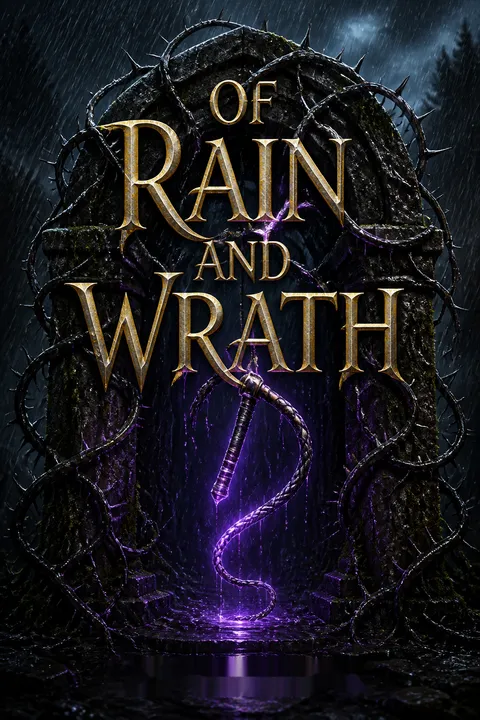


Plot Summary
The Healer's Price
Kassandra lives under Madam Herra's control, displayed in a garden tent as a paid miracle. Her red-gloved hand heals injuries, but her own body takes them first; the black-gloved hand can bring death. Because she once cured a fae with the black virus, she is mute, and each new cure leaves her to endure pain alone until her body repairs itself.
Madam Herra collects the coins while Briggs handles Kassandra like saleable property. At night, Kassandra escapes into a gray dreamscape she built herself, where she plays strategy games with Raven, a mysterious companion she believes is imaginary. The dreams give her a rare place to speak and imagine a future, but daylight returns her to the daily business of suffering for strangers.
Kassandra's power turns care into an involuntary exchange: another person's recovery is purchased with her pain, while Madam Herra converts that pain into money. Her muteness compounds the exploitation because she cannot publicly narrate what is being done to her. The dreamscape offers agency in miniature: Kassandra builds its world and makes strategic choices there, even as her waking life is managed by others. Her attachment to Raven and to books suggests that imagination is not mere escape. It is practice in wanting a life beyond the role imposed on her.
A Crack in the Wall
On the day Madam Herra and most of the guards attend worship, Kassandra slips through a gap in the garden wall after hearing an animal cry. She finds a young-looking pacon caught in a trap, frees it, and heals its torn back, taking the wound into her own body. When the creature touches her black-gloved hand and survives, Kassandra wonders whether her death magic has changed.
She names him Runt, but he follows her toward the mansion. In the forest, a huge red-haired fae appears, then turns violent when Runt attacks to protect her. Kassandra runs home alone. Madam Herra catches her, dresses her for a royal visitor, and announces that Kassandra will soon belong to someone else.
Kassandra's choice to help Runt is a small but decisive breach in the obedience Madam Herra has trained into her. She acts before she can calculate the danger, and the healing's consequence is both physical pain and an unexpected bond with the creature. Runt's survival under her death-bearing hand unsettles the identity she has been forced to accept. Yet the attempted escape does not immediately free her. Madam Herra responds by preparing a sale, showing how quickly an act of self-direction can be turned into a new form of ownership.
Sold to the Flame
The visitor is Blaze, a prince of the Fall Court, accompanied by Serena, the Spring princess engaged to marry him. Madam Herra demonstrates Kassandra's healing by having her restore Gryphon's missing arm and leg, leaving Kassandra to relive the injuries. When Blaze's own wounds do not heal at first, Briggs beats Kassandra to force a response.
As Blaze finally sees her unveiled face, they are pulled into a strange vision that declares their lives bound together. Back in the room, Blaze kills the guards and Briggs in a burst of elemental violence. Kassandra uses her black hand on Madam Herra, who crumbles before her. When Kassandra wakes, Blaze has taken her away, leaving her free of Herra but still in a stranger's custody.
The sale marks a shift in who holds power over Kassandra, not an end to the logic of possession. Blaze initially evaluates her as a useful instrument, and the failed demonstration exposes how little control she has over when her gift will work. The vision interrupts that transaction with a bond neither character understands, while the massacre makes Blaze's protection inseparable from his capacity for violence. Kassandra's killing of Madam Herra is her first deliberate use of death against an abuser, but it arrives amid chaos rather than as a clean liberation. The old cage collapses; a new dependency begins.
The Virus Behind the Courts
Far from the Fall Court, Calan, a prince of Winter, learns that his older brother Moran is dying from the black virus. Calan struggles to read other people's emotions, but fear for Moran drives him to pursue rumors of a healer called the Death Whisperer in the Spring Court. In that same court, Prince Treyton secretly oversees research on the disease.
His former acquaintance Emilia has reached its monstrous final stage, and after she bites a researcher, Treyton suspects the infection can spread through her. Desmonda Ward, his head researcher, urges him to reveal the discovery at the coming summit. Treyton hesitates, hoping to offer a cure along with the news. Both princes are moving toward Kassandra, though for sharply different reasons.
The parallel plots make the black virus more than a distant crisis: it tests what each prince believes responsibility requires. Calan's search is intimate and urgent, directed toward one brother whose illness threatens the routines that help him function. Treyton's research is political as well as personal, and his reluctance to disclose a dangerous discovery shows how easily public duty becomes entangled with control of information. Their separate motives converge on Kassandra, whose healing is already being treated as a scarce resource. The novel frames rescue as a question of who gets to decide what another person's power must serve.
A New Gilded Cage
In Blaze's carriage, Kassandra wakes in his arms and tries to escape, but he pulls her back and promises protection while still insisting she belongs with him. Serena recognizes Kassandra's Falkan, the language of the hands, and exposes how little Blaze knows about communicating with her.
Before reaching the castle, Kassandra dreams of crossing from her gray inner world into a vivid Night Court town, where a scarred guard seizes her before she wakes.
At the Spring Court castle, Runt reappears and attacks Blaze; Kassandra throws herself between them, stopping both from striking. Blaze takes her into his private quarters, where she begins using a quill to make herself understood. Her surroundings are richer than Herra's house, but her freedom remains restricted.
The castle changes Kassandra's material conditions without changing the central imbalance: Blaze can decide where she stays, and she must find ways to make her wishes legible. Falkan gives her a means of direct resistance, while the quill offers a second channel when the language fails. Her intervention between Runt and Blaze also reveals a form of courage grounded in attachment rather than combat skill. The dream's vivid Night Court and threatening guard complicate the boundary between imagination and reality. Kassandra's new life is not simply safety after abuse; it is an uncertain landscape where care and confinement coexist.
The Whip Chooses Her
Cayetana, the Spring Court's head guard, takes Kassandra to the armory with Serena. The ancient keeper, Father Barthomel, invites her to seek a weapon among blades forged with magic from all six courts. Instead of a sword, Kassandra's chosen harbara first appears as a bracelet. At her request, it becomes a black whip, the same kind of instrument once used to punish her.
Later, Kassandra meets Treyton, whose presence triggers another vision: their separate platforms join, and she senses a bond between them. That night, while Blaze sleeps, Kassandra heals his old scars and the claw wound from Runt. The cure transfers the injuries to her back. Blaze wakes, sees the blood and his restored skin, and angrily tells her not to heal him again.
The harbara gives Kassandra a weapon that answers to her, but its first form carries the history of violence she has endured. That contradiction makes empowerment psychologically complicated: the tool is hers, yet it resembles the means by which others controlled her body. The second vision extends the mysterious bond beyond Blaze, unsettling any simple romantic resolution. Kassandra's healing of Blaze is an act of care chosen privately, unlike the paid cures imposed by Herra. His anger suggests that receiving care can feel like a loss of control, especially for someone accustomed to expressing attachment through dominance rather than vulnerability.
The Night King's Nightmare
After healing Blaze, Kassandra dreams she is trapped among a king and his harem. When the king reaches for her, she touches him with her death-giving hand and kills him. His son, Draven, then accuses her of murder and threatens to torture her. Kassandra wakes in the blood from her newly acquired injuries, and Blaze discovers both that she healed him and that her back is badly hurt.
Meanwhile, the bond between them grows more complicated: Blaze begins trying to learn Falkan and offers to teach her reading and writing, while Kassandra refuses to mistake his tenderness for proof that he is good. The dream leaves her with a new fear that her power, even when used in self-defense, can make her a target.
The nightmare gives Kassandra's lethal ability a new emotional dimension. She is not merely the victim of a dangerous world; in the dream, she acts decisively against a sexual threat, then faces punishment from the dead man's heir. The sequence stages the cost of self-defense without treating it as moral equivalence: her fear is real, but so is the danger of what her power can do. Blaze's attempt to learn her language represents a practical movement toward mutual understanding. Kassandra's refusal to equate that effort with goodness protects her from confusing improved treatment with earned trust.
A Cure Freely Given
Treyton takes Kassandra through a Spring Court marketplace, where she sees that his public smile hides strain and anger. She rejects his efforts to charm her, then slips away from Cayetana to find a girl named Nimaya, whose arm bears severe burn scars.
Kassandra heals the child without accepting payment, taking the old injuries into her own body. Nimaya and her mother thank her and promise to keep her identity secret. Their gratitude gives Kassandra a kind of recognition she has never received from Herra's customers.
She returns to the marketplace rather than fleeing the court. Treyton, meanwhile, leaves with Raychel, a shopkeeper whose attention he had sought. Kassandra sees this and feels both distrust and an unfamiliar sting of disappointment.
This cure differs from Kassandra's earlier work because no handler sets the price and no crowd watches her perform. She chooses the child, accepts the pain, and receives gratitude rather than an account of what her magic is worth. The scene offers a brief experience of reciprocal human recognition, though it does not erase the risks of being discovered. Kassandra's decision not to flee also matters: attachment to Runt and the beginnings of relationships in the castle complicate escape. Treyton's departure with Raychel exposes the gap between his attentive performance and his habits, sharpening Kassandra's skepticism about the prince.
The Princes' Hidden Hunts
Treyton brings Raychel into his concealed research chambers, where Desmonda confirms the black lines beneath her skin. He releases Raychel to guards who will confine her for study, telling himself the capture may prevent the disease from spreading.
His private guilt does not stop him from making another person a specimen. Elsewhere, Aleksander, a blind assassin known as the Shadow, searches for the missing Death Whisperer on behalf of an unnamed client. He kills Neon Grayson, a fae healed by Kassandra, when Neon cannot tell him where she went.
Later, Aleksander murders a marketplace shopkeeper who knows Kassandra healed Nimaya, then takes over the man's stall so he can remain near the castle. The healer's secret is now drawing predators from several directions.
Treyton and Aleksander pursue different ends, but both treat other lives as instruments for reaching a desired result. Treyton's research is driven by a genuine fear of contagion, yet he preserves his moral self-image by describing confinement as prevention. Aleksander is more openly transactional, converting a murder into a new position from which to watch the court. Their actions make Kassandra's anonymity fragile: kindness has left witnesses, while healing itself has become a trail. The section asks whether benevolent motives can justify coercive methods, and answers by showing that good intentions do not remove the damage inflicted on the people being controlled.
Calan's Road of Blood
On the road to the summit, Day Court soldiers ambush Calan's party. Calan unleashes his elemental power and kills the attackers, then continues to the Spring Court alone, unsettled by the scale of his own violence but unwilling to abandon his mission. He wants Kassandra to save Moran. At the castle, a messenger brings news that Moran has died from the black virus soon after Calan left home.
Calan's hope turns into fury. He blames the Death Whisperer for failing to save his brother and decides to kill the healer rather than bring her back for help. His arrival also sharpens the court's danger: the Day and Night Courts have reached even the route to the summit, and none of the princes can assume their borders are secure.
Calan's violence is not presented as a simple release of anger. He kills because an ambush threatens him, then must confront the fact that his immense power can erase the boundary between defense and catastrophe. Moran's death transforms the purpose of his journey: grief narrows his thinking until the healer becomes a target rather than a possible source of hope. His difficulty identifying emotion does not mean he feels nothing; it means his loss emerges as rigid, consequential action. The attack also makes the political conflict material. War is no longer a forecast for the courts but a danger already moving along their roads.
No Wedding, No Army
As the summit debates how to resist the Day and Night Courts, Treyton proposes moving up Blaze's arranged marriage to Serena to secure an alliance. Blaze refuses, unwilling to marry Serena or hand Kassandra over to Treyton's demands, even though the Spring Court needs troops.
The two princes turn a military negotiation into a contest over Kassandra, while she is brought into the war room as Blaze's supposed pet. Serena warns that a monster is loose in the castle, but the men dismiss her.
Beneath the political argument, Treyton's secret work continues: Raychel has been confined, and the disease has advanced beyond anything the court can safely ignore. The room's leaders choose to treat Serena's warning as another eccentricity, leaving them unprepared.
The alliance debate exposes how private possession can distort public responsibility. Blaze's refusal may reflect a new commitment to Kassandra, but it also places thousands of lives behind a personal rivalry. Treyton's proposal is strategically coherent, yet the contest around Kassandra reduces her to the condition of the treaty rather than a participant in it. Serena sees the approaching threat and is dismissed because her unpredictability makes it convenient to discount her. The scene thus joins intimate coercion to political blindness: the princes argue over who may claim one woman while ignoring the evidence that their larger crisis has entered the castle.
The Cure's Cost
Raychel enters the war room transformed by the black virus and attacks a guard, killing him before turning toward Serena. Kassandra refuses Blaze's attempt to get her out and reaches the infected woman. She heals Raychel, enduring a violent transfer of the disease's effects.
Blaze and Treyton suffer alongside her, while Serena stays near her; afterward, Kassandra discovers she has lost hearing in her left ear. Raychel recognizes Kassandra as the Death Whisperer and moves toward her.
Treyton kills Raychel before she can reveal more, then turns on the remaining witnesses, including General Levethan and two other men. As guards arrive, Blaze holds Kassandra and Treyton insists her identity must stay hidden. Kassandra sees the princes as dangers as much as protectors.
The climax brings Kassandra's defining conflict into public view: she chooses to save someone even when the cost is no longer theoretical. Curing Raychel proves that the black virus can be healed, but Kassandra pays with permanent damage, and the princes are forced to experience some portion of her pain. Treyton's killings then convert rescue into concealment, protecting Kassandra's secret through the same violence that has marked the court throughout the book. The ending refuses an easy romantic refuge. Blaze's embrace may comfort her, but the surrounding blood makes clear that Kassandra's future depends on learning when to trust, when to resist, and how to wield power on her own terms.
Analysis
Of Rain and Wrath builds its fantasy conflict around a body repeatedly treated as public property. Kassandra's healing seems miraculous to those who pay for it, but the transaction hides its real cost: she absorbs each injury while Madam Herra controls the money, the crowd, and the story told about her. Her later choices matter because they alter that arrangement. Healing Nimaya is not a performance, and reaching for Raychel is not obedience. Kassandra acts from compassion, but the consequences remain hers to bear.
The princes echo different forms of power. Blaze relies on force and possession, then discovers that tenderness cannot simply be commanded. Treyton's benevolence is more polished, yet his secret cells show how readily he converts people into instruments when he believes the outcome will justify it. Calan's rigid routines and overwhelming magic make grief appear as decisive violence. Their contrasting styles do not produce a safe protector; they produce competing claims on Kassandra, each with political consequences.
The book also unsettles the familiar rescue fantasy. Blaze does remove Kassandra from Herra's control, but he initially repeats its language of ownership. Treyton offers access to the world beyond the castle while pursuing his own desire and concealments. Kassandra's growing independence therefore comes less from being chosen than from choosing: helping Runt, refusing to flee after healing Nimaya, and risking herself for Raychel. Her harbara makes that agency literal, though its whip form carries the memory of abuse.
The ending refuses to transform sacrifice into uncomplicated triumph. Kassandra cures the infected woman, loses hearing in one ear, and watches Treyton kill witnesses to protect her identity. Her gift has saved lives, but it has not made the surrounding powers trustworthy. The unresolved final question is not whether Kassandra can become useful to the courts. It is whether she can control the meaning and cost of her usefulness before others decide it for her.
Review Summary
Of Rain and Wrath received mixed reviews, with readers praising the unique premise and world-building but criticizing the slow pacing and underdeveloped characters. Many enjoyed the protagonist Kassandra's strength and disability representation but found the male love interests problematic. The book's slow-burn romance and cliffhanger ending divided opinions. Some readers appreciated the complex fantasy elements, while others felt confused by the plot. Overall, the novel shows potential for the series but left many readers uncertain about continuing.
People Also Read





Characters
Kassandra
The pain-bearing healerKassandra is a mute young fae whose healing magic transfers another person's injuries into her own body, while her other hand carries the power of death. Years of exploitation have taught her to conceal anger and expect every kindness to come with a price. She is observant, book-hungry, and more compassionate than her handlers allow her to admit. Her quietness is not passivity: she communicates through Falkan, uses humor to resist powerful men, and repeatedly chooses whom to help. Her growing sense of agency is complicated by the fact that several princes regard her as someone to claim or protect. Runt, the books she reads, and the life she imagines beyond captivity give her reasons to keep choosing for herself.
Blaze
The possessive war princeBlaze is the crown prince and military commander of the Fall Court, a physically imposing fae with a reputation for brutality. He is accustomed to making decisions through force and initially sees Kassandra chiefly as a powerful resource. His attachment to her unsettles that pattern, producing flashes of tenderness alongside jealousy, threats, and efforts to control where she goes. He wants to protect her, but often mistakes protection for authority over her choices. Kassandra's bluntness and refusal to be managed challenge him in ways his soldiers do not. His growing desire for a bond with her must contend with his existing political engagement to Serena and his own history of violence.
Treyton
The smiling Spring princeTreyton is the Spring Court prince, publicly gracious and privately burdened by guilt, ambition, and a carefully managed past. He funds shelters and schools, and wants to be seen as a better man than he once was, but his methods remain controlling when he believes a larger goal is at stake. His smile smooths over anger without erasing it. Kassandra recognizes the strain beneath his charm and refuses to become another audience for his performance. His relationship with Serena is affectionate but strained by his tendency to dismiss what she perceives. He wants Kassandra close, yet his protective language often disguises a wish to decide what happens to her.
Calan
The ordered Winter princeCalan is the younger prince of the Winter Court, precise in his routines and often uncertain how to interpret other people's emotions. He taps his fingers and organizes objects to steady the noise and panic inside his mind. His loyalty to his older brother Moran drives him to search for the rumored healer, though he struggles to express that devotion in familiar ways. Calan's elemental power is unusually formidable, and its force contrasts with his need for structure and predictable surroundings. He is neither a conventional cold-hearted prince nor an uncomplicated hero; his literalness, fear, and capacity for violence shape his choices in different directions.
Serena
The wayward Spring princessSerena is Treyton's sister and Blaze's political fiancée, a lively princess whose stories and sudden visions make others underestimate her. She moves between striking perceptiveness and apparent distraction, and the people around her do not always know when she is warning them or wandering through a private fantasy. Serena recognizes Kassandra as a person before Blaze learns how to communicate with her, and she helps bridge that gap through Falkan. Her warmth does not make her naïve. She sees the danger in the princes' possessiveness and tries to prepare Kassandra for it, even when no one else takes her seriously.
Cayetana
The fearless court guardCayetana commands the Spring Court guard and becomes Kassandra's assigned protector. Strong-willed, practical, and openly unimpressed by Blaze, she teaches Kassandra basic self-defense and takes her to the armory. Her loyalty to the court does not prevent her from challenging Treyton or bending his instructions when she believes Kassandra needs room to move. She is also Serena's longtime friend, though her protective role has strained that closeness. Cayetana's humor and confidence provide Kassandra with a model of authority that does not depend on owning or silencing another person.
Runt
Kassandra's fierce paconRunt is a small, intelligent pacon with gray and green fur, horns, and a fierce instinct to defend Kassandra. She finds him caught in a trap and heals his wounds, after which he follows her and treats her as his chosen companion. His cute appearance hides the lethal nature of his species, making his loyalty both comforting and dangerous. Runt gives Kassandra a relationship built on mutual attachment rather than payment or command.
Madam Herra
The exploitative caretakerMadam Herra presents herself as Kassandra's guardian but profits from displaying her healing gift. She controls Kassandra's clothing, movement, and access to books, and treats affection as another tool of discipline. Her polished manners toward customers conceal her willingness to keep Kassandra hungry, injured, and dependent. Her greed helps turn a miraculous ability into a public business.
Briggs
Herra's brutal guardBriggs is Madam Herra's guard and enforcer, tasked with handling Kassandra during public healings. He treats her as merchandise and uses physical force to make her comply. His coarse manner and predatory interest make him one of the clearest expressions of the danger surrounding her captivity.
Moran
Calan's ailing brotherMoran is Calan's older brother and the Winter Court heir, weakened by the black virus. He understands Calan's unusual habits and responds to him with patience, humor, and familiarity. Their closeness gives Calan a rare emotional anchor and makes the search for a healer intensely personal.
Aleksander
The blind hired killerAleksander is a blind assassin called the Shadow, skilled at tracking people through sound, movement, and other senses. He approaches murder with theatrical wit and professional detachment, following an unnamed client's orders to find the Death Whisperer. His confidence makes him dangerous, while his habit of improvising reveals a volatile streak beneath the practiced menace.
Raven
Kassandra's dream companionRaven is the shadowy figure Kassandra meets in the private dreamscape she created. His appearance changes whenever she imagines it, but his voice and presence remain familiar. Kassandra believes he is a product of her subconscious, and their games offer her companionship and a rare space to speak freely.
Desmonda Ward
Treyton's head researcherDesmonda directs Treyton's secret research into the black virus. She is sharp, unsentimental, and willing to challenge the prince, but the work steadily wears on her. Her concern for her family and her uneasy cooperation with Treyton make her a practical voice within a morally compromised project.
Father Barthomel
The ancient armorerFather Barthomel keeps the Spring Court armory and helps Kassandra discover a weapon shaped by magic from across the courts. Ancient and perceptive, he speaks of weapons as though they possess a will of their own.
Raychel
The infected shopkeeperRaychel is a marketplace shopkeeper whom Treyton meets during Kassandra's outing. Her private struggle with the black virus connects the ordinary marketplace to the prince's hidden research and the danger gathering inside the castle.
Draven
The nightmare's vengeful princeDraven appears in one of Kassandra's nightmares as the son of a king she kills in self-defense. He embodies the threat of retaliation that follows her whenever she uses her death magic.
Emilia Perri
Treyton's infected captiveEmilia is a woman Treyton once knew who has reached the black virus's final stage. Her condition and attack on a researcher deepen the court's fear of contagion and drive the secret investigation.
Plot Devices
Kassandra's healing and death magic
A cure paid in painKassandra's red-gloved hand heals by transferring an injury into her own body, while her black-gloved hand can kill through touch. Her body usually recovers after a set, but healing the black virus has lasting consequences. Madam Herra exploits the restorative power for money, while the death-giving hand makes Kassandra fear that intimacy or accidental contact could destroy someone. The magic turns every cure into a decision about who is allowed to suffer, who receives the benefit, and whether Kassandra gets to choose. It also links physical pain to the larger question of ownership, because others repeatedly try to determine how her abilities should be used.
The harbara
A weapon with its own willA harbara is a rare magical weapon forged from materials associated with the Land of Ingens and imbued with magic from all six courts. Kassandra's first appears as a bracelet, then transforms into a whip when she calls it. Its second form, the begula, is reserved for situations that demand a different kind of weapon. The harbara can protect its chosen bearer even before that person has mastered combat. Its whip form carries a painful echo of the punishment Kassandra endured, but it is now an instrument that answers to her rather than to her abusers.
The black virus
A spreading court crisisThe black virus is a lethal form of fae disease that leaves dark lines beneath the skin and can transform its victims into violent, monstrous figures. Its transmission through a bite alarms Treyton's researchers, while the lack of a reliable cure drives Calan to seek Kassandra for Moran. The disease makes political inaction dangerous, yet the court's attempt to contain it through secret imprisonment and experimentation creates further moral harm. Kassandra's ability to heal an infected victim changes what the characters believe is possible, but the cure exacts a permanent personal cost.
The fate visions
Bonds seen before understoodWhen Kassandra meets Blaze and later Treyton, she experiences visions in which strange platforms connect across open air and a disembodied voice describes their lives as bound together. The visions interrupt ordinary events and imply a connection neither prince can explain or control. They affect how Blaze claims Kassandra and how Treyton reacts to her, but they do not settle whether the bond is safety, romance, or another force limiting her choices. Their ambiguity keeps fate in tension with Kassandra's insistence that she must be able to decide her own future.
Falkan
A voice made by handsFalkan is a sign language Kassandra learned before the events of the story, giving her a way to communicate despite her lost voice. Serena understands it and helps Kassandra establish contact with Blaze, while Treyton and Cayetana can also follow her signing. Writing offers an alternate channel, but Kassandra's uneven education makes it frustrating and exposing. Falkan is therefore both a practical tool and an assertion of presence: it lets Kassandra speak in rooms where others might otherwise treat her as silent property.
The Death Whisperer Series Series


About the Author
Other books by Katie May


Download PDF
Download EPUB
.epub digital book format is ideal for reading ebooks on phones, tablets, and e-readers.








