

Plot Summary
A Road Without Rescue
Briar’s father abandons her at the foot of the mountain, leaving his hungry, exhausted daughter to climb alone to Ivy Institute, the school she has dreaded since its summons arrived. Her legs give out in the forest before she reaches the gates. Kage, a demon whose bare touch kills, watches her collapse and covers his hands before lifting her.
At the infirmary, the healer cannot sense Briar’s life, but Ziv, the scarred combat instructor, insists she is breathing and carries her onward. Kage’s urgency puzzles everyone, including himself. Briar arrives unconscious, with no luggage and little strength, while the school’s staff begin to understand that this new student is already disrupting their carefully guarded order.
The journey begins as coercion made physical: Briar is not escorted into a new life but left to reach it through hunger and pain. Her survival is habitual, not triumphant, which makes Kage’s decision to touch her a meaningful breach of his own isolation. The infirmary scene also establishes the school’s limits. Its healer cannot read Briar, while Ziv trusts the visible fact of her breathing. Her body is present, but the institutions around her cannot yet interpret it.
A Cell With Clean Sheets
When Briar wakes, Ziv questions her about the climb and learns her father left her at the mountain’s base. He notices her unsuitable clothes, brings her food, and begins replacing the things poverty has denied her. His generosity unsettles her because she expects every gift to demand payment. He places her in a reinforced dorm room meant to contain dangerous students and escorts her to Syrinx, Ivy’s headmistress.
Syrinx explains that the school has sought someone with Briar’s unusual resistance to magic and proposes testing what else she can do. Ziv volunteers to oversee her training. Briar accepts the new bed and meals warily, still measuring every kindness against the exploitation she suffered at home.
Care arrives in forms Briar cannot initially recognize as care. Food, socks, and a bed unsettle her because her upbringing has taught her that receiving anything creates a debt, often one collected through her body. Ziv’s protectiveness is genuine but also controlling, while Syrinx’s interest translates Briar’s difference into institutional value. The cell-like room captures that contradiction: Ivy shelters Briar by confining her. Safety and ownership are difficult for her to distinguish because, until now, they have so often arrived together.
Blood Starts the Bond
Ziv takes Briar to train, where her poor stamina and limited fighting skill make her easy to overpower. When he pins her in the sand and orders her to fight back, she bites his wrist. His blood overwhelms her senses, and Ziv realizes the contact has begun a mate bond. He marks her in return, warning that the connection may endanger her if he does not answer it.
Syrinx interrupts and reminds him that Briar is being prepared as Ivy’s asset. Ziv explains the Undertaking, a lethal competition among the realm’s academies, scheduled in fourteen months. Briar’s immunity to magic could give Ivy an advantage, but she has little combat training and no choice about whether the school enters her.
The bite transforms Briar’s most practiced survival response into an intimate act with consequences she cannot yet understand. She is not trained to strike strategically; she reacts because her body is pinned and danger feels immediate. The resulting bond promises connection, but it does not erase the coercion surrounding her. Syrinx’s claim and the approaching Undertaking make clear that Briar’s unusual resistance is already being treated as a resource. Her personal awakening and Ivy’s plans begin on the same day, pulling her toward intimacy and toward violence at once.
The Father Belowground
After learning what Briar endured at home, Ziv leaves Ivy to find her father, Gary, in Rale. He captures him, crushes his arms, burns the family house, and transports him to a prison below an old cemetery, where a demon will keep him alive for further punishment.
Gary’s sons Connor and Philip have helped make Briar’s home dangerous; Ziv warns Connor not to harm her again and leaves him and Odette behind. At Ivy, Kage watches over Briar while Ziv is gone. Ziv later tells Kage that Briar is also Kage’s mate. Kage accepts responsibility for protecting her, despite believing his death-dealing touch makes closeness impossible.
Ziv answers Briar’s history with force rather than conversation. His punishment of Gary offers a form of retribution, but it also reveals how readily Ziv turns protection into absolute power. Briar is not present to choose what justice should look like. Kage’s promise to guard her supplies a contrasting response: he accepts responsibility while treating his own body as a danger. Both men understand care as protection, yet neither has learned how to give Briar full control over the terms of that protection.
The Void on Trial
When a novice is found dead, drained of essence, Syrinx suspects Briar because the killing resembles the work of a rare kind of person called a void. She questions Briar through Brone, an instructor who can detect lies, but Briar calmly recounts where she spent the previous day and denies any knowledge of the death. Brone believes her.
Ziv reveals that another void, Elora, once absorbed magic and used it to kill instructors before a student stopped her. Syrinx was that student, a history that sharpens her suspicion of Briar even as she hopes to use her for Ivy’s tournament team. Briar leaves the interrogation under Ziv’s protection, but the accusation makes her a target.
The accusation turns Briar’s defining difference into evidence against her. Her immunity has protected her from magical attacks, but it also makes her difficult for Ivy’s experts to read, so Syrinx fills the gap with a precedent. Elora’s history is especially corrosive: Briar is judged not by what she has done but by what someone with a similar ability once did. Brone’s inability to use his usual lie-detection method leaves Briar’s plain account as the strongest evidence available, exposing how institutions mistake confidence in their instruments for certainty about a person.
A Bond Claimed
As Ziv explains the bond and the danger of the Undertaking, Briar tells him that her father’s attention made her bind her developing body tightly to hide it. She insists Gary never fully assaulted her, then tries to reassure Ziv that she is untouched, as if that determines her worth. Ziv cuts away the painful bindings and tells her that her body belongs to her.
He also admits Briar may be capable of absorbing and redirecting magic, as Elora once did. Briar fears being forced into the same violence and asks whether they can leave Ivy. Ziv says the school’s claim and its magical wards make escape dangerous. Briar chooses to complete their bond, and their bodies bear matching thorn marks.
The scene’s turning point is not simply romantic union. Briar has learned to describe her body through the judgments imposed on it, even treating virginity as a credential that might make her acceptable. Ziv’s answer gives her a different measure: bodily autonomy matters regardless of what has or has not happened to her. Yet their bond forms inside an institution she cannot safely leave, so emotional consent exists alongside structural constraint. Her choice is real, but it is made within a narrow field of options that the novel refuses to disguise as freedom.
Bugs Turn on Eli
Once Syrinx places Briar with the other novices and instructors, Kage stays close while the class tests her resistance. Doyle’s lightning cannot harm her, and a mimic’s copies pass through her without injury. Eli then sends swarms of insects over her, repeating an attack he once used at Briar’s home. When Briar withstands the assault, Kage kills Eli with his deadly touch.
Syrinx rebukes Kage and orders him to touch Briar, apparently testing whether his curse can affect her. He refuses. Briar tells him she is safe from the other students’ magic, but Kage remains shaken by the possibility that he could hurt her. Syrinx leaves Briar with a warning about her usefulness and the deaths around her.
Ivy’s assessment of Briar becomes a public spectacle, with instructors and novices treating her body as a surface on which to test power. Her composure does not mean the attacks are harmless: repeated magic can exhaust her and make her disappear from the world temporarily. Kage’s intervention stops Eli, but it also converts defense into another death at Ivy. Syrinx’s command that Kage touch Briar reveals the institution’s appetite for knowledge even when the experiment could be fatal. Briar’s safety depends on people willing to defy Ivy’s rules, not on the rules themselves.
The Sand Hides Fangs
Ziv’s daily combat lessons grow harsher as he tries to make Briar capable of surviving without him. During one session, she falls onto snakes hidden beneath the arena’s sand. Their venom knocks her unconscious, and Ziv keeps her alive with his own blood before killing the remaining snakes with god-fire. Kage recognizes that the nest was placed deliberately and suspects someone wanted Briar dead.
When she wakes, Briar is more concerned that her dagger may have cut Ziv than with her own injuries. Ziv destroys the evidence while clearing the arena, and the attackers remain unknown. The attempted killing changes the training from preparation for a future contest into an immediate struggle to keep her alive at Ivy.
The snake attack exposes the weakness in Ziv’s belief that strength and vigilance can guarantee Briar’s safety. He has trained her, watched her, and shared his blood, yet someone has still managed to put a lethal threat beneath her feet. Briar’s concern for the dagger and Ziv’s injury shows how quickly she has begun to care for others, but it also echoes her habit of minimizing her own danger. The destroyed weapon leaves no easy proof, shifting the conflict from a visible attacker to an unseen person embedded within Ivy.
A Dragon Takes Briar
Ivy gathers in the arena for the arrival of a powerful guest, while Ziv is absent and Kage accompanies Briar. The visitor, a goddess with emerald hair, stops time and approaches Briar alone. She tells Briar that Ziv was once her lover, then accuses the novice of taking his place.
Before Ziv can break free, the goddess seizes Briar and drags her to a window, where a black dragon with a silver belly clings to the stone. She orders the creature to carry Briar to Windsheer, declaring that the delivery will settle a debt. The dragon grips Briar and launches into the forest. Ziv and Kage remain trapped at Ivy as Briar is carried away, and the book ends before her fate at Windsheer is known.
The ending converts Ivy’s familiar coercion into a much larger claim on Briar’s life. Syrinx treats her as an asset; the goddess treats her as payment. The goddess’s former intimacy with Ziv makes Briar’s abduction personal, but her grievance does not explain or soften the act. The dragon’s arrival breaks the school’s apparent defenses and leaves Ziv unable to protect the person he has chosen. Briar’s sudden removal also suspends the growth she has begun to claim for herself. The final movement is not escape but another forced journey, this time into territory she cannot yet understand.
Analysis
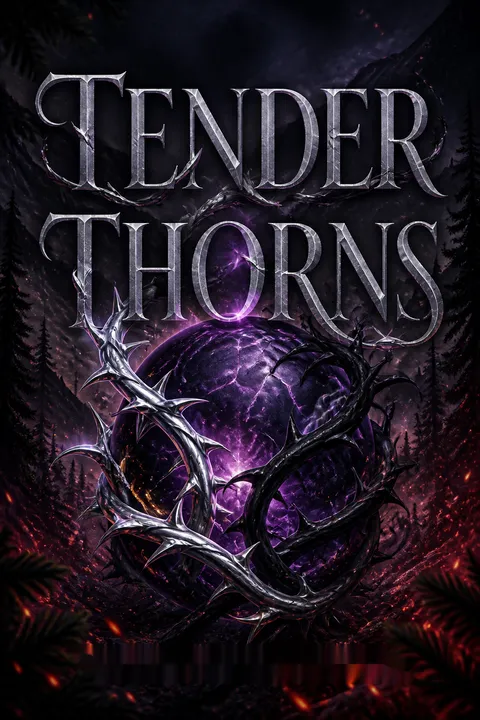
Tender Thorns places a young woman’s growth inside an institution that calls its exploitation opportunity. Briar comes to Ivy already trained by deprivation to read kindness as a possible trap. Food, clothing, and shelter therefore matter as much as combat lessons: accepting them requires her to imagine that care might not be a transaction. Ziv offers protection with frightening force, while Kage offers it through distance and restraint. Their contrasting responses expose a tension the novel does not resolve simply by pairing Briar with powerful men. Safety can still become another form of control if the protected person cannot shape its terms. Briar’s resistance to magic is both shield and social label. It lets her endure attacks that would disable others, but the school quickly converts endurance into usefulness, first for the Undertaking and then as grounds for suspicion after a student dies. The story links power to interpretation: Briar cannot be read by the usual magical instruments, so others project histories and fears onto her. Elora’s precedent makes that projection especially dangerous. Briar is treated as a possible repeat of someone else before she has the knowledge or training to define her own ability.
The romance develops alongside, rather than outside, this coercive environment. Briar’s bond with Ziv gives her an experience of being wanted and protected, and his insistence that her body belongs to her directly counters the shame her father taught her. Yet the bond’s intensity and the men’s protective decisions also risk reproducing the loss of choice that shaped her childhood. Briar’s growth lies not in becoming fearless or simply more powerful, but in beginning to speak from her own desires and recognize when others have made decisions on her behalf.
The final abduction widens the story’s scale without granting relief. Ivy is not the only institution claiming Briar; divine power can interrupt time, override the school, and turn her into payment for a debt. The novel ends by revealing that personal protection cannot yet match the forces arranging her future. Briar has begun to choose who she trusts, but she has not gained control over where she is taken.
Review Summary
Tender Thorns receives mixed reviews averaging 3.88/5 stars. Critics cite minimal worldbuilding, slow pacing, weak character development, and an abrupt cliffhanger. Many find protagonist Briar too passive and childlike, while male leads Ziv and Kage are described as controlling or underdeveloped. Several readers feel the plot lacks substance, with excessive focus on Briar's abuse history. However, fans praise the emotional depth, fated mate dynamics, and compelling premise of an academy training magical beings. Supporters appreciate the pacing and character authenticity, eagerly anticipating the sequel despite the cliffhanger ending.
People Also Read







Characters
Briar
Magic-resistant survivorBriar arrives at Ivy Institute after years of deprivation and of being treated as an object for others to test. Her resistance to magic has kept her alive, but it has not made her invulnerable to hunger, exhaustion, or physical harm. Cautious, observant, and quick to read danger, she has learned to placate powerful people before they can hurt her. She struggles to accept food, clothing, and affection without imagining the debt they will create. Her desire for safety sits beside a stubborn will to survive, and her dry humor sometimes surfaces when fear loosens its grip. Briar’s central challenge is learning to distinguish chosen intimacy from the control she has always been taught to expect.
Ziv
Fallen combat godZiv is Ivy’s formidable combat instructor, a fallen god whose great physical and magical power is matched by a habit of emotional restraint. He has spent years treating the school’s conflicts as a way to pass the time, and Briar’s arrival disrupts that detachment. His instinct is to provide safety through control: he feeds her, obtains necessities, trains her, and watches for threats. His bluntness can frighten the person he means to protect, and his readiness to punish enemies makes his tenderness difficult to separate from his violence. Beneath his authority lies a newly awakened capacity for attachment, though he must learn that protection does not automatically grant him the right to decide everything for Briar.
Kage
The death-touch demonKage is a blue-skinned demon novice who can kill through touch and can move through shadows. His curse has made ordinary closeness dangerous, leaving him watchful, isolated, and accustomed to other people’s fear. At first he keeps his concern for Briar hidden, observing her from a distance rather than risking contact. He is fiercely protective, but his restraint is not indifference; it is an attempt to keep his own power from harming someone he values. Kage’s sharp awareness and capacity for violence make him a formidable presence at Ivy, while his uncertainty about intimacy gives him a vulnerability he rarely exposes.
Syrinx
Power-hoarding headmistressSyrinx is Ivy Institute’s headmistress, a banshee who reads people keenly and uses that knowledge to maintain authority. She wants the school to win the Undertaking during her tenure and views Briar’s unusual ability as a possible advantage. Her polished manner rarely hides the calculation beneath it. Syrinx is not simply a distant administrator: her past experience with a dangerous void shapes how she judges Briar, making caution and self-interest difficult to untangle. She represents Ivy’s institutional logic, in which individual students matter most when their abilities can serve the school.
Gary
Briar’s exploitative fatherGary raised Briar in poverty while treating her resistance to magic as something he could profit from. He allowed others to test their abilities against her and controlled her through deprivation, fear, and the threat of worse treatment. His pride in her unusual endurance never becomes genuine care; he values what she can provide. His influence remains present even after Briar leaves home, because she has internalized the belief that every kindness carries a cost and that powerful people will eventually claim her.
Brone
The lie-reading instructorBrone is a pale, reaper-like instructor with a mental ability that lets him detect deception. Syrinx uses him to question Briar after a novice is found dead. He approaches the interrogation as an assessment rather than an open accusation, and he is perceptive enough to recognize that his usual talent cannot settle the matter. Brone’s encounter with Briar exposes the difference between a useful investigative tool and genuine knowledge of another person.
Mistress Myers
A wary Ivy instructorMistress Myers is an instructor who reacts to Kage with visible apprehension and reports Briar’s arrival to Syrinx. Her behavior reflects the fear his deadly ability provokes in the people around him. She is also mindful of her own position at Ivy, where staff members are watched and judged by the headmistress. Her caution makes her an early measure of how thoroughly Kage’s curse has isolated him.
Link
Myers’s protective mateLink is Mistress Myers’s mate and an instructor at Ivy. When Myers calls for him, he responds quickly, showing the instinctive loyalty that shapes their relationship. His brief presence helps reveal the staff’s fear of Kage and the close personal bonds that exist alongside Ivy’s formal hierarchy.
Connor
Briar’s guarded brotherConnor is one of Briar’s brothers and a son of Gary. Unlike the family members who made Briar’s home unsafe, he claims not to have harmed her. He is protective of Odette and careful around strangers, especially those with enough power to threaten his family. His limited knowledge of Gary’s dealings makes him a useful but uncertain witness to Briar’s past.
Odette
Connor’s quiet companionOdette, whom Connor also calls Odie, is a young girl who stays with him near the Blissa household. She is withdrawn and speaks little, relying on Connor to shield her when Ziv arrives. Her presence gives the family’s poverty a human face beyond Briar’s memories.
Philip
Briar’s favored brotherPhilip is Gary’s older son and the favored brother in Briar’s family. Briar remembers him as one of the people who made her home threatening, while Gary’s preference for him reinforces the unequal and abusive household Briar escaped.
Mistress Corin
Nature-magic instructorMistress Corin teaches nature-based magic and is found in a restricted area of Ivy. She treats Briar’s presence there with suspicion, illustrating how quickly unfamiliar students can be regarded as intruders in a school organized around secrecy and rank.
Instructor Arnold
The class evaluatorArnold oversees the class that tests Briar’s resistance to other novices’ abilities. He encourages demonstrations and allows the exercises to escalate, showing how Ivy’s instructors can treat danger as acceptable when it serves assessment. His authority in the classroom is challenged by students whose powers cannot be safely contained.
Eli
The insect-wielding noviceEli is a novice whose ability lets him command swarms of insects. He has tested Briar before and again uses his power against her in class. His confidence in the spectacle his insects create makes him an example of how easily Ivy’s competitive culture can turn a test into a threat.
Doyle
The lightning-wielding noviceDoyle is a novice who attacks Briar with lightning during her class assessment. He is grieving Syn, a fellow student, and his anger makes him less interested in Briar’s explanation than in testing whether she can survive his power.
Syn
The dead noviceSyn is a student whose death prompts Syrinx’s investigation of Briar. Her relationships with other novices, including Doyle, make the discovery personal for the students and intensify their suspicion of the new arrival.
Elora
The feared former voidElora is a previous student with an ability resembling Briar’s. Stories about her power and the danger she posed shape Ivy’s response to Briar before the new student has established what she herself can do. Her history is a warning that others repeatedly use to interpret Briar.
The emerald-haired goddess
Ziv’s powerful former loverThe goddess who visits Ivy is strikingly beautiful and commands enough power to halt time. She speaks of a past relationship with Ziv and treats personal history as a reason to assert control over the people around him. Her appearance brings divine politics directly into Briar’s life, beyond the school’s familiar rivalries and rules.
The black dragon
The goddess’s debt-bearerThe enormous black dragon has a silver belly and clings to Ivy’s stone walls with talons strong enough to break them. It is part of the goddess’s bargain and carries out her command without explanation. Its arrival makes the school’s defenses feel suddenly small.
Plot Devices
Void resistance
Magic cannot reach BriarBriar’s ability prevents magic from affecting her in its ordinary way, allowing her to withstand lightning, illusions, and attacks formed from insects. The resistance does not make her physically invulnerable: hunger, exhaustion, weapons, and venom can still harm her. Too much magic directed at her can also make her disappear into a ghostlike state, leaving her unable to act until she returns. Ivy sees the ability as a tactical advantage for the Undertaking, while Briar initially regards it as the reason people have used her as a test subject. The possibility that she could eventually absorb and redirect magic adds uncertainty to a power she has never been taught to control.
The Undertaking
A deadly academy contestThe Undertaking is a competition held every five years among the realm’s academies. It is deadly, and Ivy’s students are trained as potential contestants. The next contest is fourteen months away, giving Syrinx a reason to recruit and assess Briar despite the risks to her. The games are also a source of prestige and entertainment for the gods, while Ivy’s leadership treats victory as proof of its strength. This device turns the school’s ordinary lessons into preparation for a larger violence Briar never chose to enter.
Mate bonds
Desire binds lives togetherMate bonds draw people together through an intense physical and emotional pull, and the bond can be strengthened through reciprocal marking. Briar’s bite of Ziv begins their connection before she understands what it means, while Ziv’s dangerous touch makes Kage’s relationship to her more complicated. For Briar, the bonds offer affection and a new sense of belonging, but their intensity can also blur the boundary between instinct and deliberate choice. Their role in the story raises a central question: how can a powerful, almost fated attachment become safe when Briar has spent her life without control over who claims her?
Ivy’s wards
The mountain becomes a cageIvy is protected by magical wards and reinforced rooms designed to contain students considered dangerous. The protections are meant to keep threats out, but they also make leaving difficult: crossing the school’s boundary alerts the powers that recognize its claim over students. Briar’s assigned room resembles a containment cell, and Ziv adds his own protective runes when he needs privacy. These barriers offer real shelter from some dangers while making clear that Briar is not free to come and go. The school’s architecture turns the conflict between protection and confinement into a physical feature of the setting.
The prior void
A precedent fuels suspicionIvy’s memories of Elora, a previous void, shape the way Syrinx and others interpret Briar. Elora was said to have absorbed magic and turned it against its users, then killed instructors and threatened another institution before a student stopped her. When a novice is found drained of essence, the resemblance to the old case makes Briar an immediate suspect despite the lack of evidence. This history functions as both warning and distortion: it establishes that Briar’s power may be more extensive than she knows, while encouraging Ivy to judge her by another person’s actions.
About the Author
Other books by Albany Walker


Download PDF
Download EPUB
.epub digital book format is ideal for reading ebooks on phones, tablets, and e-readers.








