


Plot Summary
Temple Under Siege
At Gaia’s temple, Night Prince Draven leads an assault while Winter Prince Calan searches the chaos for Kassandra, his newly recognized mate. She has vanished, and Draven claims her as his wife, forcing Calan to hide his jealousy while helping search. The attack follows dreams that lured Kassandra and Calan to the temple, a trap Draven arranged.
In Spring, Prince Treyton responds to Kassandra’s disappearance by torturing a Winter dignitary, convinced Calan has taken her. His guard Cayetana warns that the prisoner may know nothing, but Treyton’s fear and guilt overwhelm his restraint. The temple falls, Kassandra is carried away by an unknown captor, and the princes’ competing searches begin.
The temple attack turns Kassandra’s absence into the engine of several characters’ choices. Calan’s disciplined detachment fractures into possessiveness, while Treyton’s impulse to protect her becomes indistinguishable from retaliation. Their responses are not simply romantic rivalry: both men reach for control when they cannot reach Kassandra herself. The sacred location offers no protection from political violence, establishing that the coming crisis will exploit even the world’s supposed neutral ground.
San Was Aleksander
Kassandra discovers that the companion who called himself San is Aleksander, an elf sent by the Amorite king to bring her to the elven castle. He had pretended to be blind, hiding his true appearance and his ability to see. Before Aleksander can explain much, the priest Patric, who helped Kassandra escape the temple, rises infected by the black virus and attacks them with unnatural strength.
His voice carries a warning that the world will burn. Aleksander kills Patric, but not before the priest brands Kassandra’s arm with a raised red mark. Aleksander recognizes it as the Mark of Chaos, an ancient sign whose meaning frightens even him.
Aleksander’s deception repeats the pattern Kassandra knows too well: people approach her under false pretenses because they want access to her. Yet his protectiveness complicates her judgment, making trust feel less like a virtue than a risk she must calculate. Patric’s transformation adds a second uncertainty. The familiar disease has become something uncanny, and the mark turns Kassandra’s body into evidence of a threat she cannot yet understand.
Faye Springs the Trap
Rather than follow Aleksander to Amorite, Kassandra pretends to comply until they reach the Summer Court’s hidden settlement. She signals Faye, a survivor who leads the local fae, and Faye’s people capture the elf. In the village, Aleksander explains that the black virus began as an instrument created by Chaos, one of the ancient deities who shaped the world with Order.
He believes Kassandra’s mark signals a new, more dangerous infection and insists that only a shaman called the Bone King can remove it. Before they can decide what to do, Blaze arrives with Runt, Kassandra’s pacon companion, and attacks the settlement, believing its people are holding her prisoner. The reunion ends the standoff, but leaves the village shaken.
Kassandra’s small act of deception matters because it reverses her usual position as the person being moved between powers. She does not overpower Aleksander; she reads the social landscape and recruits an ally. Faye’s settlement offers safety built by survivors rather than rulers, but Blaze’s rescue shows how easily protection becomes violence when nobody asks Kassandra what she wants. The emerging mythology links private bodily danger to a world-scale imbalance.
A Prisoner in Dreams
After finding comfort in Blaze’s arms, Kassandra dreams of a meadow where a woman warns that the mark allows someone to track her. In another Night Court visit, Kassandra follows an unexplained pull into the dungeons and finds a battered fae who resembles Draven but seems gentler. He knows her name before she can explain herself, then collapses before answering her questions.
Calan’s search also ends in captivity: after Draven takes him to the Summer castle, Calan investigates a locked room and sees mirror-like openings connected to distant kingdoms. Draven knocks him unconscious and imprisons him. The strange dream-prisoner and Calan’s disappearance leave Kassandra surrounded by clues whose connections remain hidden.
Dreams function here as more than escape or romance. They put Kassandra in contact with knowledge that her waking companions do not possess, while leaving her unable to distinguish warning from manipulation. The captive who resembles Draven makes identity itself unstable. Calan’s discovery of the portals offers a concrete explanation for the attackers’ speed, but imprisonment prevents him from sharing it. Information exists, yet every route toward it is controlled by someone else.
Three Princes Converge
Blaze reaches Kassandra first, and she tells him about the temple, Aleksander, Patric, and the mark. Treyton then arrives after riding through enemy territory to find her. He admits he wants to become her friend, not simply claim her, and offers to help reach the Bone King. Kassandra agrees to travel with Blaze, Treyton, and Aleksander through the Forest of the Damned, the quickest route to the Fall Court and Amorite.
Cayetana catches up with them but stays behind when Treyton orders her to return and protect Serena. Before leaving, she gives Kassandra combat drills and presses Blaze to take responsibility for her safety. Kassandra sets out with three dangerous allies and no guarantee that the mark can be removed.
The journey begins with an uneasy shift from rescue to cooperation. Treyton’s attempt at friendship gives Kassandra a choice he did not offer before, though his royal authority still shadows the offer. Cayetana’s departure underscores the cost of the mission: protection must be delegated, not assumed. The three males all treat Kassandra as central to their lives, but she has not yet agreed that their devotion grants them a place in hers.
The Day Prince's Mask
On the road, Kassandra’s dreams become increasingly physical. The fae she mistook for Draven visits her, and she eventually realizes he is not the Night Prince. He identifies himself as Sylvan, heir to the Day Court, and confirms that the battered prisoner is the real Draven, whom he has confined while using a magical cuff to borrow his powers.
Calan is imprisoned beside him. Sylvan says he seized the Summer Court after its rulers were infected by Chaos, though he offers no proof that his actions were necessary. He also claims that Kassandra is his mate. The revelation links her dreams, the temple attack, and Calan’s capture to a single political deception, while leaving Sylvan’s account suspect.
Sylvan’s confession recasts the apparent villain of Kassandra’s dreams as a stolen identity. That shift does not make him trustworthy; it makes the problem harder to solve, since charm and captivity now belong to the same person. His explanation also turns the war into a contest over who may define infection, danger, and legitimate rule. Kassandra receives facts, but the source has an obvious interest in shaping what those facts mean.
The Forest Takes Treyton
The Forest of the Damned first unsettles the travelers with unnatural quiet, then releases a pack of wraiths. Kassandra fights beside the princes with her transforming harbara, a magical bracelet that becomes a whip or dagger, while Blaze, Treyton, and Aleksander cut through the attackers. When the battle ends, Treyton has disappeared.
Kassandra follows his footprints until she encounters a false version of him, whose face changes into that of a many-eyed megart before the creature knocks her unconscious. The others find no sign of a normal struggle. Runt tracks Treyton’s trail onward, drawing Kassandra, Blaze, and Aleksander into a clearing thick with webs, bones, and the remains of earlier victims.
The forest attacks perception as much as the body. Its mimicry exploits Kassandra’s attachment to Treyton, making recognition itself dangerous. Her combat ability complicates the protective roles the princes try to impose, but it cannot protect her from a landscape that manufactures false evidence. The harbara gives her a means to act; the forest makes clear that action alone cannot guarantee reliable knowledge.
Mitchia's Webbed House
In the webbed clearing, a spider-like creature named Mitchia has trapped Blaze, Treyton, and Aleksander. She tells Kassandra that the princes are her mates and attacks Treyton, whom she calls a bad male.
Kassandra changes her harbara into a dagger, stabs Mitchia’s eye, and prepares to use her bare healing hand. Instead, Mitchia suddenly turns on herself and dies, apparently compelled by the Mark of Chaos.
Once the men recover, Aleksander confirms they are all Kassandra’s mates; Treyton then admits he helped weaponize the black virus for a war, though his father released it despite his later change of heart. Blaze reveals that he is immortal. Kassandra learns that love, guilt, and danger have been concealed from her by the men closest to her.
The rescue binds revelation to violence. Kassandra saves the men through her own judgment, yet Mitchia’s self-destruction suggests the mark can act through another person’s mind. The mates’ confession brings emotional intimacy into conflict with informed consent: they have made claims on Kassandra while withholding facts that could change her choices. Treyton’s guilt is real, but sincerity cannot erase the people harmed by his political experiment.
A Noose in the Trees
After Kassandra rejects Treyton over his role in the virus, the forest’s music draws him away from camp. Voices echo his guilt and convince him that Kassandra would be better off without him. He places a noose around his neck, but Blaze finds him hanging and cuts him down.
Blaze revives him, then agrees not to tell Kassandra until Treyton is ready, respecting that the attempt is his story to disclose. The next day, the group reaches the Fall Court. Kassandra does not know what happened, but the episode exposes the forest as a force that can turn remorse into lethal compulsion. The travelers leave its trees alive, though not untouched by what they have seen.
Treyton’s attempt is not framed as a simple consequence of rejection. The forest amplifies the guilt he already carries until self-punishment looks like moral repair. Blaze’s rescue forces him to recognize Treyton as more than the architect of a public catastrophe, without granting forgiveness on Kassandra’s behalf. His silence is a fragile act of respect, but it also creates another secret between her and the men around her.
Blaze's Castle Opens
At the Fall Court, Blaze introduces Kassandra to his father, King Darius, who welcomes her warmly despite the presence of Spring Prince Treyton and Aleksander. Blaze orders his guards to treat the visitors as guests, not prisoners, and allows Kassandra freedom within his rooms. A young attendant, Bailey, helps her dress and learns Falkan, the language of Kassandra’s hands, because Blaze had required his staff to study it.
Kassandra later visits Treyton. She apologizes for slapping him but makes clear that she cannot yet forgive his role in the virus. Their fragile conversation acknowledges both his remorse and her injury. When Kassandra’s mark begins to burn, the castle starts shaking around them.
The Fall Court briefly offers Kassandra something she has rarely received: hospitality that does not depend on her powers. Darius’s acceptance and Bailey’s effort to learn Falkan translate welcome into concrete behavior. The private meeting with Treyton is similarly careful; apology does not collapse into absolution. This modest possibility of chosen connection is interrupted by the mark, which turns the body into a force no household’s courtesy can contain.
Gaia Names Her Brother
As the mark flares, Kassandra’s pain carries her onto the divided landscape of the seasonal platform. Gaia appears and explains that she and Thanatos created two children from their magic, one girl and one boy.
Kassandra is their daughter, but her twin brother has been corrupted by Chaos and placed the mark on her to make her a vessel for the sleeping deity. Gaia fears that the intended savior may become a weapon instead. Kassandra wakes amid the destruction of Blaze’s castle.
Treyton carries her through collapsing corridors, Aleksander helps clear their escape, and Bailey lies dead beneath fallen stone. Darius and the guards are missing. Outside, the others find Runt alive under rubble, but he begins transforming into a familiar-looking fae male.
The revelation recasts Kassandra’s lifelong difference as cosmic inheritance, but it does not make her identity simpler. Gaia names a family connection while warning that kinship has become a threat. The castle’s destruction immediately grounds divine history in human cost: Bailey’s death cannot be absorbed into abstract destiny. Runt’s transformation leaves another intimate bond unresolved, suggesting that the mark’s activation has altered more than Kassandra alone.
The Prisoners Break Free
While Kassandra’s companions struggle through the ruined Fall castle, the real Draven studies the power-draining cuff that Sylvan placed on him. He finds a crack, works it wider, and breaks the device, recovering his dreamwalking magic. Draven frees Calan by destroying the Winter Prince’s cuff as well.
Calan wastes no time on gratitude; the two princes agree that Sylvan must be confronted. The book closes with Kassandra unconscious after the mark’s eruption, her twin brother still unidentified, Runt newly transformed, and the Fall Court’s fate uncertain. Meanwhile, two former prisoners are finally able to act against the Day Prince who stole Draven’s identity, powers, and freedom.
The ending creates motion rather than closure. Draven’s escape restores agency to a character whose power has been appropriated, while Calan’s release reconnects the separated political thread to Kassandra’s crisis. Yet no central danger is resolved: the mark remains, Chaos has not awakened openly, and the castle has fallen. The cliffhanger’s force comes from parallel emergencies, each demanding action before anyone knows the full cost.
Analysis
The novel’s central tension is between being cared for and being possessed. Kassandra has spent her life treated as a resource, and the princes’ intense attachment does not automatically free her from that pattern. Their protection can be tender, but it is also expressed through surveillance, violence, secrecy, and assumptions about what she should accept. Her strongest acts of agency are often small and tactical: signaling Faye, refusing to forgive Treyton on demand, insisting on answers, and choosing when to continue the journey.
The story also refuses to make guilt equivalent to repair. Treyton’s remorse is sincere, but the black virus has harmed people beyond any private apology. Kassandra’s response recognizes both the truth of his regret and the irreversibility of the damage. Blaze faces a related reckoning as his violent instincts begin to trouble him once Kassandra makes other lives matter. The men are not transformed by declaring devotion; they are tested by whether they can accept limits and responsibility.
Fantasy here turns political abstraction into bodily consequence. The virus, the mark, and the power-draining cuffs all make control visible on flesh. Even the forest’s enchantments operate through intimate vulnerabilities, using grief and shame as weapons. Kassandra’s silence heightens the importance of listening: those around her must learn to attend to her hands rather than substitute their own interpretations. The gods’ revelation expands her crisis without resolving it. She may be the product of divine magic, but her choices remain the story’s most immediate measure of personhood. The ending withholds victory because the conflict has moved from courtly war into family, identity, and the uncertain boundary between saving the world and becoming a weapon.
Review Summary
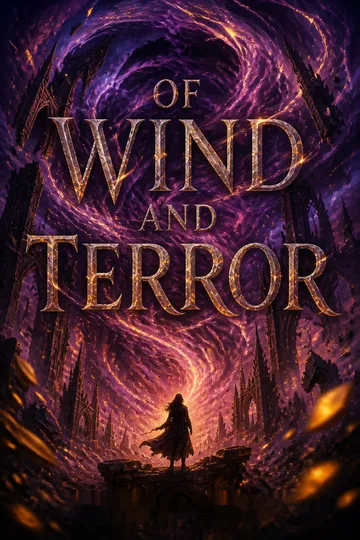
Of Wind and Terror receives mostly positive reviews, with an average rating of 4.35/5. Readers praise the captivating plot, character development, and world-building. Many enjoy the slow-burn romance and the unique personalities of the male characters. Some criticize the repetitive writing and slow pacing. The book ends on a cliffhanger that leaves readers eager for the next installment. Several reviewers mention the complexity of the story and the unexpected twists. Some readers express frustration with certain character decisions and unresolved plot points.
People Also Read


Characters
Kassandra
The mute Death WhispererKassandra is a young fae whose hands carry opposing powers: one can heal by taking another’s affliction into her own body, while the other can kill. Healing has cost her both her voice and some of her hearing, so she communicates through Falkan, a language of hand signs. Years of being treated as a useful possession have made her wary, but not unfeeling. She notices others’ pain and often chooses to act before fear can stop her. Her central struggle is learning to distinguish care from ownership, especially when powerful men claim to protect her without giving her the whole truth.
Blaze
The possessive Fall PrinceBlaze is a formidable warrior and prince of the Fall Court, accustomed to solving danger with speed and force. His possessiveness toward Kassandra grows from genuine attachment, but his instinct to dominate can make protection feel like another kind of confinement. He has spent a long life hiding vulnerability behind violence and confidence. Kassandra’s presence challenges that defense, making him confront what his past actions have cost and what it would mean to love someone without deciding for her. His tenderness appears in practical gestures as often as in grand declarations.
Treyton
The guilty Spring PrinceTreyton rules the Spring Court with charm, political fluency, and a buried history of harm. He wants to become better, but his desire for redemption is complicated by the consequences of choices made when he was young and privileged. Under stress, his protective instincts can turn brutal, and he often mistakes remorse for a path toward repair. Kassandra unsettles his polished persona because he wants her respect more than the public’s admiration. His connection with Serena and his troubled relationship to leadership reveal a prince still trying to decide what responsibility requires.
Calan
The guarded Winter PrinceCalan is the Winter Prince, a reserved and analytical fae who tries to keep emotion at a manageable distance. His grief for his brother Moran has sharpened his suspicion and shaped his pursuit of the Death Whisperer. He prefers facts, routines, and controlled surroundings because feelings make him feel exposed to manipulation. Kassandra disrupts that carefully maintained order. Beneath his icy manners is a man capable of loyalty, but he struggles to accept how much attachment can make him vulnerable.
Aleksander
The elven royal hunterAleksander is an elf and Amorite’s hunter, trained to kill and sent to retrieve Kassandra. His disguise as San, a blind and genial fae, lets him earn her confidence before revealing his mission. He is playful, sexually provocative, and casually dangerous, often using humor to control a tense room. His devotion to Kassandra complicates his professional obedience, but it does not erase the deception that began their relationship. He understands magic differently from fae and carries crucial knowledge about the old conflict between Chaos and Order.
Draven
The Night Court princeDraven is the Night Prince, a scarred ruler with silver eyes, a taste for intimidation, and a disarming streak of humor. He can enter dreams, making the border between private thought and political influence unusually thin. His charm often sits beside menace rather than replacing it. Draven is intensely drawn to Kassandra and speaks about attachment in possessive terms, leaving her to judge whether his attention offers safety or danger. His history with Sylvan and the Day Court ties personal intimacy to the wider conflict.
Sylvan
The ambitious Day PrinceSylvan is heir to the Day Court, intelligent, politically decisive, and willing to use extraordinary means to reshape the balance of power. He presents himself as acting against a threat that others cannot see, but his confidence in his own judgment makes him difficult to trust. His resemblance and connection to Draven blur the distinction between alliance and rivalry. Sylvan’s interest in Kassandra links his ambitions to her unusual power and to the ancient force he believes is returning.
Faye
The Summer survivorFaye leads a small settlement of Summer Court survivors after the kingdom’s destruction. Practical and quick to act, she recognizes Kassandra as a person as well as a symbol of hope. She helps capture Aleksander when Kassandra signals for aid, then encourages him to explain what he knows. Her losses give her a guarded view of powerful outsiders, but she offers Kassandra genuine friendship and a place to return to.
Cayetana
The loyal royal guardCayetana is Treyton’s head guard, a disciplined soldier whose loyalty does not prevent her from challenging her prince. She reads danger clearly and refuses to flatter authority when Kassandra’s safety is at stake. Her practical training gives Kassandra tools for the journey ahead. Cayetana also protects Serena, balancing her duties to the royal family with her personal concern for the people caught in its decisions.
Runt
Kassandra's fierce paconRunt is a small, horned pacon Kassandra once healed and who has since attached himself to her. He is clever, territorial, and far more capable than his size suggests, often sensing danger before the others do. His loyalty to Kassandra is uncomplicated, which makes him a rare source of companionship in a world of shifting motives. He frequently clashes with Blaze, whose jealousy extends even to the creature’s affection.
Mikage
Draven's steadfast secondMikage is Draven’s closest friend and right-hand companion. He is quieter and more measured than the Night Prince, often observing the consequences of Draven’s impulses without pretending to control him. His loyalty binds him to the Night Court’s dangerous politics, yet moments of hesitation suggest that service and conscience do not always point in the same direction.
Serena
Treyton's troubled sisterSerena is Treyton’s younger sister and Blaze’s former fiancée. She struggles to keep a stable hold on reality and compulsively invents stories, which complicates her relationships with the people trying to protect her. Treyton remembers their earlier closeness and worries about how much they have changed. Her vulnerability makes her more than a courtly complication, while her place in the royal family keeps her near the conflict.
Darius
Blaze's blunt fatherDarius is the king of the Fall Court and Blaze’s father. He meets strangers with suspicion but uses warmth and teasing once he decides they belong under his roof. His easy manner conceals a ruler’s awareness of political risk. He recognizes Blaze’s attachment to Kassandra and treats her as family, offering a glimpse of the domestic support Blaze rarely shows in public.
Bailey
Kassandra's eager attendantBailey is a young attendant assigned to Kassandra at the Fall Court. Talkative, excitable, and prone to saying more than she intends, she tries to make Kassandra feel welcome. She has learned Falkan because Blaze asked his household staff to communicate with Kassandra. Her enthusiasm brings ordinary kindness into a story crowded with political schemes and supernatural danger.
Gaia
The life-giving goddessGaia is the goddess associated with life and the fae world. She appears to Kassandra in dreams and offers information that even powerful princes do not possess. Her concern is not detached or serene; she speaks with the fear of someone who helped create a crisis she cannot simply undo. Her guidance gives Kassandra context, but not an easy solution.
Patric
The temple's old priestPatric is an elderly priest at Gaia’s temple who tries to help Kassandra escape during the attack. His kindness makes what happens to him especially unsettling. Through Patric, the story shows how the black virus can turn a familiar and trusted person into a vessel for something alien.
Plot Devices
The Death Whisperer's gifts
Healing has a priceKassandra’s two hands carry opposing powers. One transfers another fae’s illness or injury into her own body; the other can kill. Her gloves protect people from accidental contact, while her harbara bracelet can shift into a whip or dagger for defense. These abilities make her valuable to courts and rulers, but every use risks another cost to her body. The distinction between healing and harm becomes less secure as the story’s threats evolve.
The Mark of Chaos
A brand with agencyPatric leaves a raised mark on Kassandra’s arm after the temple attack. Aleksander connects it to Chaos’s ancient followers and warns that Kassandra may be absorbing power once distributed through an army. The mark can be tracked and appears to influence events around her, making it both a physical threat and a sign that the old divine conflict is resurfacing. Its nature remains unresolved at the book’s end.
Dreamwalking and soul platforms
Dreams carry real consequencesKassandra’s sleeping consciousness reaches the Night Court, where she encounters Draven, Sylvan, and a prisoner who resembles the Night Prince. These visits supply clues but also let powerful characters approach her beyond ordinary borders. Separate visions place her and the princes on platforms connected by a bridge, a symbolic image of their possible bonds. The dream world therefore works as both an information channel and a site where desire, deception, and danger overlap.
The Forest of the Damned
Landscape attacks perceptionThe forest is a dangerous passage between the Summer and Fall Courts, inhabited by wraiths, megarts, and other creatures. Its magic can create false images, summon music and voices, and turn guilt into destructive compulsion. The travelers choose it because the longer route threatens to delay their search for the Bone King. Its dangers test both their fighting skills and their ability to distinguish external enchantment from their own fears.
Power-draining cuffs
Magic becomes capturableSylvan uses enchanted cuffs to suppress and borrow the powers of Draven and Calan. Their existence turns magical ability into something that can be stolen, stored, and politically exploited. The cuffs help explain how Sylvan can use Night Court magic and keep powerful princes imprisoned. A crack in Draven’s cuff eventually gives him a way to escape, making the device both the mechanism of captivity and the opening through which the prisoners regain agency.
The Death Whisperer Series Series

About the Author
Other books by Katie May

Download PDF
Download EPUB
.epub digital book format is ideal for reading ebooks on phones, tablets, and e-readers.








