


Plot Summary
London Under Monster Rule
Joan, a half-monster, flees with Nick, her human beloved, and monster allies Aaron, Ruth, and Jamie through a London remade by her sister Eleanor. Nick had chosen Joan over the world when Eleanor forced him to choose, and now humans pay for that decision under monster rule.
Old London Bridge is the only crossing into territory the group hopes belongs to Jamie's family, but guards patrol its queues and human prisoners crouch in polished cages. The five slip past a checkpoint while guards beat another fugitive. Across the river, they find Argent family emblems where Liu territory should be. Their escape has brought them into a city whose geography, laws, and alliances no longer make sense.
The first crossing turns a private choice into a public condition. Nick saved Joan, but the visible cost is not abstract guilt: it is a new regime, caged people, and a city built to make human vulnerability ordinary. Joan's instinct to help the prisoners collides with the need to survive, so the group begins the story divided between rescue and strategy. Their arrival in unfamiliar territory also removes the comfort of inherited knowledge. Even the map of London has become unreliable.
The Inn's Wanted Wall
With curfew approaching, the group takes shelter at the Serpentine Inn, where humans work in white uniforms and monster travel tokens buy rooms. A royal notice confines humans indoors after sunset, while a wanted poster identifies Joan as a traitor. In a borrowed apartment, Jamie reads the law: humans owe their territory's monster family decades of life or labor, and numbered pendants record both lifespan and debt.
Joan suffers a dangerous fade-out while searching the bedroom, then hears her dead grandmother warn her to seek help marked with a wolf. The next evening, the receptionist, Ronan, slips her a note bearing that mark. Joan recognizes the clue, but before she can meet him, guards arrest him in the market.
The inn makes the new order intimate: exploitation is not only state violence but a room key purchased with another person's years. Joan's fade-out gives that system a bodily echo, because her own stability depends on remaining anchored in the present. The wolf mark offers a fragile alternative to official authority, but the arrest immediately complicates trust. Joan has only a sign and a warning, not enough context to know whether help is real or safe.
A Wolf Marked Message
Joan's group follows the convoy carrying Ronan to the Oliver estate, hoping to reach him before the family's head interrogates him. They hide in the garden and watch Lucien Oliver seize Ronan's remaining life with a touch, killing the receptionist without questioning him. A tear opens in the air as Joan's power reacts to the horror.
Through it, her grandmother appears in another garden and repeats the warning about wolf-marked allies, but cannot hear Joan's questions before the window closes. Searchers force the group to flee. At the estate gate, guards mistake Aaron for the powerful head of the Oliver family, giving him a chance to impersonate his counterpart and lead Joan and Nick inside.
Ronan's death overturns the group's first interpretation of the wolf symbol. A sign of resistance can also be used as bait, and the group learns that evidence of help does not guarantee benevolent intent. The tear and the brief view of Gran introduce a second danger: Joan's power responds to emotional rupture, but she cannot yet control it. Aaron's accidental access to the estate changes the immediate problem from escape to impersonation, placing his inherited familiarity with monster society at the center of the plan.
Aaron Takes the Estate
Aaron discovers that his counterpart is not merely wealthy but the new Oliver family head, with servants, a private wing, and control over the estate. He imitates that man's cold authority well enough to keep Geoffrey, the valet, from questioning his arrival. During a call, Queen Eleanor praises Aaron for crushing the wolves and expects him to oversee executions.
A recording hidden beside a wanted notice then shows the counterpart torturing Nick Ward, the gladiator leader, and killing him. Joan and her Nick watch the beating in horror, while Aaron recognizes the stone basement around them. The group assumes the counterpart was a monster and resolves to use the coming executions to find surviving resistance members.
The mansion gives Aaron a role he never possessed in his own life, and that privilege is both useful cover and psychological pressure. He must imitate the kind of authority that once wounded him, while Joan and Nick see a version of Aaron apparently capable of cruelty. The recording makes identity feel unstable: the same faces can be shaped into radically different people by their histories. Their decision to approach the executions follows from a costly assumption, one the story will later force them to reconsider.
A Mother Fakes the Axe
At Execution Dock, Aaron is expected to kill two prisoners for the crowd. His mother, Marguerite Nightingale, arrives and appears to drain their lives, then leads the group to a private room where the siblings rise alive. She reveals that Aaron's counterpart has been secretly rescuing humans under the name of the Wolf, and that Nick's death was staged to conceal the operation.
A message recorded by Nick's counterpart identifies Ronan as an informer and contains a string of numbers meant to guide Aaron. Marguerite says the resistance is only a small circle, not the broad movement the Court imagines. She takes the group to a trusted codebreaker on the river, Tom Hathaway, Jamie's husband in the life Jamie remembers.
The apparent executions expose how survival in a police state can require performing its brutality. Marguerite and Aaron's counterpart use the Court's expectations against it, but that strategy leaves them isolated and easily misread. Joan's first interpretation of Aaron's counterpart collapses, making room for moral uncertainty rather than a simple evil-twin explanation. The coded message also shifts the group's task from finding allies to inheriting a plan whose authors have vanished.
Tom Sees the Rot
Tom recognizes that Aaron and Nick are not the people he knew in this timeline, and Joan admits they came from another version of history. On the river, he identifies the numbers as a book cipher, then shows them the black holes concealed in the sky by Ali seals. Jamie realizes the Liu family is absent from this world and learns that people with perfect memory are hunted.
Tom connects the damage to Eleanor's plans: the Jubilee Games will kill hundreds of humans in one place, weakening the timeline so she can lock it permanently. Jamie's husband does not remember their marriage, but his response to Jamie's ring and their shared motto persuades him to help. The group now has a deadline and a target.
Tom's evidence turns Joan's vague sense of corruption into a material crisis. The black gaps overhead reveal that the Queen's orderly city is being held together by concealment, not repair. Jamie's missing family makes timeline change personally costly, while Tom's incomplete recognition shows how affection can persist as bodily familiarity after memory is erased. The coming games link political spectacle to cosmological violence: the same deaths that entertain the city will help Eleanor make her version of history irreversible.
Nick Returns to Family
Before visiting Nick's relatives, Nick tells Joan that he does not regret choosing her, though he grieves the world that choice produced. In the human rookery, his brother Finn and sister Mary recognize him beneath his disguise.
Their pendants show that their remaining lives have been reduced to a few years, and Mary says the family has lit candles for relatives already lost. Finn, who once served Nick's gladiator counterpart, draws the colosseum's internal layout and explains that the Queen's public appearance is usually projected into a specially prepared box.
The detail suggests she may attend in person this year. Nick leaves his family behind to protect them, carrying Finn's map back to the group and a sharper understanding of what the Court has taken.
The visit gives Nick's abstract guilt a face and a number: his siblings are alive, but their lives have been mortgaged by the regime. He cannot repair their circumstances by simply being their brother, and he refuses to expose them further by recruiting them. Joan's presence helps him bear the encounter, yet his decision to keep them out of the fight shows that care can mean restraint rather than enlistment. Finn's map converts grief into actionable knowledge.
The Jubilee Bloodbath
At the Jubilee Games, Joan's group enters the colosseum's service tunnels under Aaron's authority. Ruth unlocks prisoner wagons during a distraction, while Joan and the others reach a chamber below the imperial box. Eleanor appears in person and opens the spectacle with humans thrown among beasts, then a staged battle through a model London.
Joan tries to unmake the wall beneath the Queen's seat, but an Ali shield blocks her. Nick dresses as a gladiator and insists on entering alone, trapping Joan in a cage to keep her from following. He reaches Eleanor and wounds her, yet she drops the arena floor beneath him. A huge tear closes as the crowd cheers, and Joan believes Nick's fall has sealed Eleanor's rule.
The jubilee fuses entertainment, punishment, and political legitimacy: the audience celebrates the same violence that pushes the timeline toward collapse. Joan's failure to breach the shield demonstrates that moral urgency cannot substitute for access or power. Nick's decision to cage her repeats the protective logic that began the catastrophe, even as it saves her from immediate danger. His apparent death makes the cost of that logic unbearable and removes the person who has been the group's strongest physical defense.
A Cipher of Love
Back at the Oliver estate, Joan grieves Nick with Aaron, who refuses to let her face the loss alone. In the confusion of that night, they become intimate, and Joan admits she has loved Aaron as well as Nick. She later finds a copy of The Riverside Chaucer and decodes the numbers from the signet message. Instead of instructions for attacking Eleanor, the cipher spells out a private declaration from Nick's counterpart to Aaron's.
The revelation reframes the two men she thought could never understand one another: in this timeline, they had loved and worked together. Joan is glad they had each other, but the message also makes her feel the weight of having replaced people who had built a life and a resistance before her group arrived.
The cipher's failure as strategy becomes its success as testimony. It does not tell the newcomers how to win; it proves that people presumed incompatible could choose one another and act together under brutal conditions. Joan's intimacy with Aaron is born in grief, not a settled choice, so tenderness and uncertainty remain intertwined. The erased lovers make the group's mission ethically harder: restoring a better world may also erase the only evidence that these particular people existed.
The Ring Gives Breath
Joan and Aaron visit the Argent trophy room to retrieve Nick's signet ring from the body displayed as a gladiator exhibit. When Joan pulls the ring free, the timeline shudders and Nick gasps back to life. They escape through the roof as she releases the frozen animals to distract the cleaners. At a nearby pub, Nick's return collides with Joan and Aaron's unresolved feelings.
Their argument triggers another tear in the timeline, exposing them to witnesses and bringing Court guards. The guards cuff the three and transport them toward London Bridge. Their driver turns out to be Fern, a Grave cousin working undercover; she removes the cuffs and leads them into the Grave house, where Joan comes face to face with her mother.
The ring makes grief reversible, but not simple. Nick's return is a physical shock that restores hope while reopening the emotional choice Joan thought she had already made. The tear at the pub shows that her feelings are not merely private; they can alter the structure of the world around her. Fern's rescue changes the direction of the pursuit, transforming arrest into a long-delayed meeting with Joan's family and the first reliable explanation of her power.
Mum Behind the Window
Joan's mother explains that the windows Joan accidentally opens are part of the Grave power, not proof that she is destroying the timeline. She demonstrates by revealing the original timeline, where Joan, Nick, and Aaron were preparing peace talks with the monster families, and Eleanor opposed ending the taking of human life.
The glimpse makes clear that the three newcomers have repeatedly converged across different histories. Joan's mother confirms that the Queen has not repaired the damage; Ali seals are still hiding the tears.
She also admits her own daughter in this world was replaced by the Eleanor who created the current timeline. The family reunion gives Joan answers, but not safety: the world is still failing, and the Monster Court may be their last route to Eleanor.
The window replaces Joan's fear of being defective with a model of power that has been neglected rather than corrupted. It also makes history intimate: the original peace talks were not a distant political event but a gathering of people Joan and Aaron might have been. Her mother's account complicates blame without absolving Eleanor, showing how grief can explain a motive while leaving choices intact. The revelation of an overwritten daughter gives the family reunion its own shadow.
A Token Through Time
Joan's mother identifies Nick's ring as a human travel token made from the stolen life of his murdered family, allowing him to travel on their remaining years. It can bypass the block around the last Jubilee party at the Monster Court, fifty years earlier. She also reveals that the Eleanor who made this timeline displaced her own daughter, a gentler girl raised by Joan's parents, and releases Joan from her promise not to kill the Queen if necessary.
Nick steers the group through time while they hold hands, leaving Joan's mother behind. They arrive in the field where Holland House once stood and watch the Court's gate appear at midnight. Ruth builds a frame and uses Hunt power to open a passage, sending the six into the void-edge gardens.
The travel token turns inherited victimhood into a tool, but its fuel remains the lives taken from Nick's family. The group can use that history only by acknowledging its cost. Joan's mother does not grant permission lightly; she accepts that protecting a daughter may require letting another daughter face consequences. The jump also separates Joan from her newly found mother, making the mission a choice for action over the comfort of reunion.
Holland House Again
The group bypasses the Court's invitation-only gate through a portal Ruth opens in the ruins of Holland House, then blends into the frozen-time celebration. They search the mansion for Eleanor and encounter powerful courtiers, while Joan recognizes the place where she first met Nick and Aaron in another life.
In the library, the three acknowledge that their attachment may not have to resolve as a choice between two people. They agree to explore that possibility if they survive. Joan spots Eleanor in the Gilt Room, and the group builds a trap in the Breakfast Room using Jamie's recording of the King as bait. Nick takes a sword, Aaron guards an exit, and Joan prepares to confront her sister on ground she knows.
Holland House acts as more than a familiar setting: it is the recurring point where the three characters meet, suffer, and remake their relations. The party's frozen time suspends ordinary consequences, but the Court's courtiers make clear that danger is still active. Their tentative agreement about love is deliberately unfinished. Rather than treating the future as fate, Joan urges Aaron and Nick to choose what they want, then turns toward a confrontation that may leave no future at all.
The Leash Breaks
The recording draws Eleanor into the Breakfast Room, where Nick pins her with a sword, but her bond to the timeline makes her impossible to kill. She summons the Court. Joan counters their attacks and opens the seals hiding the world's collapse, briefly revealing her counterpart across a window. When Conrad fires at Joan, Eleanor diverts the bullet and moves the group to the field.
She admits she cannot repair or release the timeline. Aaron recognizes that Joan's deepest power awakens when she is losing someone she loves, then steps into the void so her grief will unlock it. Joan tears Eleanor's bond from the timeline. Eleanor dies as the world begins to reform, and Joan shields the others through the change.
The climax turns the story's central danger into a moral test. Joan could seize the timeline's leash and impose a benevolent design, repeating the coercion she has fought; instead, she frees the timeline itself. Aaron's sacrifice is both an act of love and an unbearable trigger, not a painless triumph. Eleanor's admission of failure gives her a moment of accountability, but it cannot undo the lives spent creating her world. Joan's power becomes most effective when she stops trying to control loss and acts through it.
A Gift Beyond the Void
Joan wakes at Holland House in a London without monster sigils or human pendants. Nick and the others survived the change, but Aaron is missing, and Joan fears the void has erased him from every possible life. As she and Nick walk toward the familiar street, Aaron crosses the lawn alive.
He says the freed timeline carried him through the void and returned him as a gift. Joan embraces him, and Nick joins them. Their rescue does not erase what they lost, but it gives them a chance to build relationships and a world by choice rather than by a ruler's design.
The return is deliberately miraculous, but it answers the novel's deepest distinction: a freed timeline can respond without being owned. Aaron's survival does not restore the world to an untouched past; the characters have already been changed by grief, guilt, and the knowledge of other possible selves. The ending therefore offers not a perfected history but renewed agency. Joan's family and relationships can be rebuilt without making any one person's will the law for everyone.
Epilogue
A year later, Joan, Aaron, Nick, Ruth, Jamie, and Tom share a riverside picnic. Time travel has stopped, and their restored families are alive in the new timeline.
The group sends a candle-bearing boat downriver to remember Eleanor, even though the rest of the world has forgotten her. Joan senses the timeline stir for the first time since their return and wonders whether travel, or even redemption, might someday become possible.
The picnic makes peace ordinary rather than ceremonial: the characters eat, tease one another, and share space without a ruler staging their happiness. Their memorial for Eleanor refuses the easy comfort of forgetting, even though the new world has erased her from public memory. The final stir of the timeline offers possibility without promising a return to the old costs. The characters can miss travel and still value the lives they recovered, holding grief and gratitude in the same quiet afternoon.
Analysis
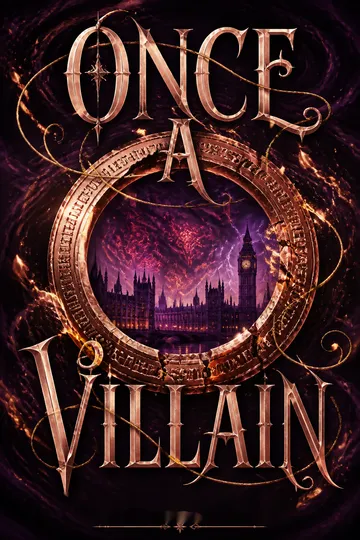
Once a Villain asks whether correcting a monstrous world gives anyone the right to design a better one. Eleanor's regime makes oppression visible through pendants, curfews, labor, cages, and public executions, but the deeper danger is her attempt to make history permanent. The timeline itself resists her, and its tears expose the limits of rule by force. Joan's task is not simply to defeat a villain. She must decide what victory means when every available power has the capacity to overwrite other lives.
The novel treats identity as the product of both continuity and circumstance. Alternate versions of Aaron and Nick can become enemies, collaborators, or lovers, while Joan's recurring attachment to both men unsettles the idea that love must follow a single predetermined pattern. Their counterparts' erased lives matter because they had made real choices in a world that denied them freedom. The surviving group cannot restore those exact people, and the story does not pretend that a better timeline makes that loss harmless.
Joan's power develops in parallel with her emotional life. She has learned to contain grief as a survival habit, but containment also keeps her from accessing what she needs. When she finally releases what she feels, she can break the bond that gives Eleanor control. Crucially, Joan refuses to take the leash herself. That refusal distinguishes repair from domination: she acts decisively against coercion without claiming the authority to manufacture universal peace.
The ending's hope is therefore ethical rather than utopian. A new timeline restores families and gives the characters room to choose, but it does not guarantee that people will always agree or that the past can be made clean. Remembering Eleanor, despite her harm, preserves complexity without excusing her. The book's answer is not that power should never be used, but that power must leave other people and the future capable of changing.
Review Summary
Once a Villain received mixed reviews, with an average rating of 3.62 out of 5. Many readers expressed excitement for the book but were ultimately disappointed with the ending and character development. The love triangle resolution was controversial, with some praising it and others finding it forced. Readers appreciated the action and world-building but criticized plot holes and rushed conclusions. Despite mixed feelings, fans of the series remained invested in the characters, particularly Aaron.
Characters
Joan Chang-Hunt
The reluctant timeline-breakerJoan is a human-raised girl with monster ancestry, caught between communities whose histories have taught them to fear one another. She is observant, practical, and quick to feel responsible for harm, sometimes carrying guilt that properly belongs to much larger forces. Her Grave heritage gives her a power she is still learning to understand, while her family history leaves her unsure what she is entitled to claim. Joan's instinct is to protect people directly, but the story repeatedly asks her to distinguish care from control. Her attachments to Nick and Aaron expose different parts of her identity without reducing her to a choice between them.
Nick Ward
The human fighterNick is a human whose courage is expressed through action, especially when others are threatened. He is physically formidable, strategically alert, and deeply attached to the family and ordinary life he was separated from. His moral instincts are demanding: he judges himself harshly when survival requires him to stand aside. At the same time, he is not a symbol of perfect heroism; he can be wounded, jealous, uncertain, and afraid of becoming the source of more harm. His bond with Joan is profound, but his commitment to protecting people extends beyond romance.
Aaron Oliver
The polished monster heirAaron is a monster raised among inherited power, formal manners, and family expectations that have often made affection feel conditional. His wit and impeccable presentation are forms of control, but beneath them is a careful person who notices when others are frightened, exhausted, or unsteady. He knows how to perform authority and understands the danger of appearing vulnerable in public. Joan draws out a gentler, more uncertain side of him, while Nick challenges his assumptions about humans and monsters. Aaron's difficulty believing he could be chosen reflects a deeper fear that love is always destined for someone else.
Eleanor
The absolute QueenEleanor is Joan's sister and the ruler of a world in which monsters no longer need to hide. She is strategic, patient, and capable of turning affection into political leverage. Her devotion to family is genuine, but it is entangled with grief, entitlement, and a conviction that she alone can decide what must be sacrificed. Eleanor sees control as protection and resistance as a threat to the people she loves. That makes her both emotionally legible and profoundly dangerous: personal pain explains her choices, but does not make those choices harmless.
Ruth
The sharp-eyed cousinRuth is Joan's cousin, a quick-thinking Hunt who uses humor to puncture fear and confidence to move through dangerous rooms. She is skilled with locks and comfortable making decisions under pressure, but her boldness is grounded in loyalty rather than bravado. Ruth recognizes when Joan is carrying too much and can challenge her without abandoning her. Her family pride remains strong even when the world has made their family vulnerable.
Jamie
The memory keeperJamie is a thoughtful monster from the Liu family, a historian by instinct and a careful observer of how timelines alter lives. His extraordinary memory helps the group navigate unfamiliar places and recover knowledge others have lost. He is patient, compassionate, and deeply devoted to Tom, though the separation between remembered and present relationships weighs on him. Jamie often sees the long pattern behind an immediate crisis, but his insight does not protect him from grief.
Tom Hathaway
The solitary boatmanTom is a formidable Hathaway who lives on the waterways and prefers self-reliance to belonging. He is perceptive, practical, and difficult to persuade with sentiment alone; he trusts evidence and watches for hidden motives. His isolation is partly a family tradition and partly a defense against dependence. Jamie's presence unsettles that independence, bringing forward a closeness Tom cannot immediately explain. He is most persuasive when he acts rather than makes promises.
Joan's mother
The hidden Grave guideJoan's mother is a Grave with a patient, attentive manner and a fierce capacity for love. She has spent years observing the daughter she could not openly reach, which makes her curious about small details as well as larger dangers. Her compassion does not blind her to Eleanor's harm, though family loyalty makes every judgment painful. She offers Joan knowledge without pretending that knowledge can remove the cost of choice.
Gran
The distant warningJoan's grandmother is a formidable Hunt whose memories and warnings connect the family across dangerous changes. She is protective but not sentimental, and she understands that survival sometimes depends on giving Joan only the information she can use. Her presence is associated with practical guidance, family history, and the consequences of old decisions.
Marguerite Nightingale
The careful resistance allyMarguerite is Aaron's mother, a Nightingale with poise, social intelligence, and a capacity to manage appearances. She can read a room and knows when a public performance is necessary to protect private loyalties. Her warmth toward Aaron contrasts with the formal world around them, while her work against the Court requires discretion and patience.
Finn Ward
The resourceful younger brotherFinn is Nick's younger brother, energetic, observant, and proud of the older sibling he admires. He has learned to read danger quickly and to make himself useful without being asked. His humor gives him a brightness that persists despite the hardship around him.
Mary Ward
The protective sisterMary is Nick's sister, resourceful and quietly protective of her family. She knows how to survive scrutiny without drawing attention and offers practical help even when she has little to spare. Her steadiness makes the family's hardship visible without turning her into a passive victim.
Fern
The undercover cousinFern is a Grave and Joan's cousin, alert, understated, and willing to take risks for family. She has learned to conceal her loyalties inside a role that gives her access to dangerous places. Her manner is dry, but her actions show a strong instinct for protecting people in immediate peril.
Cassius Argent
The blustering family headCassius leads the Argent family and masks authority beneath theatrical manners and self-satisfaction. He enjoys status, spectacle, and the social power to make others uncomfortable. His easy confidence can make him seem ridiculous, but his position and abilities make him dangerous.
Ronan
The Serpentine receptionistRonan works the Serpentine Inn's reception desk, where he sees travelers, transactions, and the shifting risks of city life. His careful manner suggests someone accustomed to measuring what can safely be said and to whom.
Lucien Oliver
The family's cold enforcerLucien is an Oliver relative whose polished appearance conceals a severe and unquestioning approach to authority. He carries out family business with chilling efficiency and has little patience for appeals to compassion.
Geoffrey
The watchful valetGeoffrey serves the Oliver household as valet, observant and attentive to every breach of etiquette or routine. He is deferential to rank, but his close attention makes him difficult to deceive.
Alfie and Enid
The human siblingsAlfie and Enid are human siblings caught in the Court's machinery of accusation. They are frightened but retain the ability to cooperate and to recognize unexpected help.
Frankie
Jamie's loyal bulldogFrankie is Jamie's small bulldog, beloved and stubbornly affectionate. She provides familiar comfort during upheaval and often acts on instinct before anyone else understands what she has noticed.
Sylvie
Tom's watchful catSylvie is Tom's black cat and familiar, independent and quick to guard her space. Her wary temperament suits Tom's solitary life, though she is capable of sharing it with others.
Joan's father
The absent human parentJoan's father raised her in the human world and kept her mother's memory present through stories and photographs. His care gave Joan a stable home while leaving her with unanswered questions about the family she never knew.
The King
The former timeline rulerThe King is the former monster ruler whose decisions shaped the families' histories and the conflict over time travel. He represents a model of authority built on control, secrecy, and the power to erase people from history.
Plot Devices
Human time tokens
Life becomes currencyMonsters travel through time by spending human years, carried in tokens that function as both currency and fuel. In Eleanor's London, pendants also display how much life a human has left and how much is owed in service. This turns an abstract supernatural rule into a visible system of class and coercion. A distinct human-made token, formed from stolen life carried in a monster's blood, can respond to a human relative and permit travel through otherwise blocked periods. Its use makes family loss materially consequential.
Grave power
Unmaking opens windowsThe Grave family can unmake matter, but its deeper power can open windows between timelines. Joan initially mistakes uncontrolled openings for evidence that she is damaging reality. Her ability responds strongly to emotion, especially fear and grief, and becomes more effective when she stops suppressing what she feels. The power is essential both to the group's attempts to reach Eleanor and to the final choice between taking control of the timeline and freeing it.
Ali seals
Damage hidden in plain sightAli power creates shields and seals that conceal or block access to dangerous things. Eleanor uses the shields to protect herself and hide the spreading tears in her timeline. The group first sees their effects as practical obstacles, then learns that sealed damage remains unresolved beneath the surface. The seals let the city appear stable even as the world approaches collapse, and Joan's ability to unmake them exposes the crisis to others.
The wolf mark and cipher
Clues left by resistanceThe wolf symbol appears on a message that seems to connect Joan with an underground movement. Later, a recorded message from Nick's counterpart supplies a numerical code that the group assumes contains tactical instructions. The symbol and code both lead toward hidden relationships, but the group misreads parts of what they find: one contact is not trustworthy, and the cipher preserves a private message rather than a battle plan. Together, they show how evidence can outlast the people who made it while remaining open to interpretation.
The human-made ring
A life becomes a passageNick's black signet ring is linked to his family and contains a hidden compartment. Its message is encoded in a book cipher, while its blood-marked interior carries the power to let a human travel on life stolen from a close relative. When Nick falls in the arena, the token preserves him in a state that looks like death. Joan's removal of the ring releases him. The object therefore joins grief, memory, and survival, while carrying a cost rooted in the violence that created it.
Monsters Series
Download PDF
Download EPUB
.epub digital book format is ideal for reading ebooks on phones, tablets, and e-readers.








