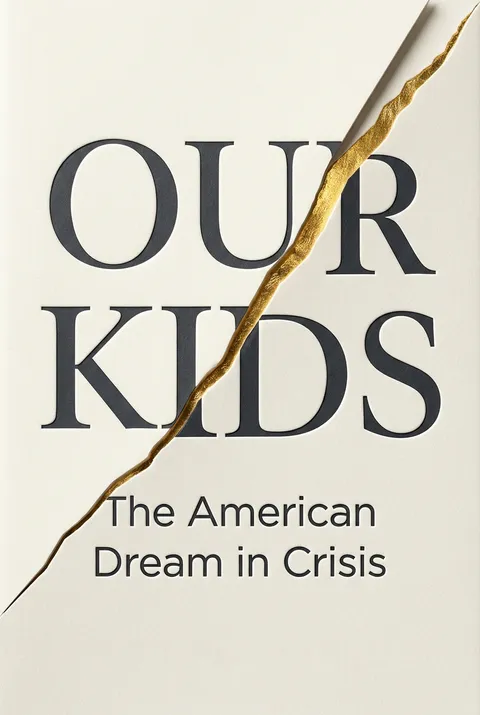


Key Takeaways
Treat opportunity as a childhood inheritance, not merely an adult competition
One town, two eras. Putnam compares his 1959 Port Clinton classmates with children growing up there decades later. Don, a working-class quarterback, reached college with help from a pastor; Frank, the wealthiest boy in the class, lived nearby and mixed with classmates across income lines. Nearly three quarters of the class eventually surpassed their parents educationally. In the later Port Clinton, a road separated a neighborhood with 1 percent child poverty from one with 51 percent.
Progress was uneven. The earlier era was not fair to everyone: Black students faced exclusion, and women were far less likely than men to finish college. The claim is narrower: class background then had less power to determine a child's prospects. Putnam argues that this advantage has since reversed, as family, school, and neighborhood resources increasingly diverge by class.
The comparison makes inequality concrete by showing how opportunity is built from ordinary supports, not just exceptional talent. A coach, a pastor, or a mixed-income school can connect ability to a real next step. The strongest reading is not that the 1950s were fair, but that communities once provided more shared routes upward. Historical comparisons still need care: Port Clinton's graduating class is a small cohort, and memories can idealize the past. Putnam addresses this with a class survey and national research, but the stories illustrate patterns rather than prove them on their own.
Stop using adult mobility statistics to infer children's current chances
Two kinds of movement. Absolute mobility means ending up better off than one's parents; relative mobility means that family origin has less power to determine a person's rank. Economic growth can raise many boats without changing who occupies the top. Conversely, people can trade places even when the overall economy is stagnant. Port Clinton's class of 1959 experienced unusually strong gains in both kinds of mobility.
The data arrive late. Conventional mobility measures compare adults in their thirties or forties with their parents at similar ages. They therefore describe childhoods from decades earlier. Putnam instead examines current conditions in families, schools, and communities as early signals of future mobility. He cautions that predictions are uncertain, but points to a widening set of childhood disadvantages that old adult statistics cannot yet capture.
This distinction is useful well beyond mobility research. It separates a growing economy from a fair contest, two outcomes that public debate often treats as interchangeable. The book's leading-indicator approach is also a practical response to a measurement problem: waiting for children to reach middle age makes policy slow by design. Yet early indicators are not destiny. Family stability, school composition, and neighborhood conditions are correlated and influence one another, so forecasting their combined effect requires humility and repeated measurement.
Strengthen the conditions for stable care instead of blaming families
Family life split by class. Putnam describes a post-1970s divide. Many college-educated families formed durable, more gender-equal partnerships, often delaying marriage and children until careers were established. Among less educated families, childbearing became less closely connected to marriage, and partnerships were more likely to break up or form again. The book calls the resulting unstable arrangements fragile families. In 1960, 6 percent of children lived with one parent; the book reports that more than half of children today are expected to spend some part of childhood in a single-parent family.
Instability has many roots. Kayla's childhood included parental separation, repartnering, money worries, and periods of disrupted care. Putnam links these pressures to falling wages and insecure work, as well as changing norms and mass incarceration. Family structure is associated with children's outcomes, but the account does not say every single-parent family is harmful or that marriage alone solves hardship.
The useful shift here is from moral judgment to conditions: unreliable work and chronic financial pressure can make relationships harder to sustain, while instability can deepen economic strain. That feedback loop helps explain why exhortations to marry have limited power on their own. It also matters that single parents are not a uniform group. A stable, attentive caregiver can offer a child far more than two adults locked in conflict or abuse. Policy should therefore support dependable care and material security, rather than treating household form as a simple proxy for parenting quality.
Buffer early stress before it narrows children's capacity to learn
Interaction builds capacity. Contingent reciprocity, also called serve-and-return interaction, is the back-and-forth exchange in which an adult responds to a child's sounds, questions, or gestures. These everyday exchanges help develop language and executive functions, including attention, impulse control, and working memory. Putnam describes executive functions as skills that help children manage tasks and adjust to new demands.
Chronic stress gets in the way. A child facing violence, neglect, addiction, or unstable caregiving may remain on alert instead of concentrating and exploring. The Adverse Childhood Experiences Scale counts ten kinds of childhood trauma; the book reports that accumulating exposures correlate with higher risks to health and functioning. Elijah experienced at least eight. Supportive adults can buffer stress, and early help matters, but difficult beginnings do not determine every child's future.
The developmental account connects social policy to biology without reducing children to brain scans. Responsive relationships help children regulate stress, which supports the attention and planning that schooling demands. This also explains why early support can have effects beyond vocabulary or test scores. A caution is important: risk measures describe probabilities across groups, not fixed outcomes for an individual. Invoking brain development should strengthen investment in children, not label them as damaged or imply that later support is futile.
Make enrichment affordable, not a privilege of well-resourced parenting
Good intentions need resources. Putnam draws on Annette Lareau's terms concerted cultivation and natural growth. Concerted cultivation means deliberately organizing activities and interactions to develop a child's skills; natural growth leaves more development to the child's own routines, with less scheduling and institutional engagement. These patterns reflect class differences in time, money, and access, not simply how much parents care. Simone and Carl read, talked, and planned activities with their children. Stephanie worked long hours and focused on safety, discipline, and providing necessities.
The investment gap widened. By 2007, families in the top tenth of incomes spent about $6,600 per child each year on enrichment, compared with roughly $750 among families in the bottom tenth. Young children of college-educated parents also received substantially more developmental care time. These are examples of unequal capacity, not evidence that poor parents love their children less.
The contrast challenges a familiar mistake: interpreting parenting differences as character differences while ignoring the schedule, safety, and financial constraints shaping family life. It also shows how institutional know-how becomes an advantage. When enrichment is privately purchased, parents with flexible jobs and money can turn concern into lessons, clubs, and school advocacy. Still, no single parenting style fits every household or neighborhood. The constructive goal is not to make every family imitate affluent routines, but to give children dependable relationships, learning opportunities, and room to develop.
Judge schools by the peers, safety, and pathways they assemble
The gap begins early. Research summarized by Putnam finds that the income-based achievement gap is 30 to 40 percent larger among children born in 2001 than among those born about twenty-five years earlier. Much of the difference is already present when children enter kindergarten. Schools do not create the whole gap, but the social makeup of a school affects what students encounter every day.
Similar budgets, different climates. Troy High and Santa Ana High in Orange County spent roughly comparable amounts per student, yet their results sharply diverged. Troy had a 93 percent graduation rate; Santa Ana's was 73 percent. At Santa Ana, students faced more violence, truancy, and disruption, while Troy offered a more academically competitive environment and far more extracurricular options. Family resources, peers, safety, parent involvement, and teacher stability all shape what a school can do.
This account avoids two easy answers: blaming teachers for every unequal outcome, or declaring schools powerless because gaps appear early. A school is both an institution and a social environment. Classmates' expectations, family engagement, and classroom stability can either reinforce learning or consume time that could have gone to it. Equal spending therefore does not guarantee equal opportunity when needs differ. At the same time, school comparisons are not controlled experiments, and differences in student intake complicate causal claims. The policy implication is to improve conditions and support where barriers are concentrated.
Build cross-class ties where children can find mentors and practical know-how
Connections open doors. Social capital is the support and access people gain through relationships. Putnam distinguishes close relationships from weak ties, or looser connections to people with different information and expertise. A pastor helped Don navigate college; a teacher and a community benefactor helped Cheryl and Sofia pursue education. David, by contrast, described wanting further education without knowing how to begin and without a trusted adult to guide him.
Help is unevenly distributed. In a national survey cited in the book, 64 percent of affluent young people had a mentor beyond their family, while 62 percent of poor young people had none. Mentoring may come from teachers, coaches, religious leaders, or family friends. It works best as a stable relationship, not a one-off encounter. The broader point is that institutions become easier to navigate when someone can explain how they work.
Information alone rarely creates access. A young person may find college requirements online yet still need an adult to interpret financial aid, recommend a course, or encourage an application. This is why networks can amplify other advantages, especially institutional confidence. The goal is not simply to count mentors, but to create durable relationships with real trust and practical guidance. Formal programs can help, although matching people is not enough if mentors disappear quickly or lack support. Community organizations can make personal connections more reliable and less dependent on family privilege.
Remove fees that ration activities that teach mobility skills
Activities build more than résumés. Sports, clubs, music, and other extracurriculars give young people practice in teamwork, leadership, discipline, and working with adults outside the family. The book reports that poor students are three times as likely as nonpoor students to take part in neither sports nor clubs, and are less likely to join both. These opportunities are also increasingly scarce in high-poverty schools.
Fees create a quiet gate. Putnam estimates that participation can cost about $400 per student per activity each year. When fees were introduced, one in three sports-playing students in households earning $60,000 or less dropped out, compared with one in ten from higher-income households. Fee waivers do not remove every barrier, including stigma and transport. Putnam's immediate proposal is to end pay-to-play and keep school activities open to all students.
Extracurriculars function like a low-stakes apprenticeship in cooperation, persistence, and responsibility. Their value is especially high when children have few other ways to meet supportive adults or try unfamiliar roles. Charging families shifts a public educational function into the private marketplace, where access predictably follows income. Participation research is not always causal, since motivated students may be more likely to join in the first place. Even so, the access problem is direct: a fee can exclude a student before any potential benefit is possible.
Invest in children as a shared economic and democratic responsibility
The costs reach everyone. Putnam cites estimates that childhood poverty costs the United States about $500 billion annually, nearly 4 percent of GDP, through lost productivity, crime, and health effects. The book also links unequal opportunity to unequal political participation: young adults with college education are more likely to vote and engage in civic life, while many poorer young people feel shut out. The case for action is economic, democratic, and moral.
Use a portfolio, not a cure-all. Putnam considers income supports for working families, help for the poorest children, parental leave, quality early care, home visiting, better-funded high-poverty schools, mentoring, vocational pathways, and reducing incarceration for nonviolent offenses. Some proposals have stronger evidence than others, and approaches must fit local conditions. The guiding principle is to restore a public sense that every child's prospects matter to the wider community.
The argument treats opportunity as infrastructure: societies benefit when more people can develop skills, contribute, and participate in public life. That framing can connect policy choices that are often split into separate debates about welfare, education, crime, and civic renewal. It also resists the fantasy of a single intervention. Family income, early development, schools, and community ties interact, so a portfolio is more plausible than a silver bullet. The book's estimates make the cost of inaction vivid, but local trials and transparent evaluation remain essential to distinguish promising programs from appealing slogans.
Analysis
Putnam's central move is to make inequality visible at the scale where it is experienced: a household, a classroom, a neighborhood, and the route from adolescence into adult life. Port Clinton supplies the historical contrast, while cases from Bend, Atlanta, Orange County, and Philadelphia show how similar class divisions appear in unlike places. The method is deliberately layered. Personal narratives convey what a statistic cannot, and national data test whether the stories reflect wider patterns.
The book's most useful conceptual distinction is between income inequality and opportunity inequality. The latter does not merely ask whether some adults earn more. It asks whether family background increasingly governs a child's access to stable care, cognitive stimulation, safe schools, mentors, and institutional knowledge. These advantages reinforce one another, creating cumulative differences before college admissions or hiring decisions occur. This is why a narrow focus on school budgets or individual effort cannot explain the full pattern.
The evidence is persuasive as a diagnosis, but not every causal link is equally settled. Many studies are observational, and family stability, income, parenting, and neighborhood conditions are entangled. The life histories are illustrative rather than representative, and the national datasets often measure outcomes long after childhood. Putnam acknowledges these limits while arguing that visible early conditions are too serious to ignore until perfect mobility statistics arrive.
The policy conclusion is consequently plural. Cash support can reduce material strain, early childhood services can support development, schools can provide safe instruction and activities, and community institutions can supply mentors and social connection. These measures do not substitute for one another. Nor should the analysis turn family patterns into moral rankings: poverty constrains choices, while many poor parents show deep commitment under difficult conditions. The book's strongest challenge is civic. A society that privatizes opportunity lets affluent families buy substitutes for supports once shared more broadly, then mistakes those purchased advantages for individual merit. Restoring fairness requires public systems that make children's potential a collective concern.
Review Summary
Our Kids: The American Dream in Crisis examines growing inequality in America, focusing on diminishing opportunities for lower-income children. Putnam uses personal stories and data to illustrate widening gaps in family structure, parenting, education, and community support between socioeconomic classes. While praised for highlighting important issues, some critics found the nostalgia for 1950s America problematic and solutions lacking. The book is viewed as an accessible introduction to social inequality, though potentially oversimplifying complex issues of race and class.
People Also Read








Glossary
absolute mobility
Doing better than parentsAbsolute mobility measures whether people achieve higher income, education, or occupational standing than their parents. It can rise when the economy expands or educational access grows, even if people remain in roughly the same relative positions. A society can therefore show considerable absolute progress without giving children from different backgrounds equal chances to advance.
relative mobility
Movement across social ranksRelative mobility measures how strongly a person's eventual position depends on their family's starting position. High relative mobility means that family origin is less predictive of where someone ends up. Unlike absolute mobility, relative mobility can occur even in a stagnant economy, as some people rise past others who fall.
fragile families
Unstable parental partnershipsA term used in the book for family arrangements in which a child's parents may never have married or formed a durable partnership. Parents may separate, form new relationships, and have children with other partners, creating changing household membership and complex sibling relationships. The term describes a pattern associated with economic insecurity, not a judgment about every single-parent household.
concerted cultivation
Deliberate skill-building parentingSociologist Annette Lareau's term for parenting that actively organizes children's development through conversation, scheduled activities, school involvement, and guided practice in navigating institutions. These practices can help children build academic and social skills. Putnam emphasizes that they require time, money, and knowledge, resources that are distributed unevenly.
natural growth
Less scheduled child developmentAnnette Lareau's term for a parenting approach in which children have more unstructured time and adults rely more on rules and discipline than on organized activities or frequent negotiation with institutions. It is not evidence of weaker parental love. In Putnam's account, economic pressure and limited access to enrichment can make this approach more common among less affluent families.
contingent reciprocity
Responsive adult-child exchangeA child-development term for interactions in which an adult notices and responds to a child's signals, such as sounds, gestures, or questions. Often described as serve-and-return interaction, this exchange helps support early language, learning, and brain development. Consistent responsive adults matter because children learn through repeated social interaction, not only through formal lessons.
Adverse Childhood Experiences Scale
Count of childhood traumasA measure that counts exposure to ten kinds of childhood adversity, including abuse, neglect, parental separation, household substance problems, and imprisonment of a household member. Research cited by Putnam finds that multiple exposures are associated with increased risks to later health and functioning. The scale tracks risk across groups; it does not predict an individual's future with certainty.
toxic stress
Unbuffered chronic stressSevere or prolonged stress that occurs without reliable support from a caring adult. Unlike short-term stress, which can be manageable, persistent exposure to danger, neglect, or instability can disrupt children's attention, emotional regulation, and problem-solving. Putnam uses the term to explain how economic hardship and difficult environments can affect development through both family experience and physiology.
social capital
Resources held in relationshipsThe support, information, trust, and access people gain through connections to relatives, friends, neighbors, organizations, and acquaintances. Social capital can help children find mentors, learn how schools or colleges work, and reach opportunities. Putnam stresses that these connections are unevenly distributed, and that ties to people with different knowledge can be especially valuable.
weak ties
Loose, diverse connectionsSocial connections that are less intimate than close friendships, such as acquaintances, family friends, or a parent's professional contacts. They can link a person to information and expertise unavailable within a close circle. In the book, such ties help explain how some families access college advice, job leads, and specialists while others have fewer routes beyond their immediate networks.
collective efficacy
Shared trust and interventionA neighborhood's capacity for residents to trust one another and act together to support common expectations, including keeping children safe. It is more than knowing one's neighbors: it includes a willingness to intervene when problems arise. Putnam connects stronger collective efficacy with better conditions for children and describes its decline in distressed communities.
FAQ
What's "Our Kids: The American Dream in Crisis" about?
- Author's Exploration: The book, written by Robert D. Putnam, explores the decline of social mobility in America and how it affects children from different socio-economic backgrounds.
- Focus on Inequality: It delves into the growing gap between rich and poor families and how this disparity impacts the opportunities available to children.
- Case Studies and Data: Putnam uses a combination of personal stories and statistical data to illustrate the challenges faced by children in low-income families.
- Call to Action: The book advocates for policy changes and community efforts to bridge the gap and restore the American Dream for all children.
Why should I read "Our Kids: The American Dream in Crisis"?
- Understanding Social Issues: It provides a comprehensive look at the factors contributing to social inequality and its impact on future generations.
- Informed Perspective: The book offers insights into the systemic issues that hinder social mobility, making it a valuable read for policymakers, educators, and concerned citizens.
- Empathy and Awareness: Through personal stories, readers gain a deeper understanding of the struggles faced by children in disadvantaged communities.
- Actionable Solutions: Putnam suggests practical steps that can be taken to improve social mobility and create a more equitable society.
What are the key takeaways of "Our Kids: The American Dream in Crisis"?
- Social Mobility Decline: The book highlights the significant decline in social mobility in America over recent decades.
- Impact of Inequality: It emphasizes how economic inequality affects children's access to education and opportunities.
- Role of Community: Putnam stresses the importance of community involvement in supporting children and improving their life chances.
- Policy Recommendations: The book suggests policy changes that could help bridge the gap between rich and poor, such as investing in education and community programs.
How does Robert D. Putnam define social mobility in the book?
- Economic Ladder: Social mobility is described as the ability to move up or down the economic ladder compared to one's parents.
- Intergenerational Mobility: The book focuses on intergenerational mobility, which measures the extent to which children can achieve a higher socio-economic status than their parents.
- Factors Influencing Mobility: Putnam identifies education, family background, and community support as key factors influencing social mobility.
- Current Trends: The book discusses how current trends show a decrease in social mobility, particularly for children from low-income families.
What are the best quotes from "Our Kids: The American Dream in Crisis" and what do they mean?
- "It's where you're going to, not where you're from that counts." This quote highlights the ideal of social mobility, where one's future is not determined by their background.
- "The American Dream is in crisis." This statement underscores the central theme of the book, emphasizing the challenges to achieving upward mobility in today's society.
- "We are a society of unequals." This quote reflects the growing economic and social disparities that Putnam argues are hindering social mobility.
- "Education has been commandeered by the middle classes to retain their advantage." This highlights the book's argument that the education system often perpetuates inequality rather than alleviating it.
How does "Our Kids" address the issue of education and social mobility?
- Educational Inequality: The book discusses how disparities in educational access and quality contribute to social immobility.
- Middle-Class Advantage: Putnam argues that middle-class families often have the resources to secure better educational opportunities for their children, widening the gap.
- Role of Schools: The book examines how schools can either perpetuate or mitigate social inequality, depending on their resources and policies.
- Policy Suggestions: Putnam suggests reforms in the education system to make it more equitable and supportive of all children, regardless of their socio-economic background.
What solutions does Robert D. Putnam propose for improving social mobility?
- Invest in Education: Putnam advocates for increased investment in early childhood education and public schools to level the playing field.
- Community Support: He emphasizes the role of community programs in providing support and resources to disadvantaged children.
- Policy Reforms: The book calls for policy changes that address economic inequality and provide more opportunities for upward mobility.
- Family and Parenting Support: Putnam suggests initiatives to support families, such as parenting programs and economic assistance, to create a stable environment for children.
How does "Our Kids" compare social mobility in the U.S. to other countries?
- International Rankings: The book highlights that the U.S. ranks low in social mobility compared to other developed countries.
- Scandinavian Models: Putnam points to Scandinavian countries as examples where social mobility is higher due to more equitable education and social policies.
- Cultural Differences: The book discusses how cultural and policy differences contribute to varying levels of social mobility across countries.
- Lessons for the U.S.: Putnam suggests that the U.S. can learn from these countries by adopting policies that reduce inequality and support all children.
What role do communities play in social mobility according to "Our Kids"?
- Community Resources: Communities provide essential resources and support systems that can enhance or hinder social mobility.
- Social Capital: The book emphasizes the importance of social capital, such as networks and relationships, in providing opportunities for children.
- Community Programs: Putnam highlights successful community programs that have improved outcomes for disadvantaged children.
- Collective Responsibility: The book argues that improving social mobility requires a collective effort from communities to support and invest in their children.
How does "Our Kids" address the impact of family background on social mobility?
- Parental Influence: Family background, including parental education and income, significantly impacts a child's opportunities and outcomes.
- Cycle of Poverty: The book discusses how children from low-income families often face a cycle of poverty that is difficult to break.
- Supportive Environments: Putnam emphasizes the need for supportive family environments to foster children's development and success.
- Interventions: The book suggests interventions that can help mitigate the negative effects of disadvantaged family backgrounds, such as parenting programs and economic support.
What are the challenges to implementing the solutions proposed in "Our Kids"?
- Political Will: Implementing the proposed solutions requires political will and commitment from policymakers at all levels.
- Resource Allocation: The book acknowledges the challenge of allocating sufficient resources to education and community programs.
- Cultural Resistance: There may be cultural resistance to changes in policies and practices that aim to reduce inequality and improve social mobility.
- Long-Term Commitment: Putnam emphasizes that improving social mobility is a long-term effort that requires sustained commitment and collaboration from various stakeholders.
How does "Our Kids" suggest measuring success in improving social mobility?
- Intergenerational Metrics: Success can be measured by improvements in intergenerational mobility, such as children achieving higher socio-economic status than their parents.
- Educational Outcomes: Tracking educational outcomes, such as graduation rates and academic achievement, can indicate progress in leveling the playing field.
- Economic Indicators: Economic indicators, such as income equality and employment rates, can reflect changes in social mobility.
- Community Impact: The book suggests evaluating the impact of community programs and policies on children's opportunities and outcomes as a measure of success.
About the Author



Download PDF
Download EPUB
.epub digital book format is ideal for reading ebooks on phones, tablets, and e-readers.








