

Key Takeaways
Treat boredom as a frustrated need for engagement, not a shortage of entertainment.
Boredom has two parts. It is the uncomfortable experience of wanting to engage in satisfying activity but being unable to do so. The mind feels underused, while desire has nowhere workable to go. The result can be both sluggish and restless: time drags, concentration slips, and even an available activity can seem unappealing. The authors call this a feeling of thinking, not simply an emotion caused by a particular event.
More than an empty moment. In a study, captive mink in bare cages approached new objects faster than mink in enriched cages, even when the object carried a predator’s smell. The researchers interpreted this as an urgent drive for stimulation, not simple apathy. The comparison captures the central point: boredom is not having nothing around you. It is being unable to connect your abilities and attention to what is around you.
What's useful here is the separation of external options from felt access to those options. A person can be surrounded by books, friends, and projects and still feel unable to begin. This distinction helps avoid moralizing boredom as laziness. It also points toward attention and motivation as part of the problem, not merely the inventory of available activities. The mink study is suggestive rather than definitive, since animal behavior cannot reveal a subjective report. Still, the authors’ cautious interpretation keeps the human model grounded in observable behavior without pretending the inner experience is directly measurable.
Find the mismatch: monotony, purposelessness, constraint, or a poor challenge fit.
Four situational traps. The authors identify four environmental conditions that often undermine engagement: repetitive tasks, activity that seems to have no value, being forced to continue or prevented from acting, and a poor match between a task’s difficulty and one’s abilities. These conditions can combine. A tedious task becomes worse when it cannot be stopped and offers no reason to care.
The task is not the whole story. Psychologist Hugo Münsterberg described a factory worker who repeated the same precise movement thousands of times each day yet found the work satisfying. The task mattered to him, and he took pleasure in doing it well. That case shows why no activity is automatically boring for everyone. Attention, emotional awareness, energy, motivation, and the ability to direct oneself also shape whether a situation becomes engaging.
This account resembles person-environment fit models used in organizational psychology: performance and well-being depend not only on a person’s traits or a job’s design, but on how the two meet. The factory worker is a valuable counterexample to the idea that repetition alone causes boredom. Meaning, choice, and competence can change the experience of the same task. That insight has practical implications for workplaces and classrooms: autonomy and visible purpose may help, but they cannot make every task compelling for every person. The model is strongest as a diagnostic map, not a promise that every mismatch can be fixed.
Use boredom as an alarm, then choose the action it cannot choose.
A signal, not a solution. The book compares boredom with pain: both feel unpleasant and can prompt action. Pain alerts a person to a possible injury; boredom signals that attention and abilities are not being usefully engaged. But the signal cannot identify the right next move. It may be better to change tasks, recommit to the current one, or seek a meaningful goal. A quick distraction may mute the discomfort without addressing its source.
Desire matters. The story of Humphrey Potter, a young valve operator on an early steam engine, illustrates boredom’s possible value. Tired of repetitive work, he devised a mechanism to operate the valves, freeing himself from the task. By contrast, a teenager with akinetic mutism, a condition that left her unable to initiate action, did not feel the same pressure to escape inactivity. Boredom can be painful precisely because the desire to act remains.
The alarm analogy clarifies why discomfort can be informative without being wise. In decision science, a warning signal changes what deserves attention, but it does not dictate a good policy. Hunger can prompt eating, for example, while leaving open what, when, and how much to eat. Boredom works similarly: it identifies a problem of engagement, not a specific remedy. Potter’s story makes the potential upside vivid, though it should not imply that boredom reliably produces invention. The signal creates pressure to change; skill, opportunity, and judgment determine whether that pressure leads somewhere worthwhile.
Beware quick relief: boredom can impair attention and invite costly escape.
Distraction has a price. In 2009, pilots on Northwest Flight 188 became absorbed in laptops and conversation during a routine flight. They missed air-traffic-control contact and flew roughly 100 miles past their destination before noticing the error. The episode illustrates how boredom during simple, repetitive work can weaken vigilance when attention still matters. In less dangerous settings, the same drift may mean errors, abandoned tasks, or poor decisions.
Relief can turn harmful. In one experiment, people left alone with their thoughts could choose to give themselves an electric shock. About two-thirds of the men and one-quarter of the women did so at least once, despite having said they would pay to avoid the shock. Other studies associate boredom with overeating and substance use. These findings do not show that boredom alone causes every harmful behavior. The authors argue that the response to boredom, especially an impulsive escape, is often the more direct source of trouble.
The flight story underscores a familiar safety problem: vigilance tasks demand attention while providing too little stimulation to sustain it. In human-factors research, this is why important systems use alarms, task variation, and automation to reduce reliance on uninterrupted monitoring. The shock experiment makes the discomfort of boredom strikingly clear, but its artificial setting limits what it can say about everyday choices. The broader lesson is not that bored people are destined for risk. It is that a highly aversive state can narrow attention toward immediate relief, making consequences that arrive later easier to discount.
Aim for a challenge you can influence, not easy wins or impossible tasks.
Challenge needs a fit. A task can fail to engage when it asks too little or too much. Repeating beginner-level Tetris for an hour can leave a capable player’s skills unused; starting at the hardest level can overwhelm a beginner. In experiments described by the authors, people were equally bored by a slow, elementary vocabulary lesson and a highly technical lecture they could barely follow. Being confused is not automatically being engaged.
Control matters too. In a rock-paper-scissors study, participants who always won against a computer became bored because there was no real challenge. Those who always lost could also become bored when the task felt impossible. In another version, participants were told they might discover a strategy that could improve their odds. Even though their win rate did not improve, the possibility of control made the game less boring. A worthwhile stretch offers effort, feedback, and a sense that one’s choices matter.
The familiar idea that challenge should match skill is valuable, but this account adds an important complication: excessive difficulty can also feel boring when the task becomes impossible to follow. That matters in education, where confusion is sometimes mistaken for productive struggle. The control finding is especially revealing. A credible sense of influence can sustain effort even before it changes the result, echoing research on perceived control and motivation. Still, perceived control cannot substitute indefinitely for actual progress. Tasks need enough feedback to show that effort can alter the outcome, rather than merely invite hopeful guessing.
Protect agency when age, isolation, or institutions shrink your choices.
Boredom changes with circumstances. A study tracking boredom across adulthood found that it generally declined from the late teens into middle age, then rose somewhat among older adults. The authors offer possible explanations, including developing self-control, changing responsibilities, and reduced opportunity for satisfying activity in later life. The evidence is limited, especially for children and older adults, so the pattern should not be treated as a fixed rule for every person.
Isolation intensifies constraint. People in sensory-deprivation experiments struggled to keep thoughts coherent and often became restless; some experienced hallucinations. Accounts from polar expeditions, space missions, and prisons describe similar challenges when routine, limited autonomy, and separation from others restrict meaningful action. Astronaut Chris Hadfield found purpose in even mundane work, while cosmonaut Valentin Lebedev described isolation and routine as difficult. Their contrast suggests that a person’s response matters, but extreme constraints can leave little room for that response.
This section connects individual psychology to social design. A person’s ability to redirect attention depends partly on the choices a setting permits. That is particularly important when considering retirement, institutional care, incarceration, or youth schedules: telling someone to find an activity is hollow if meaningful options are blocked. At the same time, Hadfield’s example should not turn resilience into a demand placed on people in restrictive conditions. Adaptation can help, but it cannot erase structural deprivation. The uneven evidence across age groups also cautions against assuming that a single life-course pattern applies across cultures and circumstances.
Separate a meaningless moment from a meaningless life before drawing conclusions.
Meaning has two scales. A person may find a particular task pointless while still believing that life has purpose. The authors distinguish situational meaning, the value of what is happening now, from life meaning, a broader sense of purpose and direction. In laboratory studies, asking people to recall a meaningless period increased their immediate boredom, while inducing boredom did not reliably make them judge their lives as meaningless. The relationship runs more clearly from diminished life meaning toward boredom than in the reverse direction.
The search can help or harm. Experiments found that bored participants were more likely to recall nostalgic memories and, in some studies, to give more to effective charities. Other work found stronger identification with one’s own group, harsher judgments of outsiders, and more extreme political self-descriptions. Boredom can motivate a search for significance, but it does not distinguish a generous source of meaning from a destructive one.
The distinction between a bad hour and a bad life prevents a temporary state from becoming an overgeneralized verdict. It also clarifies why meaning-based responses to boredom can differ morally: the need for belonging or purpose is not itself a guarantee of good judgment. Social identity can provide coherence and solidarity, but rigid group boundaries can turn that same need into hostility. The laboratory findings offer evidence for short-term shifts, not proof that boredom drives real-world polarization. Their value is as a warning about the kinds of meaning people may reach for when they feel unmoored.
Choose deliberate connection over endless novelty when screens only kill time.
More input is not more engagement. The authors revisit a decades-old concern that information overload can make it hard to separate meaningful signals from noise. Smartphones and the Internet offer immediate novelty, but rapid switching may prevent sustained attention. One study using laptop cameras found that people changed what they were doing about every nineteen seconds on average. The book argues that this kind of use can occupy time without satisfying the deeper need to direct one’s attention and connect meaningfully.
Keep the claim proportionate. The authors do not establish that society is in a boredom epidemic. Long-term evidence comparing generations is lacking, and Internet use can support genuine relationships, learning, and useful work. The concern is narrower: using a screen to escape every uncomfortable pause may leave the original need untouched. When the device is put away, the person may still have to face the same unchosen task, loneliness, or uncertainty that triggered the scrolling.
The attention-economy lens strengthens this argument: many digital products are built to make the next item easy to access, while sustained engagement often requires deliberate effort. Frequent switching can also create a sense of activity without a clear sense of completion. Yet the medium itself is not the culprit in every case. A video call can deepen a distant relationship; an endless feed can fragment attention. The key distinction is the quality of participation, not whether a screen is present. The authors’ refusal to declare an epidemic is a useful correction to technology panic, given the limits of historical comparison.
Practice engaged attention, curiosity, and calm instead of demanding constant excitement.
Engagement has many forms. Flow is an especially intense state in which attention is absorbed, a task’s challenge fits one’s abilities, and action feels self-directed. But boredom does not require an extraordinary feat to disappear. Interest, curiosity, daydreaming, and relaxation can also occupy the mind. A gardener may enjoy weeding because progress is visible and the work is chosen, even though the task is repetitive and not especially difficult.
Respond on your terms. The authors recommend tolerating a pause rather than reflexively reaching for a ready-made distraction. Mindfulness, the practice of noticing thoughts and feelings without immediately judging or fleeing them, is associated with lower boredom. Other useful questions are practical: What is making this activity hard to enter? Is there a value or goal worth bringing into it? Would a different task better use one’s abilities? The aim is not constant excitement, but a chosen form of engagement that feels worth pursuing.
This approach avoids a common trap: treating every quiet moment as a problem that must be solved with stronger stimulation. Mindfulness can create a gap between discomfort and reaction, while curiosity can make attention more exploratory and less dependent on novelty arriving from outside. The gardening example also shows how choice, feedback, and visible progress can make humble work absorbing. Still, mindfulness should not be framed as a cure for boredom caused by coercion or deprivation. Paying attention can change a person’s relationship to a situation, but it cannot always make the situation acceptable or meaningful.
Analysis
The book’s strongest contribution is its shift from treating boredom as a property of dull objects to treating it as a breakdown in the relationship between attention, desire, and the world. That move explains why a repetitive task can absorb one person and torment another, and why a crowded menu of entertainment can coexist with an inability to choose anything. Its central model is psychologically useful because it separates the felt state from its many possible causes, then separates the signal from the response.
The account also bridges levels of analysis. At the individual level, attention, emotional awareness, and self-direction affect whether a person can engage. At the situational level, monotony, poor challenge fit, constraint, and low perceived value matter. At the social level, prisons, workplaces, schools, and digital platforms distribute agency unevenly. This prevents boredom from being reduced either to personal weakness or to a universally dull environment.
The authors’ restraint is important. They distinguish evidence about momentary boredom from evidence about a person’s tendency to experience it, and they do not claim that boredom directly causes every associated harm. That discipline is especially valuable in discussions of technology, addiction, aggression, and depression, where correlation can invite dramatic conclusions. Still, the framework’s emphasis on agency has a boundary: not everyone can choose a more engaging task, and some constraints are structural rather than psychological. A useful application must ask not only how someone can reclaim choice, but who controls the available choices.
The book’s practical implication is therefore modest but powerful. Boredom is diagnostic information, not a moral failure and not an instruction manual. It identifies a failure of engagement, while the person and context must determine what kind of change is possible. That framing makes room for both personal skill and institutional responsibility, and it resists the seductive but ultimately shallow promise that more stimulation alone will solve the problem.
Review Summary
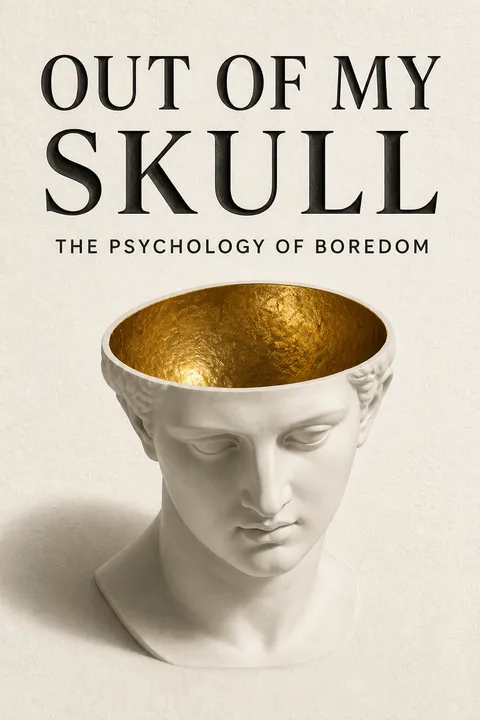
Out of My Skull explores the psychology of boredom, presenting it as a signal for change rather than a negative state. While some readers found it insightful and well-researched, others felt it was repetitive and ironically boring. The book examines boredom's causes, its relationship to mental health, and its potential benefits for creativity and self-reflection. Many appreciated the blend of psychology, neuroscience, and philosophy, though some desired more practical solutions. Overall, reviewers found the book thought-provoking, if occasionally dry.
People Also Read




Glossary
state boredom
momentary boredomThe in-the-moment experience of wanting to engage in satisfying activity but being unable to do so. In the book’s account, the mind feels underused and desire lacks a workable target. State boredom is distinguished from a person’s more enduring tendency to experience boredom frequently or intensely.
trait boredom proneness
tendency toward boredomA relatively enduring disposition to experience boredom more often or more intensely than other people. It is not a separate kind of momentary boredom. The authors distinguish this trait from state boredom because a correlation between boredom proneness and an outcome does not by itself show that a particular episode of boredom caused that outcome.
desire conundrum
wanting without a targetThe conflict at the center of boredom: a person wants to be doing something but cannot identify an available activity they genuinely want to do. The desire remains urgent but lacks a clear object. This can leave a person casting around for relief while finding each apparent option unsatisfying.
agency
self-directed influenceThe capacity to act in ways that express one’s intentions and influence one’s surroundings. The authors use agency to describe the felt ability to choose what to attend to and to pursue an activity effectively. Boredom signals that this capacity is being thwarted, though the available choices may be limited by external conditions.
flow
absorbed, well-matched engagementA deeply absorbing state described in research by Mihaly Csikszentmihalyi. It commonly involves a close fit between a task’s challenge and a person’s skills, focused attention, clear goals, and a sense of control. The book treats flow as one especially intense form of engagement, not the only way to avoid boredom.
FAQ
What's Out of My Skull: The Psychology of Boredom about?
- Exploration of Boredom: The book delves into the psychology of boredom, examining its causes, effects, and significance in our lives. It presents boredom as a signal prompting us to seek engagement and meaning.
- Psychological Framework: Authors James Danckert and John D. Eastwood provide a framework for understanding boredom, drawing on neuroscience and clinical psychology to offer a comprehensive view.
- Call to Action: Boredom is portrayed as a call to action, urging individuals to reflect on their desires and engage more meaningfully with the world.
Why should I read Out of My Skull: The Psychology of Boredom?
- Understanding Boredom: The book offers insights into a universal experience, helping readers articulate and respond to boredom effectively.
- Scientific Perspective: It provides a research-backed approach to understanding boredom, making it relevant for those interested in psychology and self-improvement.
- Practical Applications: Readers will find strategies to navigate boredom and enhance life engagement, encouraging self-reflection and agency.
What are the key takeaways of Out of My Skull: The Psychology of Boredom?
- Boredom as a Signal: Boredom indicates a lack of engagement and a need for action, leading to more meaningful experiences when recognized.
- Connection to Meaning: A lack of meaning can lead to boredom, and engaging in value-aligned activities can mitigate this feeling.
- Agency and Engagement: Fulfilling the need for agency is essential for overcoming boredom and achieving personal fulfillment.
How do the authors define boredom in Out of My Skull: The Psychology of Boredom?
- Boredom Defined: It is defined as “the uncomfortable feeling of wanting, but being unable to engage in satisfying activity,” highlighting its emotional and cognitive aspects.
- Psychological Experience: Boredom occurs when mental capacities are underutilized, shifting the focus from nuisance to a significant human experience.
- Connection to Agency: Boredom arises when individuals feel they lack control over their engagement, emphasizing the need to reclaim agency.
What are the main causes of boredom discussed in Out of My Skull: The Psychology of Boredom?
- External Factors: Monotony, lack of purpose, constraint, and poor fit between skills and challenges are identified as external causes.
- Internal Factors: Emotional awareness, cognitive abilities, motivation, and self-control are internal factors that increase susceptibility to boredom.
- Interaction of Causes: Boredom arises from the interaction between external and internal factors, and understanding this interplay can address root causes.
How does Out of My Skull: The Psychology of Boredom relate boredom to mental health?
- Boredom and Depression: Frequent boredom is linked to depression, serving as a precursor to depressive episodes.
- Maladaptive Responses: Boredom can lead to substance abuse, aggression, and impulsive behaviors, exacerbating mental health issues.
- Need for Meaning: Boredom signals a lack of meaning, contributing to feelings of emptiness and despair, which can be mitigated by creating meaning.
What strategies do the authors suggest for overcoming boredom in Out of My Skull: The Psychology of Boredom?
- Embrace Boredom: Recognize boredom as a signal to seek engagement, prompting reflection and action.
- Cultivate Agency: Take control of choices and actions by engaging in activities aligned with personal values and interests.
- Explore New Interests: Engage in diverse activities to stimulate the mind and provide opportunities for meaningful experiences.
What role does technology play in boredom according to Out of My Skull: The Psychology of Boredom?
- Information Overload: The digital age's explosion of information contributes to boredom, as individuals struggle to find meaning amidst the noise.
- Superficial Engagement: Technology often leads to superficial engagement, creating a cycle of distractions that fail to satisfy deeper needs.
- Social Media's Impact: Social media can create a false sense of connection, exacerbating loneliness and boredom rather than fostering genuine relationships.
How does Out of My Skull: The Psychology of Boredom address boredom across different life stages?
- Boredom in Childhood and Adolescence: Linked to a lack of autonomy and engagement opportunities, highlighting the importance of exploring interests.
- Boredom in Adulthood: Arises from routine and unfulfilling circumstances, with autonomy potentially reducing boredom but still present in midlife.
- Boredom in the Elderly: Increases due to cognitive decline and reduced social interactions, emphasizing the need for meaningful engagement.
What is the significance of boredom in the context of modern life as discussed in Out of My Skull: The Psychology of Boredom?
- Cultural Phenomenon: Boredom reflects broader societal issues related to engagement, meaning, and connection in modern life.
- Impact on Behavior: Influences behavior, leading to distractions or risky activities as coping mechanisms for feelings of emptiness.
- Call for Awareness: Encourages reflection on experiences and seeking more fulfilling activities to address boredom's role in life.
How does the author suggest we can cultivate curiosity to combat boredom in Out of My Skull: The Psychology of Boredom?
- Fostering Exploration: Curiosity drives exploration, encouraging new experiences and knowledge to combat boredom.
- Engaging with the Environment: Actively engaging with one's environment can spark curiosity and appreciation for everyday experiences.
- Curiosity as a Tool: It is presented as a valuable tool for personal growth, helping navigate boredom and find meaning.
What are the best quotes from Out of My Skull: The Psychology of Boredom and what do they mean?
- “Boredom is a call to action.”: Encourages viewing boredom as an opportunity for self-discovery and seeking engagement and meaning.
- “Boredom reveals an important aspect of being human.”: Emphasizes boredom as a universal experience reflecting our desire for engagement and connection.
- “Boredom is the uncomfortable feeling of wanting, but being unable to engage in satisfying activity.”: Frames boredom as a complex emotional state arising from unmet desires, highlighting the need for fulfilling activities.
Download PDF
Download EPUB
.epub digital book format is ideal for reading ebooks on phones, tablets, and e-readers.








